Blockchain Forensics Explained: Tracing On-Chain Evidence
You check a token's creator wallet and notice funds moving through several unfamiliar addresses. The transfers are visible, but deciding whether they show ordinary trading, coordinated activity, or theft takes more than following arrows on a screen.
Table of Contents
- What Blockchain Forensics Is and Where It Began
- How an Investigation Moves From Address to Suspect
- Core Methods for Tracing Transaction Graphs
- Fraud, Ransomware and AML Cases Investigators Trace
- Grading Evidence From Suspicious Link to Proof
- Limits and Myths That Mislead Readers
- Confirm Evidence Before You Act on a Finding
What Blockchain Forensics Is and Where It Began
Investigators examining Silk Road faced a problem that still defines cryptocurrency investigations: they could see payments without seeing the names behind them. Blockchain forensics is the practice of following cryptocurrency transactions on a public ledger and combining that trail with evidence that connects addresses to people, companies, or crimes.
According to Chainalysis's account of cryptocurrency asset seizures, Silk Road launched in 2011 and was shut down by the FBI in 2013, while a later investigation led IRS Criminal Investigation to seize 50,676 bitcoin from James Zhong in November 2021. Zhong pleaded guilty to wire fraud for stealing funds from the marketplace. Investigators reconstructed activity across wallet movements and periods when the funds remained untouched.
The important lesson isn't that investigators followed money. It's that a historical transaction trail remained useful long after the original activity.
A readable record without readable names
Think of a public ledger as a shared bank statement with account names replaced by long codes. Unlike a statement written in pencil, its confirmed history isn't something an account holder can casually erase or rewrite.
This illustration captures the investigator's starting point: a public record that needs interpretation.
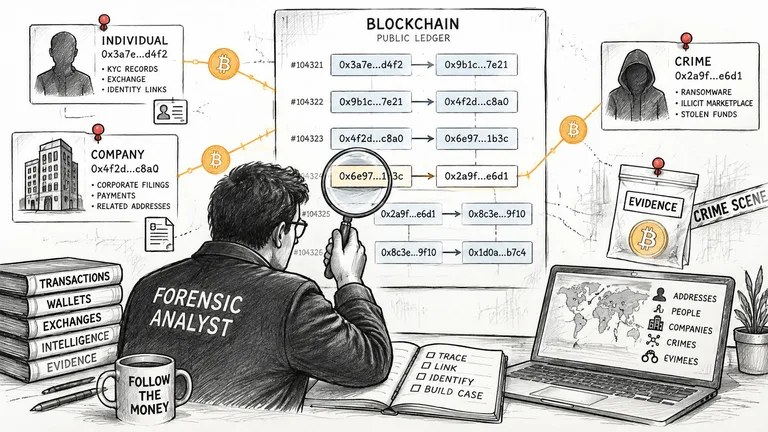
An address is pseudonymous, not anonymous. It acts like a persistent alias: someone may use it without displaying their name, but its activity can leave connections that become meaningful later.
Say someone receives a payment, moves it between wallets, and eventually sends it to an exchange. The public chain may establish the transfers. Exchange account records, a recovered device, or financial documents may establish who was involved.
Foundational distinction: The ledger records activity. Investigators build the explanation of who caused it and why.
Even then, precision matters. An account holder, a wallet's controller, and the person responsible for a crime aren't automatically the same person. A strong investigation keeps those questions separate instead of treating a recognizable destination as the end of the case.
How an Investigation Moves From Address to Suspect
A useful investigation produces a record someone else can check, not just a convincing-looking diagram. Each stage should leave behind a concrete output and a clear statement of what remains uncertain.
The workflow below organizes that progression, although a real investigation may stop before anyone can responsibly name a suspect.
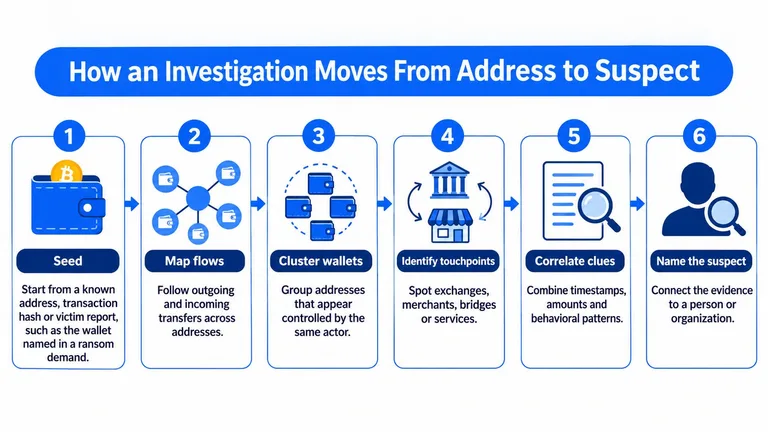
Seed the investigation. Start with a known address, transaction hash, or victim report, such as the destination in a ransom demand. Produce a seed record containing the network, exact identifier, and the reason that identifier matters.
Map the flows. Follow incoming and outgoing transfers, recording assets, amounts, transaction hashes, and timestamps. The output is a time-ordered flow map, with verified transfers separated from paths you haven't resolved.
Cluster cautiously. Group addresses that appear to share control, documenting the heuristic behind each connection. Produce a candidate cluster list, remembering that Bitcoin shared-input reasoning doesn't transfer unchanged to Solana's account model.
Label service touchpoints. Identify possible exchanges, bridges, mixers, merchants, or scam infrastructure, and record where each label came from. Your counterparty table should distinguish a service's shared wallet from a customer-specific deposit destination.
Seek attribution. Correlate the transaction path with exchange identity records, appropriately obtained disclosures, device evidence, or other independent material. Produce an attribution assessment that distinguishes a named account from evidence of actual wallet control.
Preserve and report. Save the underlying transactions, query settings, label snapshots, and analytical decisions rather than relying on screenshots alone. The output is a reproducible case package that lets another reviewer reconstruct both your findings and your uncertainty.
Apply the sequence to a creator wallet
For a Solana token, begin by verifying how the suspected creator address relates to the token's creation. Don't assume the largest holder created it, and don't treat every wallet funded by the same exchange as part of the creator's operation.
Use the Solana token creator-wallet checking guide to organize that initial inspection. Keep creator activity, service interactions, and inferred wallet relationships in separate columns.
For a visual companion to transaction investigation, use the video below.
Before extending any trace, check the basics:
- Correct network: Confirm you're inspecting the intended chain and asset.
- Verified starting point: Establish why the seed belongs in the investigation.
- Documented inference: Mark every connection that isn't directly observable.
- Useful stopping point: Record where public evidence ends and further records are needed.
Core Methods for Tracing Transaction Graphs
Blockchain forensics methods compared
| Method | What It Reveals | Main Limit |
|---|---|---|
| Flow tracing | Paths across hops, amounts, and timestamps | Mixers, bridges, and privacy-focused assets can interrupt continuity |
| Address clustering | Addresses likely controlled by one party | Shared wallets and services can cause false merges |
| Entity labelling | Possible exchange, mixer, gambling, or scam associations | Labels can be stale, incomplete, or wrong |
| Graph analytics | Neighbourhood patterns such as fan-in and fan-out | Needs time-aware validation to avoid leakage |
| Velocity and timing checks | Rapid movement or long dormancy before cash-out | Legitimate trading can look similar |
| Off-chain correlation | Identity connections through exchange or device records | Requires available records, cooperation, or legal process |
A temporal transaction graph represents activity as connected events arranged in time. Instead of asking whether an isolated wallet looks suspicious, an analyst asks what happened before and after its transactions, which counterparties were involved, and whether the sequence supports a particular explanation.
In the Elliptic benchmark paper, more than 200,000 Bitcoin transactions form graph nodes connected by 234,000 directed payment flows, with 166 engineered features per node. Those features describe transactions, neighbouring activity, and timing.
Graph convolutional networks used relationships between transactions, but the reported comparison favoured Random Forest over the tested alternatives. That's a useful corrective: an advanced graph model doesn't remove the need for carefully designed signals.
Read the shape and the sequence
Consider a wallet receiving many deposits and sending the combined balance onward. That fan-in pattern might describe a scam collection wallet, but it might also describe an ordinary service collecting customer deposits.
Reverse the shape and you get fan-out: a wallet distributing funds to many destinations. Payroll, token distributions, and attempts to disperse stolen assets can share that outline.
Useful signals include:
- Counterparty exposure: Which identifiable entities sit directly beside the activity?
- Transaction velocity: How quickly do assets arrive and leave?
- Repeated amounts: Do transfers suggest automation, coordinated execution, or routine operations?
- Neighbourhood structure: Do nearby wallets repeatedly interact in the same sequence?
The guide to reading a crypto bubble map helps translate wallet connections into a visual inspection. Treat the picture as a navigation aid, then open the transactions behind important edges.
Choose tools for the question
Start a narrow case with a public block explorer and a transaction log. Commercial analytics platforms become useful when you need labelled counterparties, broader tracing, or risk screening; in-house graph pipelines let teams combine those outputs with their own case records.
For automated detection, test on later activity than the activity used for training. Randomly mixing neighbouring transactions across training and test sets can let a model benefit from information that wouldn't have been available during a live decision.
A model that recognizes familiar activity in a shuffled dataset hasn't necessarily demonstrated that it can detect a new incident.
Every report should name the tool, its version where available, the label source, and the date of the data. Begin with manual verification of the seed and immediate transfers, then add automation when the graph becomes too large to inspect reliably.
Fraud, Ransomware and AML Cases Investigators Trace
Crime types and the on-chain signal investigators check
| Use Case | Typical On-Chain Signal | Typical Outcome |
|---|---|---|
| Investment and romance scams | Deposits into a cluster that consolidates and cashes out quickly | Freeze requests and possible partial victim recovery |
| Ransomware payments | Payment to a known extortion address, then splitting through intermediaries | Possible seizure or partial recovery |
| AML screening | Exposure to sanctioned or high-risk counterparties | Enhanced due diligence and suspicious activity reporting where warranted |
| Darknet market proceeds | Funds moving to exchanges after marketplace payouts | Potential asset seizure through court process |
| Exploit and hack proceeds | Rapid bridging and swaps across chains | Cross-chain tracing and possible exchange freezes |
| Sanctions evasion | Routing through mixers or unregistered services | Potential address designation and blocking |
These outcomes are investigative possibilities, not promises. Similar transfer patterns can arise from different activities, so investigators need the surrounding story.
For investment and romance scams, victim messages and payment instructions explain why a deposit was made. For darknet proceeds, marketplace records can help explain a payout. An exploit investigation instead starts with the unauthorized contract interaction and follows what the attacker received.
What a recovery case demonstrates
Following the May 2021 Colonial Pipeline ransomware attack, DarkSide received approximately $4.4 million in bitcoin, and the FBI recovered approximately $2.3 million, according to Chainalysis's blockchain-forensics overview. Investigators traced the payment and obtained access to the relevant private-key storage.
The operational distinction matters: tracing identified a useful destination, while access to the keys enabled the recovery. A public transaction graph alone couldn't authorize or execute the seizure.
Monitor exposure across relevant networks
Anti-money laundering teams use tracing differently from victims or criminal investigators. They screen deposits, investigate high-risk counterparties, seek supporting information, and escalate cases under the rules applicable to their organization.
According to TRM Labs' illicit-volume breakdown, approximately 58% of illicit crypto activity in 2024 occurred on TRON, followed by Ethereum at 24% and Bitcoin at 12%. Those figures describe the distribution of illicit activity, not the probability that an individual transaction on those networks is illicit.
For Solana traders, suspicious volume deserves a different kind of scrutiny. The guide to detecting wash trading on Solana offers a starting point for examining whether trading activity reflects independent demand.
Monitor known incident addresses, direct counterparties, and reachable service destinations first. Expand into more distant relationships only when the transaction path or supporting evidence gives you a reason.
Grading Evidence From Suspicious Link to Proof
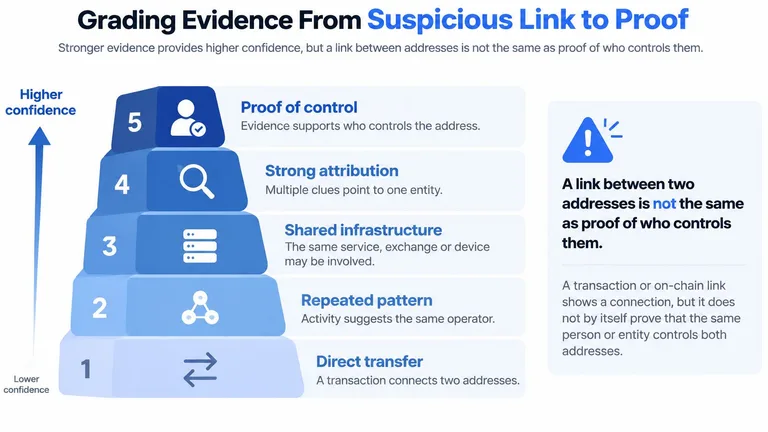
A confidence ladder separates observable activity from conclusions about control. It isn't an automatic scoring system: an exchange deposit can be firmly established while the depositor's identity remains unknown.
Evidence confidence levels and what each supports
| Evidence Level | What It Shows | What It Does Not Prove |
|---|---|---|
| Direct transfer | Funds moved from address A to address B | Who controls either address |
| Likely cluster | Heuristics suggest common control of addresses | That the whole cluster belongs to one person |
| Mixer or pool interaction | Funds passed through a shared intermediary | That downstream assets are illicit |
| Exchange deposit | Funds reached an identified regulated platform | Customer identity without corroborating account records |
| Suspected impersonation | A lookalike app or site matches a known scam pattern | The operator's intent |
| Confirmed attribution | Independent records tie an address to a person | Recovery of the funds |
Use the ladder to state the strongest claim your evidence supports, not the most alarming interpretation available.
The visual below summarizes how corroboration can strengthen an attribution assessment.
Shared pools require qualified conclusions
An Ethereum study of Tornado Cash and sanctions reported 97.61% precision and 74.08% recall for its impurity-based tracking metric. These measures describe the study's method, not a universal accuracy guarantee for mixer tracing.
Precision concerns how often flagged links were correct under the evaluation; recall concerns how much of the relevant activity the method captured. A method can avoid many false accusations while still missing meaningful flows.
For practical tracing, direct mixer interaction and distant exposure through pooled funds deserve different descriptions. Apply a documented risk-decay approach as funds move through additional intermediaries, rather than assigning every downstream asset the original risk label.
Track splits and recombinations explicitly. If funds divide between destinations and later merge with unrelated deposits, record the traced portion and the uncertainty instead of treating the whole resulting balance as criminal proceeds.
On Solana, apply the same discipline to pooled intermediaries and rapid redistribution. Preserve amount and timing tolerances, state when continuity becomes uncertain, and avoid inventing numerical confidence scores that your method doesn't produce.
Reporting rule: Describe the evidence path before stating the conclusion.
A useful finding might establish that funds entered a shared service and that a later withdrawal is a candidate continuation. That wording gives a reviewer something testable without pretending the service exposed a uniquely identifiable route.
Limits and Myths That Mislead Readers
Not everything on a blockchain is easy to trace. Public visibility helps, but privacy mechanisms, service custody, and incomplete records can prevent an analyst from establishing continuity.
A review of blockchain-forensics methods and challenges identifies privacy-focused assets, mixers, decentralized exchanges, cross-chain transfers, and obfuscation as obstacles to conventional tracing. It also describes a lack of unified methodologies and benchmarking systems, alongside legal and ethical constraints that can leave researchers working with simulated or partially labelled datasets.
Myth: Every transfer has an obvious continuation. Bridges, off-ledger swaps, and custodial services can require additional records to connect the next movement. Stop drawing a continuous path when you can't justify the connection.
Myth: A visible destination means recoverable funds. Recovery requires practical control, an effective freeze, cooperation, or a lawful seizure route. Don't pay someone merely because they can display the destination you already found.
Myth: An address label is a fact. Treat an unsupported tag as a hypothesis and inspect its provenance. A stale service label can send an investigation toward the wrong counterparty.
Myth: A flagged token proves fraud. Freeze authority, concentrated holdings, and abrupt liquidity changes present different kinds of risk. A structural capability isn't the same as evidence that someone has abused it.
Make decisions that match the uncertainty
For a prospective trade, unresolved evidence may be enough reason to pause without making a public accusation. For an incident report, explain what you couldn't establish so an exchange or investigator knows which records would help.
Tool comparisons need similar restraint. Attractive graphs and confident alerts don't establish accuracy across networks or case types; ask whether the evaluation resembles the task you're performing.
Missing information should remain unknown, not become safe or malicious. That choice protects both your decision-making and people who might otherwise be wrongly identified.
Confirm Evidence Before You Act on a Finding
Before placing a trade, publishing an accusation, or escalating an incident, check what the evidence supports and what remains uncertain.
- State the evidence level. Separate a directly observed transfer from an inferred wallet cluster or an attribution supported by independent evidence.
- Look for independent corroboration. A graph, score, and label may all rely on the same source, so they do not necessarily count as separate confirmation.
- Check entity labels. Compare a label with another credible source and examine its basis before naming a person or organization.
- Record alerts as leads. Note when each signal appeared and what additional evidence could strengthen or weaken the interpretation.
- Review Solana token risks. Check freeze-authority status, liquidity withdrawals, and trading behaviour around launch before describing an alert as evidence of fraud.
- Prepare a usable record. Include transaction hashes, network identifiers, timestamps, supporting documents, and a clear statement of the evidence level.
MemeAssist uses AI to explain measured token data in plain language. Its explanations can be wrong, and blockchain or market data may be incomplete, delayed, or unavailable. Examine the underlying evidence rather than treating the AI explanation as proof.
Choose MemeAssist for integrated research, explanations, and tracking, not exclusive blockchain data, safety guarantees, or profit promises. Suspicious activity and potentially connected wallets are starting points for further checks. Missing data does not prove a token is safe.
A useful review ends with a next check, such as verifying a destination's service label or inspecting the liquidity-removal transaction, rather than declaring a final verdict.
Visit MemeAssist to bring Solana token checks, wallet evidence, and market conditions together in an explained risk report. Review the findings alongside the explanation, then use the strongest unresolved signal to choose your next investigation step.
Topics: blockchain forensics, crypto investigation, on-chain analysis, AML compliance, crypto fraud detection
Informational only, not financial advice. Meme coins are extremely high-risk.
All articles