Crypto Copy Trading: How to Choose a Leader

In Bitget's analysis of more than 109,000 traders during the first half of 2023, 93% of futures copy traders were reported profitable, according to Finance Magnates' coverage of the analysis. That figure describes reported platform results, not the return a follower could reproduce after delayed execution, slippage, fees, position sizing and partial fills.
For anyone choosing a leader, the decision metric is the follower's net result after those costs and execution differences. Leaderboard rank can help identify candidates, but it is a biased input, not proof of skill or a promise of matching the leader's price.
Table of Contents
- What Crypto Copy Trading Means in 2026
- How a Copied Order Reaches Your Account
- Benefits and Risks of Copying Someone Else
- Metrics That Separate Skill From a Hot Streak
- Why Your Fill Will Not Match the Leader
- What the 2023 Profit Snapshot Cannot Prove
- Habits That Leaderboards Reward and You Should Not
- Decide Whether to Copy and Verify the Token
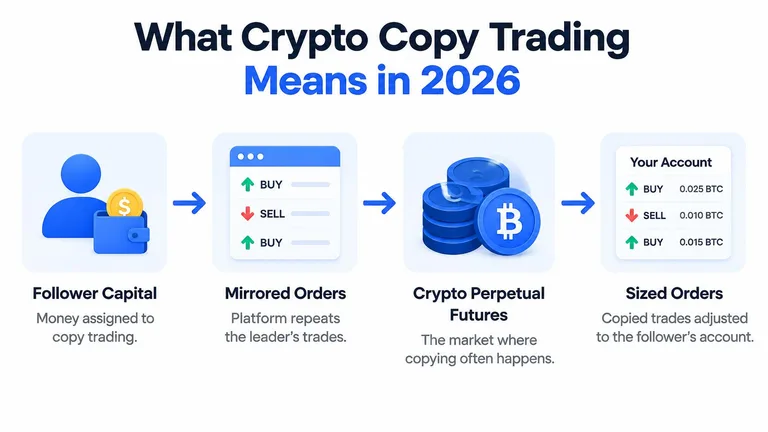
What Crypto Copy Trading Means in 2026
Crypto copy trading means allocating capital so a platform can mirror another trader's orders into your account. The leader makes trading decisions; the platform translates those decisions into positions sized under your copying settings. In perpetual futures, you're following exposure to a derivative, not necessarily buying the underlying coin.
The ACM-published study of TraderWagon and Bybit, published in 2024 and examining activity from October 2022 through August 2023, found that each strategy leader was entrusted with more than US$10,000 in follower funds on average. That study also describes the model's roots in late-2000s services such as eToro, ZuluTrade and ayondo, followed by its expansion into cryptocurrency markets, particularly perpetual futures.
Delegated execution isn't delegated responsibility
The mechanism separates decision-making from account-level consequences. A leader chooses a direction and trading style, but your allocation, margin settings and execution determine what that choice does to your balance.
That distinction matters before you evaluate performance. You aren't buying a fixed-return product or receiving an ownership share in the leader's account. You're authorizing another person's trading actions to generate orders in yours.
The investor-record study described copy trading as a small share of the overall cryptocurrency-derivatives market, alongside growing customer bases at dedicated platforms. Those observations establish participation and market structure, not a forecast of follower profitability.
A ranking is a platform choice
The platforms examined also used different default methods to rank leaders. A trader's visibility therefore reflects the interface's selection rules as well as the trader's record.
Consider how you'd interpret a profile promoted for recent returns versus one selected for a longer performance history. Neither placement substitutes for examining the underlying positions. The platform has decided what you see first, not what you should fund.
Practical rule: Treat a leaderboard as a discovery tool, then rebuild the investment case from the trade history and your account settings.
The useful questions are operational: how does a leader's action become your order, which performance measures withstand scrutiny, and what happens when your execution differs? Convenience is real, but it starts a due-diligence process rather than completing one.
How a Copied Order Reaches Your Account
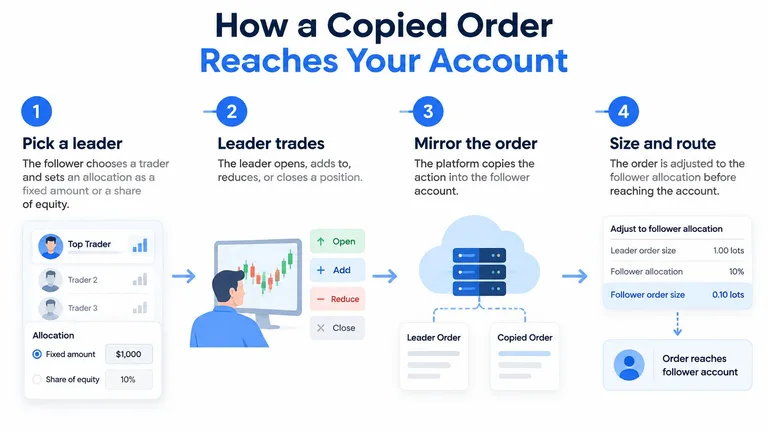
A copied trade passes through several handoffs before you hold a position. Think of it as following a recipe after the cook has already bought the ingredients: the shopping price and portion size are yours, not theirs.
The handoffs from allocation to execution
Choose the allocation. You select a leader and assign capital under the platform's available sizing method. Establish whether the setting describes money committed to the strategy, margin per order or notional exposure. Those aren't interchangeable.
The leader acts. Opening, adding to, reducing or closing a position can generate a copying instruction. Read the platform's rules on existing positions: starting a subscription may not mean you enter at the same stage as a follower who was already connected.
The platform translates the action. A fixed-amount rule assigns a specified amount to copied trades. Proportional sizing attempts to scale exposure relative to a defined account or allocation base. Confirm which balance the platform uses, especially when either account contains other positions.
Your order reaches the market. The follower instruction is routed after the leader's action. Your executable price comes from the spread and available liquidity when your order arrives, subject to any order-price restrictions.
Your account determines margin. Available collateral, margin, and the margin arrangement govern the copied position's liquidation exposure. Matching the leader's direction doesn't establish an identical liquidation price.
Your fills generate costs and exits. Fees apply to your executions. Check whether stop-loss and take-profit instructions copy automatically, whether amendments propagate, and what happens when an entry or exit is rejected.
Settings that sound similar but aren't
Copying every action and copying selected trades create different mandates. The first attempts to follow the supported sequence of position changes; the second filters that sequence. Verify whether your filter applies only to new entries or also affects additions, reductions and exits.
Likewise, fixed-amount sizing doesn't maintain proportional exposure automatically. If account equity changes while the order amount stays constant, that order represents a different share of the account.
Before activation, locate the settings for:
- Allocation: Identify the capital available to the strategy and how each order draws on it.
- Maximum exposure: Confirm whether your ceiling overrides the leader's setting or causes incompatible trades to be skipped.
- Copied stops: Establish whether protective orders and subsequent changes propagate.
- Stopping the service: Check whether disconnecting leaves positions open or closes them.
If the interface doesn't make those outcomes clear, don't infer them from the word “automatic.”
Benefits and Risks of Copying Someone Else
The honest trade-off is less decision-making work in exchange for less control over the original decision. A follower can delegate entries and exits while retaining responsibility for the allocation and account constraints.
A public trading record can also make comparison easier than following anonymous trade calls. But visibility is useful only when the record includes losses, open exposure and changes in trading behavior, not just closed winners.
Upside and downside of copy trading
| Factor | Upside for follower | Downside for follower |
|---|---|---|
| Execution | Leader makes entries and exits | Your fill arrives later and at a different price |
| Learning curve | Simple to start through an automated interface | Easy to copy risk you don't understand |
| Visibility | Public track record to compare | Rankings reward recent returns and can be gamed |
| Diversification | Spread capital across several leaders | Correlated leverage can cluster losses |
| Risk control | Copy settings can cap size | Settings don't stop a leader's regime change |
| Cost | Disclosed fees can be inspected | Repeated fees erode thin edges |
Count benefits only after checking their conditions
Diversifying across names isn't necessarily diversifying across risks. Leaders who all hold amplified exposure in the same direction can leave you with several versions of one trade. Compare their assets, direction and overlapping positions before counting them as separate strategies.
Automation can enforce an allocation rule, but it can't explain why a leader changed tactics. A strategy you selected for patient entries may become an aggressive averaging-down strategy without changing its profile name.
Learning also requires context. Watching an order arrive tells you what the leader did, not what would invalidate the idea or which exposures sit outside the copied account.
Copy trading doesn't remove loss. It changes who initiates the decision and how that decision reaches you. The convenience is worth considering only when the resulting exposure remains understandable.
Metrics That Separate Skill From a Hot Streak
Don't choose a leader because of rank, follower count or a short return banner. Use those signals to find a profile, then apply a pass-fail screen before allocating.
Leader checks before you allocate
| Check | Pass standard | Fail signal |
|---|---|---|
| History length | Live results across more than one market regime | A few weeks or a single rally |
| Drawdown | Maximum drawdown and the full return distribution reviewed | Only winning trades displayed |
| Risk-adjusted result | Profit factor, volatility and expected shortfall preferred to raw ROI | Headline ROI from leveraged beta |
| Liquidations | Rare or none across the track record | Repeated liquidations |
| Costs and delay | Net result still positive after fees and slower fills | Edge vanishes once costs are applied |
| Leverage and turnover | Stable sizing with no abrupt leverage increase | Sudden jump in leverage or churn |
| Trade concentration | Profits spread across many positions | Results depend on a few large winners |
| Allocation | Hard cap on capital per leader | Most of the account tied to one ranked name |
The behavioral reason for this discipline isn't theoretical: an experiment involving 807 experienced retail investors, discussed in Scientific Reports, found that upward social comparison increased risk-taking and trading activity while reducing reported satisfaction. Seeing someone else succeed can change your appetite for risk before you've assessed their strategy.
A failed check means don't allocate under the current evidence. Missing information isn't a neutral result, and a high return doesn't compensate for an unobservable loss distribution.
Read the losses before the return
Start with maximum drawdown, the largest peak-to-trough decline. Then inspect how losses occurred: a gradual decline, abrupt gaps and prolonged underwater periods create different practical demands on a follower.
Volatility describes return variability, while expected shortfall focuses on the average loss in the adverse tail under the chosen methodology. Ask what observation window and calculation the platform uses. A metric without a definition isn't a dependable comparison.
Profit factor, gross trading profits divided by gross trading losses, helps reveal the balance between gains and losses. It still needs context: inspect whether open losing positions are excluded and whether a few exceptional trades account for most gains.
Repeated liquidations are a rejection signal because they reveal how the leader manages account survival. An unusually calm historical drawdown also deserves scrutiny if the leader recently increased risk exposure.
A profitable direction isn't proof of a repeatable trading edge. Separate the return from simply holding leveraged exposure during a favorable move.
Test what remains reproducible
Review live results across rising, falling and unsettled conditions. Don't treat the length of an account's existence as proof that the displayed strategy operated throughout that history.
Recalculate the candidate's results using less favorable entries and the costs your account would bear. If the apparent advantage disappears, reject the strategy rather than assuming execution will improve.
For on-chain candidates, tracking smart-money wallets on Solana can support trade-history inspection. Wallet activity still needs interpretation; a visible purchase alone doesn't reveal the owner's complete exposure.
Start with a small share of risk capital, establish a hard allocation cap and write down the conditions that end the mandate. Stop copying when exposure or drawdown leaves the range you accepted, rather than rewriting the standard after a loss.
Why Your Fill Will Not Match the Leader
What would your account have made after delay, slippage, fees, sizing and partial fills? That's the question a displayed leader return can't answer.
The IOSCO report on online imitative trading practices identifies transmission and execution delays, different spreads or liquidity, position sizing differences, and repeated transaction fees as reasons follower outcomes can diverge. Your analysis needs to translate those mechanisms into account-specific assumptions.
Why a copied trade diverges from the leader
| Cause | What changes for the follower | Where it hurts most |
|---|---|---|
| Transmission delay | Entry or exit later than the displayed trade | Short-term and high-volatility markets |
| Spread and depth | Worse average price and more slippage | Thin order books and meme coins |
| Leverage and size | Different margin and liquidation distance | High-leverage copies of a large book |
| Partial fills | Position smaller or uneven versus the leader | Fast moves with limited depth |
| Repeated fees | Gains shrink or losses run further | High-turnover strategies |
| Selected trades only | Portfolio omits hedges and losing trades the leader kept | Cherry-picked copies |
For your entry, measure deterioration against the leader's recorded execution, not against a chart candle. A candle can contain prices that weren't available for your order size when the instruction arrived.
For your exit, inspect executable depth as carefully as entry depth. A position that looks profitable at the last traded price may realize less when your sell order consumes available bids.
A liquid contract versus a thin token
Say a leader buys a liquid Bitcoin perpetual and your copied order executes slightly higher. The directional thesis can remain intact, although your potential profit is smaller and your margin position differs.
Now consider the same sequence in a thin Solana meme coin. The leader's purchase may consume the available offers, leaving your order to execute materially higher or only partially. If buyers withdraw before your copied exit arrives, your loss can't be inferred from the leader's closing price.
For a perpetual position, estimate distance to liquidation using your actual average entry, collateral and position size setting. For a non-margined token purchase, concentrate on exit liquidity and the loss you could realize while selling your full position.
Execution test: A return is relevant only if the market could accommodate your entry and exit under plausible copying conditions.
Selective copying adds another mismatch. If you take the attractive-looking long but omit a hedge, you're running a different portfolio, even if both positions came from the same leader.
Keep a comparison log containing the leader's execution, your execution, filled quantity and total costs. Evaluate the strategy using your net outcome, and include rejected or unfilled orders rather than recording only successful copies.
What the 2023 Profit Snapshot Cannot Prove
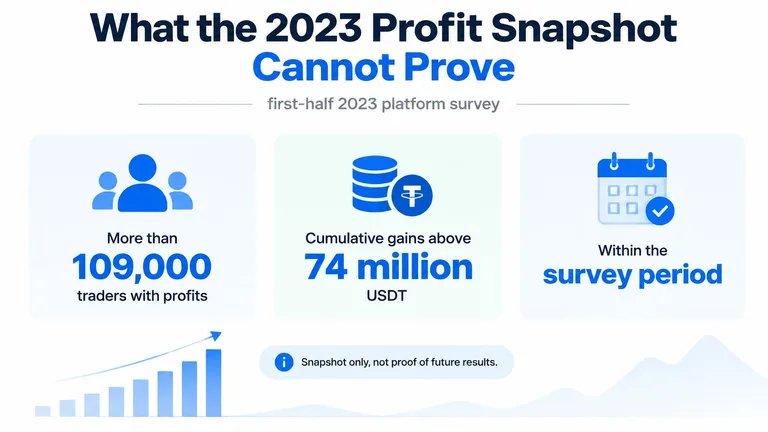
93% of surveyed futures copy traders were reported profitable during the first half of 2023 in Bitget's platform analysis, as covered by Finance Magnates. The same account reported more than 109,000 traders earning profits and cumulative gains exceeding 74 million USDT.
Those figures describe a platform-specific observation, not the probability that a new follower will profit. They don't establish whether copying outperformed independently trading the same markets with comparable risk.
Questions the headline leaves unanswered
Before treating a platform profit rate as decision evidence, establish:
- Population: Were inactive accounts, departing followers and closed accounts included?
- Profit definition: Were unrealized losses, all charges and relevant position costs counted?
- Measurement window: Did the observation include unfavorable conditions for the strategies being copied?
- Follower experience: Does the result reflect actual follower executions or a reconstruction from leader trades?
These are questions about scope, not allegations that the reported figures are false. A correct calculation can still answer a narrower question than a prospective follower assumes.
A profitable-account share also leaves out the size of gains and losses. Many modest winners can coexist with severe losses elsewhere, so the percentage alone can't describe the distribution of outcomes.
Don't turn a snapshot into a simulation
Historical profitability doesn't recreate your arrival time, order size or chosen trade filter. A promoter quoting the headline should be able to explain whether it covers futures accounts only and how costs and execution were handled.
For thin-token strategies, distinguish Solana meme-coin trade setups from backtesting. A plausible setup and a historical performance claim require different evidence, and neither establishes that a later follower can transact at the displayed levels.
Habits That Leaderboards Reward and You Should Not
A Dataintelo industry report estimated in 2025 that the cryptocurrency trading segment within social-trading platforms had grown at a compound annual rate exceeding 18.4% since 2020. Treat that as a sector-growth estimate, not evidence that a ranked trader deserves more of your capital.
More participation can mean more people evaluating the same visible profiles. It doesn't establish that those profiles offer reproducible opportunities.
Replace crowd-following with precommitment
Copying the most-followed name: Popularity can substitute for investigation when the interface makes a crowded profile easy to select. Require an independently acceptable record; don't count other followers as additional evidence of safety.
Increasing exposure after an easy win: A successful copied trade can make a larger allocation feel earned. Set the exposure ceiling before activation and refuse to revise it merely because the first outcome was favorable.
Judging a strategy inside a bull window: A leader may appear disciplined while favorable prices conceal weak loss management. Require evidence of behavior during adverse moves before increasing exposure.
Using sector growth to justify an account decision: Industry expansion describes participation and commercial activity. It doesn't tell you whether your next copied position has a favorable net payoff.
Screenshots aren't executable offers
The meme-coin version of performance chasing is copying a screenshot of an early purchase. That screenshot records an outcome for a particular holder, not a standing offer to sell you the same exposure at the same price.
Ask what has changed since the purchase: the available liquidity, holder distribution, current price and likely exit route. A spectacular historical entry can be a poor current decision.
Write your maximum tolerable loss and ceiling before opening the leaderboard. Keep them separate from the platform's suggestions so a prominent return banner can't become permission to take more risk.
Decide Whether to Copy and Verify the Token
Copy only when the leader passes the history, drawdown, cost and concentration checks, and your proposed position remains acceptable under a worse fill. The market must also offer a plausible route out at your intended size.
Skip when the record is short, profits rely on isolated winners, risk has abruptly increased or the book can't support your order. Pause when fees, actual fills or liquidation exposure aren't visible. If you choose to trade independently instead, use smaller exposure and a decision you can explain.

Verify the asset inside the go decision
For a Solana meme coin, passing the leader screen isn't enough. Verify the exact contract address and perform independent Solana token safety checks, including mint and freeze authorities, liquidity and holder concentration.
At MemeAssist, our on-demand analysis examines liquidity, holder distribution, creator behavior, wallet activity, trading patterns and historical risk indicators. A full analysis includes a health score, rug risk rating, plain-English AI verdict and detailed risk breakdown, plus a conditional trade plan when the available data and price structure support one.
Treat conditional scenarios as analysis, not trading instructions or promises of execution. Our automated reports are informational, not financial advice; meme coins are extremely risky, and you can lose all invested capital.
Keep token risk and execution risk separate
A token can pass our checks and still collapse if demand disappears, large holders sell, liquidity changes or new information appears. A favorable report also can't make an unreproducible leader fill available to you.
Make the final decision using the token evidence, your executable size and your loss budget together. If any element fails, don't let the convenience of copying overrule it.
Before mirroring a Solana meme-coin purchase, visit MemeAssist for an on-demand token analysis that explains liquidity, holder concentration and other risk signals behind the score. Use that evidence alongside your follower-fill estimate, then keep any allocation within a loss limit you set before choosing the leader.
Topics: crypto copy trading, social trading, copy trading risks, leader selection, perpetual futures
Informational only, not financial advice. Meme coins are extremely high-risk.
All articles