Crypto Insider Trading: Patterns, Cases, and Detection
Learn how crypto insider trading works, from token mints to coordinated pre-launch trades. Explore real cases, legal context, and on-chain detection methods.
Published
Updated
You've found a new Solana meme coin. The chart is climbing, the chat is filling with buy calls, and you're checking whether there's still room to enter. Before clicking, there's a more useful question than how high it might go: who already owns the tokens you're about to buy, and how did they get them?
Table of Contents
- What Happens Before the Buy Button
- What Crypto Insider Trading Actually Means
- Common On-Chain Patterns
- The Coinbase Case as the Reference Example
- Why Suspicious Wallets Are Not the Same as Criminal Conduct
- How On-Chain Analytics Detect Insider Activity
- The Real Risk for Retail Buyers
- Practical Takeaways for Solana Traders
What Happens Before the Buy Button
Consider a hypothetical launchpad trade. You arrive after a token becomes visible, see active buying, and interpret that activity as independent traders discovering the same opportunity. But the public chart doesn't tell you whether those buyers discovered the token independently or arrived through a shared plan.
A transaction review might reveal that early buyers received funding from connected addresses, that the creator distributed tokens before public trading, or that several wallets sold together when newcomers entered. Those observations would change your assessment of the trade. They wouldn't, by themselves, establish that anyone committed a crime.
The Trade Behind the Chart
Think of your entry as the end of a sequence, not its beginning. Someone created the token, someone supplied or arranged liquidity, and someone acquired the inventory now available for sale. The relevant question is whether those participants took comparable risks to yours or entered with information and execution advantages you couldn't access.
In a hypothetical token review, separate the visible activity into distinct questions:
- Access: Could particular participants know about a launch or promotion before public buyers?
- Ownership: Do apparently separate holders have transaction links suggesting shared control?
- Execution: Did early participants acquire inventory under conditions later buyers couldn't reproduce?
- Exit capacity: Could their selling overwhelm the liquidity available when you want to leave?
These are analytical questions, not accusations. A wallet can have an advantage without possessing confidential information, and confidential information doesn't automatically satisfy every legal requirement for insider trading.
Before buying: Ask what the transaction history changes about your downside, not just what it suggests about somebody else's motives.
That distinction separates the courtroom question from the trader question. The courtroom question asks whether identifiable people violated an applicable law. The trader question asks whether you're entering against participants who can sell earlier, cheaper, or with better knowledge of the next catalyst.
You don't need to resolve the former before acting on the latter. You do need to describe the evidence accurately.
What Crypto Insider Trading Actually Means
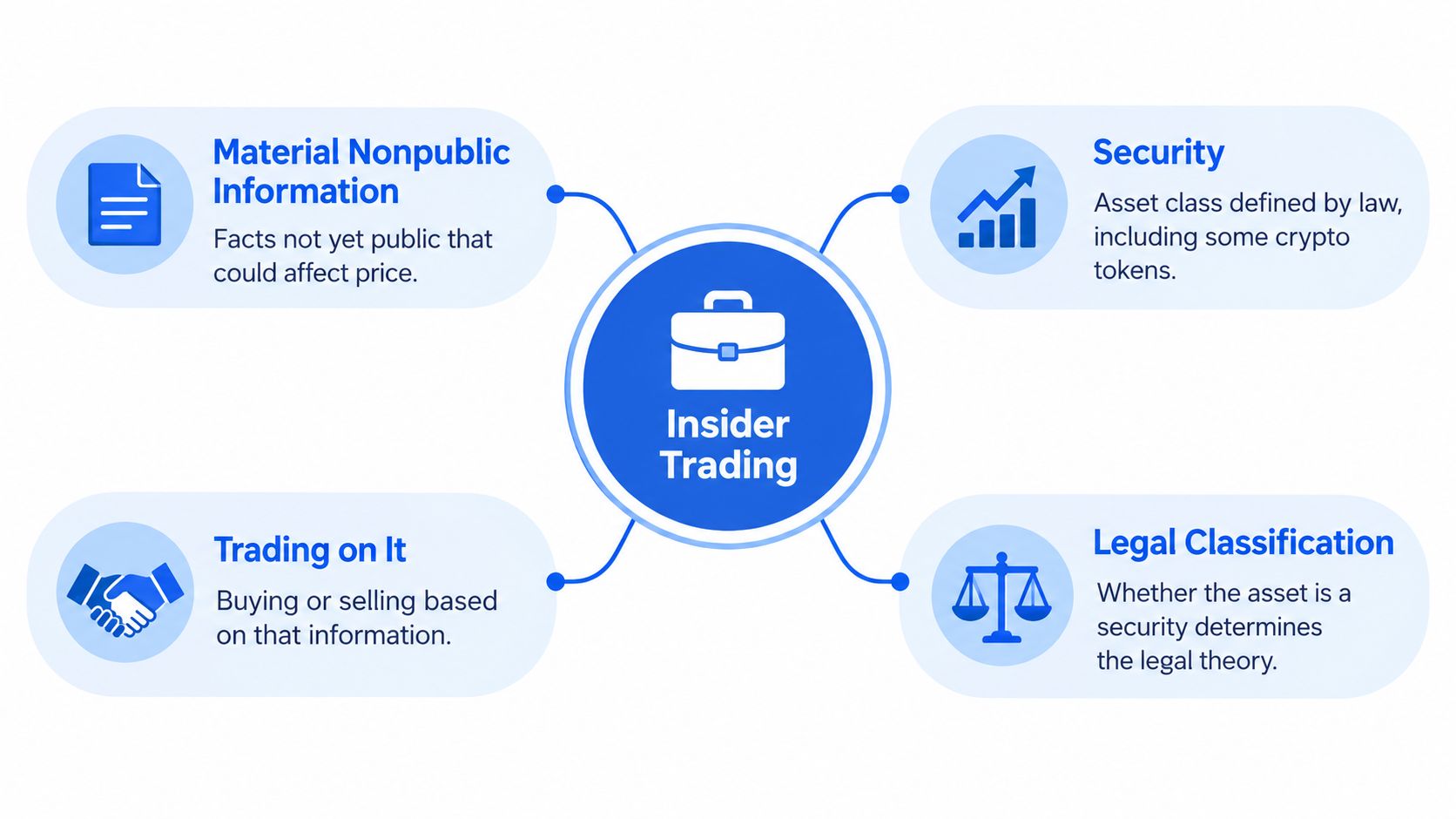
In the traditional securities-law framing, crypto insider trading involves trading a security using material nonpublic information, subject to the relevant legal requirements. Material information could affect an investment decision; nonpublic information hasn't been disclosed to the market. The SEC's Coinbase enforcement announcement provides a concrete example of authorities alleging that confidential listing information was used to trade digital assets.
Crypto traders use “insider” more loosely. They may apply it to a creator's related wallet, an unusually successful early buyer, or an address with a repeatable execution advantage. That shorthand can be useful for screening, but it combines different explanations under the same label.
The conceptual distinction starts with information, trading, and the applicable legal classification.
Separate the Legal Theory From the Wallet Label
For analysis, keep these categories apart:
- Securities-related insider trading: A trader allegedly uses confidential, price-sensitive information concerning an asset treated as a security. Advance knowledge of a listing is the relevant blockchain example.
- Fraud or manipulation involving commodities: The allegation concerns a different legal framework. A suspicious price or volume pattern needs analysis under that framework, not an automatic securities-law label.
- Suspicious but not established as unlawful: A participant buys early, receives creator-linked funding, or earns an exceptional return, but the available evidence doesn't establish the elements of an offense.
The poker analogy helps. Having stronger cards isn't cheating. Concealing cards in your sleeve is a different proposition, but observing that someone keeps winning doesn't tell you which explanation applies.
What a Useful Definition Leaves Open
A blockchain example should therefore describe behavior before interpretation: an address acquired tokens before an announcement, received funds from another address, and later sold. Calling that address an insider adds a hypothesis about access or affiliation.
The hypothesis may warrant investigation. It shouldn't replace the investigation, especially when a report cannot identify the person controlling the address or establish what information that person possessed.
Common On-Chain Patterns
A launch resembles a stage show: public buyers see the headline act, while transaction records may reveal the preparations backstage. For Solana analysis, the useful work is reconstructing those preparations without assuming that every participant belongs to the same group.
The patterns below are screening hypotheses, not documented findings about a particular token. Their significance depends on context, repeatability, and competing explanations.
Common Insider Patterns on Solana
| Pattern | Visible Signal | What It Suggests |
|---|---|---|
| Fresh-wallet early buying | An address receives funding shortly before acquiring a newly created token | Preparation for entry, potentially automated or coordinated |
| Pre-launch distribution | Tokens move from a creator-associated address to other addresses before public participation | Allocations or related inventory that deserve ownership review |
| Bundled buying | Purchases appear together within a transaction or closely grouped execution sequence | Possible coordinated execution, not necessarily confidential knowledge |
| Synchronized entries and exits | Separate addresses buy and sell around the same events | Shared strategy, shared control, or reactions to the same public signal |
| Creator-linked re-entry | An address with a documented creator connection buys again after an initial rise | Continued affiliated participation requiring position-history review |
| Selling around liquidity events | Early inventory is sold as liquidity changes or fresh buyers arrive | Potential exit advantage and pressure on available liquidity |
Read Relationships, Not Just Labels
A freshly funded address is interesting because you can examine its preparation. But “new wallet” isn't synonymous with “new trader.” Treat wallet age as an observation about that address, not proof about its controller's experience or intentions.
Likewise, don't treat purchases in the same Solana slot as conclusive evidence of a bundle. Inspect the transaction sequence and distinguish observed grouping from inferred coordination. A common response to public activity is a competing explanation that your analysis should consider.
Funding links need similar restraint. A transfer between addresses supports a relationship in the transaction graph; it doesn't automatically establish shared ownership. The guide to Solana wallet clusters provides a useful framework for examining those connections without collapsing every linked address into one actor.
The strongest analytical signal is an intersection of observations. For example, a hypothetical group receiving creator-linked funds, entering together, and disposing of inventory together deserves closer review than addresses that merely bought early.
Describe that intersection precisely. Related funding plus coordinated trading is a defensible finding when supported by transactions. “A criminal insider ring” requires evidence that a token explorer alone may not supply.
The Coinbase Case as the Reference Example
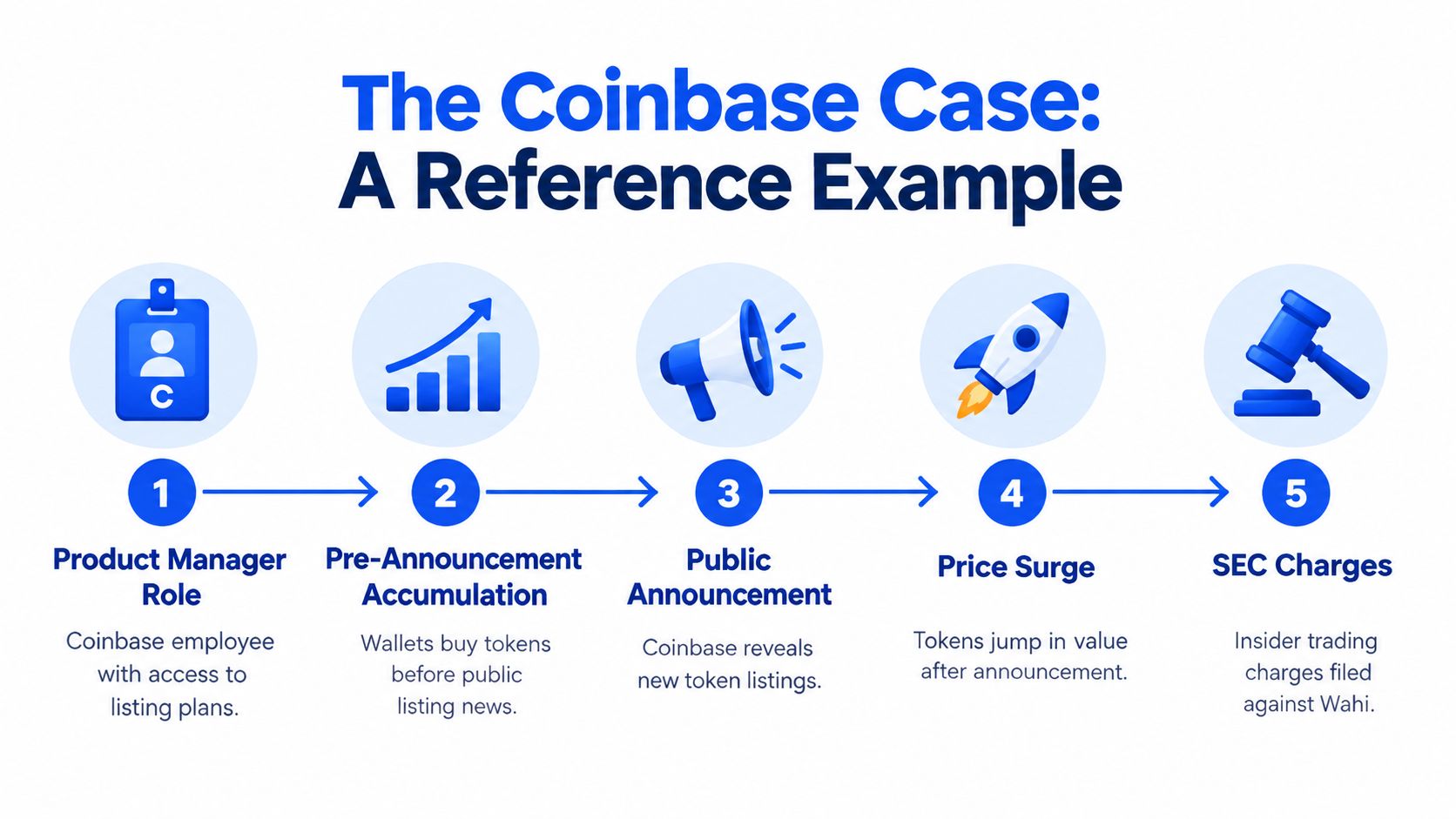
The Coinbase case gives the timing pattern a concrete human explanation. Authorities alleged that former product manager Ishan Wahi shared confidential information about forthcoming listings with his brother Nikhil Wahi and associate Sameer Ramani. The alleged information sharing ran from at least June 2021 through April 2022, with SEC and DOJ charges announced on July 21, 2022, as detailed in Skadden's analysis of the cryptocurrency insider-trading case.
The allegation wasn't merely that somebody bought a token before its price increased. Authorities identified an alleged source of confidential information and connected that access to trading ahead of public listing announcements.
The timeline illustrates the proposed causal chain.
Keep the Profit Measures Separate
The case involved 25 tokens and at least $1.1 million in profits according to the SEC; the DOJ described approximately $1.5 million in unrealized gains in the legal analysis cited above. These aren't interchangeable measures, and combining them would misrepresent the alleged proceeds.
The XYO example makes that distinction tangible. Wallets associated with Ramani allegedly purchased about $600,000 of XYO before the announcement, after which their holdings rose to roughly $1.5 million, implying an estimated $900,000 gain, according to the same case analysis. That describes the increase in holdings' value, not an independently established cash withdrawal.
Translate the Mechanism, Not the Verdict
For a hypothetical Solana launch, replace the exchange announcement with a planned promotion or liquidity event. The analytical sequence remains useful: establish the public catalyst, examine earlier accumulation, and determine what happened to those positions afterward.
But the institutional evidence differs. The Coinbase allegations included an employee's access to confidential listing plans. A Solana wallet pattern may reveal only the transactions, with no verified connection to private communications.
A useful comparison transfers the investigative method, not the accusation.
The reference case therefore teaches a narrower lesson than “early buyers are insiders.” Investigators need a bridge between privileged knowledge, specific trades, and the applicable legal theory. Without that bridge, the on-chain sequence remains a signal to examine rather than a complete explanation.
Why Suspicious Wallets Are Not the Same as Criminal Conduct
A wallet can look suspicious for reasons that matter financially but don't establish illegality. The shortcut from “bought early” to “committed insider trading” skips the most difficult parts of the inquiry: identifying the trader, establishing the information source, and determining which law applies.
Legal classification isn't a technicality. Reporting on the distinction between lawful crypto trading and actionable misuse of information contrasts the Wahi securities-based theory with the Chastain ruling's narrowing of wire-fraud liability for misuse of confidential, non-property information. The distinction underscores why confidential information, standing alone, doesn't make every trading scenario legally equivalent.
A transaction trail can support an investigation without answering its legal questions.

What Evidence Is Still Missing?
An analyst should make the gaps explicit:
- Information source: What supports the claim that the trader received private knowledge rather than reacting to public information?
- Asset classification: What legal treatment is relevant to the token and conduct being examined?
- Applicable elements: Which duty, deception, or other statutory requirement would need to be established?
- Attribution: What connects an address to a person and that person to the alleged information misuse?
These questions explain why a profitable address isn't enough. Transaction records may show acquisition and disposal, while leaving the source of the trading decision unresolved.
Use Language That Matches the Evidence
Compare two hypothetical report statements. “Creator-funded addresses acquired inventory before public promotion” describes a verifiable sequence if the funding and timestamps are documented. “The creator committed illegal insider trading” adds identity, intent, legal classification, and liability conclusions.
The first statement can justify reducing exposure or declining a trade. The second needs substantially more evidence.
For a retail trader, uncertainty about legal liability doesn't require uncertainty about portfolio decisions. You can reject an unattractive risk without accusing anyone of a crime. That's both more useful trading discipline and more honest reporting.
How On-Chain Analytics Detect Insider Activity
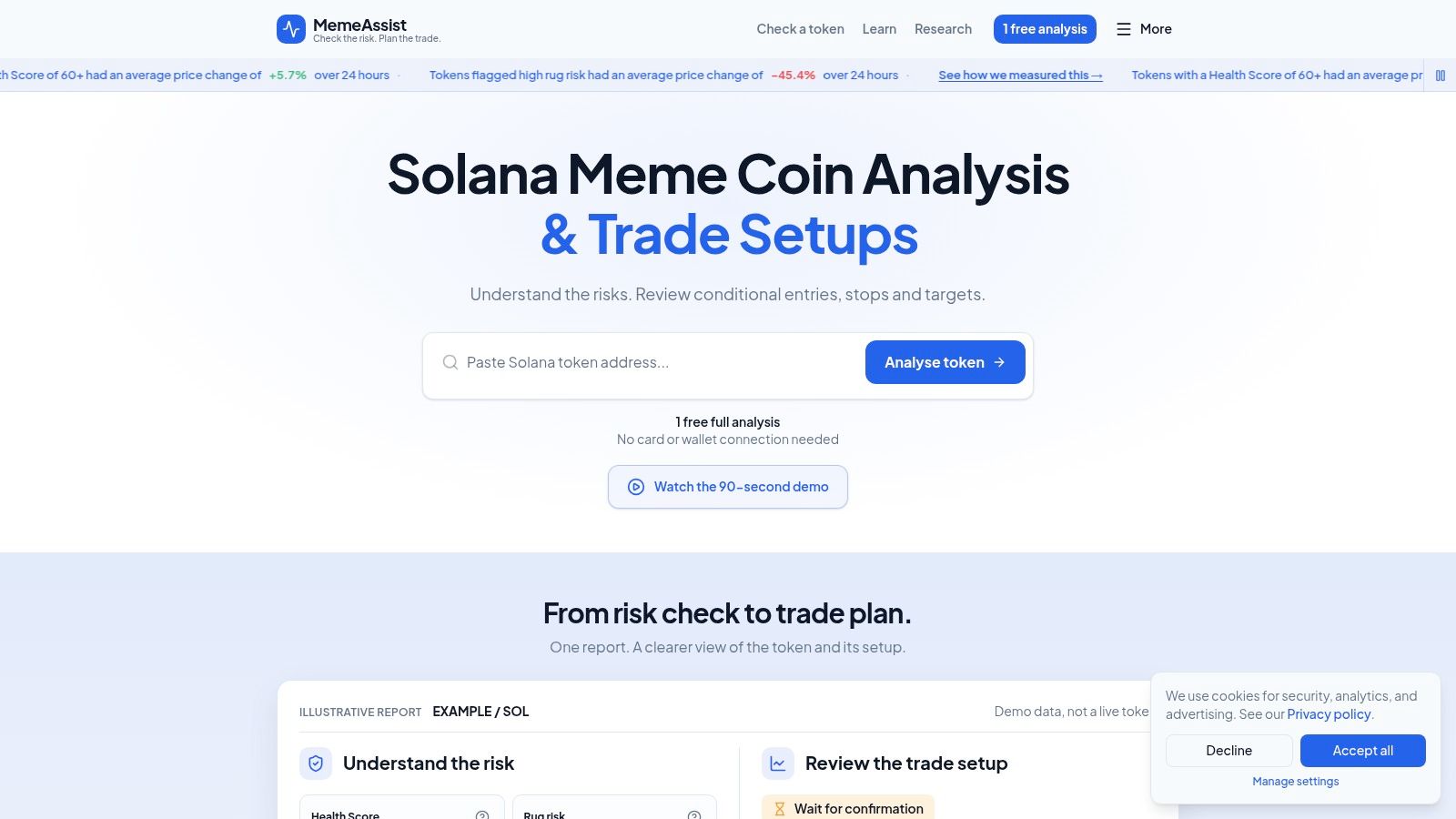
Detection starts with a mint address and an event timeline, not a guilty-wallet label. Use a Solana explorer to inspect transactions manually, or use an automated report to organize the evidence. MemeAssist is one option: its live token reports combine an Overall Health Score, Rug Risk Rating, AI Verdict, and Detailed Risk Breakdown.
The supplied report view illustrates the interface, not a verified finding about a specific token.
Reconstruct the Event Window
Research examining 170 Coinbase listing announcements between September 2018 and May 2022 estimated that insider trading may have affected approximately 10% to 25% of the sample, identified at least four connected wallets, and estimated minimum illegal profits of about $1.5 million, according to the University of Technology Sydney's research summary. That sample-based range isn't a prevalence estimate for Solana launches or every crypto exchange.
The practical workflow is to connect observations:
- Anchor the catalyst: Record when the relevant announcement became public. Keep that timestamp separate from mint creation and trading availability.
- Trace preparation: Examine funding transfers and token receipts before the event. Preserve transaction references rather than only screenshots.
- Measure accumulation: Compare buying and position growth before the catalyst with surrounding activity. Don't call returns abnormal without a stated comparison.
- Follow disposal: Distinguish transfers from actual sales and track whether linked addresses retained or liquidated inventory.
Inspect the Explanation Behind the Score
In a report walkthrough, start with the Overall Health Score for orientation, then inspect the Rug Risk Rating and AI Verdict for their stated concerns. Use the Detailed Risk Breakdown to find the observations supporting those concerns. Don't infer an actual token's findings from an interface example.
The Solana smart-money wallet tracking guide is relevant to following position histories rather than copying a wallet's latest purchase.
For a complementary walkthrough, the video can be viewed alongside the transaction checks.
Finally, review 24-hour post-flag outcomes to test whether warnings corresponded to subsequent deterioration. Outcome tracking evaluates screening usefulness; it doesn't retroactively prove private information or criminal intent.
The Real Risk for Retail Buyers
The financially important question isn't always who deserves the insider label. It's whether you're supplying exit liquidity to a group whose acquisition conditions and selling options differ sharply from yours.
A 2025 analysis of the TRUMP meme coin reported that a small number of large investors captured most profits while retail traders experienced steep losses. It described structural advantages favoring early participants, supporting the distinction between adverse-selection risk and provable illegal insider trading.
The analytical implication is uncomfortable: a token can be a poor trade for newcomers even when no available evidence supports a criminal allegation.
Evaluate the Group's Exit, Not Its Reputation
Think of a race where some participants receive a head start, a course map, and a vehicle waiting near the finish. You don't need to establish cheating to recognize that the starting conditions differ. In token analysis, the equivalent is comparing who acquired supply, under what conditions, and how easily they can dispose of it.
Useful questions include:
- Concentration: How much economically relevant inventory could related participants control?
- Entry timing: Did those participants acquire positions before the conditions visible to ordinary buyers?
- Funding relationships: Are multiple holders plausibly part of the same economic group?
- Sell capacity: How does their potential liquidation compare with available liquidity?
- Demand quality: Does trading appear independent, or do repeated relationships warrant closer examination?
Treat Apparent Diversity Carefully
A long holder list can look reassuring while leaving a central ownership question unresolved. If several addresses are connected, assess both the individual balances and the possible group exposure. Keep that grouping provisional unless the evidence establishes control.
The discussion of insider-risk signals and 24-hour outcomes is relevant to evaluating what follows a warning, rather than treating detection as an end in itself.
The actionable concern is not that an early buyer might profit. It's that your exit may depend on that buyer choosing not to sell first.
My analytical conclusion is that exit asymmetry deserves more attention than wallet notoriety. A famous address tells you who attracted attention; a reconstructed inventory and liquidity picture tells you what could threaten your position.
Practical Takeaways for Solana Traders
Before the next mint, turn curiosity into a repeatable decision process. Save the token address, inspect the evidence, and decide which findings would make you pass. A risk screen is more useful when it informs a rule you established before the chart became persuasive.
Don't require perfect certainty. Require enough visibility to understand what you're accepting, and distinguish missing evidence from reassuring evidence.
Build a Pre-Buy Checklist
- Holder concentration: Review large balances and documented links between holders. Don't assume that separate addresses mean independent owners.
- Creator wallet history: Examine the creator's transaction trail and explain which relationships are established, inferred, or unknown.
- Bundle and insider flags: Open the supporting checks. Ask whether the flag reflects execution grouping, common funding, event timing, or a combination.
- Liquidity versus sell pressure: Assess the inventory that could reach the market, not just the displayed token valuation. Consider whether your intended exit depends on continued buying.
- Comparable post-flag outcomes: Review tracked outcomes for similarly flagged tokens. Use them to assess the warning process, not to promise what this token will do.
The checklist should produce a decision, not merely a collection of tabs. If an important relationship remains unresolved, record that uncertainty explicitly. If the potential sell pressure makes your planned exit implausible, a rising chart doesn't resolve the problem.
Set Expectations for the Report
On-chain detection can identify transaction relationships, timing patterns, concentration, and potential structural advantages. It cannot, by itself, prove what someone knew, why they traded, or whether their conduct satisfied a criminal statute.
A high-risk score is not a conviction, and a reassuring score isn't a guarantee. Read the underlying evidence and its limitations before treating either as actionable.
The poker analogy ends with position sizing, not certainty. Knowing which seats repeatedly hold an advantage doesn't reveal their cards, but it should change how much you're willing to wager. Make check before you click the habit, and leave room to decline a trade whose ownership or exit conditions you can't adequately assess.
MemeAssist offers on-demand Solana token reports that combine live liquidity, holder, creator, and trading-pattern checks with a plain-English risk explanation. Before your next meme-coin purchase, submit the mint address and inspect the evidence behind any bundle or potential insider flags, without connecting a wallet or signing a transaction.