Crypto Pump Groups: How They Work and How to Spot Them
Crypto pump groups coordinate buying to inflate a token, then sell on latecomers. Learn how they work, the warning signs on-chain and how to stay safe.
Published
Updated
Targeted cryptocurrencies experienced an average 30% price decline relative to the market a year after a pump event, according to a University of Bristol study covering 765 cryptocurrencies. That reframes crypto pump groups as more than a brief trading hazard. The damage can outlast the announcement, the price spike and the group's attention.
The practical question isn't whether a channel can make a chart rise. It's who already owns the tokens when everyone else receives the instruction to buy. Treating the public announcement as a possible exit signal for insiders, rather than an entry signal for followers, changes how you read the evidence.
Table of Contents
- What Crypto Pump Groups Are
- How a Pump Group Runs, Phase by Phase
- Why Pump Groups Keep Finding Buyers
- Legal and Ethical Risks for Members and Buyers
- Token Traits That Attract Pump Groups
- On-Chain and Off-Chain Warning Signs
- Check Every Token Before You Buy
What Crypto Pump Groups Are
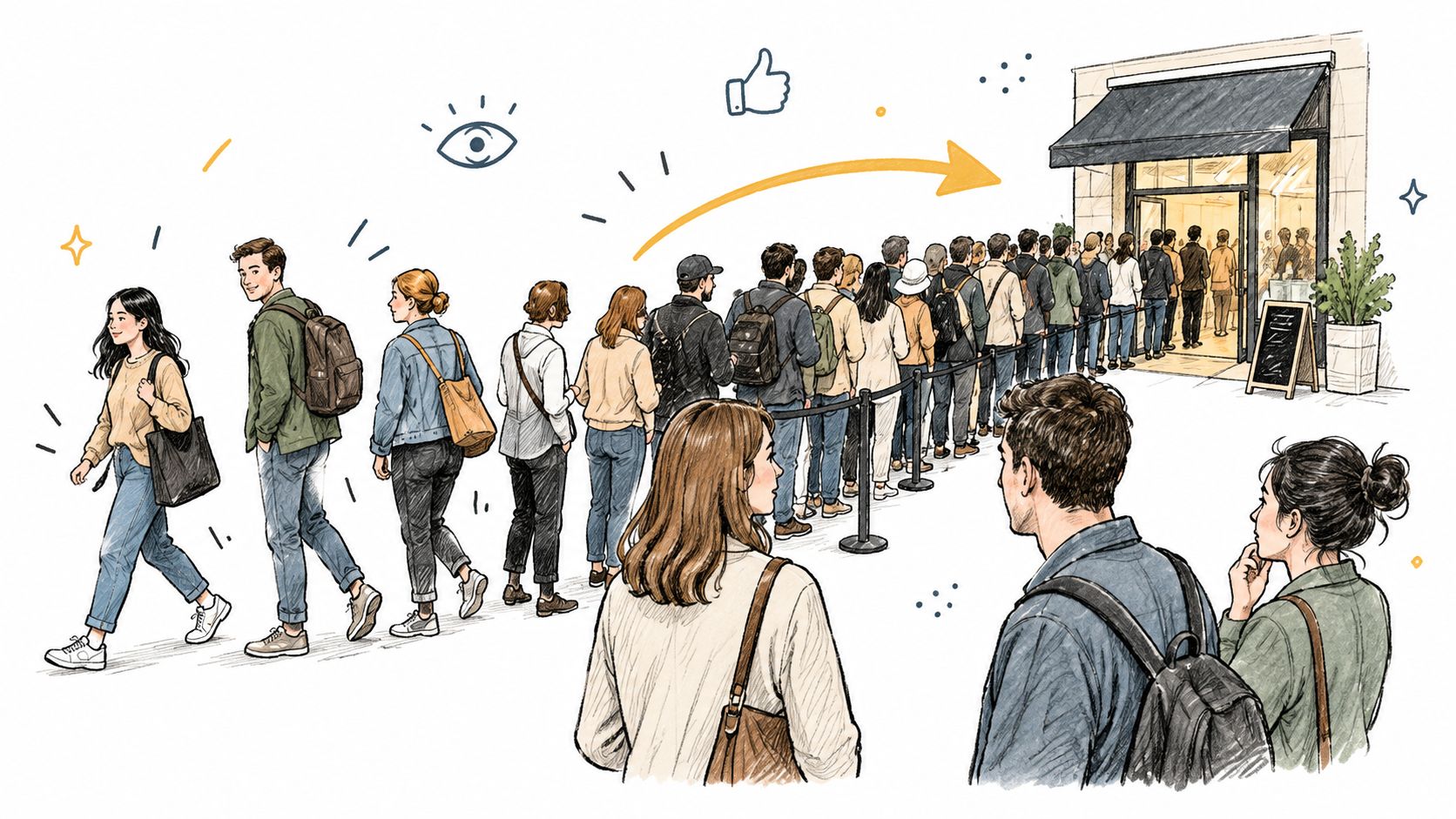
A crowd is paid to queue outside a shop. Passers-by assume the shop must be worth visiting, join the line and attract still more people. As the genuine customers arrive, the paid crowd slips away without a word.
That's a useful analogy for a crypto pump group. Organisers coordinate purchases of a thinly traded token, encourage others to buy and sell into the demand they've helped create. Telegram, Discord and X channels can provide the meeting place, instructions and public promotion.
The pump, the dump and the coordinator
The pump is the manufactured buying pressure and price increase. The dump is the sale of previously acquired tokens into that demand. The group supplies the coordination, although ordinary members may not know when organisers intend to exit.
This differs from a rug pull, where insiders abuse control over a project, for example by withdrawing its trading liquidity. The mechanisms can overlap, but a pump group doesn't need to control the token's code or development team. It needs inventory, attention and buyers.
An ordinary trading-signal channel isn't automatically a pump group either. A bad prediction, an unpopular recommendation or a losing trade doesn't establish deliberate manipulation. The distinction is whether people intentionally manufacture demand while concealing their position or planned exit.
The central test: When a rally is announced to a crowd, ask who is already positioned to sell first.
An organised operation, not an isolated stunt
A study of Telegram activity from June 2018 through February 2019 identified 412 pump-and-dump events, approximately 100 organised channels, roughly two pumps per day and an estimated $6 million in artificial monthly trading volume. The researchers also documented concentration on a small set of exchanges and repeated targeting of the same coins.
The important lesson is organisational. A messaging channel lets organisers repeatedly assemble buyers without building a new audience for every token.
Don't confuse that ability with genuine investment demand. A busy channel and an active market can both contain real people while still giving you a misleading picture of why they're buying.
How a Pump Group Runs, Phase by Phase
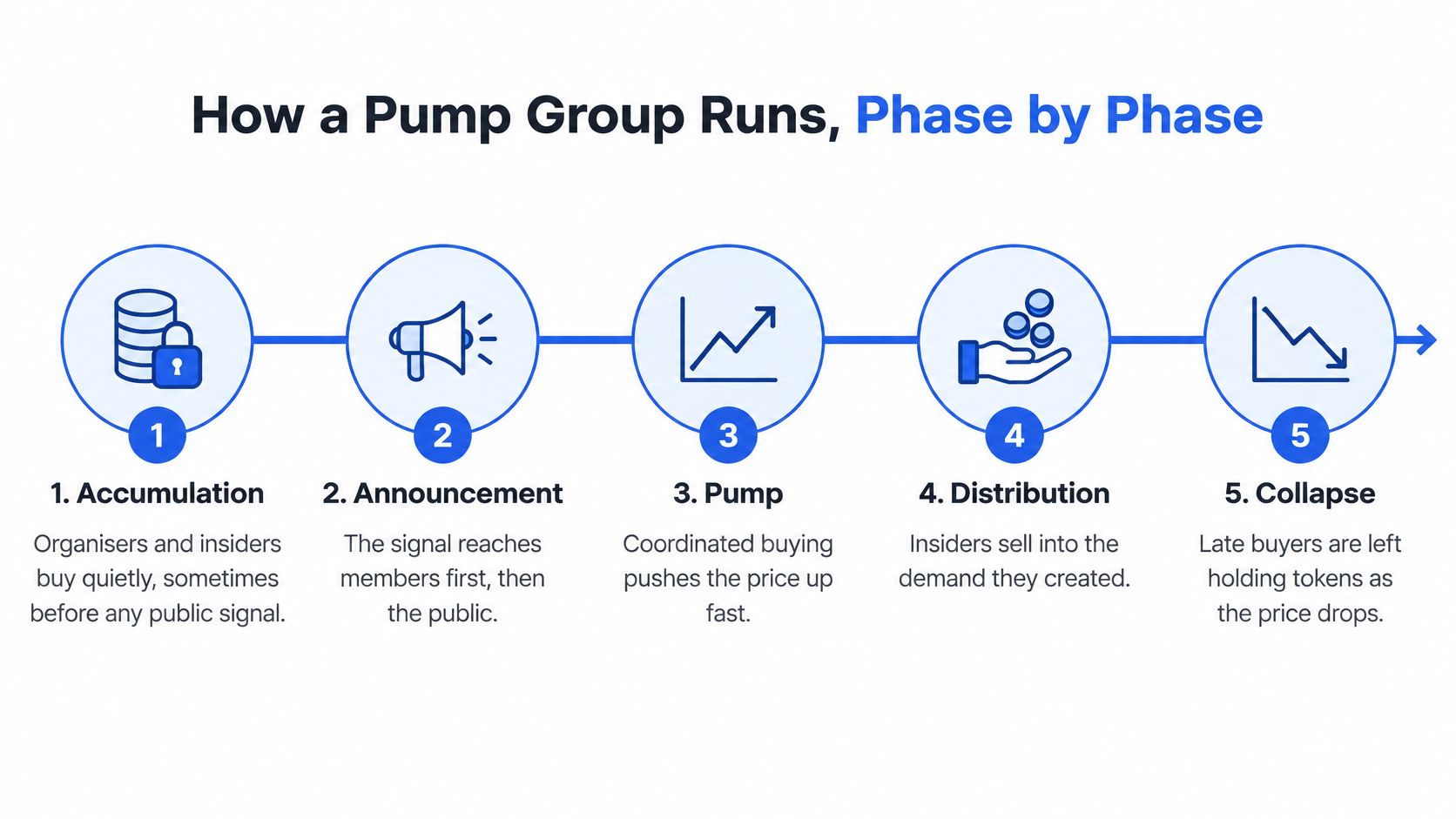
The lifecycle has five phases: accumulation, announcement, pump, distribution and aftermath. They're useful analytical categories, not neatly separated trading windows. Organisers may already be distributing tokens while followers still believe the pump is beginning.
The lifecycle from each side of the trade
| Phase | What organisers do | What retail sees | Typical timing |
|---|---|---|---|
| Accumulation | Insiders or privileged members acquire inventory | Volume builds and price drifts without an obvious public catalyst | Before the public signal |
| Announcement | Release the token name and buying instructions | Urgent posts and an initial price move | At the public signal |
| Pump | Coordinate buying while attracting outside buyers | Rapid volume growth and sharp price swings | Immediately around the announcement |
| Distribution | Sell inventory into incoming demand | Uneven price action, worsening execution or a reversal | Can overlap the apparent pump |
| Aftermath | Stop promoting the token or turn to another target | Less attention, potentially weaker liquidity and remaining holders | After coordinated demand subsides |
These timings shouldn't be treated as a schedule. There's no reliable moment at which every participant moves from buying to selling, and the public channel may not reveal that change.
The short-window evidence shows why this matters. In a study of 500 manually collected pump-and-dump events, the first 70 seconds after an announcement produced an average 25% price increase, trading volume rose approximately 148-fold, and average absolute 10-second returns reached 15%; prices also began rising roughly five minutes before the public signal.
Those are historical averages, not achievable returns for someone reading a message. Absolute returns describe movement in either direction, not a guaranteed gain.
Why reacting quickly may still mean arriving late
Suppose you see a public post, open a trading interface and submit a purchase. Someone who accumulated beforehand can be selling while you complete those actions. You're responding to information they've already acted on.
Your purchase price also isn't necessarily the price displayed when you opened the chart. Slippage is the difference between the expected execution price and what your trade really receives. A fast-changing, shallow market makes that difference especially important.
A public announcement can be the start of your awareness and the end of someone else's holding period.
The same distinction matters when evaluating channel businesses. Anyone learning how to monetize a crypto Telegram group should separate payment for useful research or community access from an arrangement that depends on followers buying the organiser's inventory.
The message timestamp is therefore evidence to investigate, not permission to trade.
Why Pump Groups Keep Finding Buyers
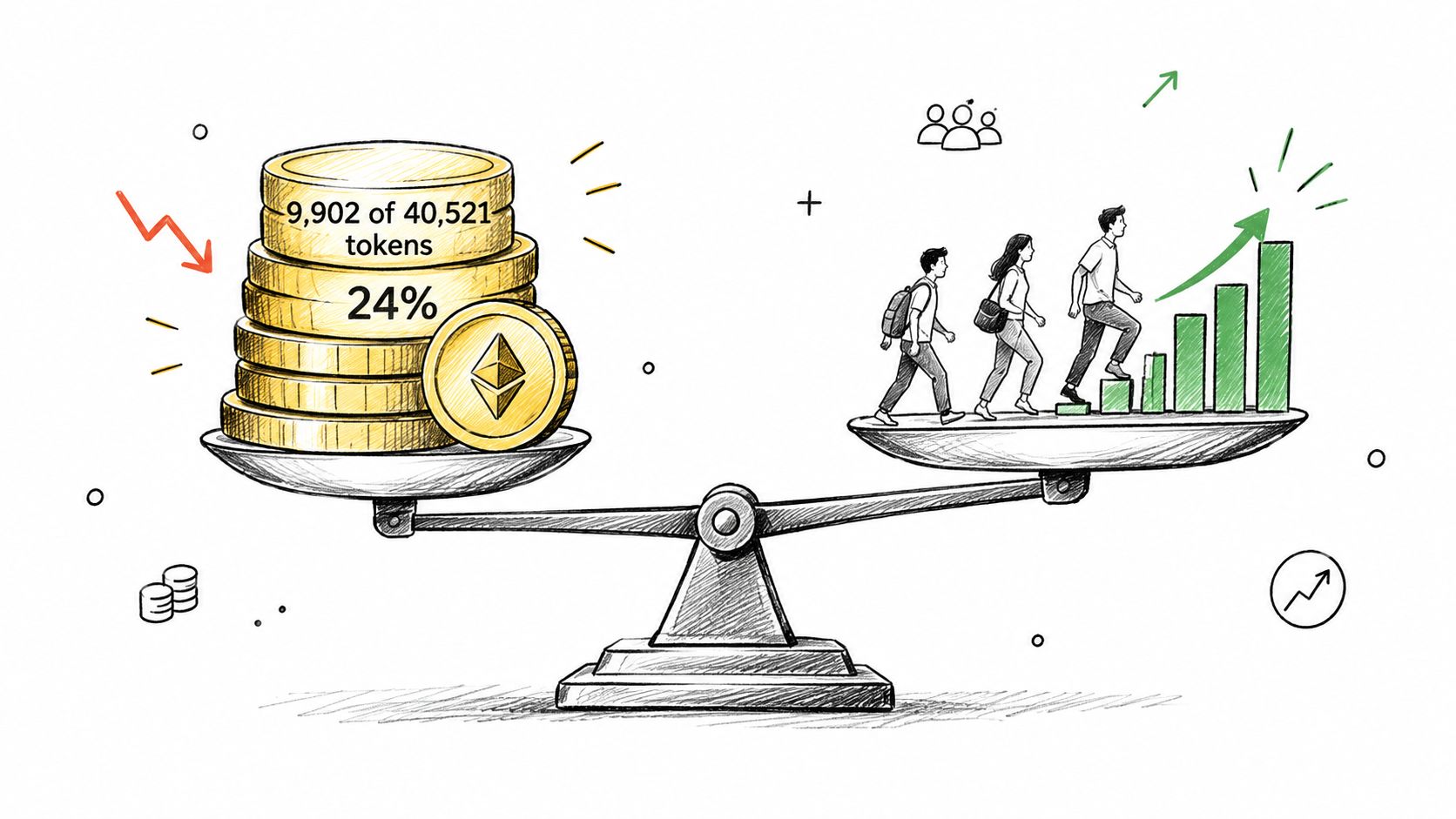
24% of the tokens in Chainalysis's selected 2022 sample experienced a first-week price decline consistent with possible pump-and-dump behaviour: 9,902 out of 40,521 tokens, with approximately $30 million in estimated aggregate profits for participants behind these schemes, according to its analysis of suspicious token launches. These were tokens that had gained enough traction to analyse, not every token launched that year.
The qualifier matters. A screening pattern indicates possible manipulation, not a finding that every flagged token was fraudulent. The analysis also described relatively limited direct returns from the typical scheme, which helps explain why repetition can matter more than a spectacular individual win.
Different incentives inside the same channel
A useful way to assess a group is to separate the possible sources of benefit. Don't assume every person involved earns money in the same way.
- Trading proceeds. An organiser who bought before promotion can benefit when followers purchase that inventory.
- Access fees. A paid VIP tier can sell the promise of earlier information, whether or not subscribers receive a usable trading opportunity.
- Audience growth. A rising chart can help an administrator attract followers and establish an apparently successful reputation.
These incentives can reinforce one another. A dramatic chart becomes promotional material for the channel, and the larger audience becomes a potential source of demand for another campaign.
None of that proves a particular paid community is manipulative. It does explain why you should examine how its operator benefits, rather than evaluating only the enthusiasm of its members.
Why the presentation feels persuasive
Think of a restaurant owner seating staff near the windows so the room looks popular. The people are real, but their presence isn't independent evidence that the food is good.
A channel can create a similar impression. Screenshots of gains, repeated endorsements and excited messages make participation look validated by a crowd. Yet members may be responding to the same instruction rather than reaching independent conclusions.
The confusion deepens when a trader treats a displayed gain as money already available to withdraw. A chart records transaction prices; it doesn't promise that enough buyers exist to absorb every holder's sale at that level.
Social proof isn't independent due diligence. Ask what evidence would remain if you removed the channel's own posts, screenshots and testimonials from your decision.
Legal and Ethical Risks for Members and Buyers
Joining a group doesn't make every member legally equivalent. Organisers, paid promoters and knowing participants can occupy different positions, and their exposure depends on their conduct, knowledge and the applicable law. This is general information, not legal advice.
Deliberately creating a misleading picture of demand raises market-manipulation and fraud concerns. But it would be misleading to give a universal legal verdict for every token, channel or jurisdiction. Don't assume that an anonymous account, a decentralised exchange or a token label settles the question.
Assess conduct rather than membership alone
| Role | Conduct that deserves scrutiny | Why the distinction matters |
|---|---|---|
| Organiser | Arranging purchases and promotion while concealing an intended sale | The person may be directing the operation |
| Paid promoter | Presenting compensated promotion as independent enthusiasm | Buyers may misunderstand the promoter's incentives |
| Knowing participant | Helping coordinate misleading activity or recruit later buyers | Taking instructions doesn't necessarily remove responsibility |
| Uninformed buyer | Purchasing without knowing about coordination | Financial harm and knowing participation are different questions |
Don't treat this table as a liability checklist. A lawyer would need the actual communications, transactions, jurisdiction and surrounding circumstances to assess a case.
If you suspect you've been drawn into a scheme, preserve public posts, timestamps, transaction identifiers and payment records. Avoid making unsupported public accusations, and seek qualified advice if you face a legal question.
The ethical issue is easier to state
A community becomes exploitative when leaders encourage followers to buy while concealing that they intend to sell to them. The problem isn't that someone loses a speculative trade. It's that the supposed shared objective hides opposing interests.
Followers are not being helped when their trust is used to create the organiser's exit.
An unsuspecting buyer shouldn't be blamed for failing to uncover every relationship behind a token. Still, buying without checking who controls supply and who benefits from promotion leaves that buyer exposed.
The scale warrants scrutiny: Chainalysis reported 74,312 decentralised-exchange pools engaged in suspected pump-and-dump schemes in 2024 in its crypto market-manipulation report. Those are pools, not a count of convicted organisers or proven offences. Preserving that distinction makes screening more credible, not less necessary.
Token Traits That Attract Pump Groups
Use a two-stage screen: first identify tokens whose market structure deserves closer attention, then monitor what happens after suspicious activity. The first stage helps prioritise investigation. The second tests whether the token remains healthy after the attention fades.
Research covering 1,457 pump events from 2018–2022 associated higher pump likelihood with lower market capitalisation, lower trading volume, stronger social-media popularity, greater developer activity and listings on fewer exchanges, as described in the research on cryptocurrency pump-and-dump schemes. Association doesn't establish that any individual project is dishonest.
Compare susceptibility with evidence
The middle column below explains plausible mechanisms, not proof of an organiser's intention. The checks help turn broad suspicions into questions you can investigate.
| Trait | Why groups favour it | What to check |
|---|---|---|
| Low market capitalisation | A small tradable supply may be easier to influence | Separate headline valuation from actual circulating supply and liquidity |
| Low trading volume | Coordinated orders can dominate an otherwise quiet market | Compare current daily volume with its recent baseline |
| Listed on few venues | Fewer independent markets may limit alternative liquidity | Count active pools and trading venues, not merely announced listings |
| Sudden social-media attention | Promotion can attract outside buyers | Compare posting activity with price changes and verifiable news |
| High developer activity | Visible activity can support a credible-looking narrative | Examine meaningful repository changes and verify team claims |
| Thin liquidity pool | Modest buying can move the quoted price substantially | Estimate price impact for the position you intend to trade |
Low market capitalisation and thin liquidity aren't interchangeable. Market capitalisation is a valuation measure; liquidity describes the available trading depth. A token can display a substantial valuation without providing a practical exit for a meaningful position.
Developer activity also needs careful interpretation. It isn't automatically suspicious, and genuine builders shouldn't be penalised for shipping updates. The useful question is whether observers are mistaking visible activity for evidence that the trading market is healthy.
Stack the evidence without declaring guilt
Several traits appearing together justify a deeper check, not an automatic accusation. A newly launched token can naturally have limited listings, concentrated ownership and an enthusiastic community.
Track rolling changes in volume and liquidity, rather than looking at either in isolation. Then revisit the token after the promotional burst: are independent buyers still trading, are holders becoming less concentrated, and is executable liquidity holding up?
The practical distinction is between a vulnerable market structure and evidence that someone exploited it. You need to investigate both before drawing a conclusion.
On-Chain and Off-Chain Warning Signs
The most useful comparison is trading activity before the announcement versus the announcement itself. It connects what promoters said with what wallets and traders had already done. A screenshot of an excited channel can't provide that sequence.
On-chain evidence includes transactions, supply distribution and token permissions. Off-chain evidence includes public posts, channel messages and claimed catalysts. Neither tells the whole story alone.
Match every warning sign to its place in the timeline
| Signal | Where to look | Red-flag pattern | Why it matters |
|---|---|---|---|
| Volume before the announcement | Trading timeline against public post timestamps | Buying expands before the public explanation appears | Consistent with pre-positioning |
| Holder concentration | Holder list and supply distribution | A few wallets control a large share of tradable supply | Those holders may dominate selling |
| Synchronised wallet buying | Early buyers' transaction histories | Similar purchases cluster in the same blocks | Warrants investigation of possible coordination |
| Creator-linked transfers | Transfers from the creator wallet | Supply moves through fresh wallets without a clear explanation | Apparent ownership dispersion may be misleading |
| Shallow liquidity | Pool reserves and executable quotes | High turnover sits alongside limited available depth | Reported activity may overstate exit capacity |
| Live mint or freeze authority | Token permission records | Relevant authority remains active | Supply or account-transfer conditions may change |
| Social surge with no news | Telegram and X posts | Similar promotional messages appear without a verifiable catalyst | Promotion may be supporting distribution rather than discovery |
Read the table as a set of investigation prompts. Similar transaction sizes don't establish common ownership, and a creator transfer can have a legitimate operational explanation. Likewise, an active authority identifies a capability, not evidence that it has been abused.
For a closer look at coordinated purchases, use this explanation of how to check if a Solana token is bundled. A bundle-related flag should lead you to examine the underlying transactions, not replace that examination.
The public post may explain activity that already happened
Research covering 1,021 tokens and approximately 8.2 million minute-level records found that 70% of pre-event volume occurred within an hour of the pump announcement, while distinguishing pre-accumulation from on-the-spot patterns in its market-microstructure analysis. That percentage concerns pre-event volume, not all trading around a pump.
The distinction prevents an overly simple rule. Some campaigns involve earlier inventory building; others depend more heavily on coordinated buying at the signal. Don't assume that every suspicious token follows an identical preparation period.
Instead, align the evidence on a timeline. Mark the earliest public catalyst you can verify, then inspect preceding purchases, transfers and liquidity changes. After publication, check whether the wallets that bought earlier begin selling.
A strong-looking chart can coexist with poor execution because the last recorded trade doesn't describe the price available for your whole position. Simultaneous selling makes that gap more consequential.
Suspicious coordination is a risk signal, not proof of wrongdoing. Missing wallet labels, incomplete histories or an apparently clean scan also don't establish safety. Uncertainty should remain visible in the decision.
Check Every Token Before You Buy
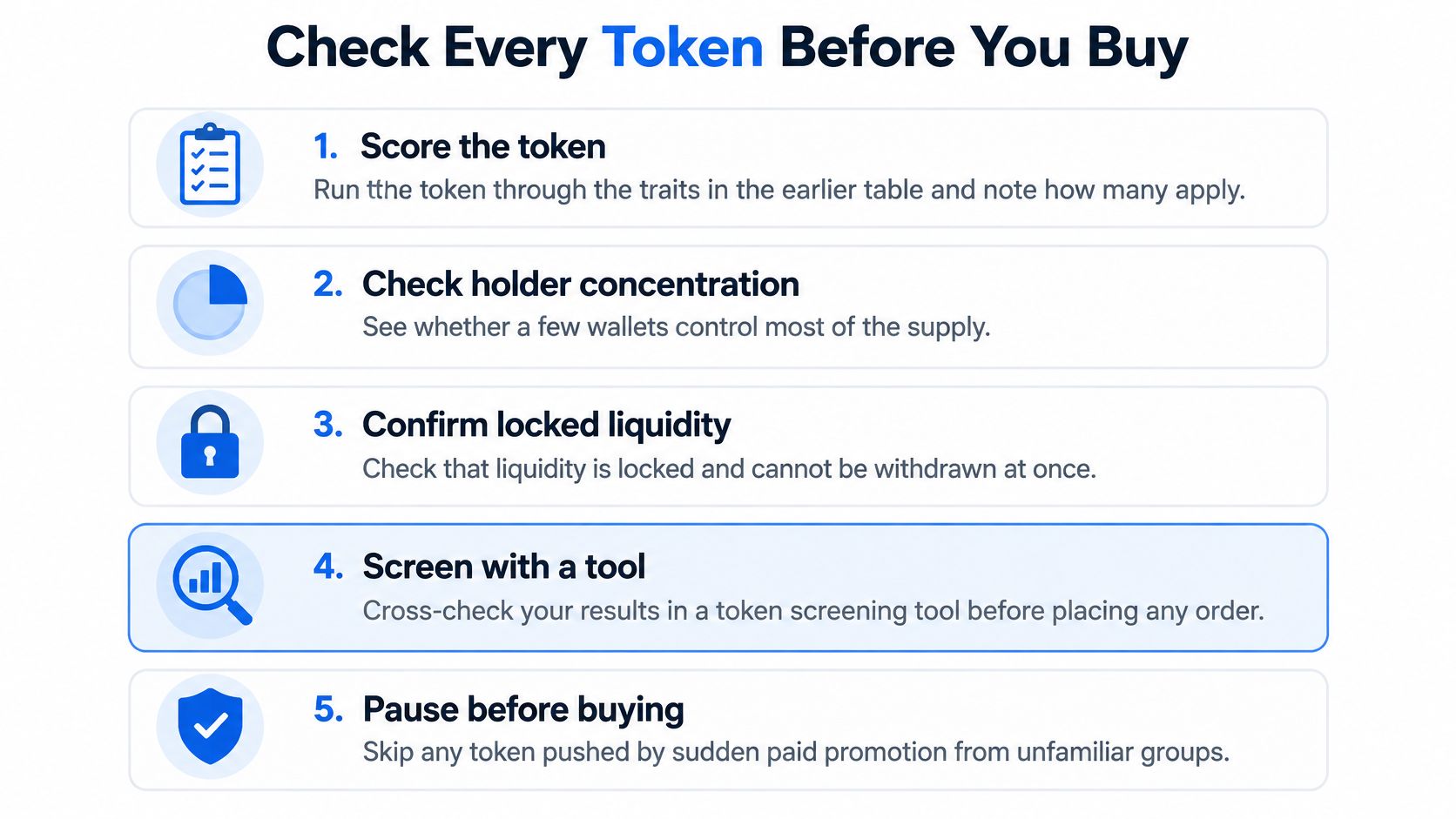
A pre-buy procedure should slow you down enough to compare the story with the evidence. You don't need to prove a crime to decide a trade isn't worth taking.
A repeatable decision process
Record the token's susceptibility traits. Use the earlier comparison table, but write down the underlying evidence rather than treating a count of flags as a probability.
Examine holder concentration and the largest early buyers. Look for possible links, while keeping confirmed relationships separate from assumptions.
Check mint and freeze authorities. For a conservative screen, treat unexplained active permissions as a reason to pause; separately verify who can withdraw liquidity and under what conditions.
Compare the trading timeline with the earliest public post you can verify. An edited message or a screenshot without context is a weak timestamp.
Estimate a full-position exit. Obtain an executable quote or price-impact estimate for the amount you would need to sell, not just a small test amount.
Write an exit rule and maximum tolerable loss before entering. Include what you'll do if liquidity deteriorates or new creator-linked transfers appear.
Schedule a follow-up check. Reassess the position after the initial excitement and whenever material evidence changes; an earlier result describes an earlier market.
Liquidity locks deserve their own caution. Verify what is locked, who benefits and when restrictions end. A lock doesn't prevent large holders from selling or guarantee continued demand.
Use the broader guide to buying Solana memecoins safely to make these checks part of a consistent routine rather than an emergency response.
If you already hold the token
Don't add to a position just because it's pumping. Recheck current selling capacity and whether earlier buyers are distributing inventory.
Consider whether staged exits would reduce immediate price impact, but recognise that waiting between sales also creates exposure. If creator-linked supply keeps moving or pool depth keeps shrinking, reassess the position against your loss rule rather than assuming a recovery.
Where a second opinion fits
At MemeAssist, our on-demand token-address analysis evaluates six evidence categories: liquidity, holder distribution, creator behaviour, wallet activity, trading patterns and historical risk indicators. A full report provides a health score, rug risk rating, plain-English verdict and detailed risk breakdown; it costs $0.20, with a conditional Trade Setup when the price structure supports one.
This is a research aid, not financial advice or a safety guarantee. A token can pass our checks and still collapse because demand disappears, large holders sell, liquidity changes or new information appears. Make a checked report and a written exit rule prerequisites for a buy, not substitutes for judgement.
Visit MemeAssist for an on-demand Solana token report that brings wallet, liquidity and trading evidence into one plain-English assessment. Before acting on a pump-group announcement, use it as a second opinion on who holds the supply, what happened before the post and whether your planned exit is realistic.