Crypto Risk Analysis: How to Read Token Risk Signals
Crypto risk analysis explained: frameworks, liquidity and concentration checks, qualitative signals and a workflow for clear, actionable risk reports.
Published
Updated
Approximately $9.3 billion in reported losses accompanied 149,686 complaints referencing cryptocurrency in the FBI's 2024 Internet Crime Report. Those are reported complaints, not a complete count of global harm. They reframe crypto risk analysis: the question isn't whether a token's price might fall, but which failure could cause a loss, who can trigger it, and whether you could exit in time.
Table of Contents
- Why Price Alone Misses Most Crypto Losses
- The Risk Classes Every Analysis Should Separate
- Liquidity Checks That Show Whether You Can Exit
- Concentration and Trading Pattern Metrics to Calculate
- Qualitative Signals Numbers Cannot Capture
- How to Build an Actionable Risk Report Step by Step
- Confirm the Verdict Before You Act
Why Price Alone Misses Most Crypto Losses
Say an investor notices a token climbing steadily, checks its recent gains, and buys. The next day, the creator removes liquidity. The investor still owns the tokens, but there's no longer enough money in the trading pool to sell them at anything close to the displayed price.
The chart didn't have to be inaccurate for that loss to happen. It showed the prices at which earlier trades occurred, not a guarantee that future buyers would absorb the investor's position.
A price chart is like a speedometer. It tells you how fast something is moving, not whether the brakes work.
Start with the failure, not the forecast
Crypto risk analysis is a structured, evidence-based assessment of what could cause a loss, how plausible that failure appears, and how quickly it could happen. Its useful output is a written verdict with a confidence level, not an unexplained safety badge.
For a token purchase, that means asking different questions:
- Control: Can someone mint more tokens, freeze transfers, or change important permissions?
- Exit: Can the intended position be sold through the available pools?
- Distribution: Could a holder or related wallet cluster overwhelm those pools?
- Behavior: Does trading reflect independent demand, or activity coordinated by related participants?
These questions require market measurements, transaction evidence, and judgment about people's behavior. None replaces the others.
Practical rule: A clean result lowers concern only for the factors actually checked. An untested permission or unidentified wallet remains an uncertainty, not a pass.
Make the conclusion reproducible
A useful report records the token address, evidence sources, observation time, intended position, and reasons behind each finding. Another reader should be able to inspect the same permissions, balances, and transactions and understand the conclusion.
Confidence also needs a separate line. You can have strong evidence of poor liquidity, or weak evidence of apparently favorable conditions.
Every check needs a timestamp because holders, permissions, and reserves can change after the assessment. A favorable snapshot isn't a continuing promise about the token.
The Risk Classes Every Analysis Should Separate
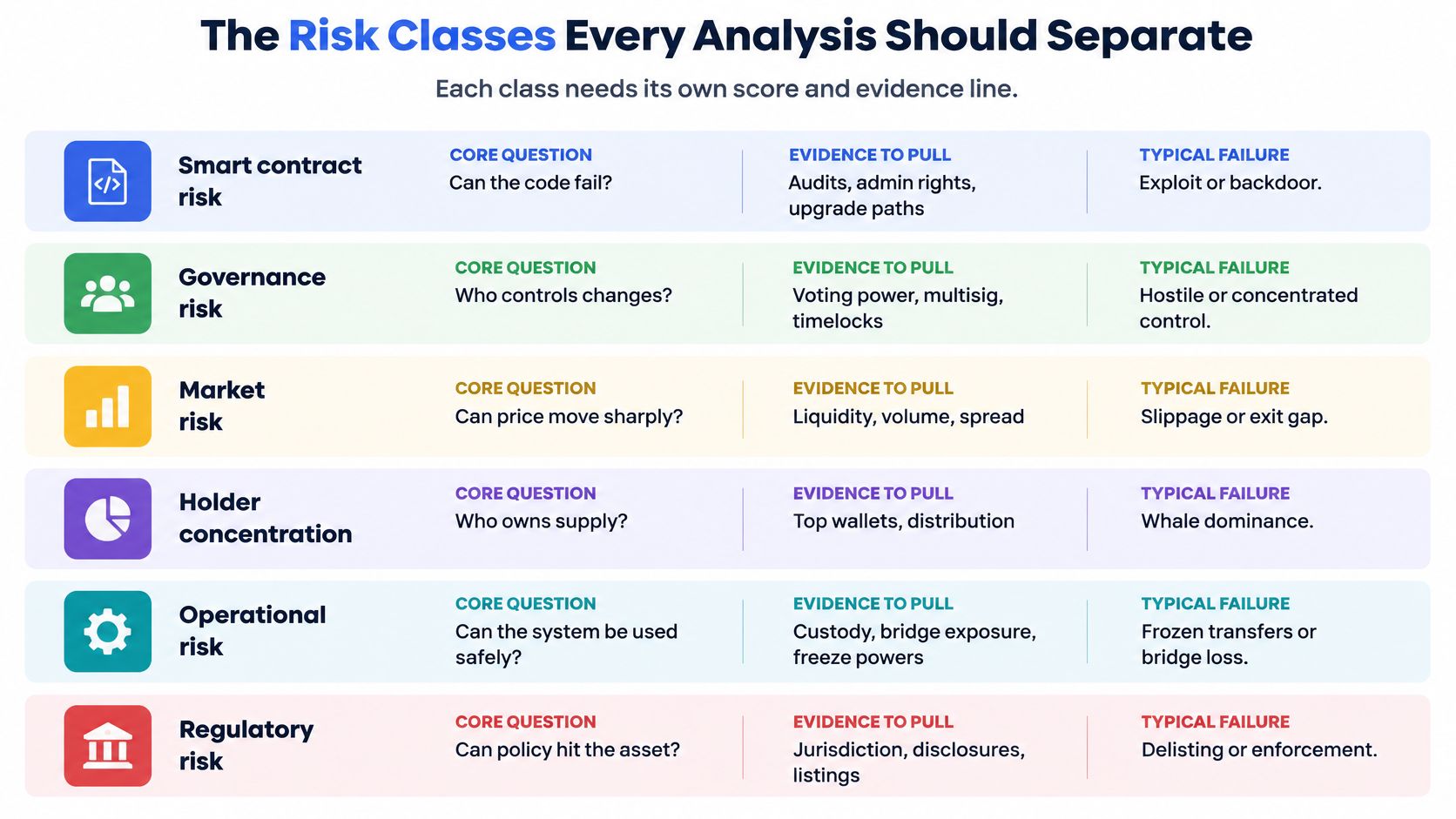
Six risk classes, the question each answers and the evidence to pull
| Risk class | Core question | Evidence to pull | Typical failure |
|---|---|---|---|
| Market risk | How far can price move against a position? | Volatility, drawdown, recent price range | Sharp drop on thin trading volume |
| Custody and key risk | Who controls the assets and the keys? | Mint and freeze authorities, admin keys, multisig setup | Compromised key or privileged account enables unauthorized changes or transfers |
| Contract and protocol risk | Can the code or permissions be changed against holders? | Upgrade authority, transfer restrictions, sell-blocking tests | Holders can buy but cannot sell |
| Liquidity risk | Can a position exit at a fair price and size? | Pool depth, price impact, liquidity-provider lock status | Liquidity removed in a transaction |
| Concentration risk | How much supply can a few wallets move? | Top-holder share, linked wallet clusters | A large holder overwhelms available buyers |
| Fraud and behavioral risk | Is observed activity genuine or manufactured? | Wash-trade patterns, creator history, repeat counterparties | High volume without growth in independent buyers |
Each class needs its own rating and evidence line. Use descriptive ratings such as lower concern, increased concern, critical, or unknown, with an explanation of what each means.
The broader crypto crime picture also extends beyond investment deception: TRM Labs attributed 33% of illicit cryptocurrency volume in 2024 to sanctions-related activity, compared with 24% to scams and fraud. These are shares of illicit volume, not probabilities that a particular token is dangerous.
Separate controls from outcomes
A token might trade within a narrow recent range while a privileged account retains the ability to freeze transfers. Its observed market behavior could look calm even though its control structure remains unacceptable.
Likewise, concentrated ownership doesn't establish fraud. It establishes that a small group can influence execution conditions. Whether those holders intend to deceive buyers is a different question requiring different evidence.
This distinction separates fraud risk from adverse market structure. A launch can be technically functional and accurately described while still leaving later buyers exposed to early holders with much better entry prices and greater selling power.
The diagram offers another way to group overlapping technical, governance, operational, and market exposures.
Don't average away a critical failure
Choose a classification scheme and use it consistently. Some analysts separate governance and regulatory exposure into additional categories; others record them within control and operational evidence.
What matters is that a serious failure remains visible. A passing market assessment shouldn't cancel an active transfer restriction, and transparent communications shouldn't compensate for an unusable exit.
A blended score can summarize findings, but it can't explain which failure would hurt you.
Liquidity Checks That Show Whether You Can Exit
A token can post a healthy chart and still be nearly impossible to leave. The headline pool value tells you what has been deposited, not what your position will fetch on the way out, so start by requesting executable quotes for your intended size.
For a price-manipulation stress test, pick two illustrative levels, here 5% and 20%, and estimate the buy size required to push the marginal price to each. Thresholds of this kind matter because manipulated prices can distort on-chain valuations, a problem the BIS discussion of oracle and price-feed risk examines in detail. Then run the equivalent sell-side test, because upward price sensitivity says nothing about how your exit will execute.
Compare the required capital with your planned position, recent traded value, and large holders' inventory valued in the same quote currency. A dollar buy requirement and a token balance measure different things.
Measure depth at your size
Price impact is the change caused by your own trade against available liquidity. Slippage is the difference between the quoted execution and the execution you receive, which can also reflect intervening trades and transaction ordering. The two overlap, but conflating them hides whether a poor fill came from shallow depth or from timing.
Liquidity checks, how to calculate them and what the readings mean
| Check | How to calculate | Healthy reading | Warning reading |
|---|---|---|---|
| Price impact at the smaller stress level | Quote progressively larger buys and sells until the chosen price move occurs | Required trade size comfortably exceeds your intended position | Your position alone approaches the stress level |
| Price impact at the larger stress level | Compare required capital with large-holder inventory valued in quote currency | Depth remains substantial relative to plausible holder selling | A large holder could overwhelm the available depth |
| Liquidity-to-volume ratio | Pool value divided by daily trading volume | Depth supports intended trades and persists during activity | Heavy turnover runs through shallow or shrinking reserves |
| LP lock status | Verify the locked share, beneficiary, unlock time, and relevant pool | Material removable liquidity is verifiably restricted beyond your holding horizon | Creator can remove material liquidity during your holding period |
| Cross-venue price spread | Compare executable quotes for matching sizes at the same time | Quotes broadly agree after fees and routing costs | Persistent disagreement or a usable exit exists only on a thin venue |
| Realized slippage | Compare actual execution with the quote captured before submission | Execution remains within your predefined cost allowance | Execution breaches the allowance or differs materially from the quote |
These are position-calibrated rules, not universal safety cutoffs. A pool works like a doorway: one that feels wide for a small purchase can be too narrow for a larger position trying to leave at once.
A Solana liquidity checker can organize the pool evidence for you, after which you verify material lock and authority claims against the underlying on-chain accounts. A lock badge alone doesn't establish that all relevant liquidity is protected.
Read mixed results conservatively
Suppose a token has verifiable liquidity restrictions but poor sell-side depth. That supports a narrow conclusion: the checked liquidity may be harder to withdraw, but selling your position could still move the price severely.
A favorable liquidity-to-volume ratio also needs context. Quiet trading can make it look strong without demonstrating active buyers, while manufactured turnover can make it look weak.
Set your maximum acceptable execution cost before requesting quotes. Raising the allowance because an attractive trade fails the test defeats the purpose.
Run executable depth tests first, verify liquidity control next, and compare venues afterward. Refresh the readings at the decision point rather than relying on a dashboard captured earlier.
Concentration and Trading Pattern Metrics to Calculate
Chainalysis estimated up to $2.57 billion in suspected wash-trading volume across Ethereum, BNB Smart Chain, and Base in 2024. That estimate is an upper bound from potentially overlapping detection methods on selected chains, not a prevalence rate for Solana.
The useful lesson is methodological: gross volume isn't the same as independent demand. Repeated buying and selling among related participants can generate turnover without a comparable change in economic ownership.
Calculate ownership before interpreting activity
Begin with raw balances, then identify pools, burn addresses, custody accounts, and other special-purpose holders. Keep exclusions documented so the denominator doesn't change between reports.
Concentration and trading pattern metrics with concern levels
| Metric | Calculation | Concern level | Why it matters |
|---|---|---|---|
| Top-10 holder share | Balance of the ten largest non-pool wallets divided by total supply | Elevated when their plausible selling exceeds executable depth | Shows how much supply a small group can sell |
| Largest single wallet share | Largest non-pool balance divided by total supply | Critical when that wallet can overwhelm your exit venue | A holder can dominate exit pricing |
| Funded-buyer ratio | Unique buyers funded from outside the identified trade cluster divided by all unique buyers | Greater concern when apparently independent funding declines | Helps distinguish independent demand from recycled wallets |
| Repeat counterparty rate | Trades attributable to recurring economic wallet pairs divided by observed trades | Elevated when repetition combines with circular transfers and little net inventory change | Identifies activity worth investigating for coordination |
| Buy-sell imbalance | Buy value minus sell value, divided by total traded value | Concerning when persistent one-sided flow conflicts with holder and reserve changes | Tests whether the apparent demand story matches settlement |
| Early same-block entries | Linked-wallet buys in the launch block divided by all buys in that block | Elevated when linked early buyers hold inventory large relative to exit depth | Exposes potentially coordinated entry advantages |
Numerical ownership bands can help organize a personal screening policy, but they shouldn't be presented as universal fraud thresholds. The more useful threshold is selling power relative to available liquidity.
A holder-concentration assessment should therefore connect wallet balances to executable exits, not stop at the ownership percentage.
Test the relationships behind the trades
On a decentralized exchange, many trades share the same pool or router. That doesn't mean the traders share ownership, so repeated pool interactions aren't a valid substitute for identifying economic counterparties.
Trace funding sources, transfer destinations, timing, and inventory changes together. Shared exchange funding or coincident timing can have innocent explanations; describe related-wallet labels as suspected unless stronger evidence establishes control.
For a stress test, recalculate:
- Adjusted turnover: Remove suspected circular trades and recompute traded value relative to the same supply valuation.
- Adjusted imbalance: Recalculate buy and sell flow after those exclusions.
- Independent accumulation: Check whether externally funded participants retain more tokens across successive observations.
Say a token ranks highly by gross volume, but independent buyer counts stay flat and the same participants repeatedly reverse positions. Its liquidity-quality assessment should weaken, even if the headline activity looks impressive.
That's evidence against treating turnover as organic demand. It isn't, by itself, proof that every participant is fraudulent.
Qualitative Signals Numbers Cannot Capture
A clean contract check doesn't establish that a token is safe. Someone still controls operational keys, publishes claims, coordinates promotion, or holds inventory that can be sold into later buyers.
Chainalysis reported approximately $2.2 billion stolen from crypto services in 2024, with private-key compromises accounting for 43.8% of stolen cryptocurrency. Key security belongs in the main assessment, not a technical footnote.
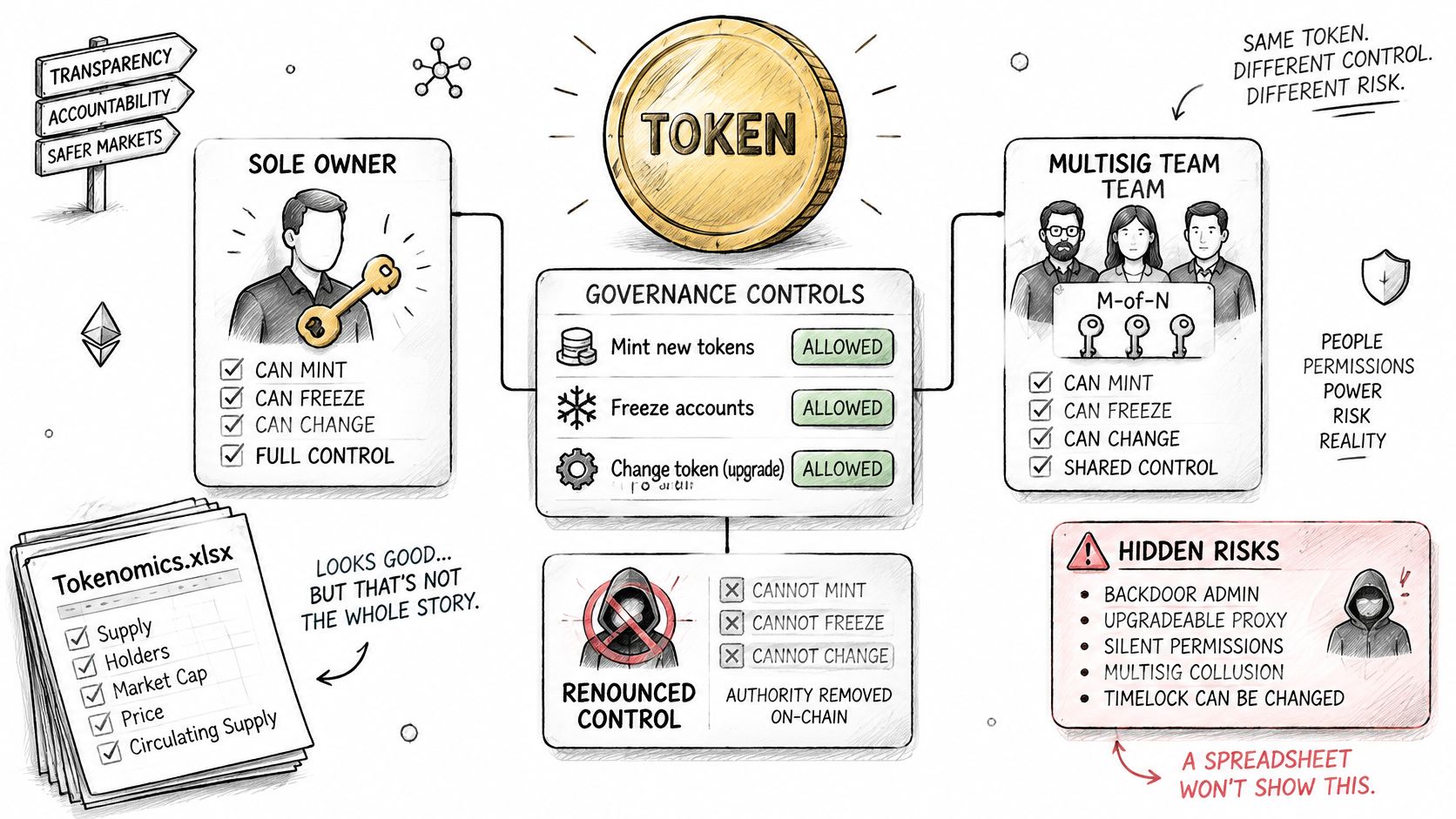
Control arrangements provide a useful starting point for the human review.
Ask questions with verifiable answers
| Signal | Question to ask | Stronger answer | Weaker answer |
|---|---|---|---|
| Key control | Who can mint, freeze, upgrade, or move controlled assets? | Verified permissions and documented signer arrangements | An assurance that control was renounced without account-level evidence |
| Creator history | What do linked deployment and funding wallets show? | Traceable prior launches with explained outcomes | Repeated abandoned launches or unexplained transfers from earlier failures |
| Transparency | Can important claims be checked independently? | Documentation matches deployed addresses and actual permissions | Identity claims or audit logos without verifiable supporting material |
| Narrative pressure | Are buyers encouraged to verify before acting? | Risks and promotional relationships are disclosed | Countdown pressure, guaranteed outcomes, or hostility toward questions |
| Upside distribution | Who can sell profitably into later demand? | Entry advantages and allocations are visible | Early linked holders can distribute large inventories into shallow demand |
A multisig means multiple approvals are required, but it doesn't automatically establish independent decision-makers. Renouncing a permission also removes only that permission, not every possible control path.
For transfer restrictions, follow a Solana honeypot-checking procedure that examines the actual token and execution path. A successful tiny sale doesn't establish that a larger sale will execute under changed conditions.
Separate credibility from economic fairness
An identifiable team can still make poor decisions, and anonymous developers can publish verifiable controls. Treat identity as context, not a replacement for evidence.
Likewise, a launch doesn't need to be an outright scam to disadvantage ordinary buyers. Early participants may hold cheaper inventory, better information, or coordinated execution options that later entrants lack.
Use the accompanying video as an additional educational resource, not a substitute for checking the deployed accounts.
Qualitative findings adjust confidence; they don't override a failed quantitative check. Persuasive explanations can clarify an unusual transfer, but they can't create missing liquidity or remove an active freeze permission.
How to Build an Actionable Risk Report Step by Step
A usable risk report supports a specific decision: reject the purchase, wait for better evidence, reduce exposure, or continue evaluating under stated conditions. It shouldn't stop at describing interesting wallet activity.
Capture evidence in decision order
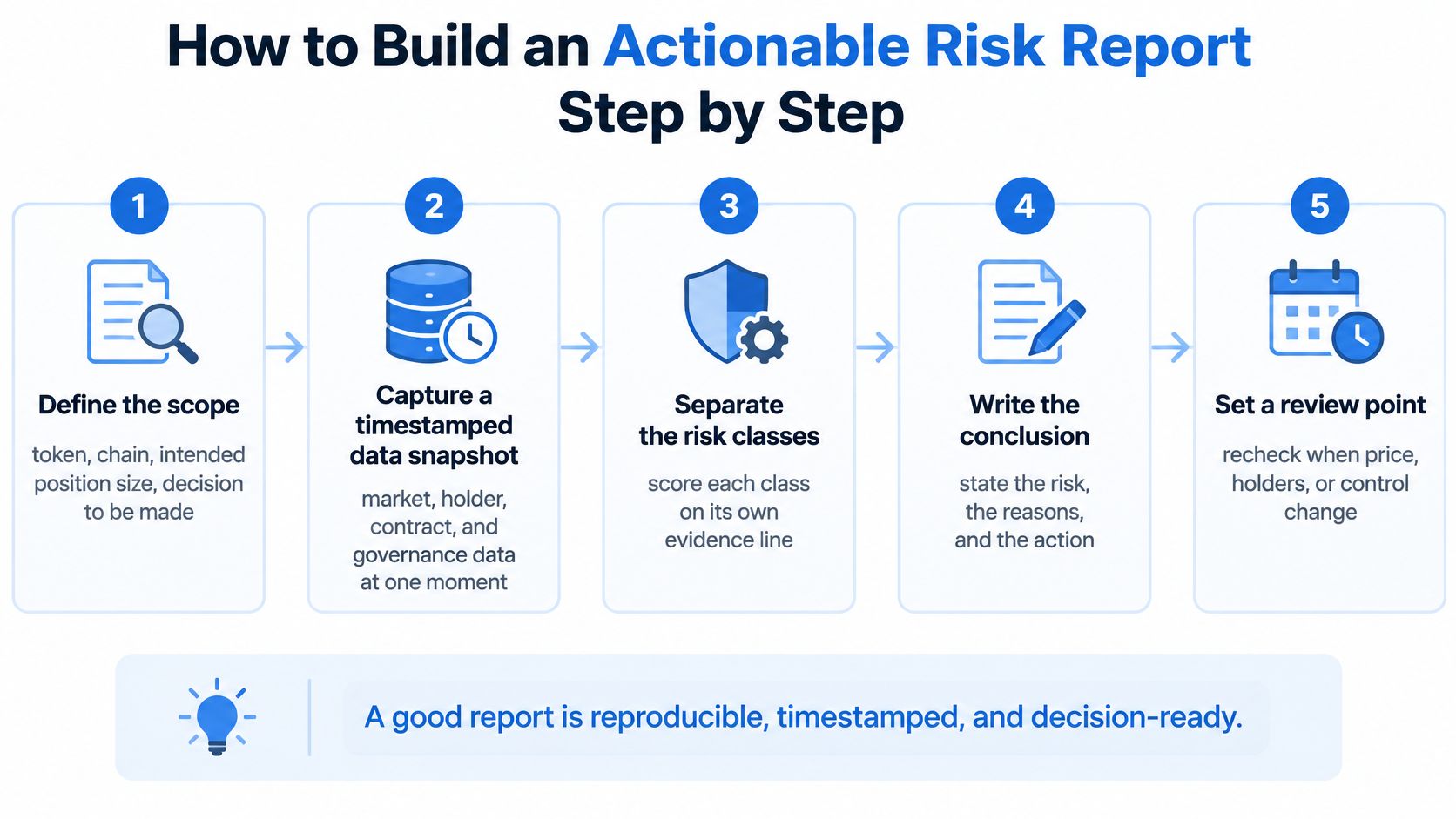
Define the scope. Record the token address, chain, intended position size, holding horizon, and decision being considered. Confirm the address before collecting evidence, because a matching ticker doesn't identify the same asset.
Capture a timestamped snapshot. Save market quotes, pool reserves, holder balances, permissions, and relevant transaction references as close together as practical. Record individual observation times when sources update asynchronously rather than pretending all readings describe an identical moment.
Run the liquidity checks. Store position-sized exit quotes and the smaller and larger price-impact stress tests. Do this before detailed narrative review so an unusable exit doesn't get overlooked after you become interested in the project.
Calculate concentration and trading patterns. Preserve both raw wallet rankings and your adjusted classifications, including suspected related-wallet clusters. Do not remove inconvenient balances without consideration or treat uncertain attribution as established ownership.
Review qualitative evidence. Check authority arrangements, creator history, disclosures, promotion, and early-holder advantages. Separate verified facts, plausible interpretations, and unresolved claims so confidence has an auditable basis.
Rate each class and write the verdict. Use consistent rating definitions, mark missing evidence as unknown, and explain the decisive failure mechanism. Confidence describes evidence quality, not the probability that the price will rise.
Set invalidation triggers and reassessment timing. Record conditions such as material liquidity withdrawal, ownership exceeding your predefined limit, or a relevant authority changing. For a newly launched token, capture an early snapshot and schedule reassessment in minutes rather than treating a daily review as sufficient.
The workflow can be condensed visually, but the report should preserve the underlying evidence.
Use a report layout that exposes uncertainty
| Report field | What to record |
|---|---|
| Verdict | Decision supported by the evidence and its main reason |
| Scope | Token address, chain, position size, intended holding period |
| Class ratings | Separate findings for each risk class, including unknowns |
| Evidence lines | Account addresses, transaction references, quotes, calculations, and exclusions |
| Confidence | Evidence quality, coverage gaps, and attribution uncertainty |
| Invalidation triggers | Observable changes that require a new decision |
| Timestamp and review point | Observation times, next reassessment, and event-based alerts |
A report is decision-ready when another reader can tell what would change its conclusion.
Keep the previous snapshot when you reassess. Comparing snapshots lets you identify whether a rating changed because the token changed, new evidence appeared, or your classification method changed.
Don't describe a later price decline alone as proof that every earlier warning was correct. Evaluation should test the flagged mechanism, such as liquidity withdrawal or concentrated selling, as well as the eventual outcome.
Confirm the Verdict Before You Act
The most expensive misreading is treating lower detected rug risk as permission to ignore everything else. A token can remain transferable and avoid an obvious liquidity removal while its price falls sharply or large holders sell into later demand.
A lower rug pull risk rating from MemeAssist doesn't mean a token is safe, and a higher health score doesn't mean its price will rise. Those are different assessments from a return forecast.
Check the interpretation, not just the number
Common mistakes change the decision in predictable ways:
- Treating one score as the verdict: Open the evidence breakdown and identify the worst unresolved class.
- Ignoring signal decay: Confirm that no material pool, holder, or authority change occurred after the recorded snapshot.
- Extending a contract pass to market risk: Require acceptable execution conditions separately from permission checks.
- Confusing volume with demand: Look for independent accumulation rather than accepting gross turnover as sufficient support.
Proceed only when every material class fits your loss tolerance, unresolved evidence is acceptable to you, and invalidation triggers are written down. If a potentially catastrophic class remains unknown, waiting is a valid conclusion.
A stop-loss order doesn't resolve these uncertainties. Transfer restrictions, depleted liquidity, and abrupt repricing can prevent execution near the intended level.
Choose the depth of review deliberately
Our free scanners are useful for a first check. A full analysis costs $0.20 per token and explains the evidence behind the Overall Health Score, Rug Risk Rating, AI Verdict, and Detailed Risk Breakdown, with a conditional Trade Setup when the token's current price structure supports one.
Conditional scenarios aren't trading instructions or guarantees of execution at displayed prices. They provide context for evaluating the observed setup, not certainty about what happens next.
All outputs are informational, not financial advice. Memecoins are extremely risky, and you can lose all invested capital.
Visit MemeAssist to run a first-pass Solana token check or request an explained report built from live on-chain and market evidence. Before making a decision, compare the findings with your intended position size, record the timestamp, and write down the changes that would invalidate your assessment.