Crypto Scam Checker: How to Spot a Scam Before It's Too Late
Use this crypto scam checker guide to spot rug pulls and fraud on Solana. Learn practical steps, live signals, and how to interpret risk reports before you buy.
Published
Updated
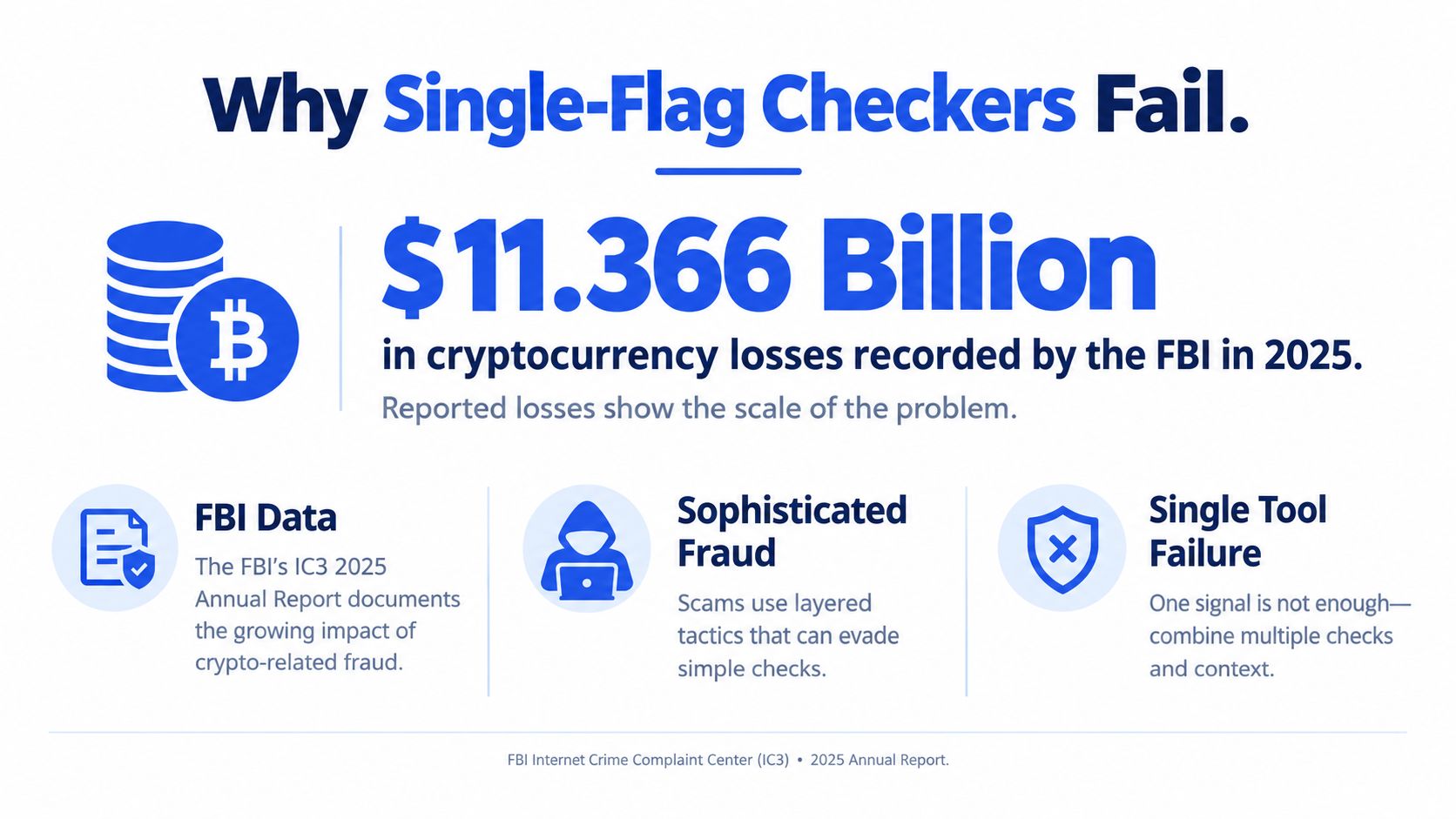
The FBI recorded 181,565 cryptocurrency complaints in 2025, with $11.366 billion in reported losses. That's why a crypto scam checker matters now, because the cost of missing one bad token can be immediate and brutal.
A lot of traders still trust a single flag, a blacklisted address, or a contract note that says “looks fine.” That approach feels fast, but meme-coin fraud keeps moving, and the only checks that matter are the ones that combine wallet behavior, liquidity shifts, holder concentration, and trading patterns in real time.
Table of Contents
- Why Single-Flag Checkers Fail
- Essential On-Chain Checks for Solana Tokens
- Static Audits vs Live Behavioral Analysis
- Reading Risk Reports Like a Pro
- When to Recheck a Token's Safety
Why Single-Flag Checkers Fail
The headline number is hard to ignore, $11.366 billion in reported cryptocurrency losses and 181,565 complaints in 2025, with 18,589 complainants saying they lost more than $100,000 (FBI IC3 2025 report). That's not a market where one warning label can protect you. It's a market where fraud is often layered, delayed, and engineered to look normal until the damage is done.
Static signals miss the way scams actually unfold
A basic checker might catch a known bad contract or a listed scam wallet. That helps, but it doesn't catch a token that starts clean and then turns toxic through insider sells, sudden liquidity removal, or manufactured activity. The FBI data shows the scale of the problem, and that scale is exactly why static logic is too narrow for Solana meme coins.
A better approach is layered and time-aware. You want to see liquidity, holder concentration, creator-linked wallets, trade flow, and pool events together, because one signal alone can mean very different things depending on the token's age and market depth. A thin, volatile launch isn't the same thing as coordinated manipulation.
Practical rule: treat a single red flag as a reason to investigate, not a final verdict.
That matters even more when the market rewards speed. A token can be briefly active, briefly hyped, and already compromised before a one-shot checker updates its opinion. For a useful starting point on the tooling side, see this Solana token checker guide.
Why a layered pipeline is the only sane default
Modern scam behavior doesn't live in one place. Fraudsters can split activity across wallets, use coordinated buys to fake demand, and delay the actual exit until attention peaks. If the report only says “safe” or “unsafe,” it hides the evidence you need to judge whether the token is healthy or just early.
The useful question is not whether a token triggered one rule. It's whether the token shows a pattern that makes the trade look engineered rather than organic. That's the difference between avoiding noise and avoiding the next rug.
Essential On-Chain Checks for Solana Tokens
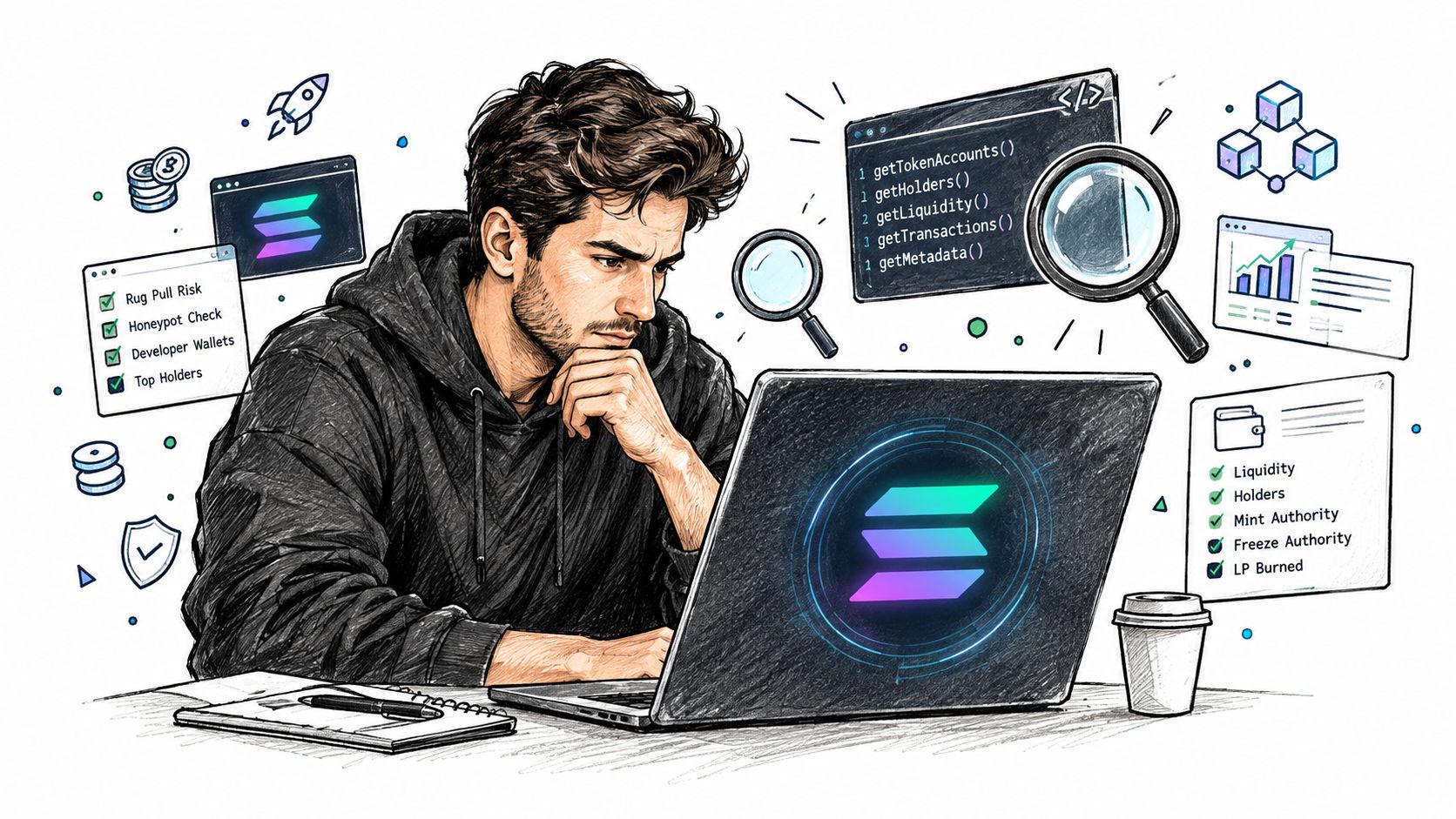
The first thing I look for is control. If mint or freeze authority is still active, the issuer may still be able to expand supply or interfere with trading conditions, and that changes the risk profile before I even think about entry. On Solana, control is not a side note, it's the part that tells you whether the token can still be steered from above.
Follow the wallets, not the hype
Creator-linked wallets and early funders tell you who had access before the crowd arrived. If those wallets cluster together, move in sync, or keep interacting after launch, that's evidence worth slowing down for. I care more about wallet relationships than slogan-heavy community posts, because hype can be manufactured and wallet trails usually can't.
Liquidity ownership comes next. If liquidity is thin, uneven, or easy to withdraw, the token can be made to look alive while still being one decision away from collapse. The important thing is to check who controls the pool and whether withdrawal behavior has already started.
Then I compare activity. Real demand usually comes with a believable relationship between trade volume and unique buyers, unique sellers, and wallet turnover. Fake demand often looks busy but weird, lots of activity, few real participants, and a pattern that smells more like coordination than conviction.
Read the timing, not just the totals
A decent crypto scam checker should preserve timestamped evidence for synchronized buys, bundled launches, rapid creator-linked selling, and sudden volume shifts. That way you can see whether a token is just volatile or actively being shaped by insiders. I've seen too many low-cap tokens look “healthy” on a snapshot and then reveal their real shape only after the first wave of buyers has already entered.
If the report can't show you when the risk appeared, it's not enough for a live meme-coin trade.
The value is in the sequence. Who bought first, who sold into strength, when liquidity changed, and whether the wallet graph shows connected behavior are all more useful than a generic warning badge. For a deeper walkthrough of Solana honeypot-style behavior, use this honeypot check guide.
A useful scan doesn't just say “there's risk.” It shows whether the risk is coming from authority settings, liquidity control, wallet clustering, or suspicious trading patterns, and it keeps those signals separate so you can judge the trade properly.
Static Audits vs Live Behavioral Analysis
A smart contract audit can be clean and still leave you exposed. An audit tells you what the code can do at a moment in time, but it doesn't tell you what the people behind the token will do after launch. That gap is where a lot of meme-coin losses happen.
Code safety and market safety are different problems
If a contract doesn't contain obvious malicious logic, that's useful, but it's not the whole story. Wash trading, coordinated buys, gradual liquidity removal, and insider dumping all happen outside the narrow frame of a code review. A token can pass an audit and still be a bad trade if the market around it is being staged.
That's why I treat audits as one input, not a finish line. The more useful crypto scam checker is the one that keeps watching wallet behavior, pool activity, and trade distribution after launch. If the market shifts from organic to coordinated, the report has to shift with it.
Live behavior catches what code review never will
Live data is what matters here. A token might look boring on a static contract page, but the wallet graph can show accumulation by connected addresses, one-sided liquidity movement, or a rush of sells after a promotional burst. Those are trading conditions, not code defects, and they need a different lens.
The most common mistake is assuming that a verified contract means a safe token. It doesn't. It only means the contract is less likely to hide one class of threat, while the market can still be manipulated in plain sight.
How MemeAssist analyzes Solana tokens fits this exact distinction because the useful part isn't the label, it's the combination of live evidence and a readable explanation.
Analyst rule: trust the report that tells you what changed, not the one that only tells you what exists.
For Solana meme coins, behavior beats reputation every time. You need to know whether the token is being traded by a real crowd or by a small set of wallets with shared intent.
Reading Risk Reports Like a Pro
A good report should make you think more clearly, not less. If it only gives you a score, you're still doing the hard work in your head, and you may miss the evidence that actually matters. The best read combines a summary verdict with the underlying checks so you can decide whether the risk is obvious, ambiguous, or probably a false alarm.
Use the score as a starting point, not a command
An Overall Health Score or Rug Risk Rating is useful only if you also read the reason behind it. A low score can come from concentrated ownership, thin liquidity, or creator-linked activity, but those signals don't always mean the same thing. A very new token can look unstable without being fraudulent, while a token with clean-looking promotion can still hide a coordinated exit plan.
That's why the plain-English explanation matters. A verdict should tell you which evidence is strong, which is weak, and which checks are still inconclusive. Without that context, a number becomes a shortcut to overconfidence.
Ask what the report can't see
A report that only covers on-chain behavior won't fully capture impersonation campaigns, fake support, or social manipulation. That's not a flaw if it's clearly explained. It becomes a problem only when the tool implies total safety and leaves users thinking the token is approved.
MemeAssist is one example of a tool that pairs live Solana checks with an Overall Health Score, a Rug Risk Rating, an AI Verdict, and a Detailed Risk Breakdown, so the output isn't just a number. The point of a setup like that is to show the evidence, not hide it behind a label.
Here's the right way to read a result:
- Look for timestamps first. Fresh wallet movement matters more than a stale snapshot.
- Check evidence strength. A high-risk signal with weak supporting data deserves caution, not panic.
- Separate token risk from off-chain scam risk. A token can be technically live and still sit inside a broader fraud campaign.
- Watch for missing context. If the report can't explain why a signal is present, don't treat it as settled.
The best reports help you answer one question, not “Is this safe?” but “What exactly is risky here, and how sure is the tool about it?” That's the level you need before pressing buy.
When to Recheck a Token's Safety
A clean scan doesn't stay clean forever. Liquidity can move, holders can rotate, and a token that looked harmless at noon can look very different by evening. Meme-coin risk is time-sensitive, so the biggest mistake is treating a one-time result like permanent approval.
The validity window is shorter than most traders think
I recheck anytime the market structure changes enough to matter. A sharp price swing, a major holder transfer, a creator-wallet move, or a sudden change in volume can invalidate the old read even if the contract itself hasn't changed. That's not paranoia, it's respecting how fast these launches can shift.
The most dangerous assumption is “nothing bad showed up, so it must be fine.” A quiet token can still be the setup phase for an exit, and a busy token can still be fake activity. Historical evidence tells you what happened, live conditions tell you what's happening now, and the second one always deserves more weight.
Recheck triggers that should be non-negotiable
Use a fresh check when any of these happen:
- Liquidity changes sharply, especially if the pool looks thinner than before.
- Large holder transfers appear, because insider distribution often starts discreetly.
- Creator-linked wallets become active, which can mean the team is changing posture.
- Volume spikes without buyer growth, a common sign of manufactured activity.
- Selling accelerates after a promotion burst, since hype can mask an organized exit.
That approach keeps your process honest. It also stops you from confusing survival with safety. A token that hasn't rugged yet isn't automatically safe, it may just be waiting for the right moment.
A result is only valid for the market conditions it describes.
The right habit is simple, check before entry, then recheck when the token changes shape. That's how you keep a crypto scam checker useful instead of letting it become a stale screenshot.
If you trade Solana meme coins seriously, use MemeAssist to screen live token behavior before you buy, then recheck when liquidity, holders, or creator wallets change. It's built for the exact problem this article covers, turning on-chain evidence into a readable risk report so you can move faster without guessing.