Crypto Token Scanner Guide: What Each Check Really Means
A friend drops a contract address in your group chat. The token is up 300% in an hour, the chart is one unbroken green candle, and a scanner link in the thread shows a health score of 82. You have about sixty seconds to decide whether to send money.
That page did something specific and limited. It took a Solana token address, pulled the on-chain and market data attached to it at that moment, and turned that data into signals. It didn't decide whether the token is a good buy, and it can't. What it produced is evidence, and reading evidence well is a skill you can pick up in an afternoon.
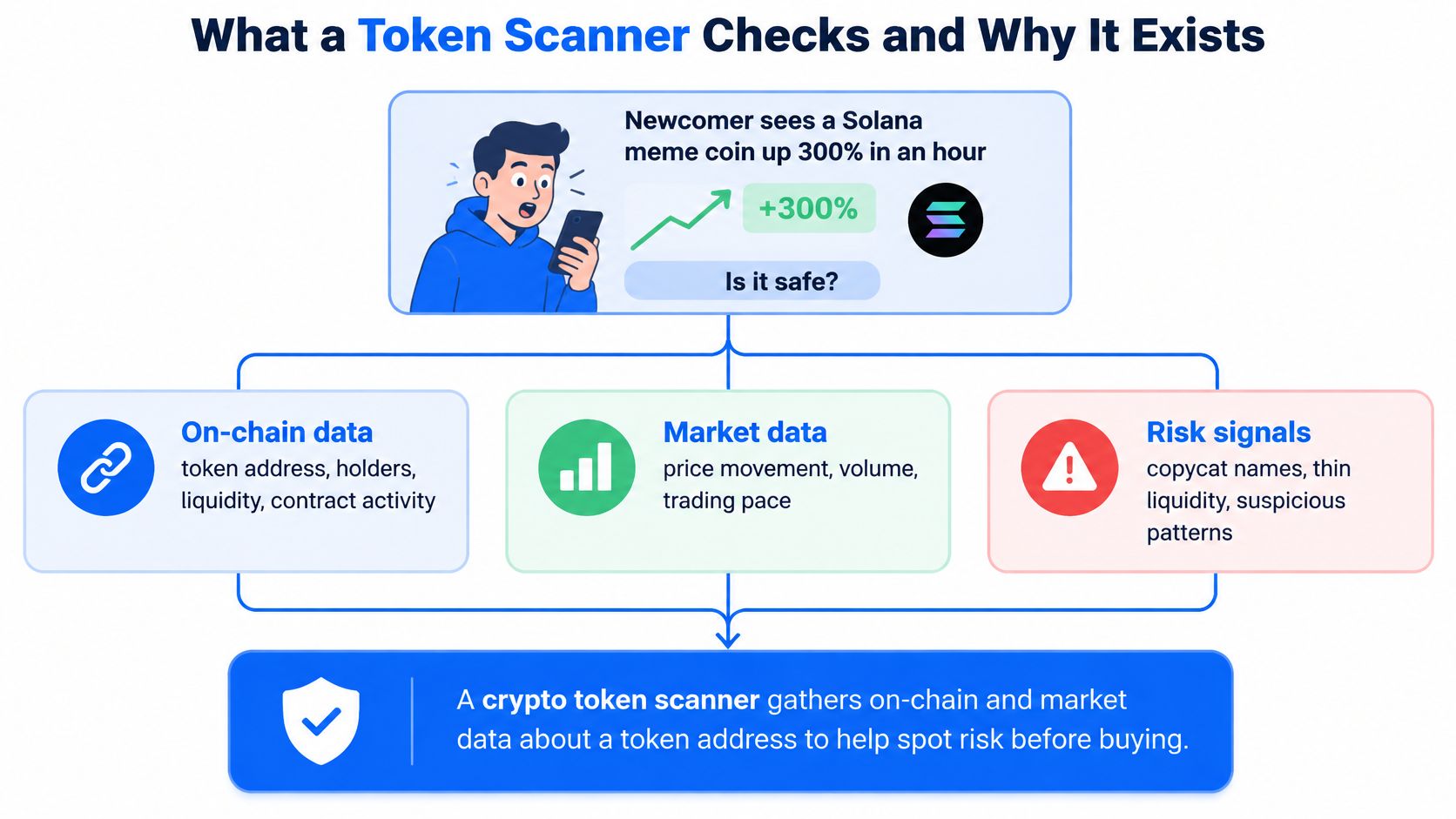
Table of Contents
- What a Token Scanner Checks and Why It Exists
- Interpreting Risk Scores and Warning Signals
- Reading Holder Concentration Beyond the Top Ten
- Real Solana Patterns Scanners Catch
- How to Run a Token Check Before You Buy
- Why a Clean Scan Does Not Guarantee Safety
- Confirm the Check Before You Buy
What a Token Scanner Checks and Why It Exists
Two Kinds of Risk Behind the Headlines
Token scanners exist because crypto losses stopped looking like rare accidents. Funds stolen from cryptocurrency platforms reached approximately $2.2 billion in 2024, a 21% increase from about $1.8 billion in 2023, according to Chainalysis research on stolen funds. Individual hacking incidents rose from 282 to 303, and stolen funds exceeded $1 billion for the fourth consecutive year.
Read those numbers carefully, because they describe platform-level theft more than they describe one meme coin. Private-key compromises accounted for 43.8% of stolen crypto in 2024, including more than $305 million from Japan's DMM Bitcoin in May and $235 million from India's WazirX in July. No token scanner catches a compromised exchange key.
The closer reason to screen a token before buying sits in the fraud numbers. The FBI's Internet Crime Complaint Center logged 41,557 cryptocurrency investment-scam complaints in 2024, up 29% from 32,094 in 2023, with reported losses around $5.7 billion, a 47% increase, per the IC3 2024 annual report. Those complaints cover U.S. victims, so they undercount the global picture rather than inflate it.
The Seven Things a Scanner Reads
A useful scanner works in categories instead of one magic number. Each category answers a different question, and each can be gamed on its own.
| Check | What the scanner examines | Red-flag example |
|---|---|---|
| Liquidity | Pool depth, lock status and whether liquidity can be withdrawn | A thin pool that a few wallets could empty |
| Holder distribution | Share of supply held by the largest wallets | One wallet holding most of the supply |
| Creator behaviour | Creator wallet history, transfers and past launches | A creator who launched several tokens that later collapsed |
| Wallet activity | New wallets, funding sources and transfers between them | Many fresh wallets funded from the same source |
| Trading patterns | Buy and sell volume, bundled buys and wash trading | Volume that loops back to the same few wallets |
| Contract control | Mint authority, freeze authority and whether a sell can complete | A creator who can mint more supply or block sells |
| Historical risk indicators | Similarity to previously observed risky token behaviour | A launch pattern that matches past rug pulls |
Contract control earns its own row because it can override everything above it. If mint authority is still held, the creator can issue more supply and dilute you mid-trade. If freeze authority is live, your sell can be blocked while you watch the price slide.
The rule that matters: a scanner reads the evidence. You decide what that evidence means for the size of your position.
No score removes market risk, contract risk or plain bad timing. What a consolidated scan does is cut the twenty minutes you'd spend hopping between explorers, liquidity dashboards and wallet trackers down to one reviewable page.
Interpreting Risk Scores and Warning Signals
A score is a compression. Dozens of data points and a timeline get folded into a single number, a rating and a sentence of plain English. That's useful when a chart is moving and you need a fast read. It's dangerous when you treat the number as the conclusion rather than the opening line.
Typical scanner output has four layers: an overall health score, a rug risk rating, a plain-language verdict, and a detailed breakdown listing what each check found. The first three are summaries written for speed. The fourth is the part you argue with, because it tells you which category dragged the score down.
What a High Risk Rating Really Says
A high rating means evidence clustered across risky categories, not that the tool caught a crime in progress. Two tokens can land on the same score for opposite reasons. One might have a clean creator history and terrible liquidity. Another might have deep liquidity and a creator wallet that has already sold.
That distinction decides your response. Thin liquidity is a size problem, so you trade smaller or skip. Insider supply is an exit problem, so position size won't save you. Reading the breakdown turns a vague worry into a specific decision.
Read the headline number second. Read the category that moved it first.
The Signal Table
| Signal | What it may mean | Check next |
|---|---|---|
| One wallet holds more than half of supply | Single point of control that could sell into buyers | Confirm whether it is a team, locked or exchange wallet |
| Liquidity pool small relative to market cap | Large sells can move the price sharply | Check whether liquidity is locked and for how long |
| Few wallets account for most buy volume | Volume may be artificial or looped | Compare unique buyers with repeat wallets |
| New wallets funded from one source | Possible coordinated accounts | Trace funding transfers back a few hops |
| Creator wallet sold early | Insider exit risk | Review the creator's history and past tokens |
| High health score but moderate rug risk | Mixed evidence across categories | Read the breakdown to find the weak category |
The last row is the one that trips up experienced traders. A token can score well on market structure and still carry a moderate rug rating, and the gap between those two labels is where the information lives.
A single signal rarely settles anything. A concentrated wallet that is a locked team allocation with a published vesting schedule is a different animal from the same percentage sitting freely in a wallet created yesterday. Weight the signal by what you can verify about it.
Finally, be honest about the warnings you can't resolve. If you can't tell whether two wallets are related, or whether a lock is real, write that down as an open question and let it affect your size. Uncertainty you've named is manageable. Uncertainty you've ignored isn't.
Reading Holder Concentration Beyond the Top Ten
Think about a concert. From the stage, the front two rows look like a crowd of independent fans. They're not. They arrived together, on one bus, with tickets bought in a single transaction, and they'll leave together the moment the lights come up.
Holder lists behave the same way. The basic metric is simple: what percentage of supply sits in the largest wallets. A token whose top ten holders each sit at 2% looks decentralized at a glance. But ten addresses prove nothing about ten owners, because one person can control all ten.
The scale of that gap shows up in the data. Research on Solana memecoin trading found that coordinated accounts held an average of 36.5% of token supply across a dataset covering more than 41,000 launches and 200 million transactions, as detailed in this study of Solana memecoin launch behaviour. Apparent decentralization weakens considerably once related wallets are analyzed as a group.
Ordinary Concentration Versus Coordinated Control
Not all concentration is sinister, and treating it that way will make you skip good tokens.
- Team and treasury wallets hold supply on purpose, often with a vesting or lock schedule you can verify on-chain.
- Exchange and bridge wallets pool user funds, so a large balance tells you nothing about intent.
- Liquidity positions show up as large holders in some trackers even though they aren't sell pressure in the usual sense.
- Coordinated clusters look different. They're funded from one source, buy in the same block and move tokens between freshly created addresses.
The practical test is funding, not percentage. Open the top holders and ask where their SOL came from and when they first bought. Wallets funded from the same address within minutes of each other, buying at the same price tier, are one economic actor wearing several masks.
Our own distribution check looks at concentration and at whether the available data suggests connections between wallets, which is the distinction that matters here.
On a launchpad, this gets sharper. Insiders can accumulate cheap at early tiers, sit through the public buying, and sell into the liquidity after migration to a deeper pool. A static snapshot taken at launch will understate that exit risk, because the wallets still look separate and the selling hasn't started.
Ask it every time: are these top holders genuinely independent, or are they one insider group?
Real Solana Patterns Scanners Catch
The base rate on Solana launchpads is bleak. A 2025 Solidus Labs study reported that nearly 99% of memecoin launches on Solana's Pump.fun were rug pulls or pump-and-dump schemes, as reported by The Defiant on the Solidus Labs findings.
Hold that figure at arm's length for a second. It covers one launchpad during one studied period. It says nothing directly about a token trading on a different venue or an established pair with months of history. What it does tell you is the prior: on that platform, during that window, the default outcome was extraction.
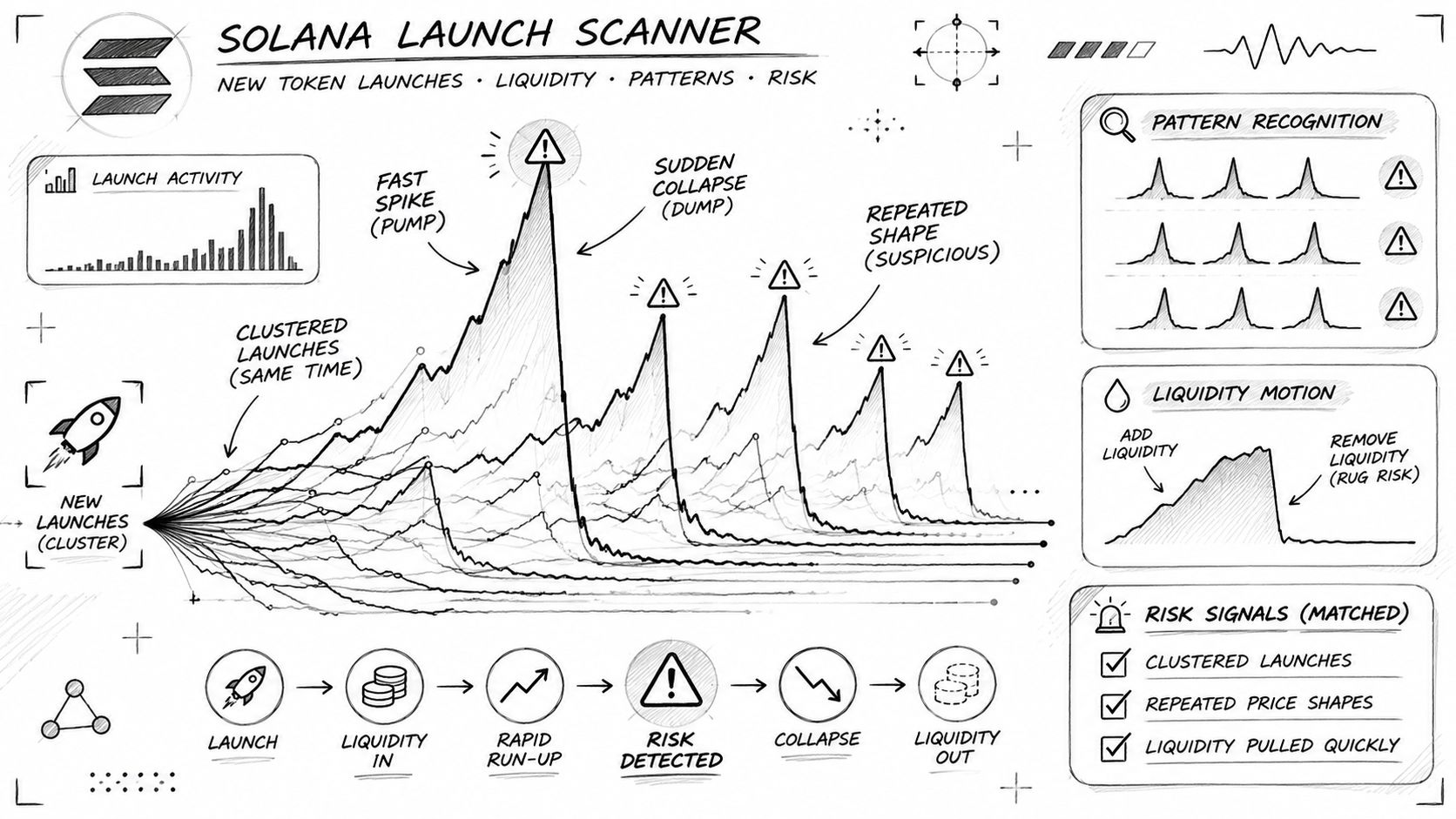
Four Traces a Live Scan Can Place on a Timeline
A scanner is most useful when it hands you a sequence of events rather than a label. These are the traces worth learning to spot on your own.
- The supply trace. The largest wallets appear within minutes of creation, or a cluster of fresh addresses gets funded from one source before public buying begins. If insiders already hold the float, you're buying their exit.
- The creator trace. The creator wallet has almost no history, or has launched tokens that went quiet soon after. Then it moves tokens out shortly after migration into a deeper pool.
- The trade trace. Buys land in the same block, volume cycles through a handful of wallets, and those same wallets sell in a burst once the price lifts.
- The liquidity trace. The pool is thin relative to the pace of the advertised gains, or liquidity sits unsecured and can be pulled rather than time-locked.
Two or more traces matching is a reason to slow down, not a conviction. Plenty of tokens match one trace for boring reasons, like a small launch where everyone is early.
A resolved trace in practice looks like this. Our public dated report on the token dog shows it was flagged when a single wallet held 79% of supply on 29 July 2026, and its price changed −69.3% over the following 24 hours. That's a supply trace with a stopwatch attached.
Historical indicators work the same way, by comparison rather than prophecy. We compare each launch against patterns from thousands of tokens analyzed before it, which is how a shape you've never seen can still read as familiar.
The habit to build is time-stamping. When did the concentration appear, when did the creator move funds, when did volume change character? A trace with a timestamp tells you where you are in the sequence. A trace without one is just a suspicion.
How to Run a Token Check Before You Buy
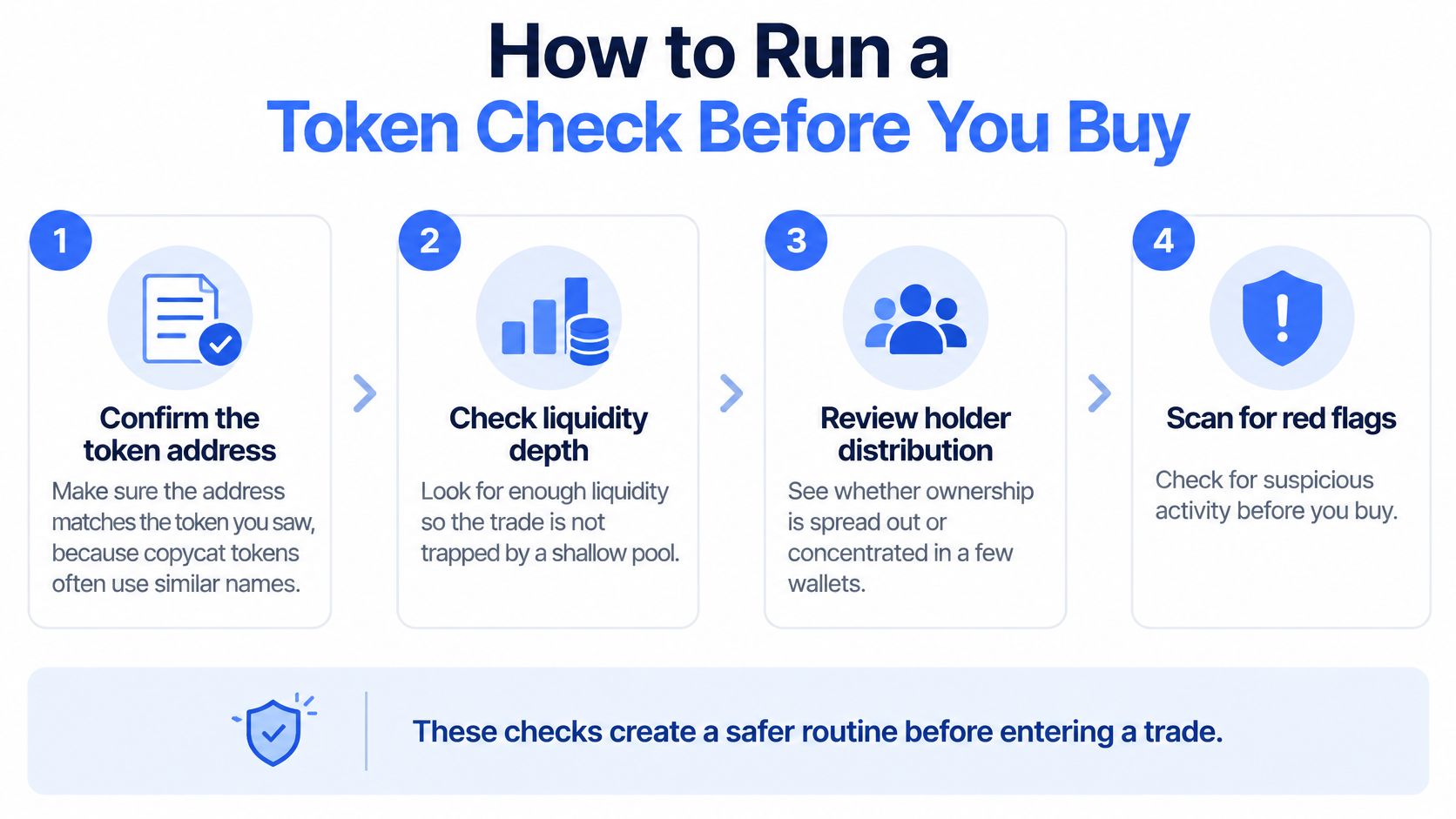
A check is a routine, not a moment. Run it in the same order every time and it takes about five minutes on a token you're considering.
- Confirm the address matches the token you saw. Copy it from the source you used, not from a reply. Copycats reuse names and logos within minutes of a launch, and the only reliable identifier is the contract address.
- Check liquidity depth and lock status. Look at how much is in the pool and whether it's locked, and for how long. A pool small relative to market cap means your exit can move the price against you.
- Review holder distribution and look for links. Focus on whether the largest wallets appear connected, not just how big they are. The common slip here is checking the top ten percentages and stopping.
- Read the creator's wallet history. Look at previous launches and whether funds left the creator wallet after the last one. A creator with a short history and a token that went quiet is a pattern, not a coincidence.
- Check contract control before you go further. Confirm whether mint authority or freeze authority is still held, and whether a sell can complete at all. An attractive holder list means nothing if the creator can mint unlimited supply or block your exit. A blocked sell is a stop, not another line in the score.
- Examine trading patterns. Compare unique buyers against repeat wallets, and note whether volume arrived in one burst or built gradually. Volume that loops back to the same few addresses inflates confidence without adding demand.
- Read the historical indicators and the verdict against the breakdown. Where the summary and the details disagree, trust the details.
- Size the position as if the scan is wrong. Decide before you buy what would make you leave, and pick a size you can hold through a fast drawdown. That's the step many skip, and it's the only one that survives a bad scan.
The most common mistake isn't skipping a step. It's running the whole routine once, at launch, and treating the result as final. Conditions change after a large price move: liquidity gets pulled, big wallets start distributing, and the volume character shifts within minutes.
Re-check after the first big move, not just before the first buy.
Why a Clean Scan Does Not Guarantee Safety
A token can pass a scan at launch and still become risky before you finish assessing it. A score is a snapshot of available evidence, not a promise about what happens next.
Research on Solana rug pulls identified 76,469 of 100,063 tokens issued on major decentralized exchanges during the first half of 2025 as rug pulls, according to this study on Solana rug-pull detection. In a manually audited sample, the estimated false-positive rate was 0.26%. That figure applies to the audited sample only. It does not mean a live score is 99.74% accurate.
Risk signals can emerge quickly after trading begins. Creator transfers, newly connected wallets, liquidity changes, and insider selling may appear after an initial scan. A clean result can therefore become outdated as the evidence changes.
The Question Almost Nobody Asks
What happened to tokens that were flagged yesterday?
A warning is more useful when you can compare it with what happened afterward. Did the price fall, did the concern remain unresolved, or did the token continue trading? Tracking outcomes helps distinguish a signal that predicts risk from one that merely describes a moment. MemeAssist compares its signals with subsequent trading activity and observed token outcomes to evaluate their reliability.
| Common belief | What the evidence shows |
|---|---|
| A clean scan means the token is safe | A token can pass checks and still collapse if demand disappears or large holders sell |
| A one-time scan at launch is enough | New evidence can change the risk picture, so a scan is only a snapshot |
| A low risk score means a profit is likely | Scores summarize available evidence, not future price, and can be wrong |
| A warning always proves a scam | Warnings are signals to assess, and their reliability depends on outcomes |
A token may pass every check and still collapse when demand fades, large holders sell, liquidity changes, or new information emerges. A report cannot prevent those events. Nor does a warning, by itself, prove that a token is fraudulent.
Treat a scanner like a weather forecast: useful for deciding what to watch, but not a guarantee of what comes next. Its score matters most when you understand the evidence behind it and keep in mind that conditions can change.
Confirm the Check Before You Buy
Before acting on a scan, confirm that you checked the right token. Match its contract address to the source where you found it; every later result depends on that first step.
Then ask whether the report shows evidence behind its warnings. A risk label is easier to judge when you can see the relevant checks, such as liquidity, holder distribution, creator behaviour and trading activity. Prefer data captured at the time of analysis, since token conditions can change.
Outcome tracking adds another useful test. When a tool follows flagged tokens and compares its signals with what happens next, you can judge warnings against subsequent activity rather than treating them as proof.
Free checks are useful for a first pass on contract control, liquidity and sell access. MemeAssist offers free tools including Contract Checker, Liquidity Checker, Honeypot Checker, Rug Checker, Risk Score, Market Radar, Live Rankings, Trending Tokens, Token Directory, Recent Analyses and Risk Watchlist. They give you a useful first pass on contract control, liquidity and sell access, though a clean first pass still leaves the deeper evidence to check.
For a token that still merits consideration, a full analysis explains its health score and rug risk, with a detailed risk breakdown and an AI verdict. A full token analysis with a conditional Trade Setup costs $0.20. The report is automated; the people named on MemeAssist's about page should not be understood to have individually reviewed or approved it.
Run the free checks first. If you would still consider the token, review the full report and size any position with the possibility of a wrong scan in mind.
A crypto token scanner gives you evidence to interpret, not a verdict to obey. MemeAssist generates reports from live Solana on-chain and market data, combining an Overall Health Score, Rug Risk Rating, AI Verdict and Detailed Risk Breakdown. Its 24-hour tracking compares flagged tokens with subsequent trading activity. Start with a free check, then use a full analysis when you need more context before deciding whether to buy. MemeAssist offers a way to check a token before acting, without treating a scan as a guarantee of safety.
Topics: crypto token scanner, Solana token check, rug pull detection, token due diligence, meme coin safety
Informational only, not financial advice. Meme coins are extremely high-risk.
All articles