Crypto Trading Platform Comparison: Fees, Custody, Safety
The usual advice for choosing a crypto trading platform starts with fees, supported coins, and ease of use. That's an incomplete comparison. A cheap-looking platform can deliver expensive fills, while a well-run venue can still give you access to a token you can't sell without a severe loss.
A better decision separates execution cost, custody risk, and token risk. Compare what you'll pay to enter and exit, establish who controls your assets, and test whether the market can absorb your position. None of those checks substitutes for the others.
Table of Contents
- Major Crypto Trading Platforms at a Glance
- Major Crypto Trading Platforms Compared Side by Side
- What a Trade Really Costs on Each Platform
- Custody Models and What Happens If a Platform Fails
- Order Types and Execution Speed Compared
- Licensing and Account Security Checks Before You Deposit
- Matching a Platform to Your Trading Style
- Verify One Platform Before You Fund It
Major Crypto Trading Platforms at a Glance
Crypto trading platform models compared
| Platform model | Who holds the keys | Fee structure | Typical order types |
|---|---|---|---|
| Centralized exchange | Platform, custodial | Maker and taker fees, often in tiers | Market, limit, stop, OCO where supported |
| Broker-style app | Platform, custodial | Built-in spread or quoted markup, not always separately itemized | Market; limit orders on supported products |
| Self-custody decentralized exchange | User's own wallet | Protocol fee plus network fee | Swaps; limit orders on supported venues |
| Institutional venue | Qualified or segregated custodian under the custody agreement | Negotiated volume-based fees | Advanced order sets and algorithmic execution where contracted |
The first distinction is control. A custodial platform manages the keys and authorizes withdrawals. With a self-custody decentralized exchange, you authorize transactions from your wallet, but you also take responsibility for permissions, signing, and recovery.
The second distinction is pricing. An exchange order book separates bids, asks, and trading fees. A broker-style interface may instead offer a single executable quote, so its convenience needs to be evaluated against an independent market reference.
The third distinction is execution choice. A swap interface and an advanced order-entry terminal solve different problems. Institutional custody and execution arrangements are contractual services, not merely a retail account with a larger balance.
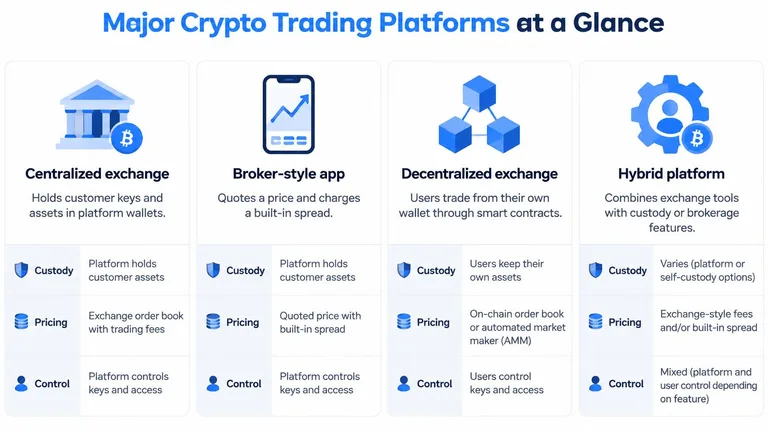
This visual summarizes the models, with hybrid platforms representing combinations rather than a separate guarantee of safety.
Compare executable liquidity
Coinbase, Kraken, and Binance are starting points for centralized-exchange comparisons. Uniswap represents the self-custody model. Classify the actual product you'll use, not just its brand, because a simplified purchase screen and an exchange terminal can have different pricing rules.
Spread means the gap between the best bid and best ask. Measure it alongside the amount available at those prices: a tight quote with little size behind it may offer worse execution than a slightly wider, deeper market.
Transparency deserves a separate check, too. The Hacken audit announcement concerning MEXC addresses asset backing and transparency, which shouldn't be mistaken for evidence of execution quality.
For each shortlisted market, record:
- Typical and stressed spreads: Compare the median with unusually wide observations, rather than a favorable screenshot.
- Depth at your order size: Estimate the average executable price, not merely the top quote.
- Data continuity: Record missing updates, API interruptions, and rate-limit responses.
Use these measurements to narrow the field. Headline volume alone doesn't tell you how much you can trade near the displayed price.
Major Crypto Trading Platforms Compared Side by Side
A platform's published fee is only one part of a trade's cost, and custody at a reputable venue does not make a risky token safe. Compare the product you can access, including its typical fee model and available order types.
| Platform | Model | Custody | Typical fee structure | Typical order features |
|---|---|---|---|---|
| Coinbase | Centralized exchange | Platform custody | Simple purchases may include a spread and transaction fee; advanced trading typically uses tiered maker-taker fees | Market and limit orders; conditional orders may be available on supported products |
| Kraken | Centralized exchange | Platform custody | Trading fees typically follow a maker-taker schedule, with tiers based on trading volume | Market and limit orders; stop orders are available on supported products |
| Binance | Centralized exchange | Platform custody | Trading fees typically follow a maker-taker schedule, with volume tiers and possible discounts | Market, limit, and stop-limit orders; OCO orders are available on supported products |
| Uniswap | Self-custody decentralized exchange | User's own wallet | Swap fee set by the selected pool, plus network fees | Market-style swaps; additional order features depend on the product |
These are typical model-level structures, not exact quotes for every account. Regional entities, products, trading pairs, and eligibility can change the fees and order menu.
Read the product terms, not just the brand
Identify whether you'll use a simplified purchase screen, an exchange order book, or a decentralized swap. A brand can offer different fee rules and execution options across those products. Check the relevant pricing schedule and confirm the order types in the interface available to your account.
Then review the customer-asset agreement. Establish which legal entity holds the assets, how ownership is recorded, and whether custody is provided by the trading entity or another company.
A useful comparison records the product, legal entity, account type, typical fee model, and supported orders in the same row. That makes differences visible without treating a headline fee as the full cost or assuming platform custody removes token risk.
What a Trade Really Costs on Each Platform
A 2025 retail crypto pricing study tested six MiCA-licensed European platforms using API observations and real-money trades, finding that €100 buy-sell round trips ranged from approximately −0.58% to −7.49%. Those negative results describe the measured round-trip outcome, not commission rates.
Build the cost estimate
Maker and taker fees are the explicit trading charges. A maker order adds resting liquidity; a taker order consumes available liquidity. A limit order isn't automatically a maker order, because a marketable limit can execute immediately against existing quotes.
The spread is another cost when you buy at the ask and sell at the bid. When measuring each side against the midpoint, use half the spread for each immediate execution. Don't add the full spread to both sides, or you'll double-count it.
Conversion markups can appear when funding, changing currencies, or using a simplified purchase interface. Compare the quoted conversion with a contemporaneous reference price in the same currency. An attractive trading fee won't compensate for an expensive conversion route.
Model the exit as carefully as the entry
Slippage and price impact require a size-specific estimate. Walk through the available bids or asks and calculate the weighted average fill price for your intended quantity. For a decentralized swap, inspect the route quote and minimum received, while recognizing that neither guarantees future exit liquidity.
Deposit and withdrawal charges belong in the calculation when the trade requires moving funds. Record the actual network and asset you'll use, including any conversion needed to withdraw. Keep trading costs separate from funding costs so you can compare both frequent trading and occasional purchases fairly.
A practical worksheet should contain:
- Entry estimate: Trading fee, half spread, and expected execution impact.
- Exit estimate: The same components calculated independently against the sell side.
- Funding costs: Conversion, deposit, withdrawal, and network charges that apply to the complete transaction.
For a hypothetical order, suppose the taker charge is four-tenths of a percent, the full spread is one-tenth, and additional impact is two-tenths. Adding the fee, half spread, and impact gives roughly two-thirds of a percent per side, or about one and a third percent for an unchanged-price round trip.
That estimate deteriorates if a larger order reaches worse prices deeper in the book. A commission-free quote can also cost more if its embedded markup exceeds the explicit fees elsewhere.
Break-even rule: If your expected price move doesn't exceed the estimated round-trip friction, the trade has no positive margin before forecasting error.
Displayed turnover isn't a substitute for executable bids. Check whether liquidity remains available when you simulate selling, especially when activity appears repetitive or concentrated among related wallets.
Custody Models and What Happens If a Platform Fails
Popularity isn't evidence that customer assets will remain accessible. The history of Mt. Gox records that the Tokyo-based exchange handled more than 70% of worldwide Bitcoin transactions by early 2014, before halting operations after losses and theft involving hundreds of thousands of bitcoins came to light.
The important custody distinctions concern legal ownership as well as key control.
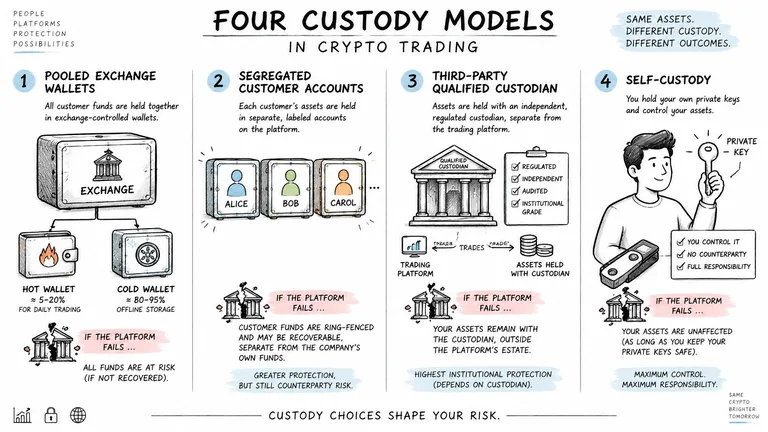
Establish your claim on the assets
Pooled exchange wallets combine operational holdings while the platform tracks customers through its internal ledger. A hot-and-cold wallet split describes how keys are used and stored. It doesn't, by itself, establish your legal position if the company fails.
Segregated custody needs a more precise definition than a marketing label. Ask whether segregation exists on-chain, in accounting records, through a separate legal entity, or through a combination of these arrangements.
A third-party custodian introduces another agreement to inspect. Identify who owes you the assets, who can instruct transfers, and what happens if either the exchange or custodian becomes insolvent. A custody provider's status shouldn't be treated as a blanket guarantee covering every service.
Use the following questions when reading disclosures:
- Ownership: Do the terms recognize customer ownership, and can the platform lend or pledge assets?
- Withdrawal authority: Which entity approves withdrawals, and what conditions permit suspension?
- Failure treatment: What do the terms say about customer claims and asset return?
- Incident disclosure: Does the platform explain historical outages, compromises, and withdrawal interruptions?
Interpret reserves evidence narrowly
Proof of reserves can provide evidence about assets at a particular point in time. Its value depends on scope: whether customer liabilities are included, whether ownership and encumbrances are examined, and whether the verification is independent.
A reserve snapshot isn't a complete solvency assessment. It also doesn't establish that every asset will remain transferable during stress or that operational controls will prevent unauthorized movement.
This custody explainer provides another format for reviewing the trade-offs.
With self-custody, an exchange account lockout doesn't control your keys, but signing mistakes and lost recovery material become your responsibility. Losing every usable key and recovery backup can make recovery impossible; self-custody isn't automatically the safer arrangement for someone without a tested backup procedure.
Keep active trading capital accessible where you execute. Consider moving longer-term holdings to a wallet you control only after testing secure storage and recovery.
Order Types and Execution Speed Compared
The right order type determines which risk you accept: uncertain price, uncertain execution, or both. Speed doesn't remove that choice.
Match the order to the failure you can tolerate
A market order requests immediate execution against available liquidity. It prioritizes getting filled, not receiving the displayed price, and may fill across multiple price levels.
A limit order sets the worst acceptable execution price. It can remain unfilled or fill only partly. For a hypothetical purchase, setting your limit below the current ask prevents paying that ask, but the market might never return to your price.
A stop-market order becomes a market order when its trigger condition is met. If trading gaps below a sell trigger, execution can occur substantially lower. Check whether the venue uses last trade, index price, or another reference to trigger it.
A stop-limit order activates a limit order instead. It protects the execution boundary, but a sharp move through that boundary can leave you holding the asset with no completed exit.
| Order instruction | What it controls | What it doesn't guarantee |
|---|---|---|
| OCO | Links orders so one execution cancels the other under venue rules | A fill at either intended price |
| Take-profit | Activates or places an exit under specified conditions | Profit after fees or a completed exit |
| Post-only | Prevents immediate liquidity-taking, through rejection or venue-specific handling | A fill or a particular fee rate |
| Immediate-or-cancel | Cancels any quantity that can't execute immediately | Complete execution |
| Fill-or-kill | Requires immediate complete execution under venue rules | Any execution at all |
Post-only deserves particular care. It can help preserve maker treatment, but the applicable maker fee still comes from the account's schedule. It isn't a promise that execution is free.
Measure the connection you'll actually use
An exchange-interface benchmark using Coinbase as the primary venue reported local-loopback median latencies of approximately 0.177–0.263 ms for FIX, 22–25 ms for REST, and 72–89 ms for WebSocket, with stronger scaling characteristics for WebSocket.
Those are benchmark conditions, not promised internet execution times. FIX can suit latency-sensitive workflows where available; REST fits request-response operations; WebSocket is useful for streaming books and trades.
For automation, document:
- Connection conditions: Protocol, geographic location, network route, and authentication method.
- Load behavior: Message rate, throttling, reconnect handling, and stale-data detection.
- Execution timing: Acknowledgment, fill confirmation, and slow-tail latency, measured separately.
A fast acknowledgment isn't proof of a fast fill, and a fast fill isn't proof of a good price.
For a retail trader without a measured latency-sensitive strategy, selecting the right price constraint is a more useful starting point than optimizing small timing differences.
Licensing and Account Security Checks Before You Deposit
The Wisconsin Lawyer review of cryptocurrency enforcement records 47 SEC cryptocurrency-related enforcement actions in 2023 and 33 in 2024, with 73% of the 2024 cases alleging fraud under federal securities laws.
That historical record supports checking legal exposure, but it doesn't establish the current status or outcome of any particular platform's proceedings. An allegation isn't a finding of liability.
Use registration, custody, and operational security as separate checks.
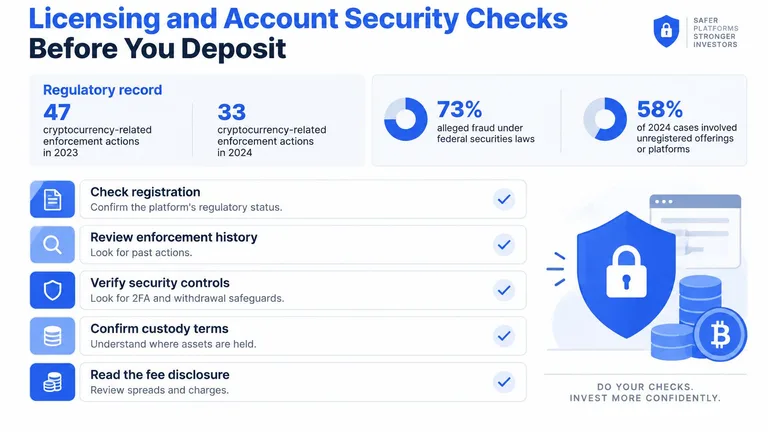
Verify the entity and permitted services
- Legal entity: Match the company named in your account agreement to the regulator's register. A familiar brand may operate through different entities.
- Jurisdiction: Confirm that the entity can serve residents where you live, not merely that it holds a registration somewhere.
- Permission scope: Establish whether the authorization covers custody, exchange, brokerage, or the specific service you intend to use.
- Product restrictions: Check spot trading separately from lending, staking, derivatives, and other products.
- Dispute history: Read official notices and subsequent case developments rather than relying on an old headline.
- Asset terms: Identify reuse rights, withdrawal restrictions, and the treatment of customer property.
A licence shouldn't be read as approval of every listed token or protection against market losses. Likewise, a registration number without a matching entity and service scope is insufficient evidence.
Configure account controls before funding
- Authentication: Prefer a hardware security key where supported, or an authenticator app, rather than relying on SMS.
- Withdrawal allowlist: Restrict destinations and inspect the rules for adding or changing an address.
- Confirmation delays: Understand security holds before they interfere with an urgent transfer.
- API permissions: Use trade-only credentials without withdrawal rights, and restrict permitted network access where supported.
- Phishing defenses: Enable the platform's anti-phishing code if available, and access the venue through a saved, verified address.
- Recovery procedure: Read the account-lockout process, store recovery material securely, and secure the associated email account.
These controls address different routes to loss. Authentication protects account access; API restrictions limit what an exposed credential can do; withdrawal controls make unauthorized transfers harder.
For an on-chain workflow, use the guide to buying Solana meme coins safely alongside the venue checks. Recheck regulatory status before funding and whenever the platform changes its contracting entity, jurisdiction, or product terms.
Matching a Platform to Your Trading Style
Platform priorities by trading style
| Trading style | Top priorities | Usually suitable platform type | Main pitfall |
|---|---|---|---|
| Beginner buying small amounts | Simple interface, clear fiat on-ramp | Broker-style app or regulated centralized exchange | Conversion markup on each buy |
| Active day trader | Low taker fees, deep books, stop and limit orders | Centralized exchange with fee tiers | Fee-tier assumptions and withdrawal delays |
| Long-term holder | Custody, withdrawal controls, recovery | Exchange with documented custody controls, or self-custody | Account lockout or lost recovery material |
| Algorithmic or API trader | Rate limits, WebSocket or FIX, uptime history | Centralized exchange with documented APIs | Throttling and outages during volatility |
| Solana meme-coin trader | Pool depth, exit conditions, token checks | Self-custody DEX via wallet | Shallow liquidity, freeze authority, bundled buys |
A beginner making occasional purchases should compare the final amount received for the same cash outlay. If the simpler interface costs more, that difference is the price of convenience, not necessarily a reason to reject it.
An active trader needs a different calculation. For repeated entries and exits, estimate cumulative friction against capital committed and expected strategy returns. Don't add fee percentages across transactions and describe the total as a percentage of aggregate traded value; repeated turnover and total notional are different denominators.
Let the holding period change the priorities
A long-term holder may accept simpler execution in exchange for a custody arrangement they understand and a recovery process they can operate. A successful purchase is only the beginning of that workflow. Test how the asset will be recovered or transferred after a lost device or account-access problem.
An API trader should rehearse failure handling, not just successful order submission. Simulate a disconnected stream, an uncertain order acknowledgment, and a restart with open orders. Otherwise, retry logic can submit duplicate trades or leave unmanaged exposure.
A Solana meme-coin trader must also investigate the asset itself. A Gate-hosted summary of Solana token research describes more than 7,000,000 Pump.fun tokens with at least five trades between January 2024 and March 2025, but fewer than 100,000 maintaining liquidity above $1,000.
That distinction changes the practical question from whether a token trades to whether a position can be sold. Examine holder concentration, creator activity, liquidity-removal permissions, freeze authority, and coordinated purchases before relying on recent turnover.
Choose the smallest useful toolset
- For manual execution: Favor clear quotes, usable exit controls, and transparent transaction records.
- For automation: Prioritize documented behavior during disconnections and throttling.
- For new tokens: Pair execution tools with independent checks on ownership and exit liquidity.
The comparison of Pump.fun trading tools can help separate discovery, execution, and screening tasks. Rank your most important criteria before choosing a platform; a longer feature list won't resolve a mismatch with your workflow.
Verify One Platform Before You Fund It
Test a single shortlisted platform with a small amount before committing meaningful capital. Keep a dated record of the entity, account product, market, and network used so that the result is reproducible.
Run a funding and execution test
- Verify authorization. Save the regulator-register entry and confirm that it matches your contracting entity and intended service.
- Activate protections. Configure the authentication, withdrawal allowlist, and API permission controls appropriate to your workflow.
- Test the transfer route. Deposit a small amount and withdraw it to a destination you control. Record the amount received, charges, processing status, and any security holds.
- Build a trade estimate. Capture the bid, ask, available depth, applicable fees, and funding charges for your intended position size.
- Test order behavior. Place a small limit order and, where appropriate, a carefully sized conditional order. Inspect trigger rules, partial fills, cancellation behavior, and the completed transaction record.
Judge the test against your own requirements rather than whether it merely succeeded. A withdrawal that completes after an unexpected hold may still make the platform unsuitable for your strategy, while a fill that differs from the estimate needs an explanation before you scale up.
Go/no-go check: Don't increase funding while an unexplained fee, custody term, or execution discrepancy remains unresolved.
A reputable platform cannot make an unsafe token safe, so use a separate MemeAssist token trade check to examine available liquidity and possible difficulties opening or closing a position. We developed MemeAssist to help traders identify warning signals and what requires further verification; conditional scenarios are analysis, not trading instructions, and neither predict a certain outcome nor guarantee execution at displayed prices.
Visit MemeAssist to examine Solana token liquidity, holder distribution, creator behavior, and trading patterns before committing to a position. Use the findings alongside your platform's cost and custody checks to identify which exit conditions and warning signals still need verification.
Topics: crypto trading platform, crypto exchange comparison, crypto exchange fees, crypto custody, crypto order types
Informational only, not financial advice. Meme coins are extremely high-risk.
All articles