Crypto Trading Risk Management: A Practical Playbook
A practical crypto trading risk management playbook covering position sizing, stop-losses, manipulation detection, and on-chain signals for smarter trades.
Published
Updated
More than 70% of trading on sampled unregulated exchanges was estimated to be wash trading in research summarized by Cornell. That finding covered major cryptocurrencies, not Solana meme coins, but it exposes a basic flaw in crypto trading risk management: sizing a position carefully doesn't help much if you mistake fabricated activity for genuine exit liquidity.
The practical question isn't just how far a token might fall. It's whether independent buyers will absorb your sale, whether insiders can reach the exit first, and whether your wallet and trading venue will remain usable. A defensible plan connects detection, position sizing, and execution, rather than treating a stop-loss as protection against every kind of loss.
Table of Contents
- Why Most Crypto Risk Plans Fail Before the Trade
- Position Sizing That Survives a Bad Day
- Stop Losses, Liquidity and Slippage Budgets
- When Strong Momentum Is Itself a Risk Signal
- Reading Holder Concentration and Creator History
- Putting a Live Token Report Into Your Entry Checklist
- A Repeatable Daily Risk Routine
Why Most Crypto Risk Plans Fail Before the Trade
A trader can follow a price-based plan perfectly and still lose more than expected. The missing assumption is usually that the market will remain tradeable when the exit condition arrives.
In its March 2022023 investor warning on crypto-asset securities, the SEC identified illiquidity, concentrated ownership, platform insolvency, halted withdrawals, technical failures, malware, and hacking as material risks. These aren't variations of ordinary price volatility. Some can prevent you from accessing funds or selling at all.
A tight stop addresses a price condition. It doesn't establish that somebody will buy your tokens, that the platform will process your withdrawal, or that you still control your wallet.
The controls need different jobs
A retail plan needs distinct defenses rather than overlapping indicators:
- Position sizing limits how much capital you commit to a fallible idea.
- Stop and exit logic defines when the trade no longer deserves capital.
- Portfolio caps constrain shared exposure to assets, venues, and related participants.
- Operational security protects access to funds and signing authority.
None substitutes for another. Smaller positions don't make a malicious signature safe, and secure custody doesn't make a concentrated token liquid.
The relationships between these risks matter more than a reassuring chart.
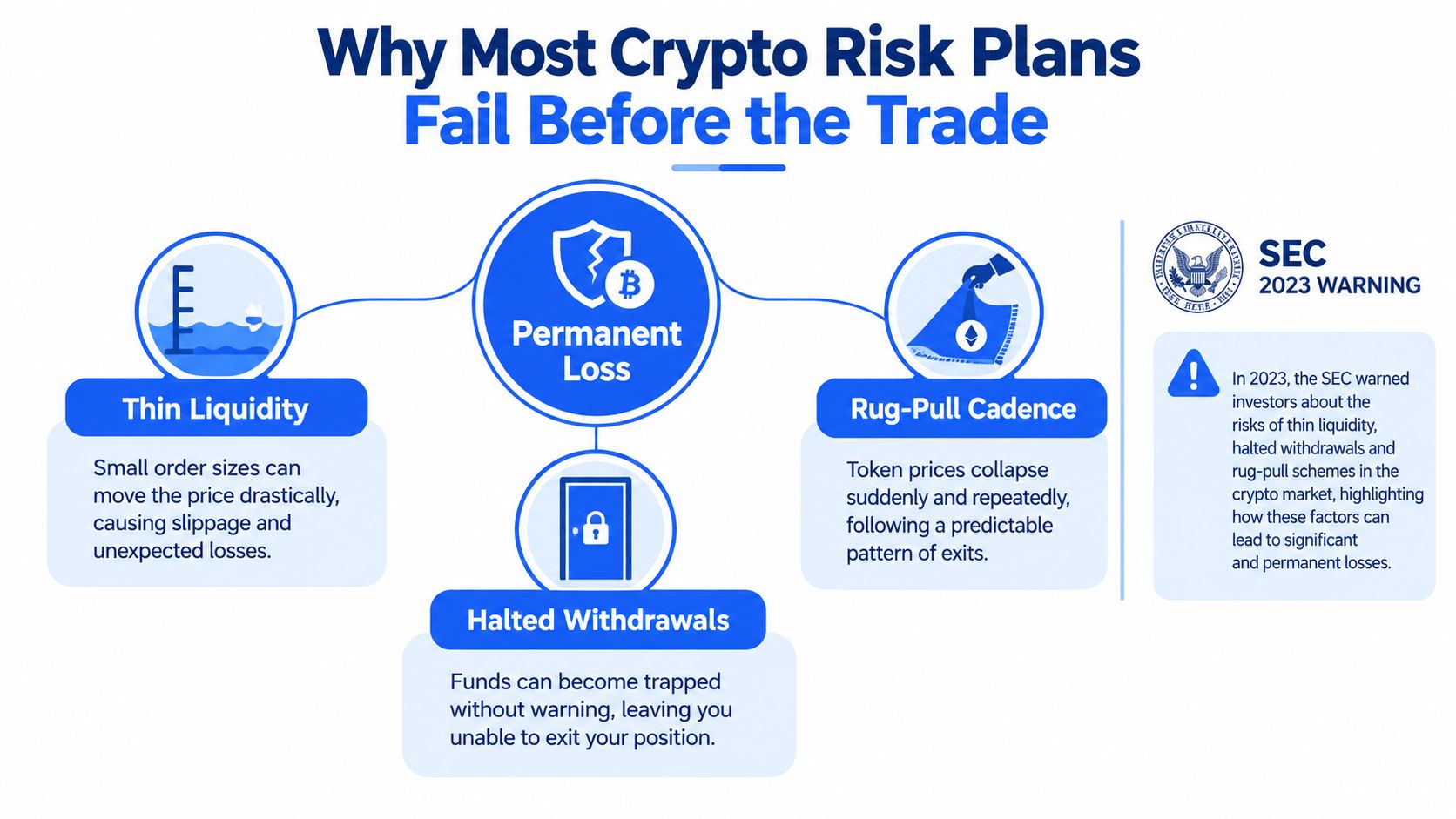
Price risk versus permanent loss
For a speculative token, separate the question of what price could do from what could make recovery impossible. Creator control, ownership concentration, and dependence on a fragile trading venue belong in the second assessment.
Practical rule: Don't approve a trade until you can explain both how you intend to exit and what could prevent that exit.
This changes the order of due diligence. Investigate whether the market is usable before debating whether the entry looks attractive. When you can't establish that baseline, passing is more defensible than compensating with an arbitrarily tighter stop.
Position Sizing That Survives a Bad Day
Position size is an output, not a conviction score. Start with the loss your account can tolerate, then determine how much exposure fits that constraint.
Set a small risk budget from current account equity. Next, identify where the setup becomes invalid using recent realized volatility or market structure. Don't choose the position first and squeeze the stop into whatever distance makes the arithmetic comfortable.
The basic calculation is:
Token quantity = risk budget ÷ expected loss per token
For a liquid setup, the expected loss per token starts with the entry-to-stop distance, allowing for execution costs. For a fragile meme pair, that distance may be an inadequate estimate.
Sizing Inputs at a Glance
| Input | What it measures | How to set it |
|---|---|---|
| Risk budget | Affordable account loss | Choose before reviewing the token |
| Invalidation distance | Where the trade thesis fails | Use observed volatility or structure |
| Scenario loss | Damage if the planned exit fails | Test adverse liquidity conditions |
| Liquidity haircut | Uncertainty in executable capacity | Reduce preliminary size when depth is fragile |
| Portfolio headroom | Capacity after existing exposure | Apply asset, venue, and aggregate caps |
| Drawdown rule | When to reduce activity | Precommit exposure reductions and a session stop |
A thin Solana pair worked through
Consider a Solana meme pair whose chart provides a nearby invalidation level, but whose sell quote deteriorates sharply at your intended size. Label your account equity E, chosen risk fraction r, and realistic adverse loss fraction s.
Your risk budget is E × r. Your preliminary position value is (E × r) ÷ s, then you reduce it further if observable liquidity can't support the exit.
For this setup, run a 50%–90% price-shock stress test, treating that range as an adverse scenario rather than a forecast, consistent with the volatility- and drawdown-aware sizing framework. If the resulting loss exceeds your budget, shrink the position or reject the trade, even if the chart stop appears close.
That's the meaningful comparison: a nominal stop implies one position; a failed-exit scenario may justify a much smaller one. If total loss remains plausible, budget against the entire committed amount.
Finally, check aggregate exposure and prohibit borrowing when exit capacity is uncertain. Define a drawdown rule that reduces size or suspends entries after your chosen loss threshold, rather than letting frustration determine the next allocation.
Stop Losses, Liquidity and Slippage Budgets
A stop defines an instruction. A liquidity check tests whether you can execute it. Keep those functions separate.
On an order-book venue, inspect the bid-ask spread and cumulative buying depth near your intended exit. For a pool-based Solana trade, inspect the executable swap quote and price impact for your actual token quantity. Don't substitute an attractive displayed price for either check.
Use the execution sequence below as a reminder, while matching the depth check to the venue you trade.
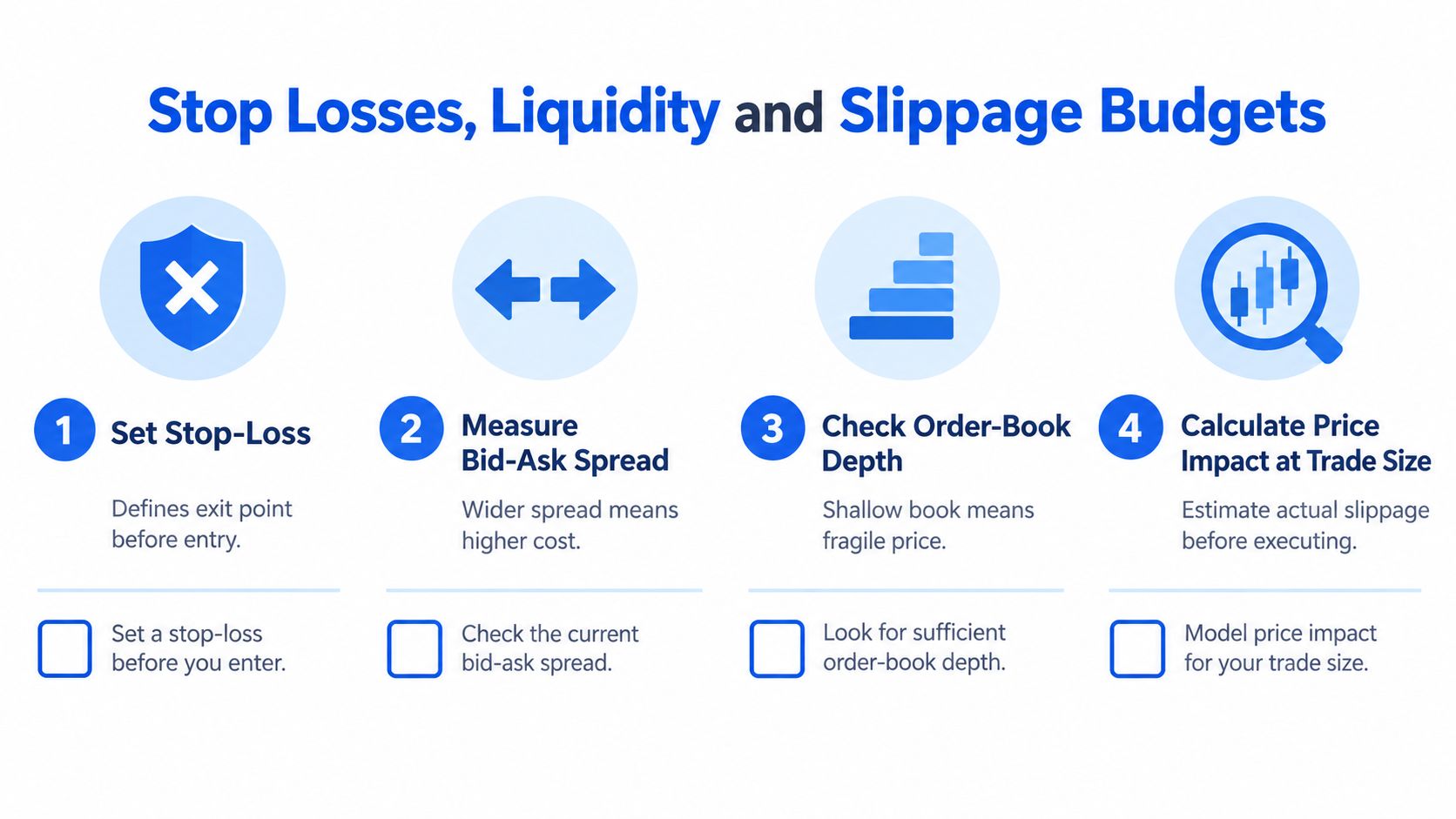
Set the execution budget before entry
Request an entry quote, then assess a sale of the proposed position. Compare what you expect to receive with the chart valuation, allowing for fees and price impact. A Solana liquidity checker can support the inspection, but the relevant question remains specific: can this market absorb your sale?
Distinguish price impact, the effect of your order on available liquidity, from slippage, the difference between expected and realized execution. Set an acceptable execution-cost budget before buying, not while you're trying to escape.
Don't solve an unacceptable quote by repeatedly loosening tolerance. That may permit a worse execution without improving the underlying trade. Conversely, an extremely restrictive tolerance can leave you holding a position after a failed attempt.
A stop price is where you want to act. An executable quote is evidence of what acting might cost.
Turnover isn't exit capacity
Reported turnover describes activity over a period, not the buying capacity available now. As the wash-trading research noted earlier illustrates, some of that activity may not represent independent demand.
Treat high volume alongside shallow depth, repetitive small trades, or clustered round-number transactions as grounds for further investigation. These patterns aren't proof by themselves, but they shouldn't justify a larger position.
Before committing, require:
- Trade-size evidence: A sell quote for the proposed position, not a token amount too small to matter.
- Independent demand: Buyers beyond the same repeatedly interacting wallets.
- Acceptable friction: Combined execution costs within your predetermined budget.
- A refresh trigger: Recheck after large swaps or material changes in available depth.
A quote is a conditional observation, not reserved liquidity. If another participant sells first, reassess rather than relying on the earlier result.
When Strong Momentum Is Itself a Risk Signal
A longitudinal study of 34,988 meme tokens found evidence of artificial growth tactics in 82.6% of tokens returning more than 100%, including wash trading and liquidity-pool-based price inflation, according to the meme-token manipulation study. That's a finding about its sample and methodology, not a probability that any particular rising token is fraudulent.
The practical response is to slow down when acceleration outpaces your ability to verify demand.
Verify who is creating the move
A chart shows executed prices, not the independence of the participants. Coordinated actors can spread activity across controlled wallets and create the appearance of broad interest.
Inspect the relationship between trades, participants, and liquidity:
- Wallet loops: Repeated interaction among a narrow group deserves scrutiny, especially when funding relationships connect them.
- Price lifts without depth: A sharp rise accompanied by little improvement in executable exit capacity is fragile.
- Apparent buyer growth: More addresses don't necessarily mean more independent decision-makers.
- Synchronized behavior: Similar entry timing followed by coordinated selling can undermine the apparent strength.
Treat these as investigation prompts, not automatic accusations. Shared timing alone doesn't establish common ownership, and legitimate traders can react to the same event.
Missing a move can be the cheaper outcome
The trade-off is real. Waiting for clearer evidence may mean paying a higher price or missing the trade entirely. Entering before verification means accepting uncertainty about who controls both the apparent demand and the next wave of selling.
Buying momentum can still be defensible when independent participation and executable depth support it. Buying solely because the chart is accelerating isn't equivalent.
Use the accompanying video as a prompt to compare visible momentum with the evidence you'd require before committing.
Write down what would disprove your interpretation before entering. If every suspicious observation becomes another reason the token is about to rally, you're defending a desired outcome rather than testing a trade.
Reading Holder Concentration and Creator History
Concentration matters relative to available liquidity. A top holder's balance becomes an execution problem when a plausible sale could overwhelm the buyers supporting your exit.
Begin by classifying large addresses before interpreting a holder table. Distinguish identifiable pool, custody, or infrastructure addresses from discretionary holders where the evidence permits. Don't assume every large address is an insider, or every separate address is an independent owner.
Read relationships, not just rankings
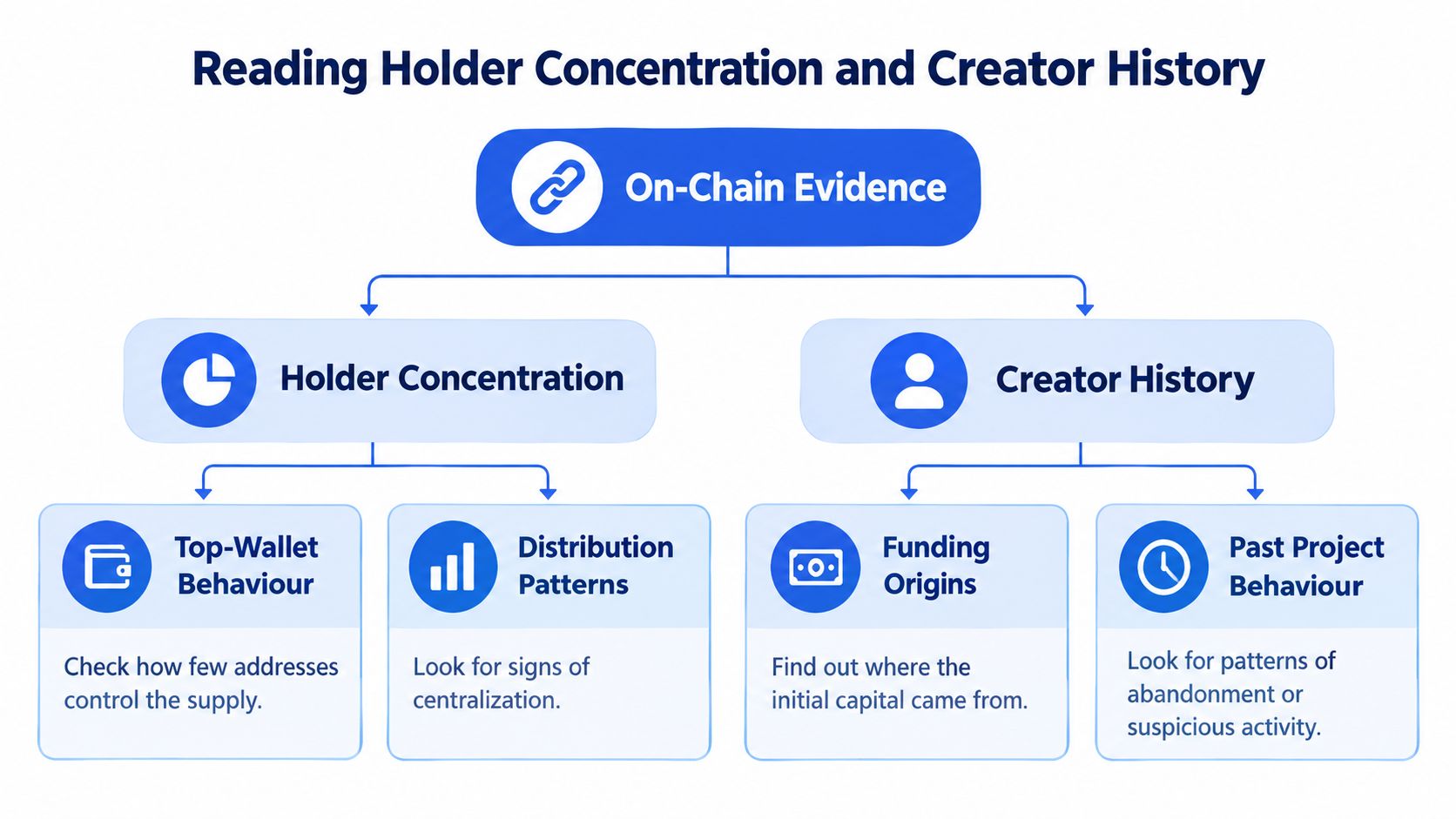
A holder concentration risk screen should connect distribution with behavior. Examine whether top wallets accumulated together, whether balances move through related addresses, and whether sales follow a coordinated pattern.
For creator history, investigate:
- Funding origins: Trace available funding relationships, while distinguishing a direct connection from incidental contact.
- Previous deployments: Review attributable prior token activity for repeated abandonment or suspicious exits.
- Bundle and insider signals: Check whether early acquisition patterns suggest coordinated access.
- Current control: Identify permissions or holdings that could materially change trading conditions.
A flagged relationship deserves explanation. It isn't proof of malicious intent, and an absence of known history isn't proof of safety.
The evidence is easier to interpret when distribution and creator behavior are assessed together.
Custody belongs in the same review
Reuters reported $2.2 billion stolen in cryptocurrency-platform hacks in 2024, with private-key compromises accounting for the majority of stolen funds, in its report on crypto hacking losses. This is a different failure mode from buying a token that falls.
Separate trading funds from long-term holdings. Avoid unnecessary wallet connections, inspect signing requests, and use withdrawal and approval controls appropriate to your custody setup.
Security boundary: A research task shouldn't become an authorization task unless you understand exactly what permission you're granting.
Keep your conclusions granular. A token may have acceptable holder distribution but unresolved creator control, or credible trading activity alongside unsafe wallet interactions. Collapsing everything into a single reassuring label hides the distinction you need to act on.
Putting a Live Token Report Into Your Entry Checklist
A live report is useful when it changes a decision you can name. Reading a verdict without defining the corresponding action just adds another screen to the trading desk.
Use manual explorer checks, execution quotes, and an on-demand report as complementary inputs. A pre-trade token check can organize the evidence, but it shouldn't replace checking the conditions of your intended transaction.
Turn the report into a decision record
Read the Detailed Risk Breakdown before relying on the headline Overall Health Score or Rug Risk Rating. The plain-English AI Verdict should explain the observations, their significance, and unresolved uncertainty, rather than become permission to ignore conflicting evidence.
Keep a compact decision record:
| Report component | Decision question |
|---|---|
| Liquidity evidence | Does current execution support the proposed size? |
| Holder and creator evidence | Could identifiable actors invalidate the exit assumptions? |
| Trading-pattern evidence | Is the apparent demand sufficiently independent? |
| AI explanation | Does the reasoning match the underlying checks? |
| Trade Setup | What observable change would cancel the entry? |
Record the token address, analysis time, proposed action, and unresolved concerns. Publicly visible evidence makes later review more useful than a screenshot of a score without context.
Respond to deterioration, not just a lower rating
If a verdict changes while you're holding, identify the underlying observation. A creator-linked transfer, thinner liquidity, and suspicious trading activity imply different problems. Don't respond mechanically to a score change without understanding what changed.
Choose among reducing exposure, preparing a transaction for review, or abandoning the position based on the new evidence and current quote. Preparing an exit should never mean blindly signing an unfamiliar request.
Research on meme-market manipulation and investor behavior connects coordinated activity with the behavioral vulnerabilities of followers. Precommitted exposure and trade-frequency limits help keep an adverse warning from turning into a justification to average down or chase another token.
Use post-flag outcome tracking to examine whether warnings preceded meaningful deterioration and whether a realistic exit remained available. A later price decline alone doesn't establish that an alert was timely or actionable.
No report guarantees execution. Its value lies in making assumptions visible early enough for you to reconsider the trade.
A Repeatable Daily Risk Routine
Crypto trading risk management is a recurring decision process, not a setup you complete once. The useful routine is short enough to follow under pressure and explicit enough to stop an entry.
Before the trading session
Review available account equity, existing positions, venue exposure, and remaining loss capacity. Set the conditions that reduce size or end the session before reviewing attractive charts.
Keep the routine practical:
- Screen first: Check liquidity, concentration, creator history, and trading patterns before selecting an allocation.
- Size second: Use the established risk budget and adverse-execution assumptions.
- Define the exit: Record both price invalidation and evidence-based reasons to leave.
- Budget execution: Confirm that the proposed transaction fits acceptable costs.
- Refresh after change: Reassess when large swaps or wallet movements undermine the original evidence.
- Throttle after drawdown: Follow the precommitted reduction rule rather than negotiating with it.
Do less overlapping work
Don't pay for several dashboards because each displays a different score. Assign each input a purpose: an explorer for transaction evidence, a quote for execution, and an analysis report for interpretation. Add another tool only when it answers an unresolved question.
Do record why you passed on a token as well as why you entered. Don't judge the decision solely by whether the next candle rose.
At the end of the session, separate losses caused by a failed thesis, poor execution, missed warning, or rule violation. Each calls for a different adjustment. Better detection won't repair habitual oversizing, and stricter sizing won't explain why you trusted coordinated buying.
The standard isn't avoiding every loss. It's committing only the capital you can defend against the evidence available, then acting when that evidence changes.
MemeAssist offers on-demand Solana token reports that combine live liquidity, holder, creator, and trading-pattern evidence with plain-English risk explanations. Visit MemeAssist before your next entry, review the underlying checks, and use the findings to decide whether your planned position has a realistic exit.