Crypto Wallet Tracker for Solana: How to Choose
A practical crypto wallet tracker guide for Solana. Compare features, privacy trade-offs and alert quality to pick the right tool for your workflow.
Published
Updated
More than 1 billion wallet addresses had reportedly been clustered into over 107,000 named entities by 2025, according to industry coverage citing Chainalysis (reported blockchain clustering figures). That statistic changes the question. A crypto wallet tracker isn't valuable because it shows another balance screen. It earns its place by helping you decide whether several addresses reflect one entity, whether an alert arrives while a trade still matters, and whether the evidence supports the conclusion.
Solana meme-coin trading exposes weak trackers quickly. A whale alert without holder concentration, creator history, funding paths, and synchronized buying is noise. A wallet label without a confidence level can create false certainty. A fast dashboard that returns stale data can make a launch look quiet after the wallets that mattered have already moved.
I grade trackers on four things: evidence quality, alert freshness, privacy exposure, and inference transparency. The right tool depends on the job. Explorers are strong for raw verification, portfolio platforms are useful for persistent monitoring, and risk analyzers are better when the decision concerns a token rather than a wallet alone.
Table of Contents
- What a Crypto Wallet Tracker Does
- The Data Behind Every Solana Wallet Tracker
- Comparing the Main Tracker Types for Solana
- Five Features That Separate a Good Tracker From a Noisy One
- Privacy Risks You Take On by Using a Tracker
- Which Tracker to Use for Which Solana Job
- Choosing Your Crypto Wallet Tracker
What a Crypto Wallet Tracker Does
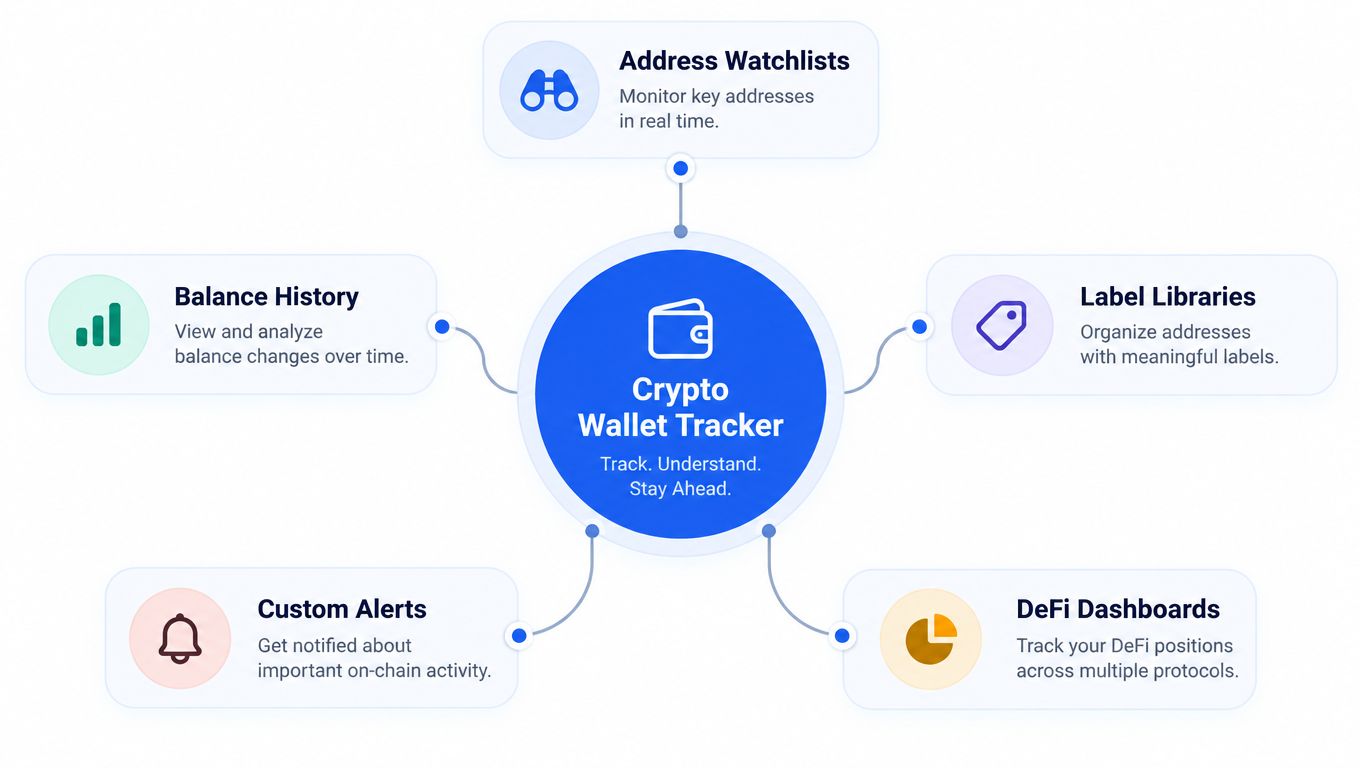
A crypto wallet tracker starts with an address, but it does not stop there. You add a public wallet to a watchlist, then inspect its balances, token accounts, transaction history, counterparties, and trading timing. Strong platforms also let you group addresses, add notes, assign labels, and monitor several wallets without reopening separate explorer pages.
The practical workflow is straightforward:
- Collect an address or token. Start with a creator wallet, suspected insider, known trader, or one of a token's largest holders.
- Check the history. Review funding sources, previous launches, recurring counterparties, exchange transfers, and the timing of purchases and sales.
- Add context. Labels can identify exchanges, protocols, treasuries, bots, or other known entities. They support attribution, but they do not prove personal identity.
- Set an alert. Monitor incoming funds, outgoing transfers, token purchases, creator selling, holder changes, or other events tied to the trade.
- Interpret the flow. Decide whether wallets are accumulating, distributing, consolidating, or using shared infrastructure.
The useful questions are, “What did this address do, when did it do it, and who did it interact with?” A tracker cannot establish whether a person is trustworthy or predict whether a token will rise. Public transaction data supports analysis, not prophecy.
A serious product should give you this working surface:
| Capability | What it answers | Reader action |
|---|---|---|
| Address watchlists | Which wallets deserve ongoing attention? | Group wallets by creator, trader, fund, or investigation |
| Balance history | What changed in the wallet's holdings? | Compare accumulation with distribution |
| Label libraries | What known service or entity may be associated with an address? | Treat labels as context, then verify the underlying flow |
| Custom alerts | Which event should trigger review? | Alert on transfers, buys, sells, or creator activity |
| DeFi dashboards | Where is value moving across protocols and token accounts? | Follow counterparties, pools, and exit routes |
The key discipline is separating observation and interpretation. A balance is an observation. A cluster is an interpretation. A “smart money” label is a stronger interpretation. Keep those layers separate, particularly on Solana, where one trader, bot, market maker, or exchange customer base may use many addresses. Judge a tracker by its evidence quality, alert lag, privacy exposure, and explanation of inferences, not by how loudly it announces a whale move.
The Data Behind Every Solana Wallet Tracker
A Solana tracker sits on infrastructure most users never see. RPC nodes provide access to chain data, while indexers organize transactions, token accounts, transfers, and historical relationships into a form an application can query quickly. Event subscriptions and WebSocket connections can push changes to the application, but only if the provider delivers complete and current data.
Average response time is a poor test. You need p50 latency, which shows the typical response, and p95 latency, which exposes the slow tail that users experience during busy periods. Solana operational guidance also points to p95 and p99 latency, timeout rates, errors, returned-slot lag, transaction-status observation time, WebSocket reconnection time, and recovery from missed notifications. The Helius benchmark methodology recommends testing correctness, reliability, response speed, and slot freshness rather than relying on a single fast request.
Infrastructure rule: A fast endpoint that returns an old slot can produce misleading wallet activity.
For a trader, the symptoms are obvious. A late alert arrives after a creator has sold. A dropped WebSocket event makes a wallet appear inactive. A stale token-account response hides a balance change. A tracker that can't retrieve older transactions reliably may also distort your view of a creator's past launches.
What to test before trusting a tracker
Use a workload that resembles the decision you make:
- Large transaction histories: Check whether the platform handles a busy wallet without truncating the useful context.
- Token-account enumeration: Confirm that token holdings update across associated accounts, not only the wallet's headline balance.
- Parsed transfers: Verify that the displayed sender, receiver, asset, and slot match an explorer or direct chain record.
- Concurrent polling: Watch several wallets at once and see whether latency or completeness deteriorates.
- Historical lookups: Test older activity, because a tracker that only performs well on recent transactions isn't enough for creator analysis.
- Recovery behavior: Disconnect or miss an event in a controlled test, then confirm that the system backfills it.
A provider-assessment document cited in the benchmark methodology sets an infrastructure floor of under 200 ms p95 for standard reads such as getAccountInfo and getBalance under normal conditions. That isn't a sufficient target for event-driven meme-coin monitoring. Launch volatility demands separate internal targets for detection, stale-slot rejection, and recovery.
The analytical layer adds another risk. A tracker may group wallets through shared funding, synchronized buys, repeated transfer paths, or common deployer interactions. Those relationships are useful, but they remain hypotheses unless supported by direct evidence. Before relying on any cluster, read what Solana wallet clusters mean and check whether the product distinguishes a direct transaction from an inferred relationship.
Comparing the Main Tracker Types for Solana
The market divides into three useful categories. None wins every job, and pretending otherwise leads traders to buy a dashboard that solves the wrong problem.
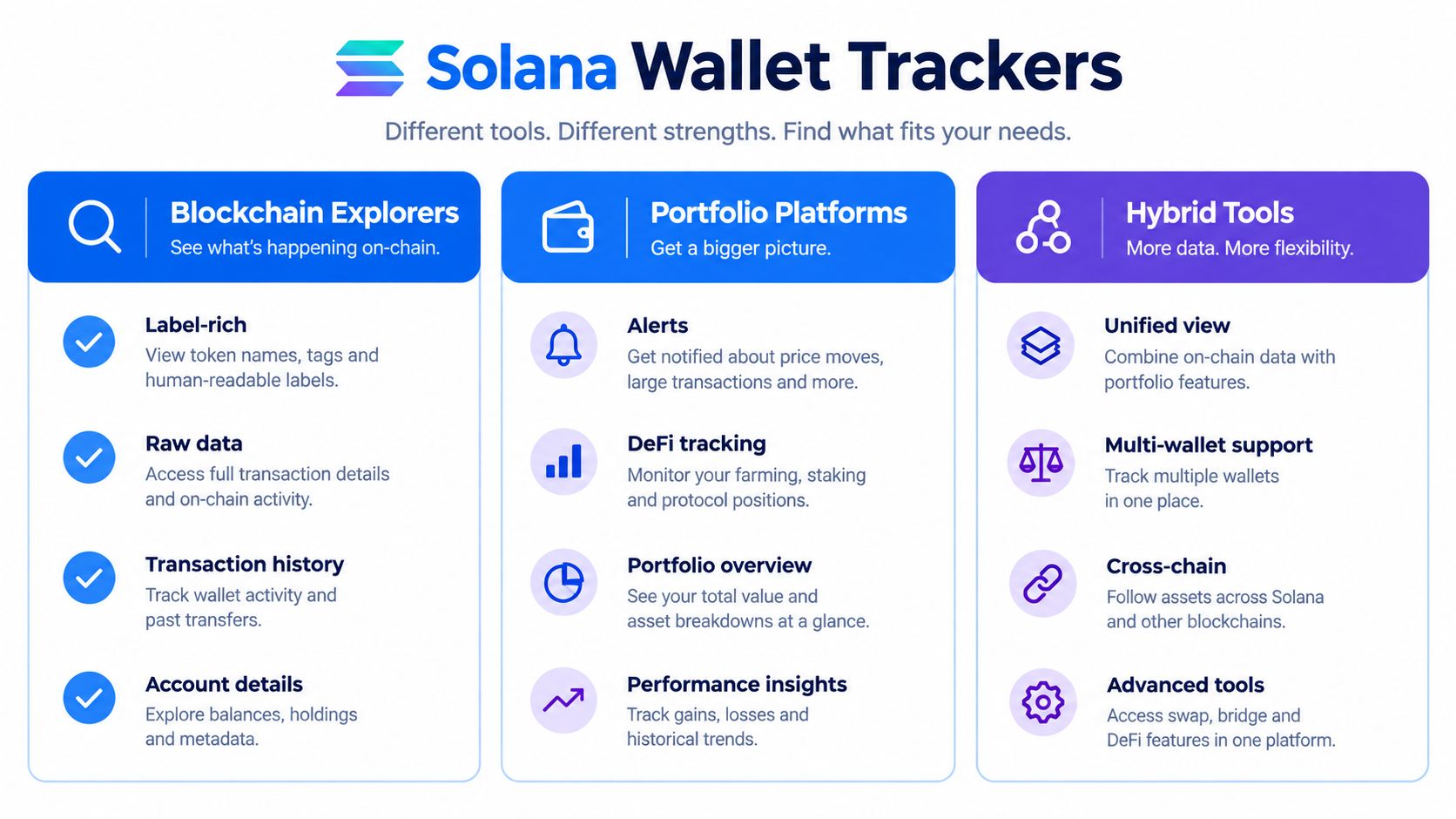
Blockchain explorers and label-rich analytics suites are the verification layer. Solscan and SolanaFM-style tools are useful when you need to inspect a transaction, follow token accounts, check a deployer, or validate what an alert claims. Their weakness is workflow friction. They often make you do the clustering and interpretation yourself, and they aren't always designed for persistent watchlists across a fast-moving set of wallets.
Portfolio and alert platforms focus on monitoring. They aggregate holdings, support watchlists, and send notifications through channels such as browser alerts, email, or messaging integrations. They fit traders who already know which addresses matter and want fewer manual checks. Their weakness is signal quality. A configurable alert is only as useful as the event definition, indexing freshness, and evidence attached to it.
Dedicated risk analyzers investigate the token as a decision object. They combine holder distribution, creator behavior, liquidity, trading patterns, and wallet activity into a report. That makes them more useful for an initial meme-coin check than a general portfolio dashboard. They won't replace an explorer during a detailed flow investigation, and they may not provide the broad cross-chain coverage a research desk needs.
| Tracker type | Primary use case | Alert latency | Evidence transparency | Typical pricing |
|---|---|---|---|---|
| Blockchain explorer | Transaction and address verification | Usually event or refresh dependent | High for raw records | Often free, with advanced paid tiers |
| Label-rich analytics suite | Entity and flow research | Varies by provider and workload | Medium to high, depending on label detail | Freemium or subscription |
| Portfolio platform | Multi-wallet monitoring | Designed for notifications, freshness varies | Medium | Free tier, subscription, or premium features |
| Alert-focused platform | Trigger-based wallet surveillance | Fast when event delivery is reliable | Low to medium unless payloads expose evidence | Subscription or usage based |
| Token risk analyzer | Launch and token due diligence | Usually on-demand, with monitoring where offered | High when checks and source data are visible | Pay per analysis or subscription |
| Hybrid tool | Combined monitoring and investigation | Depends on the underlying data stack | Varies widely | Freemium, subscription, or usage based |
If you need to prove what happened in one transaction, use an explorer first. If you need to monitor a roster of known wallets, choose an alert platform. If you're deciding whether to enter a newly launched token, use a risk analyzer that shows more than a wallet's headline balance. The comparison of Solana token alert tools is useful for separating notification breadth from actual decision support.
Five Features That Separate a Good Tracker From a Noisy One
A usable crypto wallet tracker doesn't merely show more events. It helps you decide which events deserve attention and why.
Address watchlists that preserve context
A watchlist should support folders, notes, tags, and relationships. Create separate groups for creators, early buyers, exchange-linked wallets, treasury addresses, and wallets you're still investigating. A cheap implementation gives you a stream of addresses with no memory, so you repeatedly rediscover the same context.
Holder-flow analytics beyond balances
Balances are snapshots. Flow analytics shows direction and sequence. Look for shared funding sources, synchronized purchases, transfers into liquidity pools, consolidation into a larger wallet, and movement toward centralized exchanges. Holder concentration matters because a low address count or a high apparent count can mislead when related wallets aren't examined together.
Alerts you can tune
The alert should answer a specific question. “Notify me about every transfer” is a firehose. “Notify me when a creator-linked wallet sells into the launch pool” is actionable. Delivery channels matter, but filtering matters more. Configure thresholds, event types, token scope, and severity, then test whether the alert includes the transaction, slot, asset, direction, and affected wallet.
Risk signals that connect the wallet to the token
A wallet doesn't exist in isolation. A risk-aware system connects wallet history to creator behavior, holder concentration, liquidity, bundle activity, insider patterns, and realized exits. A dedicated token analyzer can beat a pure wallet alert platform here. A profitable wallet buying a token isn't a safety signal if the creator controls concentrated supply or several connected wallets are preparing an exit.
Evidence transparency for every inference
The product should show the chain of reasoning. If it calls addresses a cluster, expose the shared funding path, timing relationship, repeated counterparties, or deployer connection. If it labels a wallet, show whether the label comes from a known service, public attribution, or a heuristic.
Research on wallet clustering reports approximately 85% to 95% accuracy for high-confidence clusters, roughly 60% to 75% for medium-confidence clusters, and low-confidence results that may be indistinguishable from chance (on-chain forensics clustering research). Use those tiers as a design rule, not a marketing footnote:
- High confidence: Show the direct evidence and the confidence tier.
- Medium confidence: Present the relationship as a lead for review.
- Low confidence: Avoid categorical ownership language.
Analyst rule: If a tracker can't show why it grouped addresses, treat the group as unverified.
Privacy Risks You Take On by Using a Tracker
Seeing a wallet doesn't make the watcher invisible.
A wallet tracker operates on public ledger data, but your use of the tracker can create a separate privacy trail. Saved watchlists, account activity, browser identifiers, connected extensions, and search behavior can reveal which wallets or tokens interest you. Read-only access is safer than signing a transaction, but it isn't a guarantee of anonymity.
KU Leuven research examining 85 browser-based crypto-wallet extensions identified structural weaknesses involving address linking, persistent wallet detection, and cross-site tracking (KU Leuven wallet privacy research). In the tested Ethereum-compatible wallets, permissions remained active after a dApp requested disconnection in 22 of 36 wallets, while hidden pages or embedded frames could request wallet information in 23 of 36. Those findings concern wallet extensions, not every tracker, but they show why users shouldn't treat a disconnected interface as proof that all access has ended.
Practical privacy discipline
Keep your operating model simple:
- Trading wallet: Use it for active entries and exits, then assume its history is public.
- Long-term wallet: Don't reuse it for public trading or routine dApp activity.
- Public-facing wallet: Use it only when you intentionally want activity associated with a visible identity.
- Tracker account: Review saved addresses, sharing settings, browser permissions, and retention policies.
- Cluster labels: Demand confidence levels and underlying evidence before accepting an inferred relationship.
A tracker can reveal public balances, counterparties, income patterns, and trading habits without exposing private keys. It can also make your separate wallets easier to connect if you reuse funding paths, timing patterns, or public identifiers. Evaluate privacy as a core product feature, alongside alert speed and evidence quality, not as a legal page you never read.
Which Tracker to Use for Which Solana Job
Checking a fresh meme coin
A 2025 report found signs of fraudulent activity in 98.6% of tokens launched on Pump.fun and 93% of Raydium liquidity pools (reported Solana token risk figures). Those figures do not make every tracked buyer malicious. They do make a wallet alert a poor safety proxy. A profitable purchase shows activity, not intent, token quality, or exit risk.
For an ape check, use a dedicated risk analyzer first. Review creator history, holder concentration, liquidity, bundle or insider activity, coordinated purchases, and whether early wallets are already selling. Use an explorer to verify suspicious transactions, not as the main decision engine. MemeAssist fits this workflow because it combines live Solana data on liquidity, holders, creator behavior, wallet activity, trading patterns, and historical risk indicators, then presents a plain-English verdict with an evidence breakdown.
A prominent wallet can be compromised or copied. In a fake Solana token launch promoted through compromised social accounts, the asset collapsed 98%, 73.8% of trading wallets lost money, and 51,862 wallets lost a combined $74.8 million, according to the Gate post-mortem on the fake-token launch. Treat those figures as a warning about imitation risk. Verify the token's structure before copying a wallet.
Monitoring a creator across launches
Historical depth matters more than flashy alerts. Start with the creator or deployer address, map its funding sources and prior token interactions, then check repeated patterns: early allocations, liquidity actions, transfers to linked wallets, and post-launch selling.
A label-rich explorer is the strongest primary tool because it lets you inspect the actual history. Add a portfolio or alert platform when the creator's activity spans too many wallets for manual review. A token analyzer helps assess each new launch, but it should not replace the historical chain of evidence.
Use this guide on tracking smart-money wallets on Solana for a more focused workflow. Track behavior across launches, not one profitable trade.
Investigating a suspicious transfer
Start with the transaction hash or anchor address. Trace inbound and outbound flows, identify repeated counterparties, check for shared funding, and follow movements toward exchanges, bridges, or consolidation wallets. A serious investigation needs raw transaction visibility, entity labels, and clustering with stated confidence.
An analytics suite or explorer fits this job better than a token-first analyzer. You need graph navigation, archival history, and evidence that another analyst can reproduce. Use a wallet tracker for discovery and alerts, then verify every important inference against the underlying transactions before calling activity coordinated or attributing it to one owner.
Choosing Your Crypto Wallet Tracker
Here is what I would do.
- Casual Solana meme-coin buyer: Use a token risk analyzer as the primary tool and an explorer as the verification layer. You need a readable decision report before you need a complex wallet graph.
- On-chain researcher: Use a label-rich explorer or analytics suite first, then add a persistent alert platform for addresses that repeatedly matter.
- Professional desk: Combine direct RPC or indexed data access, a research-grade analytics suite, and a risk analyzer for launch triage. No single interface should be your only source during a volatile event.
Run this evaluation before paying:
- Confirm that the dashboard uses live ingestion rather than a visibly cached snapshot.
- Add one wallet to a watchlist and record the displayed slot or update context.
- Set one narrowly defined alert, such as a transfer or token sale.
- Verify one event against an independent explorer.
- Review one cluster label and identify the evidence behind its confidence level.
- Separate one trading wallet from your long-term and public-facing wallets.
- Check whether the platform explains missed events, stale data, and recovery behavior.
Don't choose the tracker with the longest label list. Choose the one that shows fresh evidence, clear uncertainty, useful alerts, and the correct scope for your decision. For most retail Solana traders, that means checking the token first, following wallets second, and verifying important claims directly on-chain.
MemeAssist turns live Solana token and wallet evidence into an Overall Health Score, Rug Risk Rating, plain-English verdict, and detailed risk breakdown, with watchlist monitoring for material changes such as creator selling or whale exits. Visit MemeAssist to run a token analysis without connecting a wallet or signing a transaction, then use the report as your evidence-led starting point for Solana due diligence.