DeFi Risk Management: Frameworks, Signals, and Tools
Learn defi risk management with practical frameworks for smart-contract, liquidity, oracle, and governance risk, plus on-chain signals and tools to assess them.
Published
Updated
In 2022, DeFi protocols lost about $3.1 billion to hacking, and cross-chain bridges accounted for 64% of those losses, which is a better way to understand DeFi risk management than any audit badge or TVL snapshot. The numbers were worse than a headline about “crypto hacks” suggests, because the damage wasn't confined to one bug class, one chain, or one type of user error. It showed that protocol security, bridge exposure, custody controls, and concentration monitoring all matter at once Chainalysis on the 2022 crypto hacking peak.
A year later, the losses fell, but the problem didn't disappear. 2023 still saw roughly $1.1 billion stolen from DeFi protocols, with incidents ranging from the $197 million Euler Finance attack to the $73.5 million Curve exploit Chainalysis on 2023 stolen funds. That pattern is the starting point for any serious framework, because it shows that DeFi risk management isn't a single judgment about "safe" or "unsafe." It's a layered evidence problem, where smart-contract risk, access-control risk, oracle risk, liquidity risk, and composability risk each leave different traces on-chain.
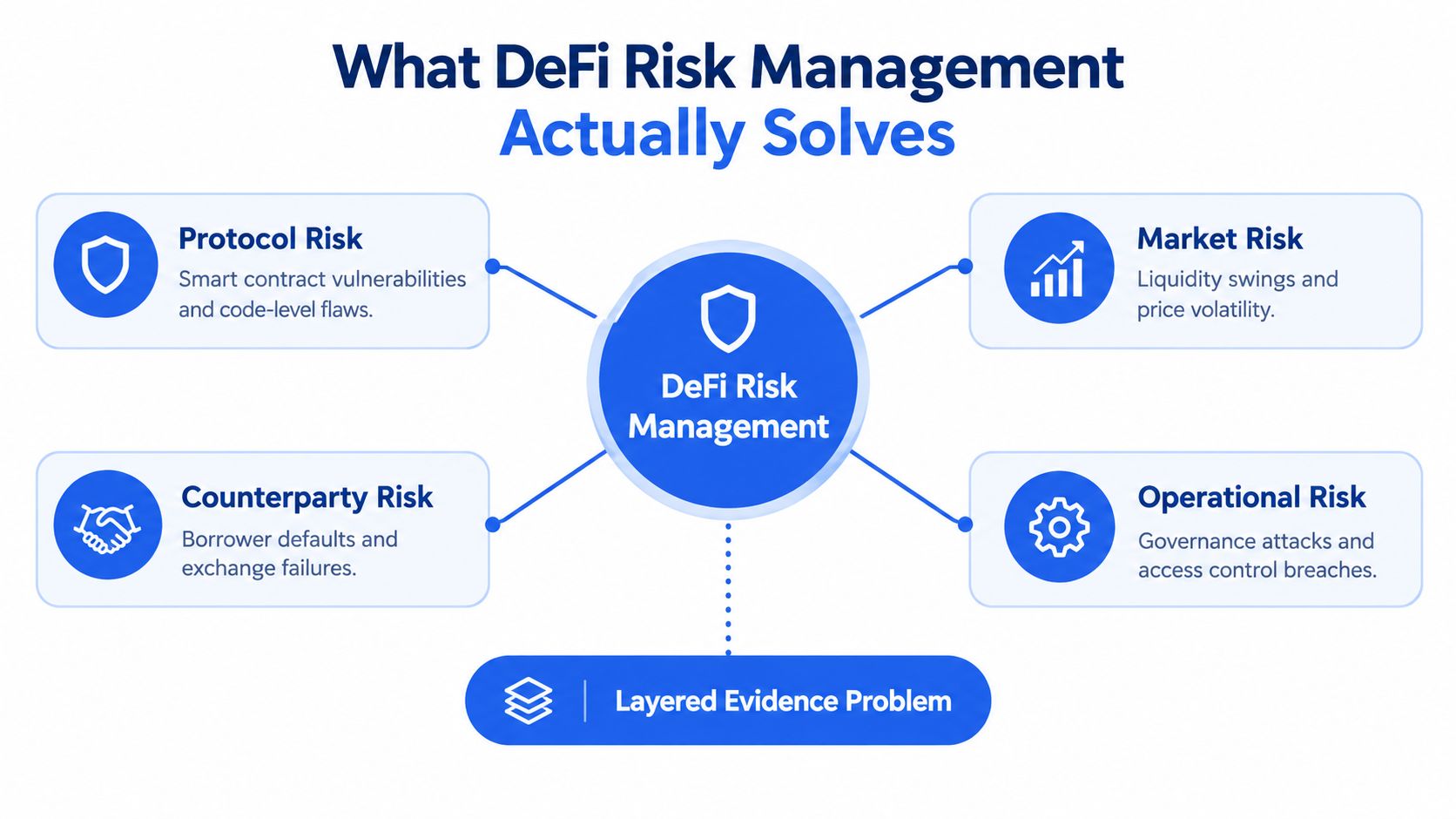
Table of Contents
- What DeFi Risk Management Actually Solves
- Smart Contract and Code-Level Risk
- Access Control and Governance Risk
- Oracle Manipulation and Price-Feed Risk
- Liquidity, Counterparty, and Market-Structure Risk
- Screening Approaches Compared
- A Pre-Trade and Pre-Deposit Checklist
- What Defi Risk Management Looks Like in 2026
What DeFi Risk Management Actually Solves
Many teams approach DeFi risk management as if it were a yes-or-no label. The job is narrower and more useful, it shows where a protocol can fail, who can change the rules, how a price feed behaves under stress, and whether liquidity is deep enough to absorb a trade without distorting execution. The loss record makes that clear.
In 2022, attackers stole about $3.1 billion from DeFi protocols, and the broader crypto ecosystem lost about $3.8 billion to hacking that year Chainalysis 2022 hacking review. October alone saw $775.7 million in losses across 32 attacks, so risk tends to cluster in bursts rather than move in a smooth background pattern. If you treat that history as one generic “security climate,” you miss the operational point, because the failure mode depends on the layer being attacked.
Practical rule: a protocol can look fine in isolation and still be exposed through the bridge, the oracle, the admin key, or the trade path.
Separate the failure layers
A useful model splits DeFi risk into technical, operational, economic, and compositional risk. Technical risk is the code itself, operational risk is who can upgrade, pause, or withdraw, economic risk is how prices and liquidity behave, and compositional risk is what happens when protocols depend on each other.
That distinction matters because aggregate loss totals can hide the mechanism. Chainalysis reported that in 2023, the median loss per DeFi hack fell by 7.4% and the number of DeFi hacks fell by about 17%, even though losses remained material Chainalysis 2023 stolen funds review. Frequency, attack type, and exposure concentration are separate variables, and DeFi risk management has to read all three.
The right output is a decision process that shows which layer is most fragile before you commit capital, approve a token, or deposit into a yield strategy.
Smart Contract and Code-Level Risk
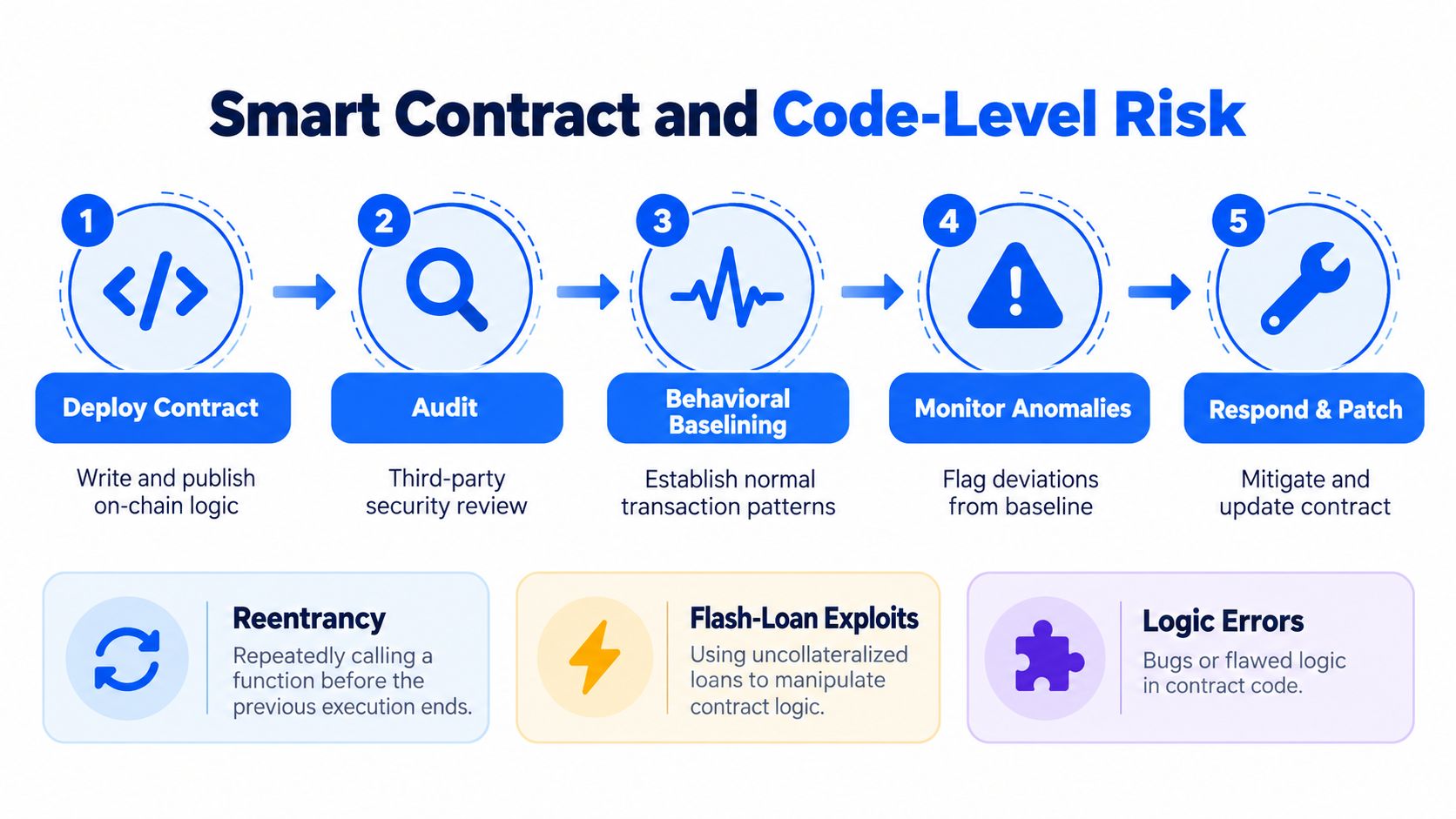
Code-level risk is the layer traders usually inspect first. It covers reentrancy, flash-loan exploits, and logic errors, but the more useful test is whether a contract's live behavior matches its normal control flow once funds start moving.
A behavioral baselining study of 37 hacked DeFi protocols found that benign transactions usually follow a limited set of unique control flows, while attack transactions introduce novel, previously unobserved flows behavioral baselining study. That finding matters because many exploit paths remain technically valid until the exact moment they are used. An audit can confirm that a bug class exists in the source code. Runtime behavior shows whether the contract has entered a path healthy users almost never reach.
What novelty looks like on-chain
A serious screen for smart-contract risk should track:
- First-seen instruction sequences, because unusual call order often marks a path normal users do not reach.
- Unexpected authority changes, because privilege shifts often come before asset movement.
- Rapid multi-step withdrawals, because attackers often chain actions to drain value before defenders react.
- Unusual transaction size patterns, because exploit traffic often differs from ordinary user activity.
These signals become more useful when paired with pre-transaction simulation and runtime monitoring. Simulation can show whether the intended call path looks dangerous before signing. Monitoring can catch a transaction that becomes suspicious only after a specific branch is reached. Neither one proves an exploit is happening, but both are better than assuming an audit has closed the issue.
A strong code review lowers uncertainty. It still leaves the question of what the contract actually does when a transaction hits the chain.
For Solana token workflows, the same logic extends to contract-checking tools such as MemeAssist Solana contract analysis. Token-level screening should look for behavioral evidence rather than a static label confirming the code exists.
Access Control and Governance Risk
Access-control failures now deserve more attention than many teams give them. Hacken reported more than $3.1 billion in crypto losses in the first half of 2025, and access-control exploits accounted for about 59% of those losses, or roughly $1.83 billion Hacken and Cointelegraph coverage. The point is not that code risk disappeared. A protocol can have solid code and still be structurally exposed if one compromised signer, one privileged role, or one opaque emergency path can move funds.
The failure mode is usually basic, which is why it persists. A leaked private key can open an emergency-withdrawal function. A single-owner upgrade path can rewrite assumptions after users deposit. An undocumented administrative backdoor can turn a maintenance tool into a draining mechanism.
What to inspect, not just what to assume
The concrete questions are simple:
- Who can change the contract today?
- Is the upgrade key multisig-controlled?
- How quickly can a compromised admin drain funds?
- What stops an emergency function from becoming a de facto backdoor?
Those questions matter because governance language often sounds safer than it is. A documented emergency mechanism is not the same as a privileged control that can be abused at any time. As the behavioral baselining study noted earlier, and as the New York Fed has also warned, a DeFi exploit can create direct user losses, then spread into reputation damage, lower total value locked, weaker fee generation, and pressure on the governance token's market value.
What evidence separates governance from control
The evidence should be observable. Look for multisig structure, timelock behavior, role distribution, and the set of functions a privileged account can call. If the chain shows a small number of addresses that can rewrite permissions, pause withdrawals, or expand execution rights without meaningful delay, the protocol carries operational risk even if the underlying code is clean.
Contrarian takeaway: a technically sound contract can still be a poor risk if its administrative controls are weak, concentrated, or hard to verify.
Governance is one of the primary attack surfaces in DeFi risk management.
Oracle Manipulation and Price-Feed Risk
Oracle risk sits at the point where technical design meets economic reality. Lending and derivatives protocols often use an oracle price as if it were truth, which means a distorted feed can corrupt collateral valuation, liquidation logic, or settlement. That's why oracle manipulation shows up so often in DeFi incident discussions, especially around lending systems.
The practical issue is simple. A protocol should not trust a single spot price or a shallow-liquidity pool when its risk engine depends on that price being hard to move. It should compare independent venues, define acceptable deviation bands, and stop new borrowing or liquidations when the feed becomes stale or abnormal.
Why TWAPs help, and why they don't solve the problem
Time-weighted average prices reduce sensitivity to a one-block shock, but they don't make manipulation go away. An ETH Zurich analysis challenges the assumption that longer TWAP windows always make manipulation proportionally harder, because a single-block attack can be cheaper than a conventional multi-block attack, and collusive multi-block proposer behavior can reduce manipulation costs sharply ETH Zurich analysis. That changes how you should think about oracle safety.
The right question is not, “Is there a TWAP?” The right question is, “How easy is it to move the price within the intended window, given current depth and venue concentration?” Liquidity depth, trade-size impact, and source diversity are coupled variables. If one of them is weak, the oracle is weaker than it looks.
| Oracle Risk Controls and What They Catch | What it stops | Residual risk |
|---|---|---|
| Independent venue comparison | Single-source distortions | Correlated venue moves |
| Deviation thresholds | Sudden feed jumps | Slow manipulation |
| Liquidity caps on borrowing | Over-collateralization against thin markets | Borrower behavior after approval |
| Staleness checks | Use of old prices | Brief manipulation inside freshness window |
| Pausing new borrowing or liquidations | Trading through an abnormal feed | Delay before operator response |
A good oracle policy is not a price prediction model. It's a set of guardrails that prevents a distorted price from becoming an authoritative one too quickly.
Liquidity, Counterparty, and Market-Structure Risk
Some of the most dangerous risk in DeFi isn't inside the contract at all. It's in the market structure around the trade. Liquidity depth, holder concentration, creator behavior, wallet clustering, and bundle activity can all change exposure faster than a static “safe” label can react. The reason is straightforward, concentrated liquidity can move price hard, and coordinated wallets can do damage without looking noisy at a glance.
That matters for meme coins and for broader DeFi positions. A token's displayed price or trading volume says very little if most of the supply sits in a handful of wallets or if the available liquidity can't absorb a real order. A stable-looking chart can hide a brittle market.
Read the token as a set of linked signals
A better workflow starts by pairing distribution evidence with execution evidence:
- Holder concentration tells you whether a few wallets can dominate supply.
- Creator behavior tells you whether the deployer or associated wallets have history that deserves scrutiny.
- Wallet activity shows whether related addresses are moving together.
- Trading patterns reveal bundles, insider timing, or unusual burst activity.
- Liquidity conditions show whether the market can absorb size without a large price impact.
Those signals don't replace one another. They compound. A token can have active trading and still be fragile if the liquidity is thin and the holder base is concentrated. It can also look healthy on a chart while creator-linked transfers or coordinated wallets suggest an exit path is already forming.
For Solana traders, a token analyzer such as MemeAssist Solana liquidity screening operationalizes that same logic by combining live checks across liquidity, holders, creator behavior, wallet activity, trading patterns, and historical risk indicators. That approach matters because it treats token safety as a bundle of evidence, not a single score.
The practical lesson is that market structure can change within minutes. A liquidity pull, a coordinated bundle, or a sudden creator-linked transfer is enough to re-rate the trade, even if nothing changed in the contract code.
Screening Approaches Compared
Three screening habits dominate retail DeFi due diligence, and each answers a different question. Static audits ask whether the code has been reviewed. TVL snapshots ask whether capital has clustered around the protocol. Behavioral baselining asks whether recent on-chain activity still resembles ordinary use.
The error is treating one of them as a substitute for the others.
What each approach catches
Static audits are useful for surfacing known code flaws and unresolved findings. They are weaker on live governance changes, oracle degradation, and market conditions that shift after deployment. TVL-based reputation helps identify where capital has clustered, but it can also create false comfort, because capital can arrive before a flaw is exploited and leave after conditions change.
Behavioral baselining is better at catching the on-chain oddities that precede real losses. Medians matter here too. As noted in the Chainalysis 2023 review cited earlier, contagion-related on-chain attacks had a median loss of about $1.4 million, while governance attacks, insider attacks, and compromised private keys each had median losses near $1 million. That spread shows why a single security label is too blunt. Different attack families leave different traces.
Recent incidents point to the same gap. The Typus Finance case reportedly involved access-control abuse in a custom price oracle, while Garden Finance reportedly lost about $11 million after an attacker targeted a single solver across multiple chains Halborn October 2025 review. An audit can catch some code problems in those systems. It will not necessarily show whether the live control path, solver dependency, or oracle architecture is fragile under actual trading conditions.
What a layered workflow looks like
A useful workflow combines:
- Code review and audit scope, to identify structural defects.
- Governance inspection, to see who can upgrade, pause, or change policy.
- Oracle checks, to verify source diversity and feed stability.
- Liquidity and holder analysis, to assess market fragility.
- Behavioral monitoring, to catch novel control flows and suspicious execution paths.
On-chain scanners, incident databases, and token analyzers fill different parts of the same evidence model. For Solana traders, a token analyzer such as MemeAssist Solana liquidity screening extends that logic by combining live checks across liquidity, holders, creator behavior, wallet activity, trading patterns, and historical risk indicators.
A Pre-Trade and Pre-Deposit Checklist
The most practical DeFi risk management habit is to run the same question set every time capital moves. Before you approve a token, enter a position, or deposit into a yield product, treat the decision as a four-layer review, not a gut feel.
The checklist
- Code-level evidence: confirm the audit scope, look for unresolved findings, and check whether transaction behavior matches normal control-flow patterns.
- Operational evidence: verify who can upgrade the contract, who controls emergency functions, and whether privileged actions require multisig approval or delay.
- Oracle evidence: inspect source diversity, deviation limits, freshness rules, and whether price depth is adequate for the trade size.
- Market-structure evidence: read holder concentration, creator-linked activity, bundle patterns, and liquidity depth together, not one at a time.
A useful rule is to re-run the screen after any suspicious event, because the risk state can change faster than a dashboard refresh. A withdrawal from a liquidity pool, a new authority change, or a strange burst of wallet activity should trigger a fresh review rather than a “wait and see” approach.
For meme coins, that workflow maps well to a tool that combines live on-chain evidence with an explicit post-flag review cycle. MemeAssist free Solana rug-check workflow is one example of how traders can turn a layered evidence model into a repeatable pre-trade habit. The broader point is not the tool itself. It's the discipline of making each layer visible before capital is at risk.
If one layer looks clean but another one looks opaque, you don't have a green light. You have an incomplete picture.
The fastest way to improve decisions is to stop asking whether a project is “safe” and start asking which evidence is missing.
What Defi Risk Management Looks Like in 2026
The open problems are now pretty clear. Composability risk remains hard because cross-protocol dependencies can fail in sequence. MEV-driven extraction can interact with price and oracle manipulation in ways that simple audits won't capture. Access-control failures still cause outsized damage because one privileged action can overrule a lot of good code.
The next generation of DeFi risk management will need to focus on live signals, not static confidence. Outcome-tracked flagging matters because a risk engine should learn from what later proved to be a real problem. Control-flow novelty detection still matters because the first unusual execution path often appears before the exploit is fully visible. Multisig and timelock evidence still matter because they are the clearest signs that operational authority is constrained. Oracle source diversity still matters because a feed that looks smooth can still be too easy to move.
The deeper shift is conceptual. DeFi risk management is no longer about proving a protocol is “decentralized enough” or “audited enough.” It's about deciding whether the current evidence says the trade path, the admin path, the oracle path, and the liquidity path all still support the same level of confidence. That's a moving target, which is why the process has to be ongoing surveillance rather than a one-time verdict.
If you want a token-level screen that applies this layered approach to Solana meme coins, MemeAssist evaluates live liquidity, holder concentration, creator behavior, wallet activity, trading patterns, and historical risk signals in one report. Use it as part of a pre-trade check, then revisit the analysis when the chain shows a new transfer, a liquidity shift, or a suspicious burst of activity.