Degen Coin Flip Explained: Odds, Risk, and Smarter Plays
Learn what a degen coin flip really is on Solana, how fees and liquidity change the odds, and how to evaluate meme-coin trades with a calmer playbook.
Published
Updated
A degen coin flip on Solana is rarely a fair 50/50 wager once fees, liquidity depth, holder concentration, and the trader's own behaviour are included. The original Degen Coin Flip recorded 9,965,362 flips, 8,583,384.36 SOL in volume, and 289,848.76 SOL in fees, but those figures describe activity, not a guarantee of fair or profitable outcomes.
The most popular advice is usually some version of “do your research, read the chart, and move faster.” That advice misses the central problem. A degen coin flip can fail before chart analysis matters, because the trader may be paying a fee, entering a shallow pool, competing with bundled transactions, facing concentrated holders, or trading while trying to recover a previous loss.
The useful reframe is simple: “coin flip” is often a mood, not a probability. In this article, the phrase covers three separate risk layers, protocol economics, execution and liquidity, and personal behaviour. If you can't name the fee, the available depth, and your exit rule, you don't know your odds. For a practical starting point, use this Solana token buying checklist before treating a fast-moving token as a simple binary opportunity.
Table of Contents
- What a Degen Coin Flip Really Is
- The Original Degen Coin Flip Protocol on Solana
- How Fees and Volume Reshape the Odds
- Execution Risk From Bundles and Sandwich Attacks
- Liquidity Manipulation and the Two Definitions of a Rug
- Why Better Tools Cannot Fix a Behavioural Coin Flip
- A Worked Example for a Single Meme Trade
- A Calmer Playbook for Your Next Trade
What a Degen Coin Flip Really Is
A degen coin flip sounds like a bet with two equally likely outcomes. In practice, Solana traders often use the phrase for a highly speculative meme-coin entry where the price could rise sharply or collapse quickly. The label describes the trader's attitude toward uncertainty, not a verified statistical probability.
That distinction matters because three independent mechanisms can tilt the result against the buyer.
The first layer is cost
Every swap has an economic cost. It may appear as a platform fee, a spread, price impact, or transaction expense. Even if the token moves in the expected direction, the trade still has to overcome those costs before it becomes profitable.
The second layer is execution
A displayed quote isn't necessarily the price you receive. Pool depth, slippage settings, priority fees, transaction routing, and coordinated activity can change the result between signing and settlement. A trader may correctly identify demand and still receive a poor entry or an even worse exit.
The third layer is behaviour
A trader who increases size after a loss, chases a rapidly rising chart, or keeps entering because the last trade failed can turn a manageable risk into a repeating gambling pattern. Better wallet tracking doesn't remove that exposure.
Practical rule: Treat “50/50” as an unverified claim until you've checked the cost, executable liquidity, holder distribution, and your own reason for entering.
This framework also prevents a common category error. A legitimate on-chain wagering protocol has explicit rules, while a meme-token trade has changing liquidity, uncertain counterparties, and market-dependent execution. Both may feel like coin flips, but their risks are not identical.
The Original Degen Coin Flip Protocol on Solana
The term has a specific historical reference. Degen Coin Flip, or DCF, is a Solana-based on-chain gambling application rather than a conventional meme coin, and Solana Compass describes its launch in 2021 and its double-or-nothing game.
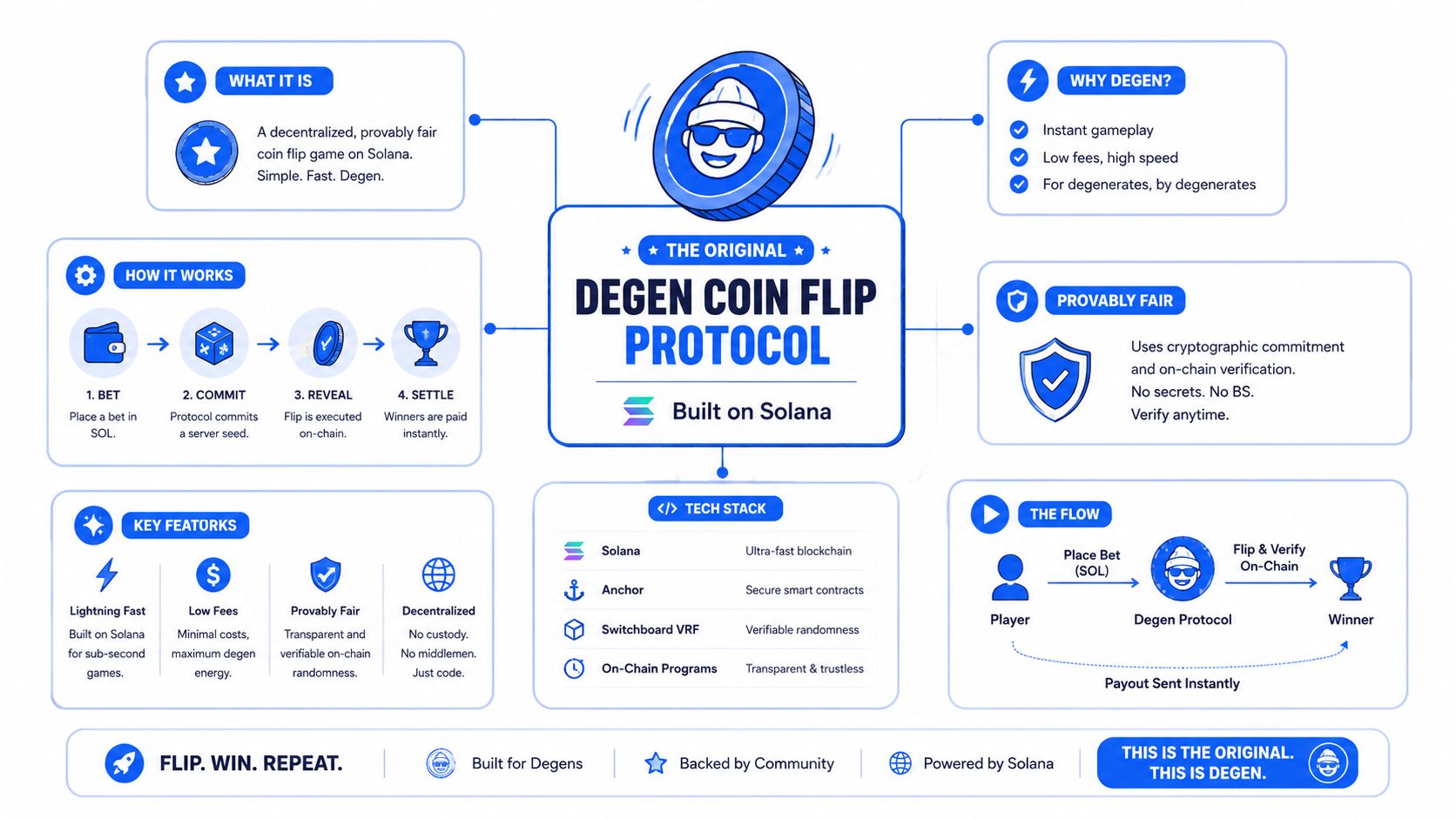
The core game used nominal 50/50 odds, but the platform deducted a 3.5% fee from winning payouts, so the advertised probability wasn't equivalent to a mathematically fair wager after costs. A player repeatedly staking 1 SOL could expect a gross return of 1 SOL before fees under the stated odds, while the fee reduced the expected net result.
DCF was non-custodial. Users wagered SOL directly from their wallets, and a smart contract handled settlement and payouts. Each game was recorded on Solana, allowing transactions and outcomes to be inspected with a block explorer. That design created a transparent record of activity, but transparency didn't remove the economic disadvantage created by the fee.
Why the distinction matters
The 2022 project NFT description confirmed the same 50/50 structure and 3.5% fee, with proceeds distributed to NFT holders. Those mechanics identify DCF as an early Solana-native wagering protocol, not just a token with an aggressive name.
Later Solana meme-token launches may borrow “degen” branding without sharing DCF's contract, game, settlement model, or fee structure. Before researching a token, identify which meaning applies:
- DCF protocol: A defined on-chain wager with smart-contract settlement and a stated fee.
- Meme-token slang: A speculative market trade whose outcome depends on liquidity, execution, token control, and behaviour.
- Marketing language: A name that may create an association without establishing any technical connection.
That separation prevents readers from importing the original protocol's apparent simplicity into an unrelated token launch. A meme coin isn't automatically a 50/50 wager because its chart looks binary.
How Fees and Volume Reshape the Odds
A fair coin flip can still produce a losing expected result when the operator takes a fee. DCF makes that visible because its stated game mechanics and public activity data can be examined separately.
The unofficial Dune dashboard for Degen Coin Flip reported 9,965,362 recorded flips, 8,583,384.36 SOL in cumulative volume, 289,848.76 SOL in total fees, and 85,986 unique players over its tracked period. It also reported negative house overall profits of 13,704.37 SOL. The dashboard identified itself as unofficial and not associated with the Degen Coin Flip team, so these are historical analytics, not live totals or audited financial statements.
The fee total divided by volume implies an average rate of approximately 3.38%, broadly consistent with the stated 3.5% fee after rounding or differences in dashboard accounting. The important point isn't that one figure perfectly verifies another. It's that a platform can have enormous recorded volume while fees, player count, and house profit tell different stories.
Reading the dashboard without mixing signals
| Metric | Reported value | What it tells you |
|---|---|---|
| Recorded flips | 9,965,362 | How many game outcomes the dashboard tracked |
| Cumulative volume | 8,583,384.36 SOL | The amount wagered across those tracked games |
| Total fees | 289,848.76 SOL | The fee flow recorded by the dashboard |
| Unique players | 85,986 | The number of distinct players represented |
| House overall profit | -13,704.37 SOL | The tracked net result for the house, not player profitability |
Volume measures activity, not quality. A large player count doesn't prove that individual participants had positive expected returns. Likewise, negative house profit doesn't turn the wager into a safe opportunity for a new player, because variance and fee treatment still matter.
For a 1 SOL stake under nominal 50/50 odds, the gross expected return is 1 SOL before fees. Once the platform deducts its fee from winning payouts, the expected net outcome becomes negative. Repeated play makes that cost more important, because the player keeps paying for exposure to the same disadvantage.
The portable lesson is to keep volume, fees, player count, and house profit in separate columns. They answer different questions and shouldn't be collapsed into one popularity score.
Execution Risk From Bundles and Sandwich Attacks
A trade can be directionally correct and still lose money because it lands at the wrong price. On Solana, transaction ordering and routing create an execution layer that sits between the trader's decision and the final result.
Solana MEV infrastructure supports atomic bundles of up to five transactions, executed sequentially and all-or-nothing. The technical explanation of Solana Jito bundles and transactions describes how this structure can support launch sniping, arbitrage, and coordinated setup-and-exit strategies.
What sandwiching means
A sandwich attack places economically related transactions around a victim's market order. The first transaction can move the price before the victim's purchase, while the later transaction benefits from the price movement caused by that purchase. The victim receives worse execution than the displayed quote.
Solana's direct transaction-forwarding design reduces, but doesn't eliminate, the public-mempool exposure seen on some other chains. A thin pool remains vulnerable to poor execution even without a textbook sandwich, because a moderately sized order can consume available liquidity and move the price.
Execution rule: A market-cap quote is not actionable until you compare your intended position with executable liquidity.
Before entering, log the conditions that determine whether the quote is usable:
- Pool reserves: Record both sides of the trading pool, not just the token's displayed market cap.
- Expected price impact: Estimate how much your order moves the pool before submitting it.
- Slippage tolerance: Set a cap that rejects an unexpectedly poor fill instead of accepting any available price.
- Priority fee: Note whether your transaction is paying for faster inclusion and whether that changes the trade's economics.
- Landing route: Record how the transaction reached the chain and whether bundled activity appeared nearby.
- Wallet synchronisation: Check whether rapid buys arrive from related wallets or in coordinated patterns.
A trader can review more detail in this guide to checking whether a Solana token is bundled. The objective isn't to predict every transaction. It's to stop treating sequential buying as proof of independent organic demand.
Liquidity Manipulation and the Two Definitions of a Rug
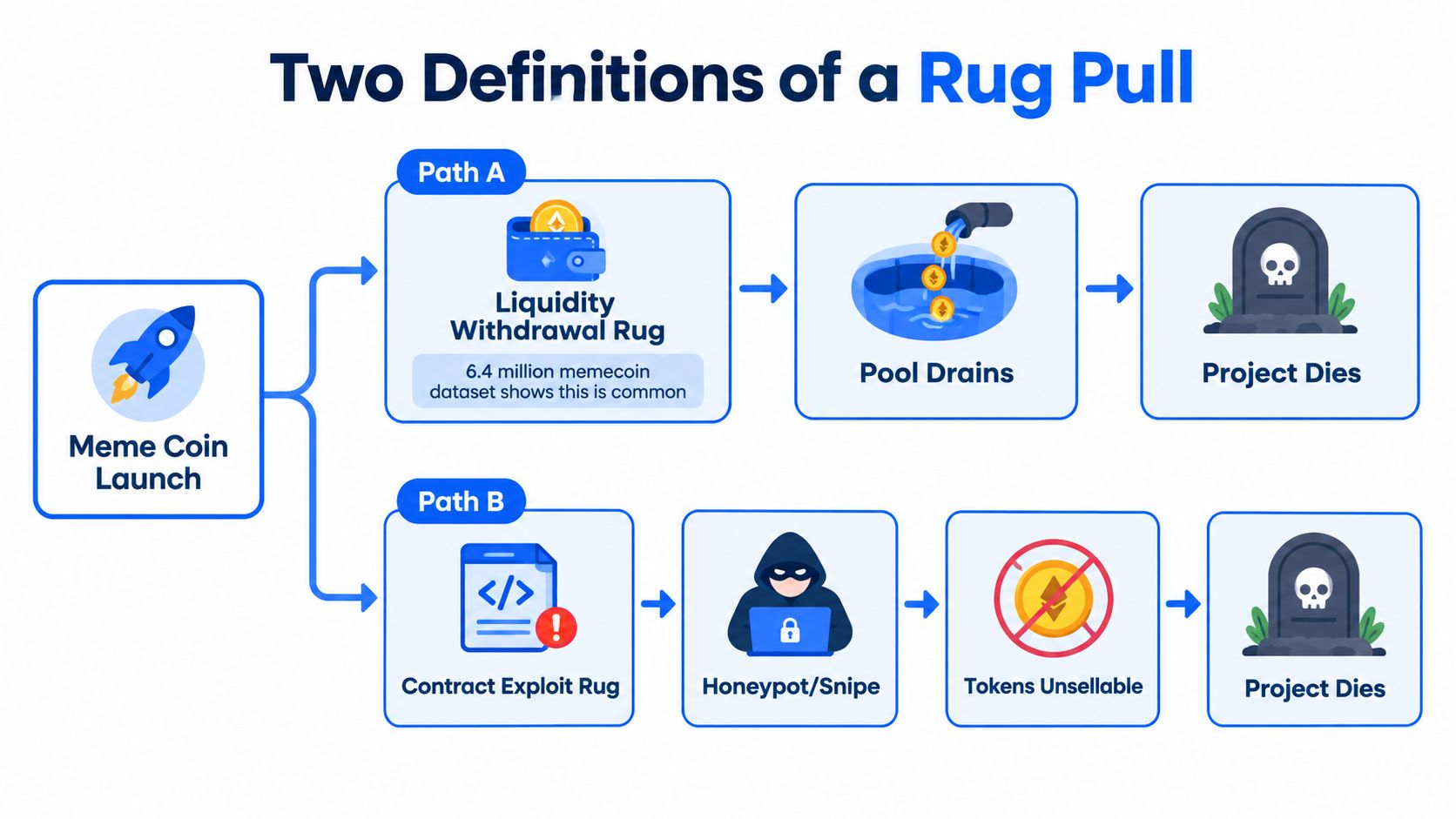
A rug pull has two practical meanings on Solana. The first is a direct liquidity withdrawal, where holders lose access to the pool that supports trading. The second is trading cessation, where the token remains live but buyers disappear and selling becomes economically impractical.
Recent research examines this distinction across millions of Solana memecoins in a preprint, separating outcomes into liquidity withdrawal and trading cessation. The categories describe different failure mechanisms. One measures what happens to withdrawable pool liquidity. The other captures a market that still displays a balance but no longer provides a realistic exit.
A balance is not the same as an exit
Read liquidity as a moving record, not a screenshot. Compare pool reserves with the size of your intended trade, check who controls the liquidity position, and trace whether creator-linked wallets can affect supply or the pool.
Holder concentration matters here for a specific reason: it connects token ownership to sell-side pressure. Review the creator and deployer wallets, early funded accounts, and top non-exchange holders. A useful signal is shared funding. If several large wallets received their first SOL from the same source, bought in the same launch window, or move tokens between related addresses, treat their balances as potentially coordinated rather than independent ownership.
Follow this investigation sequence:
- Track liquidity over time. A stable snapshot can conceal rapid withdrawals.
- Compare your exit with reserves. Ask whether the trade would consume a meaningful share of either pool side.
- Check control rights. Confirm whether a wallet or small wallet group can remove or modify liquidity.
- Map wallet relationships. Look for common funders, creator links, and synchronized transfers.
- Stress the exit. Model a 10–20% price decline against current reserves and calculate the resulting price impact.
Suppose a 5 SOL sale would materially shift the pool. The trade then has more than a price-direction problem. Its upside depends on buyers still arriving, while its downside can worsen sharply if liquidity is removed or activity stops. That is why a degen coin flip fails as a 50/50 model in three separate ways: behaviour can distort the decision, execution can worsen the fill, and token control can undermine the exit.
Use an exit-liquidity check for Solana tokens to test the price you could receive before treating a displayed balance as available liquidity.
Why Better Tools Cannot Fix a Behavioural Coin Flip
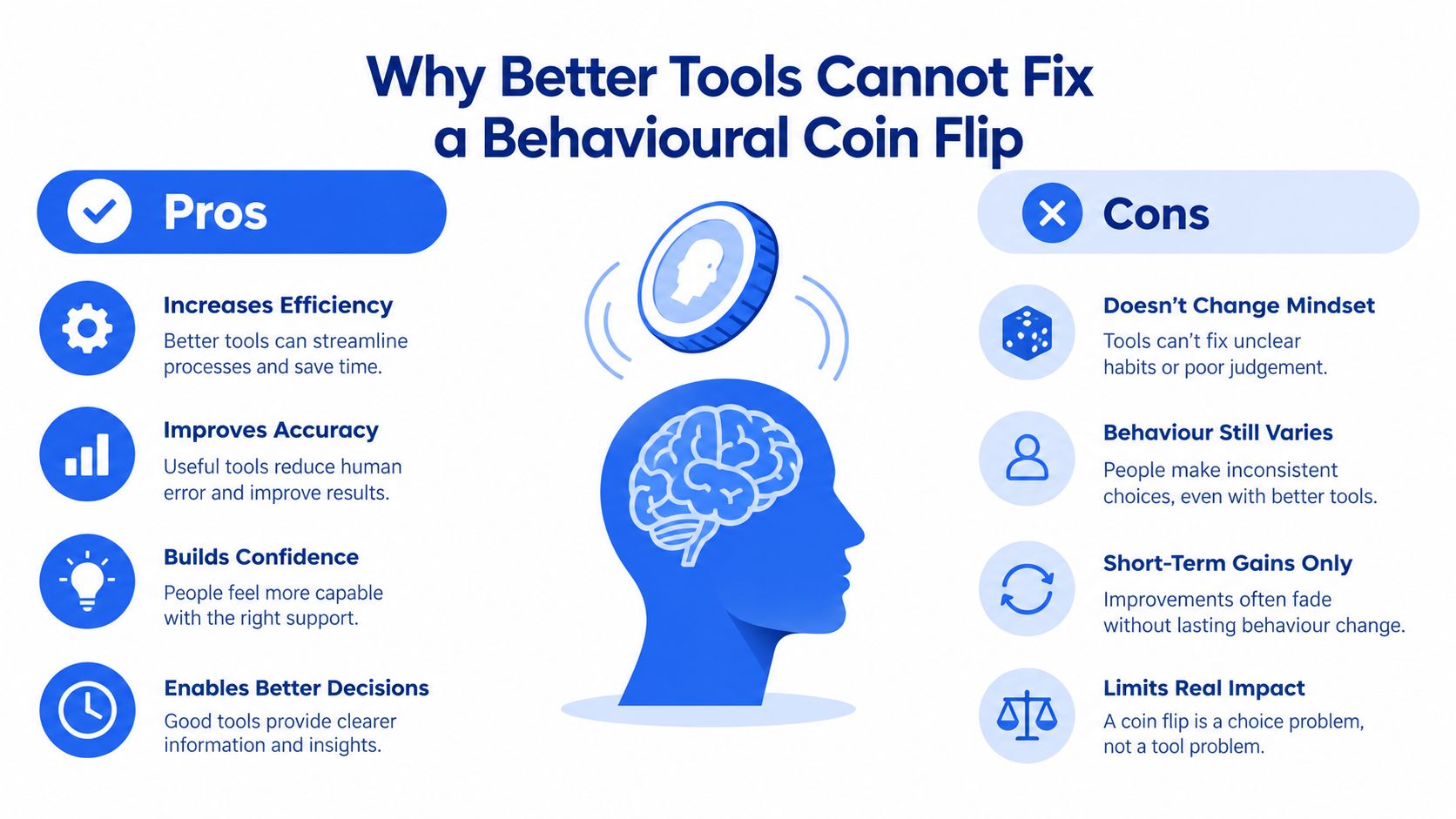
Sharper charts and faster wallet alerts can improve information. They can't decide whether you're trading an affordable risk or trying to repair an emotional state through another position.
A 2025 study of cryptocurrency traders found that 33.7% met criteria for problematic gambling, 33.9% were classified as at-risk, and 32.4% as non-problematic. The study also found coping motivation predicted problematic gambling with an odds ratio of 4.47. These findings come from the published study of cryptocurrency traders, not from analysis of one specific Solana token.
The questions a chart can't answer
Before opening a position, ask questions that measure behaviour rather than market skill:
- Loss limit: What is the maximum affordable loss for this trade?
- Frequency: Will increasing trade frequency expose you to more fee, execution, and liquidity risk?
- Motivation: Am I trading because I found a defined setup, or because I need to change how I feel?
- Loss chasing: Am I trying to recover the last loss immediately?
- Stopping ability: If I decide to stop after this trade, will I stop?
- Position size: Would a full loss affect rent, debt payments, savings, or other essential obligations?
A technically safer token can still be an unsafe trade if the position is oversized, increased in size, or opened after revenge trading. The token's contract and liquidity answer one class of questions. They don't answer whether the trader can follow a loss rule.
Better information can reduce uncertainty about the market. It can't remove the uncertainty inside the decision-maker.
Treat repeated urgency as a risk signal. If every chart looks like the last chance, if the planned size rises after a loss, or if stopping feels impossible, the appropriate response isn't another analytics dashboard. It's to reduce exposure or step away.
A Worked Example for a Single Meme Trade
Consider an imagined trade, not a historical case. A trader sees a new Solana meme token and plans to buy 5 SOL in a thin-liquidity pool.
The first concern is cost. The trader isn't using the original DCF wagering protocol, but the swap still carries a 3.5% DEX spread in this scenario. That cost must be recovered before the token produces a net gain.
Execution adds more warning signs. The trader detects Jito bundle activity near the entry block, caps slippage at 2%, and compares the intended position with the pool's reserves. A capped slippage setting helps reject a worse fill, but it doesn't make a thin pool deep. The trader still needs to know whether the transaction can land and whether the same wallets are coordinating around the entry.
Liquidity and ownership make the position more fragile. The top 10 holders control 38% of supply, liquidity isn't locked, and the exit stress test shows 14% price impact on a 5 SOL sell. Those figures are assumptions for this worked example, so they illustrate the method rather than describe a real token.
The behaviour layer changes the decision
The trader has already made a 3 SOL loss and this would be the fourth trade of the day. That context matters as much as the token checks. A trader who would normally risk less may now be attempting to recover the previous loss through a larger, faster entry.
| Risk layer | Observation | Decision pressure |
|---|---|---|
| Cost | 3.5% DEX spread | The trade needs a larger move to break even |
| Execution | Bundle activity near entry, 2% slippage cap | The quoted entry may not be available |
| Liquidity | 14% impact on a 5 SOL exit | Selling can move the price sharply |
| Ownership | Top 10 holders control 38% | Concentrated selling can overwhelm buyers |
| Behaviour | Fourth trade after a 3 SOL loss | Revenge-trading risk is elevated |
The composite answer isn't “the chart looks good, so enter.” The trader could skip, reduce size, or wait until the emotional pressure passes. If the trade only works when all optimistic assumptions hold, it isn't a clean coin flip. It's a stack of correlated risks with an exit that may be difficult when the trader needs it most.
A Calmer Playbook for Your Next Trade
A degen coin flip becomes more measurable when you separate the questions. Protocol cost tells you what the wager or swap takes. Execution and liquidity tell you whether the displayed opportunity can be entered and exited. Token control tells you who can influence supply or the pool. Behaviour tells you whether you're likely to follow the plan after the price moves against you.
Log the following before each entry:
- Pool reserves: Compare trade size with executable depth.
- Slippage cap: Set the maximum acceptable fill.
- Holder concentration: Identify creator-linked and concentrated wallets.
- Liquidity control: Check whether liquidity is locked or removable.
- Bundle activity: Look for coordinated transactions near entry.
- Maximum loss: Define the amount you can afford before submitting.
- Time stop: Decide when you'll stop monitoring or close the trade.
These checks don't create a winning probability. They create a clearer decision and expose conditions that the phrase “coin flip” hides. Due-diligence tools can organise live evidence, but they can't override position sizing, an exit rule, or the need to stop trading when the motivation becomes loss recovery.
Before your next Solana entry, write down the fee, depth, holders, and personal exit rule in plain language. If you can't complete that sentence, skipping the trade is more disciplined than guessing.
MemeAssist turns live Solana data into token risk reports covering liquidity, holder concentration, creator behaviour, wallet activity, bundle signals, and trading patterns. Use MemeAssist to review the evidence behind a token before you commit capital, then pair the report with your own loss limit and stopping rule.