Front Running Bot Crypto: How MEV Bots Steal Your Trades
Learn how front running bot crypto activity works on Solana and Ethereum, how to detect sandwich attacks on-chain, and how to reduce your MEV exposure.
Published
Updated
More than $675 million had already been extracted through Ethereum maximal extractable value before September 2022. A remeasurement study counted about 9.4 million MEV activities in that market, 6,331,851 of them arbitrage and 3,016,971 sandwich attacks. Arbitrage and sandwiching together were more than 99% of recorded MEV from 4 May 2020 to 23 March 2022, in that large Ethereum remeasurement.
A front running bot crypto searcher isn't a lone scammer in a chat room. It's an automated trader that reads order flow and pays to land first. On Solana meme coins the same contest shows up as bundles, tips, and attacks that can stretch past a single slot. A bad fill might be a sandwich. It might also be ordinary price impact in a thin pool. The difference is evidence, and the useful protection question is expected loss, not a slogan about lowering slippage.
Table of Contents
- What a Front Running Bot Actually Does
- How Sandwich Attacks Work Inside the Mempool
- Why Solana Front Running Looks Different
- How to Detect Front Running from On-Chain Signals
- Choosing Your Protection Approach and Tools
- Real Cases and What the Numbers Show
- Building a Pre-Trade Routine That Limits Exposure
- Frequently Asked Questions About Front Running Bots
What a Front Running Bot Actually Does
A front-running bot uses transaction-ordering information to place its own trade before a pending victim trade, and it often reverses that position afterward.
That behaviour sits inside maximal extractable value, the profit available to whoever can include, exclude, or reorder transactions. Searchers run the bots. Builders and validators decide what enters a block. The public gap between your signature and confirmation is the window they compete over.
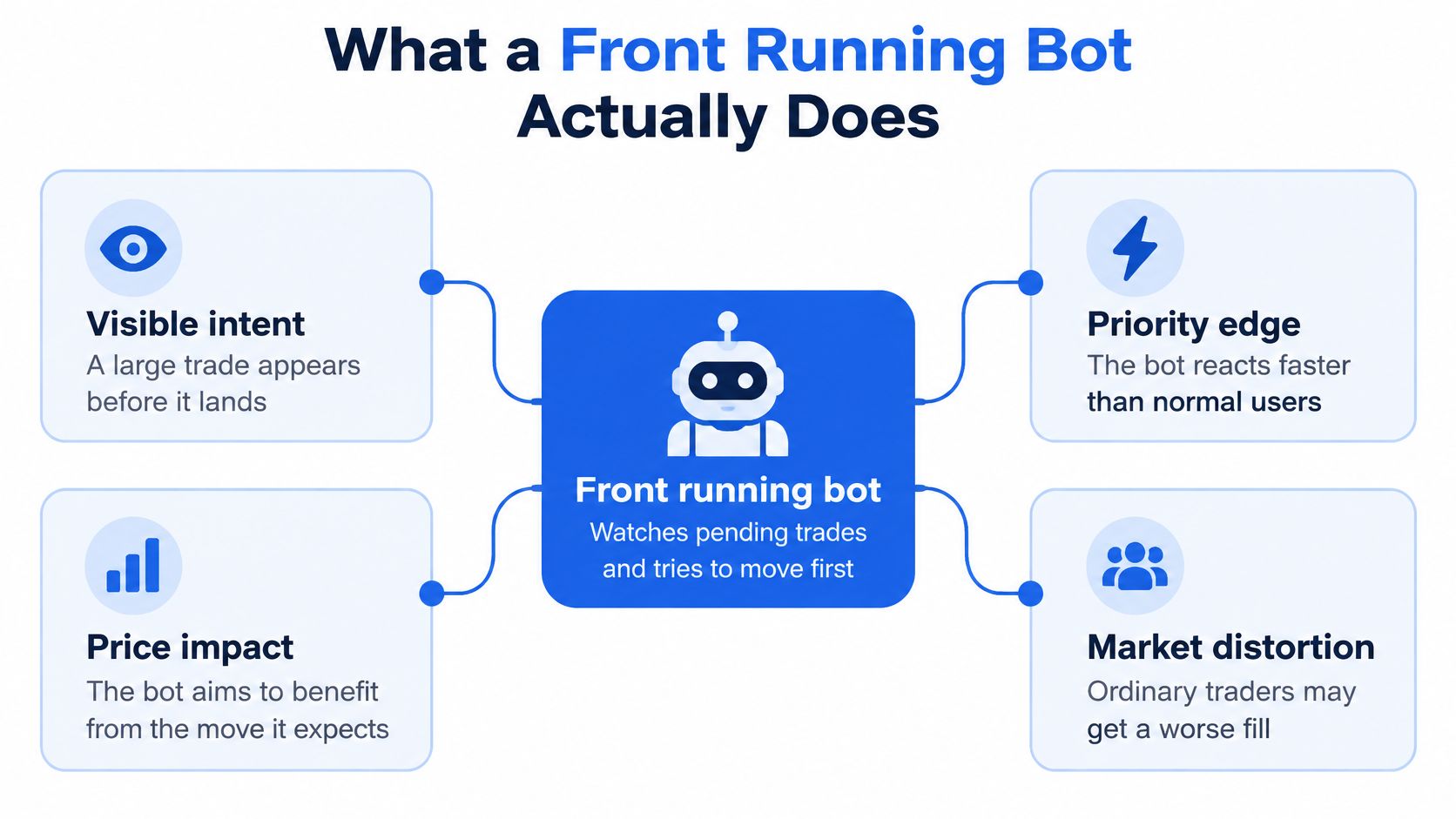
Visible intent becomes a price
On an automated market maker, a swap states size and direction before it changes the pool. If that statement is readable early, a bot can simulate the pool and decide whether cutting in front is worth the fee or the tip.
Three pieces have to line up.
- Visible intent: A trade is observable before it settles.
- Priority edge: The bot can buy earlier placement through a higher fee, a tip, or a private path.
- Induced move: The victim's own size is what the bot plans to sell into.
Practical rule: A swap that looks profitable on the quote is exposed whenever its details are visible before execution, and the exposure is sharpest in a low-liquidity pool where one trade can move the price by itself.
A market, not a rare scam
Ordering is a market, so this isn't an occasional exploit that vanishes when a chart "looks fine." Competition for position runs wherever pending flow is readable. You don't see the auction. You see a worse fill and blame the candle.
Treat that fill as something you can test: who traded, in what order, and whether someone booked a round trip around your swap.
How Sandwich Attacks Work Inside the Mempool
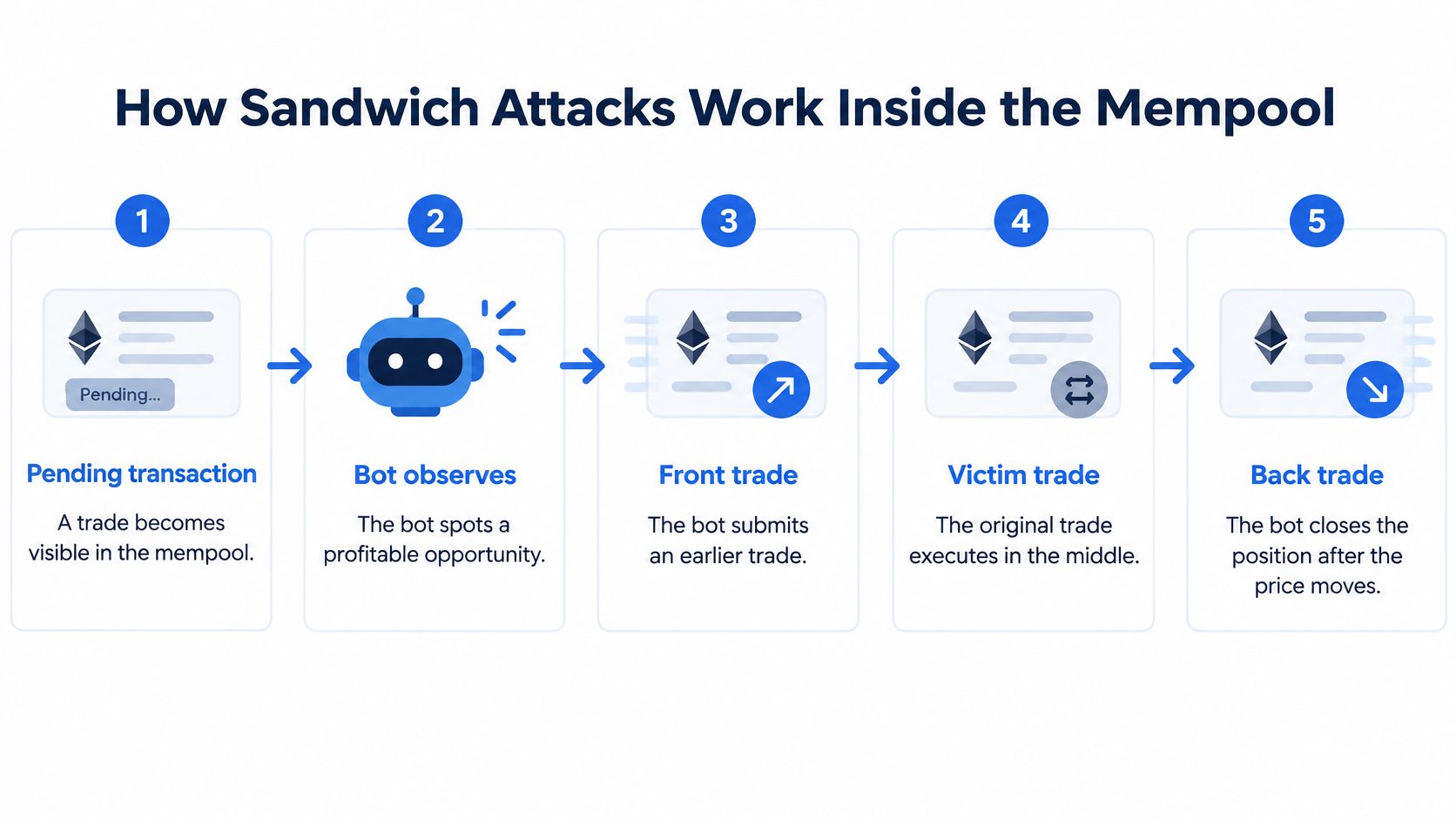
A sandwich is the common shape of that race on a constant-product pool. The bot buys before your swap, your swap lands at the worse price, and the bot sells into the move it helped create.
From the pending pool to the block
Your transaction doesn't execute when you click. It waits where builders can see it, then someone orders it into a block. A searcher simulates that pending swap against the pool. If the victim's size, the pool's depth, and the slippage limit leave room, the bot submits a buy that it wants placed first and a sell it wants placed just after.
The curve is simple. Reserves of the two tokens multiply to a constant, so buying one token makes the next buy more expensive. The victim therefore receives a worse execution price. The bot keeps part of the price change it induced, minus whatever it paid to win the ordering slot.
What makes the trade worth attacking
Research that formalized sandwiches found profitability depends on position inside the block, pool liquidity, victim trade size, slippage tolerance, and the attacker's ability to win priority. In an empirical Uniswap case, one adversarial trader generated average daily revenue of about $3,414 while targeting a DEX with more than $5 million in daily volume as of June 2020, in a formal study of sandwich attacks.
A pool attracts this pattern when the victim's order is large relative to depth, the slippage setting will still clear after the front buy, and the bot can lock both legs into the same ordering. Thin liquidity raises the victim's loss per unit the bot buys. It also leaves the bot holding inventory if the back leg fails. That inventory risk is why not every large pending swap gets sandwiched, even when the quote looks juicy.
Why Solana Front Running Looks Different
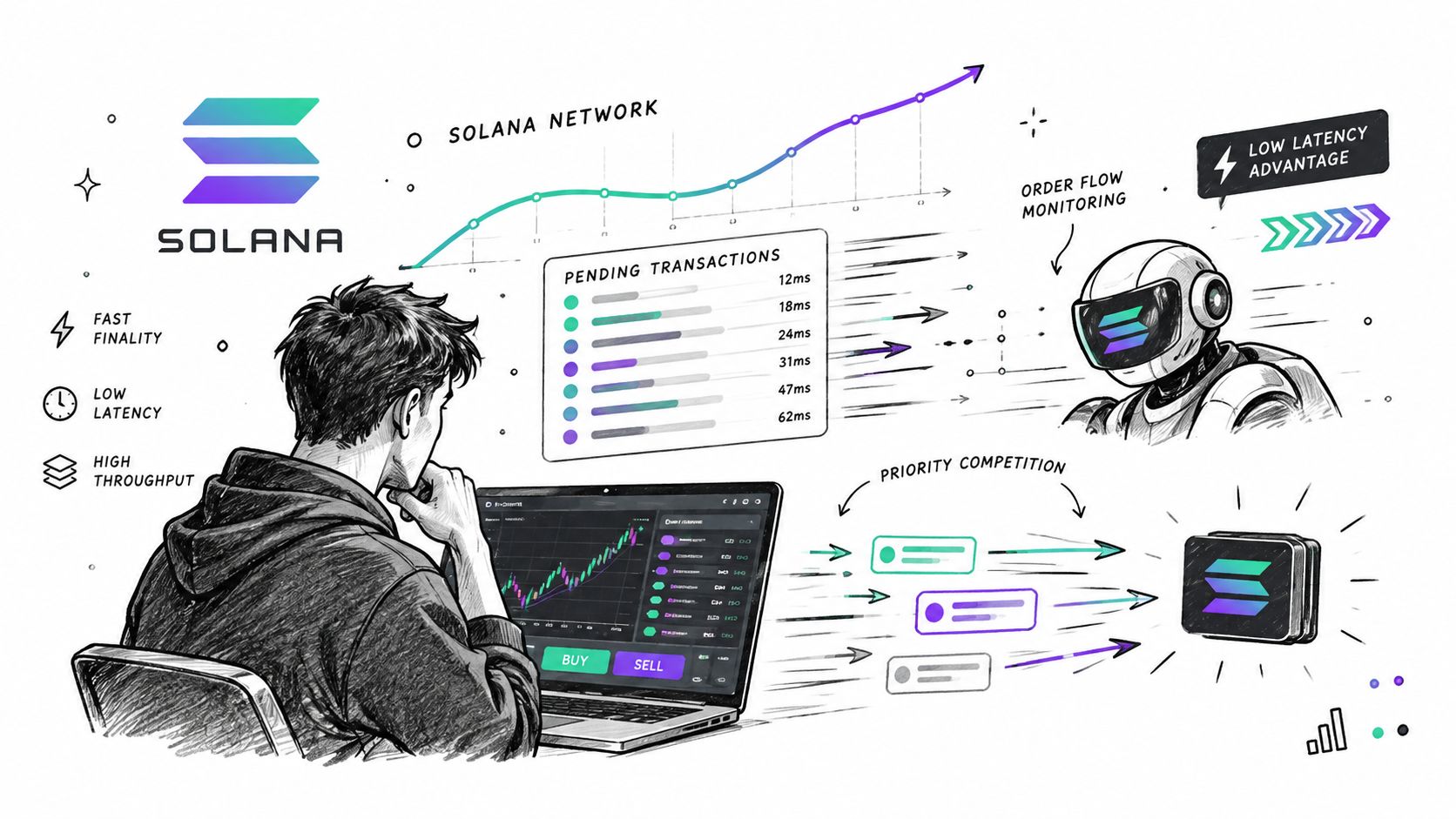
The ordering contest doesn't stop at Ethereum-style gas auctions. On Solana, bots can reach validators or a block engine, submit bundled transactions, and pay tips instead of bidding a public priority-gas auction.
Wide sandwiches, not just one slot
The textbook picture is one slot: buy, victim, sell, done. That picture is increasingly incomplete. Wide sandwiches can span multiple proposed blocks or slots, so the two attacker legs aren't sitting neatly on either side of you inside a single bundle you can spot at a glance.
A recent report cited by industry coverage found that 93% of identified attacks used this wider pattern. Research covering a full year attributed roughly 529,000 SOL of extraction to multi-slot sandwiches. Separately, EU securities regulator ESMA reported 1.55 million sandwich transactions over the 30 days from 7 December 2024 to 5 January 2025, generating 65,880 SOL in profit, in coverage of widespread Solana sandwich attacks.
For a meme-coin buyer, thin pools cut both ways. A relatively small attacker trade can shove the price hard against you. The same thin book raises the bot's inventory and execution risk, so the attack is common and still not automatic.
Removing a public mempool didn't end it
Infrastructure changes move the threat. Jito removed its public mempool to make casual sniffing harder, and later reporting still described continued sandwich activity plus validator-level concentration. Private paths and tips replace a visible fee war. They don't remove the incentive to order a victim between two of the bot's own trades.
A short walkthrough of how that ordering race shows up on a live book is here.
A high tip by itself isn't proof. Lots of urgent, honest flow pays up to land in a busy slot. The stronger signature is coordinated ordering plus a profitable before-and-after inventory cycle around one victim swap.
How to Detect Front Running from On-Chain Signals
Detection starts from fields, not from disappointment. The Flash Boys 2.0 measurement study describes priority gas auctions in which bots raise fees to buy earlier placement, and expected profit caps how much they'll rationally pay. The same logic applies when the payment is a Solana tip. Fee level is a clue. The cycle around the victim is the claim.
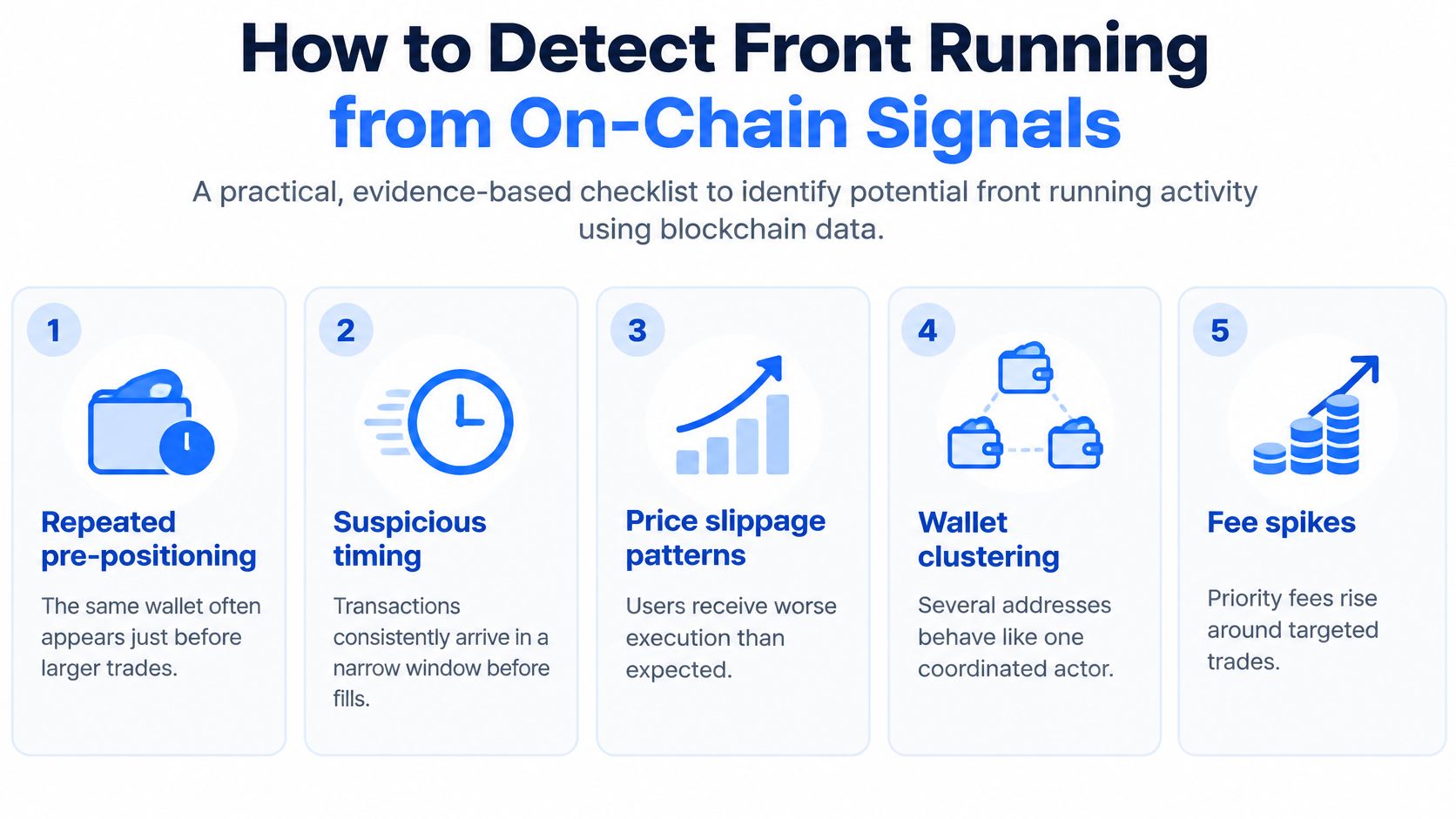
Fields worth pulling
Read the transaction, then the neighbours.
- Slot or block position: Note who landed immediately before and after, and whether the legs share a bundle.
- Signers and funding wallets: A fresh buyer that shares a funder with the later seller is one actor wearing two addresses.
- Token-account timing: Accounts created seconds before the cluster are a tell, not proof on their own.
- Balances and price: Compare pre and post balances, the effective execution price, and attacker profit after fees and tips.
A meme-coin screen, with false positives
On a Solana meme coin, the actionable cluster is an unusually tight attacker-buy then victim swap, or victim buy then attacker sell, repeated across wallets, ordered at bundle level, with victim price impact that materially exceeds what pool depth implied. The same adjacency can come from ordinary arbitrage, a liquidity rebalance, or a router splitting a path. Those can sit next to your trade without a round trip that books your loss as their gain.
A confidence-weighted label beats a binary "you got botted." If you can't show the inventory cycle and the harm, call it adjacency and keep looking.
Repeated pre-positioning in front of larger buys is also how sniper flow shows up. Our notes on sniper wallets on Solana tokens separate that pattern from a one-off unlucky fill. A 24-hour check helps: if the "attacker" inventory wasn't closed for a profit around your slot, the sandwich story is weak.
Choosing Your Protection Approach and Tools
Lower slippage is not free safety. On a violent Solana launch, a tight limit often means the transaction fails. A wide limit raises the chance you fill, and it also widens the band a sandwich can harvest.
Reported averages show why volume, not drama, is the point. The average Solana sandwich in the cited period was about 0.0425 SOL, roughly $8.70, with harm coming from very high transaction counts rather than huge one-off hits. An 22–28 April 2025 monitoring sample recorded 87,061 sandwich attacks and about $623,647 in reported extracted value, in a write-up of unsolved MEV trade-offs.
Price the loss before you click
For one order, write three numbers in dollars, not vibes: the slippage band times your size, the cost of a failed send during the move you were trying to catch, and a sandwich loss on the order of that small average if the pool is an obvious target. Then compare a smaller clip, or two clips, against one full-size market buy.
Private or protected routing changes who sees the intent. It doesn't delete ordering power at the validator. A live screen changes the inputs: depth, route, size, slippage, and whether recent flow already looks like coordinated bundles.
| Option | What It Reduces | Trade-off Accepted | Best For |
|---|---|---|---|
| Tighter slippage | Room inside the curve a bot can tax | More failed sends when the pool is moving | Deeper pools, patient entries |
| Smaller or split orders | Price impact and the size of one sandwich | More fees, and you can still miss the move | Thin meme pools |
| Private or protected routing | Easy sniffing of the public pending trade | Tips, trust in the path, residual builder power | Larger clips you can't hide |
| Live-data risk screen | Blind buys into hollow liquidity and repeat bots | It prices risk, it doesn't block a bot | Any buy you'd hate to reverse |
Free scanners are a fair first pass. A full analysis is different: we explain the evidence behind the health score and rug risk rating, add an AI verdict and a detailed risk analysis, and include a conditional trade plan when the data allows. Each run reads live Solana data across liquidity, holder distribution, creator behaviour, wallet activity, trading patterns, and historical risk indicators. Pair that with a short list of Pump.fun trading tools rather than stacking five bots that all promise to "stop MEV."
Real Cases and What the Numbers Show
Sandwich attacks generated $54.37 billion in transaction volume in the first half of 2022, while estimated trader losses reached $87.7 million, according to an analysis cited by the European Securities and Markets Authority. Separate estimates put sandwich-bot volume at $287 billion in 2022. Searchers earned about $128 million from sandwiches and $145 million from arbitrage that year, according to a policy analysis of Ethereum MEV.
These figures show the scale of MEV activity, but volume alone does not establish how much of a trader's loss came from a sandwich. A large trade can move a thin pool without any attacker, so identifying extraction requires evidence of transaction ordering, not just a sharp price change.
Private flow and who builds the block
Earlier research found that 32% of identified sandwich attacks were relayed privately to miners, leaving no complete trace in the public pool. Ethereum's Beacon Chain merge occurred on 15 September 2022. The available evidence here does not establish the claimed change in builders' share of block construction, so that figure should not be used to quantify the shift.
Private relays complicate detection: public pending transactions may show only part of the flow. A price chart records the outcome, not who ordered the transactions or whether a private relay was involved.
Concentration beside the ordering
Ordering evidence and token ownership describe different risks. A public dated report shows dog was flagged when one wallet held 79% of supply on 29 July 2026. Its price changed −69.3% over the following 24 hours.
A sandwich can explain a bad fill. Concentrated ownership can leave the market exposed to a sharp decline without any bot causing it.
Neither signal proves the other. A thin pool may be vulnerable to sandwiching, while concentrated supply may make the token fragile even without an attack. Distinguishing a genuine sandwich from ordinary price impact requires transaction-order evidence; treating every launch wick as MEV overstates what the price chart can show.
Building a Pre-Trade Routine That Limits Exposure
No routine deletes MEV. It prices it before you send, using the same fields you'd use after a bad fill.
Run this on the specific mint, not on "meme coins" as a category.
- Depth and holders first. If one wallet dominates supply, or the pool can't absorb your clip without a large move, the sandwich is optional. The exit is already the problem.
- Size against real liquidity. Compare your order to pool depth, not to your account balance. A clip that is a rounding error in a deep pool is the whole book on a fresh launch.
- Slippage in dollars. Convert the percentage into the money you're willing to donate to impact plus a bot. If that dollar figure is larger than the edge you think you have, don't widen the setting. Cut the size.
- Pattern, not a generic blocklist. Look for repeated bundles, shared funders, and tight buy-sell cycles on this token. A quiet pool with ugly holders is a different risk from a deep pool with an obvious sandwich cluster.
How to read a score without turning it into an order
We treat a health score and a rug risk rating as inputs to that list, alongside liquidity and trading patterns. Conditional trading scenarios in our reports are analysis scenarios, not trading instructions. They don't predict a certain outcome, and they don't guarantee execution at the displayed price.
Memecoins stay extremely risky. You can lose all invested capital. An informational screen doesn't change that, and it isn't financial advice.
If you want the buy flow itself, start with how to buy Solana memecoins safely, then come back to this routine for the ordering question. The insight worth keeping: execution certainty, failed sends, and MEV are one expected-loss number. Optimizing only the slippage slider just moves the loss from one column to another.
Frequently Asked Questions About Front Running Bots
How can you prove a bot caused the loss?
You need the post-confirmation record, not the feeling that the chart dipped. Line up transaction order, including whether the legs span one slot or several. Note validator or block-builder involvement if the path was private. Record the slippage you set, the pool depth at the time, and the attacker's inventory before and after fees and tips.
If a wallet buys just before you and sells just after, and its net after tips is positive while your fill is worse than depth alone implied, you have a sandwich. If nobody closed a round trip, and the move matches a thin pool plus a large buy, that is meme-coin price impact. Volatility, a failed route, and a fast arbitrage can all sit next to your signature without taking your slippage as profit.
What is the expected loss on this exact trade?
Add three pieces in dollars. First, the slippage band on your size if you do fill. Second, the cost of failing, which is the move you miss when a tight limit reverts during a launch. Third, MEV on the order of a typical small sandwich if the pool is shallow and your intent is visible, versus near zero if the order is tiny relative to depth or the route never hits a public waiting area.
There isn't a universal percentage that makes this safe. A 1% band on a tiny clip in a deep pool is a different bet from the same percentage on a large clip in a new meme pool.
Did killing the public mempool stop sandwiches?
No. Taking away an easy public feed removes one sniffing path. Searchers still reach validators, still bundle, and still pay tips. Wide, multi-slot patterns don't need the classic three-transaction postcard inside one block. The threat shifts toward whoever can still order flow, which is why validator concentration still matters after a mempool change.
What should you spend a single analysis on?
Reading public token evidence and reopening a saved report is free. Running a new analysis is the paid action. Spend it on the mint you're about to buy: liquidity and holder concentration first, then creator and wallet behaviour, then whether trading patterns already look bundled. A health score, rug risk rating, AI verdict, detailed breakdown, and a conditional trade plan when the data allows is the shape of that full run, and the run with a conditional Trade Setup costs $0.20. Don't buy a second tool until those six categories disagree with the story the chart is telling.
MemeAssist reads live Solana meme-coin data and turns ordering risk, liquidity, and holder concentration into an explained report instead of a generic "lower your slippage" tip. If you're about to send a swap and want the expected-loss inputs in one place, run it on the mint first. Start at MemeAssist.