Front Running Crypto: How Solana Traders Can Spot It
Learn what front running crypto is, how MEV sandwich attacks hit Solana memecoin trades, and how to spot and reduce the risk.
Published
Updated
You buy a Solana memecoin after watching its price climb. Your trading screen shows an expected amount, but the swap completes and you receive less than you thought you would. The token's price moved, the pool looked thin, and several wallets traded around the same time. Did a bot run ahead of your transaction, or was this an ordinary bad fill?
That uncertainty matters. Slippage, shallow liquidity, poor routing, a large holder selling, and a sandwich attack can all leave you with fewer tokens than expected. A disappointing result alone doesn't tell you which happened.
A useful way to think about front running crypto is as a diagnosis problem. First understand what the attack is. Then examine the order and surrounding trades, test alternative explanations, and choose a defense that fits the risk. That's more useful than blaming a bot every time a swap goes against you.
Table of Contents
- Why Front Running Crypto Hits Memecoin Traders First
- Front Running Crypto Explained with a Market Stall Analogy
- How MEV, Mempools, and Validators Shape Trade Order
- Real Sandwich and Launch Cases on DEXs and Memecoins
- Telling Front Running Apart From Ordinary Bad Fills
- Legal and Ethical Boundaries Around Front Running
- Comparing Protection Options and Where MemeAssist Fits
- Next Steps for Trading Solana Memecoins Safely
Why Front Running Crypto Hits Memecoin Traders First
You choose a new token, enter a buy amount, and see a quote that looks acceptable. While your transaction is waiting to execute, other trades can change the pool. By the time your swap lands, the price may have moved and your final token amount may be worse than the quote.
For a newcomer, it's natural to suspect front running. Memecoin traders often act quickly, and a sudden launch or fast-moving chart can make a swap feel urgent. But the transaction itself doesn't reveal the cause of a poor result. A bad fill is a symptom, not a diagnosis.
That distinction is especially important in a thin pool. A trade can move the price even without an attacker. A large holder can sell into your purchase. A route can perform poorly, or your slippage setting can allow the transaction to complete at a price you wouldn't have chosen if you'd seen it first.
Start with evidence: Don't label a trade front-run just because you received less than the quote. Look at the transactions before and after yours, and test other plausible causes.
The stakes aren't only about one swap. If you misdiagnose ordinary price impact as an attack, you may choose a protection that doesn't solve the problem. If you overlook coordinated trading or a profitable buy-before, sell-after pattern, you may keep trading in a pool where execution is being exploited.
This article walks through the issue one trade at a time. You'll get a plain-language definition, an explanation of how transaction ordering and Solana's MEV infrastructure affect execution, and examples of what suspicious activity can look like. Then you'll use a transaction-level test to distinguish front running from slippage, thin liquidity, insider selling, and other explanations. Finally, you'll compare practical protections and decide what to do before your next trade.
Your job isn't to prove that every bad fill was caused by a bot. It's to understand the risk, check the evidence, and avoid taking more execution risk than you intended.
Front Running Crypto Explained with a Market Stall Analogy
Think of a busy market stall with a limited supply of a popular item. A shopper sees a crowd gathering and realizes that the people in line are about to buy. The shopper pays to get ahead, buys some of the remaining stock, and sells it back to the crowd at a higher price. The people who arrived to buy the item now face a worse deal.
That's the basic idea behind front running: someone sees information about an upcoming transaction and acts before it, aiming to benefit from the price movement the transaction is expected to cause. The defining feature isn't that the price changed. It's that someone used visible order information to try to move ahead of the trade.
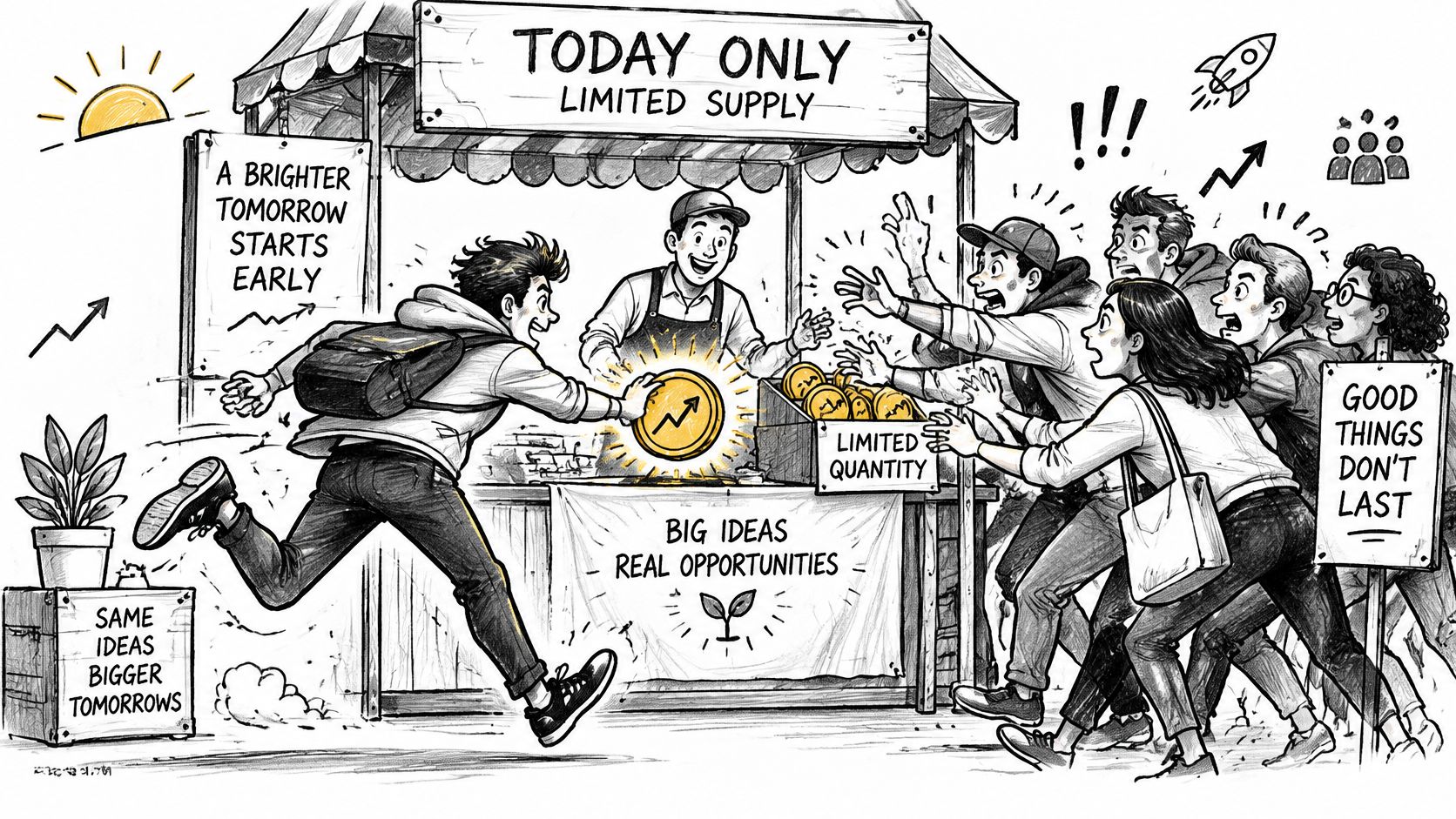
On a decentralized exchange, a swap can be visible before it's confirmed. Someone monitoring pending transactions may see that you intend to buy a token and estimate how your trade could move its pool price. If they place a buy first and a sell after your trade, they may benefit from the price movement your order helps create.
A sandwich attack has three beats:
- The attacker buys before your swap, pushing the pool price against you.
- Your trade executes at a worse price, within the slippage tolerance you allowed.
- The attacker sells afterward, seeking to capture the resulting price movement.
Slippage tolerance is your exposure dial. It sets how much the price can move before your trade fails rather than completing. A wider tolerance can make a transaction more likely to go through, but it also gives a trade more room to execute at an unfavorable price. A tighter tolerance can reject an unexpectedly poor fill, though it may also cause a legitimate trade to fail when prices move quickly.
The stall analogy helps separate an attack from bad luck. If the item becomes more expensive because demand rose while you were waiting, that isn't automatically front running. The suspicious part is someone acting on the visible intent to get ahead of you and benefit from the order of trades.
How MEV, Mempools, and Validators Shape Trade Order
A pending transaction's path through the network helps explain how its order can matter. MEV, or maximal extractable value, refers to value that can be gained by including, excluding, or reordering transactions. A mempool is commonly described as a waiting area for pending transactions, but Solana doesn't operate as one universal queue where every transaction waits in exactly the same way.
The main actors have different roles:
- Traders submit swaps that may reveal what they intend to buy or sell.
- Searchers monitor transaction flow and look for opportunities to profit from trade order.
- Validators process transactions and help determine their inclusion and ordering.
- Relayers and block-engine infrastructure can forward transactions or bundles toward a validator.
- Bundles group transactions for ordered execution under particular infrastructure rules.
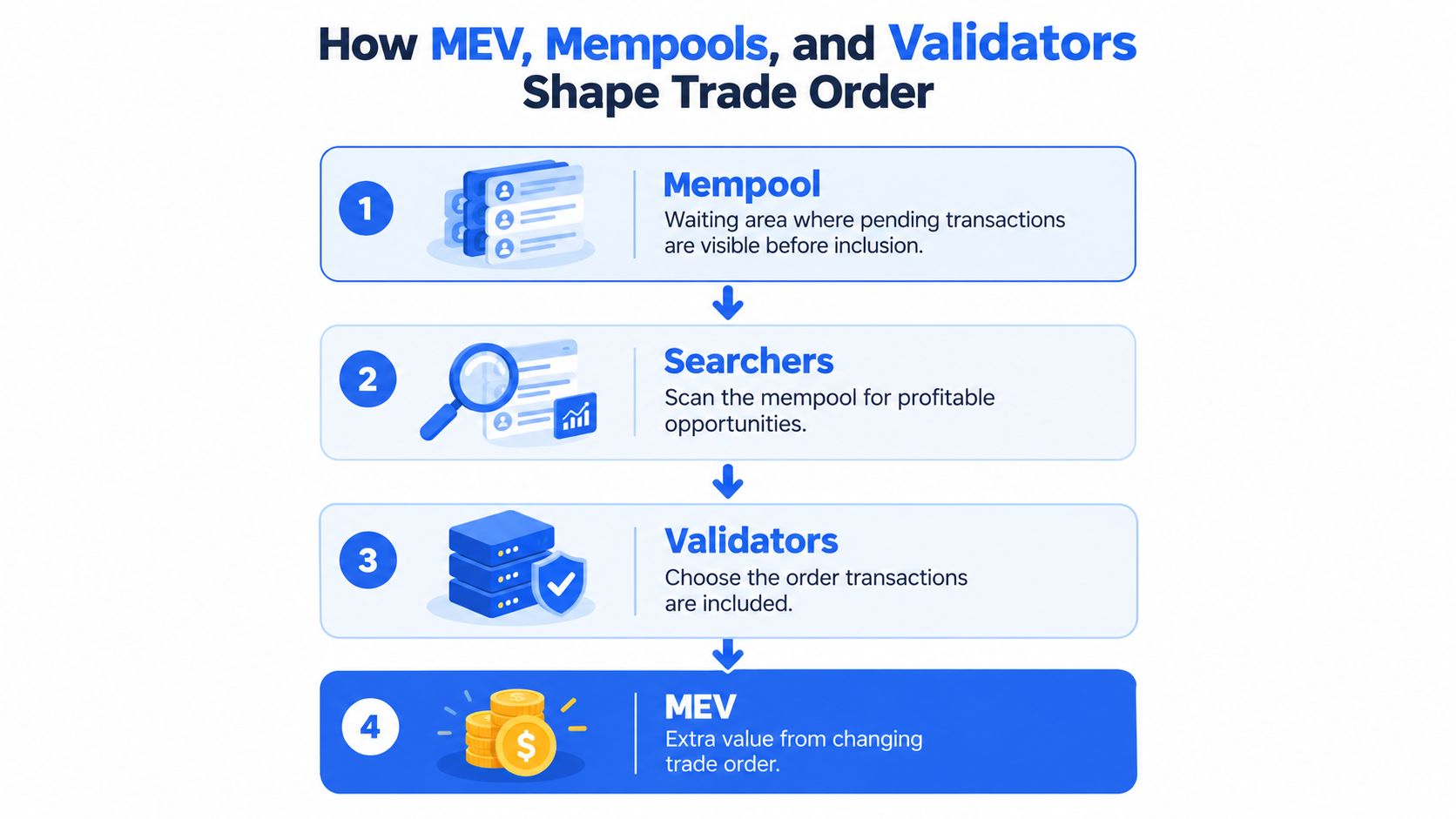
Solana's default validator scheduler is multi-threaded. Transactions are assigned to local queues, and arrival timing and priority fees can affect their placement. That means a higher priority fee may help, but it doesn't guarantee that a transaction will come first everywhere. Fee rank by itself isn't proof of an attack.
Some MEV infrastructure offers stronger ordering. Jito's block engine uses an off-chain auction in which searchers submit bundles with validator tips. Accepted bundles can execute atomically in the submitted sequence. A measurement paper describes bundles of up to five transactions, with their internal order preserved. That can make a buy, victim swap, and sell sequence operationally possible when submitted together. The same research describes a short auction window created when a Jito relayer holds transactions before forwarding them to the leader. Research on Jito's role in Solana MEV explains why bundle-level behavior can matter to an investigation.
A bundle record can help show that transactions were grouped and ordered together, but it doesn't capture every route or every form of MEV. Finding a bundle can strengthen a hypothesis; not finding one doesn't rule it out.
Here's a video overview of how MEV can affect trade ordering:
Real Sandwich and Launch Cases on DEXs and Memecoins
Consider a thin-liquidity pool where a trader places a buy. If another trader buys first, the first purchase can shift the pool's marginal price. The victim's swap then executes against a less favorable price, and the attacker may sell afterward. In a deeper pool, the same order may move price less; in a shallow one, even a comparatively modest trade may have a noticeable effect.
A launch can produce a different-looking pattern. Several wallets buy close together while attention is building, and later buyers arrive after the price has already moved. That sequence may deserve investigation, but timing alone doesn't establish that the early wallets saw or acted on a victim's pending transaction. They could be independent buyers, automated launch traders, or wallets controlled by a creator or insider. Those possibilities have different implications.
A third pattern is repetition: a wallet buys just before other traders' swaps and sells shortly after them, again and again in the same pool. Repeated timing, consistent trade order, and profitable unwinds are more informative than one wallet trade near one victim. To learn what early trading wallets can signal, read this guide to sniper wallets on Solana tokens.
The broader evidence shows why the issue deserves attention without proving that any particular memecoin trade was attacked. An ETH Zürich analysis of a continuous 12-month period identified at least 480,276 sandwich attacks and estimated cumulative attacker profits of 64,217 ETH, valued at approximately $189.3 million at the study's valuation date. The study focused on Ethereum, not Solana, so those figures are foundational evidence about public blockchain markets, not a measurement of Solana activity. The ETH Zürich study found that sandwiching was already operating at scale before the recent memecoin boom.
A broader remeasurement of Ethereum MEV activity identified nearly 9.4 million MEV transactions, including 6,331,851 arbitrage transactions and 3,016,971 sandwich-attack transactions. The same research detected 1,265,929 sandwich attacks in its analyzed block range, compared with 1,251,072 identified by the ZeroMEV reference method. It also summarizes earlier estimates of about $174 million in Ethereum sandwich losses over 33 months, with 99.97% of individual attacks below $10,000 and the largest recorded attack at approximately $170,902. These Ethereum figures show how repeated smaller extractions can add up. They don't establish what happened in an individual Solana trade. The MEV remeasurement also illustrates why detection methods can produce different counts.
Each case leaves clues to test: the order of trades, pool reserves before and after, wallet relationships, bundle details where available, and whether the suspected attacker made a profitable unwind. Look for a pattern, not a dramatic-looking transaction in isolation.
Telling Front Running Apart From Ordinary Bad Fills
A bad fill isn't automatically front running. Start by asking what the pool and other wallets did around your transaction, then compare the suspected pattern against simpler explanations.
| Observed pattern | Likely cause | Test to run first |
|---|---|---|
| Your fill is worse than the quote, but there's no clear buy-before, sell-after sequence | Slippage or ordinary price movement | Compare your minimum output and actual output with the pool's price and reserves when the swap executed |
| A small-looking trade shifts price sharply | Shallow liquidity | Check pool depth and how much of it your order consumed |
| A large sell appears around your buy | Holder or insider selling | Trace the seller's prior activity and whether the wallet appears connected to the creator |
| The route behaves differently from the quote | Poor routing or route changes | Review which pool or pools handled the swap and whether another route had better available liquidity |
| A wallet buys immediately before your swap and sells after it | Possible sandwiching | Check transaction ordering, timing, price impact, and whether the wallet's sell was a profitable unwind |
| Several wallets trade in a closely coordinated sequence | Possible shared strategy, but not proof | Compare timing, funding, transaction order, and repeated behavior across trades |
| A transaction pays an unusually high priority fee | Possible effort to gain earlier placement | Treat the fee as a clue, then check ordering and surrounding trades rather than treating fee rank as proof |
| A bundle record places related trades around your swap | Stronger evidence of ordered execution | Confirm the bundle relationship and calculate whether the surrounding trades profited |
The strongest case combines multiple signals. For example, a buy before your swap and a sale afterward becomes more compelling if the wallets have common funding, repeat the sequence around other victims, and show a profitable post-trade unwind. A single suspicious trade is weaker evidence because the same timing can occur by chance, or because several traders responded independently to a fast-moving token.
Solana's local scheduling and the limits of bundle data matter here. A missing bundle record should lower confidence in a bundle-based explanation, but it doesn't eliminate the possibility of front running through another route. Conversely, a bundle record alone doesn't show that a particular trader intended wrongdoing. The evidence needs to connect order, behavior, and benefit.
MemeAssist reports can surface suspicious activity or potentially linked wallets, but those are items to examine, not evidence of wrongdoing. Missing data shouldn't be interpreted as proof of safety either. Use the report as a starting point, then inspect the relevant transactions and consider alternative causes before drawing a conclusion.
Legal and Ethical Boundaries Around Front Running
Rules designed for traditional markets don't map neatly onto decentralized exchange activity. Traditional front running often involves someone misusing confidential client order information. In decentralized markets, pending transactions may be publicly visible, and strategies can involve software, validators, and transaction ordering. That difference doesn't settle whether a particular strategy is lawful or ethical.
The legal treatment of MEV remains uncertain in some jurisdictions. A legal analysis of the EU MiCA framework says its treatment of MEV is unclear. That uncertainty is a reason to avoid sweeping claims that every ordering strategy is either clearly legal or clearly illegal. A trader observing a suspicious pattern should describe what the transactions show, not present a suspicion as a legal finding.
Protection also doesn't remove every market incentive. A 2023 game-theoretic study found that skilled traders adapt to front running while retail traders generally don't. It also found that when retail flow reaches roughly 10% of order flow, liquidity providers may prefer pools without front-running protection. The study of front-running protection and liquidity incentives highlights a trade-off: protective measures can affect liquidity and who captures value, not just an individual trader's execution.
There's an ethical distinction between competing to execute a trade and arranging transactions to worsen someone else's fill for private gain. But an unfriendly result, a tool's flag, or a fast trade doesn't by itself prove intent. Evidence should guide the conclusion, not the label.
For a retail trader, the practical lesson is modest: a protection setting may reduce one exposure while leaving another untouched. A tighter slippage limit might constrain how poor a fill can be, but it won't prevent an insider from selling. A private route may change who can see or handle the order, but it may introduce reliance on different infrastructure. Before choosing a tactic, consider both the risk it reduces and the new trust or liquidity trade-offs it may create.
Comparing Protection Options and Where MemeAssist Fits
No single setting prevents every cause of a poor trade. Match the protection to the problem you're trying to reduce.
| Option | What it can reduce | What it can't prevent |
|---|---|---|
| Set a realistic slippage tolerance | Limits how far the execution can move from your acceptable output before the transaction fails | Creator or insider selling, a rug pull, or a trade that still fills within your tolerance at a poor price |
| Avoid or split trades in thin pools | Reduces the chance that one order moves the pool price sharply | Coordinated selling, bad token fundamentals, or every form of MEV |
| Use a protected or private route | May reduce exposure to publicly visible order flow, depending on how the route works | All ordering risk, or trust and concentration concerns around the infrastructure involved |
| Use independent token monitoring | Helps you examine liquidity, wallet activity, holder concentration, and trading behavior before buying | Guaranteed safety, perfect detection, or protection over the execution of a swap |
Use pool depth and trade size as your first decision rule. If your intended trade is large relative to available liquidity, consider reducing it, splitting it, or not trading that pool. If your main concern is a trade executing at a much worse price than expected, set a slippage limit you can live with, understanding that a tighter limit may cause a failed transaction. If you're concerned about who may be selling or how wallets are behaving, investigate those risks separately: execution controls don't prevent a creator or insider from selling into the market.
Private routing may change which parties can observe or order a transaction, but it can introduce dependence on the route's infrastructure and the validators or operators involved. Treat it as a trade-off, not a guarantee. For other Solana trading tools and research approaches, see this guide to Pump.fun trading tools.
MemeAssist is an AI-powered risk analysis tool for Solana meme coins. It builds on-demand reports from live on-chain and market data, covering liquidity, holder distribution, creator behavior, wallet activity, trading patterns, and historical risk indicators. Its report brings evidence together with an Overall Health Score, Rug Risk Rating, AI Verdict, and Detailed Risk Breakdown.
That makes it useful for integrated research and plain-English explanation, not as an execution shield. It doesn't provide exclusive blockchain data, guarantee safety, or promise profit. Use it to inform your view of token and market risk, then apply the execution controls that fit the trade.
Next Steps for Trading Solana Memecoins Safely
A safer process begins before the swap. Check the token's evidence, consider whether the pool can absorb your intended trade, and choose slippage based on the amount you're willing to accept. If the result still looks unusual after execution, examine the transaction and nearby wallet activity before calling it front running.
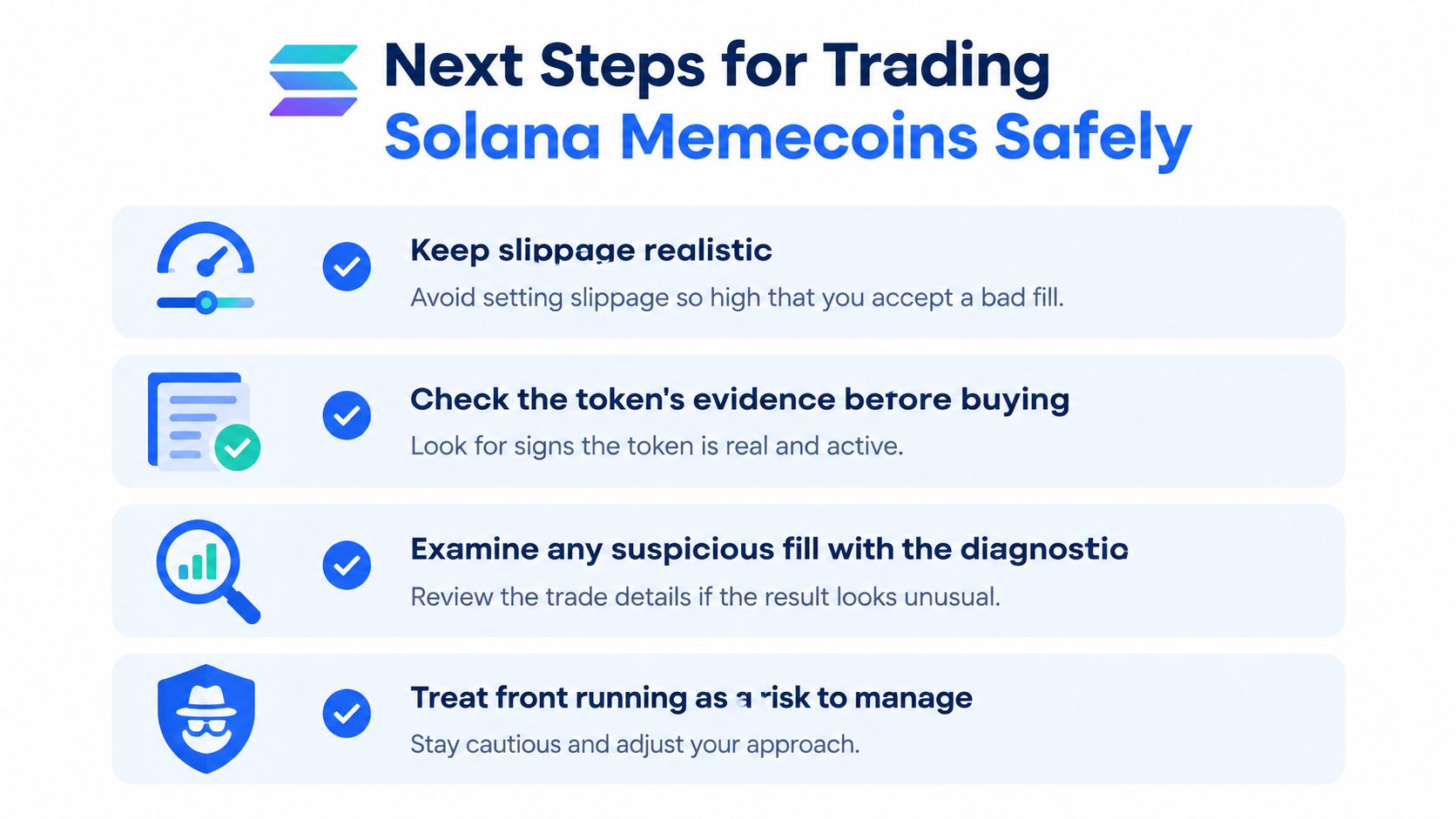
Use this checklist before and after a trade:
- Keep slippage realistic. Don't set it so high that you accept a fill you'd reject if you saw the price in advance.
- Check the token's evidence before buying. Review liquidity, holder distribution, creator behavior, wallet activity, and other available signals.
- Examine any suspicious fill with the diagnostic. Compare your trade with the transactions around it, and test slippage, liquidity, routing, and selling as alternative explanations.
- Treat front running as one risk to manage. A trade can be harmed by insider selling or a rug pull even when execution is perfect.
If you're considering a token, run a full analysis and read the Overall Health Score, Rug Risk Rating, AI Verdict, and Detailed Risk Breakdown. The analysis includes checks on minting and freezing authorities, liquidity, holder distribution, creator behavior, wallet activity, trading patterns, and historical risk indicators. Eligible new accounts receive one free full analysis, with no card or wallet needed at signup. You can also read public evidence and reopen saved reports for free.
A report can help organize clues, but it can't certify that a token is safe. Missing information isn't reassuring evidence, and a suspicious wallet connection is a reason to investigate rather than a verdict of wrongdoing. Apply the same standard to your own trade: identify what happened on-chain, compare plausible explanations, and keep your conclusion proportionate to the evidence.
Before buying, you can also follow this guide to buying Solana memecoins safely. Memecoins are extremely risky, and you can lose everything you invest in them. Only trade with money you can afford to lose.
Use MemeAssist to review a Solana memecoin's liquidity, holders, creator behavior, and trading patterns before you trade. Run an analysis, read the evidence behind its risk signals, and use those findings alongside realistic execution controls. Visit MemeAssist to examine a token you're considering.