How to Avoid Crypto Scams: A Practical Guide for 2026
Learn how to avoid crypto scams with real on-chain checks, fraud data, and actionable steps to spot rug pulls and phishing before you lose funds.
Published
Updated
The biggest crypto scams usually don't fail because the code is obviously broken, they fail because the victim never gets far enough to test the code at all. In 2024, the FBI reported more than $5.8 billion in cryptocurrency investment fraud losses and more than $9.3 billion in total reported crypto-related fraud losses, which is why skepticism has to come before curiosity, not after the first transfer. FBI report on crypto investment fraud losses
Table of Contents
- The Scale of Crypto Fraud and Why Vigilance Matters
- The Staged Verification Process Before Every Trade
- Why Basic Contract Checks Are Not Enough
- Distinguishing Asset Risk from Interaction Risk
- The Evolution of Social Engineering Scams
- Pre-Trade Checklist and Final Safety Rules
The Scale of Crypto Fraud and Why Vigilance Matters
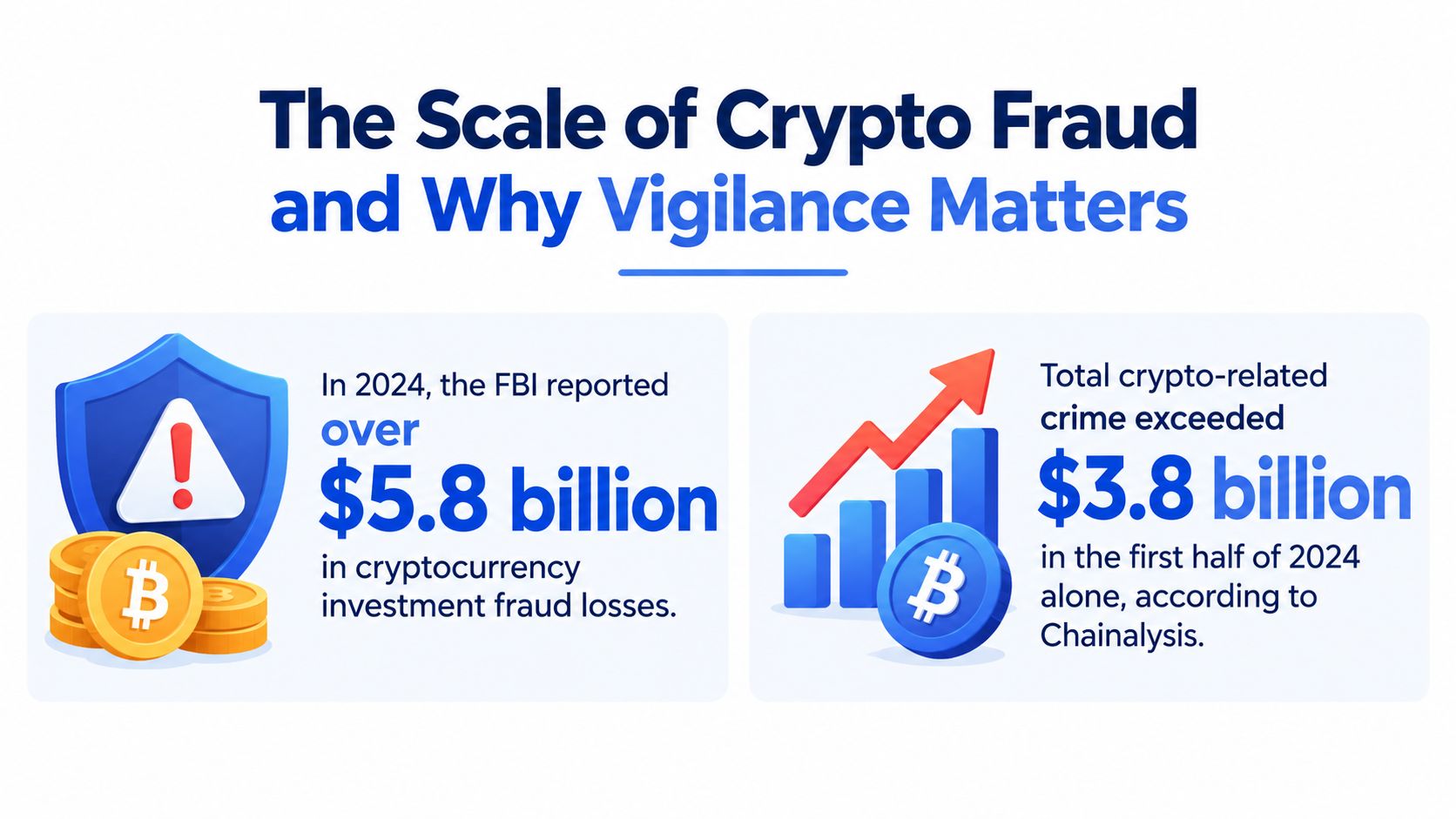
Crypto fraud is big enough to change how I trade. The FBI IC3 annual report shows more than 140,000 complaints involving cryptocurrency, so this is a marketwide risk, not a niche problem for careless beginners. Losses also hit experienced users, which is why every new offer needs to be treated as hostile until it earns trust. FBI IC3 annual report
The same reporting shows that people aged 60 and over filed roughly 33,000 complaints and reported about $2.8 billion in losses. Polished presentation can beat caution when verification is weak, and scammers know it. If an offer arrives uninvited, promises guaranteed returns, or pushes urgency, stop and verify before you touch it. IC3 elder-fraud complaint data
Practical rule: if a deal needs speed, secrecy, or blind trust, it is already asking for the wrong kind of participation.
The shift is simple. You are not trying to prove a token is good. You are trying to prove it is not a trap before capital moves. Screenshots, celebrity-style hype, and social proof are weak signals because they can be manufactured faster than a wallet can be drained.
The Staged Verification Process Before Every Trade
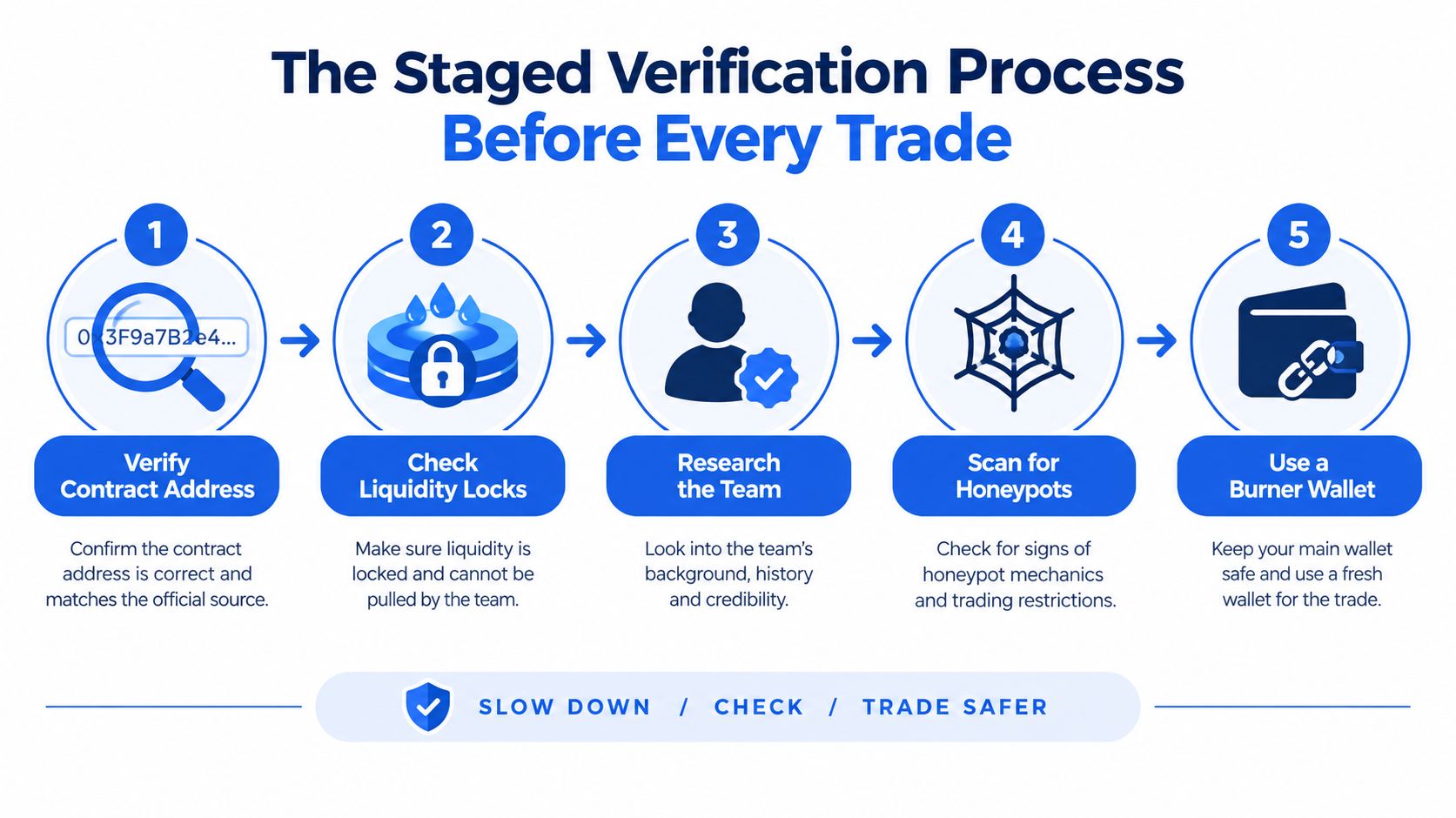
A single look at a token is not enough. Crypto scams change shape fast, and the checks need to slow the trade down before any money moves. Start with the exact token or destination address from an independently verified source, then inspect the contract, permissions, liquidity, holder concentration, creator-linked wallets, and abnormal trading patterns before you touch anything.
Run the checks in order
- Verify the address independently. Don't copy a contract or destination from a social post, a DM, or a reply thread. Pull it from a trusted project page, a block explorer, or a source you already trust.
- Inspect what the transaction can do. Look at permissions, liquidity, holder concentration, creator-linked wallets, and any abnormal activity around the launch.
- Reject friction in the wrong place. If a page wants a wallet connection, a message signature, or a seed phrase just to gain access, stop there.
- Test with a negligible amount. A small trial only matters if an independent sell or withdrawal works.
- Set a hard loss limit before size goes up. If the trade can't absorb a tiny loss, it can't absorb a real position.
The same slow path shows up in this free Solana rug-check workflow. The point is to make every permission understandable before you commit capital. That friction helps because scammers depend on speed more than anything else.
If a trade only works when you skip steps, the trade is manipulated.
The FBI's Operation Level Up found that 77% of contacted victims reportedly didn't realize they were being scammed, which is why test transactions and staged exposure matter. Test transactions and staged exposure are the only way to find out whether the market you're about to join is real before you size up. FBI Operation Level Up
Why Basic Contract Checks Are Not Enough
A token can pass the obvious checks and still be a bad trade. That's the part many traders miss. A renounced contract or locked liquidity can reduce some risks, but it doesn't tell you whether the market is deep enough, whether exits are realistically possible, or whether the volume is organic.
Solana meme coins make this painfully clear. A 2025 analysis reported that 98.6% of more than 7 million Pump.fun tokens examined showed signs associated with fraudulent activity, while fewer than 100,000 retained liquidity above $1,000. The same analysis found 93% of 388,000 Raydium pools exhibited soft rug pull patterns, including abrupt liquidity withdrawals. Pump.fun fraud analysis
Treat the market like a moving target
Static badges don't tell you what the market will look like after the next burst of attention. A token can appear tradeable at launch, then become structurally untradeable once liquidity thins, a small cluster of wallets dominates supply, or buyers and sellers stop looking organic. The key question isn't “Is the contract safe?” It's “Can I exit at a sane price if the move turns on me?”
That's why a timestamped baseline matters. Record liquidity depth, top-holder concentration, and whether trades cluster in bursts, then re-check after major price or volume changes. If one or a few related wallets can materially control the circulating supply, or if the chart only looks active because the same pattern repeats, you're looking at a setup that can punish even careful entries.
Locked liquidity is not the same thing as healthy market structure.
For deeper screening, I'd treat Solana token safety checks as a starting point, not a verdict. A one-time badge can't tell you whether trading is being wash-generated, whether exits are being coordinated, or whether a token only looks alive because insiders are managing the flow.
The safest mental model is adversarial. Someone on the other side may be trying to make the chart look legitimate long enough for you to click buy. If you don't keep re-evaluating the same position as the market changes, you're not managing risk, you're trusting a snapshot.
Distinguishing Asset Risk from Interaction Risk
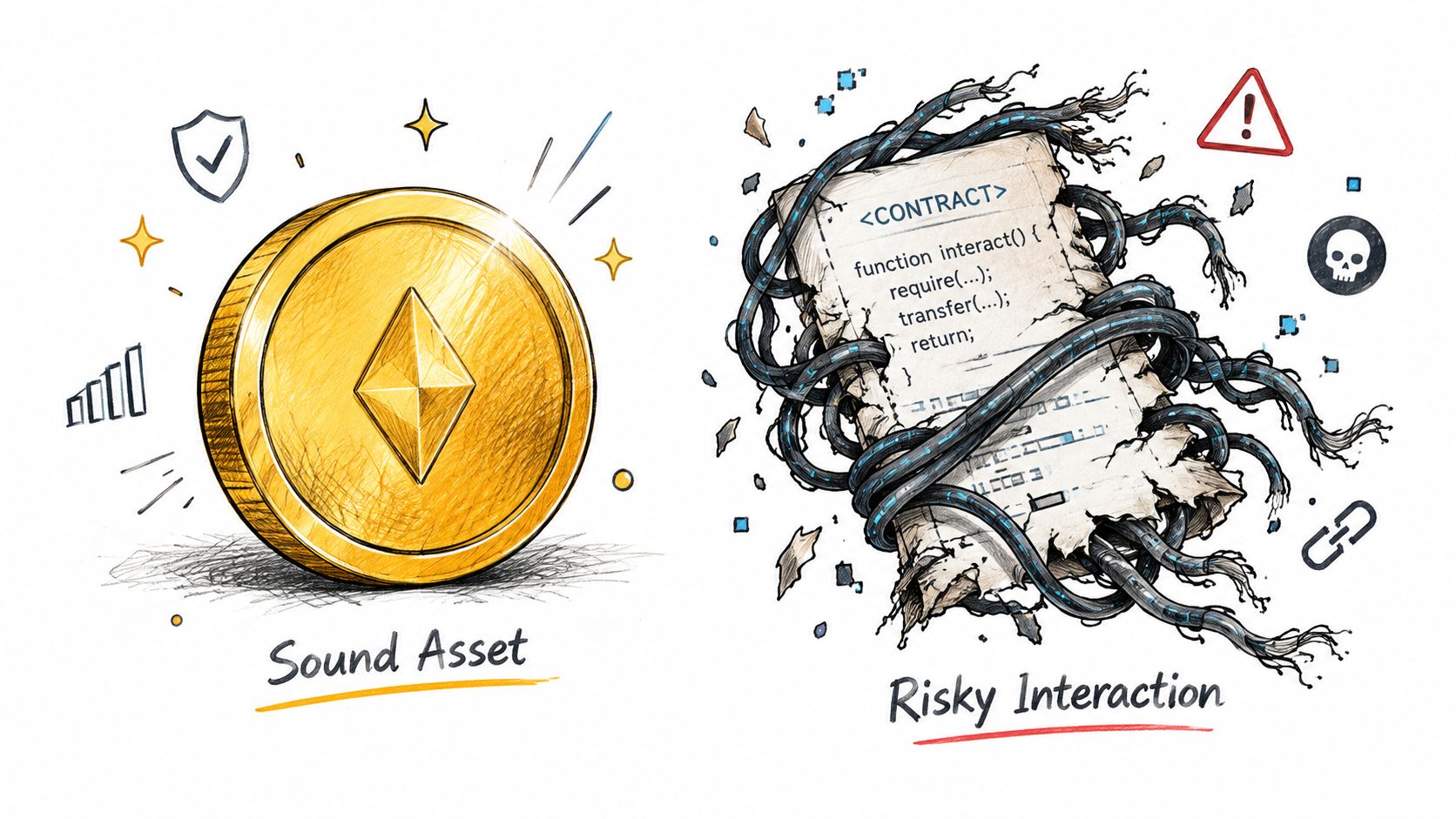
A good token can still become a bad outcome if the interaction layer is compromised. That's the distinction too many traders ignore. One part of the decision is about the asset itself, and the other part is about what the site, wallet prompt, or signature request is trying to make you do.
Wallet-drainer phishing still matters because it attacks the interaction, not just the asset. In reporting tied to 2025, estimated wallet-drainer phishing losses were $83.85 million, affecting about 106,000 users, with losses peaking in the third quarter near $31 million. Permit-based attacks also played a major role, accounting for 38% of losses in incidents above $1 million, and one reported theft used a malicious Permit signature to drain $6.5 million. Scam Sniffer-linked reporting
Two layers need separate discipline
Asset risk asks whether the token is worth touching at all. Interaction risk asks whether the page, signature, or prompt in front of you is trying to steal control while pretending to help you trade. Those are not the same question, and answering one doesn't protect you from the other.
A practical setup separates the two. Use a low-balance trading wallet, never sign from a page reached through social media links, inspect the exact approval or permission requested, and revoke unnecessary approvals after the fact. If a site wants you to connect a wallet just to view an analysis page, claim something, or “verify” access, that's a red flag in the interaction layer even if the token itself is legitimate.
A safe asset doesn't rescue a dangerous signature.
Many traders get hit here. They do the token check, feel reassured, and then move too fast when a fake claim page, impersonation account, or approval prompt appears during the trade. The right habit is to treat every wallet connection as a separate decision, not a harmless click that comes bundled with the deal.
The Evolution of Social Engineering Scams
The most expensive scams are rarely blunt. They start as conversation, not theft. A chat on social media, a friendly contact on a dating app, or a seemingly helpful trader in a group can become the bridge between curiosity and loss.
In 2024, high-yield investment scams accounted for 50.2% of scam revenue, while pig-butchering scams made up 33.2%. Together, they represented more than 80% of identified scam proceeds in the cited analysis, and pig-butchering revenue rose by nearly 40% year over year while deposits grew by nearly 210%. Chainalysis on pig-butchering scam revenue
Why the story matters more than the chart
Pig-butchering works because it builds trust before it asks for money. The scammer doesn't open with a theft attempt, they open with a relationship, a recommendation, or a fake sense of competence. By the time the victim sees the “opportunity,” the emotional setup has already lowered resistance.
That's why separation is essential. Keep social interaction and investment verification in different mental boxes. A person being charming, responsive, or consistent doesn't make the platform legitimate, and a platform showing fake profits doesn't make the person trustworthy.
The historical lesson is simple: any strategy promising unusually high returns with low risk should be treated as a fraud indicator until independently disproven. That's the same reason I never let a good conversation substitute for due diligence. If a stranger can move from small talk to pressure without ever allowing verification, the next request is usually the actual point of contact.
Pre-Trade Checklist and Final Safety Rules
Before every swap, I run the same final pass. The point is to catch the problems that still get through good contract checks, especially wallet-drain prompts, approval traps, and addresses that only look safe on a quick scan.
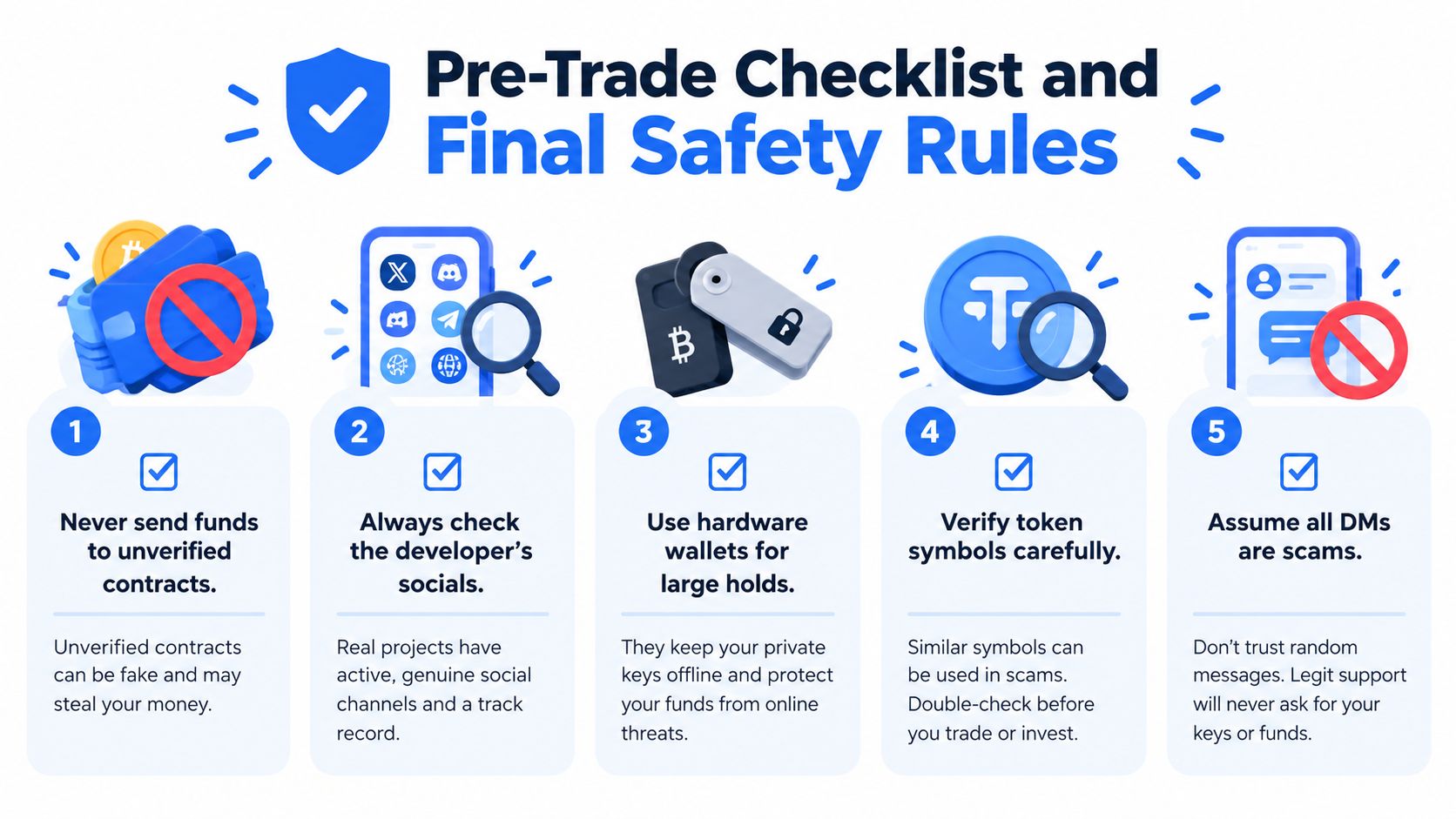
The live-trade rules that hold up under pressure
Read the approval screen as if it were the trade itself. If a prompt asks for unlimited access, a seed phrase, or a remote-support step, the trade is already compromised. I also check whether the recipient address matches a known drainer pattern or an address I have already seen tied to suspicious behavior. That kind of review belongs in Before You Buy, not after the wallet is already connected.
- Inspect approvals before you confirm. A token can be technically real and still ask for permissions that expose the wallet.
- Revoke access after the trade if the approval is no longer needed. Leftover permissions are where a lot of follow-on losses start.
- Decide the exit before entry. If I do not know where I would take profit or cut risk, I am not ready to size the position.
- Treat surprise contact as hostile until proven otherwise. Support pings, “helpful” DMs, and urgent follow-ups are common entry points for scams.
- Watch for recipient addresses that have been reused in scam reports or drainer activity. A clean-looking token can still be paired with a dirty interaction path.
Fast reporting still matters. The FBI said its intervention program had saved an estimated $285 million by January 2025 by warning victims before more losses hit, which is a good reason to report suspected fraud as soon as it shows up. FBI Operation Level Up
If you want a tool that fits this workflow, visit MemeAssist and use it to check Solana tokens against live liquidity, holder concentration, creator-wallet behavior, and trading patterns before you swap. It helps keep the trade review tied to on-chain evidence instead of a polished interface.