How to Find 100x Altcoins Without Getting Rugged
Learn how to find 100x altcoins using a disciplined method built for Solana's meme-coin jungle. On-chain checks, red flags, and trade setups explained.
Published
Updated
A 100x altcoin is an outlier inside a market where most tokens don't survive long enough to matter. CoinGecko reported that 53.2% of all cryptocurrencies recorded on GeckoTerminal had failed, with 11.6 million tokens failing in 2025 alone, and that 2025 represented 86.3% of all failures recorded from 2021 through 2025. The right question is not “which coin will go 100x,” it's “which launch can survive long enough to deserve upside consideration.”
Solana makes that question sharper. Gate Research reported that the average number of tradable tokens added weekly to Solana DEXs reached 106,200 in 2024, up 983% from the beginning of the year, with more than half originating from Pump.fun, and CoinGecko reported that Solana memecoin launches averaged 35,500 per day during the late-2024 peak and reached 73,700 in January 2025. In a feed that dense, narrative-only hunting turns into survivorship bias dressed up as analysis.
Table of Contents
- Why Most 100x Searches Fail Before They Start
- The Survival-First Screening Workflow
- Reading the On-Chain Evidence That Actually Matters
- Two Solana Launches Compared Through the Filter
- Trade Setups, Sizing, and Re-Checks After Entry
- Calibrated Decision-Making and the 24-Hour Feedback Loop
Why Most 100x Searches Fail Before They Start
A 100x target sits at the far edge of a market that already destroys most launches. CoinGecko's data shows that more than half of the tokens tracked on GeckoTerminal had failed, and 2025 alone accounted for 86.3% of all failures from 2021 through 2025 CoinGecko research. The default outcome for a new token is failure, disappearance, or a state where the asset is technically alive but economically useless.
The denominator is the problem
Most search frameworks start with the wrong assumption, that the hard part is spotting the winner. The harder task is stripping out the large share of launches that cannot be sold, cannot attract real buyers, or cannot stay relevant long enough to matter.
The scale of the washout is the signal. When more than 3.0 million new projects entered the market in 2024, and nearly 1.4 million projects failed that same year, the edge comes from rejecting weak candidates early, not from mapping upside after the fact. That is the survival filter in practice.
A better lens is probability and survival. A token that stays liquid, tradable, and transparent across market conditions has cleared a hurdle most launches never reach. The crowd often chases what looks loud, but loud is not the same as durable, and the gap between those two is where many retail losses happen.
Practical rule: if a token cannot survive basic scrutiny on liquidity, ownership, and trading behavior, it does not deserve any discussion about 100x potential.
Solana makes the denominator problem even sharper. Gate Research's weekly tradable-token figures and CoinGecko's memecoin launch counts show a market flooded with fresh supply Gate Research, CoinGecko report. If you chase narratives first, you end up ranking noise instead of filtering risk.
The Survival-First Screening Workflow
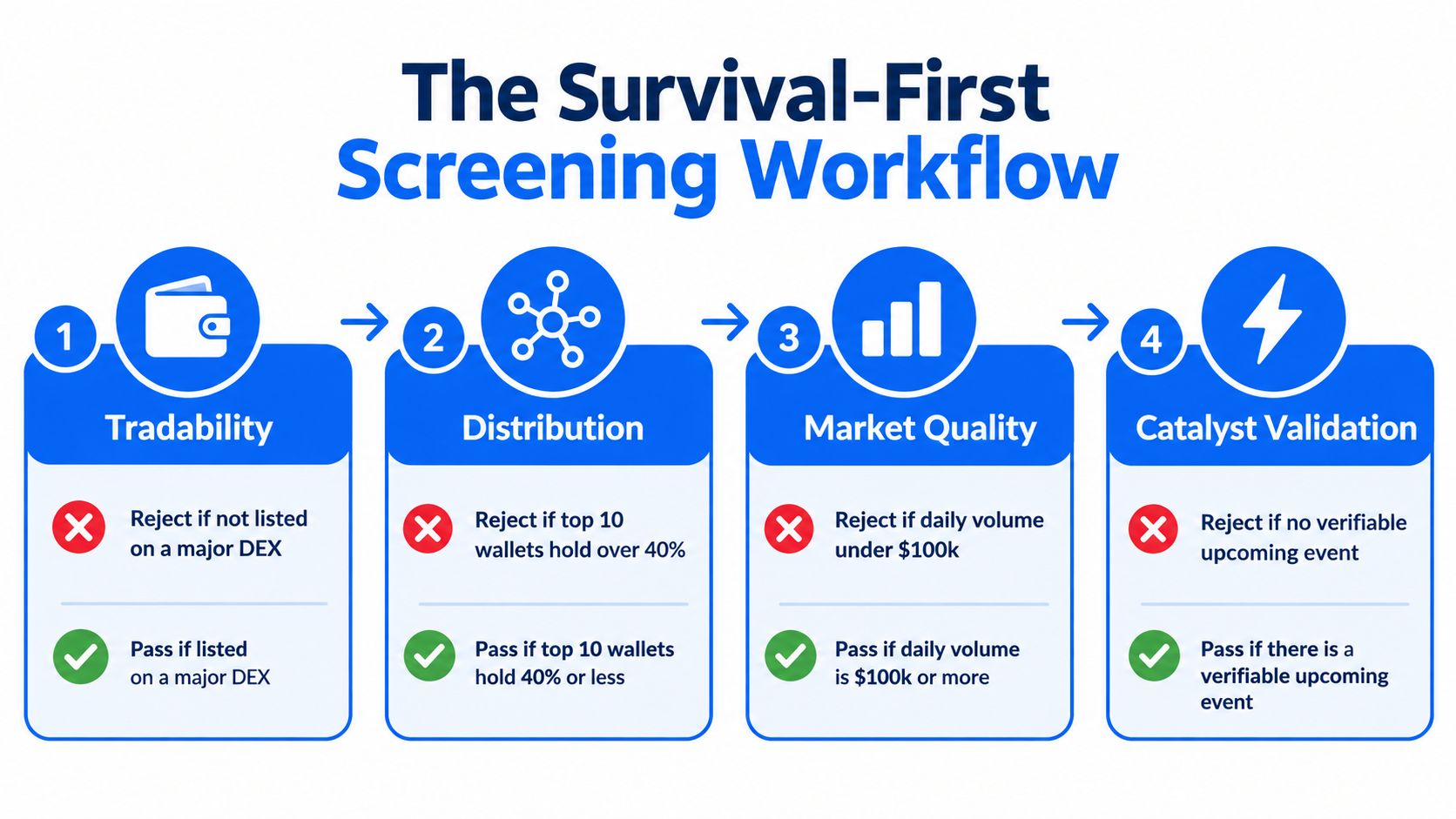
The safest way to approach how to find 100x altcoins is to reject most of them before you even think about upside. A clean workflow starts with the market's survival constraints, not its marketing claims. More than 3 million tokens were launched in 2024, but only about 1.7% were actively traded in the subsequent 30-day measure cited in reporting, which tells you how quickly the visible universe shrinks once you insist on real activity TronWeekly coverage.
Stage one tradability
The first gate is simple, can you enter and exit without being trapped by the pool? Recent DEX volume, sufficient liquidity, and a realistic exit size matter more than a tweet thread. If liquidity is thin, or if it looks removable or rapidly declining, the setup is already compromised.
Stage two distribution
Then look at who owns the supply. Concentrated insider ownership, creator-linked wallets, synchronized funding, and early-wallet overlap are all reasons to stop. A token with broad marketing can still be a tightly controlled supply event, which is exactly why holder count alone can mislead.
Stage three market quality
Now compare buy and sell counts, average trade sizes, turnover, and liquidity changes. Wash-inflated volume often looks active on the surface while failing basic flow quality checks underneath. If volume looks abnormal relative to liquidity, the chart may be advertising demand that doesn't exist.
Stage four catalyst validation
Finally, ask whether attention is broadening or just being manufactured by a small promoter cluster. That distinction matters because a narrow cluster can create a burst of impressions without creating durable demand. You can use a public research workflow like MemeAssist's Solana memecoin analysis flow to centralize those checks, but the principle stays the same, a single favorable snapshot is not enough.
Useful shortcut: if a token passes the first three stages but the catalyst still depends on one influencer, one group chat, or one launchpad blast, treat the setup as fragile.
Reading the On-Chain Evidence That Actually Matters
The surface metrics people brag about, holders, volume, market cap, can all point in opposite directions once you inspect the chain. Two tokens can show the same headline numbers and still sit on completely different risk profiles. That's why on-chain reading has to focus on control, flow, and exit realism, not cosmetic activity.
What to check and what to ignore
| Evidence Category | Specific Check | Hard-Reject Signal | Common Misread |
|---|---|---|---|
| Tradability | Liquidity depth and realistic exit size | Thin or withdrawable liquidity | “It trades, so I can exit” |
| Distribution | Top holders, creator-linked wallets, overlap | Concentrated supply or linked wallets | “Many holders means decentralization” |
| Wallet behavior | Synchronized funding and clustered arrivals | Wallets that appear independent but move together | “Different wallets means different buyers” |
| Market quality | Buy/sell counts, trade size, turnover, price impact | Wash-inflated or abnormal flow | “High volume means real demand” |
| Control risk | Creator or deployer permissions | Seller control or mutable permissions | “The chart is up, so contract risk is low” |
Bundle detection and insider clustering matter more than raw holder count. A token can spread across many wallets and still be effectively controlled if those wallets are funded together or behave in sync. That is why distribution analysis should always include wallet overlap and creator behavior, not just the number of addresses in the holder list.
What sufficient liquidity really means
Liquidity isn't a badge, it's a usability test. If you can't imagine your own exit without collapsing the book, the token isn't ready for serious consideration. Exit size matters because a position that looks attractive on screen can become untradeable once your size hits the pool.
Rule of thumb: never treat one clean chart snapshot as proof of safety. Liquidity can look healthy for a moment and still be structurally weak.
A similar mistake happens with volume. Traders often see activity and assume demand, but buy/sell balance and average trade sizes tell a more honest story. If trades are clustered, repetitive, or strangely synchronized, the market may be choreographed rather than organic.
For deeper screening logic, the Solana rug-risk ranking guide is useful because it forces the same discipline, map evidence to risk, then decide whether the setup deserves capital at all.
Two Solana Launches Compared Through the Filter
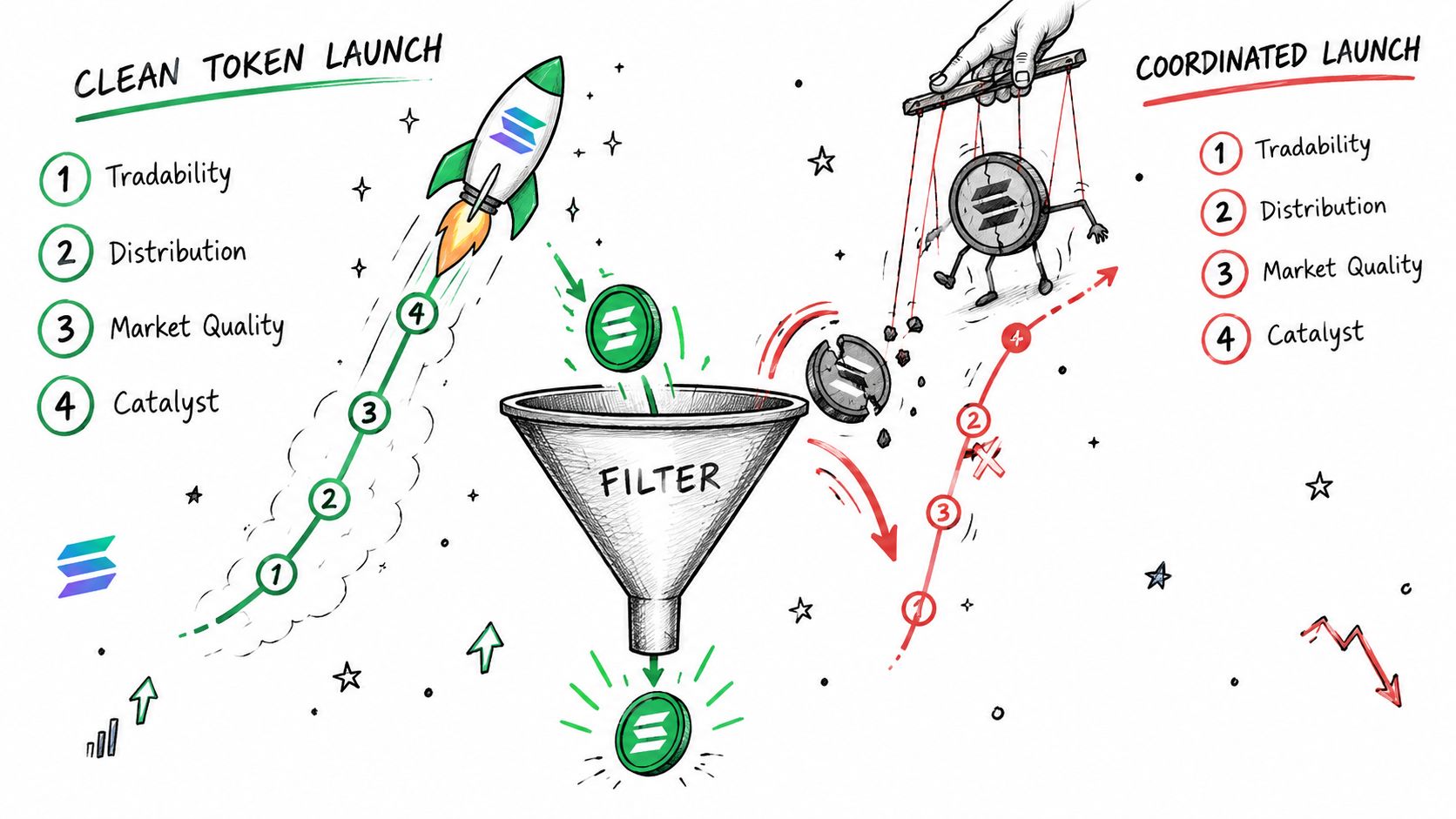
One launch can look alive and still be structurally weak. Another can look ordinary and still be far cleaner. The filter matters because the search for 100x altcoins is mostly a survival problem, and Solana's launch velocity makes that obvious.
The clean launch
A cleaner token shows a holder set that does not move in lockstep. Top-10 holders stay below a quarter of supply, liquidity holds instead of whipping around, and funding arrives over a wider window rather than from one burst of linked wallets. Trade sizes vary too, which is what organic activity usually looks like.
That does not make the token good. It only means the launch is not obviously manufactured.
The coordinated launch
A coordinated launch can look stronger on the surface. Volume prints fast, the chat fills up, and the chart pulls in attention. The problem shows up when the supply map is checked. If 60% of supply sits in wallets funded from three source addresses within 10 minutes, the holder count is a disguise, not evidence of dispersion.
Trade clustering gives the same signal. Repeated sizes, synchronized entries, and wallets that behave too similarly point to orchestration rather than broad participation.
Why yesterday's checklist goes stale
CoinGecko's State of Memecoins report put Pump.fun at close to 99% of new launches in 2025 Q1, and that concentration matters because launch behavior changes when the market changes CoinGecko report. The screen that worked in a more uniform launch environment weakens once the supply chain fragments and new launchpads begin taking share.
The useful conclusion is blunt. Holder count, volume, and market cap can all describe a token that survives or a token that was assembled to look alive. The chart only deserves trust when the wallets behind it do.
Trade Setups, Sizing, and Re-Checks After Entry
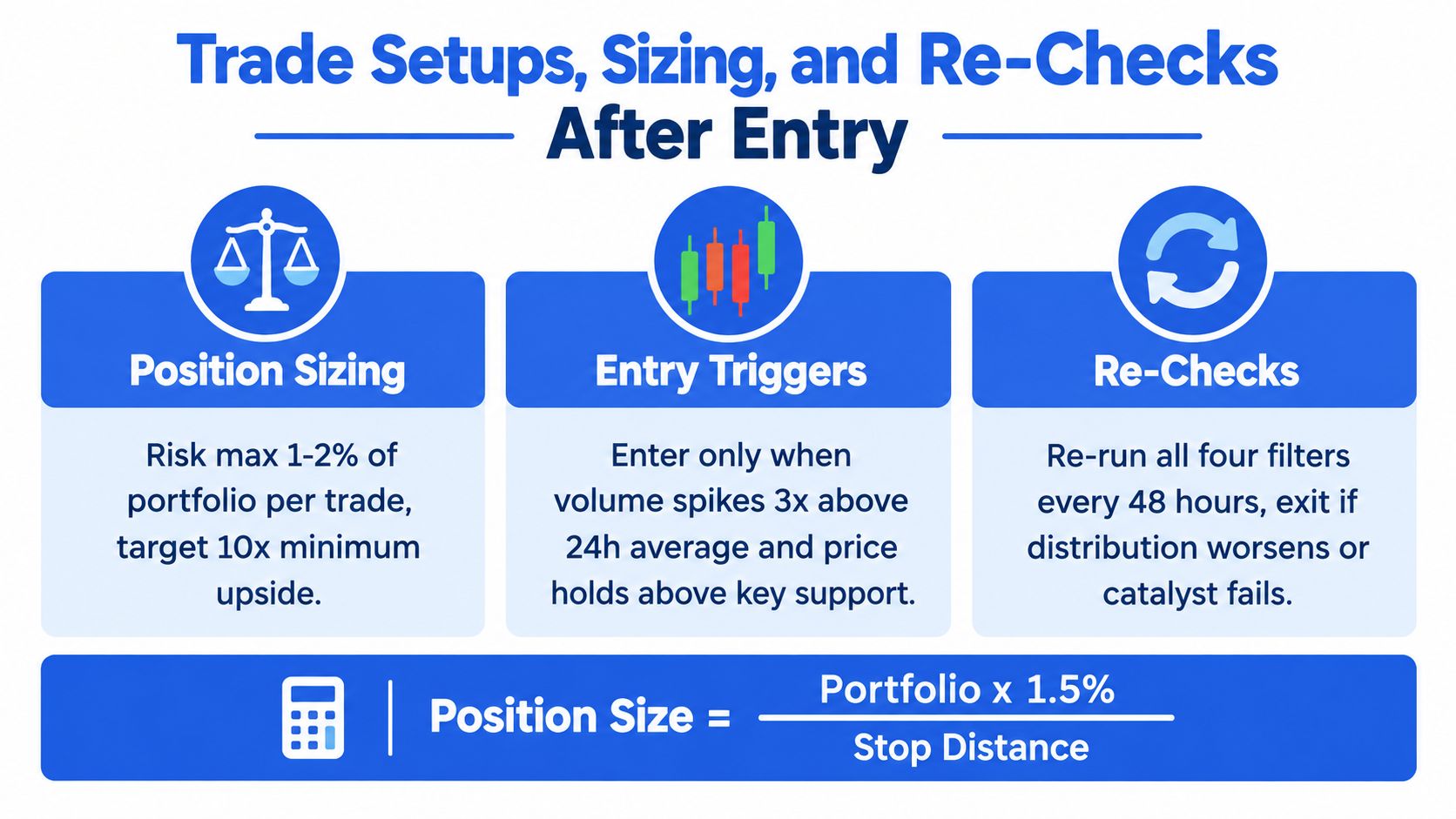
A clean screen doesn't justify a full position. It just earns the right to be treated like a tradable hypothesis. The entry should still depend on liquidity behavior, not narrative excitement, because the market can flip from promising to untradeable very fast.
Position size should respect the downside
Keep the trade small enough that a clean loss doesn't distort the rest of the book. If the setup only makes sense when you size aggressively, the setup probably isn't good enough. The point is to stay in the game long enough for the occasional asymmetric winner to matter.
Enter on evidence, not anticipation
Volume spikes and support retention matter more than “it's trending.” If price can't hold while liquidity expands, the move may not be durable. A good entry is one where the tape confirms the setup instead of asking you to believe in it.
Re-check after material movement
The same signals that justified entry should be re-run after meaningful price movement. That's where a lot of false comfort disappears, because distribution can worsen, liquidity can degrade, and the creator wallet can become more active after the first impulse. If the evidence weakens, the trade thesis should weaken with it.
Re-verify the deployer wallet, especially after a sharp move. A token that looked orderly at entry can become far less attractive once insiders start changing behavior.
For a more applied framework, the Solana trade-setup guide is a useful companion because it ties live signals to action rather than pretending backtests can capture every launchpad regime.
Calibrated Decision-Making and the 24-Hour Feedback Loop
A 100x target is a tail outcome that only matters after the survival filter has done its job. Chainalysis estimated that cryptocurrency scams received at least $9.9 billion on-chain in 2024, with high-yield investment scams at 50.2% of scam revenue and pig-butchering scams at 33.2% Chainalysis. Those figures do not identify the next winner, but they explain why upside, exit risk, and counterparty risk need to be judged together.
The checklist has to move with the market
Launchpad norms, creator tactics, and manipulation patterns shift quickly. Pump.fun's dominance in one period does not guarantee the same playbook will work next period, and trader behavior changes just as fast CoinGecko report. A screening checklist turns stale the moment it is treated like a fixed rulebook.
A warning is not a probability
A token that looks risky and a token that has been proven dangerous are not the same thing. Rug-pull totals are hard to isolate cleanly across datasets, so a neat-looking score can create false confidence. Timestamped evidence matters more than a static label.
Use the 24-hour loop
After a token is flagged, compare the original signal with what happened over the next day. Record false positives, record missed failures, and adjust thresholds by market regime. That feedback loop keeps the framework honest, because the goal is to stop mistaking noise for opportunity while the market is still filtering for survivors.
Survive first, then look for upside, then verify, then update. That sequence beats a hero narrative every time.
MemeAssist turns that workflow into a live Solana token report, with liquidity, holder distribution, creator behavior, wallet activity, trading patterns, and historical risk indicators pulled into one analysis. If you are screening meme coins for asymmetric upside, use MemeAssist to check whether the chart is telling the truth before you commit capital.