How to Find New Crypto Tokens Without Getting Rugged
By October 2025, Pump.fun had launched 12.8 million memecoins on Solana, according to the MemeTrans research dataset. Finding another new token isn't the hard part. Deciding whether anyone independent wants it, and whether you could sell it when they don't, is where the work begins.
If you're learning how to find new crypto, start with exclusion rather than price predictions. A fresh listing creates a research candidate, not a reason to buy. The useful shortlist contains tokens whose liquidity, ownership and trading activity can withstand scrutiny, not only those with the fastest-moving charts.
Table of Contents
- Where New Tokens Appear and What Each Feed Misses
- How to Find New Solana Tokens in Six Steps
- Pre-Entry Checks That Filter Most Launches
- Creator and Wallet Checks That Expose Coordinated Launches
- Testing Whether You Can Exit Before You Enter
- Decide Whether to Enter, Watch or Skip
Where New Tokens Appear and What Each Feed Misses
Discovery sources and their blind spots
| Source | What it shows | Blind spot |
|---|---|---|
| Launchpad new-token feed | Every fresh launch on the platform | Launch volume says nothing about liquidity or survival |
| New DEX pool alerts | Tokens that just became tradable | A pool can be shallow or controlled by the party preparing to sell |
| Trending and gainers lists | Tokens with recent price momentum | Coordinated buying can look like independent demand |
| Volume leaderboards | Tokens with high recent trade volume | Related wallets can trade with each other |
| Social mentions and call groups | Attention and promotion | Paid promotion can look like organic interest |
| Creator launch history | Earlier tokens from the same deployer | Only useful when the creator can be linked to earlier launches |
A launchpad feed is useful when you want the earliest possible view. A new-pool feed is more relevant when you want evidence that trading has started. Neither tells you whether the market can absorb your eventual sale.
According to Chainalysis's analysis of Ethereum launches, more than 370,000 tokens launched in 2023, roughly 45.6% became available on a decentralized exchange, and fewer than 14.1% of tokens launched in any given month achieved more than $300 in DEX liquidity during the following month. That liquidity threshold isn't a recommended trading minimum. It illustrates how little a launch or exchange listing establishes on its own.
Build a funnel, not a buy list
Those figures describe Ethereum, not Solana. For a Solana-specific view, a Pump.fun study covering September–October 2025 recorded 655,770 newly created tokens, of which 4,338 reached graduation. Graduation is a platform milestone, not proof of durable demand or a profitable trade.
Use feeds according to the question they answer. A launchpad listing answers when a token appeared. A DEX pool alert identifies where trading became possible. A trending page tells you where attention has recently concentrated.
Keep a discovery log with the mint address, creation time, discovery source and initial reason for interest. Include rejected tokens, otherwise your records will contain only the survivors you chose to keep watching.
After a fortnight, review which feeds produced candidates with persistent liquidity and usable ownership information. Judge the feed by the quality of candidates it helped you evaluate, not by the biggest price increase you missed.
Practical rule: A discovery feed should send tokens into a screening funnel, not directly into your wallet.
Expect most entries to fail. A feed that produces fewer candidates you can investigate properly can be more useful than an endless stream of launches.
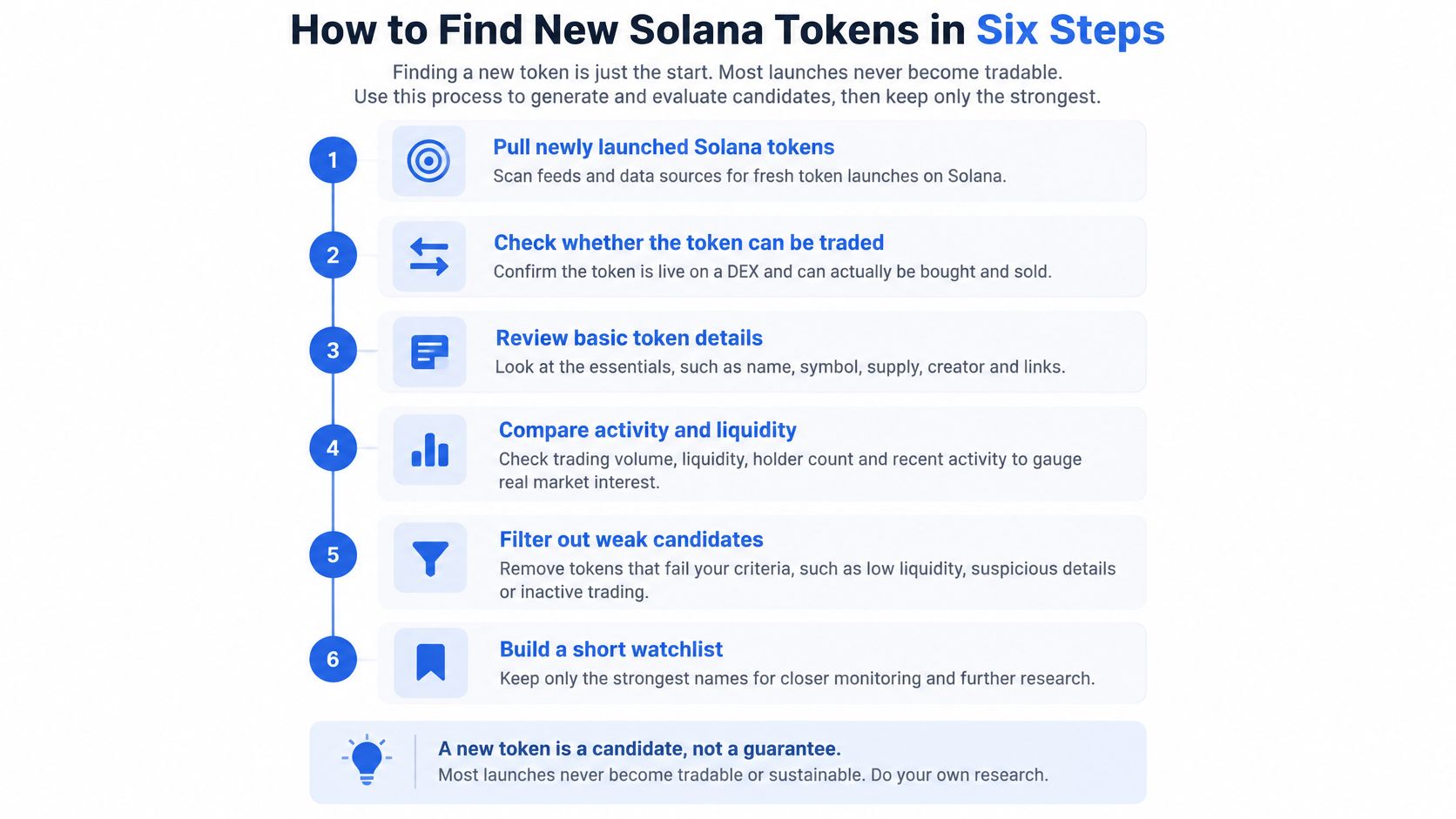
How to Find New Solana Tokens in Six Steps
A large share of the Solana meme-coin projects analysed in an ACM study of Solana meme coins collapsed after an early spike. A fast rise can mark the start of a failure, not evidence that demand will last.
Follow the address through the workflow
Pull newly launched Solana tokens. Use a launchpad creation feed or a market-data service's new-pairs view, sorted by creation time rather than percentage gains. Save the timestamp and originating listing so you can distinguish the token's age from the age of a particular pool.
Verify the mint address. Copy it from the listing and cross-check it in a Solana explorer such as Solscan, including the associated pool and token details. Tickers and names can be reused by copycats, so verify the address itself.
Observe the opening trades. Check for abrupt price acceleration, concentrated early buying, repeated small transactions and sudden liquidity changes. Inspect the underlying transactions; a rising candle alone cannot show who is buying or whether liquidity is holding.
Map the creator and early holders. Identify the deployer, review earlier launches where history is available, and compare early buyers for shared funding. Record unresolved connections as questions, not proof that separate addresses belong to one person.
Inspect liquidity and permissions. Check whether a usable trading route remains, then review mint and freeze authorities and relevant token restrictions. Mint authority can permit additional supply; freeze authority can affect token accounts. Neither should be reduced to a simple green badge.
Set an observation window. Choose its length before watching the chart, then wait for it to elapse without rejection conditions appearing. Extend the window when evidence is incomplete. A rising price is not a reason to shorten it.
Keep the steps separate: discovery produces candidates, address verification confirms what token you are examining, and observation gives you time to assess changing evidence. The key question is not only whether a token is attracting buyers, but whether you could exit and whether its holders appear independent.
Save evidence before the chart changes
For each candidate, record the mint and pool addresses, authority status, creator address and observation deadline. Add transaction references for specific behavior that concerns you. Clear notes make it easier to explain a rejection after the chart has moved.
Social attention and trade counts do not establish independent ownership. A volume burst can come from concentrated activity, while a visible following says nothing about who controls the supply.
Waiting has a cost: you may miss part of an early move, and a quiet observation period does not guarantee a token will hold up later. The trade-off is to give up some early-entry advantage in exchange for evidence that was unavailable at launch.
Passing these steps earns a candidate closer review. It does not establish that you can exit at an acceptable price or that its holders are independent.
Pre-Entry Checks That Filter Most Launches
Set your rejection criteria before opening a candidate's chart. There isn't a universal holder percentage or liquidity cutoff that makes every token suitable for every trader. Your position size, acceptable execution cost and ability to monitor the trade determine what you can tolerate.
Use the same worksheet for each candidate. Consistency makes it harder to excuse an unfavorable reading because you like the narrative.
Pre-entry checks and red flags
| Check | What to measure | Red flag |
|---|---|---|
| Liquidity against position size | Pool depth compared with the amount you plan to trade | Pool too shallow to enter and exit at your size |
| Largest holder share | Share of total supply held by the biggest wallet, after identifying pool and infrastructure addresses | One holder can overwhelm available buying |
| Creator and early-funded wallets | Combined supply held by the creator and early-funded wallets | Creator-linked wallets control a large allocation |
| Buy-versus-sell imbalance | Buy and sell volume during your observation window | Persistent buying with almost no successful selling |
| Transaction-size concentration | Whether a few trade sizes dominate volume | Repeated same-size trades without a convincing explanation |
| Wallet overlap | Shared funding and participation in other launches | Correlated wallets with no clear innocent explanation |
| Liquidity persistence | Changes in pool depth throughout observation | Liquidity drops sharply or disappears |
Don't let a safety badge override the evidence
In older token ecosystems, the rug-pull study on arXiv found that 93% of observed rug pulls occurred within the first 24 hours after pool creation, while 90% of tokens using locking contracts in that dataset eventually became rug pulls or malicious tokens. Those are dataset-specific findings, not probabilities for an individual Solana token. They do show why a liquidity lock shouldn't end your investigation.
A lock addresses a particular mechanism for removing liquidity. It doesn't establish fair ownership, independent trading or responsible creator behavior.
Use the Solana token safety checks as a repeatable checklist, then run a scanner as a second pass. Log its flags alongside your manual findings. A clean result adds no assurance about risks the scanner didn't assess or couldn't observe.
Apply hard rejection rules for:
- Unverifiable creator history: You can't establish enough provenance to satisfy your own policy.
- Unacceptable concentration: A holder or linked cluster exceeds the limit you set.
- Unexplained coordination: Funding and trading connections remain unresolved.
- Deteriorating market access: Liquidity disappears or successful selling becomes questionable.
- Wash-like activity: Repetitive or circular trading prevents a credible reading of demand.
Keep rejected and vanished tokens in your review set to avoid survivorship bias. When evaluating an old decision, use only information available at that moment, not later labels or outcomes.
Suspicious activity or potentially linked wallets in our reports are items to examine, not evidence of wrongdoing. Missing data isn't proof of safety, and a flag can justify skipping a trade without justifying an accusation.
Creator and Wallet Checks That Expose Coordinated Launches
Chainalysis's blockchain-security analysis found that 3.59% of all tokens launched in 2024 displayed patterns potentially linked to rug pulls; in suspected pump-and-dump DEX pools, approximately 94% appeared to be rugged by the pool-creating address, with the remaining 6% linked to addresses funded by the pool or token deployer. These findings make creator provenance a practical starting point, not an optional background check.
A wallet address isn't an identity. Your job is to establish what the transaction history supports and distinguish that from what it merely suggests.
Trace funding before counting holders
Find the creator's initial SOL funding. Trace backward through the explorer and label the source where possible. A transfer from a broadly used exchange is less informative than direct funding from a wallet repeatedly involved in the same launches.
Inspect earlier launches. Look at what happened after creation: whether trading persisted, liquidity disappeared or creator-associated wallets sold into promotion. An empty history is unresolved provenance, not a clean record.
Measure retained control. Record the creator's visible allocation and transfers to potentially connected addresses. Don't stop at the balance remaining in the original deployer wallet.
Compare the earliest buyers. Check shared funding, transaction timing and buys landing in the same block. Any single connection can have an innocent explanation; overlapping connections deserve more scrutiny.
Follow early-holder selling. Examine whether the largest early allocations are being distributed into incoming demand. Separate actual sales from transfers between accounts before drawing conclusions.
The creator-wallet investigation guide provides a structured way to organize these checks. Keep the transaction references that support each connection, rather than saving only a wallet label.
A hypothetical cluster
Suppose several early buyers receive SOL from an address that also funded the creator. They enter almost together, then transfer tokens through overlapping wallets before selling as promotion increases.
Treat them as a potentially correlated cluster for your risk calculation. That doesn't establish common ownership or fraud, but it undermines the assumption that each address represents an independent buyer. Unless a convincing explanation resolves the pattern, skipping is a reasonable trading decision.
You don't need to prove misconduct to decide that a token's ownership is too opaque for your money.
Don't overinterpret a shared exchange withdrawal source or automated execution timing on its own. Look for a combination of funding relationships, token transfers and coordinated behavior.
Finish with a concise evidence record: the creator's funding trail, earlier launches you could verify, the supply share held by potentially connected wallets and your confidence in those connections. A precise uncertainty statement is more useful than an unsupported insider label.
Testing Whether You Can Exit Before You Enter
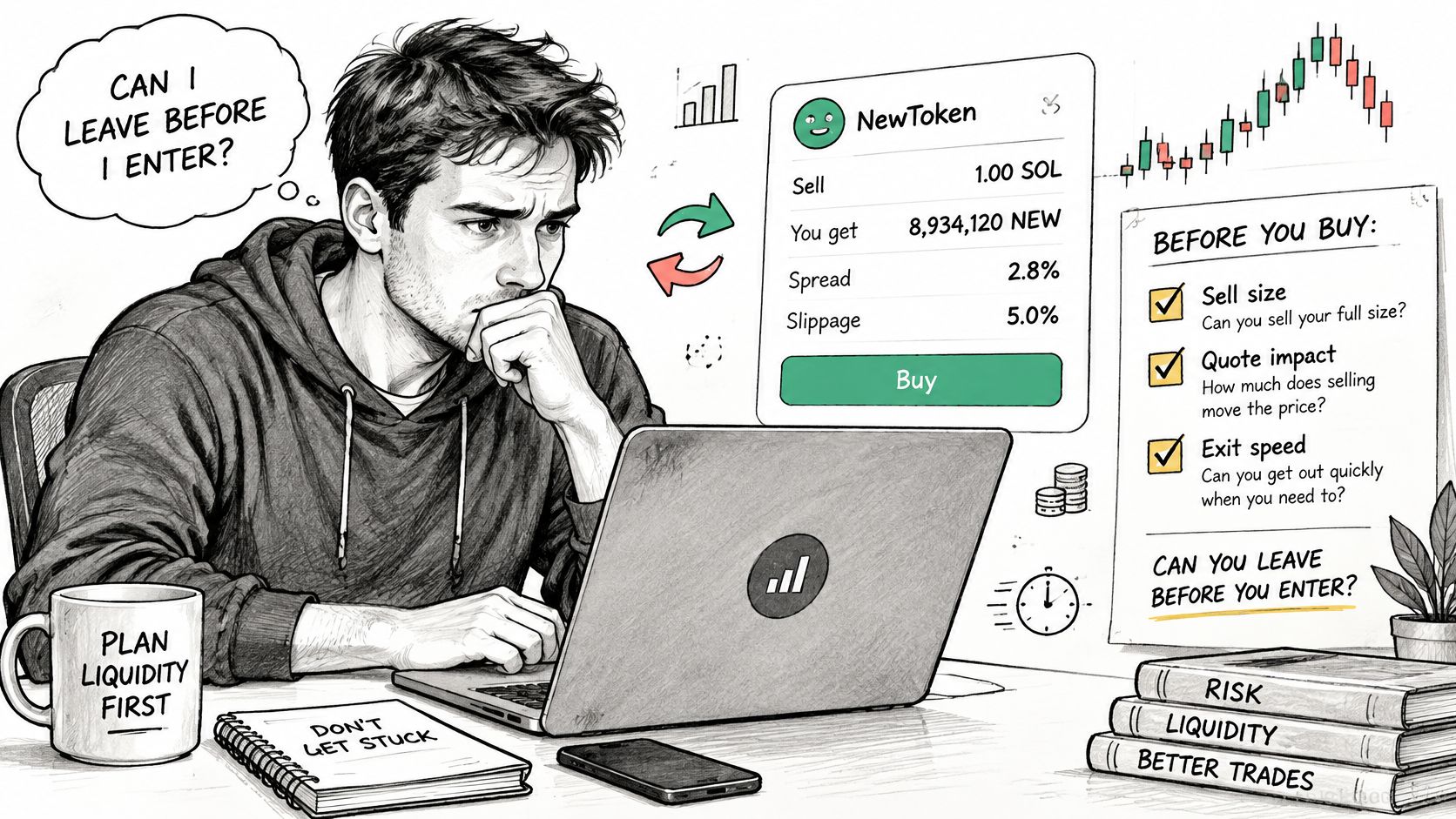
An attractive entry price says little about whether you can sell later. A purchase confirms that a swap route existed for that transaction; it does not establish that buyers will absorb your position under worse conditions.
A Bitquery investigation of approximately 2.9 million ordinary wallets trading newly launched Solana memecoins found that 74% had less SOL than they started with within two weeks, after fees, with aggregate losses of about $269 million. Treat market access as a separate test from finding a token or assessing its holders.
Write an executable exit policy
- Quote the intended sale. Request a sell quote for the quantity you expect to hold through an available swap route. Compare estimated proceeds and price impact with the chart price. A quote is an estimate, not a promise of future liquidity.
- Set maximum slippage. Choose your limit before entry. Raising slippage tolerance may accept a worse execution, but it cannot create liquidity or guarantee a sale.
- Define liquidity invalidation. Record the pool conditions your trade depends on and what deterioration would make the position unacceptable. Check the underlying reserves, not only a dollar value that can change with the token price.
- Set an observation deadline. If the token has not shown persistent market access by then, drop the idea instead of extending the deadline to justify an entry.
MemeAssist's free Liquidity Checker can support this review, but the decision should remain tied to your intended trade size and written limits. A small test sale, if you make one, demonstrates execution only for that amount at that moment.
Identify who supplies the activity
Compare the apparent demand with the holders who may sell into it. Consider shared funding, token transfers and synchronized trading when judging whether buying activity comes from independent participants. Keep infrastructure accounts separate from discretionary holders.
Repeated turnover between connected addresses says less about outside demand than trading spread across apparently unrelated participants. Independence is an inference, so record uncertainty rather than treating a cluster as proof of common ownership.
Liquidity can be available while coordinated holders sell into it. If those holders are likely to compete with you for buyers, headline volume may overstate the demand available for your exit.
Judge volume by who is trading and how much liquidity remains for your intended sale, not by the size of the number on the screen.
Decide Whether to Enter, Watch or Skip
Give each candidate a decision rather than leaving it indefinitely on a hopeful watchlist.
| Decision | Required condition | Action |
|---|---|---|
| Skip | It fails a hard rejection rule | Record the reason and remove it from the active list |
| Watch | No hard failure, but observation or exit evidence is incomplete | Set the next review time and the evidence needed |
| Consider entry | It survives observation, passes your exit test and fits your loss budget | Use the predetermined size and execution limits |
Choose position size before studying the chart's upside. Base it on what you can afford to lose completely, not on how certain the setup feels. If a total loss would affect essential expenses or force you to recover it through another trade, the allocation is too large.
Keep the decision conditional
Before entry, write down the events that would invalidate the trade and when you'll review it. After entry, re-check creator activity, holder distribution and liquidity on that schedule, with additional reviews when unusual transfers or market changes appear. Don't rewrite your original limits because you're now holding the token.
Use automated analysis as a second opinion, not permission to stop investigating. MemeAssist brings liquidity, holder concentration, creator behavior and trading patterns into a report with an Overall Health Score, Rug Risk Rating, AI Verdict and Detailed Risk Breakdown. Eligible new accounts receive one free full analysis, with no card or wallet needed at signup.
Choose our service for integrated research, explanations and tracking, not exclusive blockchain data, safety guarantees or profit promises. Our automated analyses are informational, not financial advice. Memecoins are extremely risky, and you can lose all invested capital.
The useful outcome isn't always an entry. A documented skip preserves capital, while a watch decision gives you a specific question to resolve instead of an excuse to chase.
A passing score narrows the list, but it doesn't prove a token will rise.
Bring your next shortlisted Solana mint address to MemeAssist for an explained risk report covering ownership, liquidity, creator behavior and trading activity. Compare the findings with your rejection rules and exit requirements before deciding whether to enter, keep watching or skip.
Topics: find new crypto, Solana tokens, rug pull check, crypto due diligence, new token screening
Informational only, not financial advice. Meme coins are extremely high-risk.
All articles