How to Research Crypto on Solana in 2026
Consumers reported losing $5.7 billion to investment scams in 2024, according to the U.S. Federal Trade Commission. That's not a Solana-specific figure, but it reframes the research task: you're not just looking for upside. You're checking whether the evidence behind an investment survives scrutiny.
Learning how to research crypto means replacing reassurance with a repeatable investigation. For Solana meme coins, that means preserving a dated snapshot, checking independent failure modes, and watching what changes after the token first looks healthy. A green score describes an assessment at a moment in time, not a promise about your next trade.
Table of Contents
- Set Up a Read-Only Research Toolchain
- Solana Token Checklist and Investigation Order
- What Changes After the First Check
- Concentration Numbers and Detection Limits
- Red Flags That Look Like Safety
- Run a Fresh Check Before You Buy
Set Up a Read-Only Research Toolchain
Build your research workspace before opening a token chart. Otherwise, you'll end up switching between dashboards with different timestamps, holder exclusions, and definitions of liquidity, then treating their outputs as comparable.
Keep the entire investigation read-only. Public blockchain information doesn't require your trading wallet, a signature, or permission to move funds.
Choose tools by the evidence they expose
Start with a Solana block explorer such as Solscan or Solana Explorer. Paste the full mint address into the search field yourself, then verify that the result is a token mint rather than a wallet or pool account. Don't identify a token by its ticker, logo, or a screenshot.
Use a pool viewer alongside the explorer. A charting interface such as DEX Screener can help locate markets, but inspect the underlying Raydium, Orca, or Meteora pool accounts when you need to establish control over liquidity.
Your workspace should include:
- An authority view. It must expose mint and freeze authority status, plus relevant program-control information.
- A liquidity view. Look for pool balances, the owner of the liquidity position, lock evidence, and any release conditions.
- A holder export. Choose a view that lets you inspect leading balances and calculate concentration rather than accepting a badge.
- A transaction history. You need transfers and swaps, not just candles, to investigate wallet relationships.
Use this comparison of Solana token checkers to assess coverage gaps. A convenient interface is useful, but missing evidence should remain visibly missing.
Make the snapshot reproducible
Create a spreadsheet with a row for each check. Record the mint, launch venue, launch time, observed block or timestamp, tool name, retrieval time, and the tool's own data date where available.
Keep observed time separate from retrieval time. You might open a dashboard now while its holder distribution reflects an earlier update.
| Snapshot field | What belongs in it |
|---|---|
| Token identity | Full mint address and venue |
| Observation | Block or timestamp attached to the evidence |
| Retrieval | When you collected the result |
| Method | Tool, settings, exclusions, and calculation |
| Uncertainty | Unknown fields and unresolved disagreements |
Use consistent settings across tokens. Write unknown when a tool can't expose a field, rather than leaving an empty cell that you might later mistake for a clean result.
If an interface needs an address for watch-only functionality, use a separate unfunded address. Close any supposed research page that asks you to sign a transaction or grant permissions just to inspect public records.
Solana Token Checklist and Investigation Order
Work from identity and control toward behavior. Starting with the price chart encourages you to explain away inconvenient evidence because you already like the trade.
A Solana rug-pull measurement study manually verified 117 rug-pull tokens and applied its pipeline to 100,063 tokens issued on Orca, Raydium, and Meteora during the first half of 2025. Its practical contribution is the investigation order: preserve the evidence, inspect authorities, reconstruct liquidity, measure concentration, and examine linked-wallet trading.
Establish what can fail
Keep freeze-authority abuse, liquidity withdrawal, and pump-and-dump behavior separate in your notes. These aren't interchangeable diagnoses, and evidence against one doesn't eliminate the others.
Begin by confirming the mint and launch venue. Distinguish the initial launch from the pool you're examining now, particularly if a token has migrated between venues. Record the exact observation time for each check rather than assigning the entire investigation one approximate timestamp.
Then inspect control:
- Read mint and freeze authorities separately. Mark each as held, revoked, or unknown. A retained authority requires an explanation of who controls it and what it permits.
- Identify relevant program authority. Ordinary Solana tokens use shared token programs, so don't assume each mint has its own upgradeable contract. If custom program behavior matters, identify that program and its upgrade authority.
- Preserve the account evidence. Save the relevant addresses and transaction references. A dashboard label without an underlying account is difficult to verify later.
A live freeze authority is a distinct concern because it can affect account usability. Don't let a favorable liquidity reading cancel it out.
Follow liquidity, ownership, and wallet behavior
For liquidity, identify the actual pool and reconstruct deposits and withdrawals. Record both assets in the pool, not just a displayed dollar value, and establish who controls the liquidity position.
Locked, burned, and labelled locked are different observations. Inspect the position or LP token, the locking mechanism, and any withdrawal or release conditions. Concentrated-liquidity positions may require position-account inspection rather than a simple LP-token balance check.
Next, export holders and calculate the top-10 and top-20 shares using written exclusions. Show the unadjusted distribution alongside any adjusted version so that removing a pool or burn address doesn't hide a questionable denominator.
Investigate the creator's funding and transfers into large holders. Look for common funding paths, transfers before coordinated sales, and repeated transaction sequences. Shared funding alone is a lead, not proof of common control, especially when the source is an exchange.
Finally, read trades as transactions. Compare buys and sells, participating wallets, timing, and where proceeds go. A chart can show activity without showing whether independent traders generated it.
Solana token research checklist
| Check | Record | Warning sign | Does not prove |
|---|---|---|---|
| Identity and time | Mint, venue, launch time, block or timestamp | Address accepted from a link or image without checking the mint | That later trades match this snapshot |
| Authorities | Mint, freeze, upgrade or program authority status | Any relevant authority still held by a wallet | That renouncing makes the token safe |
| Liquidity | Pool size, LP owner, lock or burn evidence, unlock time | Owner can withdraw, or the lock is short or cosmetic | That burned or locked LP cannot be worked around |
| Holders | Top-10 and top-20 share, HHI, exclusion rules | A few wallets dominate after exclusions | That a large holder count means organic demand |
| Creator links | Deployer history and transfers to top holders | Same wallet pattern as prior failed launches | That missing history means a clean creator |
| Trading shape | Buy and sell timing, bundles, circular flows | Synchronized buys or unusually even spacing | That volume equals real two-sided demand |
| Blind spots | What the dataset cannot observe | Social claims substituted for ledger evidence | That no flag equals no risk |
Corroborate concerns without delaying obvious decisions
Require independent signals before describing an ambiguous pattern as coordinated or manipulative. Creator-funded wallets selling together are stronger evidence than either common funding or simultaneous sales alone.
Independence matters. A low liquidity score and a warning generated from that same pool balance aren't separate observations, even if different dashboards display them.
Practical rule: Corroborate allegations, not your right to walk away. One unresolved critical permission can be enough to skip a trade.
Manually review borderline cases. A large holder might be a pool account that your tool hasn't labelled, while apparently unrelated holders might share a funding path.
Finish each check with a limit statement. For example, a revoked mint authority establishes a restriction on additional issuance through that authority, not an absence of insider selling. Save the complete run, including uncertainty, so another analyst could reproduce your conclusion rather than merely agree with your score.
What Changes After the First Check
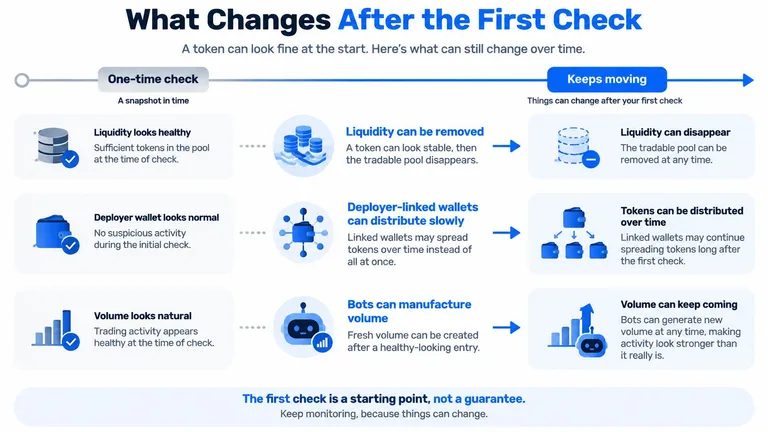
Pump.fun accounted for as much as 71.1% of Solana token minting in the period examined by a study of Solana token activity. At that scale, researching a launch as a fixed object misses the central problem: participants can change liquidity, distribute supply, and manufacture trading activity after your inspection.
The useful comparison isn't just risky versus apparently healthy. It's the previous state versus the current state.
This timeline illustrates why the first reading needs a follow-up.
Compare changes, not just dashboard colors
Say a hypothetical token initially appears well distributed. Later, fresh wallets that received funds from the deployer sell into a rising candle, while the dashboard still shows an attractive holder count.
The original count wasn't necessarily wrong. It answered the wrong question for the later decision, because addresses aren't the same thing as independent owners and a balance snapshot doesn't describe subsequent selling.
Ask these comparison questions:
- What changed in control and liquidity? Compare authority status, pool asset balances, liquidity-position ownership, and withdrawal transactions.
- Who received supply? Trace new large balances to their sources, then inspect whether recipients buy or sell together.
- What followed the apparent safety event? Check the transactions after a revocation, liquidity lock, or jump in holders rather than treating the event itself as clearance.
Record the new block time beside the previous one. Keep changes in token units as well as displayed value, since price movements can change a pool's dollar valuation without a matching liquidity deposit.
Recheck when participants change the setup
A daily review can miss the event that matters to your entry. Reopen the investigation after a liquidity withdrawal, migration, major creator transfer, authority change, or unusually sharp candle.
Use alerts to direct attention, not to automate a conclusion. A holder alert should send you to the receiving wallets; a liquidity alert should send you to the transaction and position owner.
A token can pass an earlier check honestly and still become an unacceptable trade later.
There's a trade-off between frequent checking and analytical depth. Monitor material changes narrowly, then perform a deeper review when those changes affect control, exit liquidity, or the independence of holders.
Use the accompanying video as a supplement to transaction-level inspection.
A high liquidity reading is a current measurement. Your decision needs to account for who can alter it and what they've done since you last looked.
Concentration Numbers and Detection Limits
Research figures that are warnings not cutoffs
The rug-pull detection analysis describes the following concentration, timing, and detection findings, including coverage of 7 of 34 documented root causes in datasets spanning 2,448 incidents and no evaluated tool averaging above 50% detection for combination attacks.
| Signal | Reported figure | Use it to | Do not treat it as |
|---|---|---|---|
| Holder HHI | Above 0.25 called an anomaly warning | Compare with top-10 and top-20 share | A universal sell rule |
| Gini-like concentration | Above 0.8 before some attacks | Flag unusually uneven supply | Proof an attack is underway |
| Trade-timing variation | CV 0.14 versus a stated normal of 0.8 | Look for unusually regular wash-like flow | Proof the volume is fake |
| Root-cause coverage | 7 of 34 causes in a 2,448-incident set; 19 in a broader set | Ask which failure modes the tool never sees | A complete rug taxonomy |
| Combination attacks | No evaluated tool averaged above 50% detection | Expect stacked tricks to slip through | A safe score meaning no possible rug |
A high score can still miss a combination attack because its component checks may never have been tested against that combination.
Calculate concentration with an explicit denominator
The Herfindahl-Hirschman Index, or HHI, is the sum of squared ownership shares expressed as fractions. Squaring gives larger holders more influence, which helps distinguish broadly distributed ownership from a distribution dominated by a small group.
Keep it beside the leading-holder shares, not instead of them. The holder concentration analysis guide is useful for framing that comparison, but a threshold can't establish who controls apparently separate addresses.
Write down whether your denominator is total supply or supply after exclusions. Only remove burn, pool, or exchange accounts when you can justify the classification, and retain both raw and adjusted results.
Don't calculate an all-holder HHI from a partial export without labelling it incomplete. Nor should you assume a wallet-level index measures entity-level concentration when common control remains unresolved.
Test the decision, not the headline accuracy
Define the outcome before assessing a detector. Liquidity withdrawal, severe price collapse, and suspicious behavior are different labels; combining them after observing the result makes the evaluation difficult to interpret.
For an automated screen, track:
- Precision. How often does a flagged token meet the predeclared outcome?
- Recall. How many qualifying failures does the detector catch?
- Calibration. Do stronger risk predictions correspond to more frequent observed failures?
- Decision cost. What happens when you reject a viable trade or accept a dangerous one?
Use chronological evaluation splits. Related wallets or token families appearing across training and test sets can make a model look more capable than it is on new launches.
Break performance down by venue and token age. A rule that fits mature pools may be inappropriate during launch distribution, and unusually regular timing is a reason to inspect wallet flows, not sufficient evidence of wash trading.
Interpretation boundary: A safe score must never mean no possible rug.
Evaluate subsequent behavior using the outcome window you declared in advance. Following the same mint through that window teaches you more about your detector than adding another unvalidated indicator to its score.
Red Flags That Look Like Safety
A reassuring market-wide percentage can be as misleading as a token badge. For 2024, Chainalysis's Crypto Crime Report reported that known illicit addresses received at least $40.9 billion in cryptocurrency, while its estimate adjusted for historical identification patterns was closer to $51 billion.
Those figures distinguish identified activity from estimated activity. Neither describes the probability that the particular mint on your screen is safe.
Translate badges into narrow claims
A safety signal becomes useful when you can state exactly what it proves. Strip away the marketing label and test the underlying account state.
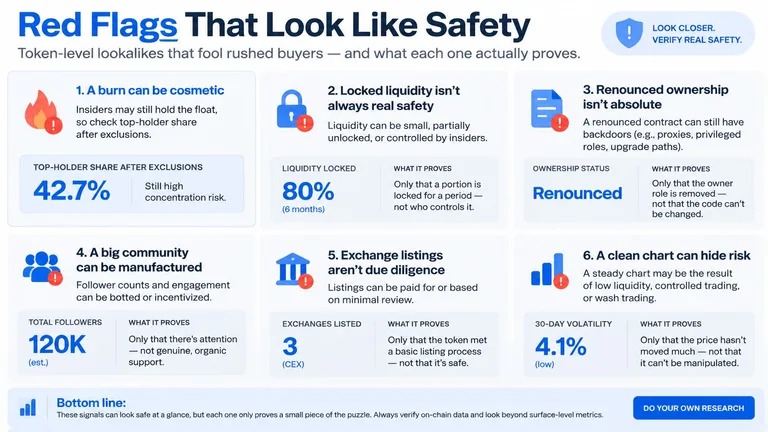
- A burn can be cosmetic. Verify what was burned and who controls the remaining tradable supply. Burning unrelated inventory doesn't establish dispersed ownership.
- A lock badge has conditions. Read the lock owner, position covered, and release terms. Don't assume the badge covers every relevant pool.
- A revoked mint is a narrow restriction. Inspect freeze authority and existing creator-controlled balances independently. This analysis of the revoked mint authority safety myth addresses that distinction.
- A busy community isn't ledger evidence. Test claimed demand against actual participating wallets and two-sided trading.
- An audit screenshot isn't a verified audit. Find the underlying document and match its scope, address, and version to the asset or program you're examining.
- An empty creator history isn't a clean record. It might reflect limited attribution rather than an established history of responsible launches.
The visual summary pairs familiar reassurance with the evidence needed to test it.
Separate facts, interpretations, and unknowns
Write conclusions in layers. A transfer between identified accounts is an observation; possible shared control is an interpretation; coordination outside the blockchain may remain unknown.
That distinction prevents overconfidence in both directions. You shouldn't accuse holders of wrongdoing from a suggestive pattern, and you shouldn't clear them because your tool lacks an attribution label.
Add the data date to every recorded figure and distinguish lower-bound observations from adjusted estimates. When evidence changes, preserve the earlier entry and explain the revision instead of overwriting the history.
Before increasing exposure, resolve contradictions between the ledger and the sales pitch. If a large candle is the reason you're reconsidering the trade, inspect the transactions behind it rather than accepting the candle as confirmation.
Run a Fresh Check Before You Buy
The final decision isn't whether a token deserves a permanent safe label. It's whether the evidence available now supports taking the specific risk in front of you.
Open the mint itself, not a screenshot of somebody else's result. Read the authority, liquidity, holder, and trading findings together, and pay particular attention to evidence collected at different times.
Turn the findings into a decision record
Write a short decision note before entering. It should say what you believe, which transactions support that belief, what remains unknown, and what event would invalidate the setup.
Use a compact pre-trade record:
- Identity confirmed. The intended mint matches the market and pool you inspected.
- Evidence current enough. No material event has occurred since the observations you're relying on.
- Contradictions resolved. Conflicting tool outputs have an explanation supported by account data.
- Exit assumptions explicit. Your plan doesn't assume displayed liquidity will remain available.
- Invalidation defined. You know which authority change, transfer, or withdrawal would trigger another review.
If the manual pass is slow, accept that you may miss the entry. Speed is valuable only when it doesn't require pretending that unknown fields are favorable findings.
A token doesn't become a better-researched trade because its price moved while you were checking it. Don't compensate for uncertainty by increasing size or chasing a later candle.
Use a second read without outsourcing judgment
An optional MemeAssist report provides an automated, informational second opinion using live evidence on liquidity, holders, creator behavior, wallet activity, and trading patterns. Creator history appears when evidence exists, missing data isn't proof of safety, and the report doesn't guarantee that a token is safe.
Read any second opinion beside your decision record. If it raises a concern you didn't inspect, follow the underlying evidence rather than averaging its rating with your preferred conclusion.
Memecoins are extremely risky, and you can lose all invested capital. Nothing here is financial advice, and no checklist removes the need to decide whether you can afford that outcome.
Save the snapshot before acting. If independent findings disagree and you can't explain why, skip the trade rather than buying the uncertainty.
Visit MemeAssist for an explained Solana token analysis that brings liquidity, holder distribution, creator behavior, and trading evidence into one research report. Use it as an optional second opinion beside your dated snapshot, then investigate disagreements before committing capital.
Topics: how to research crypto, Solana tokens, rug pull checks, on-chain research, meme coin safety
Informational only, not financial advice. Meme coins are extremely high-risk.
All articles