Insider Trading Data Explained: Sources and Signals
Following insiders isn't a trading strategy until you've established who traded, what they did, and when you could have known about it. The popular advice to copy insider buys skips those checks. A reported stock purchase may already be old information, while a fast-moving Solana wallet may have no demonstrable connection to a token's creator.
Insider trading data is evidence to investigate, not a verdict or an automatic entry signal. For listed stocks, the main limitation is often disclosure timing. For tokens, it's attribution: you can inspect transactions without knowing who controls the addresses. Reading both types well means separating observed activity from inferred relationships and testing whether either still matters at the price available to you.
Table of Contents
- Where Insider Trading Data Comes From
- What Each Insider Transaction Code Tells You
- Regulated Filings Versus On-Chain Records
- Why Reporting Lag and Gaps Limit Timing
- Spotting Coordinated Trading Clusters
- How Insider Activity Plays Out on a Solana Token
- Interpreting Signals Without Overreading Them
- Check Insider Signals Before You Trade
Where Insider Trading Data Comes From
| Source | Market | Who it covers | Typical timing |
|---|---|---|---|
| SEC Forms 3, 4 and 5 on EDGAR | U.S.-listed equities | Reportable officers, directors and large beneficial owners | Ownership and transaction filing deadlines |
| Form 5 annual statement | U.S.-listed equities | Insiders reporting certain deferred or previously unreported transactions | Annual reporting cycle |
| Form 144 notice of proposed sale | U.S.-listed equities | Affiliates proposing sales of restricted or control stock | Proposed-sale stage, not proof of execution |
| Schedule 13D beneficial ownership | U.S.-listed equities | Beneficial owners subject to substantial-ownership disclosure | Ownership-triggered reporting deadline |
| Wallet transaction history | Solana tokens | Addresses holding, transferring or trading a token | After the transaction is recorded and indexed |
| Holder and liquidity snapshots | Solana tokens | Token accounts, holder concentration and trading pools | Timestamp of the tool's latest retrieval |
Match the record to the question before interpreting the activity. Ownership disclosures, proposed-sale notices and executed transactions aren't interchangeable. A notice that someone intends to sell doesn't establish that a sale happened, and a large ownership position doesn't explain how or why it was acquired.
For listed stocks, EDGAR is the public filing database to check directly. Open the underlying document rather than relying entirely on a screener's summary. Read the reporting person's identity, transaction details and explanatory footnotes together.
What the records actually establish
Forms 3, 4 and 5 belong to the insider-ownership reporting system, but they serve different purposes. Distinguish an initial ownership statement from a transaction report and an annual statement before treating any entry as a fresh decision to buy or sell.
Form 144 is useful for investigating potential selling pressure, not confirming a completed disposal. Schedule 13D belongs to beneficial-ownership analysis, where the holder's stated purpose and accompanying disclosures matter alongside position size.
For Solana, start with the token's mint address, then inspect wallet history and holder snapshots against that exact asset. A token name or ticker isn't a reliable substitute for the address. Separate transfers from swaps, and check whether a prominent address is a trading pool or service account before describing it as an individual holder.
Practical rule: For listed stocks, start with the original EDGAR filing. For tokens, start with transaction history and timestamped holder and liquidity records.
The source establishes what is reportable or observable. It doesn't establish that a trade was improper, informed or worth following.
What Each Insider Transaction Code Tells You
| Transaction type | Form 4 code | What it may reflect | Weight for timing |
|---|---|---|---|
| Open-market or private purchase | P | An acquisition for consideration; inspect the transaction context | Relatively high if genuinely discretionary |
| Open-market or private sale | S | Diversification, cash needs or a prearranged sale | Moderate to low |
| Option exercise or conversion | M | Exercise or conversion of a derivative security | Low on its own |
| Tax-related withholding or delivery | F | Shares used to satisfy specified exercise-price or tax obligations | Very low |
| Award or grant | A | Compensation or another qualifying acquisition | Very low |
| Gift | G | Transfer without an ordinary market purchase or sale | Very low |
| Automatic plan-based sale | Inspect disclosure and footnotes | Execution under a previously established trading arrangement | Low as a fresh timing signal |
These weights are an analytical ranking, not measured probabilities of future returns. Transaction codes classify events; they don't reveal motivation by themselves. Even a purchase needs context about the security, price, ownership form and accompanying explanation.
A discretionary purchase deserves attention because the insider chose to commit capital. But don't assume every acquisition represents personal conviction: company awards, derivative conversions and other ownership changes can increase reported holdings without a new open-market decision.
Sales require a different interpretation. Someone can sell while remaining optimistic about the company, so a sale's existence alone doesn't identify a bearish forecast.
Read related transactions together
An option exercise followed by a sale should be examined as a connected sequence. Compare the securities acquired and disposed of, the resulting ownership position and the footnotes before concluding that the insider exited an investment.
Tax withholding and compensation awards belong in ownership accounting, but usually deserve little weight as entry signals. A gift changes reported ownership without establishing that the recipient or donor made a market-price investment judgment.
For plan-based transactions, inspect the filing's relevant disclosures and footnotes rather than guessing from regularly spaced trades. A scheduled execution isn't the same thing as a decision made at the execution price.
Use these questions on every filing:
- Was it discretionary? Look for an active investment choice rather than an administrative change.
- Was it planned in advance? Separate the execution date from the decision's timing.
- Was it routine compensation? Check for awards, exercises and withholding.
A discretionary purchase that wasn't prearranged or compensation-related generally deserves more investigative attention than a routine scheduled disposal. It still doesn't establish a suitable entry price.
Regulated Filings Versus On-Chain Records
| Criterion | Regulated filings (U.S. equities) | On-chain records (Solana) |
|---|---|---|
| Identity | Named reporting persons and disclosed ownership relationships | Addresses; links to people require additional evidence |
| Speed | Reporting deadlines rather than a live execution feed | Recorded transactions, subject to confirmation and indexing |
| Coverage | Ownership and activity covered by disclosure rules | On-chain activity, without complete ownership labels |
| Verification | Formal disclosures with reporting responsibilities | Transactions are inspectable; attribution requires analyst judgment |
| Funding trail | Not a complete account-level funding ledger | Transfers can be followed across visible addresses |
| Typical errors | Filing, extraction or contextual interpretation problems | False links from services, bots, market makers or copied trades |
The distinction is easier to see when disclosure documents and transaction traces are placed side by side.
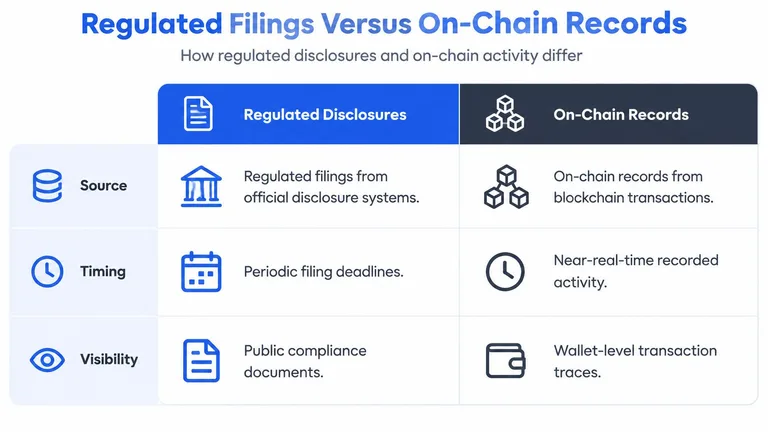
Named identity and observable execution solve different problems. A filing gives you a reporting person and a declared relationship to an issuer. A blockchain record lets you inspect an address's actions, but a label such as developer-linked adds an attribution claim that needs its own evidence.
Speed doesn't eliminate that distinction. An on-chain alert may arrive promptly while leaving the economically important question unanswered: are these separate traders, or addresses under common control?
Follow the evidence boundary
Coverage also differs. A filing system isn't a complete record of everyone trading a stock, and a blockchain isn't a complete record of every off-chain arrangement involving a token. Neither system should be treated as a universal map of information access.
Verification must therefore happen at separate levels. Check whether a transaction occurred, whether the address or reporting person has been identified correctly, and whether the interpretation follows from the evidence.
Funding history adds another investigative route on-chain. Follow transfers backward, but distinguish a direct funding relationship from withdrawals through a common exchange or service. Shared infrastructure can create apparent connections without common control.
In our analysis, we examine minting and freezing authorities alongside liquidity, holder distribution, creator behavior, wallet activity, trading patterns and historical risk indicators. That wider context helps prevent a wallet label from becoming the entire risk assessment.
Regulated disclosures are stronger on declared identity. On-chain records are stronger on transaction traces. Neither substitutes for evidence about intent.
Use the records together where a verifiable connection exists. Don't manufacture that connection just because the transactions look similar.
Why Reporting Lag and Gaps Limit Timing
Insider filings aren't real-time trade alerts. The SEC's guide to Forms 3, 4 and 5 explains that Form 4 is generally due within two business days, while Form 5 can be due 45 days after the company's fiscal year-end. Those are disclosure clocks, not promises that the disclosed price remains available.
Consider a hypothetical officer who buys on Monday and files on Wednesday. A trader reading the filing is evaluating Wednesday's opportunity, not Monday's transaction. If other buyers have already pushed the price higher, copying the insider's direction means accepting a different valuation.
Now consider a purchase disclosed through an annual statement much later. It may help explain the insider's accumulated exposure, but it doesn't establish that the insider would buy at today's price.
Measure age from the transaction
Use a practical age scale without confusing filing recency with transaction recency:
- Recent transaction: The execution is close enough to the present to compare directly with current price and intervening announcements.
- Dated transaction: Material trading or company developments have occurred since execution.
- Retrospective disclosure: The record mainly helps reconstruct ownership and past decisions.
A newly published filing can contain an old transaction. Conversely, a timely filing can still arrive after the price-sensitive development you hoped to anticipate.
Structured datasets introduce another layer between the original record and your screen. Treat extracted rows as an index to investigate, not a replacement for the filing's footnotes and transaction relationships.
Timing test: Would you still want the position if you hadn't seen the insider's purchase price?
Maintain a compact trade log:
| Field | What to record |
|---|---|
| Transaction age | Execution date compared with your review date |
| Filing type | The document carrying the disclosure |
| Confidence | Original filing checked, unresolved ambiguities noted |
| Decision context | Discretionary, plan-based, compensation-related or unclear |
A filing can corroborate an insider's willingness to hold exposure. On its own, it doesn't supply a reliable entry signal. Your entry still needs an assessment of current price, intervening information and the risk you're taking.
Spotting Coordinated Trading Clusters
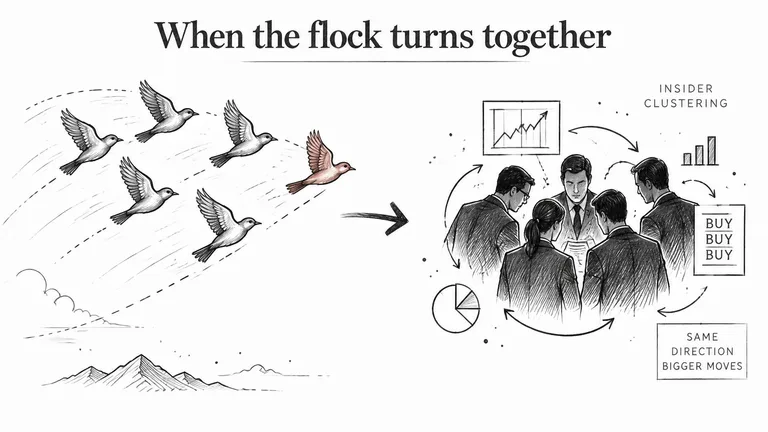
One bird turning may have its own reason. A flock turning together warrants a closer look, but the movement alone doesn't tell you what caused it.
A study of clustered corporate insider transactions finds that insiders trade alongside colleagues, especially close colleagues, and reports abnormal returns exceeding 2% over the subsequent month following clustered insider purchases. That's a finding about corporate insider transactions, not a return forecast for Solana wallet clusters.
The illustration captures the investigative idea: examine relationships, not just isolated actors.
Score the pattern rather than the largest trade
Use a network-level assessment:
- Temporal proximity: Did participants act close together relative to their usual activity?
- Common direction: Were they accumulating the same exposure or taking opposing sides?
- Wallet or account overlap: Are there direct transfers, shared counterparties or other explainable connections?
- Concentration of returns: Which participants acquired inventory before the move and benefited afterward?
- Historical independence: Have the addresses behaved separately before, or repeatedly acted together?
Say a large wallet buys a token. That observation supports a description of position-taking, but little about coordination. If previously connected wallets accumulate together immediately before a liquidity change, you have a more specific pattern to investigate.
The alternative explanations matter. Trading bots can respond to the same trigger, market makers can rebalance across accounts, and copy traders can reproduce another wallet's transactions. Synchronization is a risk indicator, not proof of misconduct.
For a practical explanation of these distinctions, use our guide to what Solana wallet clusters mean.
Trace funding before assigning control
Inspect each wallet's earliest relevant inbound SOL transfers and the funding immediately preceding the event. Look for a direct common source, similar funding sequences and subsequent transfers between participants.
Then identify what the funder is. A shared exchange withdrawal address is weaker evidence of coordination than a direct distribution from a creator-linked wallet followed by synchronized purchases.
Shared funding plus matching timing warrants closer examination, but neither is a mandatory prerequisite for concern. Connected actors can use separate funding routes. Keep the conclusion proportional: describe the observed links, explain plausible alternatives and leave ownership unresolved when the trail doesn't establish it.
How Insider Activity Plays Out on a Solana Token
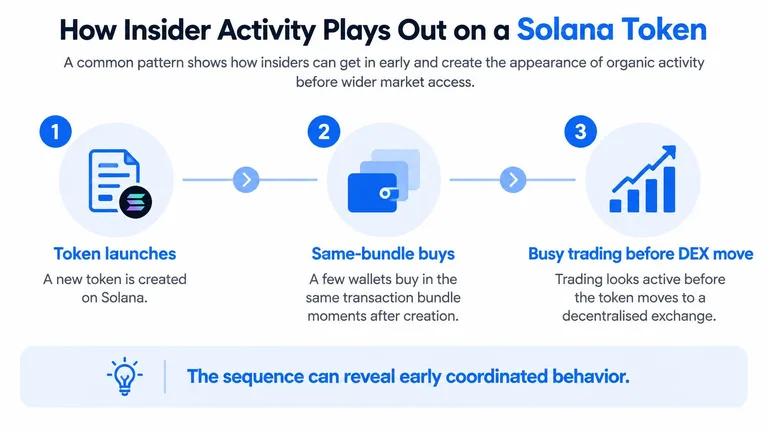
Consider a hypothetical launch. A creator deploys a token, several wallets buy through the same transaction bundle, and trading becomes busy before the token moves to a decentralized exchange. After migration, early holders begin selling into incoming demand.
That sequence gives you questions to investigate, not a ready-made accusation. The launch timeline helps distinguish early access from later trading.
An analysis of Pump.fun launches found that 98.7% of create events co-occurred with developer buys, while 21.4% of 30.8 million pre-migration transactions were classified as wash trades. The findings make launch access and transaction quality relevant checks; they don't establish that every developer purchase or busy launch is abusive.
Separate wallets by economic role
| Wallet group | Typical behaviour | What to check |
|---|---|---|
| Developer-linked wallets | Create the token or receive early supply | Deployer connections and sales after migration |
| Bundled buyers | Acquire inventory through the same transaction bundle | Funding relationships and matching entry timing |
| Unrelated snipers | Buy quickly without an established common funding link | Wider transfer history and repeated coordination |
| Wash-trading clusters | Appear to circulate trades to manufacture activity | Repeated counterparties and changes in net exposure |
| Secondary holders | Buy on the open market after migration | Entry conditions and exposure to earlier holders' selling |
A top-holder list can't make these distinctions by itself. You need acquisition history, transfers and execution context to understand whether concentration represents an early coordinated allocation, a pool account or subsequent accumulation.
Don't classify unrelated snipers merely because you failed to find a shared funder. No observed link means attribution remains unresolved, not that independence has been proved.
The accompanying video offers another format for examining the topic.
Investigate inventory and exits
Track who held inventory before public activity expanded, whether those holdings moved between related addresses, and who sold into later demand. For suspected wash trading, compare gross activity with net position changes instead of treating every transaction as independent demand.
Our guide to tracking smart-money wallets on Solana provides a related workflow for following wallet activity without assuming that profitability establishes privileged access.
An early wallet isn't automatically malicious. The more consequential combination is concentrated early access, evidence of artificial activity and selling that transfers exposure to later buyers. Describe each component separately so the reader can distinguish what happened from what you infer about it.
Interpreting Signals Without Overreading Them
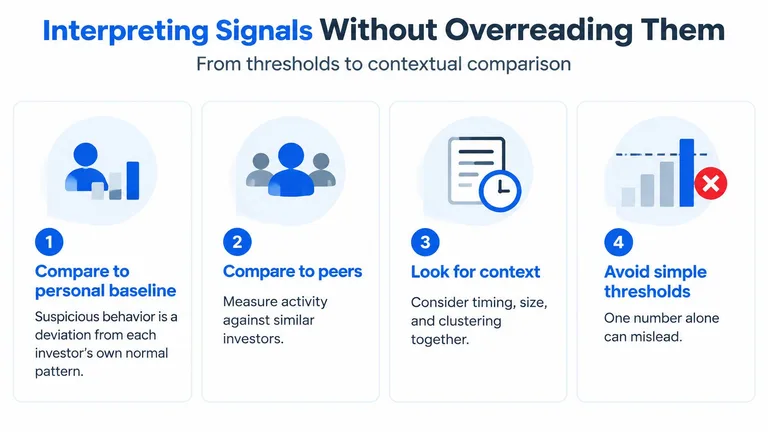
A large trade isn't necessarily unusual for the trader who made it. A modest purchase can be more informative if it sharply departs from an investor's normal behavior and occurs near a relevant event.
An academic surveillance framework tested on investor-resolved Italian equity transactions around takeover bids combines changes relative to an investor's own history with divergence from peers, and examines synchronized, directional, profitable trading by potential groups. Applying that logic to wallets is an analytical adaptation, not proof that the same model has been validated for Solana tokens.
The central shift is from a fixed threshold to contextual comparison.
Build a defensible investigation
- Establish normal behavior. Review prior position sizes, holding periods and trading frequency. A purchase that looks exceptional in isolation may be routine for that address.
- Compare relevant peers. Use traders facing similar assets and conditions. Comparing a market maker with occasional retail buyers creates misleading anomalies.
- Check event timing. Separate accumulation before an announcement, listing or liquidity change from buying after public information becomes available.
- Test competing explanations. Examine automation, copying, arbitrage and portfolio rebalancing. Don't stop after finding the explanation that best fits an insider narrative.
- Record missing evidence. Note incomplete history, unknown counterparties, uncertain ownership and unavailable off-chain information.
For example, a wallet entering a token only after a public listing may be reacting to ordinary public information. That isn't equivalent to an address changing its established behavior before the listing became public, even if both trades were profitable.
Write conclusions someone else can audit
Aggregate outcomes don't establish intent in an individual transaction. Likewise, a useful risk screen doesn't need to prove misconduct to justify reducing exposure or postponing a trade.
Our policy is that suspicious activity and potentially linked wallets are items to examine, not evidence of wrongdoing. Missing data must never be interpreted as proof of safety.
Use a short note format:
- Signal observed: State the specific behavior without a loaded label.
- Evidence behind it: Identify transactions, timing and demonstrable relationships.
- What remains unknown: Record attribution gaps and alternative explanations.
That format makes insider trading data actionable as an investigation while keeping the conclusion within the evidence.
Check Insider Signals Before You Trade
For a U.S.-listed stock, follow this sequence:
- Open the original filing. Find the company's Form 4 records in EDGAR and inspect the reporting person and footnotes.
- Classify the transaction. Separate purchases and sales from exercises, awards and withholding.
- Assess freshness. Compare execution with today's price and intervening announcements.
- Save your record. Log transaction age, filing type, confidence and discretionary-or-plan status.
For a Solana token, use a different order:
- Inspect concentration. Identify major holders and distinguish pools or service accounts.
- Review the creator. Examine deployment, distributions and subsequent activity.
- Test liquidity. Compare available depth with the position you intend to open and eventually close.
- Trace funding. Investigate whether major wallets share meaningful funding relationships.
Use the pre-trade token check to organize the token-side review. A full MemeAssist analysis with conditional Trade Setup costs $0.20; conditional scenarios are analysis, not trading instructions, and don't guarantee outcomes or execution prices.
Proceed only when the checks support the same risk assessment. If attribution, liquidity or transaction context remains unresolved, keep that uncertainty in the decision rather than treating an insider label as the deciding vote.
MemeAssist offers free token-checking tools and on-demand reports that bring wallet activity, holder concentration, creator behavior and liquidity evidence together. Visit MemeAssist with the token's mint address to examine the underlying signals before deciding whether an apparent insider pattern deserves your capital or further investigation.
Topics: insider trading data, SEC Form 4, on-chain insider activity, Solana wallet analysis, insider trading signals
Informational only, not financial advice. Meme coins are extremely high-risk.
All articles