Insider Trading Reports: How to Read Them Correctly

What would you miss if you only looked for insider activity where a form exists to report it? That question matters because insider trading reports in U.S. stocks give you a named person, a trade date, and a filing date, while a Solana token launch can show coordinated wallets and creator selling with no filing at all. Both can warn you, but neither proves wrongdoing on its own.
Read a filing as a delayed, partial record. It tells you what changed, who reported it, and when the report reached the public. It doesn't tell you why the trade happened, what the insider knew, or what happened in wallets that were never covered by the rule. Once you keep those limits in mind, the signal gets clearer and the false alarms drop.
Table of Contents
- Who Files Insider Reports and How Fast
- Transaction Codes That Change Every Reading
- Why Insider Buying Outweighs Insider Selling
- Why a Filing Is Not Proof of Wrongdoing
- Where Form 4 Ends and On-Chain Insider Risk Begins
- Check Any Filing Step by Step Before You Act
Who Files Insider Reports and How Fast
Why does a filing show up days after the trade it describes? Because an insider report isn't a live ticker. Think of Form 4 as a delayed receipt. The trade happens first, the paperwork follows, and the gap between the two dates is itself useful data.
Before the reform, that gap could be much longer. The SEC final rule on accelerated Section 16 reporting explains that Section 16(a) generally required monthly reports within 10 days after the end of the calendar month in which the transaction occurred, until the Sarbanes-Oxley change took effect on August 29, 2002 and shortened the deadline to before the end of the second business day after execution for directors, officers, and beneficial owners of more than 10% of a registered class of equity securities.
That change turned periodic disclosure into event disclosure. You're no longer waiting for a monthly batch. You're looking at a specific transaction, close to when it happened, with a timeliness benchmark you can check.
Who Must File and When
| Filer | Who Is Covered | Filing Deadline |
|---|---|---|
| Directors | Board members of a registered U.S. company | End of second business day after the trade |
| Officers | Executives subject to Section 16 | End of second business day after the trade |
| Beneficial owners | Holders of more than 10% of a registered equity class | End of second business day after the trade |
The rule covers transactions that change beneficial ownership, subject to specified exceptions. A filing inside the window is normal timing. A late, amended, or missing filing doesn't prove misconduct, but it's a reason to verify before you trust the headline summary.
First habit: For every report you read, write down the trade date and the filing date separately. If you only record one date, you'll misread how fresh the signal is.
That small step saves you later. When you compare price moves after a trade, you'll know whether you're measuring from when the insider acted or from when the public could first see it.
Transaction Codes That Change Every Reading
One letter on Form 4 decides whether you're looking at a real market bet or routine paperwork. Check the code before you check the share count, because counting every disposal as bearish selling creates false signals fast.
Form 4 Transaction Codes and How to Weigh Them
| Code | Meaning | How to Weigh It |
|---|---|---|
| P | Open-market purchase | Strongest signal, especially when several insiders buy together |
| S | Open-market sale | Weak alone; check size, role and any scheduled trading plan |
| M | Option exercise or conversion | Usually routine; not a direct bet on the price |
| F | Tax withholding or exercise-price disposition | Usually neutral; company-handled, not a market view |
| A | Grant or award from the company | Compensation, not a market trade |
| G | Gift | Not a market trade; check the recipient |
| D | Disposal back to the issuer | Mechanical; read the surrounding context |
The SEC insider transactions dataset readme records the core distinction plainly: "P" denotes an open-market purchase, "S" an open-market sale, "M" an option exercise or conversion, and "F" a tax or exercise-price disposition. That same documentation supports separating open-market activity from grants, exercises, tax withholding, transfers, and derivative transactions instead of adding them together.
P and S codes are where an insider chose to trade in the market at a market price. A P means the insider spent cash to buy shares anyone could buy. An S means shares were sold into the market, but you'll still need size and context, since a sale after years of holding is different from a sale that empties the position.
M and F codes confuse new readers most. An M often means options were exercised or converted into shares, which can raise share ownership without the insider making a fresh judgment about today's price. An F usually means shares were withheld or disposed of to pay taxes or an exercise price. It's company-handled paperwork, not a decision to exit because the price looks high.
A, G, and D codes sit outside normal market trading. An A is compensation the company granted. A G is a gift, so the recipient and footnote matter more than the share count. A D sends shares back to the issuer and needs the surrounding transaction to make sense.
Fields to Check on the Same Form
- Shares acquired or disposed: Compare this with what the insider held before.
- Transaction price: Check whether it matches the market price on the trade date.
- Post-transaction holdings: See what remains after the trade.
- Direct or indirect ownership: Note whether shares sit in the insider's name or through another arrangement.
Count P and S as the core signal. Treat every other code as context until the footnotes prove otherwise.
Why Insider Buying Outweighs Insider Selling
Buying and selling don't carry equal weight, even when the dollar amounts match. The image below captures the slower, deliberate nature of a purchase decision that ends up in a portfolio, rather than a routine administrative disposal.

Research summarized in the Wharton working paper on insider trading portfolios found abnormal returns exceeding 50 basis points per month, with roughly one-quarter accruing during the first five trading days and about one-half within the first month. A separate study in that summary reported insider purchases earned abnormal returns above 6% annually, while insider sales did not produce statistically significant abnormal returns.
The reason is practical. People sell for many ordinary reasons, including diversification, taxes, a house purchase, or a preset plan. An open-market purchase is narrower. The insider didn't have to spend new cash on the stock, yet chose to.
Say three directors buy open-market shares within two weeks, each adding meaningfully to what they already hold. That's a cluster, and it's worth tracking. Compare that with one officer selling a small slice after an option exercise. That's usually context, especially if most holdings remain, a pattern related to insider concentration rather than a single trade.
The short video below is worth watching before you build a watchlist from individual sales, because it reinforces why grouping and timing matter more than isolated headlines.
Before you act on any cluster, adjust for these factors:
- Transaction size: Weight the trade against prior holdings, not just total dollars.
- Insider role: A chief financial officer may read differently from an outside director.
- Ownership percentage and liquidity: Large holders move differently in thinly traded stocks.
- Pre-event price movement: Buying after a long fall differs from buying into a spike.
- Scheduled trading plans: A preset schedule weakens the case that timing carried information.
For a simple benchmark, compare market and sector-adjusted cumulative abnormal returns over 1, 5, and 20 trading days, keeping both execution and filing dates. You'll learn whether the move followed the trade itself or only became visible after disclosure.
Why a Filing Is Not Proof of Wrongdoing
The most common misreading is also the simplest: every insider sale must be suspicious. It isn't. A Form 4 records a reportable change in beneficial ownership. It doesn't show whether the trade used material nonpublic information.
Two Routine Patterns That Look Alarming
A sale under a Rule 10b5-1 plan. The insider set a trading schedule in advance, and the footnotes may flag the plan adoption date. The sale can look well timed only because news arrived later.
An option exercise followed by a tax sale. You'll often see an M code followed by an S or F code. The insider exercised options, then sold or withheld shares to cover costs. That sequence is routine unless other evidence says otherwise.
Check footnotes for plan adoption dates. Compare the trade with the insider's past pattern. Then look for other insiders moving the same way at the same time, because one person's schedule rarely explains a group move.
Enforcement numbers need the same care. Gibson Dunn's 2024 securities enforcement year-end update notes the SEC brought 34 stand-alone insider-trading cases in fiscal year 2024, representing 8% of its stand-alone enforcement actions. That count reflects investigative priorities and available evidence, not how common illegal trading is across all filings.
The same restraint applies on-chain. Suspicious activity or potentially linked wallets in our reports are items to examine, not evidence of wrongdoing, and the absence of data should not be interpreted as proof of safety. A late filing, a missing label, or a quiet wallet can mean you haven't found the evidence yet.
A filing starts a question. Context answers it.
Where Form 4 Ends and On-Chain Insider Risk Begins
Form 4 stops at the edge of a registered company. It covers directors, officers, and 10% owners who must disclose who they are. It doesn't cover pseudonymous token creators, linked wallets, coordinated buyers at launch, or traders who exploit advance knowledge without holding any corporate role.
On-chain evidence fills a different part of the picture. It can show when wallets bought, whether they were funded from the same source, how concentrated supply is, and whether several wallets exited together. What it can't do is name the person or prove what they knew.
Formal Insider Filings Versus On-Chain Insider Signals
| Signal | Form 4 Insider Filing | On-Chain Token Activity |
|---|---|---|
| Who is covered | Directors, officers and 10% owners of registered companies | Any wallet, including pseudonymous creators and linked wallets |
| Disclosure timing | Generally by end of second business day | Visible on-chain at or near the time of the trade |
| Identity | Named individual in the filing | Pseudonymous address, often unlabelled |
| Typical red flag | Open-market sales by insiders | Creator wallet selling, bundled launch, funding links |
| Limit of evidence | A reportable transaction, not proof of misconduct | A risk indicator, not proof of unlawful trading |
Here's a concrete risk pattern with no Form 4 equivalent. A public dated report shows the token dog was flagged when one wallet held 79% of supply on 29 July 2026, and its price changed −69.3% over the following 24 hours. No named insider filed that information. The concentration itself was the warning.
The aggregate picture is broader. Tokens flagged high rug risk had an average price change of −45.3% over 24 hours, based on 1,320 tokens analysed from 2026-08-03 to 2026-10-22, as detailed in the insider risk 24-hour outcomes study. That's an average across many tokens, not a prediction for the next one.
On-chain rule: Timing, funding links, concentration, and synchronized exits are risk indicators. They tell you where to verify next, not that unlawful insider trading occurred.
Before buying, verify creator selling, check whether early wallets share funding, and measure how much supply sits in the largest wallets. If those checks look clean, keep checking liquidity and holder growth, because one clean category doesn't clear the token.
Check Any Filing Step by Step Before You Act
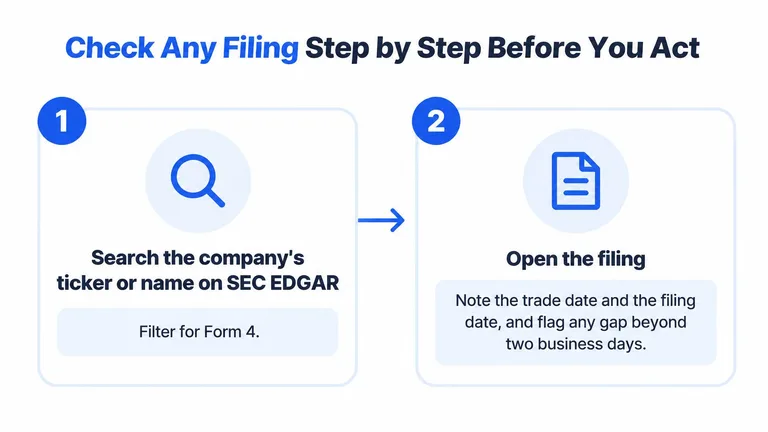
Use this order every time. It takes a few minutes and prevents the most common slips, starting with confusing the filing date for the trade date. The infographic below shows the first two steps in the search process.
The Eight-Step Check
- Search EDGAR first: Enter the company's ticker or name on SEC EDGAR and filter for Form 4, so you're reading the primary filing rather than a scraped summary.
- Record both dates: Open the filing, note the trade date and filing date, and flag any gap beyond two business days for follow-up.
- Confirm the filer's role: Mark the person as director, officer, or 10% owner, because role affects how much context the trade deserves.
- Read every code: Treat P and S as the core signal and F, M, A, G, and D as context. Never count an F code as a sale.
- Check size and ownership: Record shares, price, post-transaction holdings, and whether ownership is direct or indirect, so you can judge how much the position really changed.
- Look for Form 4/A: An amendment replaces corrected numbers from the original, so use the amended figures if one exists.
- Compare the price move: Check performance 1, 5, and 20 trading days after the trade against the market and sector, rather than the stock alone.
- Save your work: Keep trade date, filing date, delay, codes, and results in a notes sheet. You'll spot repeat patterns that a single filing hides.
Before acting, confirm you're seeing a cluster of open-market purchases rather than one routine sale, and check that no scheduled plan explains the timing. For Solana meme coins, where no Form 4 exists, check creator selling, funding links, and supply concentration on-chain before buying, using the same verification mindset described in the guide to how to track smart money wallets on Solana.
Reading public token evidence and reopening saved reports is free; running a new analysis is a paid action. Our free scanners are useful for a first check, but a full analysis explains the evidence behind the health score and rug risk rating, adds an AI verdict and detailed risk analysis, and includes a conditional trade plan when data allows.
A single signal is a reason to look closer, never a reason to trade on its own. If the code, cluster, timing, and price comparison don't line up, wait for the next filing or the next on-chain check.
When a Solana token has no Form 4 to read, use MemeAssist to check creator behaviour, wallet activity, holder concentration, and bundled trading patterns before you buy. Open a public report or run a fresh analysis, then verify each flag against the underlying evidence rather than treating any single signal as proof.
Topics: insider trading reports, Form 4 filings, insider transactions, SEC insider filings, on-chain insider risk
Informational only, not financial advice. Meme coins are extremely high-risk.
All articles