Liquidity Test Formula for Solana Meme Coins
Learn the liquidity test formula for Solana meme coins, including slippage math, pool depth metrics, worked examples, and interpretation thresholds.
Published
Updated
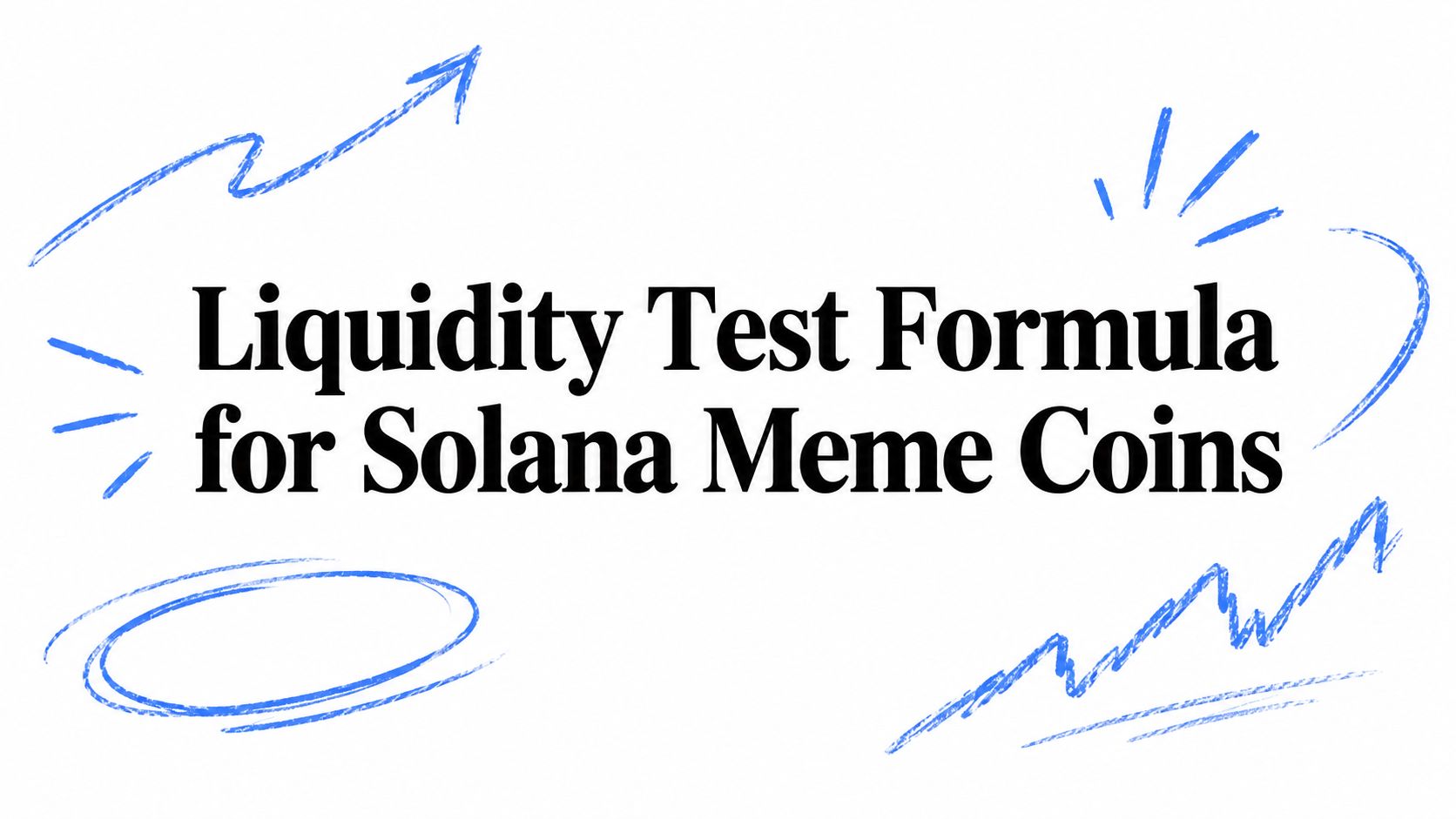
A large share of tokens launched on Solana AMMs in the first half of 2025 was flagged as rug pulls. The figure in the graphic below illustrates the scale of that problem; treat it as an estimate until a verifiable on-chain source confirms the count.
A corporate current ratio can tell you whether a business has enough short-term assets to cover short-term obligations. It cannot tell you whether a Solana meme coin pool will absorb your sell without the price collapsing. That is a different test, and it starts with pool mechanics rather than a balance sheet.
Three inputs decide the outcome: the quote-side SOL depth behind the current price, the impact your planned trade size has along the pool's pricing curve, and who controls the liquidity. If LP tokens sit in a wallet that can withdraw them, the depth you measured exists only as long as that wallet allows it.
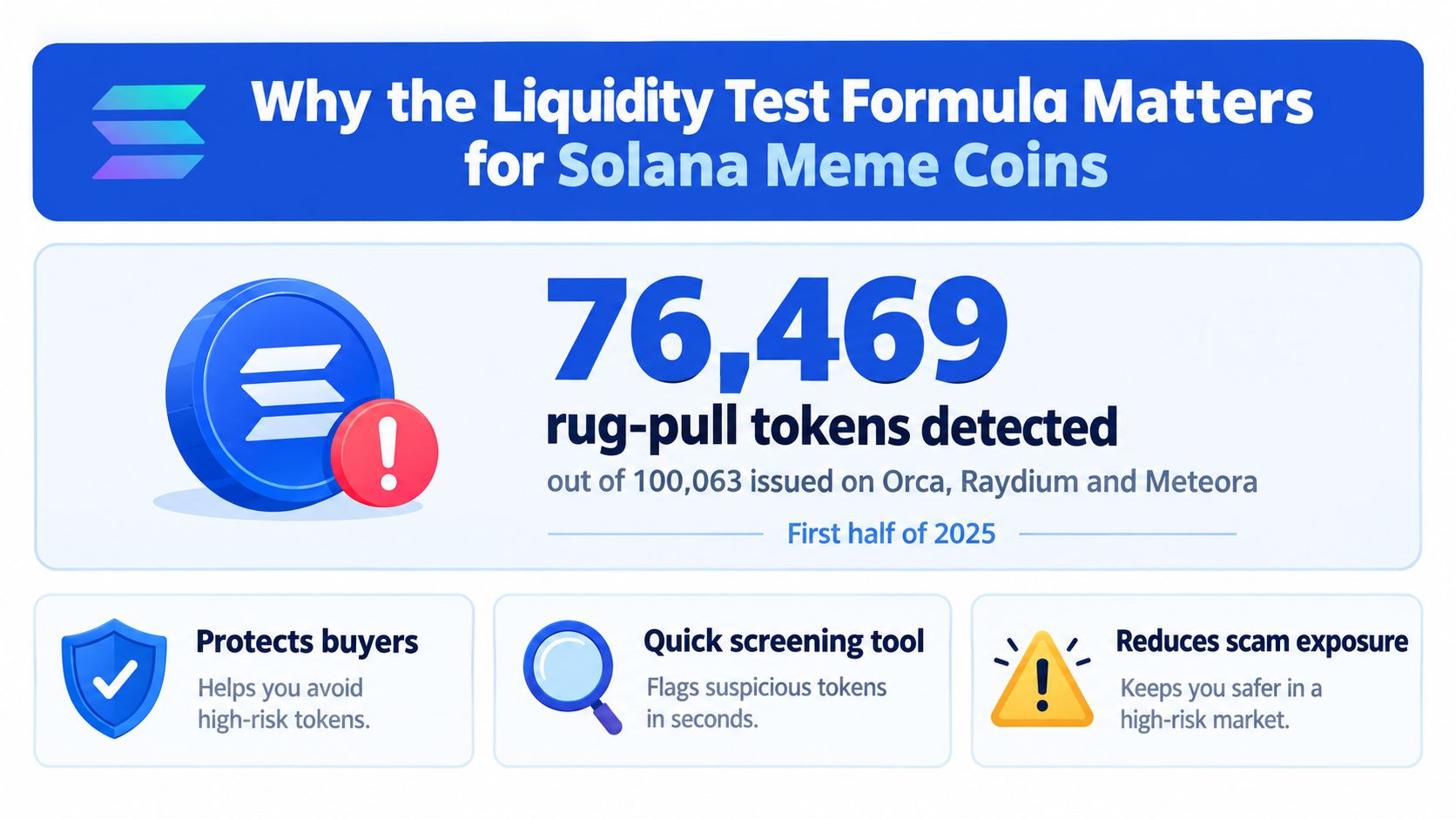
Table of Contents
- Why the Liquidity Test Formula Matters for Solana Meme Coins
- The Corporate Liquidity Test Formula and Why It Does Not Fit
- Core Components of the Solana Liquidity Test Formula
- Slippage Formula and Price Impact for a Trade Size
- Worked Example With a Realistic Solana Pool
- Depth Metrics Beyond Raw SOL Liquidity
- Why Static Liquidity Thresholds Routinely Fail
- How MemeAssist Runs This Test Automatically
- Quick Reference Checklist for Your Next Trade
- Cross-References, Glossary and Frequently Asked Questions
Why the Liquidity Test Formula Matters for Solana Meme Coins
For a meme coin, “liquidity” isn't a balance-sheet category. It's the amount of value available at prices close enough to the current quote for you to enter or exit. A pool can display an attractive token valuation while offering too little SOL depth to support a meaningful sell.
That's why the useful liquidity test formula for a Solana AMM starts with the trade, not a universal pool-size cutoff. Ask what happens when you swap the amount you plan to trade. The answer depends on the pool's reserves and pricing curve, and it can differ sharply from the headline liquidity number shown by a dashboard.
The test in this guide has three parts. First, identify the pool's SOL and token reserves, then distinguish actual reserves from any virtual reserves used in its pricing design. Next, calculate the expected output and price impact for your trade size. Finally, check LP control and token-holder concentration, because accessible pool depth can disappear or become difficult to exit against.
The purpose isn't to label a token “safe.” No formula can do that. It's to identify concrete reasons to pass on a trade: insufficient quote depth, excessive impact for your planned size, or liquidity controlled by an actor who can remove it.
Practical rule: Measure the pool against the trade you need to unwind, not the token's advertised valuation.
The Corporate Liquidity Test Formula and Why It Does Not Fit
In corporate finance, the standard current ratio is current assets divided by current liabilities. For example, a company with $500,000 in current assets and $250,000 in current liabilities has a ratio of 2.0, or $2 of current assets for every $1 of short-term liabilities. The ratio is a broad screen of a company's ability to cover obligations due within its operating period. Investopedia's overview of liquidity ratios explains the current ratio and its balance-sheet context.
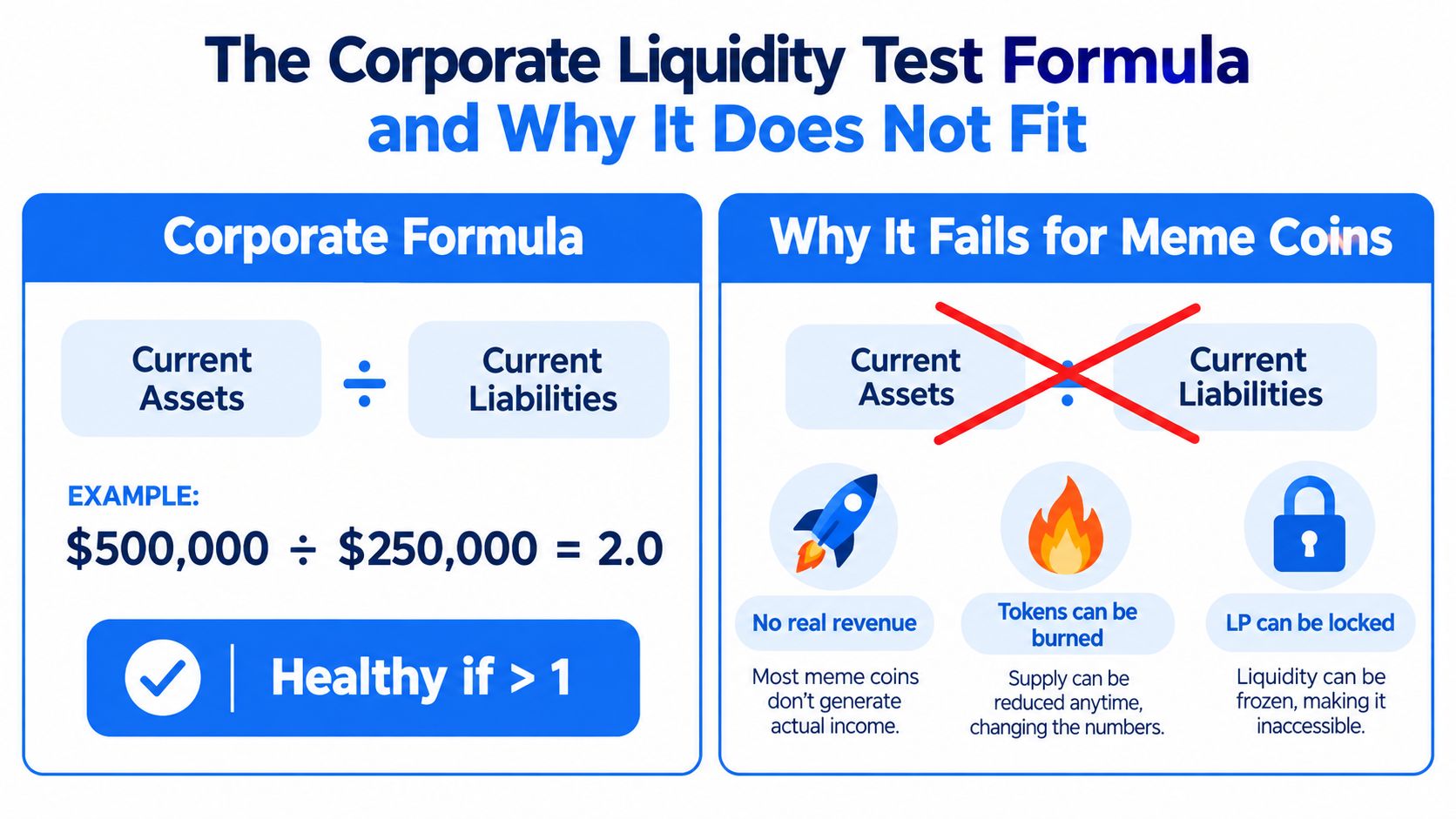
A meme coin pool has no corporate balance sheet that classifies assets as current or liabilities as due within a particular period. The pool's relevant question is different: how much token output can a swap obtain before the price moves beyond an acceptable level? A token's displayed market capitalization or fully diluted valuation doesn't answer that.
| Corporate liquidity test | Solana AMM liquidity test |
|---|---|
| Current assets ÷ current liabilities | Expected trade output and price impact, assessed against pool reserves |
| Assesses balance-sheet coverage of obligations | Assesses executable depth for a particular swap size |
| Includes accounting categories such as receivables and inventory | Examines pool assets, pricing mechanics, and LP control |
The current ratio remains useful for businesses because it relates assets to obligations. Applying it to a token pool confuses accounting liquidity with trade liquidity. For a meme coin, the meaningful unit is not “assets per dollar of liability.” It's how much SOL-backed exit capacity remains at a price you're willing to accept.
Core Components of the Solana Liquidity Test Formula
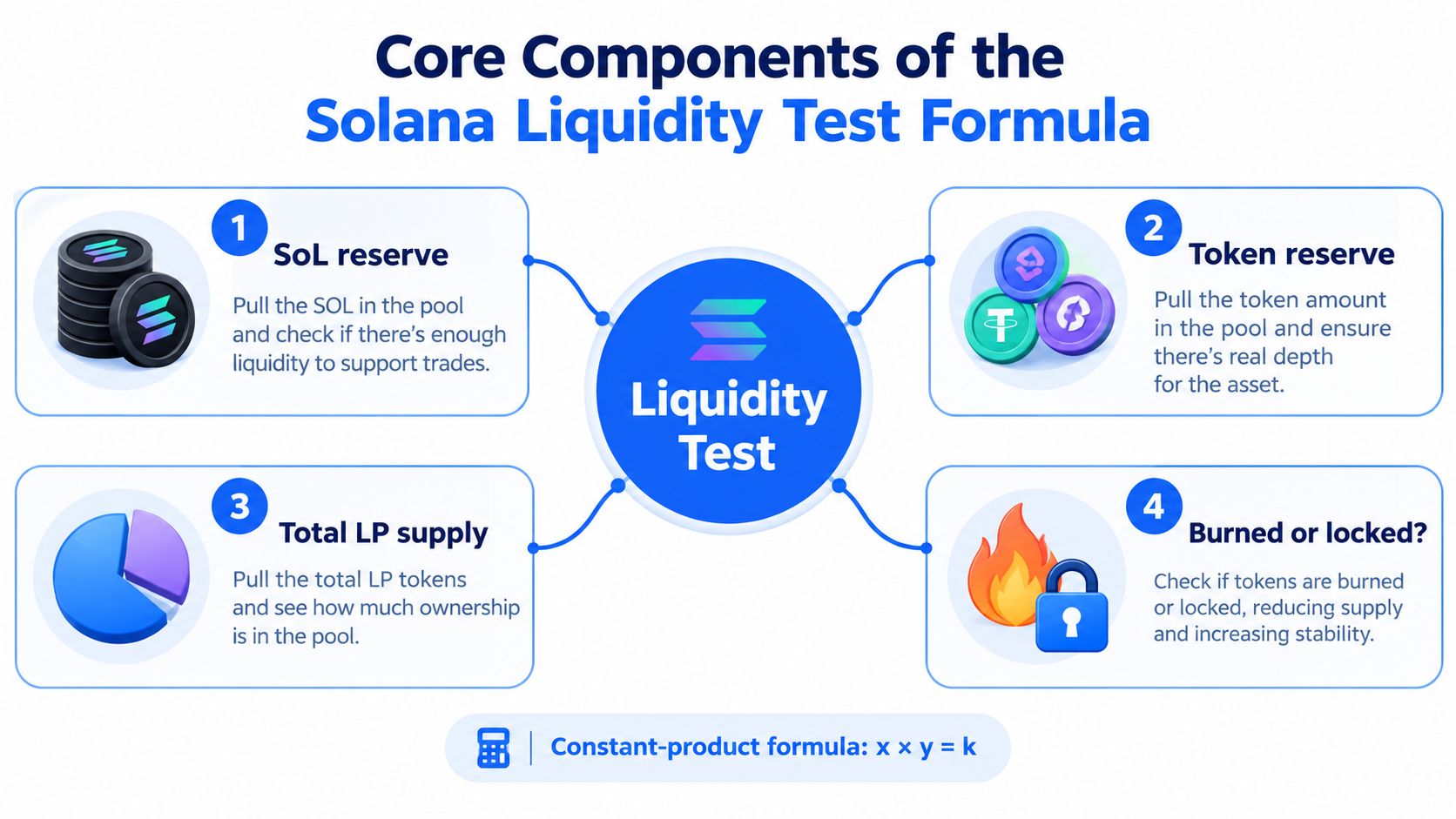
Start with the pool's SOL reserve, token reserve, and total LP supply. Then determine whether LP tokens are burned, locked, or held in a wallet that can withdraw liquidity. These values describe both the pool's trading capacity and who may control its continued availability.
Many AMMs use a constant-product relationship, written as x × y = k, where x and y represent the two reserves. A trade shifts the reserve balance along the curve: as a buyer removes tokens and adds SOL, the marginal price changes. The pool's token count alone doesn't measure exit capacity. A large token reserve paired with very little SOL can still offer thin quote-side depth.
Some pool designs use virtual reserves in calculating price, while the actual assets available to traders are the true reserves. Don't treat a virtual number as cash sitting in the pool. Check the pool's implementation and data source so you know which values represent true assets and which affect pricing calculations.
For a first-pass assessment, express usable SOL liquidity in dollars using the current SOL price:
Usable quote-side liquidity = the lower of real SOL reserve and relevant virtual SOL reserve, adjusted for LP control, then converted to USD.
That's a screening expression, not a universal AMM formula. The adjustment for LP control should reflect whether liquidity is withdrawable by a creator or another holder. A burned LP position can reduce that withdrawal risk, but it doesn't eliminate price impact, concentrated selling, or other token risks.
Before trusting a dashboard's single “liquidity” figure, record the reserve values and LP status separately. If the interface doesn't make clear which reserves are real, or who can withdraw the LP position, treat the test as incomplete rather than filling in the gaps with assumptions.
Slippage Formula and Price Impact for a Trade Size
For a constant-product pool, let x be the reserve of the asset you put in and y the reserve of the asset you receive. Let a be your input amount, and let f represent the pool's fee fraction. A common fee-adjusted estimate is:
amount_out = (y × a × (1 − f)) ÷ (x + a × (1 − f))
The pool fee and exact swap mechanics vary by venue. Check the current pool parameters and use the AMM's documented calculation where available. The equation estimates output from reserves, but it doesn't include every possible execution issue, such as transaction priority or a changing pool state.
To calculate impact, compare the effective execution price with the pre-trade spot price. For a SOL-to-token buy:
- Spot price in tokens per SOL = token reserve ÷ SOL reserve.
- Effective price = tokens received ÷ SOL input.
- Price impact = (spot price − effective price) ÷ spot price × 100.
For a sale, reverse the comparison and calculate the SOL received against the pre-trade spot value of the tokens sold. A buy and a sell of the same nominal value need not have identical execution outcomes if the pool state changes between them.
A threshold only helps if it reflects your risk tolerance and market conditions. The proposed rule max(1%, 3 × daily volatility) can't be responsibly presented as a validated universal threshold without a source for the volatility method and multiplier. Instead, set your maximum tolerable impact before trading, then use the formula to see whether the planned size stays inside it.
| Trade size | Tokens received | Effective price vs. spot | Price impact |
|---|---|---|---|
| Any planned amount | Calculate from current reserves and fee | Tokens received ÷ SOL input | Compare effective price with spot |
Without a specified pool's reserves, fee, token price, and trade sizes, exact rows would be invented. Use the pool's current values in the equations rather than trusting a generic example table.
Worked Example With a Realistic Solana Pool
Consider a hypothetical pool containing 80 SOL and 800,000,000 tokens. Assume, solely for illustration, that the pool follows a fee-free constant-product curve and that LP tokens are split evenly between a burn address and a creator wallet. The pool numbers and a proposed $5 million fully diluted valuation are illustrative inputs, not verified market data.
Find the spot price. Divide the token reserve by the SOL reserve: 800,000,000 ÷ 80 = 10,000,000 tokens per SOL. That is the starting quote before a trade changes the reserves.
Convert each dollar trade to SOL. This requires the current SOL/USD price, which isn't specified here. Call the trade input a SOL. The estimated token output is 800,000,000 × a ÷ (80 + a) under the fee-free assumption.
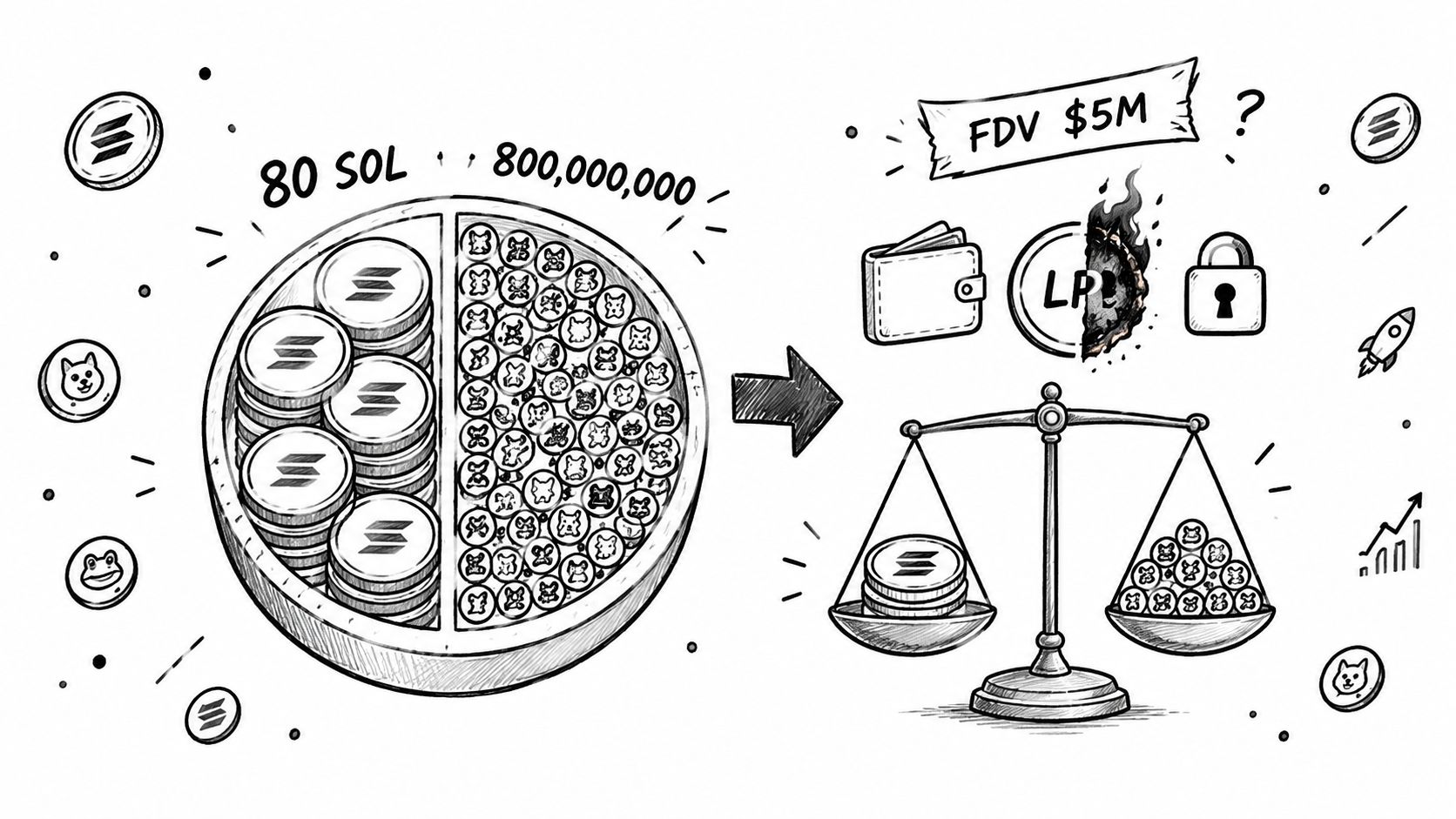
Calculate price impact. Divide the effective price, tokens received per SOL, by the starting spot price and compare the difference as a percentage. The precise impact for $500, $2,000, and $10,000 depends on the SOL/USD quote and the pool fee. Since neither is specified, assigning those trades a pass, borderline, or fail would falsely imply precision.
Assess LP control separately. A half-burned, half-creator-held LP position still leaves a creator-controlled share. The $5 million FDV claim doesn't change how much SOL the pool can pay out on a sale; it's a valuation figure, not a reserve.
A solid worked test therefore needs the live SOL price, fee, reserve state, and planned trade size. If any of those inputs are missing, the honest result is incomplete, not a confident threshold verdict.
Depth Metrics Beyond Raw SOL Liquidity
Raw reserves don't tell you whether the pool can be withdrawn or whether token holders may create heavy selling pressure. Check LP control, holder concentration, and any lock arrangement alongside the swap calculation.
LP status is a control question. Verify the LP token mint and the status of the relevant LP tokens using a reliable Solana explorer or the pool's official interface. “Burned” should mean the tokens are no longer controlled by an active wallet, not merely that someone has announced a burn. A lock can delay withdrawal, but its terms and release conditions matter.
Holder concentration changes the supply that may reach the pool. A pool with substantial SOL can still experience a sharp move if a small number of wallets control a large share of the tradable tokens and sell into it. Check whether large wallets are linked, whether balances include program or liquidity addresses, and whether the creator controls related wallets.
Lock duration is not a quality score on its own. A lock's value depends on who controls it, what assets it covers, and whether its terms can be changed. Tools and programs such as Streamflow or Bonfida may be relevant to a particular lock, but verify the specific position on-chain rather than relying on a badge.
There are no verified universal numeric cutoffs for burned LP share, top-holder concentration, or lock duration. Applying made-up thresholds would create a false sense of safety. Use the table as a decision framework, and set tolerances for your own risk rather than treating an unsupported number as a market standard.
| Check | Conservative threshold | Why it matters |
|---|---|---|
| LP control | Prefer verifiable burn or an independently verifiable lock; no universal share cutoff | The creator's ability to withdraw liquidity affects exit availability |
| Holder concentration | No universal numeric cutoff; investigate linked wallets and large token balances | Concentrated holders can sell into the pool |
| Lock duration | No universal duration; confirm terms and unlock control | A lock only helps for as long as it remains enforceable |
For a practical second opinion on pool exits, use a dedicated Solana exit liquidity checker alongside on-chain verification. A checker can help organize the evidence, but it doesn't replace confirming who controls the relevant accounts.
Why Static Liquidity Thresholds Routinely Fail
A rule such as “only buy if the pool has at least a fixed dollar amount of liquidity” sounds clean and can be dangerously incomplete. A pool's displayed depth is a snapshot. It doesn't show whether a creator can remove LP tokens, whether major holders are preparing to sell, or how your own trade size interacts with the curve.
The inverse also holds: a smaller pool isn't automatically unusable for every trade. A small order may have modest impact in a shallow pool, while a much larger order can move price sharply in a pool with more reserves. The correct comparison is planned trade size against executable depth, followed by a check of who controls that depth.
Accounting liquidity offers a useful caution here. OpenLearn's discussion of quick-ratio interpretation notes that inventory may not be a rapid source of cash and that some businesses can operate safely below a quick ratio of 1.0. Its broader lesson carries over: a static ratio can misrepresent practical access to resources. For an AMM, token reserves, virtual reserves, and LP status can similarly make a headline number more or less meaningful than it appears.
Use a three-layer decision rule:
- Formula: Calculate expected output and impact for your intended buy and likely exit.
- Depth and control: Inspect actual reserves, LP status, and holder concentration.
- Behavior: Watch how trading and liquidity change after launch rather than trusting a single snapshot.
A thin-liquidity risk guide can add context, but no fixed pool-size cutoff should overrule a failed trade-size test or an unresolved LP-control concern.
How MemeAssist Runs This Test Automatically
Manual calculations are useful for understanding what a pool's displayed numbers mean, but they take time and can miss related signals. An automated report can gather live liquidity, holder distribution, creator behavior, wallet activity, trading patterns, and historical risk indicators at the time of analysis.
MemeAssist combines those evidence categories into an Overall Health Score, a Rug Risk Rating, a plain-English AI Verdict, and a Detailed Risk Breakdown. A full analysis also includes a Trade Setup that summarizes observed risk and opportunity context. The output is a structured aid, not a guarantee that a token is safe or that a quote will remain available.
No wallet connection or transaction signature is required for an analysis. New users receive one free full analysis, with additional usage available through per-action prepaid credits. Payment options include Stripe checkout, Apple Pay, Google Pay, and crypto deposits in USDT or SOL.
Review the Solana meme coin trade check as one way to see how these checks can be assembled into a report. Public evidence visibility lets readers inspect the underlying checks and data points behind an analyzed token's score.
Quick Reference Checklist for Your Next Trade
Use the checklist before entering a position. If a key input is unavailable, don't substitute an assumption and call the test complete.
- Pull the pool data. Record the actual SOL and token reserves, relevant virtual reserves, total LP supply, and LP burn or lock status.
- Test your intended size. Use the pool's current fee and reserves to estimate output, effective price, and price impact. Compare the result with the maximum impact you decided to tolerate before placing the trade.
- Inspect token control. Review holder concentration, linked wallets, creator activity, and whether major holders could sell into the pool.
- Check current behavior. Compare the snapshot with recent liquidity and trading activity. A trade signal can add context, but it can't confirm that the pool will remain unchanged.
- Skip unresolved failures. If the impact exceeds your limit, LP control is unclear, or the on-chain evidence conflicts with the token's claims, don't force the trade.
| Check | Quick decision |
|---|---|
| Reserves | Confirm real quote-side depth; distinguish it from virtual reserves |
| LP status | Verify burn or lock control on-chain |
| Price impact | Calculate it for your actual planned size |
| Holder distribution | Investigate large or linked wallets |
| Current behavior | Recheck liquidity and trading activity before execution |
There's no verified universal percentage for holder concentration, LP burn share, or acceptable impact that fits every Solana pool. Treat those as risk limits you define and apply consistently, not as a promise that a token has passed a safety test.
Cross-References, Glossary and Frequently Asked Questions
Glossary
- Constant product: The AMM reserve relationship expressed as x × y = k.
- Virtual reserves: Values used in some pool designs to affect pricing calculations, distinct from the assets held.
- LP burn: Removing LP tokens from active control so they can't be used to withdraw the corresponding liquidity.
- FDV: Fully diluted valuation, a token valuation estimate that doesn't tell you the pool's executable exit depth.
- Slippage: The difference between an expected and actual execution price, often affected by pool movement and trade execution.
- Price impact: The estimated movement in price caused by a trade interacting with the pool's reserves.
Frequently asked questions
How much liquidity is enough for a $500 or $5,000 entry?
There isn't a universal dollar amount. Convert the intended entry into the pool's input asset, calculate expected output and price impact using live reserves and fees, then assess whether you could exit under comparable conditions.
How do I verify LP burn on Solana?
Inspect the pool's LP token mint and token accounts in a Solana explorer or through the relevant AMM interface. Confirm where the LP tokens are held and whether the holder can transfer, redeem, or withdraw them.
Does high liquidity guarantee safety?
No. A large reserve may still be withdrawable, and concentrated holders can sell into it. Pool depth measures one part of execution risk, not the full risk of a token.
How often should I rerun the test while holding?
Rerun it before a planned exit and whenever the pool, holder distribution, or trading behavior changes materially. A previous calculation is only a snapshot of the conditions at that time.
MemeAssist provides on-demand Solana token reports that combine live liquidity, holder, creator, wallet, and trading evidence into a risk rating and plain-English explanation. Before your next trade, use MemeAssist to review the underlying evidence and assess whether the pool's apparent depth matches the exit you may need.