Low Cap Crypto Gems: 7 Solana Picks to Research
Explore 7 low cap crypto gems on Solana with practical theses, on-chain risk signals, trade setups, and a checklist for spotting scams and insider activity.
Published
Updated
Forget the popular advice to hunt for the smallest market cap and assume you've found the earliest opportunity. A tiny valuation tells you almost nothing about whether you can exit, who controls the supply, or whether the volume in front of you is real. That's the central problem with most lists of low cap crypto gems, and it's why this one ranks seven Solana tokens by researchability and actionable risk context rather than by hype.
A low market capitalization can make a token both interesting and fragile. Liquidity may be shallow, ownership concentrated, and narratives easy to inflate. You'll see what makes each candidate distinct, which on-chain signals deserve attention, and how a short trade setup should change when risk flags appear.
Treat every figure here as a snapshot, not a live quote. Refresh each assessment against live market and on-chain data before you commit capital, verify the exact mint, and size any position as if a complete loss is possible.
Table of Contents
- 1. PONKE (PONKE)
- 2. GigaChad (GIGA)
- 3. Zerebro (ZEREBRO)
- 4. Pippin (PIPPIN)
- 5. MICHI (MICHI)
- 6. FWOG (FWOG)
- 7. POPCAT (POPCAT)
- Low-Cap Crypto Gems: 7-Token Comparison Matrix
- Research Before You Buy
1. PONKE (PONKE)
PONKE is a Solana meme token built around an irreverent monkey character and a loud community identity. It's easier to research than a fresh launch because there's a public brand, social channels, and reported trading on both decentralized and centralized venues. The cited snapshot put its market capitalization at roughly $11 million, and you can start verification at the official PONKE website.
That visibility is a genuine advantage, but it doesn't remove the core risk. PONKE's appeal is primarily community and meme driven, so don't assume meaningful utility sits behind the ticker. Reported volume also isn't the same as deep, executable liquidity at the size you intend to trade.
What to Verify First
- Exact mint and venue: Ticker similarities and cross-chain listings make contract verification essential before you compare prices across venues.
- Liquidity versus volume: Simulate your intended buy and sell to see price impact, rather than trusting a headline volume number.
- Holder concentration: Check whether a small group of wallets can move the market by selling into momentum.
There's a statistical reason to be strict here. Academic research on cryptocurrency market networks found that lower market capitalization was associated with increased return variance, higher kurtosis, and weaker normality, with a minimum kurtosis value of 6 and every coin significantly leptokurtic at the 1% level. In plain English, extreme moves happen more often than standard risk models imply, so treat market cap itself as a risk variable.
If you're building a broader watchlist first, compare your approach with guidance on the best memecoins to buy and how to screen them before you narrow to a single name.
2. GigaChad (GIGA)
Some meme tokens are anonymous tickers with nothing to inspect. GigaChad (GIGA) at least gives you something to work with: a recognizable internet meme, a public website, and a fitness-oriented brand with merchandise alongside the community.
The project describes itself as community run, and the cited snapshot put its market capitalization near $19 million. Start contract research at the official GigaChad site, then cross-check the mint you find there against the venue where you plan to trade. Reported access through decentralized and centralized exchanges gives you more than one place to observe activity.
Don't over-read the brand work. Fitness apparel and community activity don't automatically create token rights, revenue, or guaranteed demand for holders. Branding helps you distinguish the authentic token from copycats, and that matters, but it doesn't establish fundamental value.
Practical rule: A strong brand is evidence you can identify the right asset. It isn't evidence the asset will hold value when attention moves on.
Stress test GIGA against the wider market, not just its own chart. Research covering nine large-cap and small-cap pairs from September 2018 through March 2023 found volatility transmission ran predominantly from large caps to smaller ones, with 7 of 9 high-to-low cross-shock coefficients statistically significant compared with only 3 in the reverse direction. When correlations spike in a sell-off, diversification benefits weaken exactly when you need them, and order-book depth you saw on a calm day can disappear.
3. Zerebro (ZEREBRO)
Zerebro stands apart from the animal-meme crowd because its narrative centers on AI-generated online content and autonomous-agent concepts. That distinct identity makes it straightforward to compare with other AI-themed tokens, and it's relevant if you're researching where AI and crypto culture overlap.
Its market data also teaches a useful lesson. Recent snapshots in the research varied from approximately $29 million to $48 million, a gap large enough to change how you'd classify the token. Figures go stale fast in this segment, so pull a live number and note the time you pulled it. You can investigate the project's own claims through the official Zerebro website.
Separating Narrative From Demand
AI branding doesn't establish product quality or token utility. Ask what the token does, what the project has shipped, and whether any demand for the token exists independent of speculation on the AI theme. Reported trading across decentralized and centralized venues helps research, but venue availability doesn't guarantee safe or deep liquidity.
Volume quality deserves special scrutiny with narrative-driven tokens. A cross-chain study of 34,988 meme tokens found that 82.8% of tokens achieving returns above 100% displayed evidence of artificial growth, including wash trading or liquidity-pool-based price inflation. That same research identified more than 17,000 victimized addresses and over $9.3 million in realized losses linked to later extraction.
So compare Zerebro's volume with unique buyers, net holder growth, and buy-to-sell balance. Large volume with little net ownership change is an actionable warning signal, not a breakout confirmation.
4. Pippin (PIPPIN)
Pippin pairs a unicorn character with an AI influencer and agent-framework narrative. The category snapshot cited an approximate market capitalization of $18 million, placing it in the middle of this list by size. What makes it researchable is that its direction is documented, so you can compare stated plans with actual releases.
Read the claims yourself in the official Pippin documentation and use Solana Explorer records to inspect the token mint and transfer activity. The search results described a fixed supply on the explorer record, which is the kind of concrete detail you can confirm on-chain rather than take on trust from social posts.
- Documented roadmap: Specific plans give you claims to test against delivery over time.
- Explorer transparency: Mint and transfer records offer a direct route to verify supply and movement.
- Verification risk: Lookalike or unrelated sites make official-link and mint checks especially important.
Keep the distinction sharp. Roadmap ambitions aren't delivered functionality, and planned AI features aren't evidence of dependable utility. The AI theme can drive speculation entirely on its own, independent of adoption.
A documented plan is only useful if you revisit it. Note what was promised, date it, and check later whether anything shipped.
For Pippin, the right research habit is a claims ledger. Write down each stated feature, find the on-chain or product evidence for it, and downgrade your thesis when delivery slips without explanation. That discipline turns a cute narrative into a testable thesis.
5. MICHI (MICHI)
MICHI is a cat-themed Solana meme token with something many microcaps lack, a public site full of community-created content. The site describes a meme gallery and an AI-assisted meme-generation feature, and it reports that liquidity migrated to PumpSwap. Its approximate market capitalization in the cited snapshot was $2.7 million, the smallest on this list.
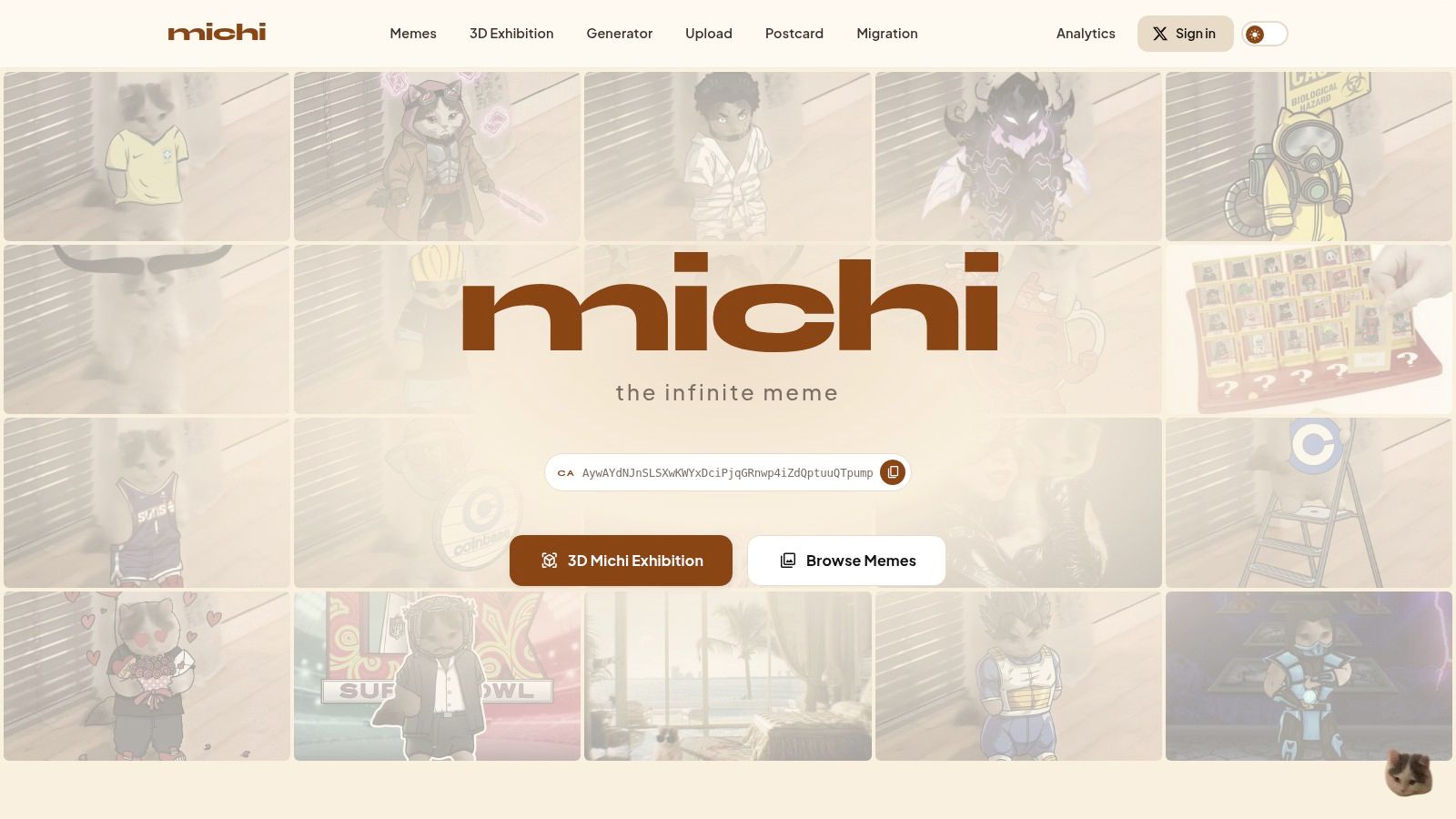
Documentation is unusually plain here. A cited MiCA white paper describes MICHI as a standard SPL token primarily for community and meme trading, with no known additional functionality pending. That honesty is useful. It tells you not to underwrite utility that the project itself doesn't claim, and you can explore the community material at the official MICHI website.
Why Size Changes the Risk
At this scale, liquidity is the whole question. A cross-chain dataset summarized from meme-coin research found that more than half of analyzed tokens had less than $1,000 of liquidity, while 88.1% had liquidity below 0.1% of reported market capitalization. A token can show an attractive valuation while lacking the pool depth to absorb even a modest sell.
Because MICHI's liquidity migrated, verify the current token address and the current pool before anything else. Then calculate your intended order as a percentage of pool reserves and simulate the sell, not just the buy. With concentrated ownership, entry gets expensive during momentum and exit gets difficult when early holders sell.
6. FWOG (FWOG)
FWOG earns its place on this list for an uncomfortable reason. It's the clearest example of how a verification gap should change your behavior. The frog-themed Solana token appeared in the researched Solana meme-token market data with an approximate market capitalization of $4.8 million, but the research didn't confirm a reliable official project website.
That absence matters more than the theme. A similarly named Solana Explorer result wasn't enough to establish that it represented the same asset, so you can't safely assume identity from a name, a logo, or a search result. Until you can independently verify the exact mint address through a trusted route, FWOG isn't a trade candidate. It's a research exercise.
- Market-data listing: Trading activity gives you a starting point for checking whether the market is real and current.
- No verified official site: Without an authoritative link source, every contract address you encounter needs extra skepticism.
- Microcap fragility: Thin liquidity, volatile pricing, and concentrated ownership are the default assumptions at this size.
The broader backdrop makes caution more urgent, not less. Market reporting showed Pump.fun daily users falling from 183,189 at the January 2025 peak to 33,275 by early January 2026, while total memecoin market capitalization dropped from $93.1 billion to $36.5 billion and trading volume fell from roughly $20 billion to below $3 billion.
In a contracting market, a token can look cheap because its market cap is small while its actual exit capacity is negligible. Ask how much you could sell without extreme slippage before you ask how far it might run.
7. POPCAT (POPCAT)
POPCAT is the anchor name here, a Solana meme token connected to the viral Popcat internet-game meme. The cited snapshot put its market capitalization at approximately $47 million, near the upper end of the roughly $50 million low-cap screen used for this list. Under stricter definitions, some traders wouldn't call it low cap at all, which is exactly why it's a useful comparison point.
Recognition cuts both ways. A widely known cultural reference makes the token easier to identify than an obscure launch, and public market-data coverage helps basic research through the POPCAT website and market listings. But brand recognition doesn't establish a formal relationship with the original meme creators, and no intrinsic cash flow or value floor should be assumed.
Age Is Not a Safety Certificate
Don't assume a token that survived its first hype cycle is now safe. Solana rug-pull research treats liquidity withdrawal, freeze-authority abuse, and pump-and-dump behavior as distinct patterns, and related research found cases where developers waited 248 and 451 days after token creation before executing apparent rug pulls. Earlier activity had helped manufacture credibility first.
So run a post-pump audit on POPCAT or any established name. Ask what changed in creator wallets, liquidity ownership, holder concentration, and trading behavior since its last major promotion. Risk can emerge late, and an established-looking chart doesn't answer those questions for you.
Low-Cap Crypto Gems: 7-Token Comparison Matrix
| Token | Research Complexity 🔄 | Market Snapshot & Resources | Expected Profile 📊 | Ideal Research Use | Key Advantage ⭐ |
|---|---|---|---|---|---|
| PONKE (PONKE) | Moderate; verify the correct contract across listings | About $11M reported; public market data and multiple reported venues | Community- and meme-driven; liquidity and prices can change quickly | Comparing established Solana meme-token communities | Distinct branding and relatively broad market information |
| GigaChad (GIGA) | Moderate; check the token contract and current exchange depth | About $19M reported; website, community links, and reported exchange access | Meme-driven; merchandise and fitness activity do not establish token value | Studying how internet-meme branding extends into community activity | Recognizable identity and a public project website |
| Zerebro (ZEREBRO) | Moderate; compare dated market-cap figures and project claims | About $29M–$48M reported across snapshots; public project links and market coverage | AI-themed narrative; market figures and liquidity may shift | Comparing AI-and-crypto narratives | Distinct AI-focused positioning |
| Pippin (PIPPIN) | Moderate to high; verify official links, mint, and delivered features | About $18M reported; public documentation and Solana Explorer records cited | AI-agent plans are stated ambitions, not confirmed utility | Checking progress against a documented AI-character roadmap | Specific claims and token records to investigate |
| MICHI (MICHI) | High; verify the current token address and pool after liquidity migration | About $2.7M reported; public site, cited white paper, and PumpSwap migration details | Community and meme trading focus; small-cap liquidity may be fragile | Examining documented community-token activity and migration details | Public content and documentation clarify the stated focus |
| FWOG (FWOG) | High; independently verify the exact mint and asset identity | About $4.8M reported; market-data listing, but no confidently verified official website | Speculative small-cap profile; liquidity and ownership need checking | Researching verification challenges in Solana microcaps | Clear example of why mint verification matters |
| POPCAT (POPCAT) | Moderate; confirm token identity and any claimed brand connection | About $47M reported; public market-data coverage and a listed website | Larger small-cap profile; cultural recognition does not establish utility | Comparing a more widely recognized meme token with smaller projects | Familiar cultural reference and market coverage |
Research Before You Buy
Treat every token in this roundup as a conditional trade thesis, not a recommendation. The right question isn't how low the market cap is. It's how resilient the market is under a realistic sell, and whether the evidence still supports your thesis today.
Before entry, verify the mint and official links from a trusted starting point. Then inspect liquidity depth, holder concentration, and creator history, and check for bundle or insider patterns in wallet activity. Compare price action with genuine volume by looking at unique buyers and net holder growth, because headline volume alone can be manufactured cheaply on Solana.
Use a written rejection rule. Walk away from weak liquidity relative to your intended size, concentrated ownership that a few wallets can unwind, suspicious creator behavior, unexplained wallet activity, or an identity you can't verify with confidence. FWOG shows why that last rule matters, and MICHI shows why pool depth matters more than a small valuation.
Plan the exit before the entry. Decide your invalidation point, your take-profit approach, and the maximum you're willing to lose while you're still calm. Re-run your checks after major attention spikes, because a token that passed an initial screen can become dangerous later through insider distribution, artificial volume, or delayed liquidity removal.
MemeAssist can consolidate these live Solana checks into an Overall Health Score, a Rug Risk Rating, a plain-English AI Verdict, a detailed risk breakdown, and a trade setup, without requiring a wallet connection. It draws on liquidity, holder distribution, creator behaviour, wallet activity, trading patterns, and historical risk indicators at the moment you run the analysis. New users get 1 free full analysis, with further use on prepaid credit.
Size the position only after the evidence supports it. If the checks raise questions you can't resolve, the disciplined move is to keep the token on a watchlist and let someone else pay for the lesson.
Before you buy any of these low cap crypto gems, run the mint through MemeAssist to get a live Overall Health Score, Rug Risk Rating, and plain-English verdict built from liquidity, holder, creator, and trading-pattern evidence. It takes one report to see whether a token's exit capacity and ownership structure support your thesis, and your first full analysis is free with no wallet connection required.