Meme Coin Launchpad Guide: How It Works and Safety Checks
More than 73% of the studied Solana memecoins fell below 40% of their migration price within an hour, according to a study of Solana memecoin risk. That changes how you should approach a meme coin launchpad. Getting a token into active trading isn't the same as creating lasting demand, and reaching a launch milestone doesn't tell you whether you'll be able to sell without a steep loss.
A better approach is to treat each launch as a fast screening problem. Check how trading works, who controls the supply, when additional tokens become sellable, and whether apparently independent buyers are connected.
Table of Contents
- What a Meme Coin Launchpad Does
- Launch Mechanisms Compared at a Glance
- How a Bonding Curve Sets the Price
- Tokenomics, Fees and Unlock Schedules
- Why Most Launches Fade Within Minutes
- Five-Minute Checks That Catch Rug Pulls
- Spotting Wallet Clusters Behind Apparent Demand
- Confirm a Launch Before You Buy
What a Meme Coin Launchpad Does
A meme coin launchpad is like a vending machine for tokens. A creator supplies a name, ticker, and image, then uses the platform's launch process to put the token into a live market. Buyers don't need to wait for a conventional exchange listing before trading begins.
Pump.fun established the modern Solana version when it launched in January 2024, combining permissionless token creation with immediate bonding-curve trading; Bitquery's launchpad analysis also counted approximately 11.5 million new tokens traded on Solana from 1 November 2025 through 7 October 2026. That scale illustrates what happens when creating a tradable asset becomes a consumer action rather than a technical project.
From an idea to a tradable token
Say a creator launches a coin based on a popular animal meme. The platform supplies the trading mechanism, while the creator supplies the branding. A buyer can encounter a functioning market without encountering a business plan, independently verified team, or evidence of continuing interest.
The interface makes the process look straightforward:
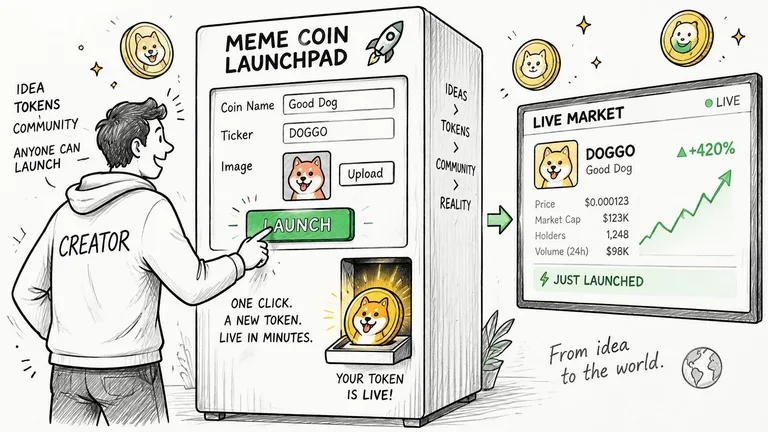
These terms help separate the people from the mechanism:
- Token creator: The address or person that initiates the token's launch.
- Bonding curve: A programmed trading mechanism that calculates prices as buyers and sellers change its reserves.
- Graduation: The milestone at which a token satisfies the launchpad's conditions for moving into another trading stage.
For a buyer, the important distinction is between availability and demand. A token can exist, display a price, and accept purchases without having a durable pool of willing buyers. The useful questions concern price formation, sellable supply, ownership, and the behavior of participants, not whether the launch succeeded technically.
Launch Mechanisms Compared at a Glance
| Mechanism | How the price is set | Who usually gets tokens early | Main risk |
|---|---|---|---|
| Bonding-curve launchpad | Virtual constant-product curve; purchases add SOL to real reserves | Early buyers, snipers, and bots can access lower starting prices | Coordinated buying can resemble demand; participants can abandon trading quickly |
| Fixed-price presale | Price is set before the token lists | Buyers who commit funds before launch | Presale allocations can become sellable at listing |
| Fair launch | Open trading begins without a presale | Whoever gets transactions executed first, including bots and insiders | Insiders can still buy in the earliest blocks |
| Direct liquidity pool | Creator pairs tokens with SOL in an automated market maker pool | Creator supplies the initial pool and controls any retained supply | Whoever controls withdrawable liquidity can remove it |
The launch structure tells you where to look for an early seller's advantage. A familiar name or convincing website doesn't answer that question, because the same branding can be attached to any of these mechanisms.
Read the mechanism before the chart
Bonding-curve launches package token creation and initial trading into a platform-defined process. The creator doesn't have to negotiate an exchange listing or independently design an opening market. Your task is to inspect who is buying through that process, rather than assuming that platform-standard mechanics imply independent participation.
A fixed-price presale introduces a different concern: buyers may acquire tokens before public trading begins. Check the allocation terms and release conditions. A discounted allocation that's immediately transferable creates a different selling opportunity from one enforced by a vesting contract.
With a fair launch, public access doesn't guarantee equal execution. Someone with advance knowledge, automated transactions, or a prepared bundle may buy before an ordinary user completes a manual purchase. Treat the label as a description of distribution rules, not proof that insiders lack an advantage.
In a direct liquidity pool, inspect control of the liquidity position. Pairing tokens with SOL creates somewhere to trade, but you still need to know whether the liquidity provider can withdraw those assets and whether any claimed lock is enforceable.
Practical rule: Identify who can sell early, and who can withdraw trading assets, before interpreting an upward chart as public confidence.
The price chart records completed trades. It doesn't reveal every allocation waiting to become transferable or every wallet operating under common control.
How a Bonding Curve Sets the Price
A bonding curve is a programmed pricing system, not an order book full of independently submitted offers. On the model discussed here, a virtual constant-product curve determines execution prices while purchases accumulate real SOL reserves.
Say a buyer purchases tokens and then another buyer follows without an intervening sale. The later purchase reaches a higher point on the curve. A seller moves the mechanism in the opposite direction, receiving SOL while pushing the quoted price downward.
The launch lifecycle
- Creation. The creator initializes the token through the launchpad rather than building an independent trading venue.
- Curve trading. Buyers and sellers trade against the programmed reserve relationship.
- Graduation. In the studied Pump.fun configuration, the threshold was approximately 85 SOL of cumulative funding and about $69,000 in market capitalization, according to the academic study of bonding-curve launches.
- Migration. Trading moves to an external automated market maker, where the pool's liquidity and swap mechanics determine execution.
Those thresholds describe the studied configuration, not a permanent promise about every platform or future launch. Always verify the rules that apply to the token you're examining.
The reserve relationship is easier to follow visually:
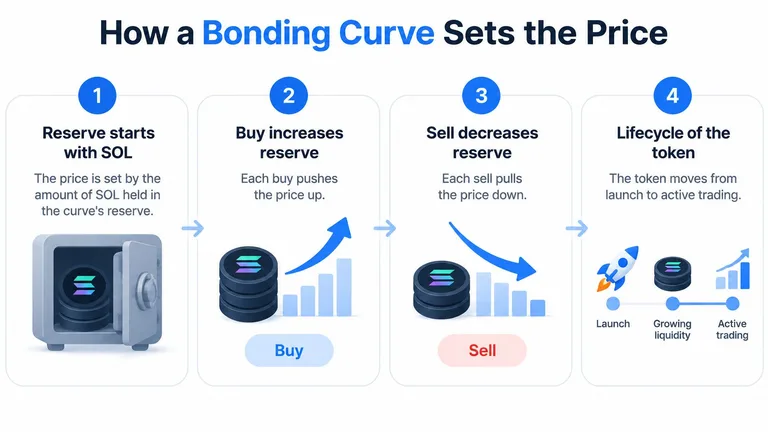
Measure movement, not just the balance
A reserve snapshot tells you how much backing is present at that moment. It doesn't tell you whether participation is broadening, whether inflows are slowing, or whether connected buyers supplied most of the SOL.
For a practical worksheet, calculate rolling SOL inflow per minute. Record purchases and withdrawals separately so gross buying doesn't conceal net selling, then compare equal observation windows at similar token ages.
Add the active-wallet count alongside the result:
- Rising inflow with expanding participation: More distinct addresses are contributing, though their independence still needs checking.
- Rising inflow with concentrated participation: A small group may be creating the appearance of accelerating interest.
- Irregular reserve jumps: Inspect transaction timing and funding relationships before treating sudden progress as organic demand.
Comparing inflow per active wallet helps distinguish broad participation from heavy spending by a narrow group. Comparing tokens at similar ages prevents an older launch's accumulated reserve from looking automatically stronger than a younger one's activity.
The Pump.fun bonding-curve trading risks guide provides additional context for interpreting execution and reserve behavior. The curve follows its formula regardless of whether purchases come from unrelated traders or a coordinated network.
Tokenomics, Fees and Unlock Schedules
Tokenomics answers a practical question: who can sell, how much can they sell, and when? A headline supply number answers none of those on its own.
Start by separating total supply from the tokens currently available for trading. Then identify creator holdings, insider allocations, tokens committed to the launch mechanism, and tokens distributed to public holders. A marketing allocation chart is a claim, not a record. Reconcile it against on-chain ownership before treating it as fact.
Read the calendar alongside the holder list
Work through a simple scenario. A creator allocation is locked until a scheduled release. Before that date, those tokens cannot contribute to selling if the lock is correctly enforced. Once they become transferable, their owners gain the option to sell, whether or not a sale follows.
Compare each release against recent trading activity and executable liquidity. A large tranche relative to ordinary turnover deserves more attention than its share of total supply suggests. Reported volume also needs checking, because repeated trading between connected wallets can exaggerate how much genuine selling the market is able to absorb.
Verify the lock itself rather than a date on a website. Confirm the beneficiary, the release conditions, the remaining balance, and whether an administrator can change the terms after launch.
A release creates the ability to sell. It does not prove holders will sell, or that buyers can absorb the sale.
Fees reveal another incentive
Many launch mechanisms split a trading fee between the creator and the protocol, so the creator earns a slice of every trade rather than only from the initial raise. That structure changes the incentive picture in a way newcomers often miss. A creator paid on turnover earns during speculation, during sharp declines, and during repeated flipping between the same wallets. High activity and healthy price action are not the same thing under this arrangement.
Fee income alone shows no commitment to maintaining liquidity or retaining holders. When screening a launch, ask who collects that fee and whether the recipient's wallet overlaps with the largest holders. A creator collecting fees through one address while holding supply through connected addresses has incentives worth mapping before you buy.
Use this reading order for a new launch:
- Map supply and creator allocation. Reconcile the stated distribution with actual balances, separating pools and program accounts from ordinary holders.
- Check release dates and tranche sizes, including immediate transferability when no vesting exists.
- Identify who receives trading fees and whether those recipients are connected to major holders.
- Ask what gives the creator a reason to support continuing participation beyond short-lived turnover.
Some launchpad tokens have no team vesting schedule at all. Where nothing is locked, insiders can already transfer their holdings, and that absence of constraint is itself the finding. The central question is when concentrated holders can reach the exit, not whether the supply looks elegantly designed on a slide.
Why Most Launches Fade Within Minutes
Among roughly 12.8 million Pump.fun tokens, just 12 tokens accounted for more than 55% of aggregate fully diluted market capitalization, according to Galaxy's analysis of memecoins and Pump.fun. A newcomer scrolling through similar-looking launches is staring at a market where almost all the visible value sits in a tiny handful of outliers.
Fully diluted market capitalization is a valuation measure built from price and supply. It describes what the whole supply would be worth at the current price. It says nothing about how much of that supply could be sold anywhere near it.
How launchpad tokens end
The observations below come from separate datasets and observation windows, so read them as a sketch of typical outcomes rather than a forecast for any single token.
| Metric | Reported pattern | What it means for a buyer |
|---|---|---|
| Pump.fun share of new Solana tokens in the studied sample | A dominant majority | One platform accounted for most observed issuance |
| Launches whose trading stopped within minutes of creation | A substantial share | Many launches went quiet almost immediately |
| Launches with no trading after their first day | An overwhelming majority | Continued activity was the exception in that sample |
| Launches that reached graduation | A small fraction | Progression was rare and proved nothing about safety |
| Tokens holding over 55% of fully diluted market capitalization among about 12.8 million | 12 tokens | A small set of outliers carried the valuation measure |
Read together, those rows describe how fast the screening problem moves. When a large share of launches stop trading within minutes, the evidence that decides the outcome, holder concentration and continued buying interest, either shows up early or never arrives. A launch that has already gone quiet has answered the main question for you.
What those outcomes mean
A dominant issuance share locates where tokens are created. Whether any of them is worth buying stays a separate question each buyer has to answer. Short trading duration means checking whether anyone remains willing to trade at all, because a polished launch page can sit on top of a market that emptied out hours ago.
Graduation only records progress through a platform's rules. It confirms movement through a mechanism while leaving ownership fairness, durable liquidity and creator intent unexamined. And with valuation concentrated in a dozen outliers, survivor stories make a poor substitute for examining the full launch population.
Risk boundary: A token doesn't need to be a scam for its buyers to lose their entire investment.
You can lose all of the money invested in a memecoin even without a rug pull, which is why a tool like MemeAssist frames every report as informational research rather than a safety verdict. Position size belongs in the initial decision, before entry, never in a recovery plan drafted after the buyers disappear. A clean-looking launch can still end in thin demand and an exit nobody wants.
Five-Minute Checks That Catch Rug Pulls
| Signal | Healthy pattern | Warning pattern |
|---|---|---|
| Reserve or pool-asset drawdown in the first five minutes | Stable or rising reserves | Sharp decline, especially alongside creator outflows |
| Sell-to-buy imbalance | Buys and sells broadly balanced | Sells outpace buys while new buyers stall |
| Creator-linked transfers | No unexplained outward movement from creator-linked wallets | Creator-linked wallets move tokens or SOL out |
| Top-holder concentration | Supply distributed across apparently independent wallets | A few wallets control much of the supply |
| Unique-buyer growth | New distinct buyers continue arriving | Volume rises while unique buyers flatline |
| Repeated trade sizes and direct or bot-like transactions | Varied sizes and less mechanically synchronized timing | Identical sizes, synchronized execution, and repeated direct calls |
These are comparison patterns, not pass-or-fail thresholds. Automated trading can be legitimate, creator transfers can have operational explanations, and distinct addresses can share an owner.
A study covering 6.4 million Solana tokens reported that most rug-pull characteristics emerged within the first hour and that gradient-boosting models could detect risk using only the first five minutes of trading data. Its outcome definition included total value locked falling below 1% of its prior level, or prolonged inactivity exceeding 80% of the token's lifetime.
That definition matters. A model trained to detect those outcomes isn't necessarily determining legal fraud or proving that a particular person intended to steal. Nor can an inactivity condition based on eventual lifetime be fully confirmed at launch.
Establish the basic facts first
Before starting the observation window, use a Solana block explorer to verify the token's mint address, retained mint authority, and freeze authority. A retained mint authority can permit additional issuance; freeze authority can permit accounts to be frozen, subject to the token program's rules.
Identify the creator address and preserve its relationship to the launch transaction. Check the address rather than trusting the ticker, since branding alone doesn't establish token identity. The Solana token safety checks guide provides a supporting checklist for these foundational checks.
Use a repeatable observation routine
- Record the launch time. Save the mint address, initial reserve or pool balance, creator address, and observation timestamps so later changes have a baseline.
- At minute one, inspect reserves and unique buyers. Look for participation expanding alongside funding rather than a reserve increase produced by a narrow group.
- At minute three, compare selling, buying, and creator-linked transfers. Inspect whether outbound transfers lead to sales, another pool, or an identifiable operational destination.
- At minute five, write a decision. Wait for clarification, reduce the contemplated exposure, or pass when several warnings align. Completing the window isn't itself a reason to buy.
A sharp liquidity decline becomes more concerning when creator-linked wallets are exiting and ownership is concentrated. High turnover without new participants deserves a different question: are independent traders arriving, or are the same actors repeatedly exchanging tokens?
Keep the supporting transaction signatures and balances with any warning. A flag is a reason to investigate, not a verdict, and a quiet observation window doesn't establish that later trading will remain orderly.
Spotting Wallet Clusters Behind Apparent Demand
A holder list can resemble a crowd even when one operator controls many addresses. Think of several branches connected to the same trunk: the visible wallets differ, but their funding or exit destination may be shared.
This illustration captures the distinction between address count and economic control:
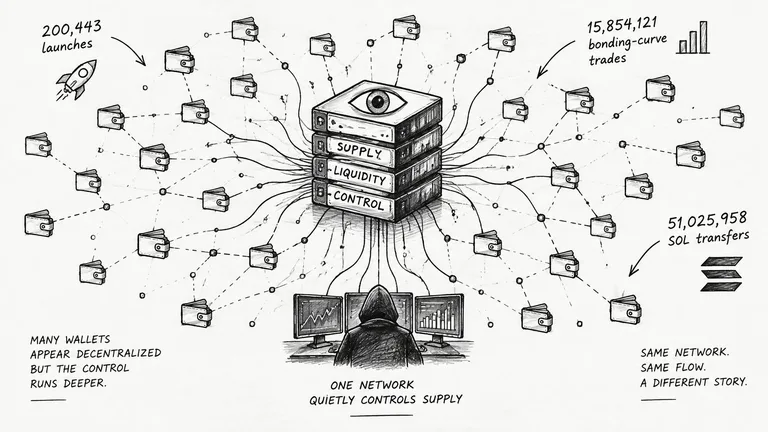
A study of coordinated launch activity identified 23,710 wallet groups across 200,443 launches, using relationships including co-buying, shared funding, joint signing, and later consolidation. This makes the largest individual holder an incomplete measure of concentration.
Look for relationships, not matching names
Trace incoming SOL, compare transaction timing, and inspect where proceeds eventually go. Shared funding becomes more informative when it appears alongside synchronized buying and a common exit.
Other clues include bundled purchases, clusters of newly active wallets, and creator-linked dispersal. In that last pattern, tokens move through several addresses without necessarily changing their underlying economic owner.
A shared exchange withdrawal source alone isn't strong proof of common control. Neither is buying during the same popular launch. Preserve each relationship separately so the conclusion doesn't become stronger than the evidence.
Use the accompanying video as an additional visual resource:
Run a holder-cluster test
- List the top 20 holders as a practical starting sample. Label pool, program, burn, and other non-personal accounts before interpreting concentration.
- Trace each ordinary holder's SOL funding and record common upstream addresses.
- Compare purchases and sales for matching timing, repeated bundles, or common destinations.
- Calculate the suspected group's combined share, then compare it with the largest individual holding.
The guide to Solana wallet clusters helps distinguish suggestive relationships from stronger combinations of evidence. If your early-trading check shows concentrated ownership, investigate these connections before committing funds.
Connected wallets demonstrate linkage, not necessarily manipulation. Present the funding paths, transaction timing, and combined holdings, then decide whether that unresolved control is acceptable for your loss limit.
Confirm a Launch Before You Buy
Turn observations into a written decision before placing a trade. Otherwise, a rising quote can tempt you to reinterpret an unresolved warning as something you'll check later.
Make the decision operational
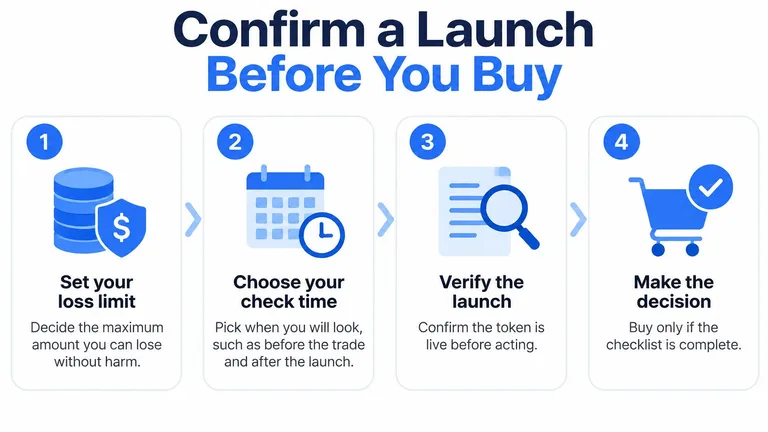
- Set your maximum tolerable loss. Use an amount you can lose entirely without affecting essential spending or obligations.
- Choose your observation point, such as after the initial five-minute window. Don't shorten it just because the price is rising.
- Write down pass, wait, or a small position. Include the evidence supporting that choice and the uncertainty that remains.
- Set exit triggers in advance, such as an unexplained reserve decline or creator-linked selling. Remember that a trigger doesn't guarantee an executable exit.
- Record applicable release dates. Recheck beneficiaries, transferable balances, and holder relationships when releases occur.
Before executing, confirm that the token address matches your notes and that the intended trading pool is live. Check the expected output and price impact for your own order, rather than relying on the last displayed trade.
Keep the checklist available when you act:
Use a second opinion without outsourcing judgment
At MemeAssist, we provide AI-powered risk analysis for Solana tokens, bringing liquidity, holder distribution, creator behavior, wallet activity, trading patterns, and historical risk indicators into a report with a plain-English explanation. Our role is integrated research, explanation, and tracking, not exclusive blockchain data, a safety guarantee, or a profit promise.
We never ask you to connect a wallet, sign a transaction, or approve anything. Our analysis is educational and informational, not financial advice, and offers a second opinion rather than proof that a token is safe.
No checklist can certify a launch. The useful result is a clearer account of what you've verified, what looks concerning, and what still requires evidence.
Before buying your next launchpad token, visit MemeAssist for a second opinion that brings Solana on-chain and market evidence into a plain-English risk report. Compare its findings with your reserve checks, holder-cluster notes, and release calendar, then decide whether to pass, wait, or accept the remaining risk.
Topics: meme coin launchpad, Solana meme coins, bonding curve, memecoin tokenomics, rug pull checks
Informational only, not financial advice. Meme coins are extremely high-risk.
All articles