Meme Coin Scanner Explained: What It Is and How It Works
Learn what a meme coin scanner is, how it reads on-chain data to detect rug pulls and scams, and which features actually matter for Solana traders.
Published
Updated
You're staring at a token address, the chart is already moving, and you've got a narrow window to decide whether to buy, wait, or walk away. That's where a meme coin scanner earns its keep, it turns a live contract and a fast-changing market into something you can read before the move is gone.
A good scanner doesn't tell you to be brave. It shows you whether the evidence is initial, developing, or confirmed, and it separates scam risk from tradability risk so you don't confuse a dead market with a malicious one.
Table of Contents
- What a Meme Coin Scanner Actually Does
- The Six Categories of On-Chain Evidence
- Why Bundle and MEV Awareness Matters
- Scam Risk Versus Tradability Risk
- Red Flags a Scanner Should Actually Catch
- How Traders Actually Use a Scanner Day to Day
- Where MemeAssist Fits in the Tool Stack
- A Trader's Checklist Before the Next Buy
What a Meme Coin Scanner Actually Does
A trader usually meets a meme coin scanner at the worst possible time, right after someone in a group chat says the chart looks hot. You paste a contract address, the tool pulls live on-chain and market data, and it gives you a fast read on whether the token is worth a second look or a hard pass.
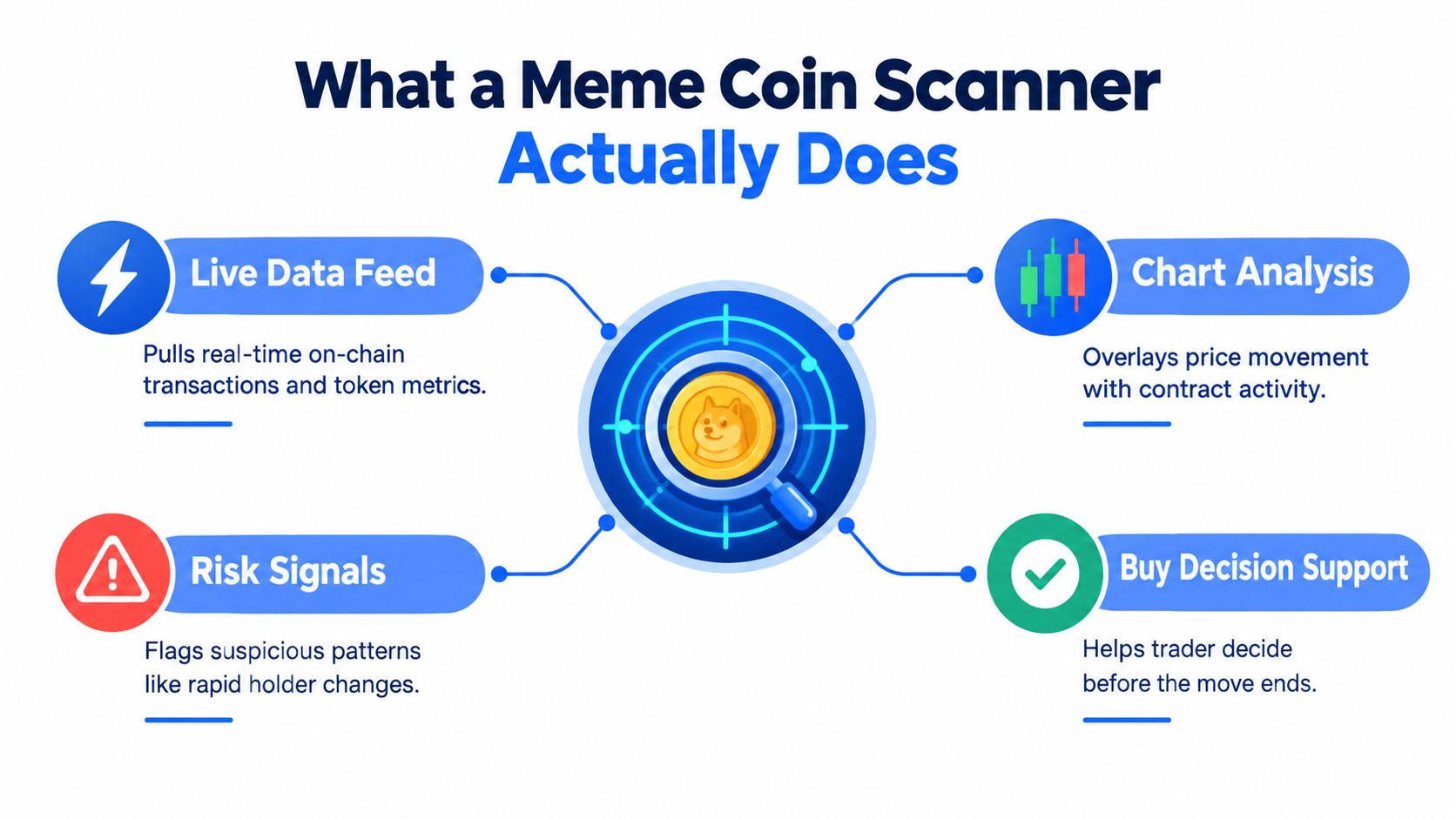
A scanner is not the same as a tracker, a sniper bot, or a portfolio app. A tracker follows a token after you already know it exists. A sniper bot tries to enter instantly. A portfolio tool helps you monitor positions you already hold. A scanner sits earlier in the workflow, it answers a narrower question, “What's going on with this token right now?”
What it can answer
A scanner can show whether liquidity looks shallow, whether holders are concentrated, whether the deployer wallet has a messy history, and whether trading behavior looks coordinated. On Solana, that matters because launch activity is fast, cheap, and easy to fake if you only look at surface-level chart movement, as the scale of the ecosystem makes clear in the Galaxy research report on Solana meme coins and Pump.fun activity Galaxy research on Solana meme coins and Pump.fun.
Practical rule: if a scanner can't tell you what changed since the last read, it's giving you a snapshot, not a decision aid.
A scanner can't guarantee a good trade, and it can't prove a token will survive. What it does is reduce guesswork at the exact moment traders are most tempted to mistake momentum for safety. That's why the tool is useful before a buy, during a hold, and after a token gets flagged.
The Six Categories of On-Chain Evidence
A serious scanner doesn't rely on one metric, because one metric can be gamed. It reads several categories together, then asks whether the token's behavior makes sense as an actual market or looks like a manufactured one.
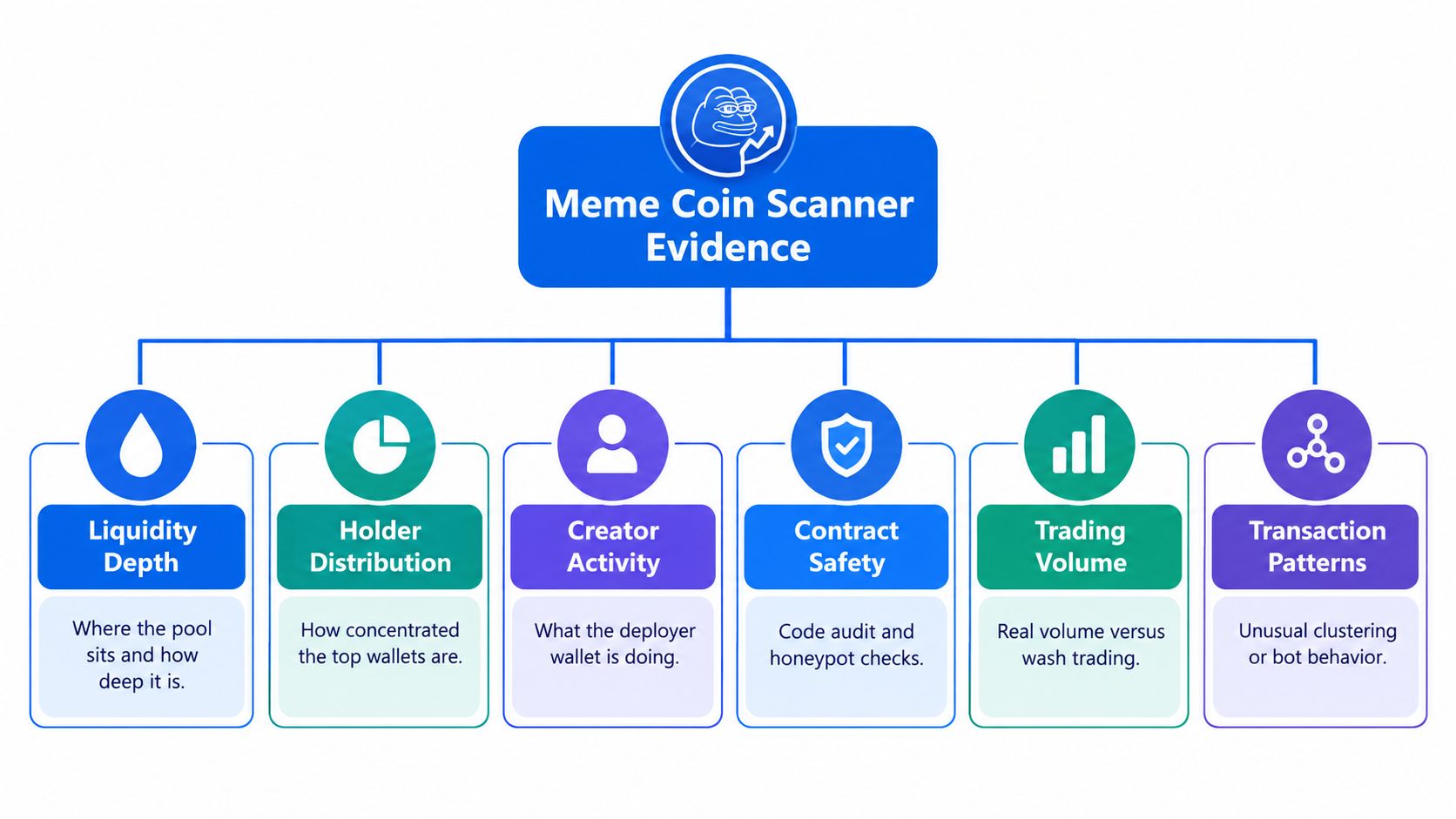
The most useful categories are liquidity depth, holder distribution, creator activity, wallet activity, trading patterns, and historical risk indicators. Each one catches a different failure mode, and skipping any of them opens a blind spot scammers already know how to exploit.
Why each category exists
- Liquidity depth: thin pools can look busy until a real exit hits them. A scanner should show where the pool sits and how much depth is available, because shallow liquidity turns one sell wave into severe slippage.
- Holder distribution: if a small group controls the supply, the token can look broad at a glance while still being tightly controlled underneath.
- Creator activity: a deployer wallet that keeps selling, moving funds, or reappearing across launches is not background noise. It's a clue.
- Wallet activity: fresh wallets, shared funding sources, and related funding paths help show whether “many buyers” are coordinated.
- Trading patterns: volume alone can be deceptive. A scanner should compare buy and sell flow, unique trader growth, and short-window behavior instead of celebrating raw turnover.
- Historical risk indicators: prior flags, previous rugs, or repeated bad patterns matter because the same actors often reuse the same playbook.
The reason these signals matter is simple. Solana meme coin markets move fast enough that a token can be launched, pumped, and distorted before a casual observer understands what they're seeing. A useful reference point for how a scanner should structure the evidence is MemeAssist's Solana token analysis overview, which shows why live ingestion across multiple evidence layers beats a single static score.
A clean chart isn't evidence of a healthy market. It's just a chart until the wallet behavior underneath it makes sense.
The point is not to collect more data for its own sake. The point is to ask better questions of each token before you treat it as tradable.
Why Bundle and MEV Awareness Matters
A scanner that counts wallets without looking at execution context can miss the true story. On Solana, bundled and reordered transactions can create the appearance of organic demand when the same actor is controlling the entire sequence.
Why the wallet count can lie
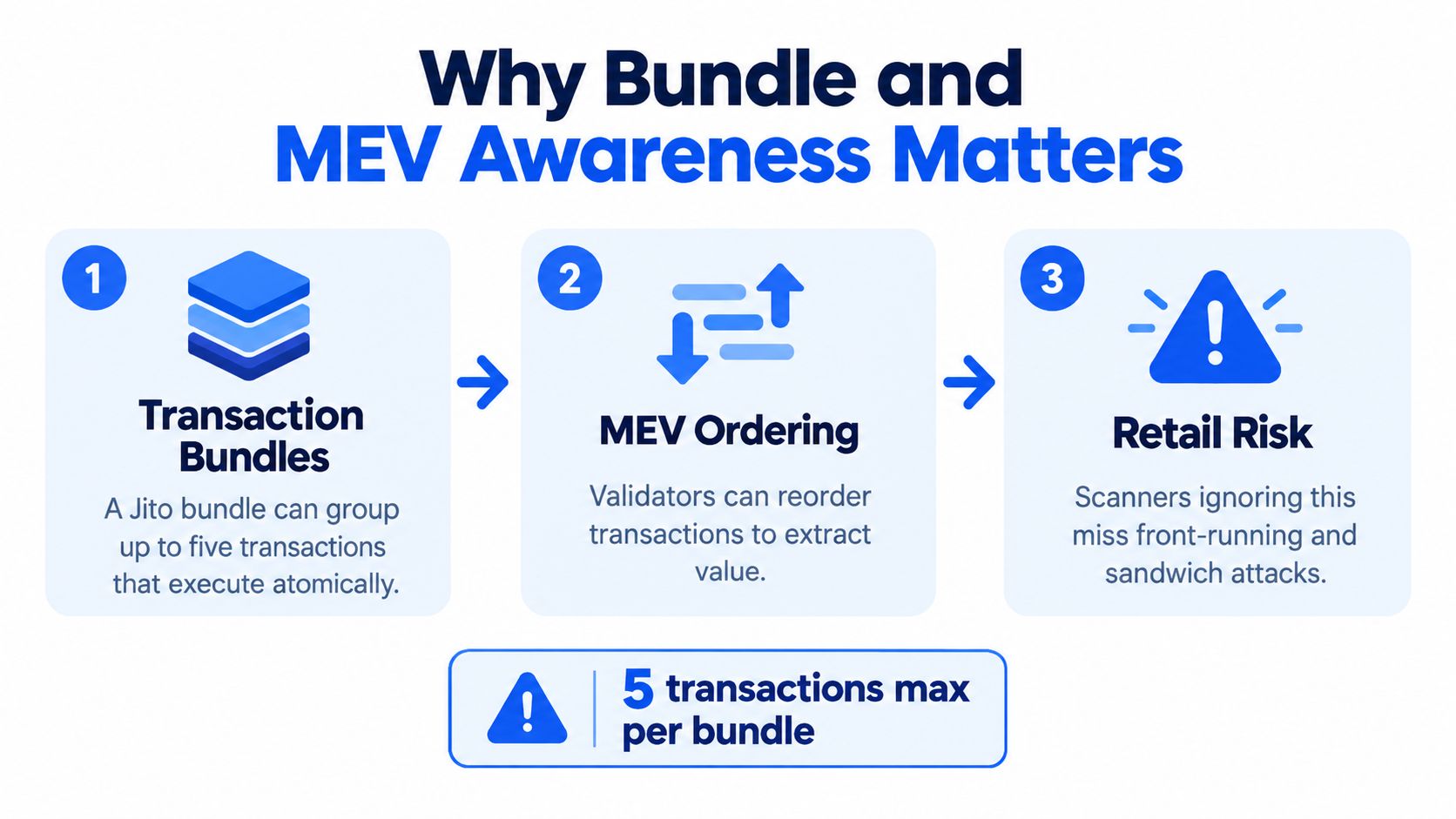
A Jito bundle can group up to five transactions that execute atomically, which means the same actor can fund several wallets, buy through all of them, and distribute supply in one sequence. That creates a false impression of broad participation if you only count addresses. The 5 transactions max per bundle detail matters because it shows how much coordination can fit inside one atomic action.
Transaction ordering also matters. Solana MEV tooling describes front-run, user transaction, and back-run behavior, and those patterns can make volume look healthier than it is while worsening execution for later buyers. The danger isn't abstract. Buyers who arrive after the bundled activity often absorb worse pricing, because the earlier flow has already set the tone for the pool.
What a scanner should cluster
A bundle-aware scanner should group activity by shared signers, funding ancestry, block-engine metadata where available, and tightly coupled timestamps. That's how it avoids treating ten related wallets as ten independent believers in the token. It also explains why a scan that ignores sequence-level behavior can understate insider exposure and overstate organic demand.
A practical tool should retain both raw wallet-level and entity-level views. You want to know who the largest holders are, but you also want to know whether those holders are one coordinated entity split across multiple wallets.
If the wallets look unrelated but they all came from the same source and bought in the same slot window, you're probably looking at coordination, not community.
For traders who want a plain check on whether a Solana token has been bundled, this bundle-detection guide is the right kind of supporting read. It keeps the question focused on execution context instead of just surface-level holder counts.
Scam Risk Versus Tradability Risk
A scanner is most useful when it answers the right question. Traders often ask whether a token is “safe” or “a scam,” but the cleaner split is between malicious intent and bad market quality.
Intent is different from outcome
Intent-related signals point to how the launch was set up, for example creator exits, insider concentration, bundled purchases, and coordinated wallet behavior. Those patterns suggest the launch was designed to benefit from confusion. Outcome-related signals point to tradability, such as thin liquidity, weak volume, and a sharp price collapse. Those problems can appear even when nobody set out to deceive buyers.
The distinction matters because a token can fail without being fraudulent. It can also look active for a short time while hiding a hostile structure. The USENIX study of 34,988 meme coins is useful here because it shows how often manipulation patterns appear in tokens that later produce large returns, and it documents more than $9.3 million in realized losses across over 17,000 victim addresses. The same study found rug pulls alone accounted for $6.04 million of those losses, affected 11,368 addresses, and produced an average loss of $671,666 per event USENIX meme coin manipulation study.
Why this split protects you
If every failed launch gets labeled “scam,” benign failures get misread. If strong volume gets treated as proof of legitimacy, engineered traps slip through. The better habit is to ask two separate questions every time.
- Is this token showing signs of intentional manipulation?
- Can this market support my exit without punishing me?
Those are different tests, and a scanner should keep them separate. That matters in a market where tokens can generate fast, misleading surface activity. The same USENIX study cited above found that among tokens with returns above 100%, 82.89% showed evidence of artificial growth strategies meant to create a false appearance of interest.
A clean way to read the output is this, scam risk is about intent, and tradability risk is about execution. A good scanner does not blur them together. It shows whether the evidence is still initial, developing, or confirmed, so you can judge both safety and exit quality before you commit.
Red Flags a Scanner Should Actually Catch
A useful report doesn't just hand you a score. It shows the exact reason the score exists, and it should surface the kind of behavior that has already burned traders in live markets.
Concentration and control signals
If the top holders control too much supply, the token can be fragile even when the chart looks active. That concern gets worse when those wallets were funded by the same source or bought in tightly linked bursts. A scanner should flag that as a concentration risk, not as a generic “maybe” signal.
The deployer wallet matters too. A fresh creator wallet with no visible track record is not proof of bad intent, but a creator wallet that has launched before, sold into strength, or shown up in previous failures deserves more scrutiny. Prior history is one of the clearest ways to tell whether you're dealing with a one-off experiment or a repeat pattern.
Liquidity and trading behavior
Liquidity warnings should be blunt. If the pool is too thin to absorb a realistic exit, the token is not just risky, it's structurally fragile. If liquidity can be altered by an authority that hasn't been neutralized, that is a separate red flag because the rules of the market can still change under your feet.
Trading behavior should also be read as evidence, not decoration.
- High turnover from a small wallet set: suggests a narrow group is manufacturing activity.
- Repeated alternating buys and sells: often points to wash-like behavior or coordinated churn.
- Volume that doesn't match pool depth: can mean the trade flow is overstated relative to real liquidity.
- Creator selling into demand: shows the deployer is exiting while buyers are still arriving.
A scanner that can connect these signals gives you something actionable. It tells you whether the problem is the contract, the crowd, or both. That's more useful than a flat “risk high” label, because you can decide whether the issue is fatal or just a reason to size down.
How Traders Actually Use a Scanner Day to Day
A scanner is only useful if it fits the way people really trade. Most traders don't sit down with a token and do a full forensic audit. They react to a chart, then they need a fast read, and later they need a second read when conditions change.
Before entry
The first job is pre-buy screening. A trader sees a token moving, pastes the contract address, and checks whether the report shows clean enough liquidity, sane holder distribution, and no obvious creator abuse. If the evidence is still initial, the right move is usually caution, not conviction.
A 2025 study of 6.4 million Solana tokens collected over seven months found that most tokens displayed rug-pull characteristics within the first hour, while machine-learning models could detect risk using only the first five minutes of trading data Solana token timing study. That's why the first scan matters so much. The market often reveals its shape fast, and waiting too long can turn a valid question into an expensive answer.
After entry and after a flag
Mid-position monitoring is different. Now the question is whether the trade is getting healthier or uglier. If creator selling starts, liquidity drops, or new bundled behavior appears, the scan should move from developing to confirmed risk. That changes urgency, and it should change your stop placement too.
Post-flag tracking is where a scanner proves whether its earlier warning was useful. If a token gets flagged and the outcome later matches the warning, that builds trust in the system. If it doesn't, the tool should preserve the evidence so the mismatch can be reviewed, not ignored.
Working rule: scan once before you buy, scan again if the market structure changes, and trust the label more when the evidence is timestamped.
The big habit shift is this, don't treat the score as permanent. Treat it as a live read on a fast market.
Where MemeAssist Fits in the Tool Stack
MemeAssist sits in the part of the workflow where Solana depth matters more than chain breadth. It's built to pull live data at the moment you analyze a token, then combine quantitative checks with a plain-English verdict so the evidence isn't trapped in raw metrics. It also keeps public evidence visible for later review, which helps when you want to verify why a token was flagged in the first place.
| Capability | Generic multi-chain checker | MemeAssist |
|---|---|---|
| Chain focus | Broad, often thinner per chain | Solana-only depth |
| Data timing | Sometimes cached snapshots | Live re-ingestion at run time |
| Output style | Mostly score-driven | Score plus AI explanation |
| Evidence review | Often limited | Public evidence visibility |
| Post-flag tracking | Usually weak or absent | 24-hour follow-up on flagged tokens |
The practical difference is simple. In a market with fast launches and short holding periods, stale data can mislead you. A scanner that refreshes from live on-chain and market data at analysis time is better aligned with the pace of the trade, and the MemeAssist trade check shows how that logic fits into a pre-buy workflow.
A Trader's Checklist Before the Next Buy
Before you click buy, check the pool, the holders, the creator, and the recent trade pattern. Then ask one final question, is the evidence initial, developing, or confirmed.
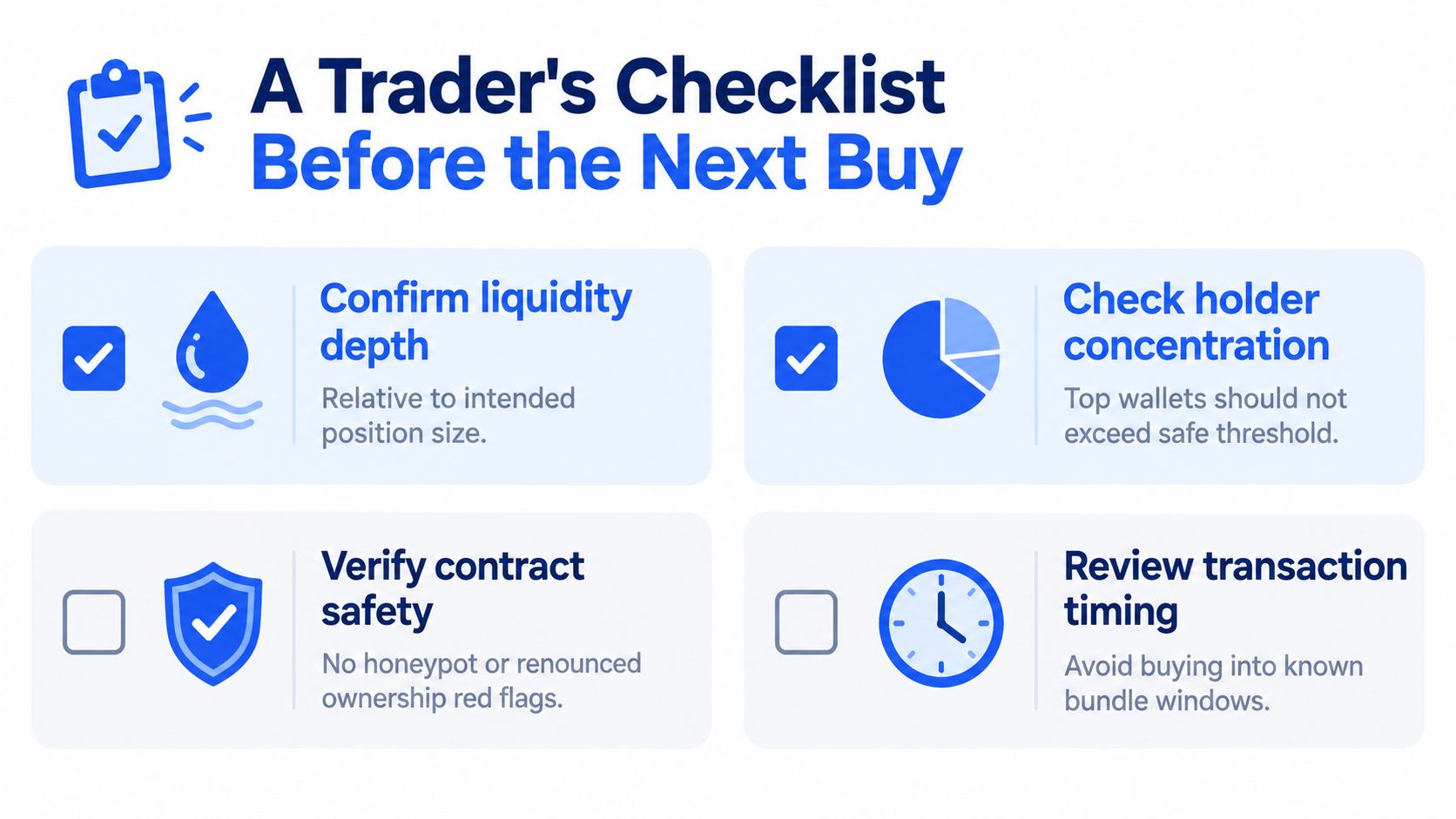
- Confirm liquidity depth: make sure it can handle your intended position size.
- Check holder concentration: top wallets shouldn't be controlling the whole supply.
- Verify contract safety: look for honeypot, authority, or creator-control warnings.
- Review transaction timing: avoid buying straight into known bundle windows.
A scanner lowers the odds of a bad entry, but it doesn't remove risk. Your own position size and exit discipline still do most of the work, and they matter more when the token is moving fast.
If you want a live Solana screen that reads liquidity, holders, creator behavior, wallet activity, trading patterns, and historical risk together, start with MemeAssist. It gives you a fast report you can use before a buy, while you hold, and after a token gets flagged, which is exactly the kind of time-aware check a meme coin trader needs.