Meme Coin Tracker Guide: How Solana Tools Compare
Meme coin tracker tools compared for Solana traders — see which features matter, how leading options stack up, and which one fits your trading style in 2026.
Published
Updated
CoinGecko recorded the meme coin market cap at about $20 billion at the start of 2024, later climbing above $100 billion and reaching an all-time high of $150.6 billion in December 2024, while average daily trading volume jumped from $1.1 billion in 2023 to $9.7 billion in 2024, with a temporary spike to $87.4 billion after exchange-listing news involving dogwifhat and Pepe (CoinGecko 2024 Annual Crypto Industry Report). That scale changes what a meme coin tracker has to do. A static token page is too slow for a market that can swing from thin attention to crowded liquidity in a matter of hours.
A serious tracker doesn't just list prices. It pulls live on-chain and market data, inspects holder distribution, reads liquidity depth, watches creator-linked wallets, and checks whether trading behavior matches the story a token is telling. For Solana, that matters even more because launch speed, bundle activity, and rapid rotation can make the first few minutes more informative than the chart looks at first glance.
| Tool type | What it catches well | Where it usually falls short |
|---|---|---|
| Launch scanner | Fresh pairs, early volume, new token discovery | Often weak on deeper holder and creator analysis |
| Rug checker | Ownership flags, liquidity status, concentration | Can miss live trading context and post-flag monitoring |
| Wallet cluster map | Related wallets, coordinated behavior | Needs interpretation, not a verdict on its own |
| AI risk analyst | Plain-English synthesis across signals | Only as good as the evidence it ingests |
| Portfolio tracker | P&L, positions, alerts on holdings | Usually not built for scam or launch-risk analysis |
Table of Contents
- What a Meme Coin Tracker Actually Does on Solana
- The Detection Ladder From Launch to Exit
- Common Tool Types and Where Each One Stops Short
- Evaluation Criteria That Actually Matter for Solana Tools
- Real-World Use Cases for a Solana Meme Coin Tracker
- Head-to-Head Comparisons Across the Solana Stack
- Choosing the Right Meme Coin Tracker for Your Style
What a Meme Coin Tracker Actually Does on Solana
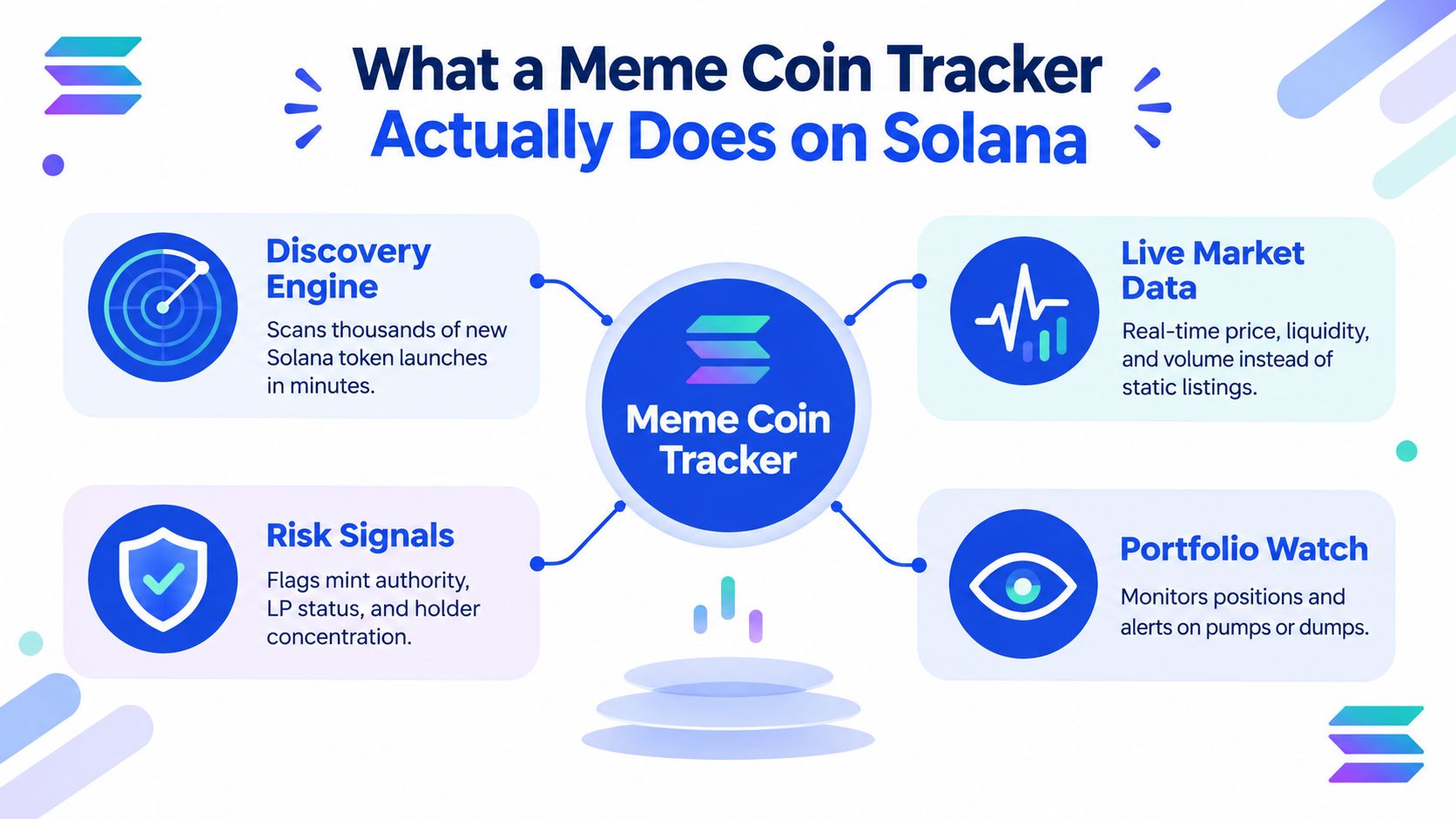
A meme coin tracker on Solana is not just a watchlist with a price feed. It's a live decision layer that combines discovery, market structure, and risk checks so you can judge whether a token is tradable, fragile, or already compromised. The reason this matters is simple, market cap alone can look impressive while the actual exit path is thin or misleading.
The practical job starts with live ingestion. At run time, the tracker needs to read liquidity, holder distribution, creator behavior, wallet activity, trading patterns, and historical risk indicators together, not one by one. If those signals are separated, you can end up with a clean-looking chart that hides a concentrated supply or a wallet set that's already preparing to sell.
The output should be decision-ready
A useful tracker should not bury the answer in a wall of raw data. It should give you four things at once, overall health score, rug risk rating, a plain-English AI verdict, and a detailed breakdown that shows why the token got that result. That format matters because the same token can look active and still be structurally weak.
Practical rule: if the tool can't show you the evidence behind the verdict, treat the verdict as a hint, not a screen.
A basic price aggregator can tell you a token moved. A scanner can tell you it's new. A rug checker can tell you a few ownership facts. An AI analyst can tie the signals together. But a proper tracker should do all four jobs in one flow, then keep watching the token if conditions change. For a Solana-specific workflow, that's the difference between reacting to a feed and making a trade with context. One example of that kind of workflow is a Solana memecoin scanner that ties token discovery to risk analysis rather than stopping at price discovery.
The Detection Ladder From Launch to Exit
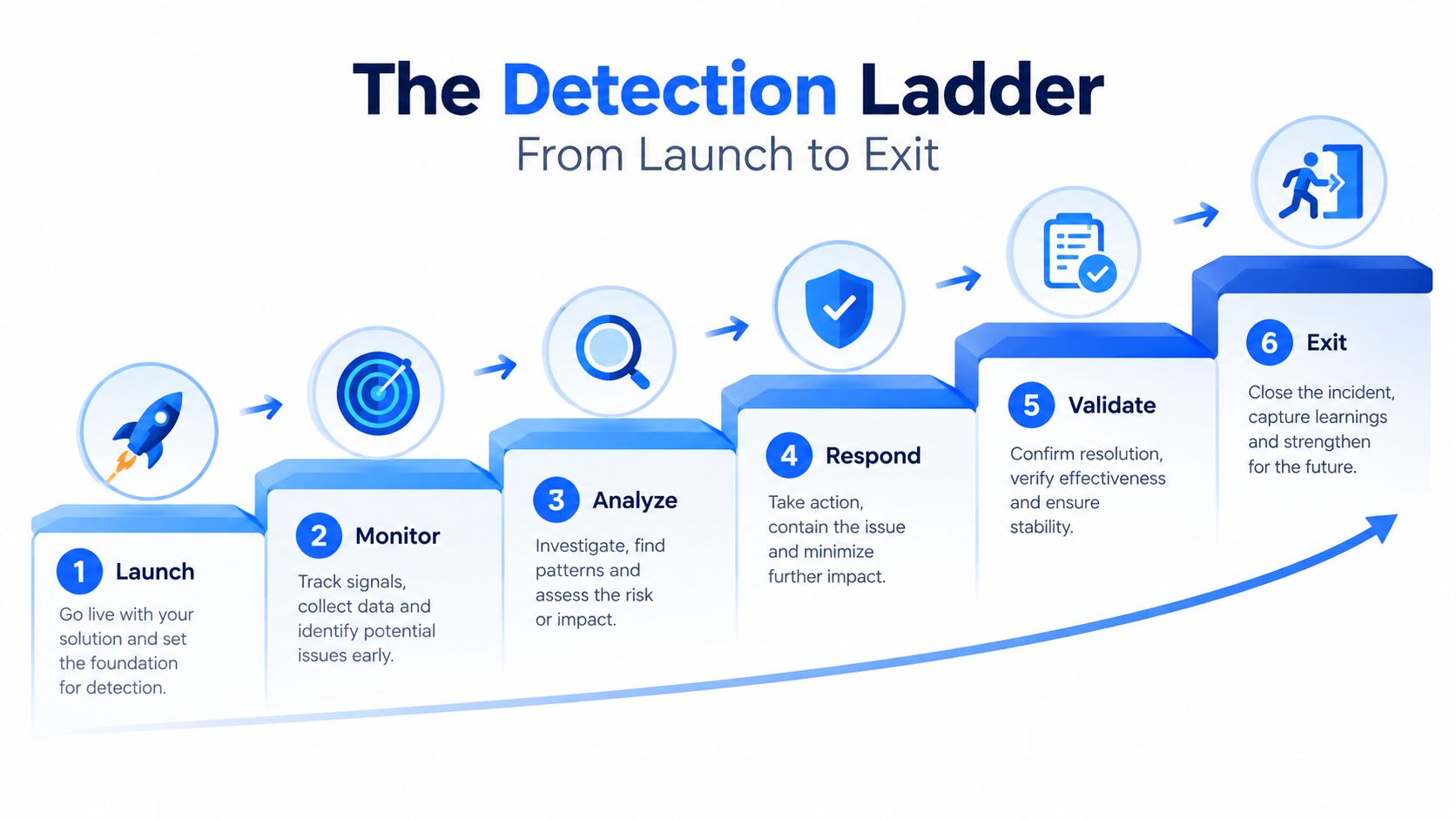
A tracker is only useful if it answers a different question at each stage of a token's life. Early on, the question is whether the token looks manipulative or merely new. Later, the question becomes whether the market is still liquid enough for normal entry and exit. Academic work on Solana meme coins keeps pointing to those stage changes, especially when risk shows up fast and gets masked by volume.
Launch and early trading
At launch, the useful signals are the ones visible in the first minutes of trading, not the social narrative that shows up later. A recent large-scale study of Solana memecoins found that most displayed rug-pull characteristics within the first hour, and models could detect risk using only the first five minutes of trading data (launch-stage study). That's the right mental model for a tracker, the first question is not “is it trending,” it's “what does the opening behavior already reveal?”
A good tool should therefore surface early wallet clustering, bundled buys, creator-linked activity, and suspicious sell pressure as time-series evidence. If it only reports “new” or “trending,” it's too shallow for launch-stage risk.
Consolidation and exit
As a token matures, the signal shifts from burst activity to ownership quality and exit ability. A cross-chain study of 34,988 meme coins found that 88.1% had liquidity below 0.1% of reported market capitalization, which shows why executable liquidity has to matter more than market cap alone (liquidity study). Thin pools can make small orders move price hard, which means a token can still look alive while becoming expensive or impossible to exit cleanly.
A chart can rise while the exit narrows.
That's why the ladder matters. Launch tells you whether the token is already contaminated. Early growth tells you whether the attention looks organic. Consolidation tells you whether participation is broad or concentrated. Exit tells you whether the remaining liquidity can absorb selling without severe slippage.
Common Tool Types and Where Each One Stops Short
On Solana, a meme coin tracker is only as useful as the stage it can read correctly. Launch scanners, rug checkers, wallet maps, AI analysts, and portfolio trackers all solve different parts of the job, and each one leaves blind spots that matter if you are following a token from the first burst to the exit.
Scanners, rug checkers, and wallet maps
A launch scanner is built for the opening minutes. It is the tool that catches a fresh pair, a sudden spike, or a token that starts moving before the crowd notices. The limitation shows up fast. A token can keep printing activity after launch while the scanner has already done its job, so the output tells you that something happened, not whether the move has staying power.
A rug checker works on structure. It is useful for checking ownership, liquidity, and distribution patterns before you commit capital. The weakness is that it often evaluates a pair like a frozen frame. A live Solana market can change quickly, and a token that looked clean at the first check can still develop a bad exit profile later. Analysts using Solana manipulation study style thinking should treat that as a reminder that manipulation methods are varied, from concealed ownership to wash trading and creator-linked dumping.
A bubble map is useful when wallet clustering matters. It can show whether supply sits in a tight set of addresses, or whether the distribution looks more spread out. The catch is interpretation. A cluster alone does not tell you whether wallets are coordinating buys, farming volume, or just reacting to the same catalyst. In practice, I use it to confirm a pattern I already suspect, not to make the first call on its own.
AI analysts and portfolio trackers
An AI risk analyst is the translator. It ties liquidity, holder structure, and trading behavior into a plain-language verdict, which saves time when you are checking many tokens at once. That convenience comes with a trade-off, since a polished explanation can sound more certain than the underlying evidence really is. If the inputs are thin, the output can still miss genuine risk.
A portfolio tracker serves a different job entirely. It is useful after entry, when the question becomes how a position is behaving, what P&L looks like, and whether alerts should fire on assets you already hold. It rarely helps with the earlier decision of whether the token deserved a buy in the first place.
Pick one tool per stage and accept that no single product covers the full ladder. A scanner can catch the launch, a rug checker can expose weak structure, a bubble map can show concentration, an AI analyst can summarize the evidence, and a portfolio tracker can watch the position after entry. The right workflow is to chain them in order, then stop asking one tool to do every job.
Evaluation Criteria That Actually Matter for Solana Tools
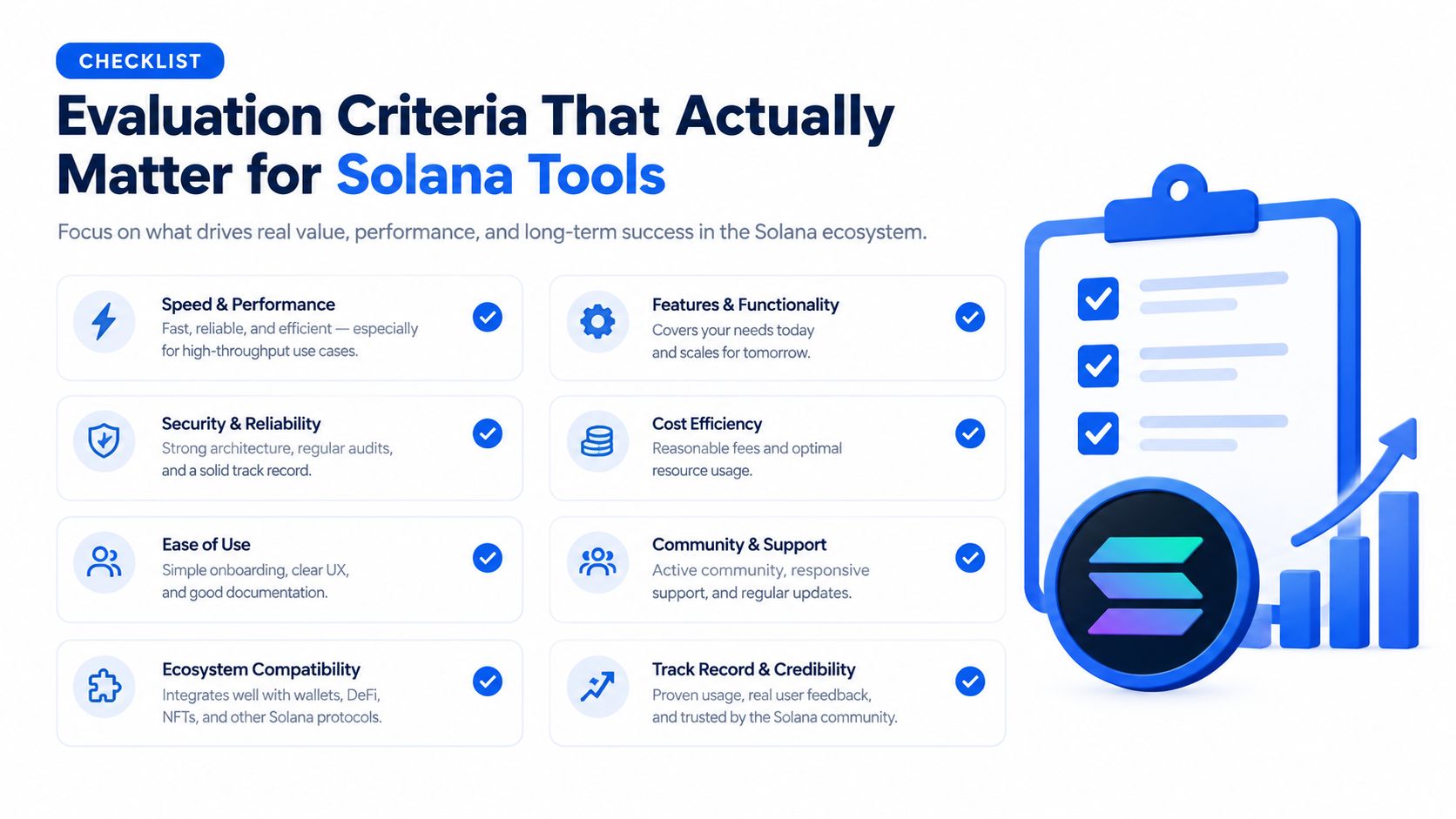
The first thing to check is data freshness. If the tool relies on cached snapshots or delayed indexing, it can miss the exact behavior you're trying to catch during launch or exit. For Solana meme coins, that's a real problem because the useful signal often arrives before the crowd has had time to react.
Evidence transparency and alert logic
A tracker should show you the underlying checks after the fact. If it gives you a verdict but hides the supporting evidence, you can't audit the decision or learn whether the warning was justified. That matters even more when the tool is used repeatedly, because you want to compare outcomes, not just read labels.
The other criterion that matters is alert logic. A token shouldn't disappear from view the moment it gets flagged. The better workflow is to keep tracking the token after the alert, because risk often changes as liquidity shifts and wallets start distributing or dumping.
A solid candidate should also make the scope obvious. A single-chain Solana tool is usually deeper on token behavior than a broad multi-chain product that spreads attention across several ecosystems. That doesn't make multi-chain tools bad, but it does mean they can be thinner where Solana microstructure matters most.
Wallet signature and pricing
The wallet-connect question is essential. If a tool asks for a wallet signature just to read risk data, that's a red flag. Analysis should not require access to the wallet you're trying to protect. In the same vein, pricing should be clear enough that you know whether you're paying per report, by subscription, or through some hybrid model.
The internal question to ask is simple, can the tool tell you what happened, why it matters, and whether it still matters after the next few blocks? A guide to Solana token health score comparisons and manual checks can help you pressure-test that logic without confusing a score for a full review.
Real-World Use Cases for a Solana Meme Coin Tracker
A pre-buy check is the most obvious use case. You paste the token address, inspect the result, and look for immediate contradictions, a healthy-looking chart with ugly holder concentration, or a promising launch with no real liquidity behind it. If your tool only shows price and trending status, you're basically buying a story before checking the structure.
A mid-trade check is different. The chart can still look strong while on-chain behavior starts to weaken. If the tracker doesn't surface creator wallets, bundle activity, or repeated counterparties, you can hold through the exact moment when a token's risk profile changes.
After you're already in the trade
Post-flag monitoring is where a lot of tools underperform. Traders often only notice a problem after a dump, because their scanner stopped at discovery and never followed the token after the initial alert. That's why ongoing review matters, especially for tokens that can remain live while becoming functionally untradeable.
The real failure mode isn't missing one bad token, it's trusting a static label after conditions have already changed.
Bot and quant workflows need a different format altogether. They need a risk signal that can be consumed programmatically, but still anchored in evidence that humans can audit later. If the output is too vague, the signal is hard to automate. If it's too shallow, automation just scales the mistake.
MemeAssist fits one part of that workflow because it produces live Solana reports with a health score, a rug-risk rating, a plain-English verdict, and a detailed breakdown, while keeping the evidence visible and avoiding wallet-signature requests. That makes it useful when you want a single analysis pass instead of stitching together three or four separate tools.
Head-to-Head Comparisons Across the Solana Stack
| Tool category | Launch signals | Holder & creator behaviour | Trade-pattern analysis | Post-flag tracking |
|---|---|---|---|---|
| Launch scanners | Strong | Weak | Medium | Weak |
| Rug checkers | Medium | Strong | Weak | Weak |
| Bubble maps | Weak | Strong | Weak | Weak |
| AI risk analysts | Medium | Medium | Strong | Medium |
| Portfolio trackers | Weak | Weak | Weak | Strong |
| MemeAssist | Strong | Strong | Strong | Strong |
At first glance, the table looks like a feature comparison. The core question is stage fit. A tracker earns its keep by catching the right problem at the right moment, whether that means first-minute discovery, wallet concentration, trading shifts, or what happens after the first alert.
Launch scanners are still the fastest way to find fresh Solana pairs. They are useful when the token is barely live and you need a quick read before the move develops. Their weakness shows up later, because early visibility does not tell you much about whether the token will stay healthy once trading gets noisy. For a broader market view of tool options, see a comparison of the best Solana token alert tools.
Rug checkers pull more weight on ownership and liquidity structure. They help answer whether a token looks hostile on paper, which makes them a good first filter before entry. The limit is that static checks can miss what changes after launch, especially when a token starts trading in ways that do not match the original setup.
Bubble maps are useful when wallet clustering matters. They can surface linked holders and suspicious concentration faster than a manual wallet search, but the map alone does not tell you whether those wallets are active, coordinated, or already exiting. The chart needs live behavior beside it, or the visual can feel more conclusive than it really is.
AI risk analysts matter most when the trade needs interpretation, not just a label. MemeAssist fits here because it gives a live Solana readout with evidence you can inspect. That matters for traders who want one analysis pass they can audit instead of stitching together separate checks.
Portfolio trackers sit in a different part of the stack. Once a token is already in the book, they become the right place to watch exposure and P&L, but they do not replace launch-stage screening. That is the practical split: use one category to catch the entry, another to monitor what changed after entry.
Choosing the Right Meme Coin Tracker for Your Style
The first buy on Solana should start with a tool that gives a clear safety verdict and shows the evidence behind it. A raw scanner can help you find tokens, but it will not tell you whether the structure is clean enough to enter. The common mistake is simple, a buyer sees momentum, assumes quality, and skips the risk check.
Fast entrants need speed, but speed without structure only creates faster mistakes. A launch scanner paired with a quick risk read is a better fit than a charting tool alone. If the scanner is the only source, it can miss holder concentration or creator-linked behavior until the move is already done.
Different traders need different stacks
Quant and bot traders should prioritize outputs they can parse quickly and rules they can reproduce. They also need a way to review why a token was flagged after the fact, so the workflow stays consistent when a setup fails. Position sizing matters here too. If a signal is noisy, keep the first allocation small and rerun the check before adding size.
Swing traders need a setup they can revisit, not a one-time screen. Recheck the token after the initial alert, then again if liquidity thins or the holder mix shifts. If the tool only speaks at entry, it leaves you blind to later decay, which is often where the loss starts.
MemeAssist is one reasonable option for traders who want live Solana analysis and visible evidence in one place, especially when the main need is token-level due diligence rather than a broad portfolio suite. The cleanest stack for more active users still separates discovery, evidence, and position management.
For style fit, use the tool that matches your weakest point. A first-time buyer needs clarity. A fast degen needs speed plus enough structure to avoid obvious traps. A quant needs repeatable signals. A swing trader needs follow-through. The best tracker is the one that fits the stage of the token you are trying to catch, not the longest feature list.