Memecoin Guide: How to Judge Solana Memecoins On-Chain
Memecoin risk explained: how Solana tokens launch, why hype drives prices, and the on-chain checks to run before you buy any memecoin.
Published
Updated
A cross-chain study of 34,988 memecoins found that 82.89% of tokens achieving returns above 100% showed evidence of artificial growth tactics, according to the study published in the ACM Digital Library. That single finding changes the question you should ask before buying. Don't start with whether a chart is rising. Start with who generated the volume, whether that demand is real, and whether you could exit if those buyers disappeared.
Table of Contents
- What a Memecoin Is and Why It Trades Differently
- How Solana Memecoins Launch and Where They Fail
- Why Hype Moves Memecoin Prices Faster Than Fundamentals
- Concentration and Creator Risks Most Buyers Miss
- Checking a Solana Memecoin On-Chain, Step by Step
- What the First Five Minutes Can and Cannot Tell You
- Deciding Whether to Trade at All
What a Memecoin Is and Why It Trades Differently
A memecoin is a cryptocurrency built around a joke, animal, celebrity, or cultural moment. It usually has no product, revenue, or promised utility behind it. People buy it because the idea is funny, timely, or popular, not because it entitles them to future earnings.
Its price works like a ticket priced by the crowd's mood. A share in a company can be weighed against sales and profits. A memecoin ticket gains value when more people want to join the crowd, and it can lose that value just as quickly when attention moves somewhere else.
Three Structural Differences
- No earnings anchor: there is normally no cash flow you can use to judge whether the price is cheap or expensive.
- Very low creation cost: new tokens can appear quickly, so buyers always have another similar option competing for attention.
- Attention creates most value: community activity, celebrity mentions, and a rising chart can matter more than any underlying service.
Those differences set a ceiling on what a rising price can prove. CoinGecko's 2025 State of Memecoins Report reported that total memecoin market capitalization reached approximately $88.0 billion on October 29, 2021, while daily trading volume peaked at $49.6 billion on October 28. Dogecoin alone accounted for $31.5 billion, or 35.8% of the entire memecoin sector, on October 29.
That is real money moving through a market driven mostly by mood. Dogecoin also showed how quickly sentiment can reverse: its price climbed to extreme highs during 2021 and then fell sharply within months.
A memecoin's price is attention made visible. It can reach major market size, but it can also reverse within weeks when that attention fades.
None of this makes every memecoin identical. It means you cannot value one as if it owned a business. What you are really judging is crowd behavior: who generated the buying pressure, whether that demand is real, and whether you could still exit if those buyers disappeared.
How Solana Memecoins Launch and Where They Fail
Say a creator launches a cat-themed token on Pump.fun during your lunch break. The token exists within moments, complete with a name, ticker, and image. It doesn't begin on a conventional exchange order book. Early trading usually happens on a bonding curve, a formula that raises the price as people buy and lowers it as they sell.
The lifecycle below shows how quickly that token can move from an idea to an exit problem.
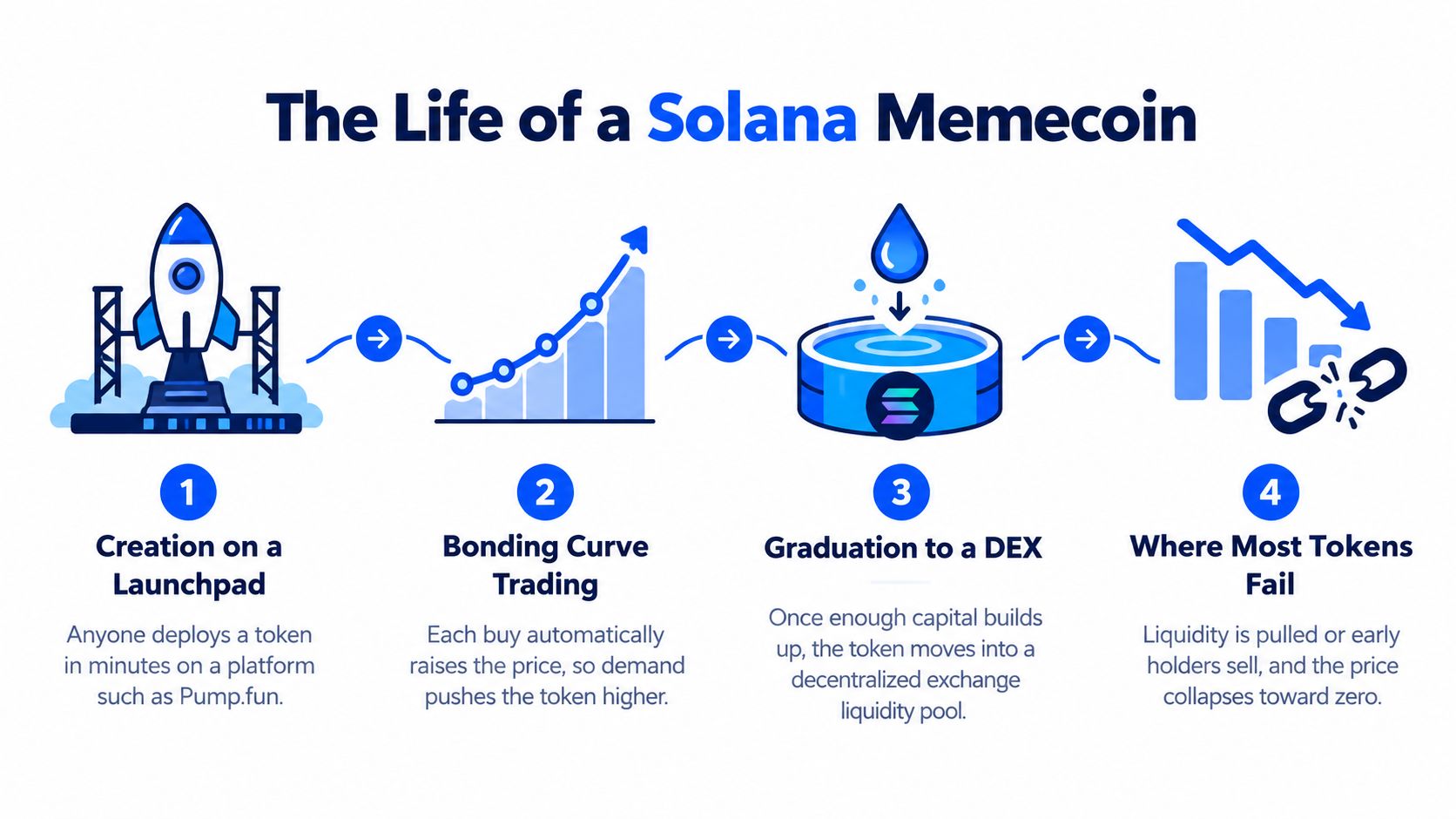
Early buyers receive the cheapest tokens because they're buying before the curve has climbed. If enough capital enters, the token reaches its graduation threshold. Liquidity then moves into a decentralized exchange pool, where buyers and sellers trade against assets held in that pool.
Graduation sounds like success, but it creates a new question. Can the pool absorb realistic sell orders without sending the price sharply lower? Our explainer on Pump.fun bonding curves and the risks before graduation covers why the transition matters for anyone entering late.
| Stage | Typical Timing | Main Risk |
|---|---|---|
| Creation | Seconds, often in one transaction | Near-unlimited supply of similar tokens |
| Bonding curve | Minutes to hours of buying | Earliest buyers hold the cheapest supply and most influence over price |
| Graduation | When the curve threshold is met | Liquidity moves into a pool that can be withdrawn |
| Open trading | Days to weeks, or abandoned | Exit depth decides whether holders can sell at a fair price |
Most tokens never complete that journey. A 2025 academic study of Pump.fun activity during the fourth quarter of 2024 found that the platform accounted for as much as 71.1% of all tokens minted on Solana and contributed between 40% and 67.4% of decentralized-exchange transactions. Daily active users rose from approximately 60,000 to peaks of 260,000, yet fewer than 2% of launched tokens successfully transitioned to major decentralized exchanges.
That contrast is the lesson. A busy launchpad proves people can create and trade tokens, not that most tokens have durable demand. If you find one that has graduated, it has passed a harsh survival filter, but the pool still decides whether your paper value can become money you can withdraw.
Why Hype Moves Memecoin Prices Faster Than Fundamentals
The image below captures the basic loop, with people moving toward growth that appears to confirm itself.

A token rises, screenshots spread, and new buyers treat the rise as proof they found something important. Their buying lifts the price again, creating fresher screenshots and another round of buyers. Nobody needs to improve a product for this loop to work because the chart itself becomes the marketing.
It's like a stadium where the scoreboard controls the crowd's noise, and the noise then changes the scoreboard. The cheering feels like evidence that the team is winning. In a memecoin market, rising prices can produce the same false confidence until buying slows and sellers discover how few people remain.
Where Late Buyers Fit
Early holders need someone to buy their tokens. That later demand is often called exit liquidity, a blunt term for the people whose purchases let earlier participants leave. You don't become exit liquidity just by buying late, but the risk rises when your only reason is that everyone else is buying.
Narratives also rotate quickly. Animals dominate one day, a celebrity or political event takes over the next, and an older token loses attention without anything changing in its code. That's why our guide to detecting wash trading on Solana focuses on who produced the activity rather than treating every trade as independent demand.
The scale of that attention can be enormous. Cointelegraph's report on CoinGecko's traffic study states that memecoins and related categories captured nearly 31% of global crypto investor interest from January 1 through December 21, 2024.
The short video below gives a visual walkthrough of how momentum can build before buyers stop to ask who is on the other side.
When the chart leads the conversation, slow down. Ask what new buyers know besides the price. If the answer is nothing, you're probably looking at momentum, not evidence.
Concentration and Creator Risks Most Buyers Miss
A clean-looking contract can create a false sense of safety. Even if nobody can mint unlimited tokens, a handful of wallets may own enough supply to overwhelm the pool. Their first large sale can consume available liquidity, push the price down, and leave smaller holders selling into a much thinner market.
Don't read market capitalization as money waiting to pay every holder. It multiplies the latest price by supply, even when only a small amount could be sold near that price. Executable liquidity is more useful because it asks what happens when a realistic order reaches the pool. A token showing a large market cap on thin liquidity may only absorb a fraction of its paper value before the price slides.
The SEC staff statement on meme coins characterizes them as highly speculative and subject to significant volatility. Concentration is one reason that volatility hits so hard: when supply sits in few hands, ordinary selling pressure can turn into a collapse.
Six Ways Buyers Get Hurt
| Risk | How It Plays Out | Why Buyers Miss It |
|---|---|---|
| Holder concentration | A small group of wallets controls a large share, so one sale can crash the price | Price looks stable until the largest wallets move |
| Creator control | The deployer keeps supply, mint or freeze powers, or liquidity | Control can change after buyers have committed |
| Liquidity removal | The pool is withdrawn or drained, leaving no exit | The chart still shows a price, with no real way to sell |
| Insider and bundled buying | Linked wallets buy at launch and sell into later demand | Early volume looks like broad interest |
| Copycat tokens | Lookalike names and tickers borrow existing attention | Buyers pick the wrong token |
| Demand collapse | Attention moves on even when the contract is clean | A clean-looking token still loses value |
Creator behavior deserves its own check because the deployer may retain a large allocation, coordinate supposedly independent buyers, or control the liquidity position. Use our walkthrough on checking a Solana token creator wallet to inspect prior launches, funding links, and whether the creator is already distributing tokens to other wallets.
Losses don't require a dramatic rug pull. You can lose all of the money invested in a memecoin, even without a rug pull. A token can pass MemeAssist's checks and still collapse because demand disappears, large holders sell, liquidity changes, or new information appears.
Practical rule: Treat combined risks as more dangerous than isolated ones. Concentrated holders are worrying. Concentrated holders plus a creator who controls liquidity can remove both price support and the exit.
Say the top wallets appear quiet while social posts accelerate. That quiet period isn't proof they'll hold. It may mean they're waiting for enough outside demand to sell into. Before buying, ask two questions: who generated this volume, and could you exit at the depth the pool shows today?
Checking a Solana Memecoin On-Chain, Step by Step
Start by asking whether trading looks like many independent people making different decisions. Genuine demand is usually messy. Amounts vary, wallets arrive at different times, some buyers hold, and others sell quickly. Manufactured activity often looks unusually tidy, synchronized, or repetitive.
That distinction matters because research on Pump.fun-scale markets estimates that at least 17% of trading transactions are wash trades. The same research estimates that copycat tokens represent at least 10% of coins on the platform. Volume alone therefore can't tell you whether buyers are independent.
Use the comparison below as a first screen. One suspicious row isn't a verdict because bots also participate in normal markets and enthusiastic communities can arrive together after a post. Several suspicious rows appearing at once deserve much more caution.
| Signal | Organic Pattern | Suspicious Pattern |
|---|---|---|
| Unique buyers | Wallet count rises steadily | Trade count climbs while unique buyers stay flat |
| Trade sizes | Varied amounts across many wallets | Repeated identical amounts |
| Wallet age | A mix of older and newer wallets | Many fresh wallets funded from one source |
| Entry timing | Buys spread across the first hour | Buys clustered in the same blocks |
| Sell pressure | Sellers appear gradually | Sell orders absorbed by bots right after buys |
| Pool depth after a rally | Liquidity deepens or holds | Pool thins as price rises |
Run the Checks in Order
Confirm whether mint and freeze authority are disabled. Open the token mint address in a Solana explorer, not a link supplied by a promoter. An active mint authority can create new supply and dilute holders. An active freeze authority can freeze token accounts, potentially preventing selected holders from selling. Disabled authorities don't make a token safe, but active ones give one party powers you should understand before risking money.
Measure the top holders. List the top ten wallets, then remove the liquidity pool and obvious burn addresses from your interpretation. Add the remaining share and inspect whether several wallets received tokens from the same source at similar times. For example, if ten apparently separate wallets hold almost half the supply and were funded from one wallet, treat them as potentially coordinated. There's no universal safe percentage, so record the actual concentration and compare it with pool depth rather than hunting for a magic cutoff.
Find who controls the LP tokens. Liquidity-provider tokens represent ownership of the pool position. Check whether they were burned, locked, or left in a wallet that can withdraw them. A burned position generally can't be reclaimed by the creator. A lock is only as reassuring as its amount, duration, and controlling address. Screenshot claims aren't enough, so verify the destination address and transaction yourself.
Test the exit before testing the entry. Simulate a buy and a sell using an amount close to what you'd realistically risk. Note price impact, minimum received, route, and any transfer fee. Then imagine several larger holders selling first and ask whether the remaining pool could still absorb your order. A token that's cheap to buy but punishing to sell isn't liquid in the sense that matters.
Read the creator wallet's history. Look for earlier token launches, how long those tokens remained active, and whether the wallet repeatedly creates, promotes, and abandons similar tickers. Check whether the creator still holds tokens directly or has spread them across fresh wallets. A single abandoned experiment isn't proof of fraud. A repeated pattern of launches followed by rapid distribution is much harder to excuse.
Inspect the earliest blocks for bundled buying. Sort transactions from the beginning and look for multiple wallets buying in the same block or within a few blocks, especially in similar sizes. Trace their SOL funding source. Bundled buys can make five related wallets look like five independent believers. Shared funding doesn't prove intent, but it means you shouldn't count those wallets as broad demand without other evidence.
Compare unique buyers with trade count at several checkpoints. Record both numbers rather than relying on one snapshot. Say trade count doubles while unique buyers barely move and the same wallets alternate between buying and selling. That pattern suggests churn, wash trading, or bot activity rather than an expanding holder base. Also watch whether buyers remain after the first price dip or vanish as soon as incentives and promotion slow.
Write a concern level and repeat the work later. Use high, medium, or low concern, then note the evidence behind your choice and what would change it. Repeat the checks after 24 hours because authorities, holders, liquidity, and creator behavior can change. A range forces honesty. It reminds you that a score is a summary of current evidence, not a promise about tomorrow.
Our analysis includes mint and freeze-authority checks alongside liquidity, holder distribution, creator behaviour, wallet activity, trading patterns, and historical risk indicators. If you're doing the work manually, keep the same categories in a simple note so you don't let an exciting chart displace boring but decisive evidence.
Use explorers and analysis tools that let you read public data without exposing your wallet. We never ask users to connect a wallet, sign a transaction, or approve anything.
The most useful result isn't a green check mark. It's a clear sentence such as, "Holder growth looks broad, but the pool is too thin for my intended exit and the creator controls the LP position." That sentence tells you exactly why you'd wait, reduce size, or walk away.
What the First Five Minutes Can and Cannot Tell You
Early tokens present a difficult trade-off. Waiting provides more evidence, but the cheapest prices and many failures both occur near launch. The workable approach is to label what each time window can actually prove rather than treat five minutes as a verdict.
The stopwatch image below is a useful reminder that launch analysis is time-sensitive, but speed doesn't turn missing history into safety.
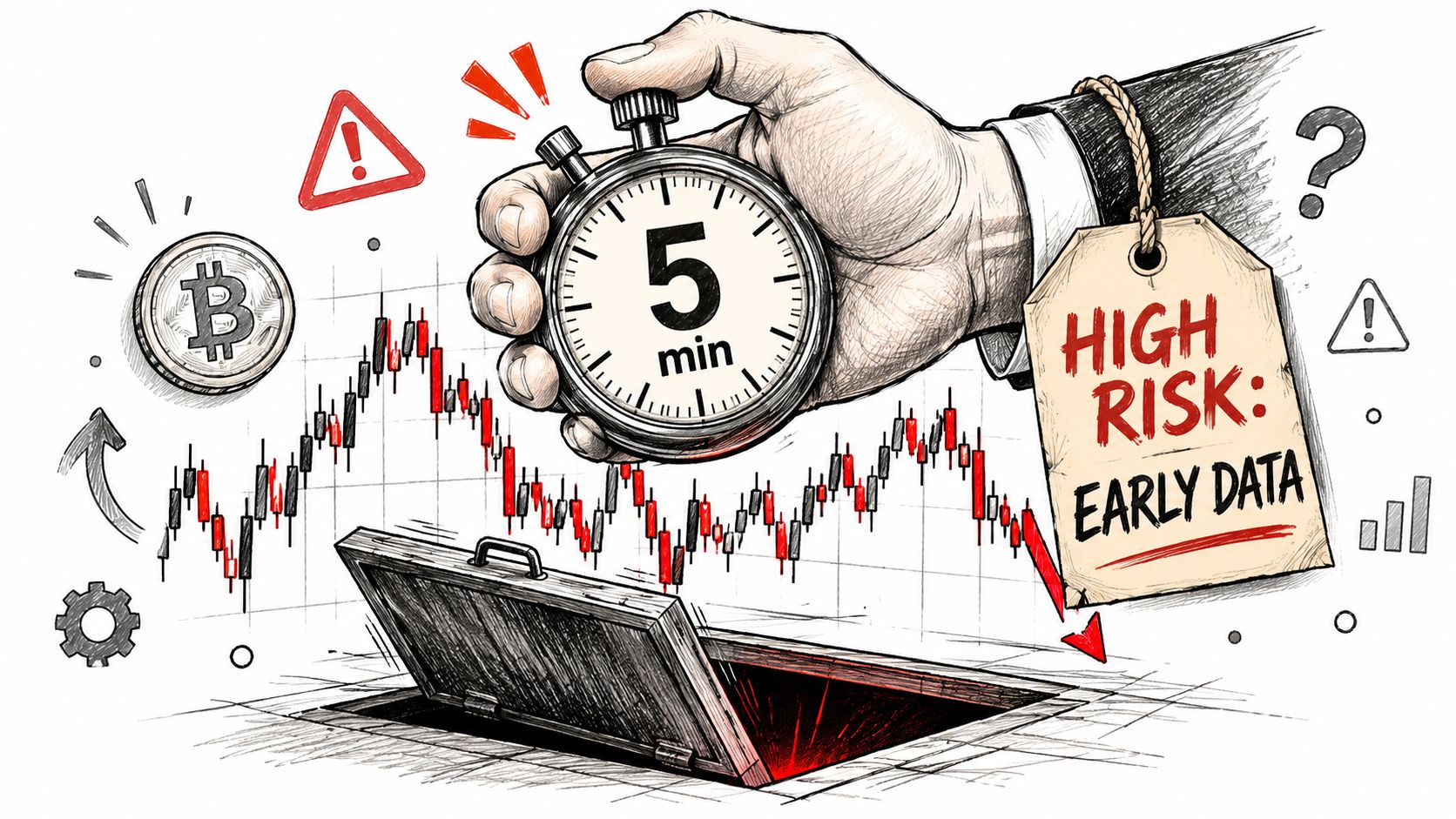
Large-scale research on 6.4 million Solana tokens across seven months reported that a vast majority displayed rug-pull characteristics within one hour and that machine-learning models could identify potential rugs using only the first five minutes of trading data.
Those findings support early screening. They don't justify a simple safe or unsafe label. Think of the opening minutes as a job interview, not a background check: you see how the token behaves under pressure, but you haven't yet seen how it acts when nobody is watching. Two questions matter most in that window. Who generated the volume, and could you exit if you needed to? A chart can look healthy while a small group of wallets trades among themselves and the pool stays too thin to absorb a real sell.
Separate Missing Evidence From Bad Evidence
- At launch: You can inspect authorities, supply, creator history, and initial allocations. You can't yet know whether independent buyers will stay.
- After five minutes: You can see buyer clustering, repeated sizes, funding links, price impact, and whether unique wallets are increasing.
- At graduation: You can judge the new pool, who controls it, and whether trading survives the move from bonding curve to open market.
- After the first liquidity shock: You learn whether sellers can exit, buyers return, and liquidity remains after the first serious test.
A token with almost no history is uncertain, not clean. Missing evidence means the screen hasn't had time to observe holder persistence or pool behavior. Negative evidence is stronger, such as active dangerous authority, concentrated bundled supply, or a rapidly thinning pool.
Update your conclusion as each window closes. A quiet first five minutes may only mean the organized sellers haven't acted yet, while suspicious opening trades deserve attention before social proof gives a false sense of comfort.
Deciding Whether to Trade at All
Begin with a firm default. Treat any memecoin purchase as money that can go to zero, even after careful checks. If losing the full amount would affect rent, debt payments, savings, or your ability to think clearly, the trade is too large regardless of the chart.
Set three commitments before buying.
- Maximum loss: Write down the exact amount you can lose completely.
- Exit condition: Define the evidence that makes you leave, such as liquidity falling, a major holder distributing, or the creator regaining control.
- Review limit: Decide when you'll stop re-checking and either exit or accept the position without refreshing the chart all day.
Then turn your notes into one of three choices. Avoid the token when mint or freeze authority is active, liquidity is freely withdrawable, or volume looks clearly manufactured. Use only a small amount when evidence is mixed and your simulated exit still works. Wait when the token is too new to read and uncertainty is the main finding.
MemeAssist can provide an optional second opinion through on-demand Solana reports with a Health Score, Rug Risk Rating, AI Verdict, and Risk Breakdown. It uses prepaid, pay-as-you-go account credit with no subscription. That's a research aid, not a guarantee that a token is safe.
We're also clear about the boundary. MemeAssist is an educational and informational tool only and is never financial, investment, legal, or tax advice. Use the verdict to challenge your reasoning, not to replace it.
Before your next Solana memecoin trade, run the token address through MemeAssist for an on-demand report covering its Health Score, Rug Risk Rating, AI Verdict, and Detailed Risk Breakdown. Compare that evidence with your own holder, liquidity, creator, and exit checks, then decide whether the trade deserves your money or a pass.