Memecoin Trading: On-Chain Checks Before You Buy
Pepe gained approximately 1,205% during 2024, according to Cointelegraph's year-end market review. That's a spectacular token return, not evidence of a repeatable trading strategy. The useful question in memecoin trading isn't whether a chart can multiply your money. It's whether independent buyers, available liquidity, and executable exits support the price you're being shown.
Pass or skip comes before position size. If linked insiders dominate supply, apparent demand looks manufactured, and the pool can't absorb your sale, a smaller entry doesn't repair the setup.
Table of Contents
- The Base Rate Behind Memecoin Trading
- Six On-Chain Rejects Before You Buy
- How to Spot Manufactured Memecoin Demand
- Position Size When Most Launches Lose
- How to Execute From Check to Exit
- Run the Screen on One Mint
- Decide Skip or a Capped Probe
The Base Rate Behind Memecoin Trading
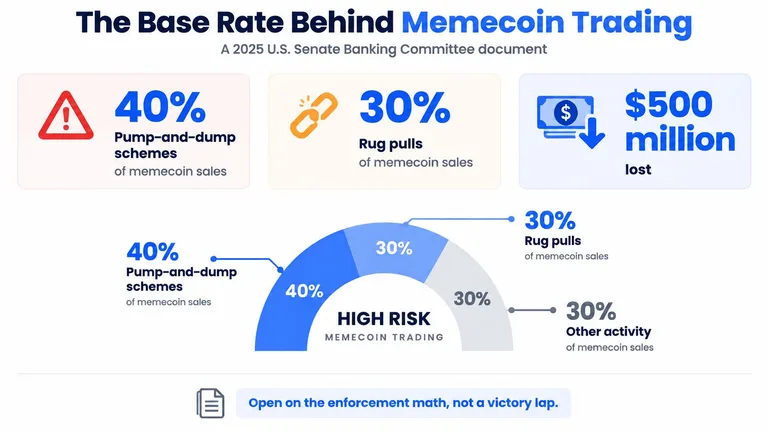
A 2025 U.S. Senate Banking Committee document put pump-and-dump schemes at 40% of memecoin sales and rug pulls at another 30%, with $500 million lost to rug pulls in 2024; the SEC's crypto-scam investor alert describes the underlying promoter-and-late-buyer failure pattern. Promoters create or hype a token, buyers arrive, promoters sell into that demand, and later buyers absorb the decline.
Those figures describe the document's reported categories, not a calibrated probability that any particular mint will fail. They're still a better starting point than a feed selected for winning screenshots. Your initial assumption should be that the apparent opportunity needs verification, not that momentum deserves an allocation.
The enforcement framing makes the relevant risks visible.
Attention Isn't the Same as Independent Demand
A community can contain enthusiastic buyers while promoters coordinate the activity that brought those buyers in. Genuine interest doesn't establish fair distribution, and a busy chat doesn't reveal who controls the inventory being sold.
Separate the questions:
- Who owns the supply? Identify the creator's exposure and possible connections among early buyers.
- Who generates the activity? Distinguish independent participation from wallets trading around the same funding cluster.
- Who can provide your exit? Check the assets available in the pool, rather than treating the displayed token valuation as spendable money.
These questions apply to established narrative coins and fresh Solana launches, although the available evidence and execution conditions differ. A familiar ticker doesn't exempt a trade from liquidity analysis. A new mint doesn't deserve a pass because its chart looks unusually strong.
Start With a Rejection Standard
Practical rule: Don't buy a chart until you can explain who could sell into you and how you would sell out.
The asymmetry matters. Insiders may have accumulated before public attention, while your entry requires paying the price created by that attention. If they control a meaningful share of supply, their decision to sell can invalidate your chart-based thesis without warning.
A useful screen therefore needs more than a fraud label. It needs wallet relationships, concentration, executable depth, and a record of what happened after entry, including trades that couldn't be closed.
Large historical winners are the wrong mental model for an ordinary launch-time trade. Begin with the contract address and a pass-fail list, not a target return.
Six On-Chain Rejects Before You Buy
| Check | Fail signal | Action |
|---|---|---|
| Deployer and early wallets | Creator funded snipers, bundles, or linked early buyers | Stop |
| Holder concentration | Creator, snipers, bundles, and top holders control the supply | Stop if liquidity is also thin |
| Liquidity versus order size | Pool cannot absorb entry and exit without heavy slippage | Cut size or skip |
| Buy and sell balance | The same wallets repeatedly buy and sell | Treat volume as suspect |
| Wash trading or promotion | Synchronized trades or fabricated comments | Do not buy the hype |
| Price depends on few wallets | The move dies without a handful of buyers | Skip |
Stop at the first hard fail. The table isn't a points system in which appealing branding offsets creator-funded snipers. A material distribution or execution problem requires resolution, not compensation from unrelated positive signals.
A study of 6,000 Pump.fun tokens hosted by University College London found that concealed accumulation by creators or snipers can benefit insiders, while wash trading and fabricated comments attract other participants. That finding supports inspecting the ownership and transaction structure before treating visible activity as evidence of demand.
Trace Control Before Counting Holders
Start in a Solana explorer with the deployer, initial transfers, and early purchases. Follow funding paths into early buyers and look for wallets that received funds from the same source before acting together.
A shared exchange withdrawal alone isn't conclusive proof of common control. Combine funding evidence with timing, transfers, and repeated behavior. The question is whether supposedly separate holders appear to act as a connected inventory position.
Next, aggregate plausible linked holdings. Counting each address separately can make concentrated ownership look distributed. When reviewing top-holder concentration as a rug signal, distinguish pool accounts and identifiable infrastructure from wallets that can independently sell tokens.
Record uncertainty explicitly. If you can't distinguish an infrastructure address from a discretionary holder, don't assign it the interpretation most favorable to buying.
Test the Sale, Not Just the Purchase
Request an entry quote for your intended amount, then inspect a reverse quote for the tokens you'd receive. Compare expected proceeds, price impact, route, and fees. Don't execute the purchase just because the interface can quote it.
Pool liquidity is a starting measurement, not an assurance of exit quality. Your actual route and order size determine how much price impact you face. If the reverse quote already looks unacceptable before other holders sell, reject the trade or reduce the proposed amount.
Then examine repeated buyers and sellers. Closely timed round trips, recurring counterparties, and activity concentrated in related wallets should prevent you from accepting raw volume at face value.
The strongest combined rejection is concentration plus artificial activity plus shallow liquidity. That combination puts inventory control, apparent demand, and your escape route in unfavorable hands.
A mild concern with credible depth still isn't permission for a full-sized position. It's a reason to carry uncertainty into sizing. Positive momentum, visible comments, and raw turnover are not independent passes, because the same actors may influence all of them.
How to Spot Manufactured Memecoin Demand
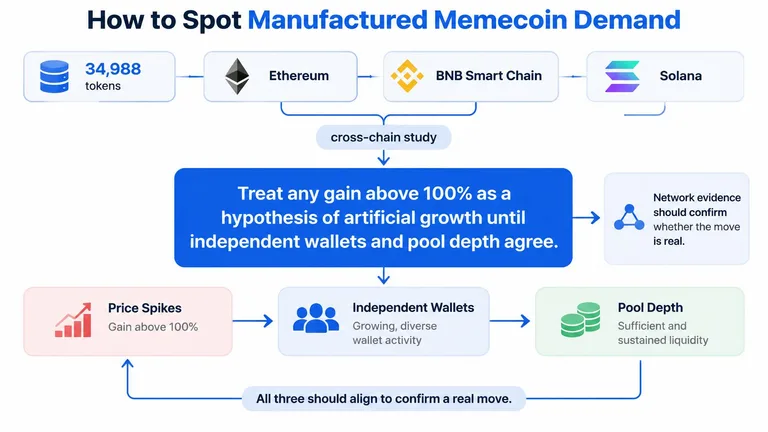
In a cross-chain study of 34,988 tokens across Ethereum, BNB Smart Chain, Solana, and Base, 82.89% of tokens with returns above 100% showed evidence of artificial growth, including wash trading or liquidity-pool-based price inflation, according to the paper indexed in the ACM Digital Library. That's a finding about the study's sample, not a universal fraud rate for every rising token.
The appropriate trading response is a hypothesis: a triple-digit print needs independent confirmation. Don't label every sharp move fraudulent, but don't treat the move itself as confirmation that buyers are genuine.
Use the relationship between wallets, price, and pool depth as the measurement framework.
Reconstruct the Buyers Behind the Tape
- Build the transaction history. Export or inspect launch-period swaps and transfers. Preserve wallet addresses, timestamps, trade direction, and amounts rather than relying on a volume summary.
- Group plausible related wallets. Combine shared funding paths with synchronized trades, repeated counterparties, and transfers between participants. Treat a cluster as a hypothesis requiring corroboration.
- Compare activity with independent participation. Measure whether turnover comes from broader participation or repeated activity within the same cluster. Swap count isn't buyer count.
- Compare price with holder growth and depth. Ask whether new, apparently independent holders are arriving alongside the price move and whether accessible liquidity supports that valuation.
- Inspect sensitivity to small trades. Use quotes and recent execution records to assess whether modest purchases produce disproportionate price changes.
- Track the early cluster's exit. Watch for inventory distribution, coordinated selling, or liquidity withdrawal after the promotional phase.
For a closer operational breakdown, use this guide to detecting wash trading on Solana. Keep the distinction between suspicious patterns and proven common control intact.
Discount What You Can't Validate
Price appreciation that outruns independent-holder growth deserves skepticism. So does apparent volume concentrated in linked wallets, especially when modest trades move the quoted price sharply.
A displayed market cap is not an exit. It applies a marginal price to circulating supply without demonstrating that buyers or pool reserves could purchase your position near that price.
Avoid three analytical shortcuts: counting every swap as a new buyer, excluding creator-funded wallets from relationship analysis, and assuming an established social campaign developed organically. Each shortcut can turn coordinated activity into apparent confirmation.
Use the accompanying video as a supplementary walkthrough, not a substitute for inspecting the mint's live evidence.
Position Size When Most Launches Lose
A launch strategy can look attractive because a handful of exceptional winners lift the average. That doesn't establish that you can identify those winners in advance, obtain the assumed entry, or execute the modeled sale.
Analytics Insight's review of launch and wallet outcomes describes a study of 1,411 Solana launches and a separate investigation of nearly 2.9 million wallets. The reported outcomes below are sizing warnings, not forecasts for an individual token.
Launch Outcomes That Should Set Position Size
| Evidence | Figure | Trading implication |
|---|---|---|
| Entry 30 minutes after launch, result at six hours | 62% loss | Treat a fresh launch as a likely loser |
| Same window with extreme winners removed | 74.2% loss | Do not plan around the outlier |
| Tokens dead within six hours | Two-thirds | Use a time stop measured in hours |
| Wallets versus starting SOL after two weeks | 74% held less | Assume most participants are not paid |
| Aggregate loss, nearly 2.9 million wallets | About $269 million | The category extracts unevenly |
| Share of winnings taken by the top 1% | 56% | Size as if you are not that 1% |
| Sandwich bots in sampled launch weeks | Profited every week | Budget execution cost, not just price |
The reported launch loss is a performance measurement, not the probability of a losing trade. Don't convert it into an individual token forecast or assume every launch declines by that amount. Its practical message is that a strategy must survive adverse outcomes without depending on rare winners.
Separate the Planned Loss From the Maximum Loss
Begin with the cash amount you can lose completely without damaging the broader portfolio. Then calculate a separate planned-exit budget, allowing for the price move to invalidation, estimated execution costs, and fees.
A useful approximation is:
Position notional = planned dollar-loss budget ÷ estimated combined loss rate
For a clearly hypothetical example, suppose the planned loss allowance is $100, the adverse price move is 12%, and estimated exit friction is another 8%. An additive 20% planning assumption gives a $500 notional before any additional fees or contingency allowance. These are illustration inputs, not observed market costs.
That calculation does not cap the actual loss at the planned allowance. A failed exit could expose the entire notional. If losing the whole position would breach your genuine maximum-loss limit, reduce the position to that limit regardless of what the stop-based calculation permits.
A stop is an exit condition. It isn't a guarantee that someone will buy your tokens at the planned price.
Include entry costs too, and avoid double-counting price impact already embedded in a quote. Stress-test a worse sale rather than assuming today's reverse quote will remain available.
We built MemeAssist from direct memecoin-trading experience to provide a second research perspective, not a safety guarantee. A token can pass our checks and still collapse when demand disappears, large holders sell, liquidity changes, or new information appears.
Write the invalidation and dollar exposure in a sentence before entering. If you can't do that clearly, there's no adequately defined setup.
How to Execute From Check to Exit
Execution conditions change with participation. Daily memecoin trading volume fell to just under $5 billion in December 2025, after surging more than 760% to $87 billion in 2024, according to CoinDesk. Don't assume the liquidity remembered from an active market remains available for today's sale.
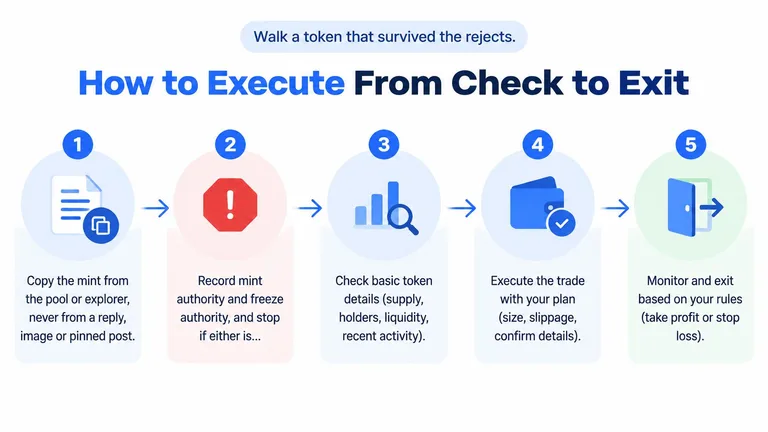
Keep the operational sequence visible before opening the trading interface.
Use a Written Execution Ticket
- Verify the mint. Copy the address from the pool or explorer and cross-check the pair. A reply, image, or pinned promotional post isn't sufficient verification of token identity.
- Record token authorities. Inspect mint and freeze authority. If either remains active, stop unless you can identify the controller and explain why accepting that capability fits your risk policy.
- Write down the exposure. Put pool liquidity, largest-holder distribution, intended notional, and estimated exit proceeds on the same ticket. Don't leave these in separate tabs where contradictions are easy to overlook.
- Set the cash limit before the target. Include entry and exit friction, transaction costs, and a failed-exit scenario. If the acceptable amount shrinks, change the order rather than widening the loss allowance.
- Use a capped probe. Where supported, use a limit entry instead of an unrestricted market purchase. A limit can constrain the acceptable entry price, but it may remain unfilled.
- Define event and time invalidation. Specify which liquidity changes, holder sales, or failure to attract independent participation would end the trade. Use a time-based review for a fresh launch rather than holding indefinitely.
- Log the decision. Record skips, fills, failed transactions, priority fees, and actual sale proceeds. Preserve the evidence available when you acted.
Don't Let Discovery Become Authorization
A trending list is a queue for investigation, not a buy button. Reading token information shouldn't require granting token-spending rights, so don't connect a wallet or sign an approval merely because an unfamiliar scanner requests it.
Plan when to sell Solana memecoins around explicit invalidation and executable liquidity, not chat-room reassurance. Also assess correlated exposure: several similar narrative tokens may depend on the same buyers.
After a loss, identify whether the evidence changed, execution failed, or you ignored a rule. Don't assume every loss proves a skipped check, and don't erase failed exits from the journal. A complete record is necessary to distinguish a flawed process from an unfavorable outcome.
Run the Screen on One Mint
Consider a hypothetical Solana mint whose deployer funded several early sniper wallets before public buying developed. Those wallets then accumulated together and began selling into incoming demand. The decision is skip, with creator-linked early accumulation recorded as the reason.
There's no need to finish an optimistic target calculation. Once a hard rejection is established, further analysis shouldn't become a search for permission.
A Position Can Fit the Budget and Still Fail
Now consider a different hypothetical mint. Its creator-linked holdings appear limited, its largest discretionary holders are identifiable, and the pool initially looks deep enough for a modest probe.
The reverse quote is materially worse than the displayed chart price. Reducing the proposed position brings the planned exit loss within the cash allowance, and the entire probe is small enough to lose without impairing the portfolio.
That establishes affordability, not trade quality.
| Observation | Interpretation | Decision effect |
|---|---|---|
| Proposed probe fits the cash allowance | The position is financially tolerable | Continue checking |
| Price rises faster than independent participation | Buyer breadth doesn't confirm the move | Discount apparent momentum |
| Linked wallets generate substantial turnover | Volume may exaggerate outside demand | Reject the demand thesis |
| Promotional activity precedes broader ownership | Attention hasn't established independent buying | Don't chase |
When the wallet history is reconstructed, much of the activity belongs to a connected cluster. Apparently independent holders aren't expanding enough to support the original interpretation of the price move. The token fails the manufactured-demand test even though the proposed position fits the loss budget.
Let the Stricter Finding Decide
Decision discipline: Affordable exposure isn't evidence of a favorable opportunity.
Record the skip with a specific explanation: linked-wallet turnover undermined the demand thesis. Preserve the relevant funding paths and transaction window so a later review can evaluate the decision without relying on memory.
If the token subsequently rallies, don't rewrite the original evidence. A skipped winner doesn't prove the filter was wrong, just as a lucky profitable fill doesn't prove the process was sound.
Apply the same sequence to another mint during the session. Consistent decisions require the same evidence standard whether the chart is quiet, accelerating, or already circulating through trading groups.
Decide Skip or a Capped Probe
For the next Solana mint, permit only skip or a capped probe with written invalidation. A social post doesn't override adverse wallet evidence, and an encouraging second opinion shouldn't be averaged with a hard rejection.
Skipping means the available evidence doesn't justify exposure. A probe means uncertainty remains, but the amount at risk is acceptable even if the intended exit fails. Neither decision requires predicting the eventual chart.
Use a Second Read Without Outsourcing Judgment
MemeAssist can provide an optional explanation layer that brings warning signals and outstanding verification questions together. We developed it to help traders identify potential problems earlier, not to certify safety; reading an analysis requires no wallet connection or token-spending authorization.
A complete analysis may include conditional entry, stop, and target scenarios when live price structure supports them. Those are informational scenarios, not orders, promised fills, or financial advice.
- Skip when ownership, demand, or execution evidence fails your standard.
- Probe only when the evidence is acceptable and a complete loss fits your cash limit.
The final test is whether you can tolerate being wrong without changing the rest of your month. Memecoins can become worthless without a formal rug pull, so don't make the plan depend on a clean exit.
Bring a Solana mint to MemeAssist for an on-demand analysis of liquidity, holder distribution, creator behavior, and trading activity. Use the explanations to identify what needs manual verification, then make a documented skip-or-capped-probe decision before placing an order.
Topics: memecoin trading, Solana meme coins, rug pull checks, on-chain analysis, trade setups
Informational only, not financial advice. Meme coins are extremely high-risk.
All articles