Robinhood Token Analyzer: What It Can and Cannot Verify
The most popular advice about token checking is also the most misleading. People tell you to paste an address into a checker, look for a green score, and treat a platform listing as reassurance. That shortcut blends three different questions into one answer. A useful Robinhood Token Analyzer workflow keeps them apart. First, can you trade the asset on that platform, in your jurisdiction, today? Second, does the market behave like real demand, with enough depth for your size? Third, what right, if any, do you hold after you buy? A token can pass the first question, fail the second, and leave the third unanswered. That's not a contradiction. It's exactly why you need separate checks.
Table of Contents
- What a Robinhood Token Analyzer Can and Cannot Tell You
- Classify the Token Before You Score It
- Ownership Rights Behind a Token Ticker
- Platform Support Can Change Overnight
- Telling Falling Activity From Real Risk
- How to Run a Token Check Step by Step
- Confirm the Exit Before You Buy
What a Robinhood Token Analyzer Can and Cannot Tell You
No single Robinhood Token Analyzer can certify that a token is safe. That's the direct answer, and it isn't a flaw in one tool. Platform tooling and rug pull screening answer different questions. One tells you about access and execution. The other looks at supply control, creator behavior, and whether buyers can sell. When you merge them into one verdict, you lose track of what the evidence proved.
The diagram below sets out that split before any scoring begins.
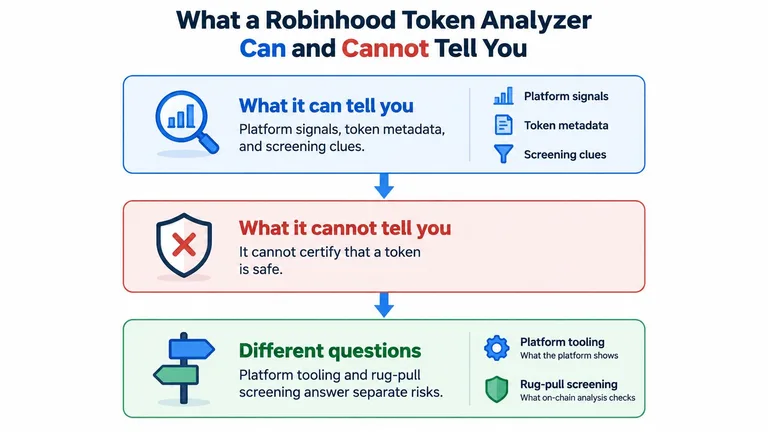
Think in evidence layers instead of a single score. Each layer answers one question well and stays silent on the others.
| Evidence layer | Question it answers | Typical signals | What it cannot prove |
|---|---|---|---|
| Platform availability | Can I trade this asset here? | Product listing, live quotes, supported jurisdiction | Safety, permanence or liquidity depth |
| Market conditions | Is trading driven by real demand? | Volume, unique traders, spreads, slippage at my size | Who controls the supply |
| On-chain risk | Who holds the supply and can they sell? | Holder concentration, creator wallets, liquidity removal risk, bundled trades | Legal rights attached to the token |
| Legal structure | What claim does the buyer actually hold? | Issuer, claim type, redemption terms, jurisdiction | Future price direction |
A quote is not a safety verdict
Robinhood's own tooling shows the boundary clearly. The Robinhood Crypto Trading API documentation describes an interface for reading crypto market data, accounts, holdings, orders, products, and quotes, with authenticated requests requiring an API key, signature, and timestamp headers. That's an execution and account data interface. It isn't a token forensics feed.
A valid product and a live quote confirm tradability on the platform. They don't establish on-chain liquidity depth, holder concentration, wash trading, insider accumulation, creator behavior, or your ability to sell under stressed conditions. A token can quote normally while a few wallets control most of the supply and the sell side is too thin for your position.
Practical rule: Label every result with its evidence source and timestamp, because a quote can change while the holder distribution stays exactly the same.
That labeling habit prevents a common error. You screenshot a healthy looking price, then assume the supply picture is healthy too. Keep the layers separate, date each one, and you'll know which question you've answered and which ones are still open.
Classify the Token Before You Score It
Two tokens can sit side by side in your watchlist, both carrying a Robinhood linked name, and share almost nothing underneath. One may be a structured product offering exposure to a U.S. listed stock. The other may be a permissionless meme coin anyone could launch in an afternoon. Run both through the same scoring template and the numbers will look comparable. They aren't. The risks live in different places.
Robinhood's own tokenized equity products show why. Its "Classic Stock Tokens," launched in June 2025 in certain European Economic Area jurisdictions, were described as instruments providing exposure to selected U.S. listed stocks and exchange traded products. Later "Stock Tokens," launched in July 2026, were described as tokenized debt securities issued by Robinhood Assets (Jersey) Limited, as covered in TheStreet's report on Robinhood tokenized securities. Same brand, same token language, different legal structures, and both differ from an ordinary decentralized cryptocurrency.
Three questions do the sorting, and most scoring tools blur them into one number. Does a platform list the asset? Is the market activity behaving like real demand? Does the buyer hold any enforceable right at all? Classification comes before interpretation. Sort the asset first, then decide which metrics matter.
| Token type | Who issues it | What the holder has | First risk to check |
|---|---|---|---|
| Crypto asset supported on Robinhood | Independent blockchain project | Exposure to the crypto asset through the platform | Delisting or custody arrangement |
| Tokenized stock product | Robinhood affiliated issuer, for example Robinhood Assets (Jersey) Limited for newer Stock Tokens | A claim linked to an underlying stock or fund | Issuer solvency, redemption terms and underlying verification |
| Solana meme coin | Anonymous or pseudonymous creator | A tradable token with no issuer obligation | Concentrated supply and liquidity removal |
Scale figures don't answer the classification question
The newer stock token product grew quickly within months of launch, building a substantial asset base, a wide holder count, and heavy daily decentralized exchange volume. Growth at that speed shows a market can scale fast. It says nothing about liquidity quality, redemption certainty, investor protection, or whether the product suits you.
Holder counts are a good example of why order matters. For a meme coin, a rising holder count might suggest distribution is spreading out, though you still need to check for linked wallets. For a tokenized security, the same figure tells you almost nothing about whether the issuer holds the underlying asset, how redemption works, or what happens if the issuer fails. One metric, two meanings, and only the classification step tells you which applies.
So start every check with four plain questions. Who issued this? What claim does it represent? Where is it offered? How does it redeem? If you can't answer those, don't interpret the volume chart yet. You're reading market activity for an asset you haven't identified, and any score built on that reading rests on sand.
Ownership Rights Behind a Token Ticker
Most explainers cover availability, fees, and how to place a trade. They skip the question that matters when something goes wrong. What exactly does the buyer own, and what happens if the issuer, custodian, or underlying company disputes the arrangement?
The image below captures that distinction between holding an asset directly and holding a claim arranged through another entity.
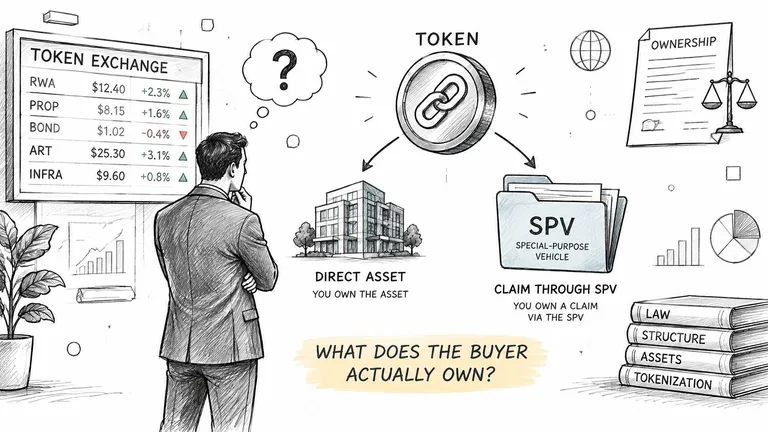
A tokenized offering can represent a claim on a special purpose vehicle rather than direct ownership of the underlying shares, and buyers may lack voting, dividend, information, and other shareholder rights, a concern raised in Reuters coverage of investor protection flags in stock tokenization. You get price exposure. You may not get the rights a shareholder gets through a conventional brokerage account, and the protections that apply depend on your jurisdiction.
Where the gap widens
Private company linked tokens show the problem at its sharpest. Valuation is already hard to verify because there's no public market price for the underlying company. Transferability can be restricted. If the token trades around the clock while the reference asset has no continuous market, the token price can drift away from any verifiable value and you've got no direct claim to fall back on.
A useful analyzer checks these points explicitly:
- Legal structure: Is this direct ownership, a debt claim, a derivative contract, or a claim on a vehicle that holds the asset?
- Issuer and counterparty exposure: Who owes you something, and what happens if that party fails?
- Redemption terms: Can you convert the token into the underlying asset or its cash value, and on what timeline?
- Underlying verification: Is there evidence the reference asset is held?
- Trading hours mismatch: Can the token move while the underlying market is closed, and gap against you at the open?
The short video below walks through how tokenized exposure differs from holding the underlying asset itself.
Don't assume on-chain means more transparent or safer. You can gain continuous, crypto style trading while giving up enforceable rights you'd have with a conventional security. Meme coins sit at the far end of this spectrum. There's no issuer obligation at all, so the ownership question gets a blunt answer. Nothing is owed to you.
A token shows what the market will pay. It does not show what the holder is owed.
Platform Support Can Change Overnight
A token can look liquid right up to the day a venue stops offering it. Robinhood has removed U.S. trading support for assets such as Cardano (ADA), Polygon (MATIC), and Solana (SOL) while securities-related scrutiny hit the wider crypto industry. The trigger was a compliance decision, not a collapse in volume. A listing answers only one question: can I trade it here now. It does not prove demand will hold, and it gives the holder no enforceable claim on the platform.
Robinhood offers both brokerage-held crypto access and self-custody access, and the risk split changes with the model. With brokerage custody, the platform holds the asset and can restrict trades, transfers, or availability. With self-custody, you control the keys and carry the loss if they are misplaced. The choice works like a bank vault versus a home safe: one can deny entry, while the other cannot be restored by asking a provider for help.
A dated routine you can reuse
- Record the asset and the date checked. Support status is a snapshot, so a saved screenshot or note tells you what was true that day.
- Record the jurisdiction. Token availability can differ by country and regulatory regime, so an asset offered in one place may be absent in another.
- Record the custody model. Write down whether the position sits with the brokerage or in a self-custody wallet, because recovery options and platform control differ.
- Re-check before each decision. A token that was tradable last month may not be tradable today, and your exit plan depends on current support.
- Keep platform risk separate from market metrics. Volume, liquidity, and price movement describe trading. They say nothing about whether the venue will keep offering the asset.
A listing is permission from a venue, and permission can be withdrawn. Treat support status as time-stamped evidence you refresh, the same way you would refresh a quote before trading.
Telling Falling Activity From Real Risk
When a small token's volume drops, the instinct is to call it a dying project or a slow rug. Sometimes that's right. Often it isn't. Solana DEX activity reportedly fell from about 4.8 million daily traders at the start of 2025 to roughly 900,000 in August, while daily transactions declined from 45 million to 28.8 million, according to PumpView's data backed review of Solana memecoin trading. In a contraction that broad, a quiet token may reflect ecosystem wide risk aversion.
That doesn't mean falling activity is harmless. It means you need a benchmark before you interpret it. If the whole market's trader count dropped sharply and your token dropped by a similar proportion, you've mostly measured the weather. If your token's unique traders collapsed while comparable tokens held steady, and its liquidity thinned at the same time, that's token specific evidence.
Compare against the ecosystem, then look closer
- Volume and unique traders: Compare the token's change with Solana wide benchmarks over the same window, not with its own launch week peak.
- Liquidity depth and slippage: Check what a sell order of your actual size would cost right now, not what the headline price suggests.
- Holder concentration: Look at whether supply is spreading out or consolidating into fewer wallets as activity falls.
- Creator wallet behavior: Watch for the creator or linked wallets selling into remaining demand.
- Bundled trades: Treat synchronized buying bursts with suspicion, since coordinated activity can imitate organic demand.
High activity isn't healthy on its own, either. Wash trading, coordinated promotion, and insider exits all produce busy charts. A token can look alive precisely because insiders are distributing their holdings to incoming buyers. If you're trying to understand a slide already in progress, our guide on why a coin is falling walks through separating broad selloffs from token specific causes.
Consider a hypothetical case. A token's top wallet holds most of the supply, trading is thin, and the price line looks calm for days. Then one large seller arrives, the shallow liquidity can't absorb the order, and the price gaps down hard. The warning wasn't in the price. It was in the holder map and the sell side depth the whole time. A public dated report shows the token dog was flagged when one wallet held 79% of supply on 29 July 2026, and its price changed −69.3% over the following 24 hours. That's the pattern to watch for, concentration first, price move second.
Decision question: Can I exit at a realistic size right now, at a price close to the one on screen?
If you can't answer that, a scam label or a clean label doesn't help you. Exit capacity is the practical test that falling activity, thin liquidity, and concentrated supply all feed into.
How to Run a Token Check Step by Step
You can run a disciplined check in seven steps. Each step answers one question, and each one has a common slip that undoes it. Work in order, because later steps assume the earlier ones are right.
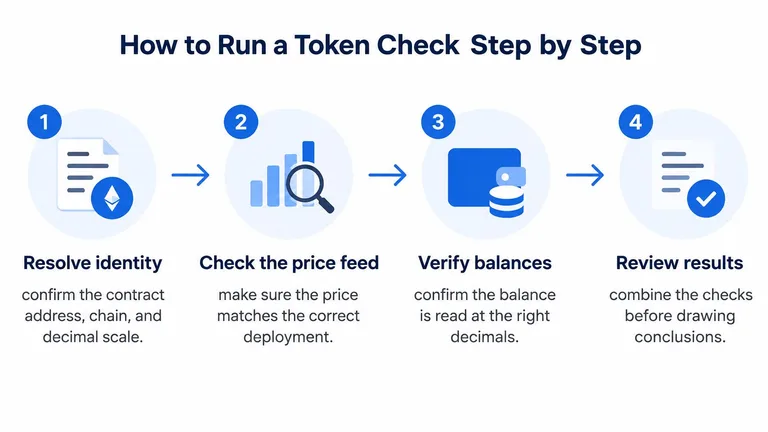
The process graphic below summarizes the identity checks that anchor everything else.
Steps 1 to 3 identity, classification, platform
1. Resolve identity. Confirm the contract address, chain, and decimal scale before you calculate anything. The Robinhood asset registry exposes token identifiers, symbols, names, deployment contract addresses, and decimal precision, with returned records showing token decimals such as 18. Use metadata like that for identity resolution only. The common slip is trusting a ticker, since a price attached to the wrong deployment, or a balance read at the wrong decimals, produces confident and incorrect results.
2. Classify the asset. Write down the issuer, claim type, jurisdiction, and redemption route. This takes two minutes and determines which risks even apply. The slip here is skipping straight to the chart because the token name looks familiar.
3. Check platform status. Confirm the listing, your jurisdiction's eligibility, and the custody model, then date stamp the result. The slip is reusing last month's check. Support status expires.
Steps 4 to 7 market, supply, exit, record
4. Read market conditions. Compare volume, unique traders, spread, and slippage at your intended trade size against current Solana wide conditions. A token declining in line with the ecosystem reads differently from one declining alone. The slip is judging activity without a benchmark.
5. Check on-chain supply. Each analysis evaluates six signal categories, liquidity, holder distribution, creator behaviour, wallet activity, trading patterns, and historical risk indicators. Within that, we examine token supply distribution, including concentration and possible wallet connections, because five wallets that move together aren't five independent holders. Look for concentrated holders, creator wallet links, and bundled or insider like buying. The slip is trusting a single green score without reading which category produced it. Our walkthrough of Solana token safety checks explains how these categories fit together in practice.
6. Test the exit. Estimate how much you could sell at a realistic price against current liquidity. Use your intended position size, not a tiny test amount that flatters the result. The slip is checking the buy price carefully and never simulating the sell.
7. Record and re-check. Save the evidence source and timestamp for each layer, then repeat the check before you buy. Quotes, holder distribution, and platform support each change independently, so a clean result from yesterday describes yesterday. The slip is treating your notes as a standing clearance.
None of these steps requires special access. They require order and honesty about what each result proves.
Confirm the Exit Before You Buy
A token can pass every check and still collapse, because demand disappears, large holders sell, liquidity changes, or new information arrives. That's not a reason to skip the checks. It's a reason to size and decide as if the checks describe conditions right now, not guarantees about next week.
Use a two-part go or no-go rule. Buy only if the exit test passed at your intended size, and only if the asset's legal structure matches your goal. If you want shareholder rights, a tokenized claim that doesn't provide them fails the second test no matter how liquid it looks. If you're evaluating a Solana meme coin, judge it on on-chain evidence, and use a Solana exit liquidity checker to estimate whether your position can be sold against current depth.
For Solana meme coins, an automated on-chain report can organize that evidence into one place so you're not stitching together five browser tabs. The access model is simple to plan around. Reading public token evidence and reopening saved reports is free, while running a new analysis is a paid action. Keep the limits in view, too. MemeAssist provides automated, informational token analyses, not financial advice, and memecoins are extremely risky, so you can lose all invested capital.
Run the seven step check today, record the result with its timestamp, and do not buy unless the exit test passes.
That rule won't make a risky market safe. It will stop you from entering positions you already know you can't leave, which is where most avoidable losses in this corner of crypto happen.
Before your next trade, run the token through MemeAssist to see its holder concentration, liquidity depth, and creator wallet evidence organized into one timestamped Solana report. Check whether you could exit at your intended size, compare that against what the token entitles you to, and only proceed when both answers hold up.
Topics: Robinhood token analyzer, token risk analysis, on-chain risk signals, Solana meme coin safety, tokenized stocks
Informational only, not financial advice. Meme coins are extremely high-risk.
All articles