Top 12 Smart Contract Scanner Tools for Solana in 2026
Compare 12 smart contract scanner tools for Solana tokens, with features, limits, and usage tips to check rug risk before you trade.
Published
Updated

Solana meme coins move fast, and a convincing token page can hide risks that only appear after liquidity is added, privileges are granted, or holders begin dumping. A smart contract scanner can flag common problems before you trade, but it is not a substitute for careful research.
This roundup covers 12 websites and platforms built for checking contracts, wallets, tokens, and liquidity. The list is organized around three practical categories:
- Static analysis tools for inspecting mint authority, freeze authority, token extensions, honeypot behavior, and other contract-level risks.
- On-chain intelligence tools for reviewing holder concentration, deployer history, liquidity conditions, bundling patterns, and wallet connections.
- Solana and EVM options for traders who need coverage across networks, including EVM-specific checks for ownership, taxes, proxy contracts, and contract permissions.
Each entry includes screenshots, a direct link, the strongest use case, and the main limitations. That format makes it easier to compare tools for quick pre-purchase checks, deeper investigations, and automated risk screening in trading workflows.
A clean scanner result lowers obvious red flags. It does not prove a token is safe, legitimate, or likely to hold its value.
Some platforms inspect source code, while others rely more heavily on live on-chain data and behavioral tests. Understanding that distinction matters, especially for newly launched Pump.fun tokens. No scanner can guarantee profits or detect every malicious design, so use the results as one input alongside token economics, team activity, liquidity depth, and your own risk limits.
Table of Contents
- 1. Solana Contract Checker
- 2. RugCheck
- 3. Solsniffer
- 4. GoPlus Security
- 5. Quick Intel
- 6. Token Sniffer
- 7. Honeypot.is
- 8. De.Fi Scanner
- 9. Cyberscope Cyberscan
- 10. Solana Tracker Rugcheck
- 11. Bubblemaps
- 12. DEXTools DEXTscore
- Smart Contract Scanners: Top 12 Comparison Matrix
- Building a Checklist That Holds Up Under Pressure
1. Solana Contract Checker
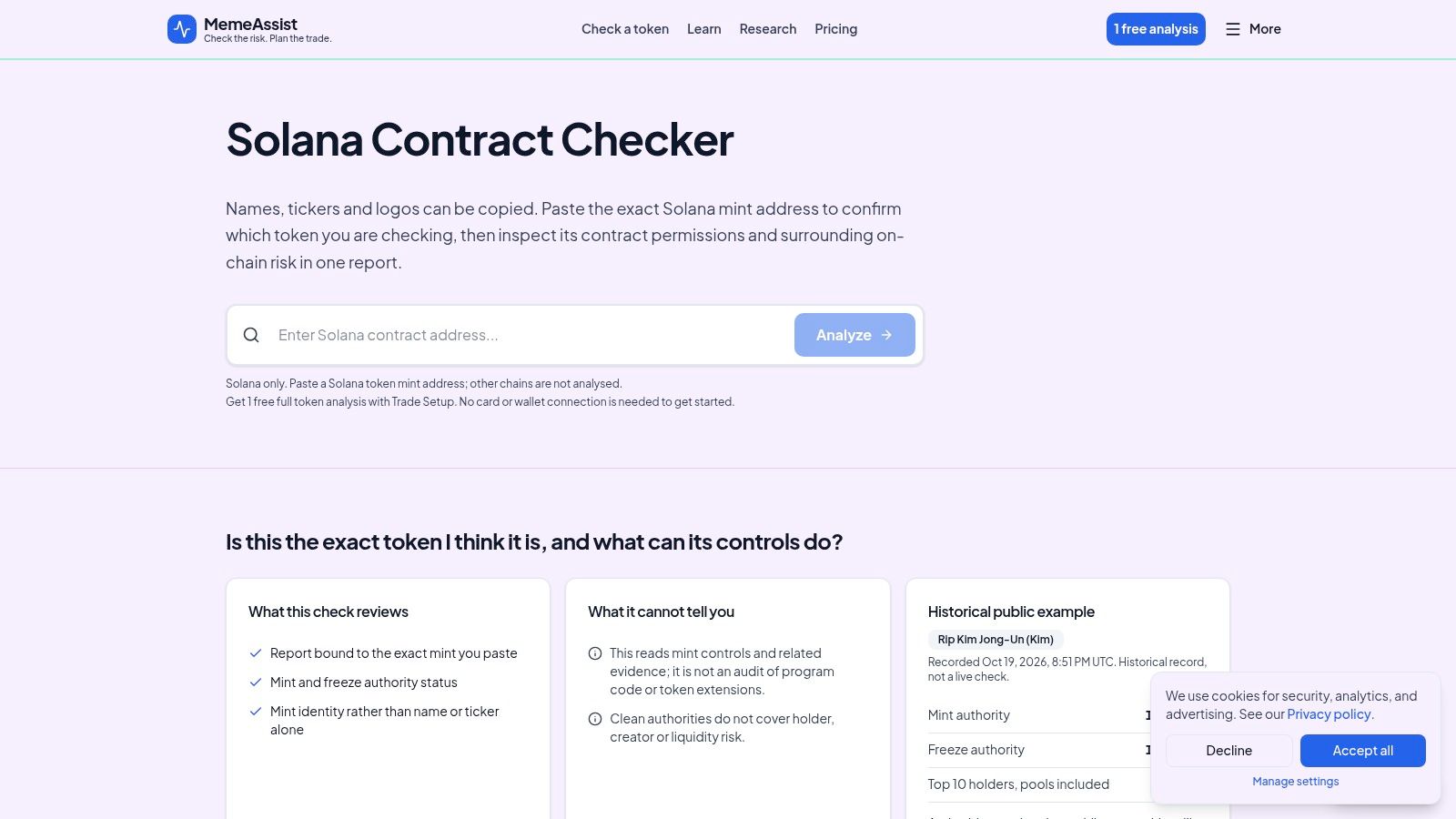
MemeAssist’s Solana Contract Checker is a practical starting point for retail traders evaluating Solana meme coins, particularly tokens that surface through Pump.fun and other fast-moving launchpads. It offers a free initial inspection without requiring a wallet connection or transaction signature, which makes it useful for screening a contract before committing funds. The broader MemeAssist toolkit then connects token, holder, wallet, liquidity, and market data in a paid analysis, helping users move from a basic contract check to a more evidence-based risk assessment.
What It Checks
The scanner is designed as a focused Solana smart contract scanner, rather than a multi-chain security platform. Its initial check is intended to answer a simple question quickly: is this token worth investigating further? The free entry point can provide an accessible way to review a token before opening MemeAssist’s deeper research tools.
For traders, the most useful workflow is staged:
- Run the free contract check to identify whether the token warrants further review.
- Review liquidity and honeypot indicators as part of the broader toolkit.
- Inspect the paid analysis for a health score, rug-risk rating, and AI verdict.
- Read the detailed risk breakdown to understand which signals drove the assessment.
- Consider the conditional trade setup when sufficient data is available.
This sequence suits users who want a quick screen but do not want to confuse a passing contract check with proof that a token is safe.
Why It Stands Out
MemeAssist differs from a conventional code-audit tool by combining the initial scanner with live on-chain and market signals. The deeper report covers:
- Liquidity conditions and potential liquidity risks
- Holder distribution
- Creator behavior
- Wallet activity
- Trading patterns
- Historical risk indicators
- A token health score and rug-risk rating
- An AI-generated verdict with an explained risk breakdown
That combination is valuable for meme coin traders, where contract permissions alone may not reveal concentrated ownership, suspicious wallet activity, unstable liquidity, or abrupt changes in trading behavior.
A scanner is best treated as a triage tool, not a final investment decision. MemeAssist stands out because it connects a fast first check with deeper evidence for tokens that require more scrutiny.
Pricing and Access
The basic Solana Contract Checker is free, and users can perform the initial check without connecting a wallet. A full analysis costs $0.20, which is modest for day traders, swing traders, and newcomers seeking a second layer of verification before entering a position.
No wallet signature is needed for the free check, reducing friction and avoiding unnecessary permission requests. For automated or bot-driven workflows, the narrower Solana focus should still be tested against your own integration requirements before relying on it at scale.
Practical Use Cases
The checker is especially relevant for:
- Pump.fun traders reviewing newly launched tokens
- Meme coin investors checking liquidity and rug indicators
- Solana newcomers looking for an accessible risk screen
- Day and swing traders comparing token behavior before entry
- Quantitative users testing whether the signals fit a custom screening process
A sensible approach is to compare the tool’s output with the contract address on a trusted Solana explorer. Check liquidity lock status, mint authority, token distribution, and recent wallet movements independently. MemeAssist’s broader analysis can explain the risks, but independent verification remains important.
Limitations and User Experience
The main limitation is scope. This is a Solana-only smart contract scanner, so it does not replace tools built for Ethereum, Base, or other EVM networks. It also does not provide the same kind of source-code review that a formal smart contract auditor would deliver.
The interface is likely most useful when treated as a quick research workflow: enter the token, read the initial result, and use the deeper report only if the token appears relevant. For larger trading operations, teams should confirm report speed, data coverage, export options, and customer support before depending on it for execution.
Overall Assessment
Solana Contract Checker is a strong choice for users who need a fast, low-cost first pass on a Solana token. Its differentiator is not the free scan alone, but the path from that scan to liquidity, holder, creator, wallet, trading-pattern, and historical-risk evidence. For Solana meme coin research, it offers a practical middle ground between manual explorer checks and a full professional audit.
Visit MemeAssist’s Solana Contract Checker to review a token before deciding whether deeper analysis is warranted.
2. RugCheck
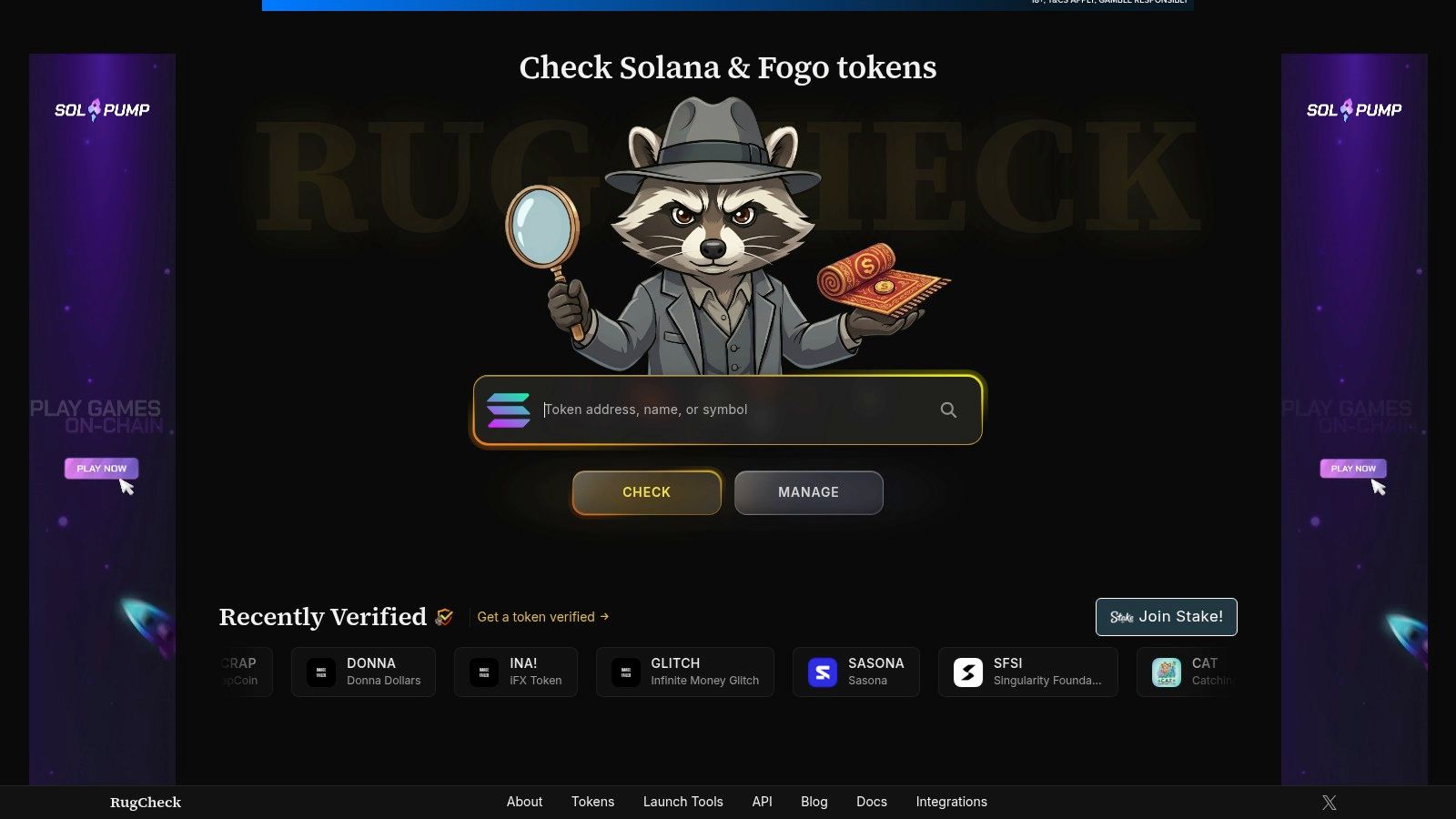
RugCheck is a Solana-focused token risk scanner that gives retail traders and meme-coin buyers a clearer view of a token’s on-chain behavior before they transact. Its reports combine token-authority permissions, holder distribution, insider-network signals, and liquidity information into a risk score, rather than relying on a simple “safe” or “unsafe” label.
What users can inspect
For traders researching Pump.fun launches and other Solana assets, RugCheck is useful as a first-pass smart contract scanner:
- Holder concentration: Large wallets, connected clusters, and insider activity can reveal coordinated selling pressure.
- Token authorities: Mint and freeze powers show whether the deployer retains meaningful control.
- Liquidity checks: Reported liquidity helps users judge whether a token can be sold without encountering an immediate liquidity trap.
- Risk indicators: The overall score summarizes several findings, while the detailed report explains what triggered each warning.
- Public reports: Token reports are accessible directly through the website, making quick checks possible without starting an API project.
- API access: Automated screens can compare incoming tokens against risk thresholds, though current pricing, authentication, rate limits, and commercial terms should be confirmed on the official site.
Why it stands out
Its main advantage is focus. RugCheck treats Solana as its primary environment instead of distributing attention across many chains. That focus matters for meme-coin traders because token creation, migrations, bundled launches, and rapid liquidity changes create Solana-specific risks.
A score is most useful when the underlying reasons are visible, not when it replaces every stage of due diligence.
The interface is straightforward for newcomers, although dense wallets and network links may require some interpretation. Experienced traders will likely spend more time comparing holder clusters and liquidity states across several candidate tokens than reading the score alone.
Practical limitations
On-chain data cannot establish whether a team is credible, committed, or acting honestly. A token can receive a strong warning because a legitimate deployer controls the mint, and a weak score does not guarantee safety. RugCheck also complements, rather than replaces, source-code review and research into unlocks, vesting, governance, and off-exchange announcements.
For effective use, check the report on the token’s actual mint address, inspect connected wallets, and confirm liquidity conditions at the moment of trading. Treat RugCheck as one filter in a broader smart contract scanner workflow, especially for swing traders and bot operators handling high volumes of Solana launches.
3. Solsniffer
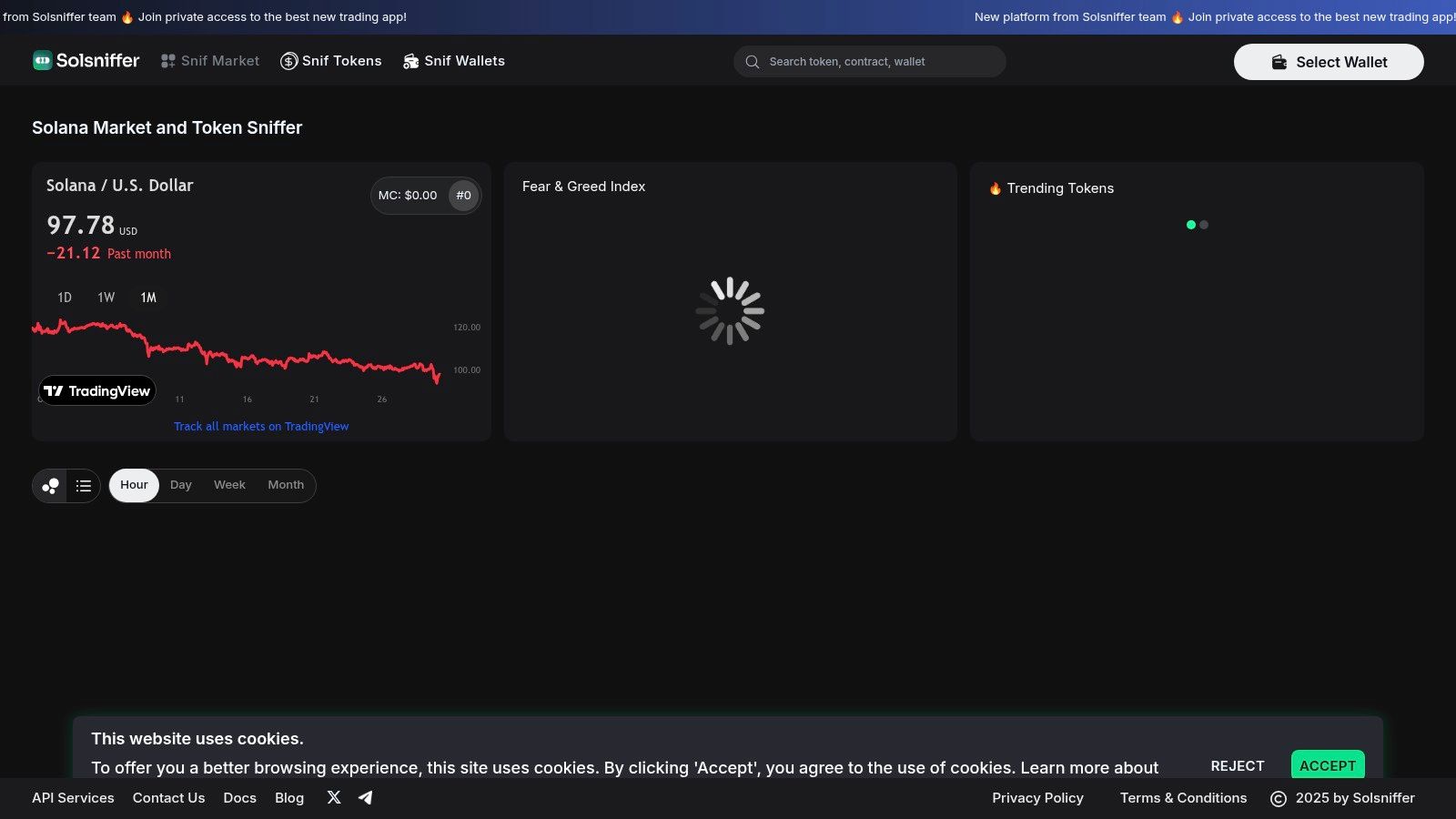
Solsniffer gives Solana traders a place to screen tokens and browse market activity without installing a separate analytics stack. It combines token-security signals with discovery pages, making it useful for checking a newly found Pump.fun or meme-coin candidate before opening a position.
What users can inspect
As a Solana-oriented smart contract scanner, Solsniffer offers several ways to evaluate a token:
- Token risk score: An indicator-style rating summarizes selected on-chain signals, giving users a quick basis for comparison.
- Security checks: Reviewable warnings help distinguish tokens that show common signs of control, concentration, or trading risk.
- Token pages: Individual assets include market information and security context, reducing the need to jump between separate services.
- Market discovery: Search and discovery views can help traders find active tokens, then screen them without beginning with a known contract address.
- API access: Automated and bot-driven workflows may use an API, although current endpoints, limits, authentication, pricing, and commercial terms should be confirmed with Solsniffer.
Why it stands out
Solsniffer sits between a basic token directory and a deep on-chain investigation platform. Its main draw is the combination of discovery and screening in one interface, which works well for traders moving quickly through Solana launches.
Running the same candidate through two scanners can reveal differences in risk interpretation that a single score would hide.
For newcomers, the interface provides more context than token names, logos, and price charts alone. Experienced traders may find it especially useful as a second opinion alongside RugCheck, particularly when one tool flags a concern the other does not.
Practical limitations
A score summarizes specific signals; it is not an independent audit or proof that a token is safe. Public documentation on pricing and scoring methodology may also be limited, so users should verify what each warning means before acting.
Some liquidity, holder-cluster, and wallet-link analysis may require separate tools. For best results, search for the token by contract address, compare results across scanners, inspect the underlying warnings, and reconfirm liquidity before trading. Customerservice and support options should be checked directly on the official site for current availability.
4. GoPlus Security
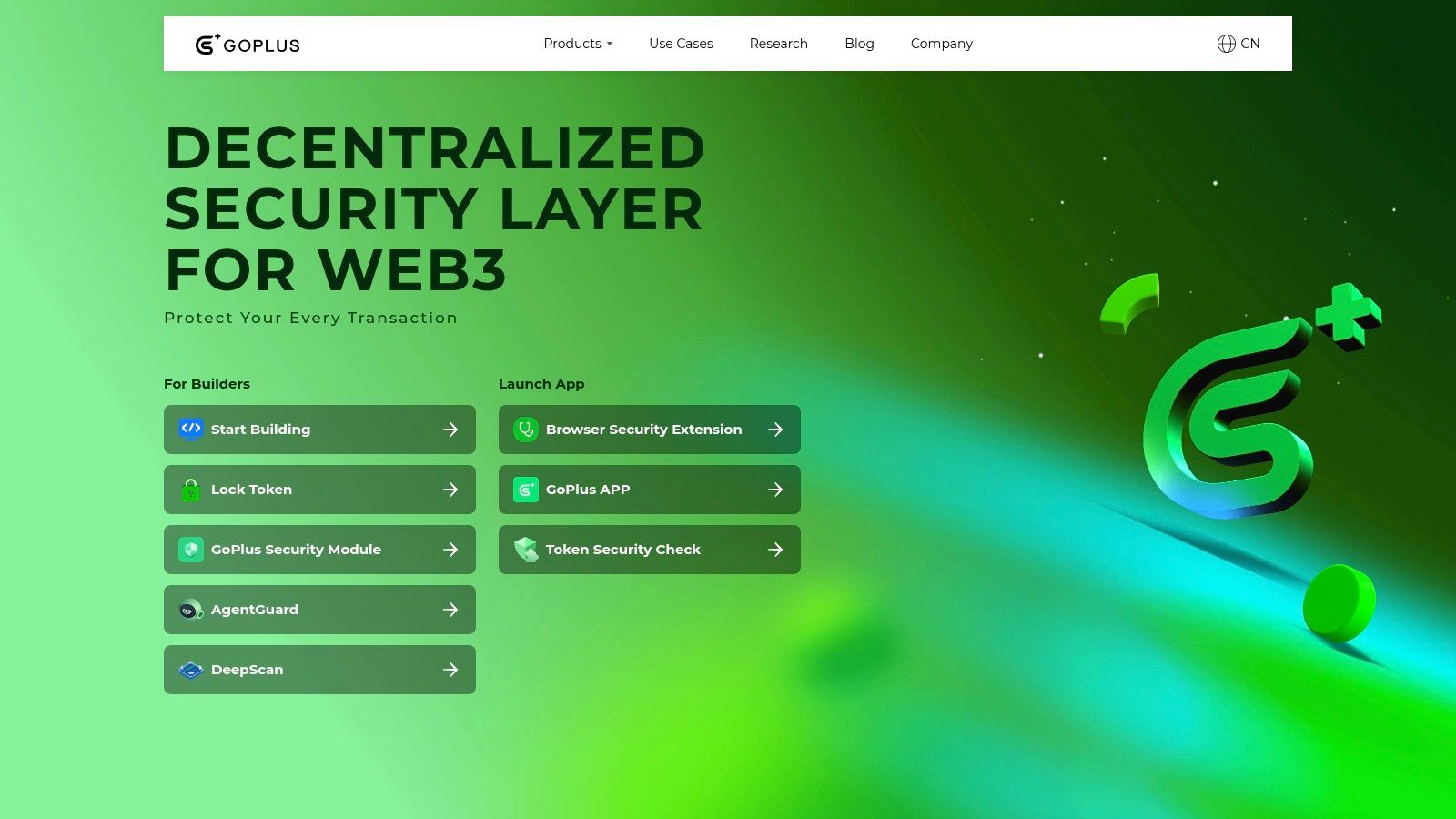
GoPlus Security is a multi-chain token-risk platform for traders, wallet teams, and developers who need more than a simple contract-age or liquidity check. Its security interface and APIs expose specific risk categories for supported networks, including a documented Solana Token Security API, making GoPlus useful as a smart contract scanner before buying a token or approving a transaction.
What users can inspect
GoPlus provides several practical checks for Solana meme coins and assets on other supported chains:
- Token permissions: Review whether a token can be minted, frozen, or controlled by an owner or authority.
- Trading restrictions: Examine signals for taxes, blacklist functions, honeypot behavior, and restrictions that may limit selling.
- Contract ownership: Identify whether ownership remains active and whether control appears concentrated.
- Chain-specific risks: Compare results across supported networks, although availability can differ by token and chain.
- Related security services: Additional tools cover malicious addresses, token approvals, and transaction risks.
- Developer integration: The Security API supports wallets, trading interfaces, bots, and automated screening workflows. Published guidelines describe API access as free, but users should confirm current quotas, authentication requirements, and usage terms.
Why it stands out
Its defining advantage is breadth without losing category-level detail. GoPlus can serve both a retail trader checking a Pump.fun token in the browser and a quant team adding automated risk gates before execution.
A useful scanner should explain why a token was flagged, not merely display a single risk number.
The interface is best suited to users who understand basic token permissions and contract controls. Raw API responses may feel technical for newcomers, but the separate warning categories make the output easier to investigate than an undifferentiated score.
Practical limitations
GoPlus flags do not replace source-code review, holder analysis, liquidity checks, or manual contract audits. A warning may reflect a legitimate multisig or mint authority, while a clean result does not prove that a project is safe. Some tokens also receive limited coverage because of unsupported chains, unusual implementations, or incomplete contract data.
For best results, query the token’s exact mint or contract address, review each warning instead of relying on a summary, and compare the result with current on-chain liquidity and holder concentration. Customer support and documentation quality can vary by plan or integration, so teams should test error handling, rate limits, and response consistency before connecting the API to a production trading system.
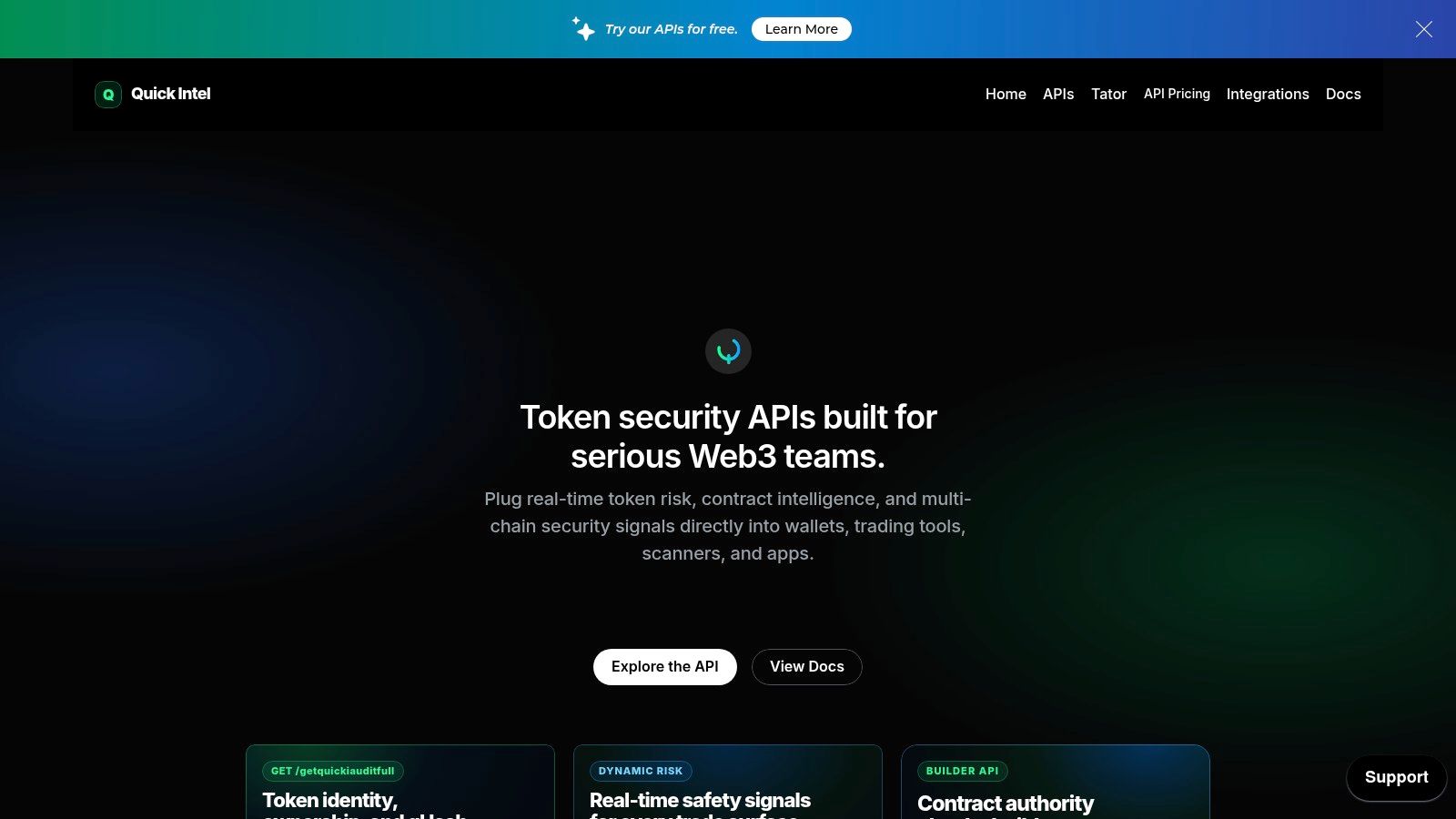
5. Quick Intel
Quick Intel is a multi-chain security scanner that turns complex contract findings into plain-language risk reports. Retail traders can paste a token or contract address and inspect honeypot behavior, taxes, ownership controls, mint functions, and liquidity-related issues without connecting a wallet. Its public scanner is presented as free, while API access and pricing are handled separately.
What users can inspect
For anyone comparing tokens across Solana and EVM networks, Quick Intel works as a practical smart contract scanner:
- Contract behavior: Honeypot checks can indicate whether selling may be blocked or whether trades behave asymmetrically.
- Trading restrictions: Tax settings help users identify fees that could make a purchase unusually expensive.
- Control permissions: Ownership and mint-function findings reveal which addresses can change or issue assets.
- Liquidity checks: Users can review liquidity-related warnings before committing funds.
- Plain-language summaries: The report presents detected risks in terms that are easier for non-developers to assess.
- API access: Developers and quantitative teams can query findings when adding risk screens to bots or internal tools, subject to the separate API terms.
Why it stands out
Its defining advantage is accessibility. Quick Intel covers several chains without requiring wallet connection, and its interface favors readable explanations over raw code output. That makes it a convenient first stop for newcomers, Solana meme-coin traders, and active investors who need a quick screen before researching a token further.
A readable risk summary is useful for triage, but the underlying signals still deserve a closer look.
Practical limitations
Quick Intel does not replace manual source-code review. The public website and developer API may not expose identical checks or access conditions, and plain-language or AI-assisted explanations should be checked against the underlying data. Confirm current API pricing and availability on the official site, verify results against the correct chain and address, and treat liquidity and honeypot findings as time-sensitive. For Pump.fun buyers and day traders, scanning immediately before an order is more dependable than relying on an older report.
6. Token Sniffer
Token Sniffer is a multi-chain smart contract scanner designed to surface known scam patterns before retail traders commit funds. It combines source-code and bytecode analysis with a token score, giving users a quick snapshot of risks such as malicious contract behavior, serial rug pulls, impersonation, and phishing-related details.
What users can inspect
For Solana meme-coin traders, Token Sniffer offers a practical first screening layer:
- Automated scam detection: Contracts are checked against known malicious and suspicious patterns rather than judged solely by their score.
- Source-code and bytecode analysis: Available contract data helps identify dangerous transfer, trading, and ownership logic.
- Serial rug-pull checks: Reports can flag mechanisms associated with repeated withdrawals or abrupt fund movement.
- Impersonation warnings: Traders can look for signs that a token imitates a legitimate brand, project, or account.
- Phishing-related details: Contract metadata and behavior may reveal links associated with phishing attempts.
- Issue summaries: Reported findings explain why a contract received its score, making the results more useful than a simple safety label.
- API access: Teams can incorporate automated checks into launch-monitoring, portfolio, or trading workflows.
Why it stands out
Token Sniffer supports several blockchain environments, which makes it useful for traders moving between Solana assets and EVM tokens. Its strongest feature is the combination of a visible score with specific scam indicators. That distinction matters because a low score can narrow the list of obvious dangers without claiming to guarantee safety.
A smart contract scanner is most useful as an early filter, especially when a new token has little reputation, limited history, or an unfamiliar contract structure.
The interface is straightforward enough for newcomers, although traders familiar with Solidity, Rust-based programs, or EVM bytecode will get more from the technical details. For a closer comparison with another screening approach, learn more about MemeAssist versus Token Sniffer.
Practical limitations
Results depend on the contract information available. An unverified source file, incomplete bytecode, or proxy-based upgrade structure can limit detection accuracy. A favorable score also cannot establish team credibility, future liquidity conditions, or whether a token’s social accounts are safe.
Token checks are available through the website, while the published API Pro plan costs $99 per month. Enterprise pricing is available by inquiry, so high-volume or commercial users should confirm current allowances and terms directly with the provider.
Use Token Sniffer before buying, but verify the token address, read every flagged issue, and inspect liquidity and holder concentration separately. For Pump.fun traders and bot operators, it works best as one filter within a broader risk process rather than an automatic buy signal.
7. Honeypot.is
Honeypot.is is a focused smart contract scanner for checking whether a token appears to permit purchases while preventing or restricting sales. It accepts either a token address or a trading-pair address and can simulate liquidity behavior for tokens that do not yet have an active pair, making it particularly useful for newly launched Solana meme coins.
What users can inspect
For retail traders and Pump.fun users, Honeypot.is offers a narrow but important set of checks:
- Token or pair lookup: Submit the relevant address directly to test whether the contract’s sell path appears blocked.
- Buy-versus-sell behavior: The report focuses on the difference between allowing an initial purchase and allowing the position to be sold afterward.
- Liquidity simulation: For tokens without a live trading pair, the optional simulation estimates whether a purchase could be completed once liquidity exists.
- API access: Automated workflows can query checks without a key, according to the documentation available at the time of review. Confirm current authentication, rate limits, and commercial terms before integrating it.
- Quick interpretation: The results give beginners a direct answer to a question that is difficult to assess manually.
Why it stands out
Most scanners combine honeypot detection with holder concentration, authority, liquidity, and source-code checks. Honeypot.is instead concentrates on one high-impact failure: buying a token that cannot realistically be sold.
A token can look healthy in several areas and still be dangerous if its sell function is restricted.
Practical limitations
Honeypot.is does not replace a broader contract or holder scanner. A successful check does not rule out rug pulls, creator privilege, poor liquidity, wallet clustering, or contract exploits. Some cached contract information may also be outdated, and results may be unavailable for certain tokens or trading structures.
The interface is straightforward, but users should check the contract on the actual chain and compare the result with the contract address shown on the trading platform. For background, learn more about checking a Solana token for honeypot behavior. Customer support options are less prominent than the scanning tools, so traders should rely on current documentation and independent on-chain checks when a result is unexpected.
8. De.Fi Scanner
De.Fi Scanner is an automated smart contract scanner that checks deployed contracts for known vulnerability patterns and organizes the results into a risk report. It also sits within De.Fi’s wider security toolkit, which includes tools for monitoring wallet approvals and identifying scam activity.
What users can inspect
De.Fi Scanner is useful for traders who want a quick security check before buying a newly launched token:
- Automated contract analysis: The scanner evaluates contract code for known issues instead of requiring manual source inspection for every candidate.
- Risk findings: Results are presented as a report, making severity and detected weaknesses easier to review.
- Wallet-approval checks: Related tools can reveal active token allowances, helping users identify permissions that may expose a wallet to future transactions.
- Scam and audit information: The broader platform provides additional context that can support research beyond a single contract scan.
- Public access: De.Fi describes the scanner as free, although users should confirm current availability, supported chains, and any feature restrictions on the official site.
Why it stands out
Its defining feature is the connection between contract analysis and wallet security. A contract may pass a basic scan, yet the buyer’s wallet could still contain risky approvals from unrelated platforms.
Checking both the contract and connected wallet permissions gives traders a more complete view of transaction risk.
The report structure also makes De.Fi Scanner practical for fast screening. The interface should appeal to newcomers who need clear findings, while active traders can use it as one step in a broader Solana research routine. Support for EVM contracts and Solana assets depends on current scanner coverage, so chain support should be verified before relying on a result.
Practical limitations
Automated detection cannot identify every flaw, including business-logic errors, hidden owner privileges, or malicious behavior disguised as normal token operations. A low-risk result is not proof that a contract is safe, and users should not confuse a public scan with features that require wallet connection.
For best results, verify the correct contract address, read each finding rather than judging by the summary alone, and review mint authority, liquidity locks, token distribution, and wallet approvals separately. Treat De.Fi Scanner as an additional filter for meme-coin traders, swing traders, and bot operators, not a replacement for manual due diligence.
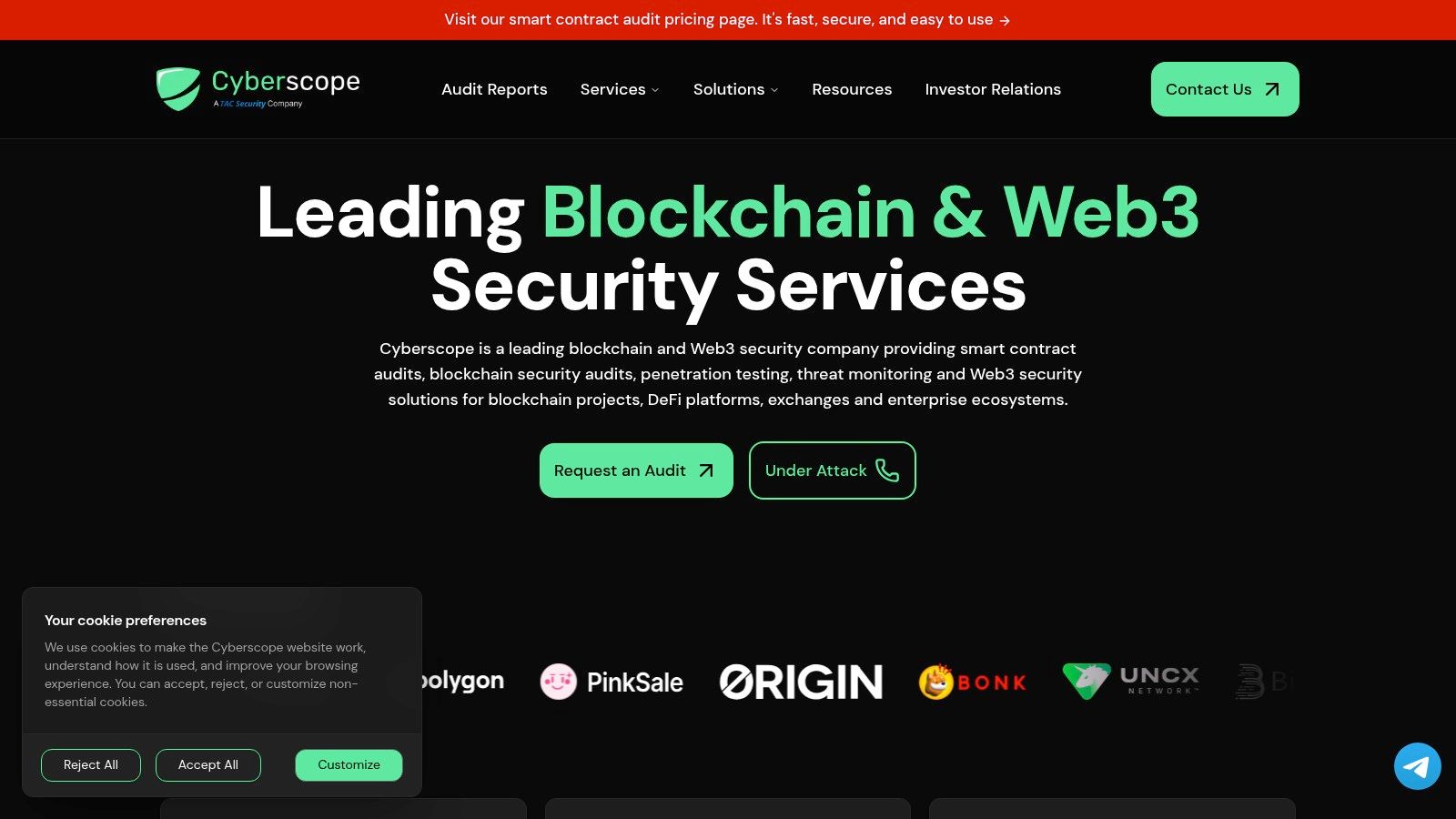
9. Cyberscope Cyberscan
Cyberscope Cyberscan combines automated smart-contract analysis with project, audit, market, and social information. Unlike tools focused only on source code or on-chain ownership, it gives traders a broader view of a token before they act, making it a practical smart contract scanner for Solana and EVM projects.
What users can inspect
Users can review key project and contract details in one workflow:
- Automated analysis: Contract findings are presented in an accessible format for quick initial screening.
- Project context: Audit status and related security information help distinguish an unaudited contract from one that has received professional review.
- Market and social signals: These indicators can reveal whether a project has an active footprint beyond its deployed contract.
- API access: Developers and bot operators can integrate Cyberscan findings into internal dashboards, trading tools, and automated risk checks.
- Related services: Cyberscope also offers audit and security services for teams that need a more extensive review.
Why it stands out
Cyberscan’s distinguishing feature is the combination of contract intelligence and project-level research. This is useful for traders who want more than a technical score but do not want to assemble market, social, and audit data from several services.
A project snapshot can expose questions that source-code analysis alone will not answer, such as whether an audit is documented or whether the project has an established public presence.
The interface appears designed for progressive research, with contract findings available without requiring a developer integration. Customer support and access arrangements are handled directly through Cyberscope, which is relevant for teams seeking custom API terms.
Practical limitations
Cyberscan should be treated as an automated screening tool, not the equivalent of a complete manual audit. API access is documented at five calls per minute, so high-frequency automated workflows may need a different arrangement through Cyberscope’s sales or support team. Pricing and unrestricted-access terms should therefore be confirmed before integrating the service at scale.
Market activity, social engagement, and audit labels also do not prove that a contract is safe. For meme-coin purchases, verify the contract address across official project channels, inspect liquidity and holder concentration separately, and review the underlying findings. Cyberscan works best as one part of a broader smart contract scanner process that combines automated results with independent on-chain checks.
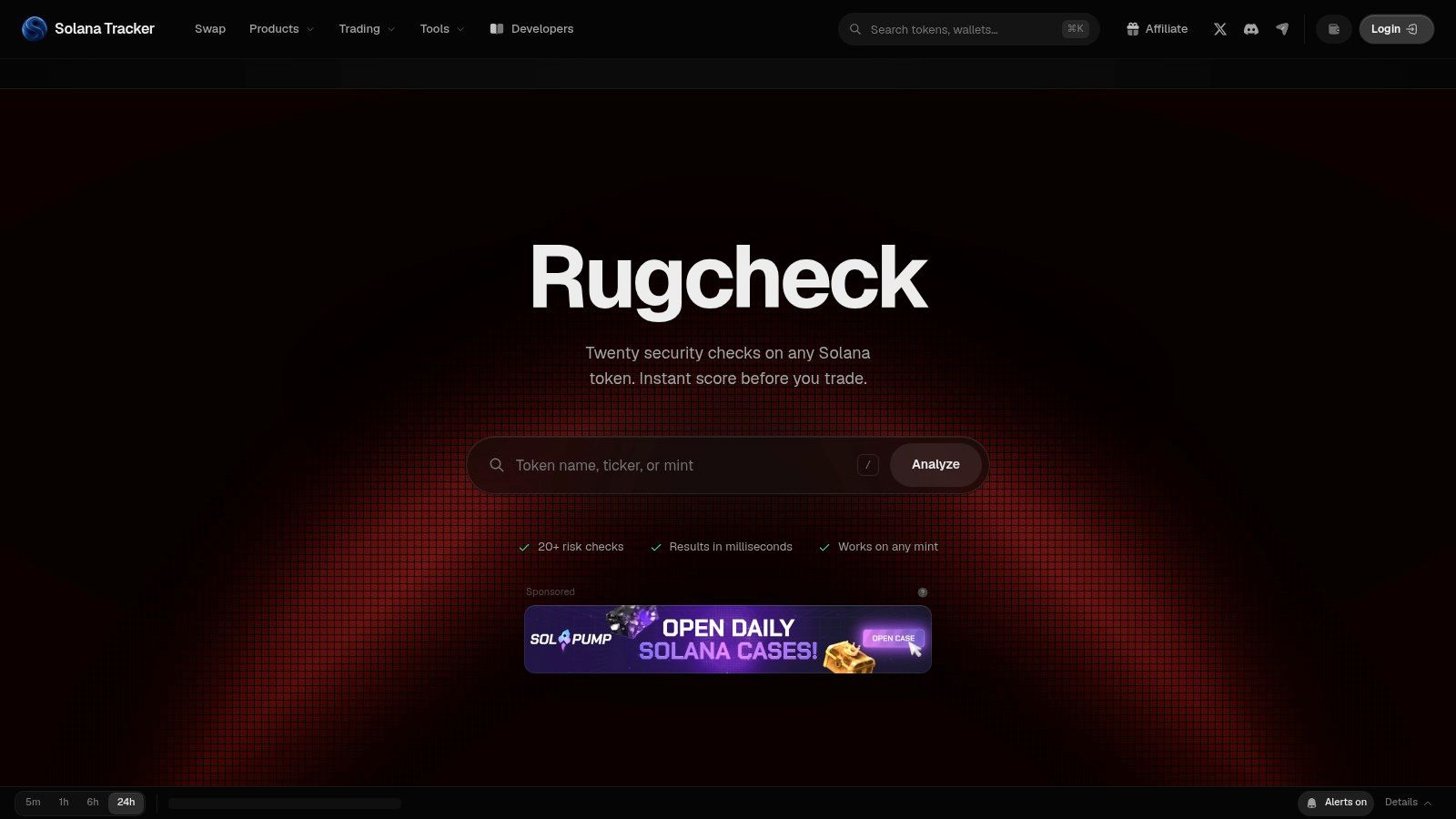
10. Solana Tracker Rugcheck
Solana Tracker Rugcheck provides a convenient token-level security check within Solana Tracker’s broader analytics and trading platform. It is best suited to Solana meme-coin buyers, Pump.fun traders, and swing traders who want a quick second opinion before buying, rather than teams seeking a full source-code audit.
What users can inspect
For users researching newly launched Solana assets, this smart contract scanner offers a focused way to review a token address alongside the platform’s wider market data.
- Security-check summary: A token-address scan presents key risk signals in a more accessible format than raw contract data.
- Integrated token research: Results sit within Solana Tracker, making it easier to compare the security reading with pricing, liquidity, holder, and trading information.
- Cross-platform comparison: Traders can compare its findings with dedicated scanners such as RugCheck instead of treating one result as definitive.
- Faster screening: The workflow is practical for checking several Pump.fun candidates before spending time on deeper investigation.
- Platform continuity: Users who already rely on Solana Tracker can conduct the initial check without moving to a separate research environment.
Why it stands out
Its distinguishing feature is not a deeper audit methodology. It is the combination of a security summary with Solana Tracker’s broader token-data and trading tools. That continuity can reduce the friction between spotting a suspicious token and investigating its market context.
The strongest use is as a quick screening layer, followed by deeper checks elsewhere.
The interface is likely most familiar to active Solana users, while newcomers benefit from a more guided starting point. Customer support and account options should be assessed through the main Solana Tracker site, and users should confirm current availability, pricing, and any API or authentication requirements directly with the provider.
Practical limitations
Solana Tracker Rugcheck is not a complete substitute for source-code review, wallet clustering, liquidity analysis, and manual investigation of unlocks or insider selling. The public page also provides less detail about its methodology than some dedicated tools. Always verify the token’s mint address, compare the result with another scanner, and avoid treating a favorable summary as a guarantee that an asset is safe.
11. Bubblemaps
Bubblemaps is an on-chain visualization platform that maps major token holders as bubbles and connects wallets linked by transfers. Rather than testing code for vulnerabilities, it adds a different layer to a smart contract scanner workflow: showing whether ownership appears concentrated among connected or repeatedly interacting addresses.
What users can inspect
Bubblemaps is particularly useful for Solana meme-coin traders evaluating ownership concentration and potential wallet clusters:
- Holder clusters: Large bubbles and shared transfer paths can reveal addresses that may have accumulated or distributed supply together.
- Wallet relationships: Transfer links help users trace how assets moved between addresses instead of examining every transaction individually.
- Historical Time Travel: Earlier holder distributions can show whether concentration increased, wallets were bundled, or liquidity shifted over time.
- Multichain coverage: The platform supports major ecosystems, including Solana, making it useful for comparing token launches across networks.
- Interactive analysis: Clicking bubbles and links lets users examine specific wallets, balances, and transaction paths.
Why it stands out
Most scanners focus on contract permissions, liquidity locks, or mint controls. Bubblemaps contributes ownership context, making complex distributions easier to interpret at a glance. For beginners, the visual format can be easier to understand than a wall of addresses; experienced traders can use it to generate leads for deeper investigation.
A bubble map is best treated as an investigation aid, not a verdict on whether a token is safe.
Practical limitations
The site is not primarily a code scanner, so it does not establish whether a contract can be exploited or whether a token remains sellable. A linked wallet cluster also does not prove common ownership or malicious intent. Basic mapping is accessible through the website, while some premium features may require BMT-based access, so users should confirm current requirements before relying on advanced views.
For best results, verify the official token address, compare the current map with historical snapshots, and cross-check findings against a dedicated smart contract scanner. Newcomers can also learn more about how to read a crypto bubble map before interpreting wallet clusters.
12. DEXTools DEXTscore
DEXTools DEXTscore is a project-reliability indicator within the DEXTools market-data platform. Rather than inspecting contract code for specific vulnerabilities, it combines signals such as liquidity, holder count, transaction activity, contract creation, social information, and external audits into a composite score.
What users can inspect
DEXTools gives traders a quick way to assess market context before buying a Solana token:
- Composite project score: DEXTscore summarizes several token, trading, and project indicators into one readable signal.
- Liquidity and holders: Users can compare pair liquidity and holder participation when evaluating whether a token has enough market depth.
- Transaction activity: Trading patterns provide context for a project that may be new, inactive, or unusually concentrated.
- Contract and social signals: Contract-creation information and social activity supplement the numerical market data.
- External audits: Audit information appears among the score inputs, offering a useful reference point without substituting for direct review.
- Integrated analytics: The score sits beside DEXTools’ pair, holder, liquidity, and trading tools, reducing the need to move between separate dashboards.
DEXTscore is best treated as a fast market-context check, not as proof that a contract is secure.
Why it stands out
Its main strength is breadth. A dedicated smart contract scanner may reveal mint permissions or reentrancy risks, while DEXTscore helps answer a different question: does the surrounding project activity look consistent with expectations? Traders already using DEXTools can review this context without adopting a separate risk-analysis platform.
Practical limitations
DEXTools does not replace code-level analysis. Missing inputs, weak social signals, or inaccurate external audit information can affect the result, and a high score cannot prevent a rug pull, honeypot, or coordinated manipulation. Confirm access requirements and any account or subscription restrictions directly on DEXTools.
For effective use, open the token’s exact contract address, compare the score with liquidity and holder data, and verify audit claims independently. Pair DEXTscore with a dedicated smart contract scanner and manual contract review before trading, especially for Pump.fun launches and rapidly promoted Solana memes.
Smart Contract Scanners: Top 12 Comparison Matrix
| Tool | Focus & Core Checks | Experience & Standout | Best For | Price / Access |
|---|---|---|---|---|
| MemeAssist Solana Contract Checker | Free first-pass Solana token check; broader tools cover liquidity, honeypots, and rug risk | ✨ Full report adds live evidence, health and rug-risk scores, AI verdict, risk breakdown, and conditional trade setup when data allows | 👥 Solana meme-coin users seeking an explained risk report | 💰 Checker is free; full analysis is $0.20. No wallet connection required |
| RugCheck | Solana risk indicators, holder distribution, liquidity, authorities, and insider activity | ★ Risk score and public reports; API available | 👥 Solana traders wanting a dedicated risk scanner | 💰 Public reports available; check official site for API terms |
| Solsniffer | Solana token security checks, risk indicators, and discovery information | ✨ Can provide a second risk view alongside other scanners | 👥 Solana users screening newly discovered tokens | 💰 Check official site for current pricing and scan details |
| GoPlus Security | Multichain token checks, including minting, ownership, taxes, blacklists, and honeypot signals | ✨ Solana API plus developer tools for other security checks | 👥 Multichain users, developers, and integrations | 💰 Security API described as free under published guidelines; verify terms |
| Quick Intel | Multichain checks for honeypots, taxes, ownership, mint functions, and liquidity | ★ Plain-language findings; public scanner requires no wallet connection | 👥 Traders wanting an accessible scan across chains | 💰 Public scanner presented as free; API access handled separately |
| Token Sniffer | Automated scam-pattern detection, contract scoring, and source-code/bytecode analysis | ✨ Checks for malicious contracts, serial rugs, impersonation, and phishing-related details | 👥 Users screening for known scam patterns; API teams | 💰 Website checks available; API Pro is $99/month, enterprise by inquiry |
| Honeypot.is | Checks whether tokens appear buyable and sellable; supports token or pair addresses | ✨ Optional liquidity simulation for tokens without a trading pair | 👥 Users focused on sell restrictions and honeypot risk | 💰 Check site for current access and requirements |
| De.Fi Scanner | Automated contract vulnerability scanning and risk breakdown | ✨ Part of a wider toolkit with wallet-approval monitoring and scam information | 👥 Users combining contract and wallet-security checks | 💰 Scanner described as free; check for current restrictions |
| Cyberscope Cyberscan | Contract analysis plus project information; API can include market and social data | ✨ Combines security and project context in one workflow | 👥 Developers and users wanting broader project data | 💰 API limit listed as 5 calls/minute; contact Cyberscope for unrestricted access |
| Solana Tracker Rugcheck | Solana token security-check summary within a broader analytics platform | ✨ Convenient for users already using Solana Tracker | 👥 Solana traders seeking another scanner to compare | 💰 Check site for current access and requirements |
| Bubblemaps | Visualizes major holders, wallet connections, and historical distribution; includes Solana | ✨ Bubble maps and Time Travel views help inspect holder relationships | 👥 Users investigating concentration and wallet links | 💰 Basic mapping available; premium features may use BMT-based access |
| DEXTools DEXTscore | Composite project signal based on factors such as liquidity, holders, transactions, and audit information | ✨ Integrated with DEXTools market and trading data | 👥 DEXTools users seeking quick project and market context | 💰 Check DEXTools for current account and subscription requirements |
Building a Checklist That Holds Up Under Pressure
A reliable smart contract scanner workflow is not a single green check or a single score. It is a sequence of decisions designed to filter out obvious risks, examine token behavior, and verify whether the market structure supports a trade. The tools in this guide cover different parts of that process: Solana-native scanners for mint authority, freeze authority, liquidity locks, and holder concentration; EVM scanners for contract permissions, honeypots, and transaction behavior; and on-chain analytics platforms for liquidity, wallets, volume, and holder movement.
The most effective approach is staged. Start with a fast contract or honeypot check, then add holder and liquidity context, and save the deeper report for tokens that pass those initial filters.
A Practical Decision Sequence
Start with a fast safety check. Use a Solana Contract Checker, RugCheck, Solsniffer, GoPlus Security, Quick Intel, Token Sniffer, Honeypot.is, or De.Fi Scanner to identify exposed authorities, suspicious transfer behavior, weak liquidity, and honeypot conditions.
Inspect ownership and liquidity. Add Bubblemaps, Cyberscope Cyberscan, Solana Tracker Rugcheck, or DEXTools DEXTscore to review holder distribution, liquidity depth, wallet clustering, trading activity, and signs of coordinated control.
Run a deeper review only when justified. A token that already fails basic checks does not need a more elaborate report. Save time by moving past it, especially when reviewing fast-moving Pump.fun launches.
Recheck before execution. Token behavior can change between discovery and entry. Run the relevant checks again after confirming the contract address, and again if the price, liquidity, or holder mix shifts abruptly.
A scanner result is evidence, not a verdict. Treat every score as one input among several, alongside chart structure, volume quality, liquidity, token distribution, and your own risk limits.
Choosing the Right Tool
For quick Solana checks: Choose a scanner with clear contract-permission reporting and readable warnings. Solana-native tools such as RugCheck and Solsniffer are useful for this stage because their checks map closely to Solana program patterns.
For launchpad or meme-coin screening: Prioritize tools that make mint authority, freeze authority, transfer restrictions, and liquidity information easy to locate. These details matter when a trader has only a few minutes to assess a new token.
For holder and liquidity analysis: Use Bubblemaps, Cyberscope Cyberscan, Solana Tracker Rugcheck, or DEXTools DEXTscore to test whether liquidity is concentrated in a small group of wallets or whether apparent ownership is spread across connected addresses.
For EVM comparisons: GoPlus Security, Token Sniffer, Honeypot.is, and De.Fi Scanner provide useful checks for sell restrictions, hidden taxes, honeypot behavior, and contract permissions. Compare results across more than one source when a contract produces inconsistent findings.
For bots and repeatable workflows: Confirm that the tool offers a usable API, stable endpoints, clear output fields, and documented limits. Also account for rate limits, RPC latency, false positives, and the possibility that a contract changes shortly after a successful scan.
Questions to Record in Your Trading Log
A short checklist creates a consistent record and makes it easier to learn from past decisions. Capture:
- The token address and chain
- Scan time and tool names used
- Contract permissions and freeze or mint status
- Liquidity amount and lock or burn status
- Top holder percentages and connected-wallet findings
- Buy and sell tax results where applicable
- Whether the token passed each stage
- The reason for entering, rejecting, or monitoring the trade
This record is especially important for novice Solana traders. It separates a verified observation from a feeling that a token “looked safe.” It also gives quantitative and bot traders a cleaner basis for refining automated risk rules.
Limits Every Trader Should Accept
Automated scanners can miss coordinated wallet activity, deceptive liquidity, upgradeable contracts, off-chain coordination, and market manipulation. They can also misread normal contract behavior as malicious. No smart contract scanner can guarantee profit, prevent a rug pull, or replace careful contract-address verification.
Always confirm that you are viewing the correct network and token address. Check the source contract directly when a warning is unclear, and investigate unexplained discrepancies instead of accepting the highest score. Position sizing, stop rules, and a willingness to exit remain more important than any badge or grade.
If you want to add contract-risk context without building a large stack of browser tabs, MemeAssist can serve as one option in a broader smart contract scanner workflow for Solana token research. Use it alongside independent contract checks, holder analysis, and liquidity review, then make the final decision from verified evidence rather than a single alert.