Smart Money Crypto: How to Read On-Chain Signals in 2026
Smart money in crypto means wallets, funds or trading desks whose realized trading results and well-timed entries suggest they're better informed than the average trader, but it's a probabilistic signal, not a buy instruction.
The popular advice to follow successful wallets skips the hardest part: deciding whether their success is repeatable and whether you can still trade at a sensible price. A wallet can make a good decision while a follower makes a bad trade.
For Solana meme-coin traders, useful analysis starts with completed trades, not screenshots of rising balances. It ends with a separate question: after checking the wallet, the token and your executable price, is there still a reason to enter?
Table of Contents
- What Smart Money Means in Crypto
- On-Chain Signals That Point to Informed Money
- How to Test a Wallet's Track Record Step by Step
- Two Wallets, Two Verdicts
- Where Smart Money Signals Mislead
- Execution Checks Before You Follow a Trade
- Verify the Signal Before You Follow the Money
What Smart Money Means in Crypto
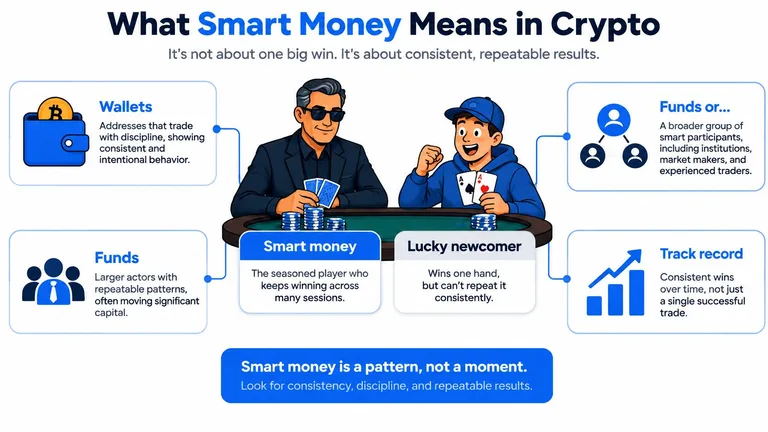
At a card table, the seasoned player who keeps winning across many sessions deserves more attention than the newcomer who wins a spectacular hand. You'd still want to know how much the experienced player risked, how often they lost and whether their advantage survives against different opponents.
Apply that standard to smart money crypto analysis. A large wallet isn't automatically skilled, and an early buyer isn't automatically informed. The useful distinction is between a repeatable decision process and a favorable outcome that could have happened by chance.
Where informed capital appears
Professional participation reaches crypto through several channels:
- Direct token trading: Wallets buy, sell and manage positions in observable markets.
- Regulated investment products: Investors obtain exposure through funds rather than holding tokens themselves.
- Market infrastructure: Market makers, custodians and liquidity providers support trading without necessarily making a simple bullish bet.
The institutional-access milestone was the SEC's approval of spot Bitcoin ETFs on January 10, 2024, with trading beginning the following day, according to the institutional crypto market report. The report puts December 2024 net inflows at approximately $40.5 billion for U.S. spot Bitcoin ETFs and $2.8 billion for spot Ether ETFs, with combined assets under management of roughly $135 billion.
Those figures establish a change in access, not proof of forecasting ability. An institution holding a fund can have a long investment horizon, a portfolio mandate or a hedging requirement that tells you little about tomorrow's token price.
What a useful signal must establish
Suppose a wallet repeatedly buys before broader attention and later closes profitable positions. That makes it a candidate for investigation, not an authority to obey.
The working test has separate conditions: the activity plausibly reflects informed decisions, the advantage persists, and enough relevant activity is observable on-chain to evaluate it. Missing any condition limits what you can conclude, even when the wallet's balance looks impressive.
On-Chain Signals That Point to Informed Money
On-chain signals of informed flow and their innocent explanations
| Signal | What It Looks Like | Why It May Matter | Innocent Explanation |
|---|---|---|---|
| Accumulation before a move | Wallet buys in several steps over days without selling | Suggests conviction before public attention | Scheduled buying or treasury rebalancing |
| Repeated realized exits | Wallet sells into strength and banks gains across several tokens | Shows realized results, not paper gains | One lucky exit or a streak of small wins |
| Early entry into new tokens | Wallet buys within the first minutes after a launch | Can indicate early information or access to liquidity | Automated bot or sniper activity |
| Large transfers to exchanges or OTC desks | Sizeable token movement from a wallet to a deposit address | Can precede selling | OTC settlement, collateral or hedging |
| Clustered wallets buying together | Several addresses buy in the same blocks | May indicate one decision-maker behind several wallets | Bundling, airdrop farming or wash trading |
| Liquidity provision | Wallet adds liquidity to a pool | Signals commitment to trading depth | Can be withdrawn quickly, so it is not a lasting commitment |
A block explorer such as Solscan lets you inspect the underlying transaction rather than rely on a dashboard label. Open the transaction details, identify the assets received and sent, and distinguish a swap from a transfer or pool interaction. A token leaving an address doesn't, by itself, establish a sale.
The same caution applies to apparent coordination. Several addresses buying together could represent independent enthusiasm, but a shared funding path or repeated synchronized activity deserves closer inspection. Use a crypto bubble map to examine relationships, then verify the transactions behind the visual connections.
Combine evidence without double-counting it
Say a wallet accumulates a token, related addresses also buy, and the original wallet later exits profitably. That sequence deserves more attention than an isolated purchase.
But don't count every observation as independent confirmation. If related addresses belong to the same operator, their purchases may be parts of a single decision. Likewise, a dashboard alert and a social post describing that alert are not separate evidence.
A transaction tells you what an address did. Explaining why requires a hypothesis and a competing explanation.
Liquidity provision requires particular care. A provider can earn fees, manage inventory or support a launch without expecting a straightforward price increase. Inspect both sides of the pool position and subsequent withdrawals before treating the action as conviction.
Record the interpretation before the outcome
Keep a watchlist that separates observation from inference:
- Transaction evidence: Save the timestamp, wallet, token address and transaction signature.
- Economic action: Record trade size, assets exchanged and whether ownership changed.
- Working interpretation: Write why the activity might be informative.
- Competing explanation: Note the ordinary operational reason that could explain it.
- Outcome review: Add what happened afterward without rewriting the original interpretation.
This prevents hindsight from turning every successful purchase into an obvious signal. It also makes failed interpretations useful: you can identify whether you misread the transaction, misunderstood the wallet or encountered an uncertain outcome.
How to Test a Wallet's Track Record Step by Step
A wallet's headline profit is only as useful as the accounting behind it. Start with transaction history from a block explorer or wallet analytics dashboard. Export buys and sells by token, reconcile transfers, and match disposals to acquisition costs so unsold holdings are not counted as completed profits.
A useful wallet track-record review should leave an auditable trail from its summary back to individual trades. If you cannot explain how a dashboard calculated its result, treat that result as provisional.
Build a comparable trading history
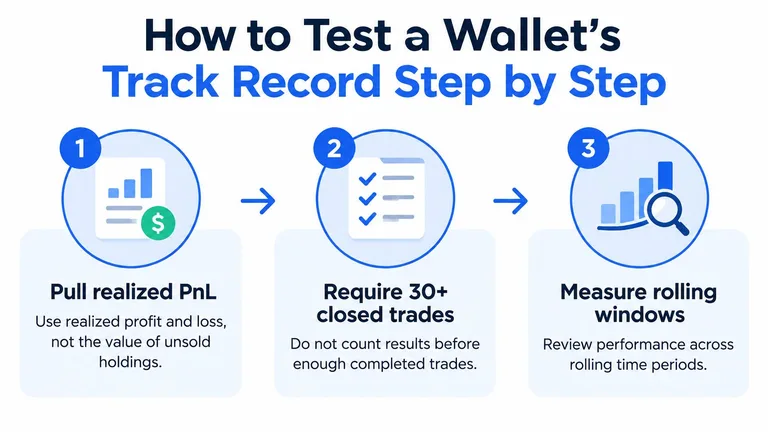
Calculate realized profit and loss. Subtract attributable acquisition costs and transaction costs from disposal proceeds. Keep unsold holdings separate, and flag transferred-in tokens whose original cost basis is unknown.
Set a closed-trade requirement before screening. Decide what counts as enough completed positions before looking at attractive wallets. Match the threshold to the strategy: rapid inventory turnover and occasional swing trades produce different-sized samples.
Use rolling evaluation windows. Compare recent results with a longer history, using consistent window definitions across candidates. Separate active periods from inactivity so a dormant wallet does not look stable because it made no trades.
Test persistence on later observations. Rank wallets using an earlier period, then assess them against a later period that did not determine the ranking. This reduces the risk of selecting wallets only after their success is visible.
Challenge the apparent advantage
Inspect concentration and drawdown. Recalculate the assessment without the largest winner, then examine losses between profitable exits. If removing one exceptional trade erases a wallet's apparent edge, lower your confidence in the record.
Reconcile related addresses. Check for direct transfers, recurring funding relationships, and coordinated disposal patterns before treating wallets as independent. Mark uncertain relationships as uncertain rather than claiming common ownership.
Compare like with like. Evaluate similar strategies together and check whether a wallet's behavior stays consistent. A shift from swing trading to automated launch buying makes its earlier record less comparable.
A wallet-level study reported through Fidelity, covering 1,101 candidate wallets and 6,062,848 reconciled native orders, found historically profitable wallets had 2.63 times higher odds of remaining profitable the following week. That relationship weakened after zero-profit observations were excluded, so how inactivity and break-even outcomes are treated affects the result.
The study also reported 89.4% cross-week retention for high-frequency trading behavior, compared with 34.8% for the low-price-entry behavior label. These figures describe how often behavior labels persisted, not the probability of making a profit.
Your output should be a ranked watchlist with confidence notes. Record accounting gaps, strategy changes, and concentration concerns alongside each score. A wallet's record is a probability signal, not a standing instruction to copy its next trade.
Two Wallets, Two Verdicts
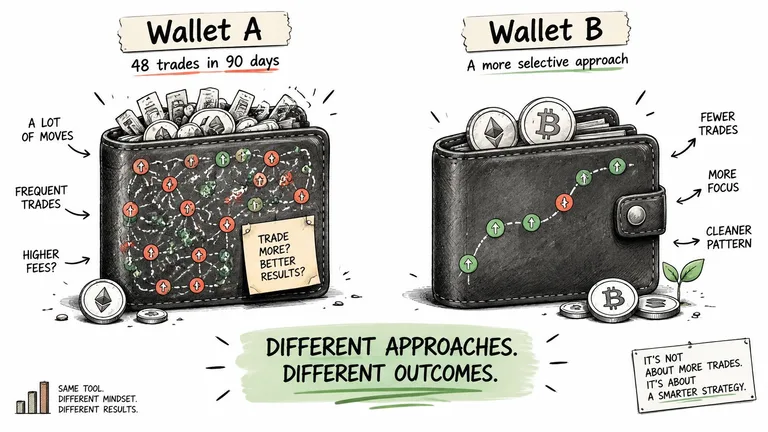
Suppose you're comparing Wallet A and Wallet B after both appear on a profitable-wallet dashboard. Wallet B has the more dramatic headline gain, while Wallet A attracts less attention.
The following figures are illustrative assumptions, not real addresses or observed results. They show how the same checks can produce different verdicts without relying on the largest profit screenshot.
Two hypothetical wallets tested with the same criteria
| Metric | Wallet A | Wallet B |
|---|---|---|
| Trades in last 90 days | 48 | 6 |
| Realized profit | Positive across 40 closed trades | About $95,000, mostly from one token |
| Largest single trade share of profit | 12% | 96% |
| Profitable weeks out of 12 | 9 | 3 |
| Verdict | Add to watchlist | Discount until more trades confirm |
Wallet A offers a broader basis for evaluation. Its hypothetical results suggest that removing the largest winner wouldn't erase the entire case for monitoring it.
Wallet B could still belong to a capable trader. But its visible record doesn't yet distinguish skill from an exceptional payoff, and the limited sample leaves little evidence about how the operator handles ordinary trades or losing periods.
A ranking advantage isn't certainty
A logistic-regression model using historical profitability, recent profitability, transaction count and PnL magnitude achieved an AUC of 0.681, while its Brier score improved from 0.2493 to 0.2278, approximately 8.6%, according to the candidate smart-money wallet study.
In plain language, AUC measures how well a model ranks outcomes, while the Brier score evaluates probability predictions, with lower scores indicating better performance. Neither metric tells you that a particular wallet's next purchase will succeed, and neither establishes your returns after copying costs.
The practical verdict is deliberately restrained. Wallet A earns monitoring, not blind trust; Wallet B needs more evidence before its headline result should influence a trade.
A watchlist is permission to investigate further. It isn't permission to skip token checks, and it doesn't establish whether the operator's strategy is available to an outside follower.
Where Smart Money Signals Mislead
A tagged smart-money wallet will keep winning.
That assumption confuses a provider's classification with a permanent property of the trader. Labels describe a selected cohort under particular rules, and a wallet can change strategy, migrate funds or distribute activity across addresses.
Crypto Economy's discussion of smart-money tracking on Solana highlights label decay, survivorship bias and activity that can inflate apparent performance. Give each classification a review date and a reason for renewal rather than carrying it forward indefinitely.
A wallet earned its label through skill
The wallets visible on leaderboards are already selected for outcomes that attracted attention. You may not see the unsuccessful addresses that followed similar approaches.
That's survivorship bias: evaluating the survivors without accounting for the broader group from which they emerged. An exceptional liquidity event can make a wallet look unusually capable even when its ordinary decisions provide little evidence of an advantage.
Ask when the label was assigned and which trades justified it. If the explanation consists entirely of a short winning streak, treat the label as a hypothesis to test.
A credible label needs a renewal rule, not just an origin story.
Visible activity is clean
A long transaction history isn't automatically a long history of independent economic decisions. Wash trading, airdrop farming and transfers among related addresses can create activity that looks more informative than it is.
Check what changed: economic exposure, beneficial control, pool reserves or merely the address holding the assets. Avoid counting internal movement as fresh demand.
Keep the interpretation bounded:
- Potential links: A connection warrants investigation, not an accusation.
- Missing records: Incomplete history reduces confidence rather than establishing safety.
- Unexplained activity: Preserve alternative explanations until the transaction sequence supports a conclusion.
In our reports, suspicious activity and potentially linked wallets are items to examine, not evidence of wrongdoing. The absence of data should not be interpreted as proof of safety.
A wallet-level signal also can't settle a token-level question. Creator behavior, holder concentration, liquidity and bundle or insider activity require their own assessment, even when a buyer has a credible trading history.
Execution Checks Before You Follow a Trade
Execution checks before following a wallet trade
| Check | Question to Ask | Warning Sign |
|---|---|---|
| Entry delay | How long after the wallet's entry does the alert arrive? | Minutes to hours after the wallet bought |
| Slippage | What is the realistic fill price after fees? | Executable quote far from the wallet's entry price |
| Liquidity depth | Can the position exit without moving the price? | Pool is thin relative to the planned size |
| Position size | How large is the copied position against pool depth? | Size is large relative to available liquidity |
| Trade direction | Was the wallet's move a directional buy? | Only a transfer, collateral move or liquidity action |
Public signals can arrive minutes to hours late, according to Hidden Systems' smart-money analysis. That delay matters because you're buying the available price now, not the historical price displayed beside the tracked wallet.
A late alert doesn't automatically invalidate a longer-horizon idea. It does mean the original trader's entry is no longer evidence that your entry offers similar economics.
Compare the trade you can actually execute
First, reconstruct the entry. Use the wallet's swap amounts to estimate its average execution price, then obtain a live quote for your planned order. Include route fees and transaction costs, and distinguish quoted price impact from slippage tolerance, which is a limit on acceptable execution deterioration rather than a fee you necessarily pay.
Next, test pool depth at your size. Use a router quote and a Solana liquidity check to inspect whether the available trading depth supports the intended position. Don't substitute headline token valuation or total trading volume for executable liquidity.
Finally, test the exit. Quote a sale of the proposed holdings and consider how the result changes if other holders sell first. Reduce size or skip the trade when exiting requires accepting a price move beyond your predefined limit.
Separate skill from copyability
A Solana meme coin with thin liquidity can be attractive to a small early buyer and unattractive to a later, larger follower. The tracked wallet may also use automation, hedges or execution routes you don't have.
Record the gap between the observed entry and your executable quote, then review whether following the signal worked after costs. This evaluates the strategy available to you rather than the one available to the original trader.
Signal quality and tradeability are separate questions. A trade needs a defensible yes to both, and uncertainty about either is a valid reason not to enter.
Verify the Signal Before You Follow the Money
The useful end product isn't a collection of impressive wallets. It's a decision record that explains why a particular action makes sense under the conditions you can observe.
Ask these questions in order, and allow unknown as an answer. Uncertainty shouldn't become approval just because a token is moving quickly.
Is the wallet's edge persistent? Require positive realized results across a credible trading sample and multiple evaluation windows. Check whether the conclusion survives removing an exceptional winner and resolving accounting gaps.
Is the signal fresh and tradeable at your size? Use the current executable quote, not the tracked wallet's historical price. Include delay, fees, price impact and a realistic exit in your decision.
Does token-level safety support proceeding? Examine liquidity, holder concentration, creator behavior and bundle or insider activity. A strong wallet history doesn't cancel an unresolved token risk.
If any answer is no, don't follow the trade. If an answer is unknown, investigate further or pass rather than treating missing evidence as favorable.
Use a second opinion without outsourcing judgment
MemeAssist brings liquidity, holder distribution, creator behavior, wallet activity, trading patterns and historical risk indicators into an explained Solana report. Use it for integrated research, explanations and tracking, not exclusive blockchain data, safety guarantees or profit promises.
That report is a second opinion, not a replacement for your own research. A token can lose value without a rug pull, and meme coins can cost you everything you invest.
Keep position sizing separate from confidence in the story. Even a well-supported interpretation can be wrong, and a correct interpretation can coincide with a loss.
Keep a record you can review
Paste this checklist into your watchlist before entering:
- Wallet: Address, relevant cluster notes and the reason it qualifies for monitoring.
- Timestamp: Observed transaction time and the time you evaluated it.
- Token address: Verified contract address rather than the ticker alone.
- Trade size: Intended position and the liquidity available for entry and exit.
- Delay: Elapsed time since the tracked wallet acted.
- Executable price: Current quote, fees and acceptable execution limits.
- Competing explanation: The strongest alternative interpretation of the activity.
- Decision answers: Persistent edge, tradeability and token-level safety, each marked yes, no or unknown.
Afterward, record the actual outcome and whether your original reasoning held up. Keep skipped trades too, so your review doesn't become another collection of selected winners.
MemeAssist offers explained Solana token reports that connect wallet activity with liquidity, holder distribution and other risk indicators. Visit MemeAssist to get a second opinion on the token behind a smart-money signal, then compare the evidence with your watchlist and executable quote before deciding whether to trade.
Topics: smart money crypto, on-chain analysis, wallet tracking, crypto whale signals, Solana trading
Informational only, not financial advice. Meme coins are extremely high-risk.
All articles