Sniper Bot Crypto: How They Work and How to Stay Safe
Learn what a sniper bot crypto is, how it exploits MEV on Solana, signal patterns to watch, and practical defenses to protect your trades.
Published
Updated
Automated activity on Solana has become large enough to shape what traders see: research summarized from a study of 44 million Solana transactions identified 15 bot categories and reported bot-related DEX transactions exceeding $250 million in daily volume in January 2026 (Brave New Coin's coverage of Solana meme-coin activity). That doesn't mean every busy launch is manipulated, or that bots cause every retail loss. It does mean the first price, trading activity, and apparent demand you encounter may already reflect automated decisions.
The useful question isn't only who bought first? It's who funded those wallets, whether they're acting together, and where the proceeds go. Speed matters, but a fast entry can be a warning sign when early buyers share funding or sell in coordination. Understanding that difference is more useful than treating a sniper bot as either a shortcut to profit or a threat that can be switched off.
Table of Contents
- Why Sniper Bots in Crypto Matter Right Now
- What a Sniper Bot Actually Is in Crypto Markets
- The Sandwich Mechanic and Why Meme Coins Are Exposed
- How Sniper Bot Behavior Differs Between Solana and EVM Chains
- When the Sniper Bot Is Part of the Scam
- Reading the On-Chain Evidence of a Sniper Attack
- Defenses Traders Can Actually Use Against Sniper Bots
- Legal, Ethical, and Final Risk Considerations
Why Sniper Bots in Crypto Matter Right Now
A token can look active before independent traders have had time to assess it. Automated wallets may buy as soon as a pool becomes available, trade repeatedly, or accumulate enough supply to influence how the launch looks to later buyers. A chart can show movement and a holder list can show multiple wallets, but neither fact alone tells you whether the buying reflects independent interest.
Solana makes this problem especially visible in newly launched meme coins. Bots monitor transaction flow and compete for favorable execution, while traders often make decisions under time pressure. The result is a noisy first impression: rising activity might mean genuine interest, automated competition, coordinated buying, or some mixture of all three.
The scale of automated trading doesn't prove that a particular token is unsafe. It does make it unwise to treat early speed or volume as proof of quality. A trader needs to check what sits behind the activity, including wallet relationships, liquidity, and the way early buyers behave after entering.
Look beyond the first trade
Public reporting presented at the Accelerate 2025 conference estimated that Solana sandwich bots extracted between approximately $370 million and $500 million over the 16 months ending in May 2025 (Lightspark's overview of sandwich activity). Sandwich bots aren't identical to launch snipers, but both depend on automated transaction ordering and execution priority. The estimate illustrates why order-flow competition matters beyond a handful of unusually fast trades.
Two easy conclusions miss the point. Buying faster isn't a substitute for checking risk, and avoiding every token touched by automation isn't a practical analysis method. A better approach is to understand what the bot is doing, look for signs that early wallets are connected, and decide whether the opportunity still makes sense after those checks.
What a Sniper Bot Actually Is in Crypto Markets
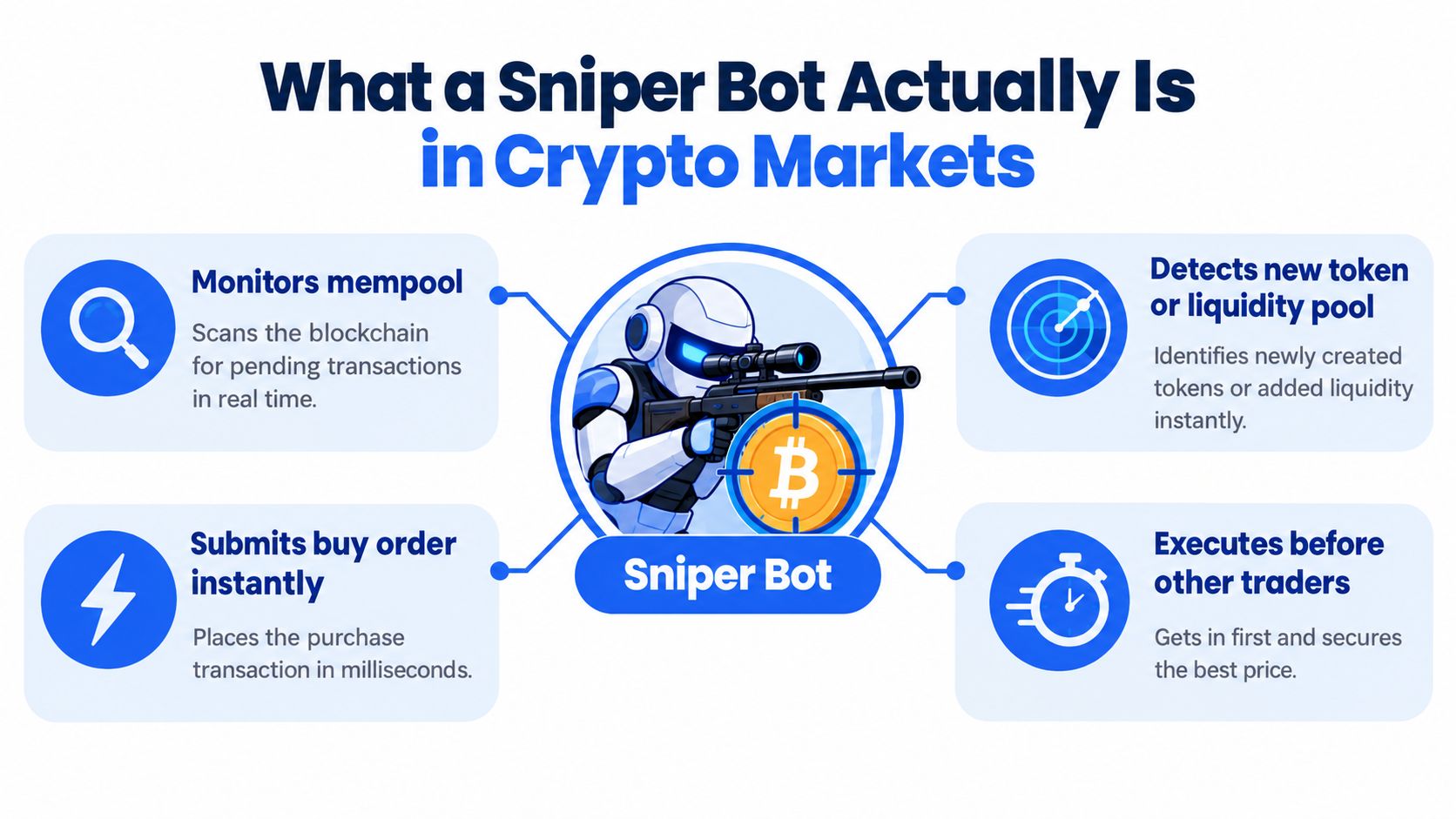
A crypto sniper bot is an automated trading system designed to detect a newly created token or liquidity pool and submit a buy faster than an ordinary trader can. On Solana, that activity sits within the broader field of maximal extractable value, or MEV, where participants use transaction flow, fees, routing, or ordering opportunities to seek more favorable execution.
Think of a concert where the best seats are released at the same moment for everyone. A human has to notice the sale, open the page, select a seat, and confirm the purchase. A bot can monitor for the release and submit its request automatically. The bot isn't guaranteed a seat, but it can react before a person finishes the same sequence.
Bundle-based infrastructure adds another layer. It can submit multiple transactions atomically, in a chosen order within the same block or slot. In practical terms, this can let a bot coordinate an action around a market's creation or a target trade instead of waiting for a public trading interface to refresh.
Separate sniping from related strategies
Sniping usually means attempting to buy as soon as a token or pool becomes available. Sandwiching is different: a bot places a trade before another user's swap and a trade after it, seeking to profit from the price movement its ordering advantage creates. Arbitrage seeks to profit from price differences between markets or pools. These strategies can all involve automation and execution advantages, but they aren't interchangeable labels.
That distinction helps when you're assessing a bot's claims. A tool described as a launch sniper may focus on reacting to new liquidity. A claim about sandwich protection concerns how your own transaction is routed or ordered. A claim about arbitrage describes an attempt to capture price differences. Ask what transactions the tool submits and under what conditions, rather than relying on a product label.
The Sandwich Mechanic and Why Meme Coins Are Exposed
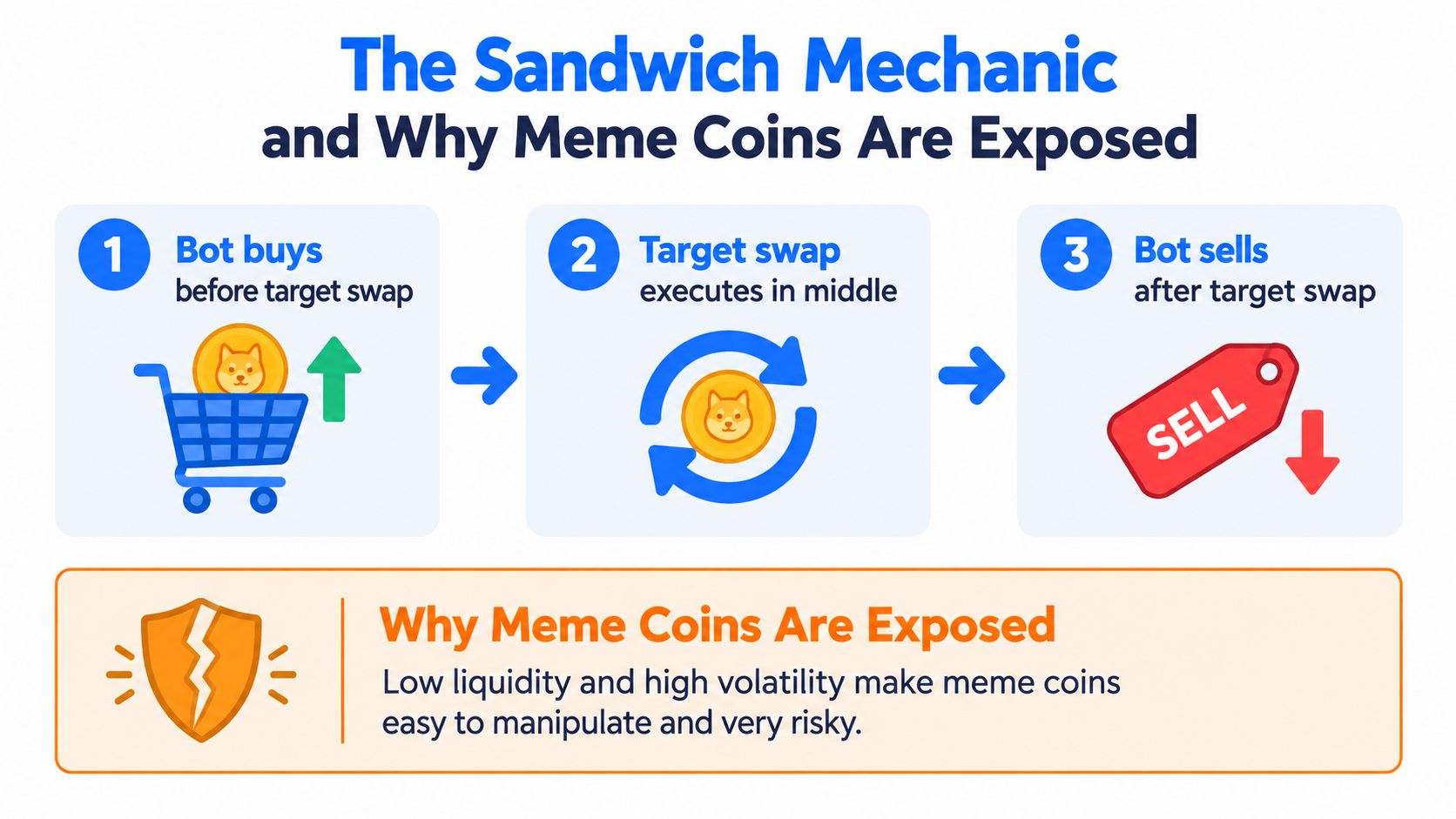
A sandwich attack has a recognizable shape. A bot spots a target swap, places a buy immediately before it, and sells immediately after. The bot's first trade pushes the pool price against the target trader. The target then receives fewer tokens for their input than they would have without the preceding trade, and the bot's follow-up sale aims to capture value from the induced movement.
Follow the three transactions
Suppose a trader tries to buy a thinly traded meme coin. The bot's buy consumes some of the available tokens and shifts the pool price upward. The trader's swap then executes at a worse price, and the bot sells into the movement after that swap. The exact result depends on pool conditions, trade size, fees, and slippage settings, so a single simple example can't represent every attack.
The practical risk is clearest when a trader accepts a wide range of possible execution prices. Higher permitted slippage gives a transaction more room to fill despite adverse price movement. That flexibility can help a trade execute in a volatile market, but on a thin pool it can also create a larger window for an attacker to profit from the victim's tolerance.
A 2025 measurement presented at Accelerate estimated that sandwich bots extracted approximately $370 million to $500 million from Solana users between January 2024 and May 2025, and that about 0.72% of blocks contained a sandwich pattern (Now Nodes' explanation of MEV on Solana). The important detection signal isn't speed by itself. Look for a repeated sequence in the same pool, close timing, a directional effect on the target trade, and a profitable reversal.
Meme-coin pools can be exposed because liquidity may be shallow while attention and trading are volatile. A trader's swap can move the price more in a thin pool than in a deeper one. Before you trade a launch, review the risks of the market structure itself, including Pump.fun bonding-curve trading risks.
This video also illustrates the transaction-ordering mechanics:
How Sniper Bot Behavior Differs Between Solana and EVM Chains
The phrase “sniper bot” can describe similar goals on different networks, but the transaction environment changes how bots compete. Solana and Ethereum use different execution systems, and Ethereum's major layer-two networks add their own transaction paths and market structures. Don't assume that a setting or protection strategy that makes sense on one chain transfers directly to another.
On Solana, launch sniping is closely tied to fast transaction flow, priority fees, and bundle-based execution. Those tools can help a transaction compete for inclusion or ordering, but they don't establish that the token is safe or that a trade is likely to profit. A trader still needs to assess the pool, token distribution, and relationships among early wallets.
Ethereum's public-mempool environment has provided a well-documented setting for sandwich attacks. Research covering Ethereum transactions in November and December 2024 identified 117,581 public sandwich attacks and 2,932 private-channel sandwich attacks (the Ethereum sandwich-attack study). That evidence describes Ethereum, not Solana meme-coin launches, so it's a reference for the mechanism rather than a direct measure of Solana activity.
Sniper and MEV conditions across chains
| Dimension | Solana | EVM (Ethereum and major L2s) |
|---|---|---|
| Launch activity | New token and liquidity events can attract rapid, automated buying. | Launch behavior depends on the chain, venue, and token's market setup. |
| Execution priority | Priority fees and bundle-based infrastructure can affect execution opportunities. | Transaction fees and ordering conditions vary across Ethereum and each L2. |
| Transaction visibility and routing | Transaction flow and routing choices matter to MEV exposure. | Public transaction visibility and private-channel options can shape exposure. |
| Practical check | Examine launch timing, wallet connections, and execution patterns. | Review the network's routing options and the specific venue's transaction behavior. |
Use the table as a prompt for chain-specific checks, not a guarantee that one environment is safer. On either type of network, rapid buying can be independent or coordinated. The chain tells you what execution conditions to investigate; wallet evidence helps you understand who may be behind the activity.
When the Sniper Bot Is Part of the Scam
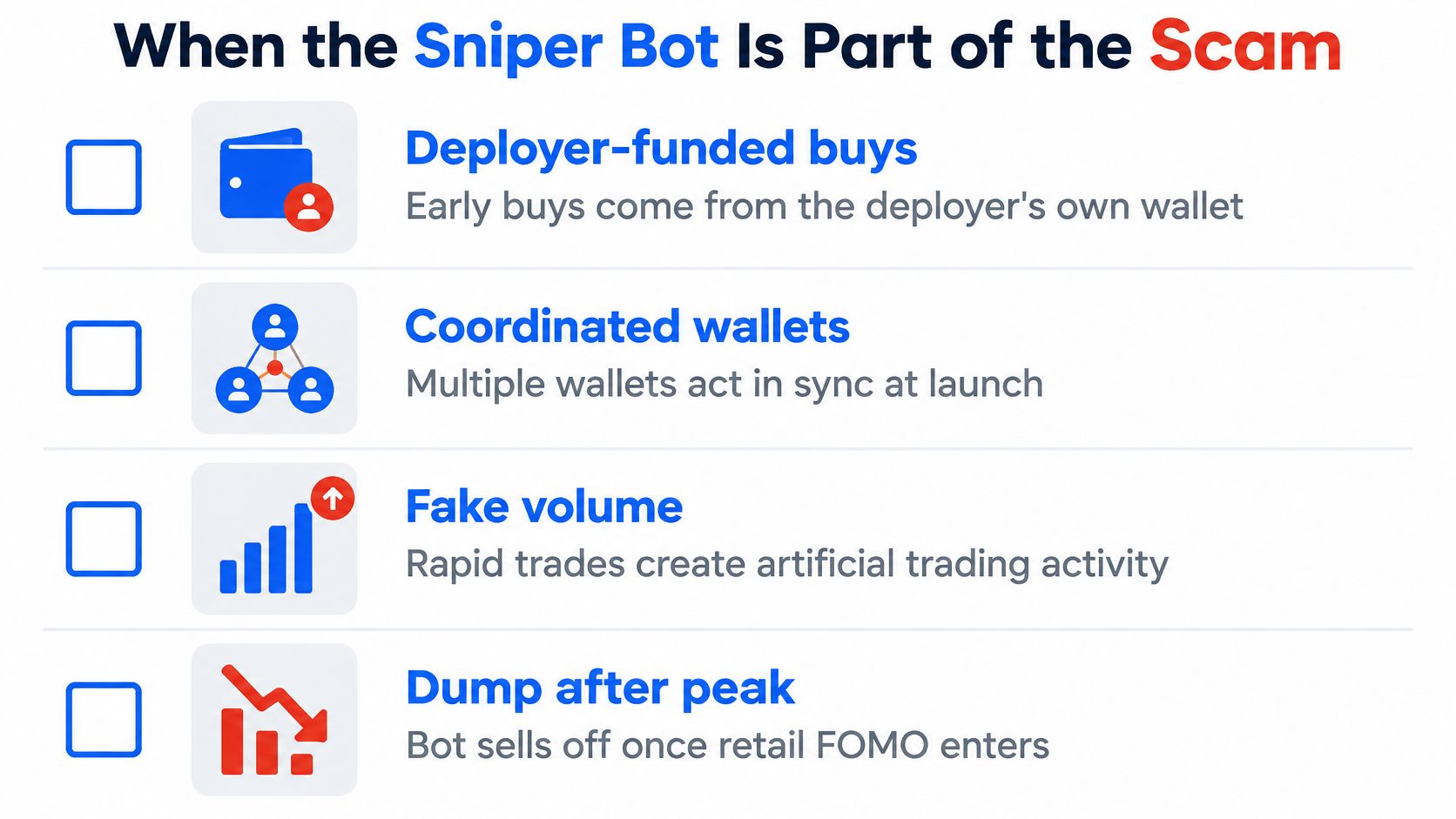
An early buy can look like conviction. It can also be a coordinated purchase funded by the token creator or another connected wallet. In that case, a series of fast buys may make a launch look popular before independent buyers have had time to participate.
A 2025 investigation describes deployers funding sniper wallets that buy in the same block as a launch, with activity spread across temporary wallets and coordinated exits intended to simulate organic demand (Gate's investigation into coordinated launch activity). That account doesn't mean every same-block purchase is an insider trade. It does show why “who bought first?” is an incomplete question.
Trace the relationship, not just the timing
Start with the funding trail. Did several early wallets receive funds from the creator, or from a shared wallet that may link them? Did those wallets buy in the same block or show similar entry behavior? Do they later send tokens or proceeds to the same destination?
No single clue proves coordination. A shared funding source may have an innocent explanation, and synchronized timing can occur when many traders respond to the same launch event. The case becomes more concerning when several signals line up, such as common funding, clustered purchases, related wallet behavior, and coordinated selling.
A token report should therefore distinguish entry speed from wallet relationships. Speed describes how quickly an account acted. Relationship analysis asks whether the accounts may be connected, who funded them, and where value flows after the trade. Those are separate questions, and collapsing them into one “smart money” signal can disguise insider inventory as independent demand.
Practical rule: Treat unusually coordinated early buying as a reason to investigate, not as proof that a launch has momentum.
When early holders appear linked, ask whether later buyers might be providing their exit liquidity. The trader who sees a rush of green trades may be looking at planned distribution rather than broad interest. Follow the funding and proceeds before deciding what the launch activity means.
Reading the On-Chain Evidence of a Sniper Attack
A launch begins, liquidity appears, and several wallets buy almost immediately. The chart moves before a person can assess the token. Later, some early wallets transfer tokens or proceeds elsewhere. That sequence can be consistent with automated buying, but a chart alone can't tell you whether the buyers were independent or connected.
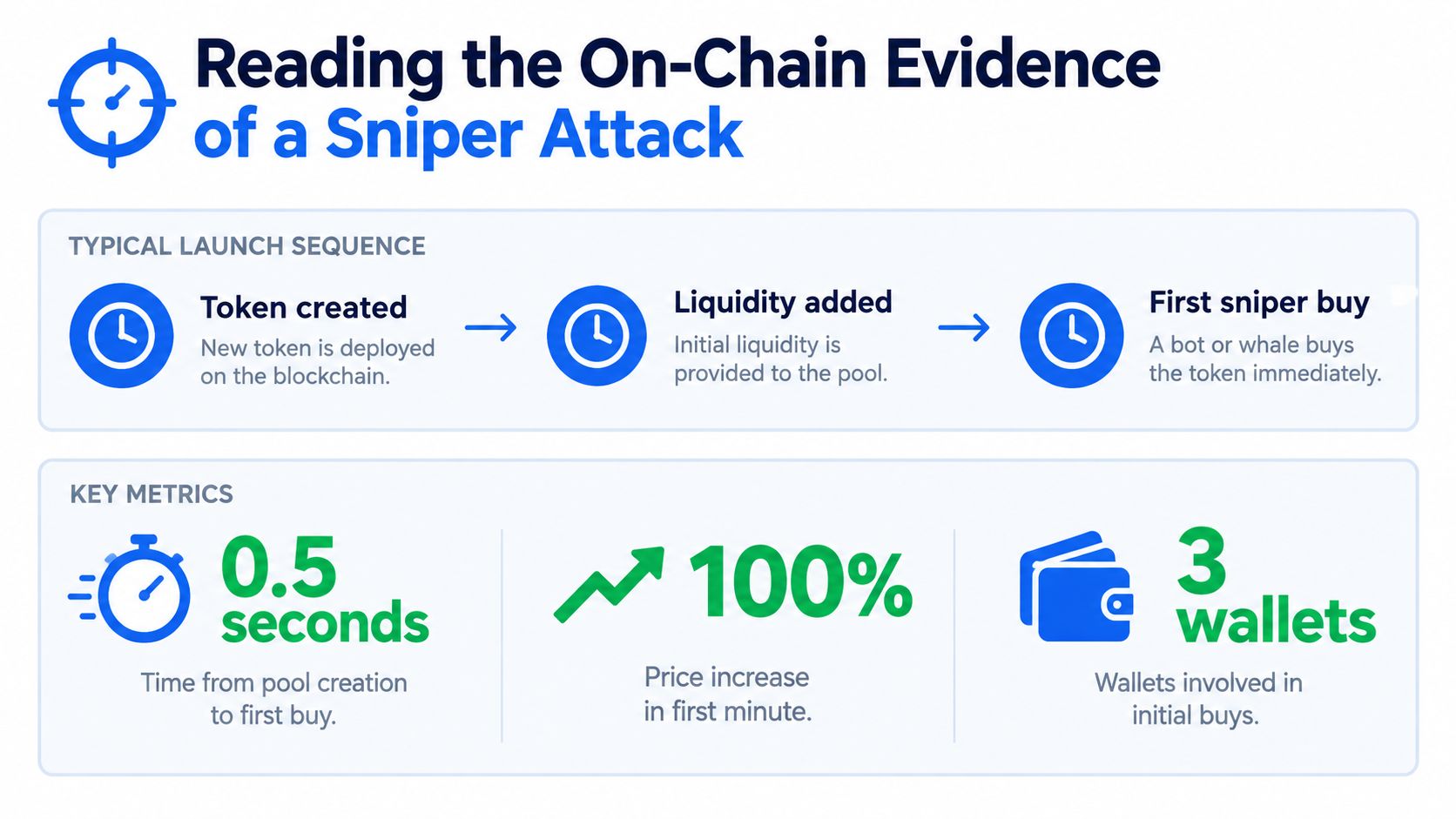
The infographic's illustrative timing and wallet counts aren't evidence about a specific token. For an actual launch, verify timing and wallet activity against the token's on-chain records. Look at which transactions occurred close together, whether several wallets bought in the same block or slot, and how ownership is distributed after those purchases.
Weigh signals as a group
- Wallet funding: Check whether early buyers received funds from a shared source or from wallets associated with the creator.
- Holder concentration: Review whether a small set of wallets controls a notable portion of the available supply. Concentration can magnify selling pressure, but it needs context.
- Transaction ordering: Look for coordinated purchases or a bundle-like pattern rather than treating one fast transaction as conclusive.
- Exit flows: Follow whether early wallets sell independently or send value toward the same destination.
- Trading context: Compare on-chain activity with the wider evidence available for the token. A burst of trades alone doesn't establish organic demand.
Some observations are noisier than others. One fast buy may reflect a trader using automation. Several wallets with similar timing deserve a closer look, especially if the funding and exit patterns also connect them. A token score is more useful when you can see the underlying evidence behind it.
For a focused explanation of wallet clues, consult this guide to sniper wallets on Solana tokens and what they mean. The aim isn't to label every fast wallet a scammer. It's to distinguish isolated activity from a pattern that makes apparent demand less trustworthy.
Defenses Traders Can Actually Use Against Sniper Bots
No setting can make a risky launch safe. But traders can reduce avoidable execution exposure and avoid treating speed as a reason to skip due diligence. Start with the transaction itself, then decide whether the token deserves a trade at all.
Control what your transaction will accept
Set slippage with the pool's liquidity and volatility in mind. A setting that's too tight may cause a trade to fail; one that's too wide can accept a substantially worse execution. If you can't explain why your chosen tolerance fits the trade, pause rather than widening it just to force a fill.
Calibrate priority fees to the conditions you're trading in, and understand whether your routing choice offers any protection relevant to that transaction. Private routing or other protection mechanisms can alter exposure, but they don't verify a token's creator, distribution, or selling behavior.
Keep wallet hygiene separate from trade analysis. Don't connect a wallet or sign an unfamiliar prompt just to see a token report. Use a token address to research the asset, and treat requests for unexpected permissions as a reason to stop.
Make the decision from evidence
Before buying, review liquidity, holder concentration, creator activity, wallet behavior, and trading patterns. Track suspicious signals as they develop rather than treating a single report or price snapshot as a permanent verdict. If several early wallets appear connected, or if the trade depends on buying before you can assess who holds the supply, skipping the token may be the strongest defense.
A practical safety routine is simple:
- Check the token address: Confirm you're analyzing the asset you intend to trade.
- Review the pool: Consider whether liquidity can support both entry and exit.
- Trace early wallets: Look for shared funding and related selling behavior.
- Set execution limits: Choose slippage and routing deliberately, not under launch pressure.
- Be willing to pass: A missed trade is preferable to an entry you can't explain.
For a broader checklist, use this guide to buying Solana memecoins safely. A disciplined trader doesn't need to beat every bot to make sound decisions. They need to know when the evidence is too weak, the execution risk is too high, or the apparent demand may come from wallets that are not independent.
Legal, Ethical, and Final Risk Considerations
Sniper activity can range from aggressive competition for a new market to conduct that raises questions about manipulation. Whether a particular pattern violates a law or a platform rule depends on the jurisdiction, venue, and facts. Automated trading, front-running, sandwiching, and coordinated activity aren't interchangeable legal categories, so traders shouldn't assume that every bot is unlawful or that every automated strategy is acceptable.
The ethical concern is more concrete: some activity can make demand look broader or more independent than it is. A trader who follows only the earliest buys may mistake connected wallets for genuine market interest. Checking funding sources and eventual proceeds helps put that activity in context, even when the available evidence can't establish intent with certainty.
Keep a short set of rules in mind:
- Treat early buying as a clue, not an endorsement.
- Assess wallet relationships separately from transaction speed.
- Prefer evidence and clear risk explanations over promises of faster entry.
- Revisit a token's condition as trading and ownership change.
A token analysis is a view of observed evidence, not a guarantee about what will happen next. The question isn't whether a bot can buy earlier than you. It's whether the market structure and wallet behavior give you a reason to take the risk at all. Faster automation doesn't replace independent judgment, and a fast entry into a coordinated launch can leave a trader holding what someone else planned to sell.
MemeAssist provides on-demand Solana token reports that combine live on-chain and market checks with a plain-English explanation of risk signals. If you're weighing a launch where early buyers may be coordinated, visit MemeAssist to review the evidence before deciding whether to trade.