Solana Wallet Tracker: How It Works for Meme Coin Risk
Solana wallet tracker basics: read holder concentration, funding trails and early buyers, with thresholds and a pre-buy checklist for meme coin risk.
Published
Updated
You refresh the chart and the token is already up. Nine wallets bought in the first minute, and every one of them is green. A tracker labels two of them whales. Your thumb hovers over buy.
That is the moment most guides get wrong. They tell you to watch big wallets and copy the profitable ones. Profit on a two-minute-old chart is a weak clue. The useful question is how those wallets are related. Did one funder pay for several of them? Did they buy the same size, in the same seconds, and later sell through the same route? A wallet can look smart and still be one arm of a bundle.
A Solana wallet tracker is how you ask that question with public records instead of a hunch. It will not name the person behind an address. It will show holdings, funding, timing, and exits. Read those together, and a pretty PnL stops looking like a reason to follow.
Table of Contents
- What a Solana Wallet Tracker Shows You
- How a Wallet Tracker Reads the Ledger
- The Numbers to Check First
- Spotting Creator and Bundle Wallet Coordination
- Reading Early Launch Buyers Without Copying Them
- Privacy, Security and the Limits of Attribution
- Run a Pre-Buy Wallet Check Before Every Trade
What a Solana Wallet Tracker Shows You
A Solana wallet tracker follows the addresses behind a token and shows their holdings, transfers, funding sources, and trading history, all read from the public ledger.
Think of a company share register that updates in under a second. You can see who holds how much, and the minute a block of shares changes hands. Then correct the picture. The register lists addresses, not people. One trader can control many addresses. One address can be a bot, a liquidity pool, or an exchange hot wallet. If you treat every row as a separate human, concentration looks milder than it is, and "independent buyers" can be the same operator wearing new keys.
Three tools people mix up
Token scanner: This checks the mint. It looks for mint authority, freeze authority, and other contract settings. It does not follow who bought.
Wallet tracker: This follows holders and their movements. Balances, inbound SOL, swaps, and later sells live here.
Portfolio tracker: This watches your own wallet. It is for your PnL, not for judging a launch.
A holder tool answers three questions. Who holds the supply right now? Where did that supply, and the SOL behind it, come from? What did those holders do next?
Practical rule: If a screen cannot show the funder and the next sell, it is a balance list, not a tracker.
The checks below turn those three questions into numbers, a way to read them, and a routine you can run before you buy.
How a Wallet Tracker Reads the Ledger
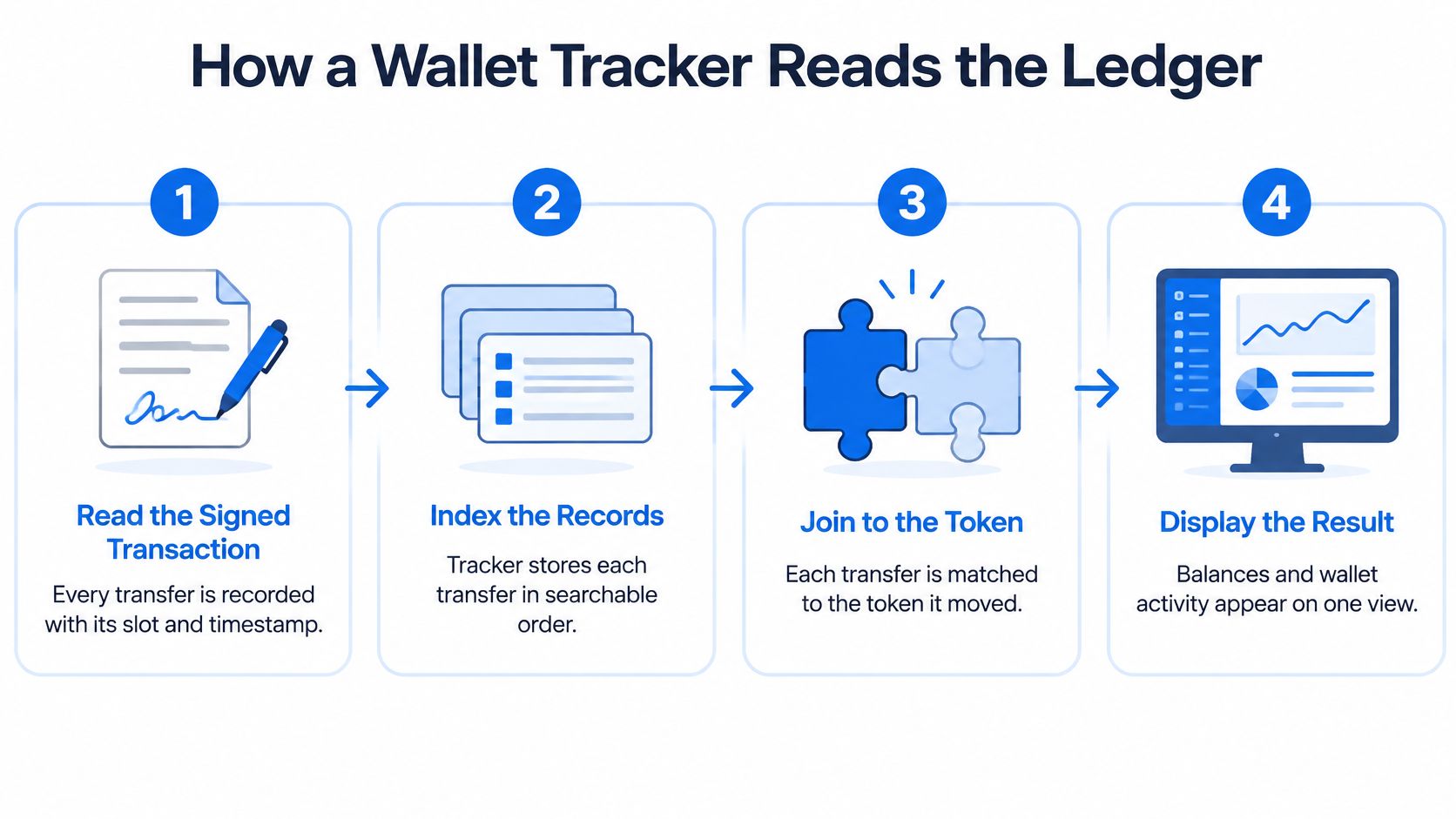
Every transfer is a signed transaction with a slot and a timestamp. A tracker indexes those records and joins them to one token so you are not scrolling a raw explorer.
The pipeline runs in a fixed order.
- Read the mint and its token accounts. The mint is the token. Holdings sit in token accounts, not in the wallet key itself.
- Map balances to holders. Sum by owner. One owner can hold the same token in several associated token accounts. If the tool lists each account as a separate holder, concentration looks smaller than it is.
- Pull history for each address. You want order, not a single balance snapshot.
- Trace the first inbound SOL. That payment is the practical funder. It is the wallet that paid for fees and the first buys.
- Group shared funders and shared seconds. Wallets funded together, or trading in the same seconds, belong in one cluster until you can explain them apart.
- Score and stamp the time. A cluster at minute one is a different fact from the same wallets drifting in a day later.
Steps four and five do the heavy lifting. A profitable wallet tells you someone won a trade. A shared funder tells you two "separate" wallets may answer to one operator, and that is the fact that changes whether a holder count means anything.
Scale is not the same as users
Headline address counts mislead if you treat them as people. Cointelegraph reporting on Artemis and Solscan data put Solana's monthly active addresses above 100 million in July 2025, versus about 509,000 at the start of 2024, roughly 196 times or about 19,550%, and stressed that many addresses were empty. The same reporting put daily active addresses in the second quarter of 2025 at roughly 1.5 million to 4 million, counting addresses that signed at least one transaction in 24 hours. 21Shares reported a 2025 average of 1.2–1.5 million daily active addresses. Monthly breadth, daily signers, and funded humans are three different counts. Confirm which metric your tool uses before you compare two screens.
| Data layer | What it reveals | Blind spot |
|---|---|---|
| Token balances and token accounts | Current holdings per owner | One owner can split holdings across several token accounts |
| Transfer history with timestamps | Order and timing of moves | Timing shows sequence, not intent |
| Funding source | The first inbound SOL that paid for the wallet | Exchange deposits and intermediaries hide the real origin |
| Counterparties and DEX swaps | Which pools and wallets trade together | Bots and pools appear as ordinary counterparties |
| Wallet age and transaction count | How old and active an address is | Operators can age wallets with small transfers |
Match the layer to the question. Balances answer who holds supply. Funding answers where it came from. History answers what they did next. None of them, alone, proves a name, and every blind spot in the table is a place where an innocent explanation still fits.
The Numbers to Check First
These bands are a personal screen, not a law and not an exchange rule. A higher-risk reading means look harder before you buy. A lower-risk reading means that signal is not your main worry.
| Signal | What to measure | Higher-risk reading | Lower-risk reading |
|---|---|---|---|
| Largest single wallet (excluding pools and burn address) | Share of total supply | Above 10% | Under 3% |
| Top 10 wallets combined (excluding liquidity pools) | Share of total supply | Above 50% | Under 25% |
| Liquidity depth | Pool value as share of market cap | Under 3% | Above 10% |
| LP tokens | Lock or burn status | Unlocked and held by creator | Locked or burned with a verifiable lock |
| Sell impact | Slippage on a sell of about $100 | Above 5% | Under 1% |
| Clustered holdings | Supply held by wallets sharing one funder | Above 10% combined | None found |
Holders, then the pool
Exclude liquidity pools and the burn address before you rank holders. A pool is inventory for trading, not a person waiting to dump. Count it in the top 10 and you hide real concentration, or you panic at a number that is mostly the pool.
Take two tokens with the pool removed. On the first, the top 10 still hold 61% of supply. On the second, they hold 18%. The first sits above the 50% band, so you trace funders before you size a buy. The second sits under 25%, so holder share is not the reason you walk away. You still check liquidity and the creator.
Liquidity and the exit
Depth under 3% of market cap means a small sell moves the price a lot. LP tokens that are freed up in the creator wallet mean that depth can vanish. Slippage above 5% on a roughly $100 sell is the same problem felt in your own order. A thin pool can be innocent on a brand-new mint. It is still a bad place to size up.
One funder, many wallets
If wallets that share one funder hold more than 10% combined, treat them as one holder until you can separate them. A fresh launchpad paying gas is a common innocent case. Write that down. Do not ignore the overlap.
Test the bands on a few tokens whose ending you already know. If they would have waved through a coin that died in an hour, tighten them before you trust them on a live chart.
Spotting Creator and Bundle Wallet Coordination
A cluster is not proof of one operator. Most trackers show balances, transfers, and a trading history. They rarely say whether those wallets are one person, a market maker, or strangers who happened to buy the same coin.
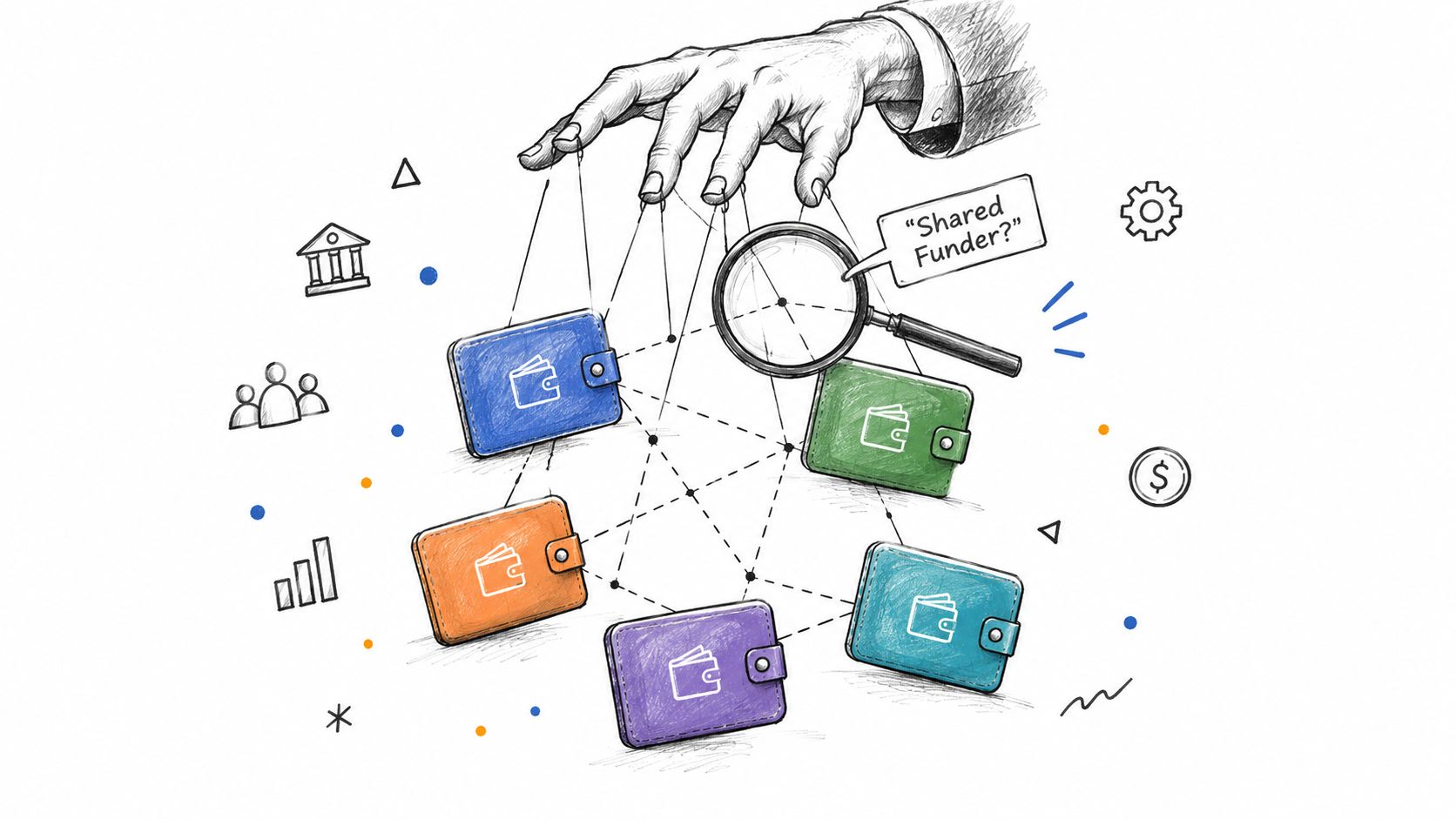
That gap matters on meme launches. Research on 100,063 tokens issued in the first half of 2025 identified 76,469 suspected rug pulls and at least $151 million in direct losses, plus 78 large fraud syndicates that reused "star" and "cluster" wallet structures, according to a 2025 token-fraud study. The pattern is relationships, not a single fat balance.
What a link can mean
| Evidence | What it may indicate | Innocent explanation |
|---|---|---|
| Same funder sends SOL to several wallets within minutes | One operator splitting supply across wallets | Launchpad or bot infrastructure funding transaction fees |
| Equal initial token allocations across wallets | Pre-planned bundle at launch | Market maker split or airdrop |
| Repeated buy and sell timing across wallets | Coordinated trading | Shared trading bot or copy-trading tool |
| Common destination for sale proceeds | Liquidity extraction through one route | Shared exchange deposit wallet used by many users |
| Same creator behind several earlier launches | Repeat launch pattern | Creator with several legitimate projects |
Read each row as a lead. A shared funder in the first minutes is stronger than similar buy times an hour later, because copy-trade bots pile into the same candle without sharing a key. Equal clips at the first slot look like a bundle. They can also be a market maker splitting inventory. A shared exit into one deposit address looks like extraction until you notice it is a busy exchange wallet. Creator history across tokens is a habit, not a verdict. Some people ship several real projects.
A practical walk-through of bundle checks sits in this guide on how to check if a Solana token is bundled. Use it to list links. Do not stop at a red badge.
Keep two labels. An observed fact is "this wallet received SOL from that funder at this slot." An inference is "these wallets are probably one operator." Give the inference a confidence level. High confidence needs more than one column from the table, for example a shared funder plus equal clips plus one exit route. One column stays a maybe.
A wallet's profit, or its follower count, does not establish trust. The relationship graph, and how the behavior unfolds over time, is the signal. Smart-looking PnL is what a bundle is designed to display.
Reading Early Launch Buyers Without Copying Them
The token triples in ten minutes. Nine of the first buyers are in profit. This is when traders most want to copy a wallet, and it is the window most often manufactured.
Solidus Labs' review of Pump.fun and Raydium pools covered more than 7 million Pump.fun tokens created from January 2024 through March 2025. 98.6% showed signs of pump-and-dump or rug-pull behavior, and fewer than 100,000 kept more than $1,000 in liquidity. In the same reporting, 93% of 388,000 Raydium pools showed soft-rug characteristics, with median losses of $2,832 and a maximum reported loss of $1.9 million. Early buying, by itself, is not a quality signal.
Questions for the first minutes
Work down this list while the candle is still young. Skip one and the story gets flattering.
- Wallet age: A key funded today is not a veteran. A year-old key can still be a prepared insider. Age removes the laziest fresh-wallet story. It does not clear the buyer.
- Funding source: Who sent the first SOL? Park the shared-funder test from the section above here. Do not rebuild it.
- Entry sequence: Did they buy before public chatter, in the same slot, with no gap?
- Trade-size regularity: Identical clips repeat. Humans vary.
- Buy-to-sell timing: A buy and a sell a few slots apart is inventory recycling, not conviction.
- Liquidity depth and slippage: If the pool cannot absorb the size they pretend to hold, the print is theater.
- Post-launch exits: Watch whether "independent" winners leave through the same pool in the same minute.
Survivorship bias does the rest. After a pump you see the wallet that was early and right. You do not see the dozens that took the same bet and got stuck. Intermediaries can also hide the link, so the visible winner may be a hop away from the funder.
Copying that wallet is not research. A short method for judging repeat early buyers, without treating profit as proof, is how to track smart money wallets on Solana. The test is coordinated accumulation, artificial volume, or liquidity that can be pulled. A green early wallet fails that test often enough that you should not follow it on autopilot.
Privacy, Security and the Limits of Attribution
Watching a public address is passive. You read what the chain already shows, and nothing you look at can move your funds. The danger starts when a site asks you to connect a wallet or sign something.
Hacken's 2024 loss review, as reported by ForkLog, put Web3 losses above $2.9 billion, with access-control vulnerabilities accounting for 78% of breaches. Read that figure carefully. Access control there means protocol-level failures: flaws in smart contracts and key management that let attackers move funds they should never have reached. Your risk as a tracker user sits on a different layer. It is the signature you approve without reading, the token approval that hands a contract permission over your balance. The review measured broken code and compromised keys. The loss you can cause yourself comes from one bad click.
Habits that keep the read separate from the funds
Do not sign to view a report. A real read of public data does not need your signature. If a site asks for one just to show you a wallet, close it.
Keep analysis off the trading wallet. Use a browser profile that does not hold the keys you trade with.
Use a fresh wallet for tests. If you must connect somewhere, fund it with a small amount you can lose.
Your own history is public too. Anyone can trace the wallet you buy with, including size, timing, and what you still hold. A tracker can also surface holdings of people who never asked to be watched. Publish less. Do not paste your main address into chats to prove a trade.
What a flag is allowed to mean
A flagged wallet is a starting point for further checks. Nothing in the flag counts as evidence of misconduct by itself, and a clean report means only that no alarm fired. The chain cannot show you an intermediary, an old associated token account, or a funder that routed through an exchange first. When the record is thin, the honest label is "unknown." Unknown is a reason to size down or skip. It is not a reason to relax.
Run a Pre-Buy Wallet Check Before Every Trade
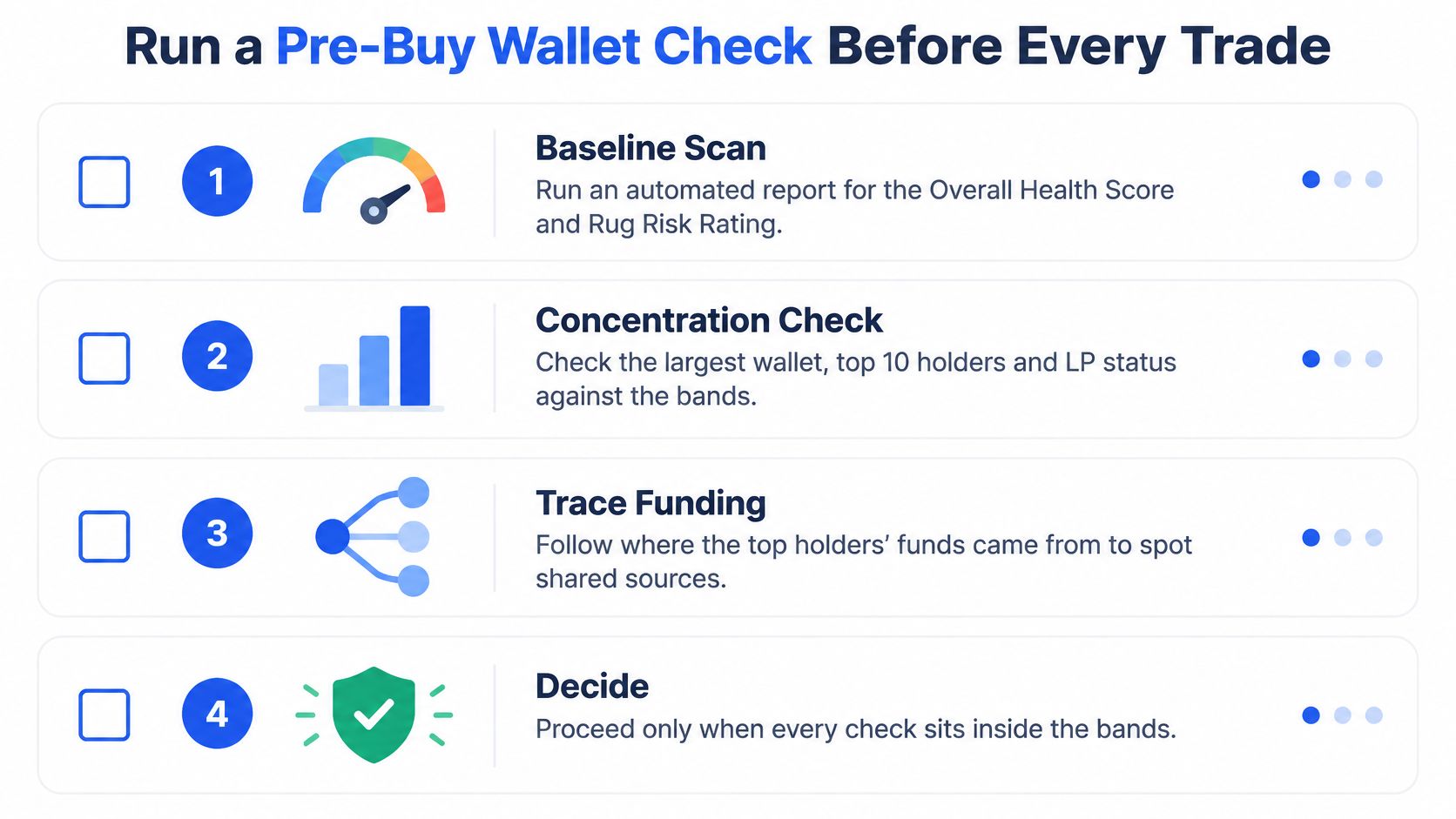
Run this before the order, not after the candle cools. Each step is one action and one reason.
- Run an automated report first. You want a baseline Overall Health Score and Rug Risk Rating so you are not starting from a blank chart.
- Check the largest wallet, the top 10, and LP status against the bands. You are screening concentration and whether the pool can be pulled.
- Trace funders of the top 10 and note any shared source. Overlap turns ten holders into fewer real owners.
- Review the creator's earlier launches. A repeat pattern is context. It is not, by itself, a guilty verdict.
- Watch the first 15 minutes for early buyers exiting into the same pool. Shared exits are the live version of a shared route.
- Size the position as if the token could go to zero. The check reduces surprise. It does not remove the chance of a total loss.
- Re-check after 24 hours and log what changed. New funders, LP that is no longer locked, or a quiet top holder who started selling belong in the note.
Who does which job
The report is the filter. The tracker is the check on who and where. MemeAssist connects token checks, wallet evidence, and market structure in one explained Solana report with an Overall Health Score, Rug Risk Rating, AI Verdict, and Detailed Risk Breakdown. Each analysis evaluates six signal categories: liquidity, holder distribution, creator behaviour, wallet activity, trading patterns, and historical risk indicators. Suspicious activity or potentially linked wallets in those reports are items to examine, not evidence of wrongdoing, and the absence of data should not be read as proof of safety.
If the report and the wallet check disagree, stay out until you can explain the gap. A calmer sequence for the buy itself is how to buy Solana memecoins safely. The tracker does not owe you a winner. It owes you a clear no when the wallets are not independent.
MemeAssist turns a pasted Solana mint into one explained report, so holder concentration, funding links, creator history, and liquidity sit next to an Overall Health Score and a Rug Risk Rating instead of across five browser tabs. That is the pre-buy wallet check in a form you can rerun before the next launch, with the links labeled as leads rather than verdicts. When you are ready to run it on a token you are considering, visit MemeAssist.