Token Analysis Checklist Before You Buy
Run token analysis on a Solana meme coin: liquidity, holders, creator history, the first hour of trades, and a pass or fail risk verdict.
Published
Updated
Most coins do not die on the candle you bought. They disappear later, and a launch print does not tell you which path you are on. A lifetime study of cryptocurrencies from 2009 through 2021 found significantly better survival outcomes for tokens than for coins, with a chi-square statistic of 42.02 and a p-value below 0.001, in the University of Pretoria cryptocurrency survival analysis. The same tests found minable cryptocurrencies carried a significantly higher failure risk. That is the reframe for token analysis. A green open is not proof the market will still take your sell tomorrow, or in twenty minutes.
On a Solana meme coin the evidence is narrower than a brand, a ticker, or a busy social feed. You are deciding whether the chain is safe enough for a defined size, or whether you pass. I would rather miss a runner than fund someone else's exit.
Table of Contents
- What Token Analysis Is For
- Pass Caution and Fail Screens
- How to Run the Checks in Order
- Reading the First Hour of Trades
- Who Can Sell Before You
- Write the Risk Verdict and Size
What Token Analysis Is For
Say the pool looks deep because it is full of the token, the chart is already up, and mint or freeze authority is still live. You are not looking at demand. You are looking at a door the creator can still close. Token analysis exists to catch that gap before you size a buy.
The decision is pass, caution, or do not buy, on a defined amount. It is not a story about the meme. Work liquidity, who holds supply, what the creator did before, how wallets are funded, how the tape prints, and what earlier launches from that wallet looked like. A name does none of that. Neither does a rising print.
Waiting for a long track record is the wrong method on these launches. The pattern that later gets called a rug usually shows while the market is still new, often inside the first hour, and sometimes in the opening minutes. You will not get a week of honest tape. You get a short window, and you judge only what that window contains.
A pool balance is not safety if the creator can still mint, freeze, or pull the quote asset.
Fill the screens, read who can sell, then write a verdict you can act on. If any hard fail is open, the trade is a pass, not a smaller buy you talk yourself into.
Pass Caution and Fail Screens
Apply this screen before you invent a narrative for the contract. Walk it from the top. Each row is trying to stop a different way you get stuck with a token you cannot leave.
| Check | Measure | Caution | Fail |
|---|---|---|---|
| Liquidity depth | Pool value versus your order size | Your order would move price more than a few percent | Liquidity unlocked or removable by the creator |
| Supply controls | Mint, freeze, and metadata authority | Authority retained but unused | Active mint or freeze authority |
| Holder concentration | Top wallets excluding the pool and known programs | Largest non-pool wallet or linked cluster holds roughly a tenth to a fifth of supply | One wallet or linked cluster controls about a fifth or more |
| Wallet links | Shared funding and same-block buys | Several buyers funded from one source | The cluster behaves as one seller |
| Early trading | First five to sixty minutes of buys, sells, and unique wallets | Volume from a handful of addresses | Wash loops, bundles, or snipers take most of the float |
| Creator history | Prior tokens from the same wallet | Prior launches with abandoned liquidity | Repeat rug pattern or concealed ownership |
| Exit capacity | Liquidity near the current price versus a realistic sell | You could exit only at a large discount | Insiders can sell before ordinary buyers |
Liquidity and supply
Liquidity depth compares pool value with your order, not with the market-cap headline. A huge cap on a thin quote side means your buy is the move. Caution when that order would shift price more than a few percent. Fail when liquidity is released or still removable by the creator, because the pool you priced against can vanish. Supply controls cover mint, freeze, and metadata authority. Retained but unused is caution. The switch still exists even if nobody has flipped it. An active mint or freeze authority is a fail. You do not wait to see them use it.
Holders and linked wallets
Holder concentration counts wallets only after you exclude the pool and known programs. A liquidity pool in the top ten is not a whale. Caution when the largest non-pool wallet, or a linked cluster, holds roughly a tenth to a fifth of supply. Fail when one wallet or linked cluster controls about a fifth or more. Wallet links look for one funder and same-block buys that turn several addresses into one seller. Several buyers funded from one source are a caution. If that cluster then sells as one entity, it is a fail. A raw top-ten share misses this, which is why top-holder concentration as a rug signal only helps after those exclusions.
Tape, history, and the exit
Early trading is the first five to sixty minutes of buys, sells, and unique wallets. Volume from a handful of addresses is caution. Wash loops, bundles, or snipers that take most of the float are a fail. Creator history is caution when prior launches left abandoned liquidity, and a fail on a repeat rug pattern or concealed ownership. Exit capacity asks whether a realistic sell clears near the current price. Leaving only at a large discount is caution. Insiders who can sell before ordinary buyers are a fail.
One fail outweighs several passes. A full set of cautions is a reason to cut size, not a green light.
How to Run the Checks in Order
A later chart should not talk you out of an early fail. Run the checks in this order so the candle is the last thing you look at, not the first.
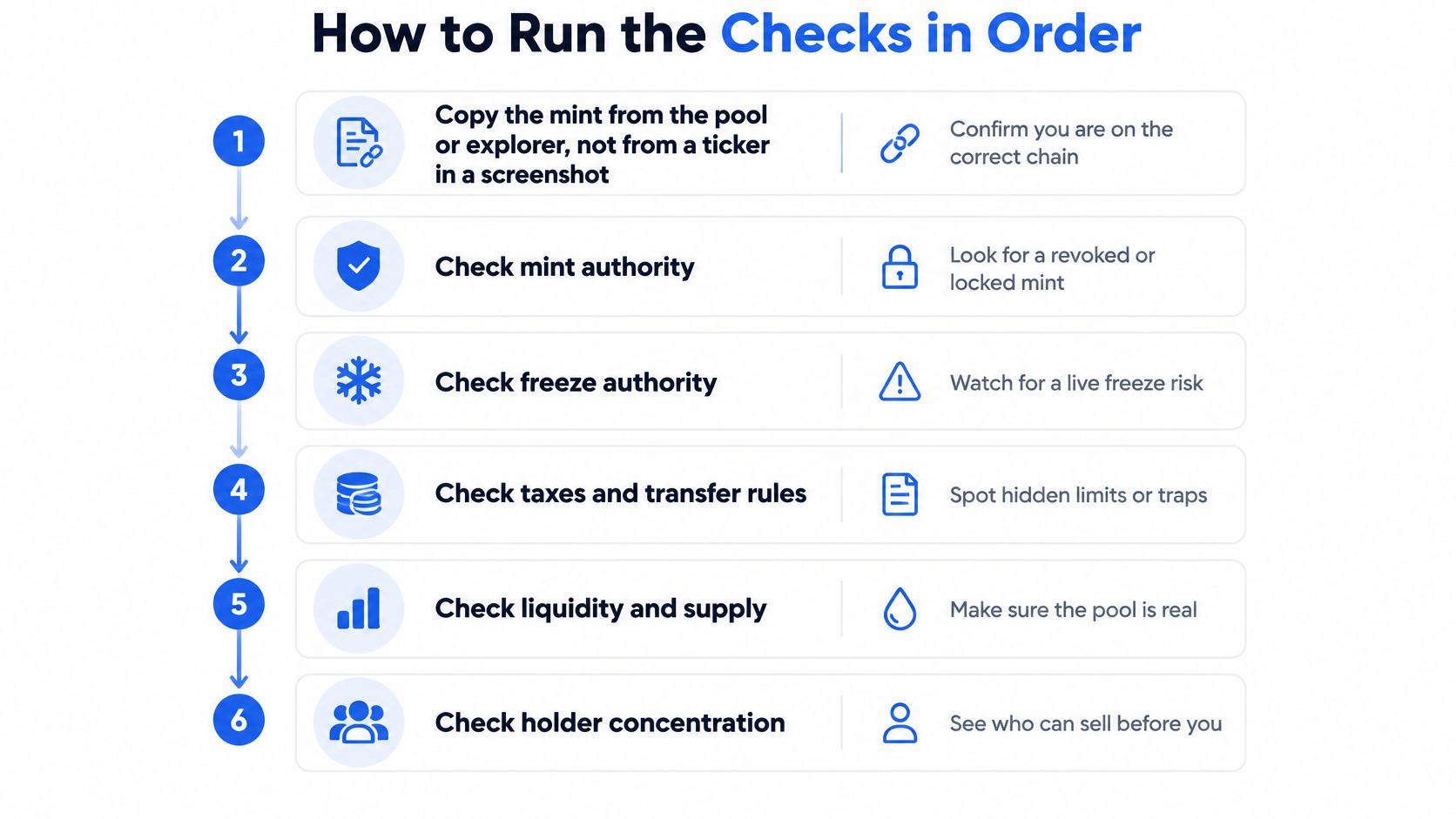
Each analysis evaluates six signal categories: liquidity, holder distribution, creator behaviour, wallet activity, trading patterns, and historical risk indicators. The sequence below is how those categories get filled without letting a pretty open rewrite a bad authority or a fake holder list.
- Copy the mint from the pool or the explorer, not from a ticker in a screenshot, because tickers collide and phishing pages swap the address, which stops you grading the wrong asset. Confirm you are on Solana before you read anything else.
- Read the token program and the authorities, mint, freeze, and who can change metadata, because a live mint or freeze means supply and transfers are still someone else's switch. Stop if either is active. Watching it is not a check.
- Record pool size and where the liquidity sits, locked, burned, or still in the creator wallet, and what percent of the pool your intended buy is, because a headline market cap hides a tiny quote side and stops you sizing off a number that is not your exit.
- List top holders after removing the pool and known programs, then trace funding. Open each top non-pool wallet and read its earliest incoming SOL transfer. Group wallets whose first funding came from the same address, then check whether those wallets bought in the same block or sold in the same transactions. Record each group as one entity in the holder table. That stops you counting one seller as five holders.
- Open the creator wallet and note prior mints, pulled liquidity, and whether this wallet still holds a large slice, because a fresh mint from a repeat deployer is not a new operator. A clean current contract does not clear a dirty history.
- Replay the first five minutes and the first hour, unique buyers, buy-to-sell timing, bundled transactions, and whether the same few addresses create the volume, because recycled prints are not demand.
- Estimate a sell of your full size against liquidity near the current price and note who sits ahead of you, because the last trade is not your fill. This stops a "small" buy that cannot leave.
- Write the verdict only from the screens you already filled. Starting at the chart is the common slip. Treating the liquidity pool as a holder is the second.
The same order is easier to keep if you watch the clicks with the mint pinned in another tab.
Reading the First Hour of Trades
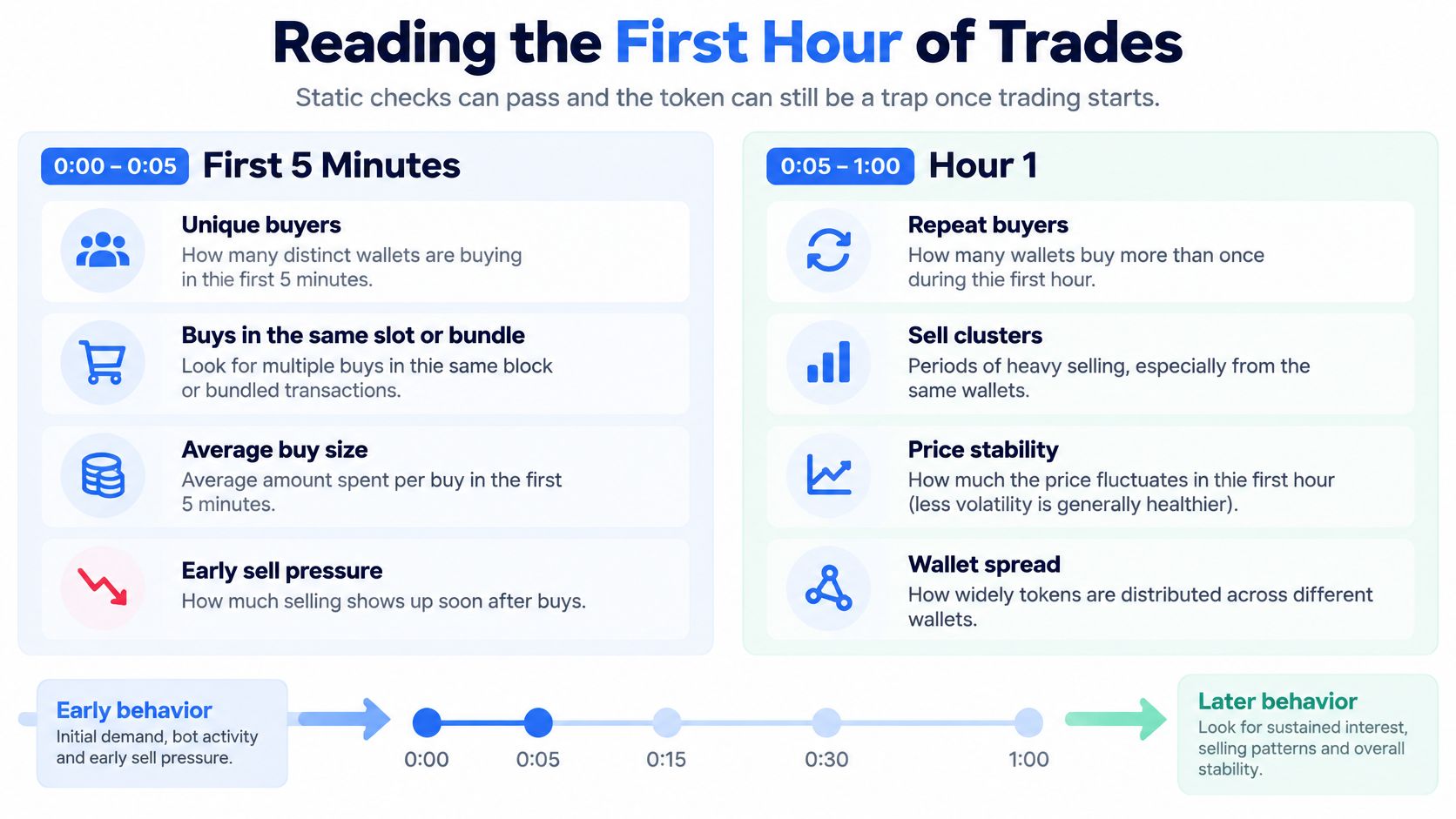
Static checks can all pass and the token can still be a trap once trading starts. Recent Solana research assembled a dataset of 6.4 million tokens across seven months and found that most tokens displaying rug-pull characteristics did so within the first hour. Machine-learning models could identify risk using only the first five minutes of trading data, in that Solana launch-trading study. Renounced authorities, visible liquidity, and a calm holder percentage miss what the tape does next.
The first five minutes
Count unique buyers, whether buys land in the same slot or bundle, how fast creator-linked wallets sell, and whether price jumps on tiny size. A healthy open has many unrelated buyers and liquidity that stays put. A coordinated open has a few wallets trading back and forth, snipers taking a large share of supply, and volume that is really one cluster talking to itself. Same-slot buys are a warning, not yet proof. They tell you the open was arranged. They do not, by themselves, prove the pool will be pulled.
From five minutes through the hour
Watch liquidity adds and removes, the buy-to-sell flip, and whether new wallets are new people or the same cluster with fresh addresses. Wash trading on Solana is recycled volume, not someone who will buy your exit. A sniper is not a community. Split wallets are not distribution. Those are different problems, and one green candle does not sort them. If volume collapses the moment a few addresses pause, treat that as a warning that the "market" was those addresses.
| Window | Observation | Reading |
|---|---|---|
| First 5 minutes | Many unrelated buyers and liquidity that stays put | Healthy open |
| First 5 minutes | A few wallets trade back and forth, snipers hold a large share | Warning |
| First 5 minutes | Buys land in the same slot or bundle | Warning |
| 5 to 60 minutes | Volume collapses when a few wallets pause | Warning |
| 5 to 60 minutes | Liquidity added and removed repeatedly | Warning, stronger if liquidity is pulled |
| 5 to 60 minutes | Creator-linked cluster sells into late buyers | Stronger evidence |
| Any time | Freeze authority used or liquidity pulled | Stronger evidence |
| Any time | One large early buy or a volatile first candle alone | Warning only |
One large early buy, a violent first candle, or a creator who still holds a small disclosed slice is a warning only. Liquidity pulled, a freeze used, or the same cluster dumping into late buyers is stronger evidence. Write down the window you observed. Ten minutes of history is not a week-old market, and you should not grade it as one.
Who Can Sell Before You
A top-ten percentage is not a risk score until you know who those wallets are. Independent research on Solana meme coins reports that profits are concentrated among a small group of early or advantaged wallets while most participants lose money, and that hype and FOMO can keep buyers active after the profitable phase has ended, in this early-wallet study of meme coin markets. The question under that finding is simple. How much could you sell, and who could sell before you?
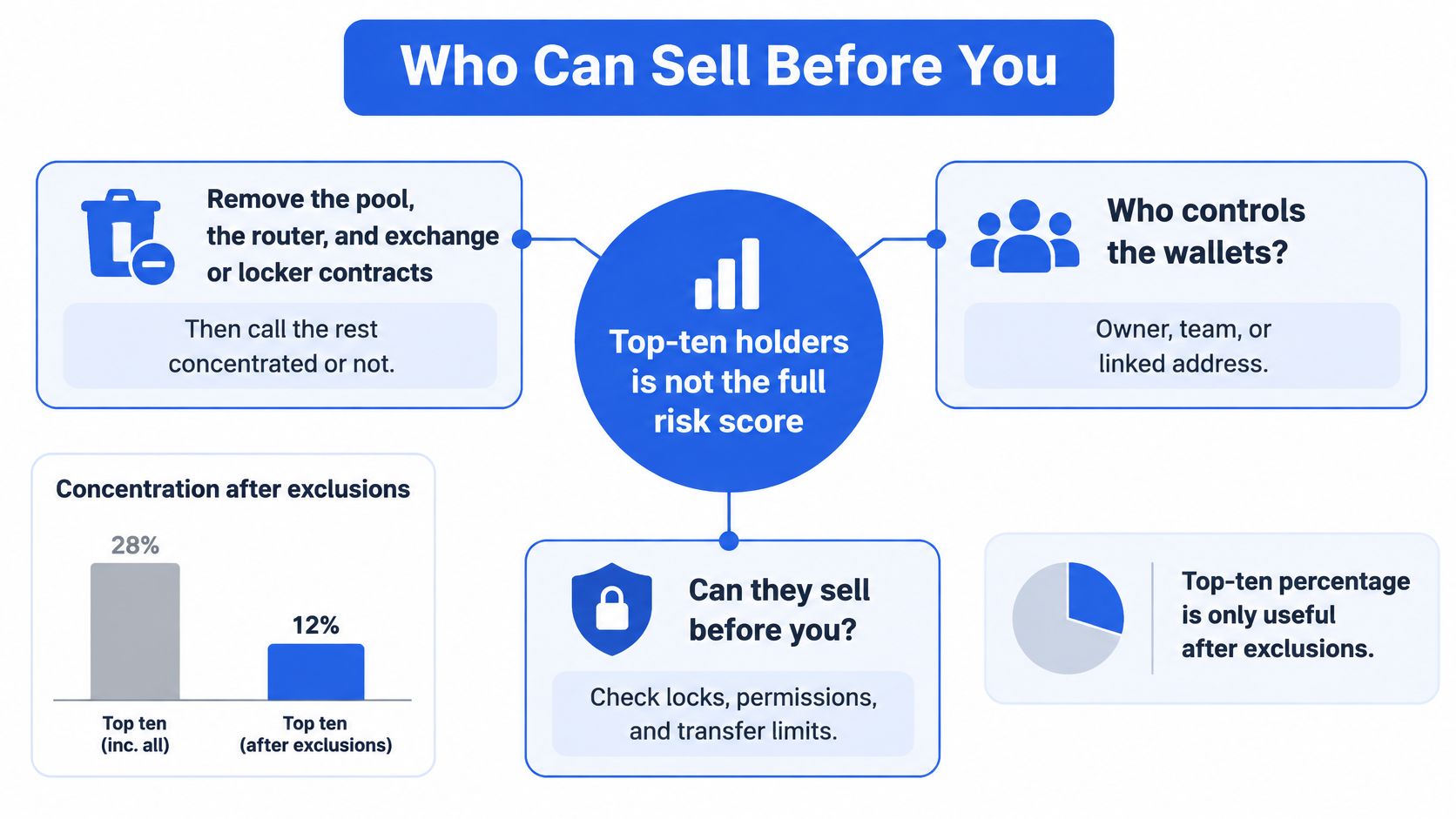
Remove the pool, the router, and exchange or locker contracts before you call the rest concentrated. Then the remaining percentage is about people and linked wallets, not about the market's own inventory.
Three questions the percentage cannot answer
Did related wallets buy the supply at launch, even if no single address looks large? Do several addresses move together, funded from one wallet or selling in the same transactions? How much quote liquidity sits near the current price, and what happens to price if you sell your full size?
A token can look distributed and still trap you because its float is thin. It can look concentrated because the pool was counted as a holder when outsiders could have exited normally. Volume does not repair either case. Wash prints add trades without adding a buyer for your sell. A transfer that will not go through is a different failure, closer to a Solana honeypot check than to a crowded holder table.
Work a concrete case. You plan to buy an amount equal to a few percent of the pool. The top non-pool cluster holds about a fifth, and that cluster is already in profit. Your realistic exit is worse than the chart implies, because they can sell first and you are the liquidity. Write that exit note beside the holder figure. The figure without the note is unfinished work.
If you cannot name who is ahead of you, the check is incomplete, not clean.
Write the Risk Verdict and Size
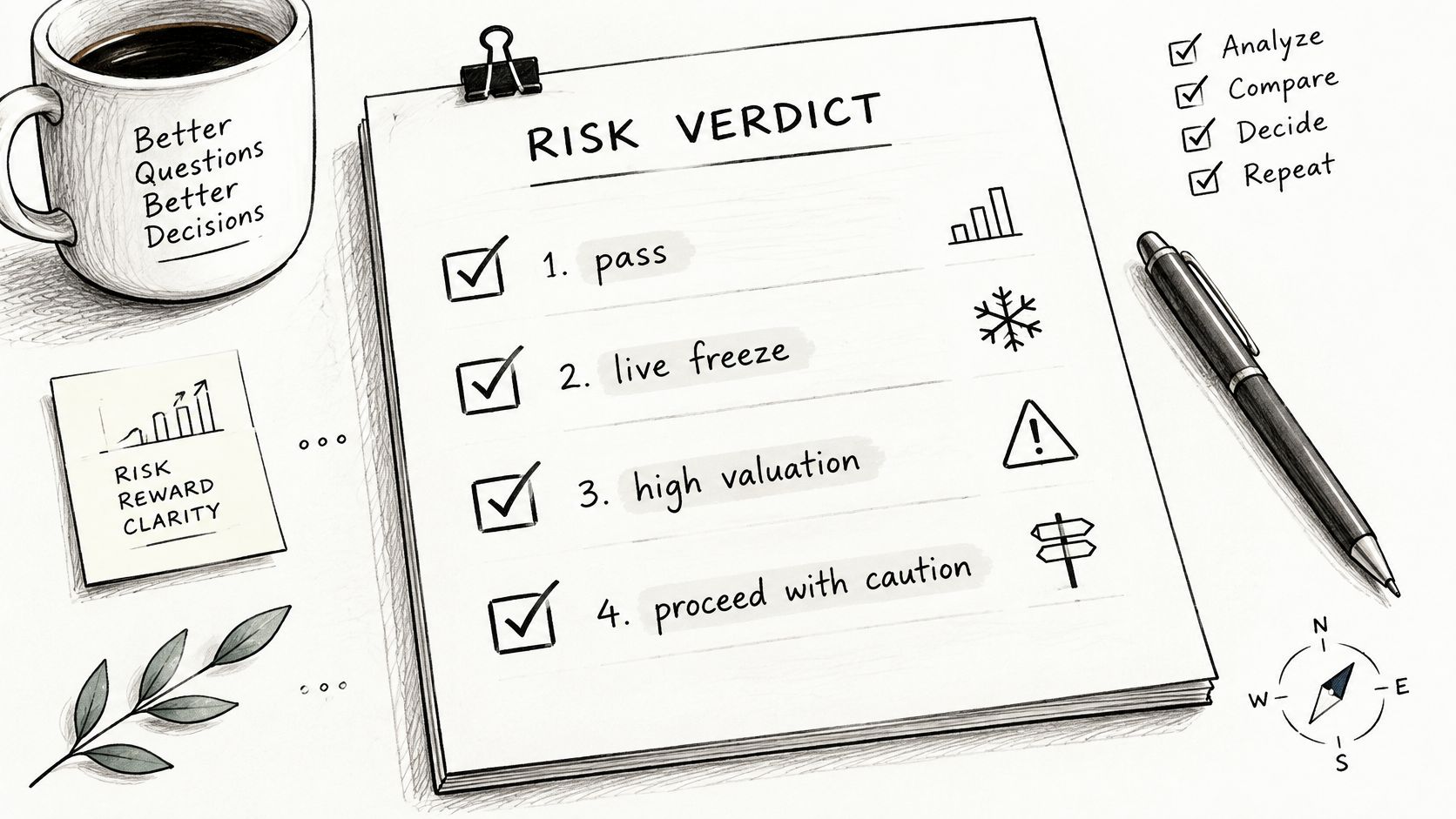
Write four lines after every check is filled. If you cannot fill a line, you do not have a trade. You have a guess.
The four lines
- The call. Pass, small size, or do not buy.
- The strongest fail or caution, in plain words. Live freeze authority. One linked cluster ahead of you on the sell. Not a paragraph of maybes.
- What would change your mind. Locked liquidity, a cluster that is separate wallets, or an hour of unrelated buyers. Name the evidence, not a feeling.
- The size. Skip, a fraction of a normal trade, or a normal trade only when every screen passes and the first hour was observable.
What inflates a weak token into a buy
Do not upgrade a caution because the meme is trending. Do not call a token safe because a detector would catch classic rugs. A 2024 ICSE study analyzed 201 real-world rug-pull incidents and reported that its detection system achieved 98.0% recall and 98.9% precision (ICSE 2024 rug-pull detection paper). A 2024 rug-pull research survey identified 2,448 documented incidents in existing datasets and reported that those datasets covered only 20% of the 34 identified root causes (2024 rug-pull survey). High precision on a known set still leaves most root causes outside that set.
List what you could not see. Missing creator history, a pool too new to judge, wallets you never linked. Those blanks stay on the verdict. They do not become passes by silence.
Treat any AI summary as a translation of measured figures, not an independent expert, and reopen the underlying numbers before you trust the sentence. A completed run returns an Overall Health Score, a Rug Risk Rating, a plain-English AI Verdict, and a Detailed Risk Breakdown. New eligible accounts receive one free full analysis. Further analyses are $0.20 each, or $5.00 for 25, paid per use with prepaid credit and no subscription.
Pass and wait while any fail is open. Size down only when every fail is clear and the exit you calculated still works. A normal size is for a full set of passes plus an observable first hour, not for a chart you like.
Paste the mint into MemeAssist before you size the buy, and let the six checks run on live Solana data instead of on the candle. You get a health score, a rug rating, a plain-English verdict, and the breakdown under it, which is the same verdict you should be able to write by hand. Start with the free full analysis on a new eligible account at MemeAssist.