Token Audit on Solana: What It Really Covers
A token audit reviews code at one point in time. Learn what Solana reports cover, how they differ from live risk checks, and how to read findings.
Published
Updated
Only buy audited tokens sounds like sensible advice. It's incomplete. A clean code review doesn't tell you whether the creator can empty the pool, whether connected wallets control the supply, or whether a retained authority can interrupt transfers. Before treating an audit badge as a buying signal, separate what the reviewer examined from what the token's controllers can do now.
Table of Contents
- What a Token Audit Actually Answers
- Code Review Versus Live Market Checks
- Mint Freeze and Token-2022 Checks
- How to Read Typical Findings
- Why Audited Tokens Still Get Hit
- A Worked Reading of One Solana Mint
- Recheck the Live Mint Before You Buy
What a Token Audit Actually Answers
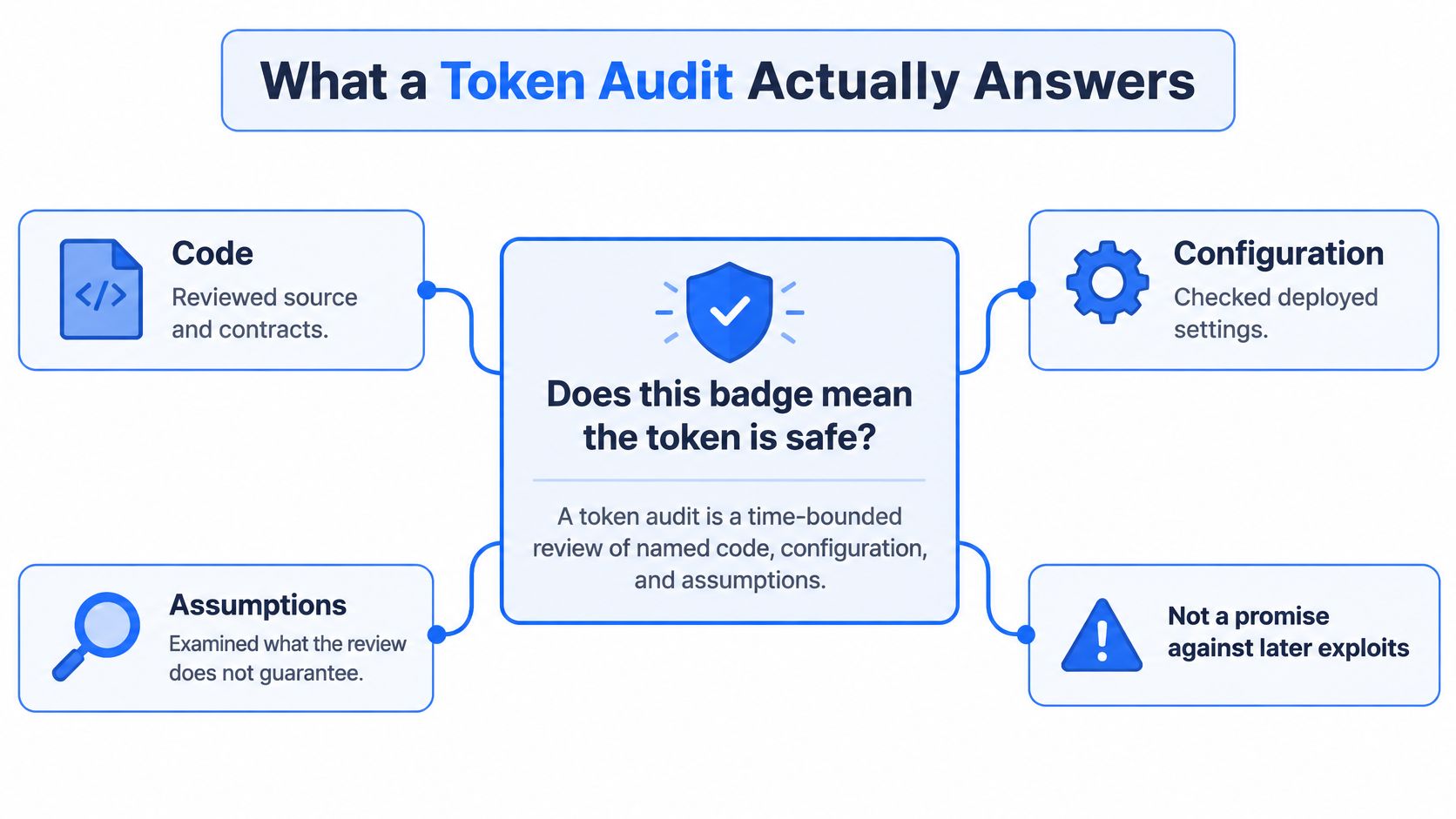
Does this badge mean the token is safe? No. It means a particular scope was reviewed at a particular time. The useful questions are which code, which configuration, which assumptions, and whether the deployed token still matches them.
A token audit is a time-bounded assessment, not continuing supervision. An auditor may examine the implementation carefully without controlling later administrative actions, protecting signing keys, or monitoring the market into which buyers enter.
The distinction becomes clearer when you separate the evidence into distinct layers.
The layers behind the badge
- Code assurance asks whether the submitted program behaves according to its specification and whether reviewers identified exploitable implementation errors.
- Deployment integrity asks whether the actual Solana mint, controlling programs, and configuration correspond to the reviewed version.
- Live holder and liquidity risk asks who controls supply, who can withdraw liquidity, and whether observed demand could be coordinated.
Think of a building inspection. The inspector examines the plans and the structure as they exist during the visit. That inspection doesn't guard the locks afterward, prevent the owner from changing access arrangements, or guarantee that everyone can leave through a crowded exit.
The same boundary applies to token ownership. Reviewed transfer logic can work exactly as intended while buyers face hostile permissions or inadequate liquidity.
The diagram separates the review itself from the broader safety question.
A useful report preserves the boundaries
Don't combine those layers into an unexplained passed label. Record the audited repository and commit separately from the observed mint settings. Keep holder and pool observations timestamped rather than presenting them as permanent properties.
This also changes how you interpret missing coverage. If the reviewer didn't examine pool withdrawal rights, the report provides no conclusion about those rights. Silence isn't approval.
Scope rule: An audit can support confidence in named code under stated assumptions. It can't establish that buying the token is safe now.
For Solana meme coins, that boundary matters because a bad trade doesn't require exotic malicious code. Ordinary token mechanics, concentrated ownership, and creator-controlled liquidity can be enough to expose buyers to losses.
Code Review Versus Live Market Checks
| Risk area | Code audit | Live check | If only the audit is clean |
|---|---|---|---|
| Mint authority | Only if the submitted code exposes it | Current address or None at analysis time |
Supply can still be expanded |
| Freeze authority | Only if in the reviewed source | Current address or None now |
Accounts can still be frozen |
| Token-2022 extensions | Only if that schema was in scope | Parsed extension types and parameters | Fees or close rights can still apply |
| Upgrade or program authority | If the program was in scope | Who can upgrade today | Logic can change after the report |
| Liquidity removal | Usually out of scope | Pool depth and who can withdraw | Creator can still pull the pool |
| Holder concentration | Out of scope | Top-wallet share and links | Insiders can still sell into thin liquidity |
| Creator and deployer history | Out of scope | Prior mints and wallet behavior | Repeat-deployer behavior is invisible to the PDF |
| Bundled or wash-like trading | Not covered | Buy patterns and linked wallets | Volume can be manufactured after a clean audit |
Read each row as a coverage boundary
For mint authority, source review can establish how a program uses issuance permissions. It doesn't replace reading the authority currently assigned to the mint. The same distinction applies to freeze authority: an intended permission model and the address holding that permission are different evidence.
Token-2022 extensions require explicit coverage. A report that considers ordinary token transfers shouldn't be treated as approval of extension behavior it never analyzed. Likewise, reviewing upgrade logic doesn't establish who controls the upgrade authority today.
These rows concern deployment integrity. A live screen should connect the reviewed implementation to its current permissions rather than merely recognize a familiar token program.
Liquidity removal crosses into market structure. Pool balances alone aren't enough, because the person entitled to withdraw them determines whether that liquidity remains available. Holder concentration then affects how much selling pressure those balances may need to absorb.
Creator history and trading patterns add context rather than certainty. Prior deployments can justify further investigation, while clustered purchases can prompt wallet-link analysis. Neither observation should become an automatic accusation.
Clean code can coexist with hostile trading conditions
The Rug.tools explanation of token-audit limits describes the distinction between code assurance and live market risk, citing Chainalysis findings that approximately 94% of suspected DEX-pool pump-and-dump cases involved the pool creator removing liquidity.
That pattern doesn't require a token-transfer bug. A creator can promote the token, encourage apparent demand, and exercise legitimate withdrawal permissions against buyers' interests. The code may execute correctly throughout.
This is why a live screen isn't a substitute for professional code review, and professional code review isn't a substitute for a live screen. They answer different questions with different evidence.
Treat the table as a coverage map, not a competition between tools. If your concern appears only in the live-check column, a clean audit PDF doesn't resolve it. Your decision still needs evidence from the mint account, the relevant pools, and the wallets that control them.
Mint Freeze and Token-2022 Checks
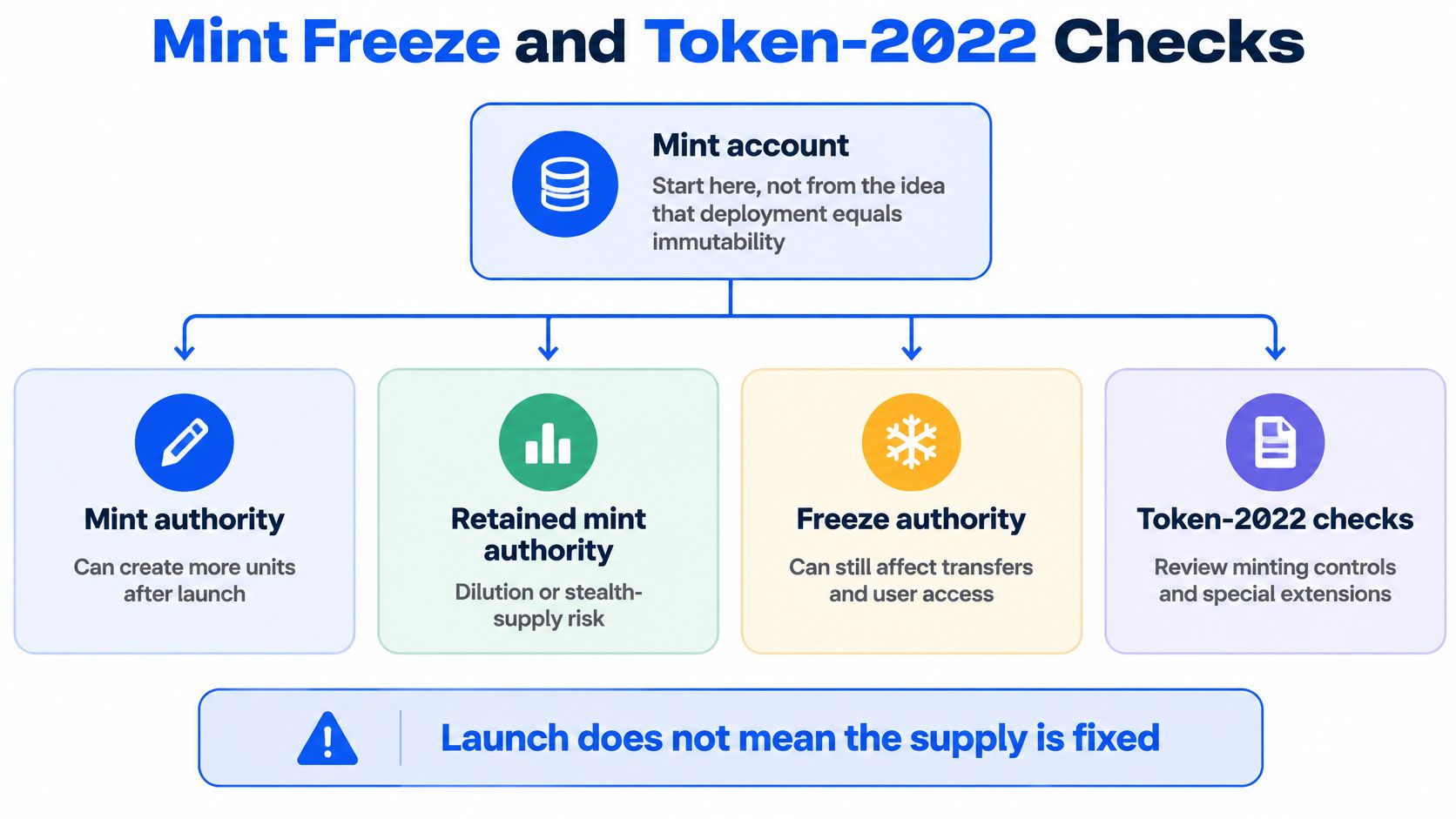
Start with the mint account, not the assumption that launch made the token immutable. Preserve the exact mint address and observation time so another analyst can identify what you examined.
The authority relationships are easier to interpret when their consequences remain visible alongside the fields.
Read authorities as capabilities
The Solana token documentation explains that mint_authority controls additional issuance, while freeze_authority can freeze token accounts and prevent operations including transfers and burns. Setting an authority to None permanently revokes that authority; until revocation, the current authority can use SetAuthority to change control.
Record more than a revoked or active label. Identify whether the controller is an external wallet, a multisignature arrangement, or a program-controlled path. A single signing wallet introduces a different compromise and governance exposure from a control arrangement requiring multiple approvals.
Use the freeze-authority explanation to distinguish a token-account restriction from a general warning about price or liquidity.
| Field | Record at analysis time | Risk if retained |
|---|---|---|
| Mint authority | Address or None |
Retained authority can expand supply |
| Freeze authority | Address or None |
Retained authority can freeze token accounts |
| Authority controller | Wallet, multisig, or program path | One wallet raises key-compromise exposure |
| Transfer-fee extension | Fee rate and cap | Recipient receives less than the gross transfer amount |
| Mint-close authority | Address or None |
Extra privileged lifecycle action |
| Unparsed extension | Raw type and data | Failed coverage, not a pass |
Parse the extension state
The Solana Token Extensions documentation describes extension configuration stored in tlv_data, requiring decoding according to the enabled extension types. Most extensions can't be added after initialization, which makes the creation-time configuration important evidence.
Enumerate mint and relevant token-account extensions. For a transfer-fee configuration, preserve the parameters and explain the net amount a recipient would receive. For a mint-close authority, identify the controller and the conditions attached to that lifecycle action rather than implying unrestricted closure.
Also check whether extension combinations support the behavior the interface promises. A normal-looking supply figure doesn't establish ordinary transfer mechanics.
Coverage warning: Unsupported extension data means the screen couldn't finish its job. It doesn't mean the extension is harmless.
The practical walkthrough below can supplement, but shouldn't replace, recording the account fields yourself.
Keep the raw extension types and parameters with the plain-English interpretation. That lets a later reviewer distinguish a truly absent control from a parser that failed to recognize it.
How to Read Typical Findings
| Finding | What it means | What to do |
|---|---|---|
| Unresolved Critical or High code issue | A plausible loss path remains open in the reviewed scope | Don't treat the badge as passed |
| Fixed finding tied to an old commit | The repair applies only to that version | Match the deployed program to the fixed commit |
| Mint authority still set | More supply can be created | Treat dilution as an open risk |
| Freeze authority still set | Token accounts can be frozen | Assume transfers can be blocked |
Mint and freeze set to None |
Those powers are permanently off | Still examine holders and liquidity |
| One wallet holds a large share | A large sale may overwhelm available exit liquidity | Reduce exposure or skip if other flags reinforce it |
| Creator can remove liquidity | The creator can withdraw available pool liquidity | Treat it as a rug path, not a lock |
| Bundled buys or linked wallets | Demand may be coordinated | Investigate, without claiming fraud |
| Unparsed Token-2022 extension | The screen didn't understand the mint | Count it as failed coverage |
Read severity alongside status
Start with the report's own severity definitions. Critical and High findings generally identify serious exploit or loss possibilities within the engagement's scope, but severity labels aren't standardized guarantees about likelihood.
A Medium finding may require additional conditions. A Low finding may have limited impact. Informational findings can document design choices or assumptions, and their presence doesn't certify that everything else is safe.
The more useful question is whether a serious finding remains unresolved, was remediated and retested, or was merely accepted by the project. Accepted means the project chose to retain the issue. It doesn't mean a reviewer removed the risk.
Read the remediation evidence, not just the status column. Identify the repair commit, the reviewer's follow-up, and any assumptions that still apply.
Establish that the repair reached deployment
A fixed source-code finding protects a buyer only if the relevant deployment contains that repair. Confirm the repository tag or release named in the report, then compare the deployed program with the audited commit using a verifiable build or an appropriate binary comparison.
Don't compare a source-file hash directly with a deployed binary and call it verification. The comparison needs to account for how the source was built. If you can't establish that relationship, mark deployment integrity unverified.
For tokens using shared standard programs, identify what the project submitted for review. It might be launch configuration, a custom controller, or another component rather than a bespoke token implementation.
A repaired code issue and a retained live permission are separate findings. Closing the former doesn't close the latter.
Interpret market flags through interaction. Concentration alone doesn't establish that a holder will sell, and it doesn't prove thin liquidity without examining the pool. Concentration combined with removable liquidity and an active freezing capability creates several independent ways a buyer could lose access to an orderly exit.
Use a disciplined reading order: scope and date first, unresolved serious findings next, current permissions and market structure last. Page count and an attractive certificate aren't substitutes for any of those checks.
Why Audited Tokens Still Get Hit
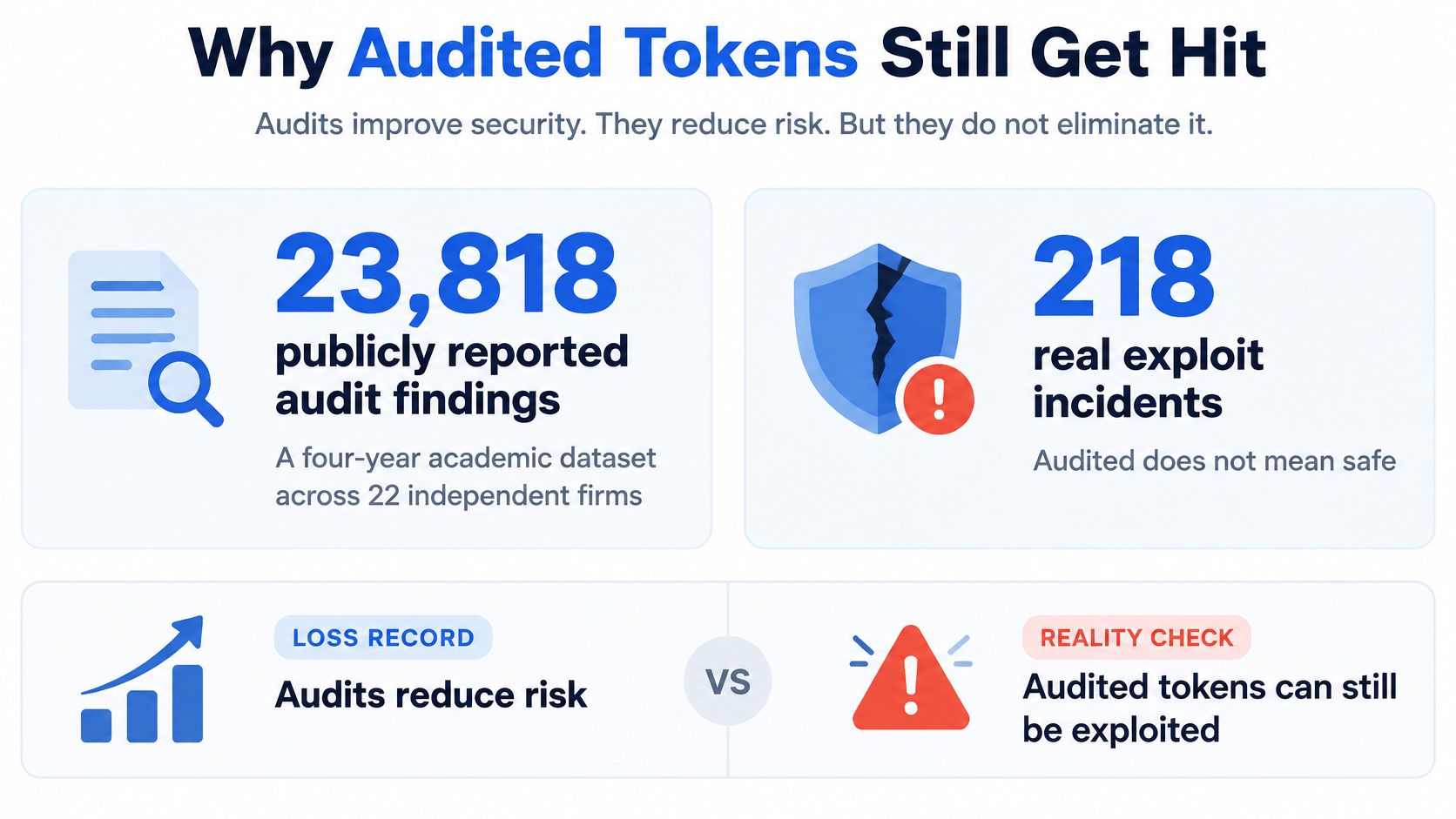
The historical exploit record contradicts the idea that audited means safe. A four-year academic study of public audit findings and exploit incidents found that 105 of 218 exploit incidents, or 48%, affected protocols with at least one public audit before the attack, accounting for about $4.3 billion in recorded losses.
Those are incidents among exploited protocols, not the probability that an arbitrary audited project will fail. There's no denominator of all audited projects in that comparison, so it shouldn't be presented as an audit failure rate.
The infographic summarizes the scope of the study.
Separate implementation failures from operational failures
An industry account of quarterly security losses reported that compromised keys, signers, and infrastructure caused approximately 88.3% of stolen funds, while smart-contract bugs accounted for about 11%. That distinction matters because reviewing code doesn't secure every credential or operational system around it.
Nor does an exploit after an audit automatically prove the auditor overlooked an in-scope defect. Establishing responsibility requires identifying the attack path, the reviewed version, exclusions, and subsequent changes.
- Implementation exposure concerns whether executable logic permits an unintended action.
- Operational exposure concerns who can authorize actions and whether attackers can obtain that authority.
- Economic exposure concerns whether authorized behavior can still harm buyers.
For a meme-coin buyer, the practical consequence is to investigate the loss path rather than the badge. The revoked-mint-authority safety analysis addresses the related mistake of treating a removed permission as a general safety verdict.
An audit remains useful evidence. It becomes misleading only when someone stretches its conclusion beyond the component and conditions the reviewer examined.
A Worked Reading of One Solana Mint
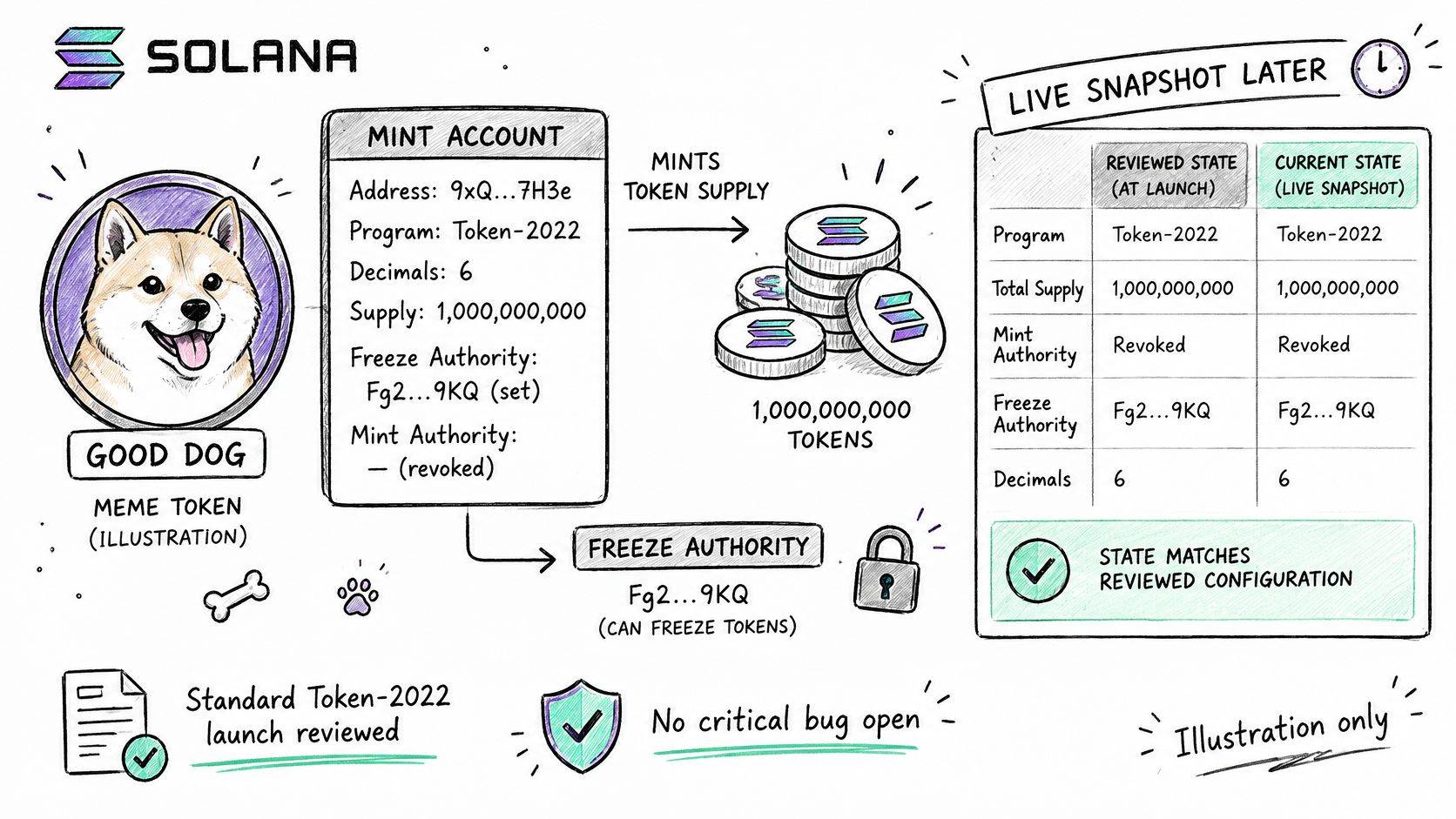
Consider an illustrative composite mint, not a real ticker. Its report says the launch uses Token-2022, the submitted configuration was reviewed, and no Critical finding remained open in the named version.
A later account snapshot shows mint_authority set to None, but freeze_authority still belongs to an external wallet. A large holder controls a substantial supply position, the pool creator retains withdrawal rights, and a transfer-fee extension applies to transfers.
The wrong reading is simple: the audit passed, so buy. That conclusion discards nearly all the evidence relevant to the proposed trade.
The illustration represents the distinction between report details and a later account reading.
Apply the evidence without changing its meaning
Code assurance is narrowly favorable: the named review found no open Critical issue in its scope. That doesn't establish that other severities were absent or that every related component was examined.
For deployment integrity, compare the live freezing permission and fee configuration against the report. Their presence isn't automatically a mismatch: the auditor may have documented them correctly. If the seller promised revoked freezing and fee-free transfers, however, the current state contradicts those claims.
Live market risk remains unfavorable because the large holder and withdrawable liquidity create a fragile exit. A buyer needs evidence about the holder's relationship to the creator and the actual withdrawal controls, not reassurance from the clean code paragraph.
Suspicion isn't a fraud verdict
In a Cryptonomist interview with Chainalysis's Nicola Buonanno, Chainalysis reported that 3.59% of tokens launched in 2024 displayed classic pump-and-dump or rug-pull behavior. The suspected patterns combined factors such as promotion, wash trading, low historical liquidity, and concentrated ownership.
That finding doesn't justify calling every busy, unevenly held launch fraudulent. Early ownership can be concentrated without proving coordinated misconduct. The composite case is concerning because several controllable exit risks coincide, not because any isolated signal establishes intent.
A disciplined trader could skip this setup rather than try to price every retained power. Anyone proceeding should treat it as speculation with explicitly limited exposure, not an audit-backed safe trade.
Preserve the warning and examine subsequent outcomes: liquidity withdrawals, holder sales, authority changes, and deterioration in executable liquidity. Evaluate whether the warning identified the mechanism that later mattered, including cases where the feared event never occurred. Otherwise, a dramatic screenshot can masquerade as a reliable screening method.
Recheck the Live Mint Before You Buy
Run the decision check against the same mint you intend to purchase, at purchase time. A saved report remains evidence of an earlier observation, not proof that the current conditions match it.
- Match the audit identity. Confirm the report date, repository commit, program address, and scope. Disregard a badge that refers to a different component.
- Read current authorities. If the seller claims issuance and freezing were revoked, require the corresponding fields to show
None. - Inspect every extension. Record enabled types and parameters. Calculate the expected transfer deduction for your intended amount rather than assuming the displayed gross amount is what the recipient receives.
- Establish withdrawal control. Identify who can remove pool liquidity and whether the creator controls that path.
- Inspect holder relationships. Examine major balances alongside deployer links and available pool depth.
- Investigate coordinated demand. Use bundled purchases and possible wallet connections as reasons to slow down, not as evidence of misconduct.
- Make the exposure decision explicit. If freezing power, creator-withdrawable liquidity, and extreme concentration overlap, skipping is a reasonable conservative rule. It isn't a validated numerical scam threshold.
Treat unknowns as incomplete work
If an account field, extension, or withdrawal permission can't be read, record unknown. Don't convert an unavailable result into a green indicator.
Keep the evidence with your decision so you can distinguish a changed condition from an overlooked one. The guide to buying Solana meme coins safely provides a broader execution checklist, but no manual or automated screen guarantees safety.
The actionable conclusion should be specific: the evidence supports proceeding within your risk limit, supports skipping, or remains incomplete. Incomplete isn't a weaker version of safe.
We offer a second opinion for research, not a guarantee that a token is safe, combining current Solana token checks with wallet and market evidence. Visit MemeAssist to run a full token analysis for $0.20, including a conditional Trade Setup when the data allows, and compare the live findings with the scope of any audit before you buy.