Upcoming Meme Coins: 7 Discovery Tools and How to Vet Them
Compare seven places to find upcoming meme coins on Solana, with launch context, risk flags, and a due diligence checklist to run before any buy in 2026.
Published
Updated
A token is trending in your group chat. The website looks polished, a countdown is ticking, and the launch is set for tomorrow. Before anyone buys, ask what evidence exists beyond the pitch. A launch page can show that a token was created, but it can't establish who controls its supply, whether buyers can exit, or whether early activity is genuine.
That distinction matters in a market where thousands of new Solana tokens can appear daily. CoinGecko reported that an average of about 35,500 tokens launched per day during the fourth quarter of 2024, while daily issuance reached about 73,700 in January 2025 after the TRUMP token launch, according to its 2025 State of Memecoins report. Early discovery is easy. Separating a tradable token from a dangerous one is the hard part.
This guide covers seven public tools that can surface upcoming meme coins and newly launched Solana tokens. Each is a starting point for due diligence, not a source of picks. Use what it shows to decide what to check on-chain before a token earns your attention.
Table of Contents
- 1. Pump.fun Explore
- 2. Birdeye, Trenches and New Listings
- 3. DEX Screener, Solana New Pairs
- 4. DEXRabbit by Bitquery, New Solana Token Launches
- 5. SOLLMG, Live Solana Meme-Token Scanner
- 6. GateKept, Bundle Tracker
- 7. Chainlytics Verify
- How the seven upcoming meme coin discovery tools compare
- Turn Upcoming Meme Coin Lists Into a Checklist You Actually Run
1. Pump.fun Explore
Pump.fun Explore is a direct way to browse coins launched through Pump.fun. Its new-coin view and other categories, including movers and custom pairs, can surface a token near launch, before it has much trading history. The Pump.fun Explore page is publicly browsable, so you can inspect listings without relying on a third-party “upcoming coin” article.
That access is useful, but a listing is not a recommendation. Anyone can create a coin, and the page doesn't establish that a token is legitimate, safe to trade, or likely to keep its value. A brand, logo, and active listing are easy to produce. They don't tell you who can change token settings or whether the apparent liquidity will support an exit.
Use the listing as a lead, not a green light. Before considering a token, inspect the mint and freeze authorities, holder concentration, creator wallet, and liquidity. If you need to follow the token through its next stage, you can also review new Pump.fun graduations, then verify the token address independently.
The main trade-off is speed versus evidence. Pump.fun can show you a token early, but very new tokens often have little history to assess. If the token has just appeared, don't fill those gaps with confidence based on its presentation or social buzz. Wait for checkable evidence, especially around ownership, liquidity, and creator behavior.
2. Birdeye, Trenches and New Listings
Birdeye's Solana new-listings page gives more launch-stage context than a simple stream of token names. Its views include New, Bonding, Final Curve, and Migrated, alongside market data. That can help you track how a token moves through stages and compare its visible activity with other listings on the Birdeye Solana new-listings page.
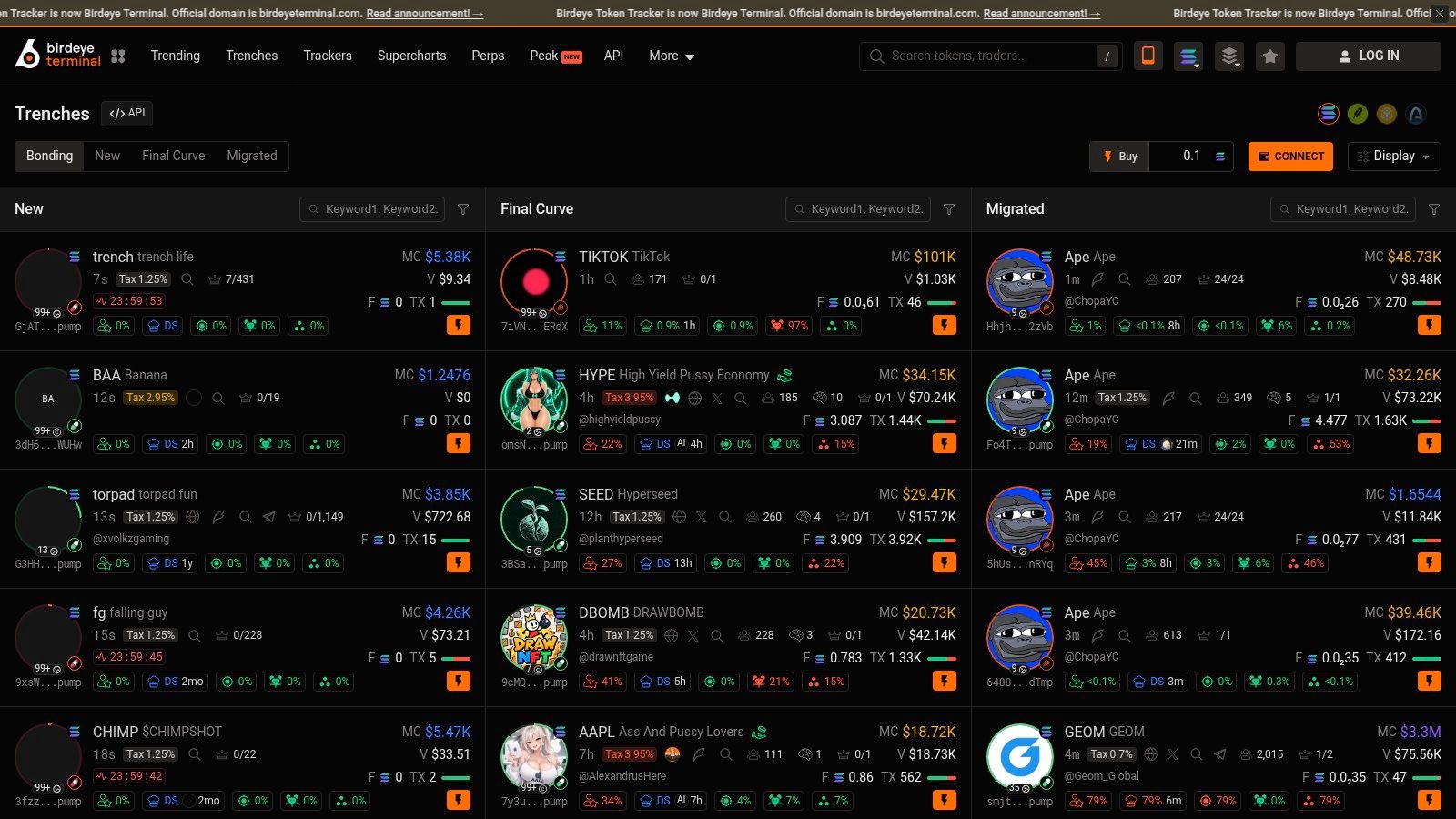
Stage labels make browsing more organized, but they don't prove that a token is safe or easy to sell. A market-data panel can show activity without telling you whether wallets are linked, whether holders are concentrated, or whether volume reflects independent demand. Very new tokens may also lack enough history for meaningful comparisons.
Use Birdeye to see where a token sits in its launch path, then switch to the token's on-chain evidence. Check the mint and freeze authorities, inspect the largest holders, and trace the creator wallet's earlier launches. Compare liquidity with the trading activity rather than treating volume as proof of demand. For a separate walkthrough of the discovery process, see how to find new Solana memecoins early.
Birdeye works best as a market-context tool. It can help you organize candidates and observe changes, but it can't do the judgment for you. If the numbers look active while ownership is tightly clustered or the creator has a concerning pattern, treat that mismatch as a reason to investigate, not a reason to rush.
3. DEX Screener, Solana New Pairs
DEX Screener's Solana New Pairs page answers a practical question: has the token started trading, and what does the visible market look like? The Solana New Pairs view lists recently indexed trading pairs and displays information such as pair age, price, transactions, volume, and liquidity.
That makes it useful after you hear about a token elsewhere or spot it on a launchpad. You can look up the pair and see whether trading has begun, then inspect the activity in one place. But DEX Screener is not a pre-launch calendar, token audit, or safety verdict. A new pair can exist even when liquidity is thin, trading is distorted, or the token carries serious ownership risks.
Visible liquidity isn't the same as reliable exit liquidity. Check how much a hypothetical sell could move the price, and examine who controls the supply before trusting a busy chart.
Use the pair data as an execution check, not a full due-diligence process. Compare displayed liquidity with recent trades, watch for activity that appears unusually concentrated, and verify the token's mint and holder distribution using on-chain tools. Pair-level data can show what traders have done. It can't, by itself, explain who those traders are or what the creator can do next.
4. DEXRabbit by Bitquery, New Solana Token Launches
DEXRabbit provides a newest-first feed for Solana token launches. Its Solana launch feed links to token, mint, and deployer information, making it a useful starting point if you want to move quickly from discovery to wallet investigation. The page also offers an API option for users who want to work with the underlying data programmatically.
The newest-first format is good for monitoring fresh launches, especially if you prefer to inspect activity rather than rely on a trending list. For quantitative traders, an API-oriented workflow can help bring launch events into a separate screening process. But speed only helps if you have a disciplined filter. A firehose of token creations is not a curated shortlist.
Start with the deployer. Review its wallet history, look for repeated launches, and check whether related wallets received funds or bought early. Then verify the mint and freeze authorities, holder concentration, and liquidity changes. The feed's links help you investigate those questions, but the launch itself says nothing about whether the token has independent demand or a viable exit.
DEXRabbit's trade-off is clear: it prioritizes fresh discovery over interpretation. That's useful if you already know what evidence to examine. It's less useful if you mistake “new” for “promising” or assume a visible creator address tells the whole story. Indexing and feed freshness also depend on the available source data, so verify critical details directly before acting.
5. SOLLMG, Live Solana Meme-Token Scanner
SOLLMG pairs a live feed of Pump.fun launches with risk-signal labels. Depending on the token, those labels may point to concentrated holders, developer selling, serial deployer activity, large developer buys, or bundled buys. The SOLLMG scanner also presents wallet-activity and crash-history context, which can help you decide which launches deserve closer review.
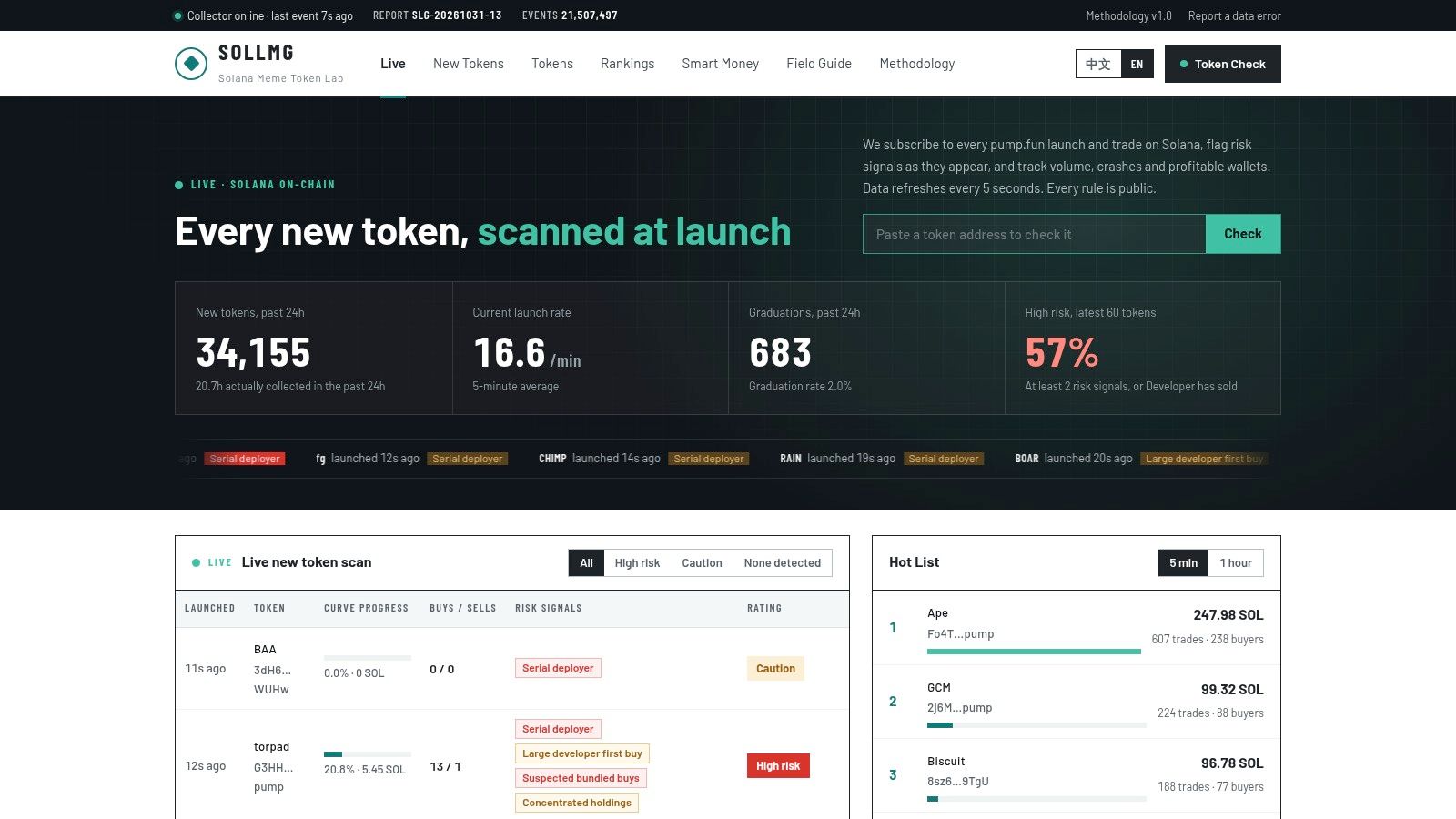
Risk labels can save time by directing your attention to specific questions. They don't prove wrongdoing, and a clean-looking screen doesn't prove safety. Automated systems can miss relevant wallets, misread behavior, or work from incomplete data. SOLLMG also focuses on Pump.fun, so don't assume it covers every Solana launch source.
When a label flags bundled buys, check the wallets involved and how their holdings relate to the creator. When it notes developer selling, inspect the transaction history and whether liquidity changed at the same time. For concentrated holders, identify whether the wallets appear connected before deciding what the concentration means. Treat each label as a prompt to verify the underlying transactions.
The tool is most useful for prioritizing investigations, not replacing them. Cross-check the token's mint and freeze authorities, holder distribution, and liquidity. A risk signal can be a false positive; an unflagged token can still be dangerous.
6. GateKept, Bundle Tracker
GateKept focuses on launch-time wallet behavior. Its bundle tracker offers views of launches and teams, token search, and wallet-attribution information related to bundled activity. That makes it a specialized complement to broader discovery pages that emphasize price and volume.
A bundled launch pattern can tell you that early purchases may have been coordinated or connected. It doesn't tell you, on its own, whether the token is a scam. Wallet attribution can be uncertain, and a bundle view doesn't replace checks of liquidity, token authorities, holder distribution, or current trading conditions.
A bundle is evidence to investigate, not a verdict. Look at when the wallets bought, how much supply they control now, and whether they have sold or moved tokens since launch.
Use GateKept alongside a token page and direct wallet checks. If several early wallets appear connected, trace their funding and compare their behavior with the creator's history. Then test whether the pool could handle an exit without severe slippage. If you want a focused walkthrough of the pattern, read how to check whether a Solana token is bundled.
GateKept's strength is its focus on early-wallet behavior. Its limitation is the same specialization: bundle analysis covers one risk category, not the entire token. Check the official site for current access and pricing terms, and don't mistake a wallet-attribution label for proof of identity or intent.
7. Chainlytics Verify
Chainlytics Verify examines a token against Solana mainnet data, with described checks for creator and early-buyer context. For Pump.fun launches, it can also look for repeat-launch activity by creators. Its Chainlytics Verify page describes more limited checks for tokens from other launchpads, so confirm what coverage applies to the token you're researching.
This kind of creator-history context can add an important layer beyond a website or social profile. A repeat deployer may have a pattern worth reviewing, particularly if earlier launches show similar wallet behavior or abrupt liquidity changes. But past activity doesn't establish the current token's safety, and creator or early-buyer information doesn't tell you whether you can exit at a reasonable price.
Start by confirming that the token address is correct. Review the creator's earlier launches and the wallets that bought early, then check supply concentration, mint and freeze authorities, and liquidity. If a token comes from a launchpad with limited coverage, don't interpret missing flags as a clean bill of health. Coverage gaps are not evidence that a risk is absent.
Chainlytics is best used as an on-chain follow-up to a discovery feed. It can help frame questions about who launched or bought a token early, but its checks aren't independent proof that every risk has been detected. Use the results alongside direct transaction and liquidity review.
How the seven upcoming meme coin discovery tools compare
| Item | Main Focus | Built-In Risk Signals | Best For |
|---|---|---|---|
| Pump.fun Explore | Discovering newly created Pump.fun tokens and categories | No built-in safety checks; listings are not endorsements | Finding Pump.fun tokens at or near launch |
| Birdeye, Trenches and New Listings | Exploring Solana tokens by launch stage with market data | Stage and market context; no audit or tradability guarantee | Tracking tokens through launch stages |
| DEX Screener, Solana New Pairs | Recently created Solana trading pairs and early market activity | Shows pair age, trading activity, and liquidity; no safety assessment | Checking whether a discovered token has an active pair |
| DEXRabbit by Bitquery, New Solana Token Launches | Newest-first Solana token launch feed | Links to token, mint, and deployer information; no safety assessment | Rapid launch discovery and technical data access |
| SOLLMG, Live Solana Meme-Token Scanner | Live Pump.fun launch scanning | Flags holder concentration, developer selling, serial deployers, and bundled buys | Prioritizing new tokens for further risk review |
| GateKept, Bundle Tracker | Launch-time wallet and bundled-launch activity | Bundle and wallet-attribution signals | Investigating early-wallet patterns |
| Chainlytics Verify | On-chain checks of new tokens, especially Pump.fun launches | Creator, early-buyer, and repeat-launcher context | Reviewing launch and creator history |
Turn Upcoming Meme Coin Lists Into a Checklist You Actually Run
A listing is a question, not an answer. Before considering a position, confirm the mint and freeze authority status, inspect holder concentration, review the creator's launch history, and verify that liquidity could support an exit. If the data is incomplete, treat the uncertainty as a risk rather than filling it with confidence.
Keep separate questions separate. Can you trade the token? Check that a market pair exists and inspect its activity. Can you exit? Examine liquidity and likely slippage under a sell. Who controls the supply? Review large holders and possible wallet connections. Who launched it? Trace the creator and repeat-launch behavior. A strong answer in one area doesn't clear the others.
Every tool in this list has blind spots. A feed can miss launches, a label can be wrong, wallet attribution can be uncertain, and market data can lag or show activity without revealing who is behind it. A token can pass several checks and still collapse when demand disappears, large holders sell, liquidity changes, or new information emerges. Memecoins are extremely risky, and you can lose everything you invest.
If you want a second perspective on a specific Solana token address, MemeAssist produces on-demand informational reports that bring together on-chain and market evidence, including mint and freeze authority checks, liquidity, holder distribution, creator behavior, wallet activity, and trading patterns. The report can help organize what to investigate, but it isn't financial advice or a safety guarantee. Only risk capital you can afford to lose entirely.
MemeAssist provides on-demand Solana token reports that bring together liquidity, holder, creator, wallet, and trading evidence to help you investigate upcoming meme coins. Run a token address through MemeAssist for a plain-English risk analysis, then verify the key on-chain details yourself before making a decision.