What Is an Insider Attack in Crypto and How to Spot One
Learn what is an insider attack in crypto, how coordinated wallets and bundled trades work, and the on-chain signals that reveal them before you buy.
Published
Updated
An insider attack in crypto is a wallet with authorized access or knowledge using that position to hurt other holders. In practice, that often means a creator, team, advisor, or bundled partner wallet trading ahead of the crowd, coordinating exits, or shaping price with information nobody else had.
You're probably looking at a launch right now that feels busy, liquid, and safe enough to buy. The chart is green, the chat is loud, and one wallet behavior is already telling a different story.
Table of Contents
- The Launch That Looked Perfect Until It Wasn't
- What an Insider Attack Actually Means
- The Insider Pattern From Access to Exit
- Four On-Chain Signals That Reveal Insider Attacks
- Two Insider Attack Patterns in the Wild
- How to Detect Insider Attacks Before You Buy
- A Trader's Insider-Attack Checklist and Bottom Line
The Launch That Looked Perfect Until It Wasn't
A fresh Solana token can look clean for the first hour. Buyers stack in, the chart lifts, and the volume makes the room feel honest. Then one wallet exits early, the floor breaks, and the late buyers are left arguing about whether it was a rug or just bad timing.
That confusion is exactly why what is an insider attack matters as a trading concept. It's not just “someone hacked the contract.” It's a pattern where a wallet that already had privileged access or privileged knowledge uses that edge to trade ahead of, coordinate with, or distort the market.
Practical rule: if a launch only looks fair until you line up the wallets, funding paths, and exits, you probably weren't watching a clean market in the first place.
On-chain, the tell is rarely one dramatic transaction. It's the stack of evidence, creator funding, clustered entries, synchronized exits, and supply control, that makes the launch look less like open trading and more like controlled distribution. If you only stare at the candle, you miss the plumbing.
A useful working definition is simple. An insider attack is any trading or control behavior carried out through an existing trusted position, whether that trust came from being the creator, a connected wallet, a pre-launch recipient, or a compromised account. That definition is broad on purpose, because the chain doesn't care why the wallet acted, only that it already had the access needed to move first.
What an Insider Attack Actually Means
CISA's insider-threat framing is the right mental model, even for crypto. It defines an insider threat as someone with authorized access or special organizational knowledge who can harm an organization intentionally or unintentionally, and it includes damage to confidentiality, integrity, or availability across data, systems, facilities, personnel, and other resources (CISA insider threat fact sheet).
Translate that into token trading, and the “organization” becomes the launch itself. The insider isn't just a malicious dev, it can be a creator wallet, team wallet, advisor wallet, bundled partner wallet, or any address that got pre-launch SOL or tokens. The harm isn't limited to stealing funds, either. It can show up as manipulated price discovery, misleading distribution, hidden ownership relationships, or exits that leave late buyers with the bag.
Why valid access is the problem
The hard part is that insider activity often looks normal at first glance. The wallet used a valid path, the trade came from a known address, and the transaction doesn't look like obvious malware. CISA's mitigation guide separates technical indicators from behavioral ones, and that distinction matters on-chain too, because valid credentials and approved tools can appear harmless in isolation (CISA mitigation guide).
That's why a live token report has to look at identity, timing, size, destination, and sequence together. A creator wallet sending SOL to a handful of newly active addresses before launch means something different from random retail accumulation. The same goes for a team-connected address that buys early, then sells into the first strong bid.
The internal link that fits this thinking is a good reminder to watch wallet concentration as a risk signal, not just a market stat, through insider concentration.
If you treat every suspicious trade as malicious, you overreact. If you treat every valid wallet as innocent, you get front-run by the people who knew the playbook first.
The Insider Pattern From Access to Exit
The usual insider pattern is boring in structure and damaging in effect. First comes access, then staging, then coordinated action. That sequence shows up in enterprise security and it shows up on-chain too, just with different props.
1. Access gets established
In blockchain terms, access can be a creator wallet funding buyers, a team wallet sharing SOL, or a connected address receiving tokens before the public crowd arrives. The important detail isn't just that the wallet exists, it's that it already sits inside the trust circle.
2. Positions get staged
Staging is where the behavior starts to cluster. Multiple small buys can look organic on their own, but if they share a parent wallet, appear in a tight launch window, or repeat the same sizing pattern, they stop looking random. The chain of evidence matters more than any single transfer at this point.
3. The exit gets coordinated
The final stage is the part traders remember. Several wallets sell in the same block, or within a very short window, and the exits often resemble each other in size and timing. That's the on-chain version of a staged collection and dump, using legitimate access rather than flashy technical exploitation.
MITRE's insider-threat work and Verizon's breach data both point in the same direction, insiders tend to use valid accounts and relatively simple techniques, and the harm comes from the coordination rather than clever code (MITRE and Verizon context). In trading language, that means you should ask whether the chart is being traded, or managed.
What to look for in a live report
- Funding before launch: SOL sent from a creator or team wallet to future buyers.
- Clustered entries: several wallets buying in sequence from the same source.
- Synchronized exits: early wallets selling together when liquidity opens up.
- Role confusion: a wallet that looks like retail but behaves like a controlled participant.
The pattern matters because insider attacks usually don't need advanced code. They need timing, trust, and a market that hasn't learned who was standing nearest the supply yet.
Four On-Chain Signals That Reveal Insider Attacks
The easiest way to spot insider risk is to stop looking for a single smoking gun. You want signal families, each one telling you something different about who knew what, and when they knew it.
Insider bundles
A bundle is a cluster of wallets that buys in the same early blocks, often funded by the same parent source. On the chart, it can look like strong launch demand. Underneath, it can be a pre-positioned group taking inventory before the public flow arrives.
Synchronized sells
When several wallets dump in the same minute or block, especially with matching or near-matching sizes, that's not how most retail traders behave. Retail exits are messy. Coordinated exits are tidy. That difference matters because tidy exits often mean the wallets were planned together.
Creator-funded wallets
This one is easier to prove than people think. If the deployer sends SOL to multiple addresses, and those addresses then buy the token, the funding trail is visible. That doesn't automatically prove abuse, but it does raise the question of why the launch needed seeded buyers before public discovery.
Pre-launch control
Sometimes the issue isn't just who bought, but who controlled supply before the market had a chance to price it. Mint authority, airdrops, and hidden concentration can shift the launch outcome long before the first chart candle settles. For a trader, that means supply control is part of insider analysis, not a separate topic.
Read the behavior, not the label. A wallet can look like a normal holder and still be part of a structured launch path.
For a practical cross-check, holder concentration is one of the fastest ways to spot whether a few addresses dominate the setup, and that's why tools often link it to rug signals like top holder concentration.
| Signal | On-Chain Fingerprint | What to Do |
|---|---|---|
| Insider bundles | Multiple early buys from wallets tied to one funding source | Treat the launch as pre-arranged and look for the parent wallet |
| Synchronized sells | Several early wallets exit together in a tight time window | Assume the group can dump again on the next pump |
| Creator-funded wallets | Deployer sends SOL to fresh buyers before or at launch | Check whether those buyers are really independent |
| Pre-launch control | Creator-linked supply or authority stays concentrated | Avoid if public buyers can't realistically set price |
Two Insider Attack Patterns in the Wild
The first pattern is the instant rug. The creator launches the token, a small cluster of funded wallets buys early, the social feed fills with momentum, and then the cluster plus the creator wallet exits almost at once. Late buyers enter on strength, but the liquidity is already leaving the scene, so the chart collapses before they can react.
The second pattern is slower and easier to miss. The token runs for days or weeks, and each time the chart pops, the same group of creator-funded wallets unloads into that strength. Nothing looks dramatic in any single minute, but the funding graph shows the same relationship over and over, and the retail crowd keeps absorbing the exits.
Why the second pattern fools traders
The slow dump is dangerous because it hides inside normal volatility. A trader sees dips, recoveries, and a few green candles, then assumes the market is healthy. But if the same wallets keep selling into each bounce, the token is being distributed, not discovered.
That's where the wallet graph beats the candle. The chart can say “momentum,” while the funding trail says “structured exit.” If you only watch price action, you'll often mistake a managed unwind for a natural pullback.
The shared lesson
Both patterns rely on the same advantage, privileged access used before the broader market understood the setup. One is explosive, one is gradual, but both reward the same habit, tracing wallets, not narratives. The loudest launch isn't always the fairest one.
How to Detect Insider Attacks Before You Buy
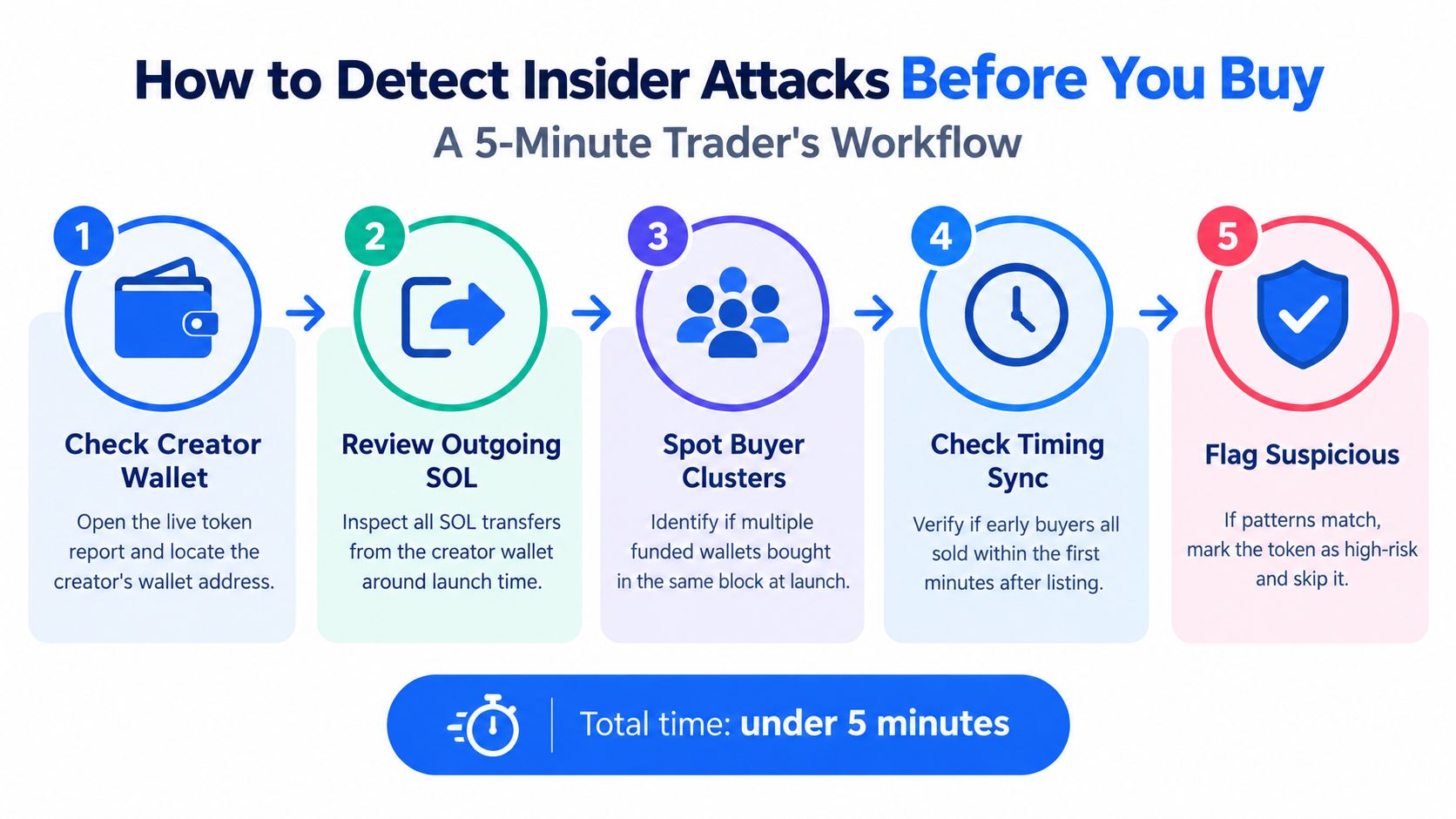
Open the live token report and start with the creator wallet. You're looking for outgoing SOL around launch time, especially if it lands in a small set of fresh addresses that later buy the token.
Then inspect the first cluster of buyers. If several wallets were funded by the same source, bought in consecutive slots, or show nearly identical position sizes, you're probably looking at coordinated entry rather than scattered demand.
Next, check the sell side during any early pump. Synchronized exits are one of the best clues you'll get, because they often reveal how the group behaves when it's time to take money off the table.
After that, cross-reference holder concentration with the creator's wallet history and any rug indicators. A single clue can be noise. Two or three clues together are a pattern.
The visual below is a quick field guide for that workflow.
The useful mindset is correlation, not certainty. You're not trying to prove a crime in five minutes. You're trying to decide whether enough wallet evidence exists to keep your money out of a setup that already looks pre-arranged.
For a deeper wallet-level check, this guide on how to check a Solana token creator wallet helps anchor the launch analysis in the right place.
A Trader's Insider-Attack Checklist and Bottom Line
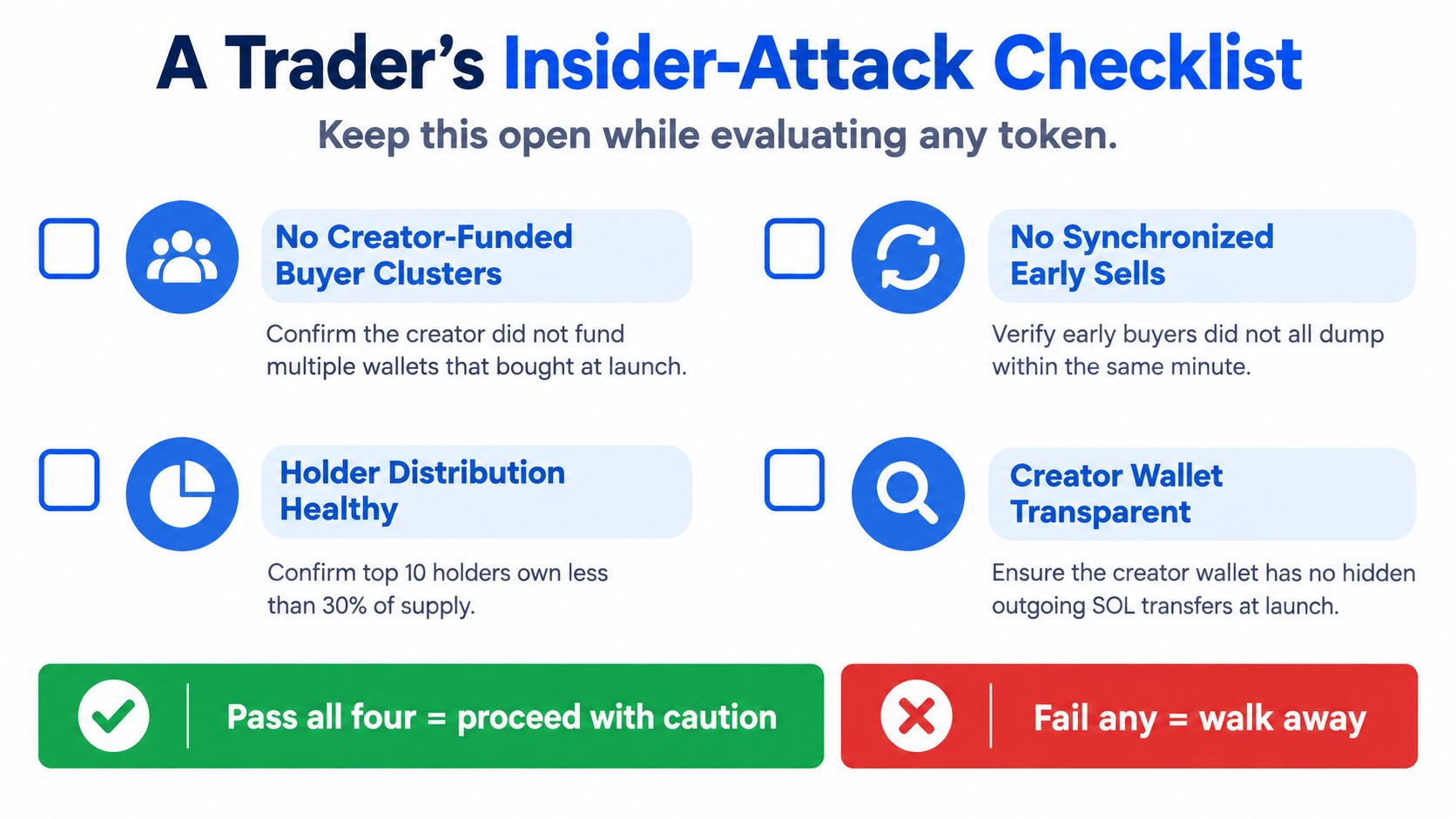
Use this checklist before you buy:
- No Creator-Funded Buyer Clusters: confirm the creator did not fund multiple wallets that bought at launch.
- No Synchronized Early Sells: verify early buyers did not all dump within the same minute.
- Holder Distribution Healthy: confirm top holders aren't dominating supply through pre-launch wallets.
- Creator Wallet Transparent: make sure the creator wallet has no hidden outgoing SOL transfers at launch.
CISA's broader point applies cleanly on-chain, too. Insider outcomes often look like carelessness rather than obvious malice, because the behavior can come from negligence, compromise, or pre-positioned access, not just a cartoon villain with a plan (CISA insider threat mitigation).
That's why a serious trader should separate access from behavior. A wallet with privileged knowledge isn't automatically malicious, but once that wallet starts funding buyers, timing exits, and shaping supply around launch, the risk changes fast.
A useful tool doesn't just count holders. It scores insider risk as a specific, evidence-backed category, then shows you the wallet relationships behind the score. That's the difference between noise and a real read on a Solana meme coin launch.
If you want this kind of launch analysis in one place, MemeAssist gives you on-demand Solana token reports with live wallet and risk checks. It's built for the exact problem covered here, spotting creator-linked behavior, bundle patterns, and suspicious exit structure before you buy.