What Is Slippage in Crypto and Why It Matters
What is slippage in crypto? See why quotes miss the fill, how to calculate the loss, and how Solana meme-coin traders limit it.
Published
Updated
Slippage is the gap between the price quoted when you send an order and the price at which it fills. On an automated market maker, a large swap moves through the pool at progressively worse prices, and a 1% unfavorable outcome means receiving approximately that much less value than expected, before separate fees.
You tap Buy on a Solana meme coin. The wallet shows an amount you're happy with, but the confirmation arrives with fewer tokens. Or the swap fails, your tokens stay put, and your SOL balance still drops slightly.
Those are different outcomes. Understanding the difference helps you decide whether to change the trade size, inspect the pool, or walk away instead of repeatedly raising a setting.
Table of Contents
- What Slippage Means on a Live Swap
- Why the Quoted Price Moves Before You Fill
- How to Calculate Slippage in Percent and Dollars
- How Often DEX Fills Miss the Quote
- What Slippage Looks Like on Solana Meme Coins
- How to Limit Slippage Without a Blind Setting
- Check Pool Conditions Before the Next Buy
What Slippage Means on a Live Swap
Your wallet's quote is an expectation, not a completed trade. Crypto slippage measures the difference between that expectation at submission and the execution you receive.
For a purchase, an unfavorable fill means paying more per token or receiving fewer tokens for your input. For a sale, it means receiving less in proceeds than the quote suggested. A 1% unfavorable result represents approximately 1% less value on the purchase or sale, before network and trading fees, consistent with the execution-cost framework described in this empirical study of Uniswap trading.
The quote tells you what you expected. The fill tells you what you received.
Read the whole swap, not just the token price
On an automated market maker, or AMM, you trade against pooled assets rather than waiting for another trader to accept your order directly. As a purchase changes the pool's balance, the remaining tokens become more expensive along its pricing curve. A sale moves the exchange rate in the opposite direction.
That makes a displayed token price incomplete. It describes a rate, but it doesn't tell you whether you can buy your intended position near that rate or sell it back without moving the pool substantially.
- Quoted output is the amount the interface estimates for the proposed swap.
- Executed output is what the successful transaction delivers.
- Displayed token price isn't a guarantee that your whole position can trade at that price.
A cheap-looking meme coin can therefore be expensive to enter and harder to exit. The relevant question isn't just whether its price looks attractive. It's whether enough liquidity exists for the amount you want to trade.
Also distinguish the pool's current token price from a quote calculated for your complete order. A size-aware quote may already incorporate your expected price impact. Any additional difference between that quote and the eventual fill is a separate execution gap.
That's the practical answer to what is slippage in crypto: it's an observable trading result, not the percentage box beside the swap button.
Why the Quoted Price Moves Before You Fill
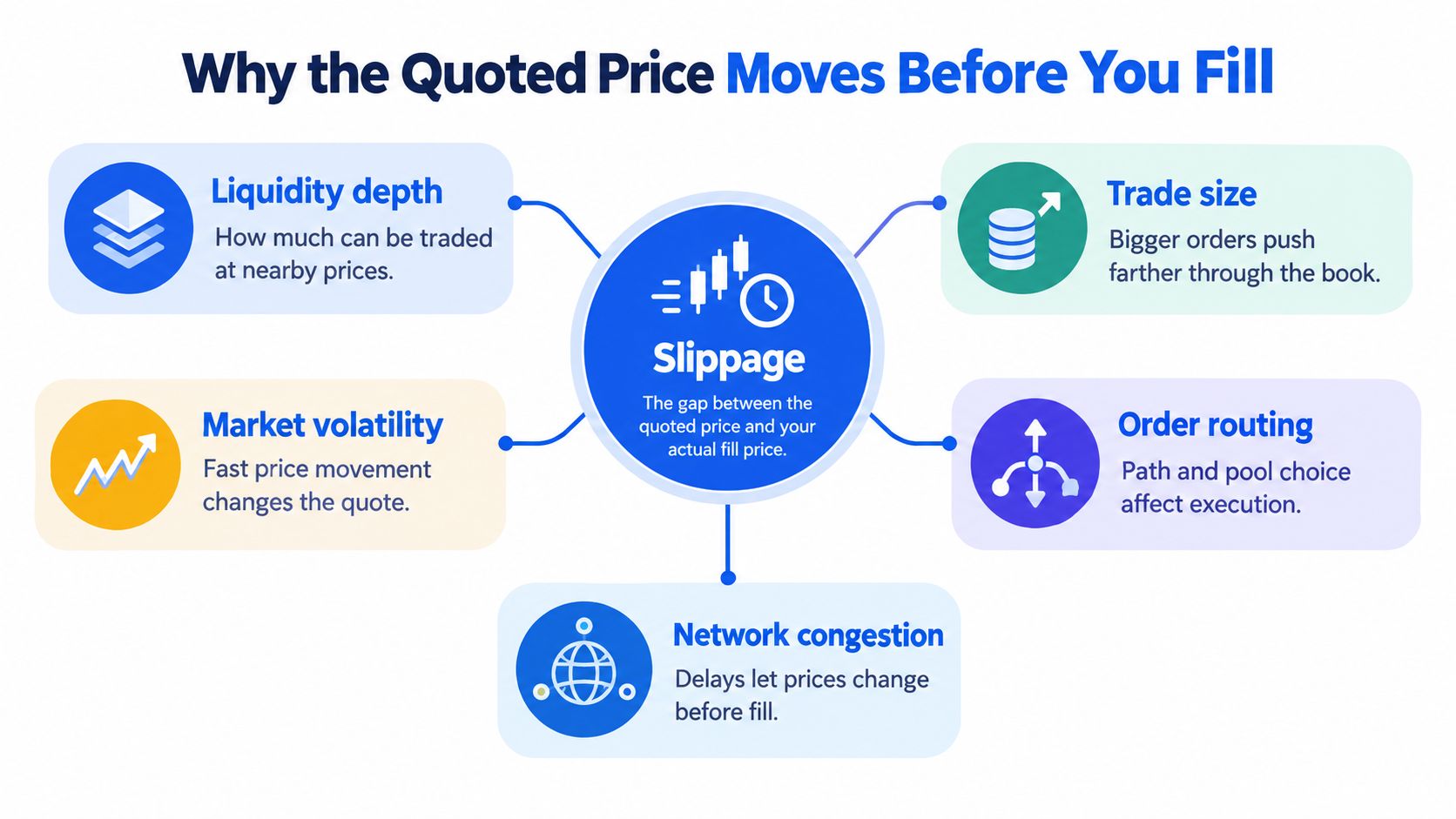
A worse fill doesn't always have the same cause. Your own order can move the pool, another trader can change its balance before you arrive, or the selected route can expose you to different trading conditions.
Start by separating the machinery involved.
The conditions behind a changing quote
- Liquidity depth describes how much you can trade near the current price. A thin pool offers little room before the exchange rate changes materially.
- Trade size determines how far your swap moves along the pool's pricing curve. An order that looks modest in your wallet can still be large relative to available liquidity.
- Market volatility changes the conditions between quoting and execution. Other buyers and sellers can alter the pool before your transaction completes.
- Order routing determines which pools your swap uses. Different paths can produce different outputs for the same intended trade.
- Network congestion can delay inclusion, leaving more time for the quoted conditions to change.
The diagram separates these factors so you can identify the problem before adjusting a control.
Your impact and other traders' actions are different
Price impact is the change your own trade creates. If the quote already accounts for your order size, that expected impact may be visible before you sign. Raising tolerance doesn't reverse it or add liquidity.
Other actors can also trade ahead of confirmation. In adversarial ordering, traders may position transactions around yours to extract value. A sandwich-style trade uses that ordering to worsen your execution while the attacker benefits.
These causes can overlap. You might submit a large order into a shallow pool while other buyers are pushing its price higher. A different route may help with pool selection, but it won't necessarily solve the underlying lack of liquidity.
Fees belong in a separate category. The Uniswap research cited earlier found that gas dominated small-swap costs, while price impact and slippage accounted for most costs on large swaps. That finding is about the analyzed market, not a universal cost ranking for every Solana trade.
Before changing tolerance, ask whether you're dealing with your own impact, changing conditions, or poor routing. Each calls for a different response.
How to Calculate Slippage in Percent and Dollars
Use the quote you approved, not a chart price from earlier. Then compare it with the completed transaction using the same asset and unit of measurement.
For an unfavorable buy-price change, subtract the expected price from the execution price and divide by the expected price. For an unfavorable sell-price change, subtract the execution price from the expected price and divide by the expected price. Express the resulting fraction as a percentage.
Keep the price calculation separate from the output calculation
A fixed-spend purchase introduces a small distinction. A percentage increase in unit price isn't mathematically identical to the same percentage decrease in token output. Use either price or output consistently rather than switching between them mid-calculation.
For dollar budgeting, let D represent the quoted dollar value of your order. Applying the unfavorable percentage illustrated earlier gives an approximate dollar shortfall of D multiplied by that percentage. On a buy, that's a shortfall in received value; on a sell, it's a shortfall in proceeds.
You don't need an invented token price to make this useful. Substitute your wallet's quoted order value for D, then compare the result with the amount you're prepared to lose through execution alone.
Quote, Fill, and Tolerance on One Swap
| Item | Buy example | Sell example |
|---|---|---|
| Expected price | Quoted purchase price per token | Quoted sale price per token |
| Execution price | Higher than quoted | Lower than quoted |
| Percent gap | Extra purchase price divided by expected price | Missing sale proceeds per token divided by expected price |
| Dollar gap | Extra price multiplied by tokens bought | Missing proceeds multiplied by tokens sold |
| Inside tolerance | May complete if all other checks pass | May complete if all other checks pass |
| Beyond tolerance | Reverts rather than accepting the worse result | Reverts rather than accepting the worse result |
Tolerance is permission, not a prediction
Slippage tolerance is the maximum deterioration you authorize relative to the quote. It doesn't predict what you'll lose, and it doesn't automatically charge you the entire allowed amount.
A tight limit can reject an unacceptable fill. It can also reject a trade after an ordinary price move, even when nothing suspicious happened.
Before signing: Compare the quoted output, the minimum acceptable output, and the dollar value between them.
That difference is the execution loss you're permitting. Trading fees and network charges still need their own place in your budget.
How Often DEX Fills Miss the Quote
Historical trade records show that a quote and a fill don't always match. They also show why calling every difference a loss is misleading.
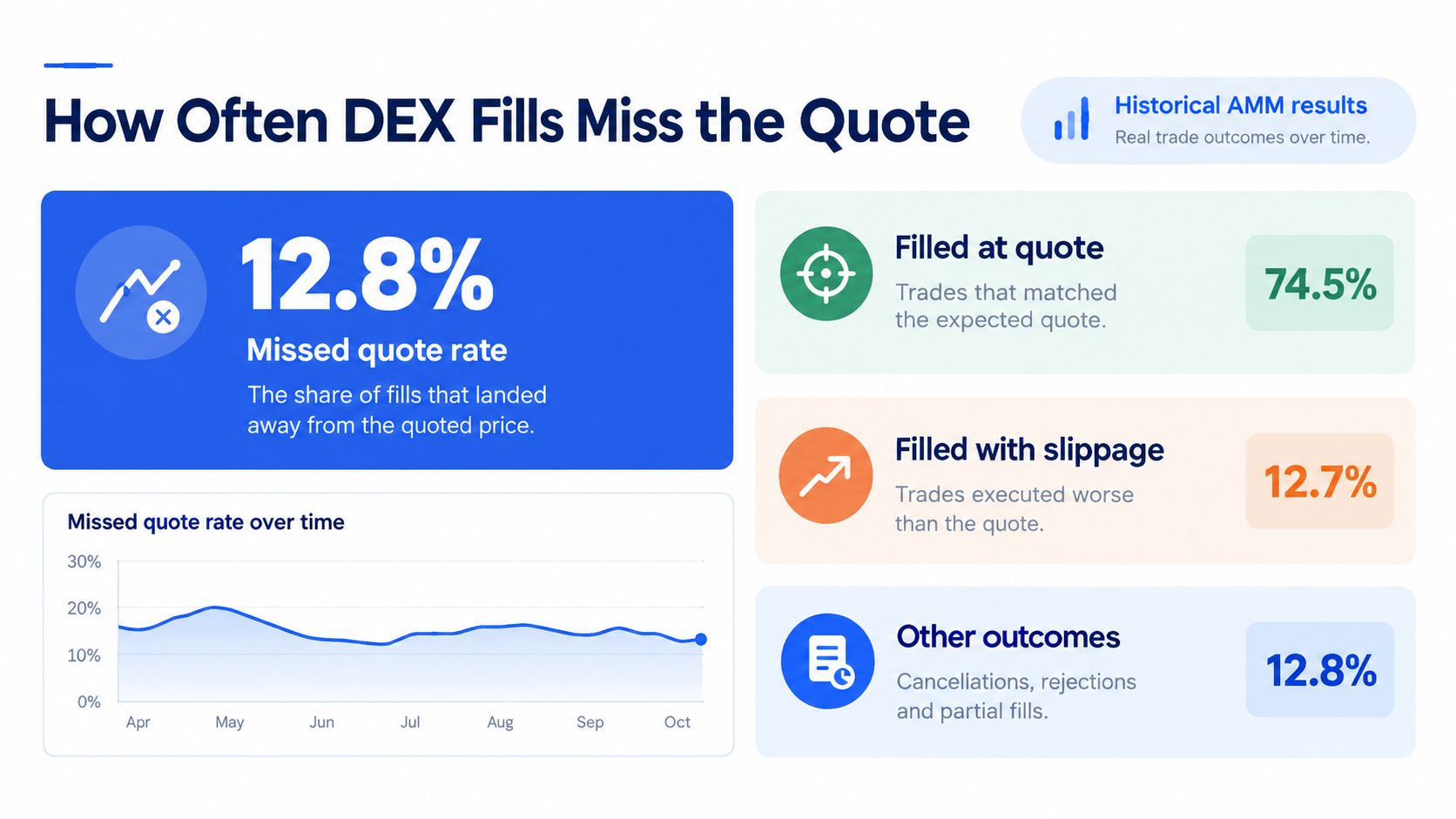
A 0x analysis of hidden DEX execution costs examined more than 673,000 Swap API trades executed on Ethereum between April and November 2021, across venues including Uniswap v2, Uniswap v3, and SushiSwap. It found approximately 50% with zero measured slippage, 17% with positive slippage, and 33% with negative slippage.
Positive slippage means the trader received a better result than quoted, such as more output for the same input. Negative slippage means the opposite.
What those outcomes tell you
| Observed outcome | Meaning for the trader |
|---|---|
| At the quote | Execution matched the expected result |
| Better than the quote | The change benefited the trader |
| Worse than the quote | The change reduced the trader's received value |
The historical breakdown above is the numerical evidence to use. The following supplied visual illustrates quote-versus-fill outcomes, but its headline rate isn't supported by that analysis and shouldn't be used as a trading benchmark.
Keep the historical lesson narrow
These were Ethereum trades from a particular period and execution workflow. They aren't a forecast of what your next Solana swap will do, and they don't establish a universal failure rate for meme coins.
The useful lesson is simpler: a clean quote is incomplete evidence of the final outcome. You still need the actual fill to judge execution.
Keep separate records for the expected output, the received output, and explicit charges. Otherwise, you might blame a trading fee for a price difference or assume that a better fill eliminated every other cost.
There's another important boundary in these results. A completed trade with unfavorable execution isn't the same event as a rejected swap. Historical fill quality tells you about transactions that executed. It doesn't, by itself, explain what you paid when an attempted transaction failed.
What Slippage Looks Like on Solana Meme Coins
You submit a buy while a meme-coin pool is moving quickly. Before your transaction executes, another trade changes the available output. Your minimum-output check is no longer satisfied.
The transaction is processed but fails. The intended swap doesn't happen, so the traded tokens stay where they were. Yet the network can still charge for processing the attempt.
A failed swap can still have a fee
Solana's charging rule separates the transaction's processing from the swap's success. The base fee is 5,000 lamports per signature, with any priority fee added for scheduling; an included transaction can incur these charges even when execution fails, as explained in this analysis of failed Solana swaps and their fee costs.
That analysis reported 2.4 billion failed swaps, or 22% of 11 billion submitted swaps, between October 30, 2025 and October 7, 2026, identifying price movement before execution as a common reason. This is a reported historical window, not a prediction of your personal failure rate.
The distinction changes how you respond to a missed entry.
- Price slippage describes the difference on a trade that fills.
- Tolerance determines which deterioration your swap instructions permit.
- Failure cost is what you may pay for a processed attempt that doesn't complete the swap.
Don't turn a missed entry into repeated paid attempts
An execution-cost spiral starts when you keep resubmitting without checking what changed. Your principal may remain untouched, but each processed failure can consume fees. You also spend time chasing a quote that no longer reflects the pool.
Open the transaction details before trying again. Confirm whether it failed on-chain, whether the error involved the output limit, and what the fee breakdown shows. A submission that never reaches processing isn't the same as an included transaction that fails.
Keeping your traded tokens doesn't mean the attempt was free.
There's also a larger risk beyond execution. At MemeAssist, we warn that meme coins are extremely risky and you can lose everything invested, even without a rug pull. A falling price alone doesn't establish that a rug pull occurred.
For launch-stage context, review the mechanics behind Pump.fun bonding-curve trading risks. A failed entry, a bad fill, and a collapsing token require different diagnoses.
How to Limit Slippage Without a Blind Setting
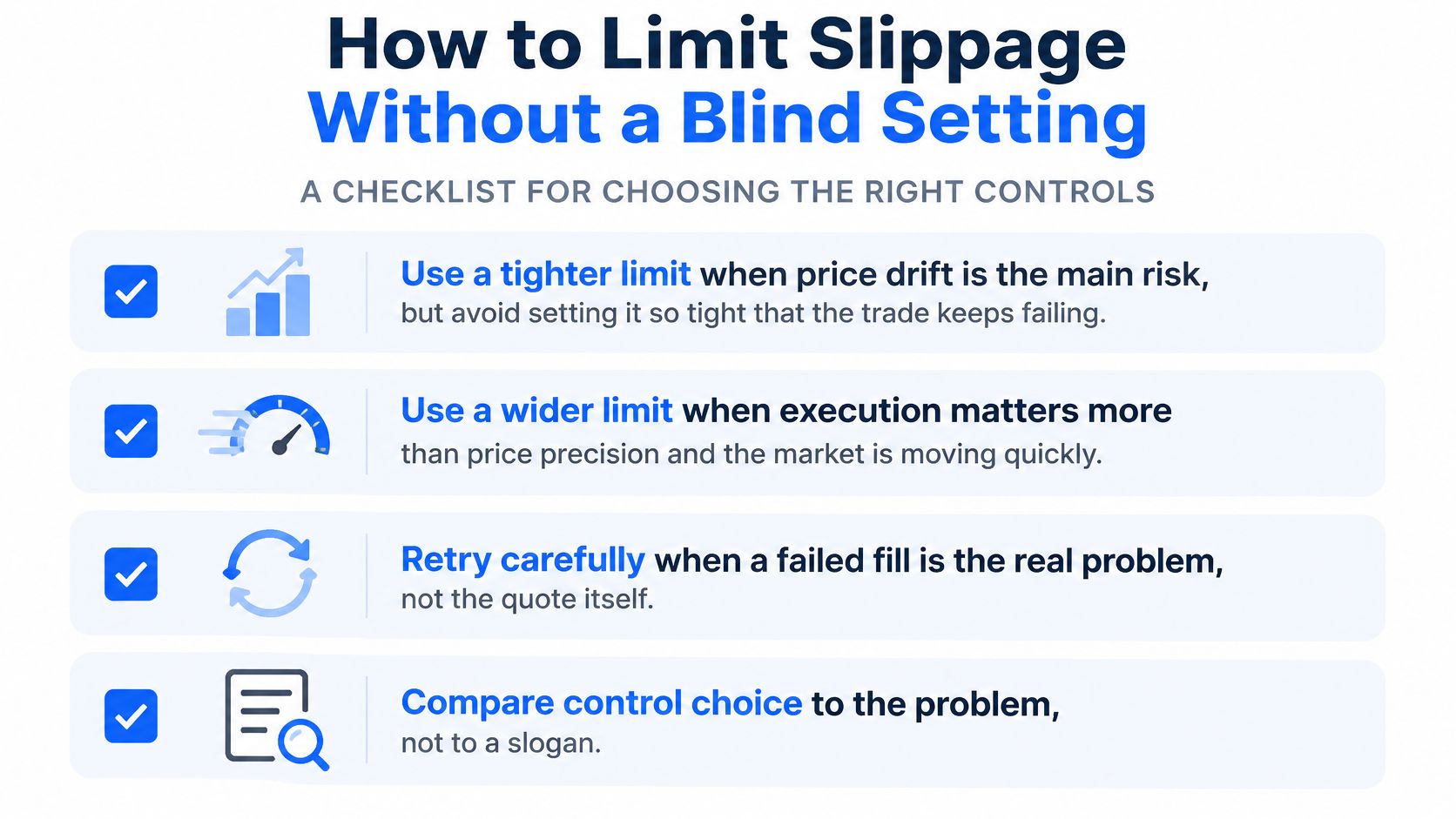
Neither “always tighten tolerance” nor “raise it until the swap works” is a sound decision rule. The right control depends on what's causing the problem and what loss you're willing to accept.
On a low-liquidity pair, tolerance above roughly 3%–5% can authorize substantially worse execution and increase sandwich-style exposure, a risk highlighted in the discussion of Solana transaction ordering and execution protections. That range isn't a safety boundary or a recommended default.
Match the control to the cause
| Control | When it may help | What it doesn't fix |
|---|---|---|
| Depth-aware tolerance | You need a clear maximum acceptable deterioration | It doesn't create liquidity |
| Limit order, where supported | You can wait for an acceptable price | It doesn't guarantee a fill |
| Smaller order pieces | Your proposed size creates substantial impact | Repeated trades can still move the same pool |
| DEX aggregator | Another route may offer better execution | Every available route may still be thin |
| Pool-depth and concentration check | You need to judge whether the position is tradable | Conditions can change after inspection |
Splitting deserves particular care. Smaller pieces can reduce each individual trade's immediate impact, but repeatedly buying from the same pool without replenishment doesn't magically eliminate the total effect. More transactions also mean more opportunities for fees and changing prices.
An aggregator is similarly a routing tool, not a guarantee. Compare the estimated received amount and route conditions rather than assuming an extra routing step always improves the result.
Use the checklist as a prompt to diagnose the trade, not as permission to widen tolerance automatically.
Resize or skip when the pool is the problem
Ask what maximum dollar deterioration you're authorizing relative to the available depth and current movement. If that amount feels unacceptable, the answer may be a smaller position rather than a looser limit.
Use liquidity requirements for Solana meme coins to frame that inspection. Thin or unusually concentrated pools deserve scrutiny before either tightening or loosening a setting.
Execution isn't the only goal. An order that fills within your chosen limit can still be a poor trade if the position is difficult to unwind.
Check Pool Conditions Before the Next Buy
Before approving another attempt, put the token's liquidity and ownership evidence beside the swap quote. A quote alone can't tell you how concentrated the supply is or whether unusual activity deserves further investigation.
A token-address report can bring those scattered checks into the same view.
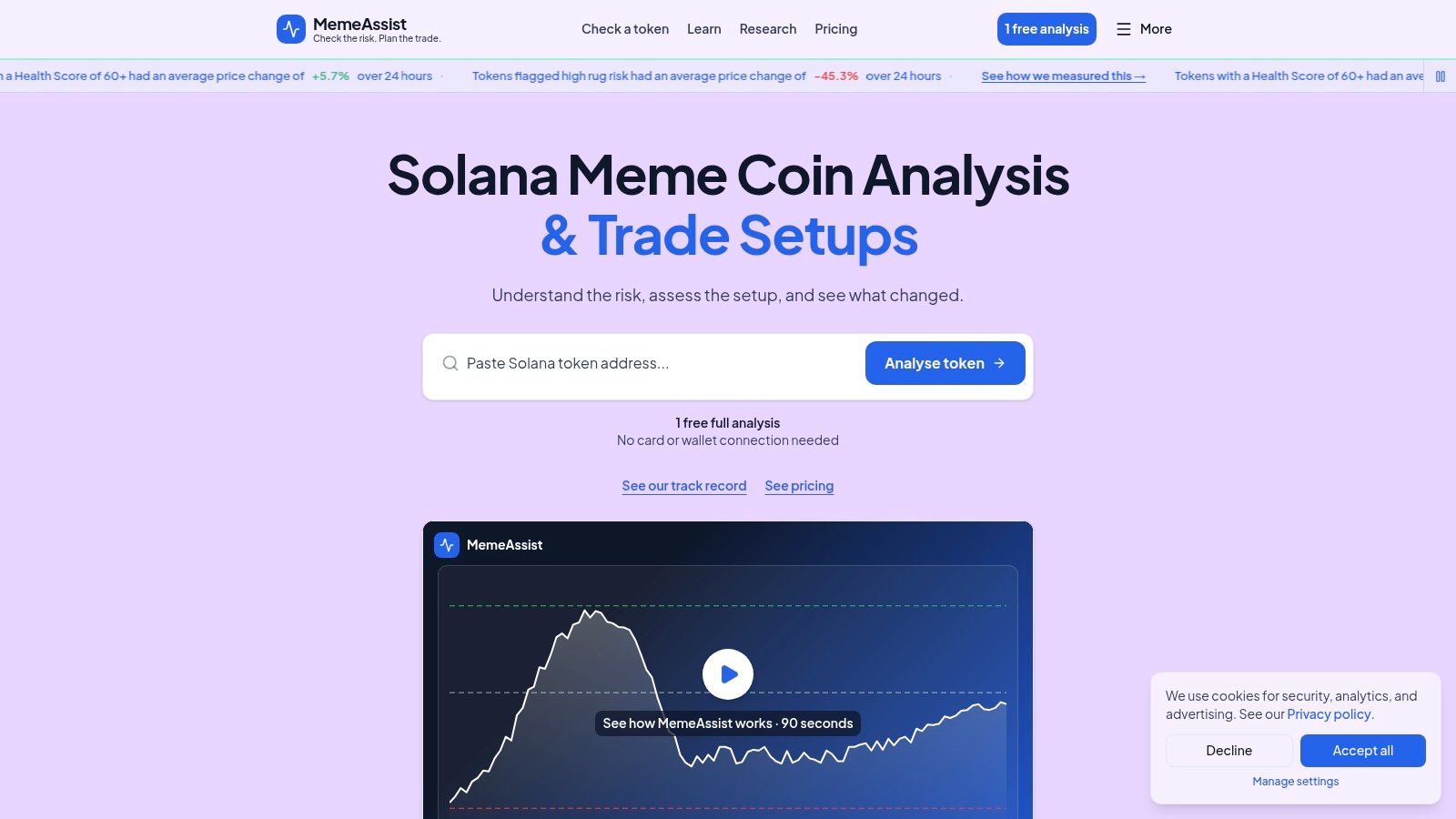
Read execution risk alongside token structure
MemeAssist is our AI-powered risk analysis tool for Solana tokens. It analyzes live on-chain data across liquidity, holder distribution, creator behaviour, wallet activity, trading patterns, and historical risk indicators, including available liquidity and possible difficulties opening or closing a position.
The informational report combines an Overall Health Score, Rug Risk Rating, AI Verdict, and Detailed Risk Breakdown. Use the evidence behind those outputs rather than treating the labels as a trading instruction.
A Solana liquidity check is relevant because your intended position needs a plausible exit as well as an entry. Holder concentration and unusual trading activity add context about who could change the conditions you're pricing.
- Available depth helps you assess whether your intended size fits the pool.
- Holder structure helps identify concentrations that warrant closer examination.
- Trading evidence helps you decide what requires another check before committing funds.
Suspicious activity or possibly connected wallets are starting points for investigation, not proof of wrongdoing. Missing information isn't proof of safety either.
Treat the explanation as something to verify
Our AI can misinterpret information or produce an erroneous explanation. Blockchain and market data can also be incomplete, delayed, or unavailable.
A lower rug-risk rating doesn't mean a token is safe, and a higher health score doesn't mean its price will rise. A token can pass checks and still collapse when demand disappears, large holders sell, or liquidity changes.
For a visual walkthrough, watch the accompanying video.
The useful decision is whether the current evidence supports your intended size and permitted execution loss. If it doesn't, leave the tolerance box alone until you've resolved that mismatch.
MemeAssist brings live Solana liquidity, holder, and trading evidence into an explained token-risk report. Before raising tolerance on a thin pair, visit MemeAssist, run a fresh analysis on the token address, and compare the liquidity evidence with the dollar loss your tolerance would authorize.