Crypto Degen Explained: Culture, Risks and Rules
You're refreshing a token-launch feed late at night. A coin with a ridiculous name is climbing, the group chat is celebrating, and buying feels easier than explaining why you stayed out. Before you click, there's a more useful question than how high it could go: who will buy when you want to sell?
That question separates understanding crypto degen culture from participating in it. The excitement is real, but a good risk check should help you judge exit conditions and realistic outcomes, not convince you that you've found the next winner.
Table of Contents
- What a Crypto Degen Is and Where the Term Came From
- The Degen Mindset and the Fraud Behind It
- Why Launch Volume Overwhelms Degen Research
- The First Hours Decide Most Meme-Coin Outcomes
- Safety Signals That Separate Real Tokens From Hype
- What Realistic Degen Outcomes Look Like
- Confirm Your Limits Before Your Next Degen Trade
What a Crypto Degen Is and Where the Term Came From
A crypto degen, short for degenerate, is someone who takes highly speculative crypto bets, often embracing the speed, uncertainty, and thrill. It's a self-aware label, frequently worn with pride rather than shame. The term describes an attitude toward risk, not a professional qualification or a particular blockchain.
Say you buy a newly launched token because its name makes you laugh and its chart is rising. You aren't necessarily making a claim about future earnings or useful technology. You're betting that other people will find it compelling enough to buy after you.
An investor might approach a purchase like buying a house after surveying the street. A degen's impulsive entry looks more like buying a lottery ticket after hearing about the winner. That comparison describes the decision process, not a claim that every speculative trade has identical odds.
The surrounding attention grew substantially: meme-coin narrative interest represented 14.36% of global crypto narrative interest in 2024, compared with 8.32% in 2023, according to CoinGecko figures reported by crypto.news.
Core Degen Vocabulary and the Risk Each Term Signals
| Term | Meaning | Risk It Signals |
|---|---|---|
| Degen | Trader who takes high-risk bets for the thrill | Bets sized beyond what they can afford to lose |
| Ape in | Buying quickly with little research | Entry before any checks are done |
| Bag holder | Buyer left holding a token after insiders sell | Entry that came too late to exit well |
| Rug pull | Creators drain liquidity and abandon the token | Funds that cannot be recovered |
| Exit liquidity | Late buyers who let early holders sell | Price collapse when they try to leave |
| DYOR | Do your own research | Reliance on a single source or a social post |
| HODL | Hold through volatility, a famous misspelling of hold | Keeping a failing token too long |
These terms compress complicated risks into casual language. Recognizing them helps you notice when a conversation is encouraging speed, loyalty, or bravado instead of scrutiny.
The Degen Mindset and the Fraud Behind It
The attraction isn't difficult to understand. Fast-moving feeds offer constant novelty, other buyers provide social proof, and a rising chart makes hesitation feel expensive. After a loss, the next launch can also look like a shortcut back to even.
Those motivations deserve honest examination, not mockery. Enjoying speculation doesn't make someone foolish, but excitement can blur the distinction between accepting uncertainty and ignoring evidence.
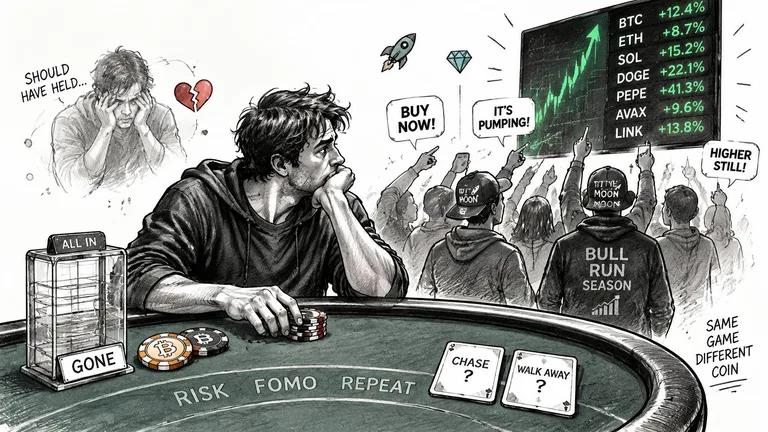
The gambling analogy captures that tension.
Volatility Isn't the Same as Deception
Think of a casino where some tables are rigged and the lights are dimmed. You can knowingly accept the normal gambling risk while still being unable to identify which game is dishonest. In speculative crypto, a price decline alone doesn't establish fraud, and a price increase doesn't establish legitimacy.
Chainalysis estimated cryptocurrency scams received at least $9.9 billion on-chain during 2024, with the total expected to rise as additional illicit addresses were identified.
That figure doesn't isolate Solana meme coins or retail degen trading, and not every meme-coin loss is a scam. It establishes the broader fraud environment, not the probability that a particular launch is fraudulent. A creator can deceive buyers, but buyers can also lose money in a token launched in good faith that nobody wants anymore.
Check Your Reason for Entering
Before evaluating the token, evaluate the decision you're about to make:
- Total-loss acceptance: Would losing the entire amount affect essential spending, debt payments, or your ability to sleep?
- Evidence versus reaction: Did you examine the token, or did you react to a chart and enthusiastic posts?
- Recovery motive: Are you making this trade because it stands on its own, or because you want to erase a previous loss?
If your reason is recovery, changing tokens doesn't change the emotional problem. Step away before turning disappointment into a larger exposure.
Practical rule: Judge the reason for the price increase separately from the reason you believe the token is safe.
Rapid gains and fraud can coexist. Neither excitement nor profitability is a substitute for checking what participants can do with the token.
Why Launch Volume Overwhelms Degen Research
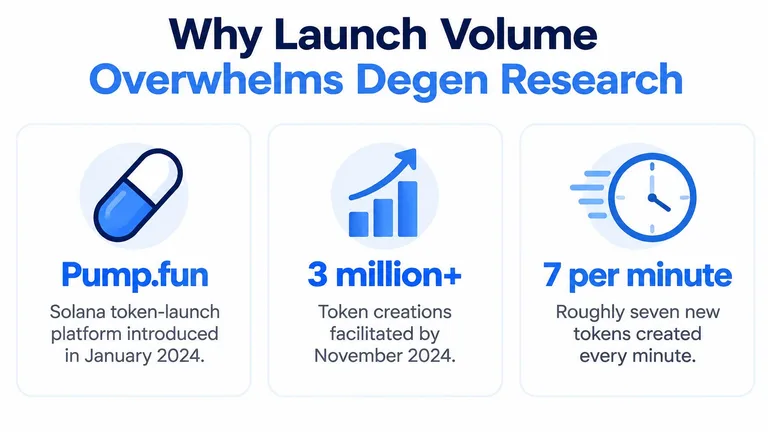
Pump.fun made the screening problem unusually visible. The Solana token-launch platform, introduced in January 2024, had facilitated more than 3 million token creations by November 2024, equivalent to roughly seven new tokens per minute, according to an analysis of Pump.fun's launch activity.
A human trader can't perform meaningful due diligence at that pace. Even reading every description would leave little time to inspect ownership, liquidity, or creator activity. The sensible response is to reject more candidates, not research faster until every check becomes superficial.
The scale is easier to grasp visually.
Separate Discovery From Due Diligence
Think of a flea market where new stalls keep opening while you walk. The loudest seller attracts a crowd, but noise tells you little about the merchandise. A crowded token feed creates the same temptation to mistake visibility for quality.
Use discovery tools to find candidates, then switch tasks deliberately. A trending list answers what people are watching. A token explorer, wallet view, and trading interface help answer whether the asset deserves further attention.
A workable triage sequence is:
- Confirm identity: Match the exact mint address rather than relying on a name, logo, or ticker.
- Check inspectability: Look for accessible authority information, holder records, and a recognizable trading venue.
- Reject unresolved hazards: Skip candidates when critical information is missing or contradictory.
- Reserve deeper work: Investigate creator-linked wallets and execution conditions only for candidates that remain plausible.
This is a filter, not a scoring contest in which every token eventually earns a buy. An unknown is a reason to pause, especially when the missing information affects whether you can sell.
Give Attention a Budget
Don't let a launch feed determine how long you spend watching it. Decide what evidence you need before opening another candidate, and keep a short written rejection reason. That record makes it harder to revisit a rejected token merely because its chart improved.
Your first triage rule should be simple: no clear identity, no inspectable market, no further attention. Passing that rule earns investigation, not an entry.
The First Hours Decide Most Meme-Coin Outcomes
An on-chain investigation by Bitquery covering 11.5 million new tokens reported that 79% never traded after launch day, while half of launches had their last trade within approximately three minutes. Famous winners therefore provide a poor picture of the full launch population.
Bonding-curve launches begin price discovery with limited depth. Relatively small orders can move prices sharply, so a rising chart may describe the effect of buying into a shallow market rather than durable demand. Your result depends on the price you can execute, including fees and slippage, not just the latest displayed price.
Launch Windows, What Research Shows and What to Watch
The windows below are monitoring checkpoints, not promises that waiting makes a token safe. Keep them beside a live trading view rather than treating them as entry deadlines.
| Launch Window | What Research Shows | What to Watch |
|---|---|---|
| First 3 minutes | Trading can end during the opening burst | Whether new trades keep arriving after the first buys |
| First 5 minutes | Early flow can contain useful fraud indicators | Whether activity is two-way, using the token checks below |
| First hour | Rug-pull characteristics can emerge during initial trading | Liquidity remaining after the first sell wave |
| First day | Continued trading cannot be assumed | Rolling unique traders and trade frequency |
For a closer examination of these timing risks, use our guide to how fast Solana memecoins rug. The operational question is whether participation persists after the excitement of launch.
Measure Exit Quality Directly
Watch time since the last trade, the rolling count of unique traders, and trade frequency per minute. Then request a sell quote for the position size you're considering, not an arbitrarily tiny amount. A quote isn't guaranteed execution, but it can expose a mismatch between the chart and the available market.
Say your wallet shows a large unrealized gain while trades arrive less frequently. That displayed gain assumes you can sell near a recent price. If your own sale would materially reduce the price, your realizable proceeds may be much lower.
A profitable-looking position isn't the same as a position you can close profitably.
Use activity persistence as a condition for staying interested. Market-cap rank and a single volume snapshot are weak safety proxies, because neither tells you whether independent buyers will remain available when you leave.
Safety Signals That Separate Real Tokens From Hype
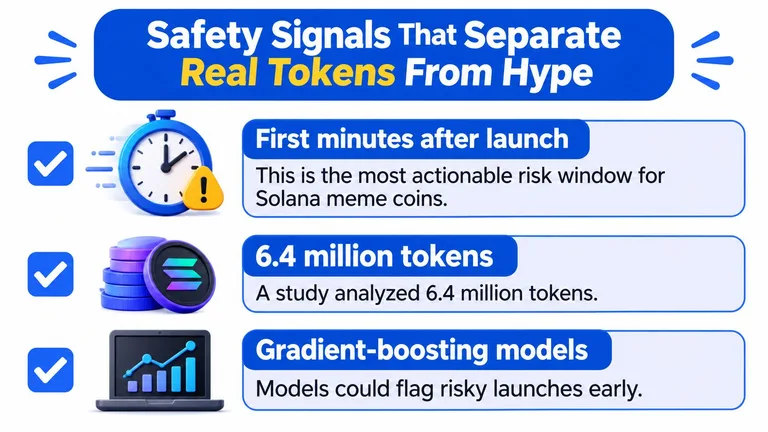
The opening minutes contain useful risk information. A study of 6.4 million Solana memecoins reported that most displayed rug-pull characteristics within one hour, while gradient-boosting models such as XGBoost could identify likely fraudulent tokens using only the first five minutes of trading data.
That finding supports early screening, not blind trust in a model. Coordinated or automated traders can generate activity that resembles broad demand, so the useful task is to inspect who traded, in which direction, and what happened when someone sold.
Use the checklist as an evidence map, not a guarantee.
Token Safety Signals, What They Tell You and the Red Flag
| Signal | What It Tells You | Red Flag |
|---|---|---|
| Holder concentration | How much supply a small group of wallets controls | A few wallets hold most of the supply |
| Liquidity depth | How large an exit can be before price falls sharply | Liquidity shrinks after the first sell wave |
| Mint and freeze authority | Whether supply can be expanded or holders frozen | Authorities still active after launch |
| Buy-sell balance | Whether early activity has real two-way flow | Buys dominated by a small set of repeat wallets |
| Artificial growth | Whether returns come from wash trades or pool manipulation | Volume cycling between a few linked wallets |
| Creator wallet history | Whether the deployer launched tokens that later failed | Creator-linked wallets tied to earlier rugs |
Start with holders, but distinguish trading pools and other identifiable accounts from discretionary owners. Wallet count alone isn't enough, because someone can spread holdings across addresses. Examine possible connections before interpreting a wide distribution as independent ownership.
Next, compare liquidity before and after selling. Then inspect mint and freeze authorities: retained permissions deserve investigation, though an active authority isn't by itself proof of fraud.
Read the Flow Behind the Volume
Break raw volume into unique wallets, repeat-wallet behavior, trade direction, and post-entry selling. If the same participants repeatedly buy while creator-linked wallets distribute tokens, additional volume may not represent additional independent demand.
That's adverse selection in plain language: you may be buying from participants who are better positioned to leave than you are. Our Solana token safety checks guide provides a practical framework for examining those conditions.
A 2026 cross-chain study of 34,988 meme tokens found that 82.89% of tokens achieving returns above 100% showed evidence of artificial growth, including wash trading and liquidity-pool price inflation. A strong return alone therefore isn't evidence of genuine demand.
Our MemeAssist analysis includes minting and freezing authorities, liquidity, holder distribution, creator behavior, wallet activity, trading patterns, and historical risk indicators. Our AI can misinterpret information or produce an erroneous explanation, and blockchain and market data can be incomplete, delayed, or unavailable. Check explanations against the underlying signals, especially when an interpretation would change your decision.
What Realistic Degen Outcomes Look Like
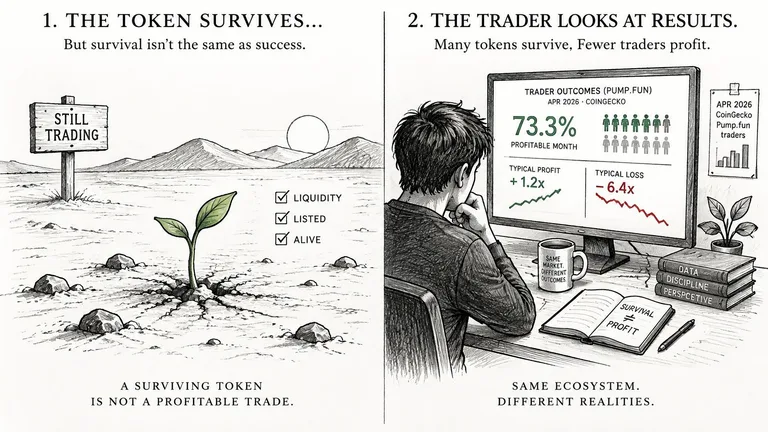
A token can keep trading while its buyers lose money. A trader can also profit from a token that later disappears. Survival and profitability measure different outcomes.
A summary of CoinGecko figures from Analytics Insight's report on memecoin trading outcomes puts profitable Pump.fun traders at 73.3% in April 2026. The same summary says 65.1% of wallets earned $1–$500, roughly 25% lost $1–$500, and only 5.4% earned more than $1,000. It also describes a Bitquery investigation of nearly 2.9 million ordinary Solana memecoin wallets: 74% held less SOL than they initially spent within two weeks, with combined net losses approaching $269 million.
Those figures describe different groups and periods, not a personal forecast. A surviving token does not mean its holders made money.
Base Rates Aren't Personal Predictions
A base rate is the starting pattern for a relevant group before you assess a particular token. It gives you a reality check: if you expect a launch to outperform its peers, identify the evidence behind that expectation. Recognizing a funny meme is not, by itself, evidence of an edge.
MemeAssist's learning library on token safety checks offers background on how to assess token risks. Keep survival separate from wallet returns when reviewing your own results. Track completed trades and proceeds after costs, not screenshots of peak portfolio value.
Turn Expectations Into Conditions
Before committing capital, answer three questions:
- Relevant comparison: What usually happens to launches with a similar age, venue, and level of participation?
- Time to failure: What observable event would invalidate your reason for entering?
- Executable size: How much could you sell under current conditions without taking an unreasonable execution loss?
Clear conditions make it easier to reassess when evidence changes. Being right about a token's direction at first does not justify staying after the case for the trade has weakened.
A token can pass MemeAssist's checks and still collapse if demand disappears, large holders sell, liquidity changes, or new information appears. A screening result helps you judge whether to keep evaluating; it does not promise a profit.
Confirm Your Limits Before Your Next Degen Trade
The most useful pre-trade routine produces a decision you can follow when the chat gets loud. Write it outside the trading interface so you aren't negotiating with yourself while watching a candle.
A Routine You Can Actually Follow
Set a loss budget in dollars. Choose an amount you can lose entirely without changing essential spending or financial commitments. Don't substitute the amount you hope to lose after a stop, because an exit may fail.
Write the exit condition before entering. Use an observable condition, such as a price invalidation, an expiration time for your thesis, or a deterioration in liquidity. Decide what you'll do if execution becomes worse than expected.
Record failed checks. Inspect authorities, holders, liquidity, trading flow, and creator history. Writing down unresolved issues prevents an appealing chart from turning unknowns into assumed positives.
Cross-check independently. Compare the mint address and important findings against a separate explorer or analytics source. Different interfaces may share an upstream feed, so apparent agreement isn't always independent confirmation.
Reduce the proposed size and control execution. In thin markets, avoid unbounded market orders where alternatives exist. Review quotes, set a maximum acceptable execution price or slippage, and accept that a controlled order may not fill.
Choose a cooling-off rule. After a loss, stop until your predetermined break has ended and you can explain the next trade without mentioning recovery. Don't increase size merely to make the previous loss feel smaller.
Decide What Makes You Abstain
A routine needs a no-trade outcome. Missing evidence, unacceptable execution, or an emotional recovery motive should be sufficient reasons to leave the token alone.
Before you fund the next trade, write down the amount you can lose completely and the condition that makes you stop.
Our role is a second opinion for research, not a guarantee that a token is safe. We provide automated, informational analyses rather than financial advice. Memecoins are extremely risky, and you can lose all invested capital.
Use free scanners for an initial check, then visit MemeAssist for a full Solana token analysis that explains the evidence behind its health score, rug risk rating, and AI verdict. Bring a specific token address and use the report to challenge your assumptions about safety and exit quality, not to outsource your loss limit.
Topics: crypto degen, meme coin trading, Solana memecoins, crypto risk management, rug pull signs
Informational only, not financial advice. Meme coins are extremely high-risk.
All articles