Honeypot Token Checker: How to Spot Scam Coins
Learn how a honeypot token checker works, what signals to inspect, and the best workflow to avoid buying scam meme coins on Solana.
Published
Updated
The chart is green, the pool looks active, and your buy lands without a problem. Then you tap sell. The transaction returns a custom program error, or sits pending until it fails, while the token price keeps moving without you. A clean-looking buy never proved that the token would let you exit.
That's the trap a honeypot token checker is meant to help detect, but a scan is evidence from a moment in time, not a promise about what happens next. The practical question isn't only whether a token can be bought or sold in a simulation. It's whether its transfer rules, liquidity, ownership patterns, and later changes leave you a realistic way out.
Table of Contents
- The Buy That Looked Perfect Until You Tried to Sell
- What a Honeypot Token Actually Is on Solana
- On-Chain Signals Worth Inspecting on Solana
- How a Honeypot Token Checker Works Under the Hood
- A Pre-Buy Workflow That Actually Catches Honeypots
- Why a Passing Check Is Not the End of the Question
The Buy That Looked Perfect Until You Tried to Sell
A trader finds a new Solana meme coin, checks the mint address, and sees no obvious warning. The buy goes through cleanly. When the trader tries to sell, the route fails with a program error. They retry through another route, adjust the transaction, and get nowhere. The token is in the wallet, but the holder can't turn it back into SOL through the expected path.
This isn't a contradiction. A token's buy and sell paths can behave differently. A transfer hook or other token logic may restrict transfers under specific conditions, while a thin or manipulated pool can make an otherwise permitted sale fail in practice. A checker that only confirms a purchase, or reads one reassuring field, hasn't tested the question that matters to a trader: can this wallet execute a sale?
If you're already stuck with a token you can't sell, separate a transfer restriction from a failed trade route or inadequate liquidity before trying again. This guide to why you can't sell a Solana token can help you identify what kind of failure you're seeing.

Practical rule: A successful buy tests entry. It doesn't prove that your wallet can exit, or that the pool will still support an exit later.
Treat every new token as untrusted until several independent signals make the trade look executable. The rest of the check is about finding where a sell can break: in token logic, in account permissions, or in the market itself.
What a Honeypot Token Actually Is on Solana
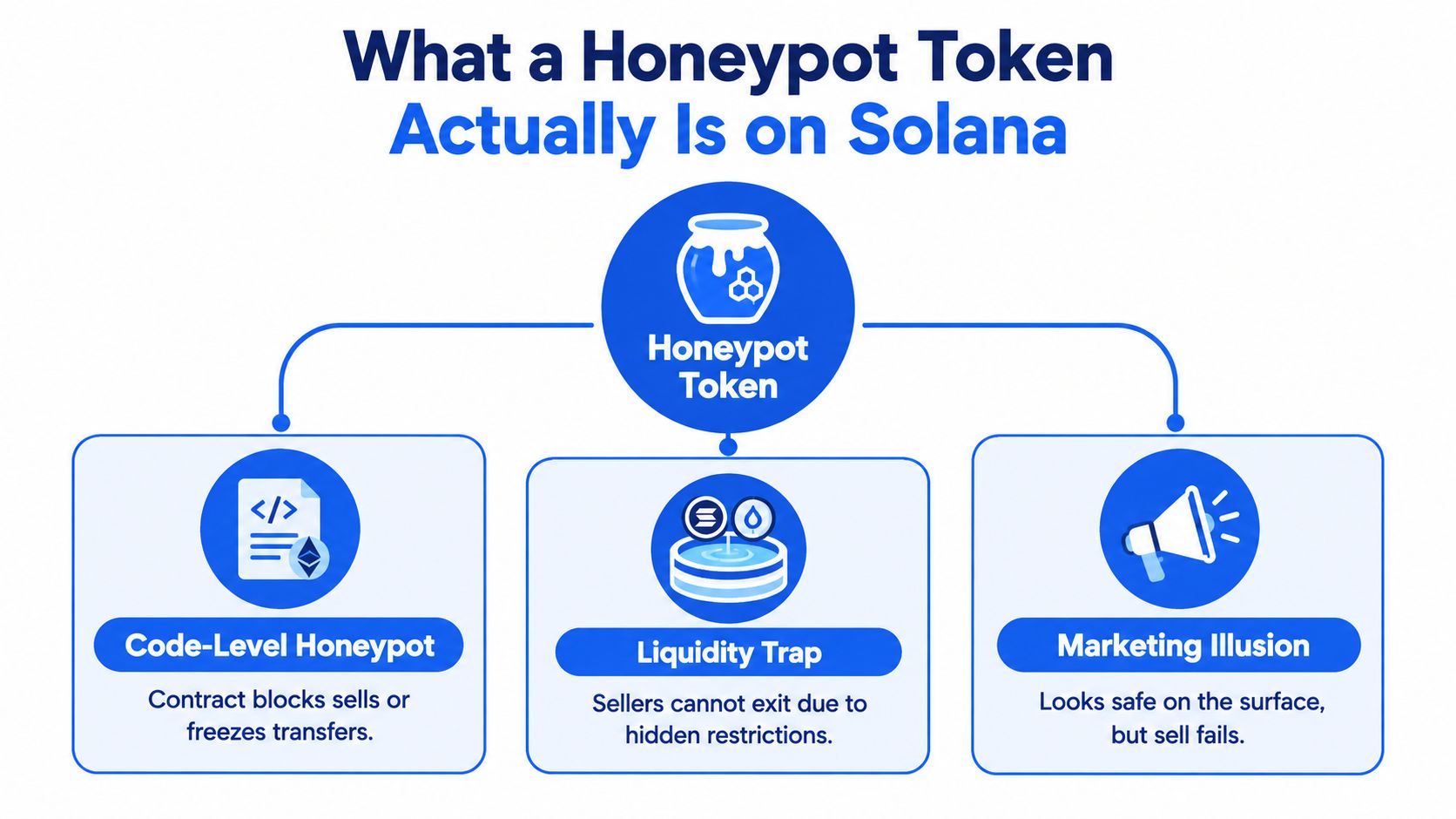
A honeypot is commonly understood as a token that lets buyers in but prevents them from selling. On Solana, that phrase is useful shorthand, but it can hide two different failure modes.
A code-level trap uses token behavior or permissions to block, freeze, or restrict transfers. A market-level trap may allow a sale at the token level while making an exit impractical because liquidity is shallow, ownership is concentrated, or liquidity disappears. The first is about what the token's rules permit. The second is about whether a buyer can trade out under actual market conditions.
Token-2022 adds features a serious checker needs to inspect. A Transfer Hook can invoke a custom program during transfers. Default Account State can make newly created token accounts frozen until an external program unfreezes them. A Permanent Delegate can give an authority persistent control over tokens, and freeze-related authorities can affect whether holders can transfer. These aren't automatic proof of a scam, but they create conditions that a simple mint-authority check won't capture.
The broader research supports treating a scan as risk triage, not a guarantee. A historical Uniswap study labeled 27,588 tokens, classifying 26,957 as malicious and 631 as non-malicious. It also found that 90% of tokens using locking contracts eventually became rug pulls or otherwise malicious tokens. The study focused on Uniswap, so its percentages shouldn't be applied directly to Solana, but it illustrates why a single signal such as locked liquidity can't establish safety (the decentralized-exchange token scam study).
Solana-specific research identified 62,895 suspicious liquidity pools and 22,195 tokens with rug-pull patterns. Those are analytical classifications, not proof that every token was a literal code-level honeypot. They underline an important distinction: transfer permission alone can't tell you whether the surrounding market is viable (the SolRPDS Solana dataset study).
On-Chain Signals Worth Inspecting on Solana
Not every warning means the same thing. An active authority may create a capability for abuse, while a dense cluster of creator-linked wallets or a disappearing pool can point to more immediate exit risk. Read the evidence together, and don't treat a single green field as a verdict.
Start with authorities, then check holder control
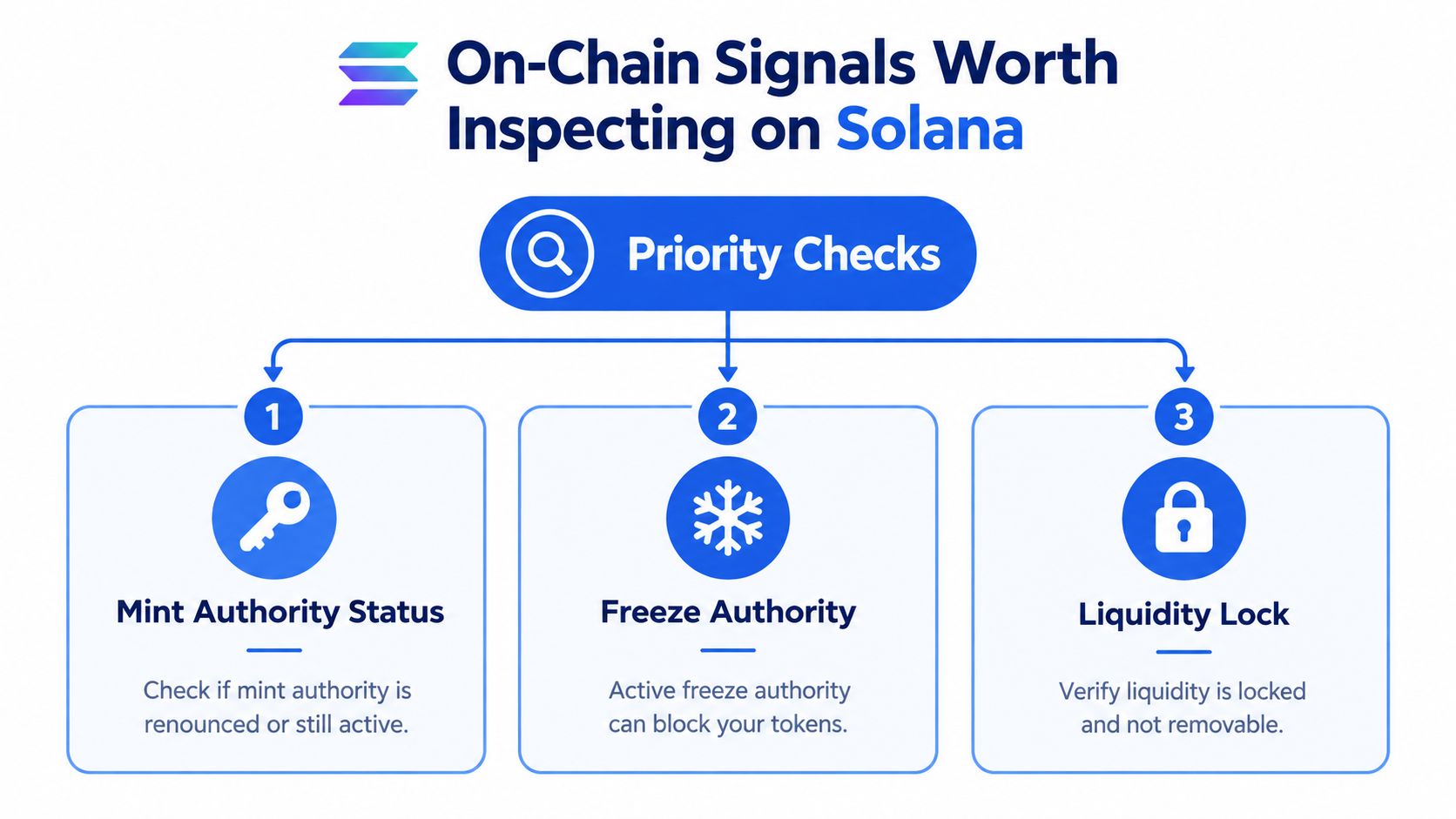
Mint authority tells you whether an authority can create additional tokens. If it remains active, that's a meaningful control to understand, but it doesn't by itself prove that the token is malicious. Freeze authority deserves similar scrutiny because freezing can stop holders from transferring. For Token-2022 assets, also check the Transfer Hook, Default Account State, and Permanent Delegate rather than assuming a revoked mint authority makes transfer behavior safe.
A guide to Solana freeze authority can clarify what that permission allows. The key is to distinguish between an authority's existence and evidence that it has been used to restrict holders.
Holder concentration helps expose risk that mint fields won't show. Look for large balances and clusters of wallets that appear connected through funding or synchronized activity. A token can distribute supply across multiple addresses while leaving effective control with a small group.
Follow the liquidity and wallet links
Liquidity ownership and depth matter because a technically successful sell can still produce a poor or failed execution when a pool is shallow. Verify who controls the liquidity position and whether it can be removed. A claimed lock is one piece of evidence, not a substitute for reviewing pool behavior.
Creator history and wallet relationships take more work than reading a mint account. Trace funding links, prior token activity, and transactions that happen together. Bundled or synchronized buying can make early demand look broader than it is. These signals are contextual: a cluster or concentrated holder isn't proof of wrongdoing, but it warrants closer examination before entry.
How a Honeypot Token Checker Works Under the Hood
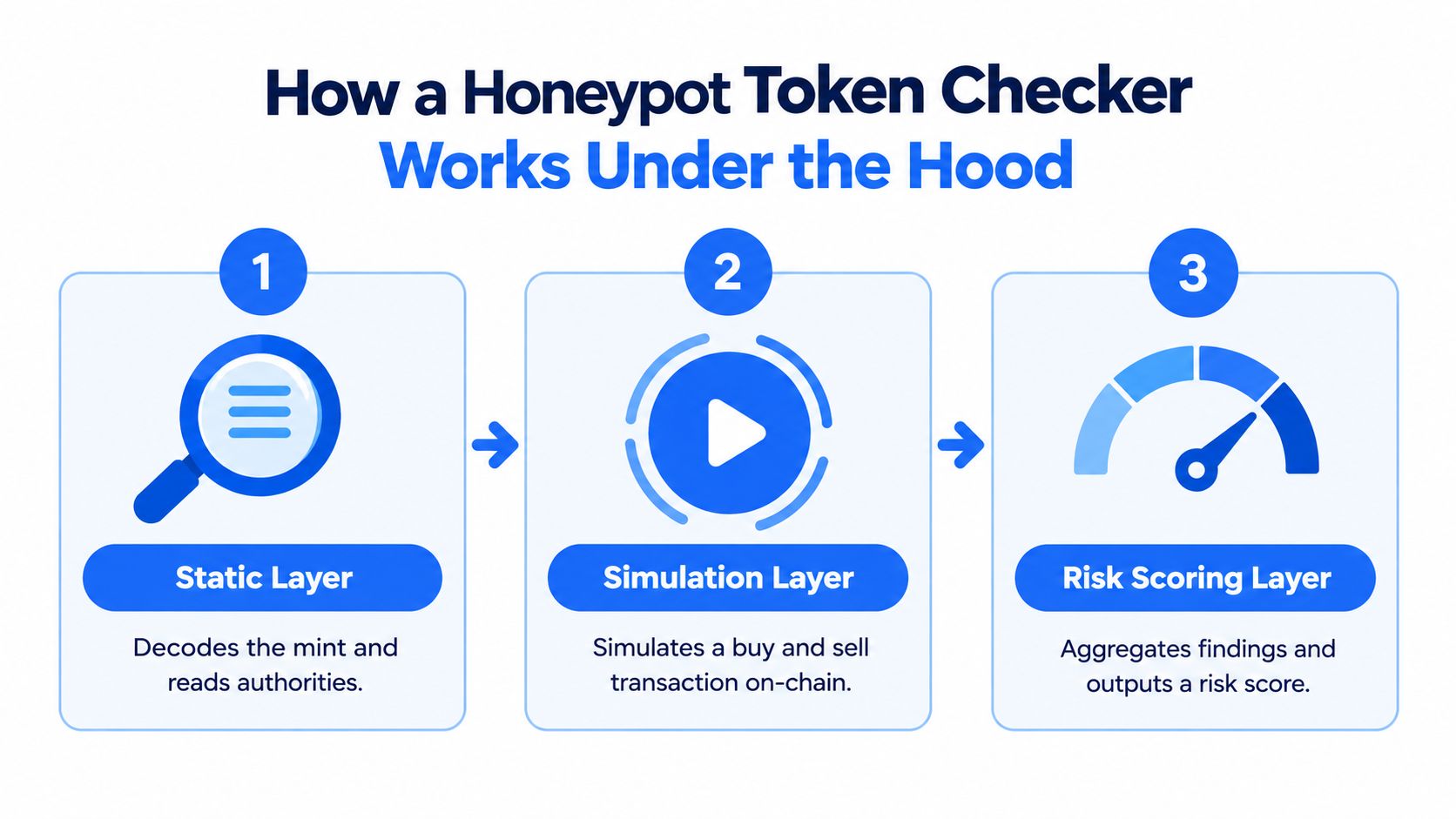
A useful checker does more than display a green badge. It combines account inspection, simulated transactions, and market evidence, then makes the limitations visible.
Static inspection finds permissions, not every outcome
The checker first identifies the token program, decodes the mint, and reads relevant authorities and extensions. This can reveal settings worth investigating, but a static view can't show every condition that might apply during a transfer. A report that says “mint authority revoked” has answered one question, not all of them.
Simulation tests an exit path
A stronger checker simulates a representative buy, transfer, and sell using independent buyer and seller wallets. For Token-2022, it needs to resolve any extra accounts required by a Transfer Hook. It should record program errors, failed account-state changes, and destination-specific restrictions.
Solana's guidance for Transfer Hook integrations recommends resolving required accounts and simulating transactions before sending them. That makes simulation a practical part of checking, not a cosmetic extra (Solana's Transfer Hook integration documentation). A useful result distinguishes an intentional transfer denial from a sale that fails because of price impact or insufficient liquidity. A successful purchase alone proves neither that the sell path works nor that the pool can support it.
Risk scores summarize evidence, they don't certify a token
Reports may show a health score, rug-risk rating, written verdict, or detailed breakdown. Those formats help organize evidence, but the useful part is the underlying reason for a warning: an authority, a failed simulation, concentrated ownership, or abnormal market behavior. An AI-written summary can make findings easier to interpret, but it shouldn't replace the evidence behind the summary.
A recent study of Solana tokens issued on Orca, Raydium, and Meteora during the first half of 2025 classified 76,469 of 100,063 tokens as rug pulls and reported a 0.26% estimated false-positive rate from a manual audit of 382 tokens (the empirical Solana token study). Those results describe that sample and its labeling rules, not a universal checker guarantee. A low reported false-positive rate in a particular audit can't tell you whether the next token is safe, especially if conditions change after the scan.
A Pre-Buy Workflow That Actually Catches Honeypots
Start with the mint address, not the ticker or token name. Copy the address from a source you trust, confirm it matches the asset you intend to trade, and run it through a Solana-focused checker. A similar name can point to a different token entirely.
Read the report as evidence, not a verdict. A useful analysis should show what it found about liquidity, holder distribution, creator behavior, wallet activity, and trading patterns. Then ask whether the report tested the sell path and whether it identifies Token-2022 features that could affect transfers.
| Signal | Healthy Report | Red-Flag Report |
|---|---|---|
| Authorities and extensions | Permissions and Token-2022 settings are clearly identified, with no unexplained transfer controls | Active freeze-related powers, unexplained Transfer Hook behavior, or unclear extension settings |
| Simulated sell | A representative sale completes, and the report distinguishes transfer failure from route or liquidity problems | Sell fails, destination restrictions appear, or the simulation is missing |
| Holders and wallets | Concentration and wallet links are visible and interpretable | Supply appears controlled by linked wallets or synchronized buyers |
| Liquidity | Pool depth and control are disclosed, with no unexplained removal behavior | Thin depth, unclear LP control, or signs liquidity can be withdrawn |
| Creator activity | Relevant history and related wallet behavior are reported | Creator-linked transfers or prior activity raise unresolved concerns |
Cross-check the result with another source of evidence instead of treating one tool's output as independent confirmation of everything. Manually inspect major holders and who controls the liquidity position when that information is available. If a finding is unclear, don't let urgency turn uncertainty into a green light.
MemeAssist provides on-demand Solana token reports with an Overall Health Score, Rug Risk Rating, AI Verdict, Detailed Risk Breakdown, and trade setup based on observed evidence. Use a Solana meme-coin safety checklist alongside any checker result, and size a trade only after the exit path and the main risk signals make sense to you.
Why a Passing Check Is Not the End of the Question
A scan describes observed behavior at the time it runs. Owner permissions, blacklist rules, fee settings, or upgradeable code can change later, and liquidity can be removed. An earlier pass can't establish that a later sell will work.
The practical response is to keep a record of what the checker saw and when it saw it. If you plan to hold or trade after the initial scan, revisit the token and compare authority settings, pool liquidity, holder behavior, and sell activity. A stale report without a timestamp or change history can reassure you about conditions that no longer exist.
Research on Solana tokens issued on major venues during the first half of 2025 found 76,469 suspected rug pulls among 100,063 tokens, with manual auditing estimating a 0.26% labeling false-positive rate for that dataset (the Solana token-study summary). These classifications and audit results apply to the study's sample, not every Solana token or checker. The practical takeaway is to preserve uncertainty, monitor changes, and track what happens after a token is flagged instead of treating any one result as a warranty.
Freshness matters: A checker can test whether a simulated sale works now. It can't promise the token's permissions, liquidity, or market behavior will remain unchanged.
If you trade after an initial scan, make follow-up checks part of the decision rather than waiting for a sell to fail. Compare fresh evidence with the original report, and step aside if the token's conditions have shifted or the exit path is no longer clear.
MemeAssist analyzes Solana meme coins using live on-chain and market data, and presents findings in a report with risk ratings, an AI explanation, and visible supporting evidence. If you want to review those signals before your next trade, visit MemeAssist.