How to Buy Meme Coins Safely: A Solana Checklist for 2026
You've found a Solana meme coin, the chart is climbing, and people in the replies insist you're still early. Your wallet is ready, but the swap screen shows unfamiliar settings and you're not sure whether you're buying the original token or a copy.
Learning how to buy meme coins means answering more than whether the buy button works. You need to separate token risk, such as creator control and concentrated ownership, from execution risk, such as poor routing, slippage, fees, and an exit that pays far less than the chart suggests. No checklist guarantees a profit, but a disciplined process gives you concrete reasons to buy a planned amount or walk away.
Table of Contents
- Choose a Solana Wallet and Trading Venue
- How to Buy a Meme Coin Step by Step
- Token Checks That Separate Real Demand From Hype
- Slippage, Price Impact and Testing Your Exit
- Setting Your Budget and Walk-Away Rules
Choose a Solana Wallet and Trading Venue
Most meme coins trade on decentralised exchanges, so a Solana wallet and a swap venue are the practical starting point. You'll need SOL for the purchase and a separate reserve for transaction fees.
Solana venues compared for meme coin buyers
| Venue | Best for | Watch for |
|---|---|---|
| Self-custody wallet such as Phantom or Solflare | Holding SOL and approving swaps yourself | Never share your seed phrase; approve only swaps you've checked |
| DEX aggregator such as Jupiter | Routing trades across pools and showing price impact | Confirm the output token's address before you swap |
| Launchpad such as Pump.fun | Buying brand-new tokens still on the bonding curve | The newest launches expose you to acute rug and sniper risk |
| Centralised exchange | Buying tokens it has already listed | A listing doesn't make a token safe; most meme coins never list |
A self-custody wallet holds the keys that authorise transactions. Phantom and Solflare can provide a convenient swap interface, but convenience doesn't remove your responsibility to inspect what you're signing. Keep your speculative trading wallet separate from long-term holdings so you aren't exposing your main wallet whenever you try a new venue.
A DEX aggregator, such as Jupiter, searches available trading routes. It's useful when the same token trades across different pools, because the most obvious pool isn't necessarily the route with the best net output.
Match the venue to your experience
Pump.fun lets buyers enter tokens while they're still on a bonding curve, before trading moves into a conventional liquidity pool. That early access comes with less history to inspect and competition from automated traders. Compare Pump.fun trading tools by their risk visibility and execution controls, not just their speed.
A centralised exchange simplifies purchasing when it already lists your chosen token. Its listing review isn't a guarantee, and waiting for a listing means accepting a narrower selection rather than chasing every launch.
Connect your wallet only inside the trading venue you've deliberately chosen. MemeAssist doesn't require a wallet connection or spending authorisation, and never asks you to sign a transaction or approve anything.
Before funding, write down your seed phrase and store it offline. Bookmark the venue's verified address, avoid links in posts or direct messages, and leave enough SOL for several transactions rather than spending the entire balance on tokens.
How to Buy a Meme Coin Step by Step
Use an address-first workflow. A familiar ticker, logo, or project name isn't enough to identify what you're purchasing.
Keep this sequence beside your swap screen.
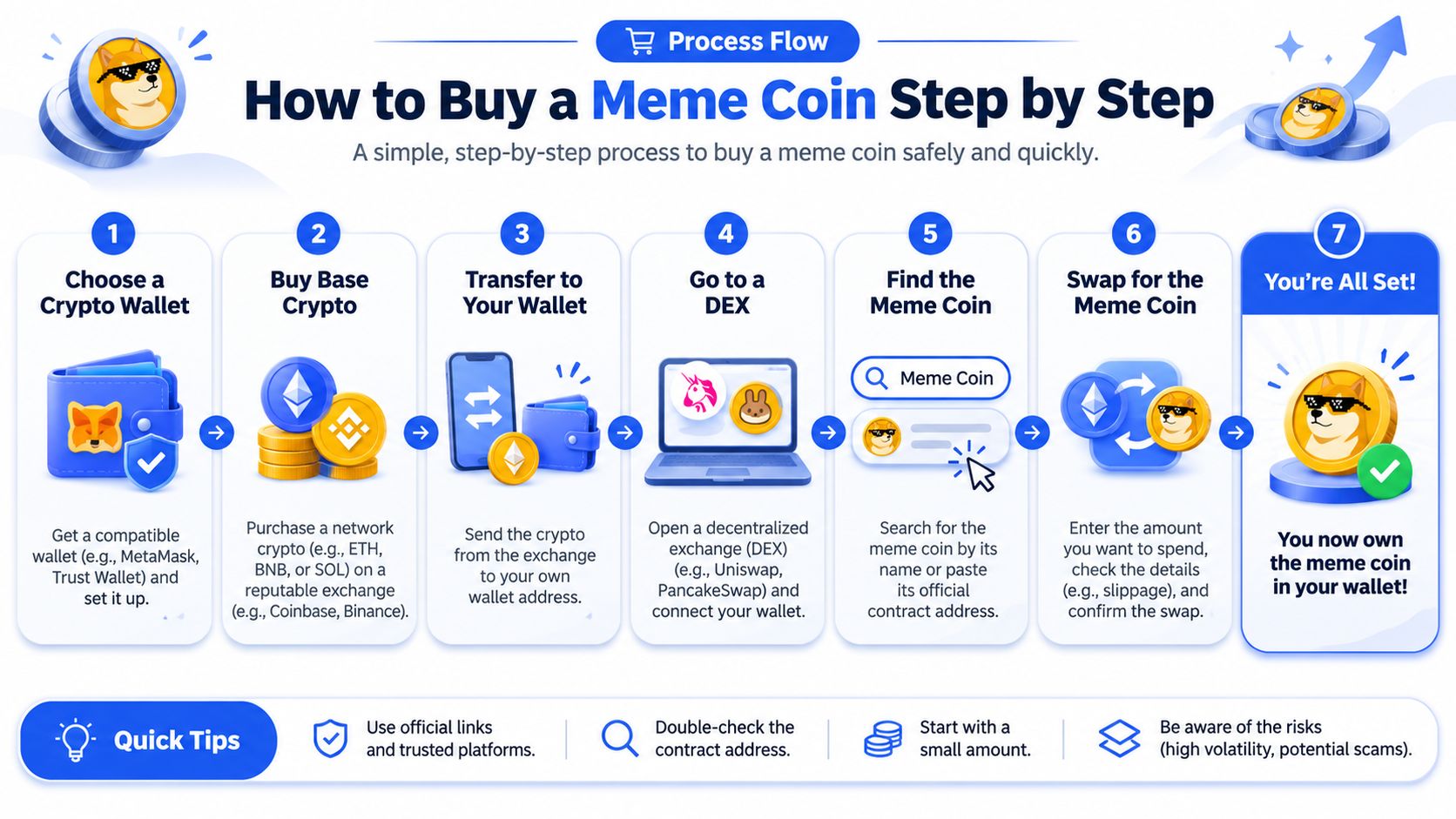
Copy and independently verify the token address. Start with the project's official site or a reputable listing, then compare the full address across independent sources. Don't copy it from a reply or direct message, and don't assume matching names mean matching tokens.
Inspect that exact address. Check authorities, holder distribution, creator activity, liquidity ownership, and suspicious trading patterns before opening a swap. The usual mistake is researching the genuine project, then accidentally buying a lookalike.
Fund the wallet with SOL and preserve a fee reserve. Transfer SOL using the Solana network and confirm it arrived before trading. Your budget must cover entry, any account-creation costs shown by the interface, and the eventual exit, not just the advertised purchase amount.
Configure slippage deliberately. Inspect the route, minimum received, price impact, and displayed fees before approving. Don't raise tolerance when a transaction fails, because that can authorise a much worse fill without solving the underlying problem.
Make a small test buy. Choose an amount you could lose entirely and save the quoted output before submitting. Compare it with the actual tokens received, rather than treating a successful transaction notification as proof of acceptable execution.
Verify the received token and balance. Open the transaction details and confirm the mint address matches the one you checked. Wallet display values and logos aren't sufficient, and a misleading valuation can make an ordinary fill look like an immediate windfall.
Run a small test sell before adding capital. Request a sell quote and execute a small return trade, checking the SOL received after costs. If there's no route, the transaction fails unexpectedly, or the output is unacceptable, stop instead of increasing your exposure.
Keep wallet approval separate from research
Fraudulent websites and social channels can impersonate legitimate trading or advisory businesses, as the SEC investor alert on crypto-asset securities warns. Never sign an unexplained transaction to access an analysis, presale allocation, or airdrop.
A clean first trade: You receive the verified token within your authorised execution terms, the balance matches the transaction, and a return trade produces an acceptable result.
A small sell confirms only that selling worked under those conditions. It doesn't establish that your eventual full position can exit at the same price.
For a visual walkthrough, keep your own wallet's approval details and transaction results as the final reference.
Token Checks That Separate Real Demand From Hype
| Check | Healthy signal | Red flag |
|---|---|---|
| Mint authority | Revoked, preventing additional minting through that authority | Still active, allowing additional supply |
| Freeze authority | Revoked, preventing freezes through that authority | Still active, allowing token accounts to be frozen |
| Top holders | Supply spread across independent wallets | A few wallets hold a large share or appear linked |
| Liquidity pool | Meaningful depth relative to valuation, with verified liquidity protection | Thin pool the creator can remove |
| Creator wallet | No identified failed-launch pattern or suspicious pre-spike transfers | Deployer-linked transfers shortly before a price spike |
| Trading volume | Activity across many independent wallets | A handful of wallets repeatedly trading back and forth |
A rising chart doesn't establish genuine demand. A 2025 cross-chain academic study examined 34,988 meme tokens across Ethereum, BNB Smart Chain, Solana, and Base, and found evidence of artificial growth tactics in 82.89% of tokens that produced returns above 100%.
Authorities and concentrated control
Inspect mint authority and freeze authority on the token's mint account. Revocation removes those specific controls, but it doesn't prove the token has no other restrictions or risks, particularly where token extensions are involved.
For holder concentration, distinguish ordinary wallets from pool vaults, burn addresses, and exchange accounts before drawing conclusions. Then inspect whether large holders share funding sources or coordinate transfers. A long holder list can conceal common control if someone splits supply across related wallets.
Creator history needs the same care. No visible failed launches means no failures were identified, not that the creator has an established clean record. Trace transfers around promotional activity and price spikes rather than accepting a profile's claimed history.
Liquidity protection and believable volume
Check who controls liquidity positions and whether any lock covers the pool you'll trade against. Verify its expiry and withdrawal rights. Locked or burned LP tokens can reduce a particular removal risk, but they don't stop major holders from selling.
Volume deserves scrutiny when the same wallets repeatedly exchange tokens, purchases arrive in suspicious clusters, or large activity produces little growth in independent participation. High volume isn't the same as broad demand.
MemeAssist's free Contract Checker, Liquidity Checker, Honeypot Checker, and Rug Checker help organise these checks. Eligible users can start with a free full analysis, then pay only for additional analyses and tools they choose, without a recurring monthly subscription. Use the Solana token safety checklist to interpret the evidence rather than relying on a score alone.
Skip rule: An unresolved authority, liquidity, or volume red flag is a reason to reject the trade, not to buy a smaller amount and hope.
Even clean results can't prevent a collapse when demand disappears or holders sell.
Slippage, Price Impact and Testing Your Exit
The price on the chart isn't necessarily the price you'll receive. Slippage is the difference between expected and executed price; price impact is the effect your own trade has on the available pool.
Fees add another cost, but they aren't slippage. Check network and priority fees, venue or routing charges, and any token-specific transfer costs separately so you can identify what reduced your proceeds.
Set tolerance around the trade, not the excitement
Your slippage setting defines how much adverse movement you'll accept. It doesn't improve liquidity, guarantee inclusion, or make an overpriced route competitive.
Starting slippage settings by trade situation
| Trade situation | Starting slippage | Why |
|---|---|---|
| Deeply traded, established token | Tight tolerance supported by a fresh quote | Protects the fill when the pool can support your order |
| Established mid-cap meme coin | Start tight and review the actual route | Market-cap labels don't establish available depth |
| New launch with a thin pool | Reduce size or wait before widening tolerance | A wider limit can permit a severe adverse fill |
| Any token during a fast move | Re-quote before confirming | An old quote may no longer represent executable conditions |
There's no universal percentage that makes a new launch safe. I would reduce order size or wait for steadier liquidity before giving a volatile pool broad permission to fill at a worse price.
Inspect minimum received, not just the headline quote. That field makes the downside you're authorising more concrete, although it still doesn't account for every cost outside the swap output.
Overly tight settings can cause failure when prices move before execution. Overly loose settings expose you to unnecessary adverse movement and potentially adversarial transaction ordering.
Diagnose a bad fill before trying again
Token risk and execution risk require different fixes. A creator-controlled token calls for rejection; a weak route may call for a different route or smaller order. Confusing them leads traders to keep changing settings on a token they shouldn't be buying.
Solana trading documentation from GMGN describes bots inserting transactions around a buyer's trade, with thin pools magnifying the resulting price distortion. A poor fill alone, however, doesn't prove a sandwich attack.
Investigate in this order:
- Recheck token behaviour. Look for changed authorities, transfer restrictions, or liquidity withdrawals.
- Compare routes. Request fresh aggregator quotes for the same input and compare net output, not just route labels.
- Inspect your permission. Check whether your minimum received allowed substantially worse execution than you intended.
- Review transaction ordering. Examine nearby pool trades for activity consistent with adversarial execution rather than ordinary movement.
- Account for separate charges. A small test trade can look disproportionately expensive when fixed costs make up a large share of the input.
Don't pay for another attempt until you can explain the first result. Increasing priority fees may affect transaction inclusion, but it won't create deeper liquidity or fix an unacceptable exchange rate.
Measure the sell side
Market capitalisation extrapolates a marginal trading price across token supply. It isn't a reserve of cash waiting for holders.
The CopyFomo meme-coin trading guide illustrates the mismatch with a $20 million market cap backed by a $40,000 pool. Treat that pool figure as a warning about limited execution depth, not a promise that its entire value is available for sellers.
Inspect the quote-asset reserve, such as SOL or a stablecoin, rather than assuming total pool value equals immediately withdrawable sell proceeds. Pool structure matters too: concentrated liquidity may be available only within particular price ranges.
Before taking a meaningful position:
- Quote the full intended exit. Enter your complete planned token balance into the sell interface without submitting.
- Record net proceeds. Note output, price impact, fees, and minimum received, not just whether a route exists.
- Stress the available depth. Consider substantially less quote-asset liquidity and competing sellers. If you can't model it reliably, shrink the position rather than assuming today's quote will survive.
- Verify liquidity control. Check withdrawal permissions and lock expiry against how long you intend to hold.
A trade can execute while still giving you an unacceptable exit. Successful execution and acceptable proceeds are different tests.
Fraud can also remove the opportunity altogether. Chainalysis's 2024 Crypto Crime Report defines a rug pull as a creator abandoning a project and taking users' funds.
If a sell fails, distinguish a missing route, insufficient fee balance, restrictive token behaviour, and poor liquidity before retrying. The guide to unsellable Solana tokens helps organise that diagnosis.
Write down a net-proceeds floor, a liquidity floor, and a deterioration signal, such as creator-linked selling or disappearing routes. These are decision triggers, not guaranteed stop prices.
Setting Your Budget and Walk-Away Rules
Use only money you can lose completely. Keep rent, emergency savings, debt payments, and essential expenses outside your trading budget.
Size a position by its executable exit, not by a market-cap screenshot or the gain you hope to make. If a full-size sell quote already looks uncomfortable before entry, the position is too large for those conditions.
Decide what ends the trade
A secondary analysis from Axis Intelligence citing Chainalysis reports that 3.59% of approximately 2.06 million token launches in 2024 showed pump-and-dump patterns and that 94% of suspected pools were rugged by their deploying address. Those figures are a risk benchmark from secondary reporting, not a population-wide failure probability for your next purchase.
Write your rejection rules before opening the swap:
- Failed authority or liquidity check. Don't negotiate with an unresolved control risk because the chart looks attractive.
- Price impact above your limit. Reduce the position or reject the trade instead of moving the limit to accommodate it.
- Creator or wallet-cluster warning. Pause when coordinated activity undermines the explanation for demand.
- Failed test sell. Don't add capital while the return path remains unexplained.
- A sudden gain that tempts you to abandon the plan. If the price doubles, reassess the position and current exit conditions rather than automatically adding more.
A loss limit isn't insurance. Fast price moves, vanishing liquidity, and transaction failures can leave you with worse proceeds than planned, even without fraud.
MemeAssist provides automated, informational analysis as a second opinion, not financial advice or a substitute for your own research. You can lose all invested capital even without a rug pull.
Make a single decision: if the checks pass and the position fits both your loss budget and exit conditions, buy only the planned amount. Otherwise, skip.
Visit MemeAssist to examine a Solana token's authorities, holder distribution, creator behaviour, liquidity, and trading activity before placing your order. Use its free tools or, if eligible, a free full analysis to identify what needs further verification, then compare that evidence with your own buy and full-size sell quotes.
Topics: how to buy meme coins, buy meme coins, Solana meme coins, meme coin safety, Solana token checks
Informational only, not financial advice. Meme coins are extremely high-risk.
All articles