Insider Threat vs Insider Risk: Key Differences Explained
The familiar advice is to separate insider threat from insider risk by intent: threats are malicious, risks are accidental. That's too narrow for operational use. It can leave a security team debating someone's motives while an exposed credential still works or sensitive records remain accessible.
The more useful distinction is between a harmful pathway to investigate and an exposure to assess and manage. For security leads, the insider threat vs insider risk question should change decisions, not just terminology: how much evidence warrants verification, when temporary restrictions are justified, and which actions require stronger proof.
Table of Contents
- Insider Threat and Insider Risk Side by Side
- What an Insider Threat Actually Includes
- How Insider Risk Gets Measured
- Where Insider Incidents Really Come From
- Matching the Response to the Evidence
- Use Cases in Enterprises and Crypto Markets
- Pick the Right Term for Your Program
Insider Threat and Insider Risk Side by Side
An insider threat is a person or pathway involving authorized access or organizational knowledge that could cause harm. Insider risk is the assessed likelihood and impact of that harm, given the access, vulnerabilities, and surrounding evidence.
Both terms can cover intentional and unintentional activity. The distinction below is an operating model for assigning work, not a claim that every organization uses identical job titles or scoring methods.
Insider threat vs insider risk by criterion
| Criterion | Insider threat | Insider risk |
|---|---|---|
| Core question | Who could cause harm with authorized access? | How likely is harm, and how severe would it be? |
| Scope | A person or pathway with authorized access or organizational knowledge | Likelihood and impact across insider behaviors, access rights, and vulnerabilities |
| Behaviors included | Malicious, negligent, and compromised-credential activity | The same behaviors, plus warning signals before and after an incident |
| Time orientation | A possible event or capability | A continuously updated estimate before, during, and after an event |
| Typical output | An alert, case, or named pathway to investigate | A calibrated score, risk category, and treatment plan |
| Primary owner | Security investigations, working with HR and legal | Risk governance, security leadership, and business owners |
| Measured by | Confirmed incidents and detection hits | Precision, detection lead time, and expected loss avoided |
The operational consequence is straightforward: an insider threat is something you investigate, while insider risk is something you manage continuously. An investigation establishes what happened and preserves evidence. Risk management decides what exposure remains, who accepts it, and which controls should change.
Test the output, not the product label
When a vendor or policy uses the terms interchangeably, examine what the workflow produces. A tool that identifies unusual downloads may support investigations without estimating business impact. A dashboard that assigns severity may still lack a defensible method for confirming events.
Ask the team to show its latest completed output:
- A case file about a person or access pathway indicates threat-focused work.
- A score with a treatment plan and accountable owner indicates risk-focused work.
- An alert without verification or follow-up indicates an unfinished process, regardless of its label.
Neither output replaces the other. The practical failure is buying detection capability and assuming that prioritization, intervention, and accountability arrive with it.
What an Insider Threat Actually Includes
The Cybersecurity and Infrastructure Security Agency's insider-threat definition covers the potential for someone with authorized access or special organizational knowledge to cause harm intentionally or unintentionally. Its scope includes data, personnel, facilities, networks, systems, and other resources, not merely cyberattacks.
That definition requires more than a search for disgruntled employees. A useful program must cover malicious misuse, careless or negligent conduct, and authorized accounts exploited after credential compromise.
Follow access rather than employment status
Include contractors and former employees when they retain access or relevant organizational knowledge. Don't assume an employment-status change proves that credentials, shared secrets, or practical access have been removed.
Consider these hypothetical cases:
- A finance analyst emails a client list to a personal account. Preserve the message and access records, establish whether the transfer was authorized, and involve HR and legal where appropriate. Don't treat the destination alone as proof of theft.
- A developer commits a live credential to a public repository. Revoke or rotate the credential, examine its use, remove the exposed secret, and review repository scanning and secrets-handling practices. Containment shouldn't depend on proving intent.
- A contractor's login appears for sale on a forum. Validate the finding, suspend the affected access, inspect recent sessions, and notify the vendor through the agreed incident channel.
These cases require different responses because the immediate harmful pathways differ. An employment investigation won't invalidate an exposed secret, and a password reset won't establish whether information was deliberately removed.
Separate behavior from motive
The same caution applies outside the enterprise. A trader examining insider concentration is assessing a distribution and control signal, not establishing the intentions of every linked holder.
Case-record rule: Document the access held, the act observed, and the evidence concerning intent as separate fields.
A bulk transfer can be authorized, negligent, or malicious. Record what the evidence supports before assigning a label. Where intent remains unknown, say so explicitly, while still addressing any active exposure.
How Insider Risk Gets Measured
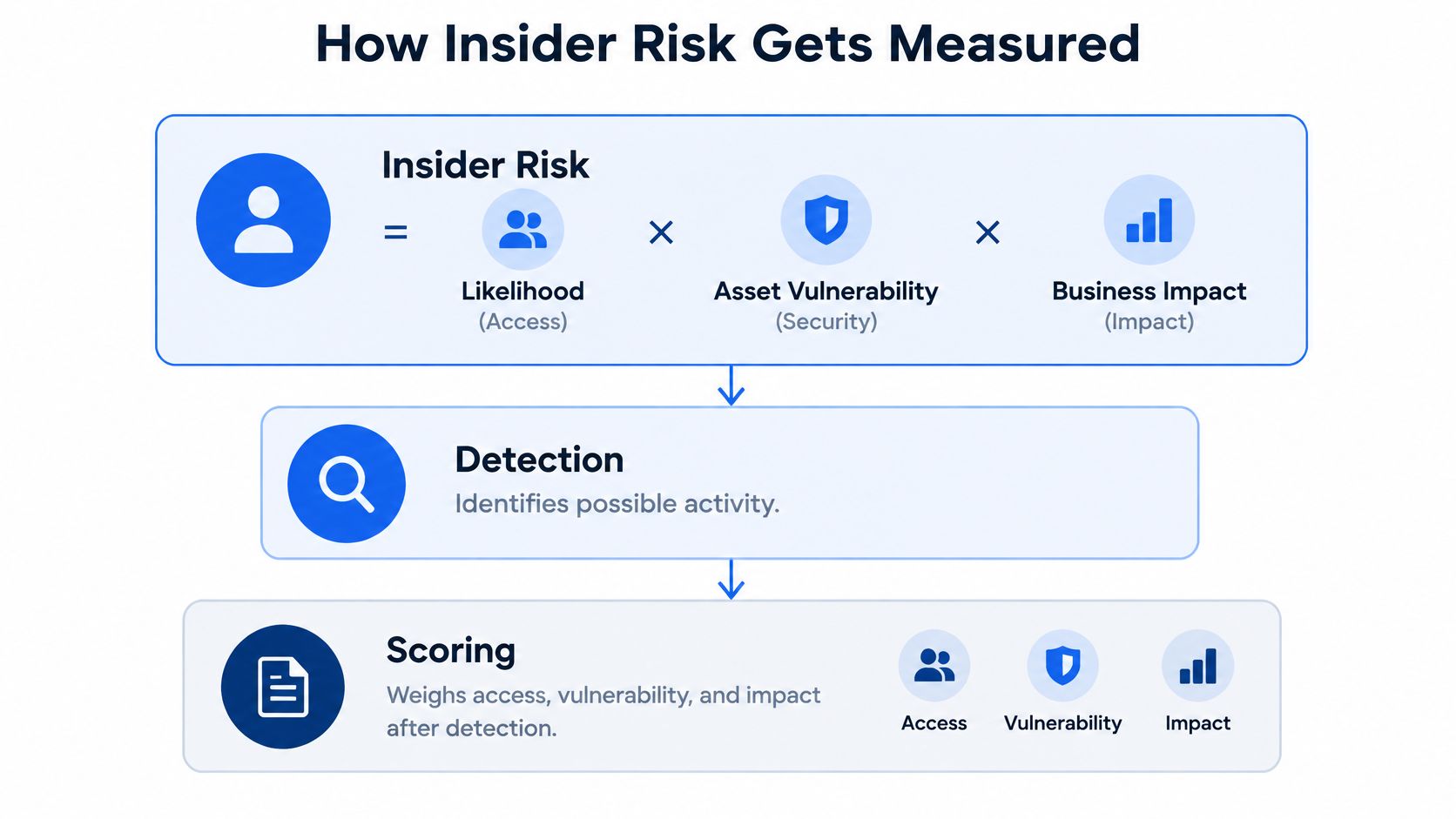
Treat likelihood × asset vulnerability × business impact as a conceptual model, not a validated calculator. Multiplying arbitrary severity labels doesn't produce a reliable probability. A defensible score requires a defined outcome, an assessment horizon, and comparison with what subsequently happened.
The CISA insider-threat mitigation framework separates detection and identification from assessment and management, and examines factors including interest, motive, intention, and capability. That separation matters: detecting unusual activity establishes a reason to look, not a final estimate of harm.
Detect first, then assess consequence
Detection features might include privilege changes, unusual data access, rapid transfers, and departures from an account's behavioral baseline. Scoring should then ask what those observations mean in context.
Suppose a finance administrator receives new production privileges and begins exporting substantially more data than their established pattern. That combination warrants greater scrutiny than the same export by an account performing an approved reconciliation. The privilege change matters because it changes the account's reach, but neither observation proves intent.
Insider risk scoring variables
| Variable | What it measures | Example signal |
|---|---|---|
| Access privilege | How far the account can reach | New administrator rights on production data |
| Observable intent or motive | Evidence of a reason to misuse access | Bulk downloads before departure, requiring verification of purpose |
| Capability | Technical or practical ability to cause harm | Knowledge of backup and logging controls, or repeated bypass attempts |
| Potential impact | Expected loss if the event happens | Access to customer records or financial settlement systems |
Don't infer malicious intent from resignation or job-search activity. Such context cannot substitute for evidence about the activity under review.
Preserve history and test the score
Point-in-time indicators describe the current exposure: concentrated privileges, synchronized account activity, or sudden escalation. Longitudinal indicators provide context: repeated involvement in confirmed incidents, recurring account clusters, or the sequence between access changes and anomalous behavior.
The CISA insider-threat fact sheet supports behavioral baselines, continuous monitoring, and evaluation metrics. A practical evaluation should include:
- Precision and recall: How often alerts identify confirmed harmful events, and how many such events the system misses.
- Precision-recall performance: Whether prioritization remains useful when harmful events are uncommon.
- Calibration error: Whether estimated probabilities match observed outcomes.
- Median detection lead time: How much warning precedes an adverse event.
- Expected loss avoided per alert: A decision estimate with explicit assumptions, not an automatically observable result.
Alerts generated is a workload measure, not proof of effectiveness. For token screening, our 24-hour outcomes study provides a way to examine post-flag review. Whatever the domain, retain the original evidence and score so reviewers can distinguish genuine calibration from hindsight.
Where Insider Incidents Really Come From
Malicious insiders aren't the whole problem. In Verisk's summary of Ponemon Institute survey data, 75% of insider-risk incidents in 2023 were attributed to non-malicious insiders, comprising 55% negligent or mistaken insiders and 20% employees exploited by external attackers.
That mix changes control priorities. A program organized exclusively around catching deliberate theft can overlook exposed credentials, excessive access, and routine mistakes.
Insider incidents by cause and cost
| Source and year | Incident category | Share of incidents | Average cost |
|---|---|---|---|
| Ponemon 2022 and 2025 findings, 2022 category | Careless or negligent insiders | 56% | $6.6 million annual remediation cost per organization, not per incident |
| Ponemon 2025 | Criminal or malicious insiders | 25% | $3.7 million per incident |
| Ponemon 2025 | Credential theft | 20% | $4.8 million per incident |
| Verisk, citing Ponemon 2023 | Non-malicious insiders, comprising negligent or mistaken insiders and employees exploited by external attackers | 75% | Not reported in the cited summary |
The table combines different reporting years and measures. Don't add the shares across rows, interpret them as a single population, or compare annual organizational costs directly with per-incident costs. These figures describe the cited study populations, not the probability that a particular employee or token creator will cause harm.
Match the control to the cause
For negligent activity, investigate why a risky action was possible and convenient. Review excessive permissions, approved sharing routes, secrets storage, and the instructions employees receive at the point of work. Training alone doesn't remove an unnecessary export permission.
For credential theft, prioritize account protection and session containment. Check authentication strength, revoke compromised sessions, review recovery methods, and inspect what the attacker could reach after login. Treating the legitimate account holder as the malicious actor would misdirect the investigation.
For deliberate misuse, preserve behavioral evidence and establish clear escalation authority. Investigators need to reconstruct access, actions, destinations, and attempted concealment without making unsupported claims about motive.
A useful incident classification should change the corrective action. If every category leads to the same training assignment, the classification isn't doing enough work.
The analytical conclusion isn't that negligence deserves attention instead of malicious conduct. It's that frequency and severity require separate decisions. Common mistakes justify preventive controls across the workforce; credible evidence of high-impact misuse may justify urgent, targeted intervention.
Review your most recent incidents and classify their initiating pathways. Which category produced the last few cases, and did the resulting control changes address that category? That answer is more actionable than importing a survey percentage into your own risk register.
Matching the Response to the Evidence
Use evidence confidence, potential impact, and reversibility to choose an intervention. The following matrix is a proposed operating aid, not a CISA-prescribed scoring standard; reversibility means how easily the intervention itself can be undone.
Decision matrix for monitor, verify, restrict or escalate
| Evidence confidence | Potential impact | Reversibility | Action |
|---|---|---|---|
| Low | Low | Easy | Monitor and log |
| Low | High | Easy | Verify with a second source |
| Medium | Low | Easy | Monitor against a role baseline |
| Medium | High | Hard | Verify before restricting |
| High | Low | Easy | Restrict access and notify the owner |
| High | High | Hard | Restrict now and escalate |
| Low | High | Hard | Verify urgently and avoid public accusation |
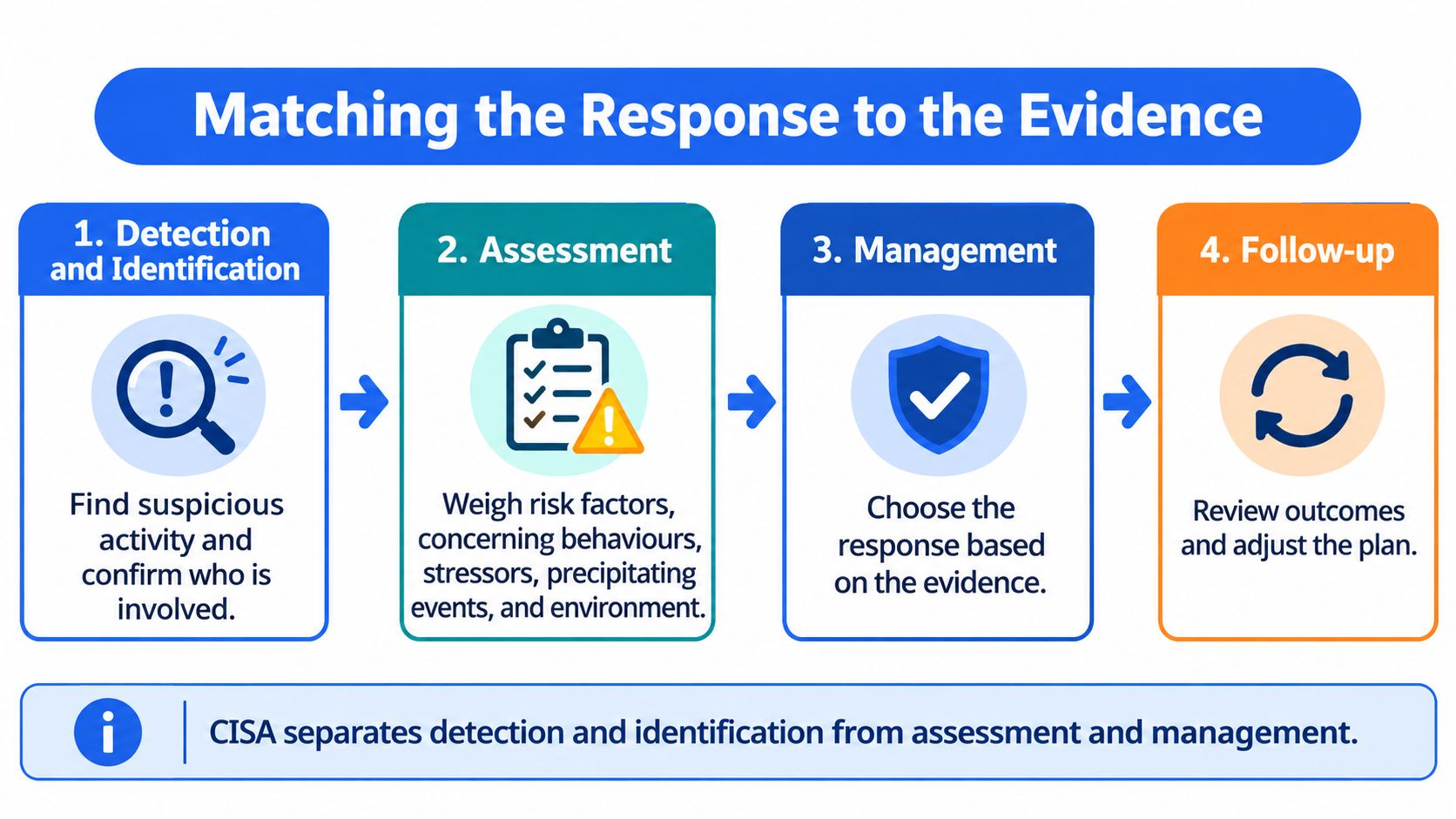
The CISA guidance on defining insider threats separates detection and identification from assessment and management. It calls for assessment of risk factors, concerning behaviors, stressors, precipitating events, environment, and predispositions, rather than a conclusion based on one suspicious event or a personality profile.
Make the decision reproducible
Apply the matrix through a short case procedure:
- Record the observation. Preserve the timestamp, account or wallet, affected asset, source record, and comparison baseline.
- Check the relevant normal pattern. Compare an employee with the same role and workflow, not the entire workforce. For wallets, distinguish creator-linked activity from unrelated large holders.
- Verify the interpretation. Ask the asset owner whether the action was approved, or seek an independent log, transaction trace, or other corroborating record.
- Choose the least intrusive effective action. Limit the affected session, credential, or permission where that can contain the exposure. Document why broader restrictions are necessary.
- Set a review trigger. Assign an owner and review deadline, with earlier reassessment if additional evidence appears.
“Verify before restricting” must not become an instruction to leave a credible, active compromise untouched. Where delay could permit irreversible loss, use an authorized temporary safeguard while verification continues. Record both the reason for acting and the uncertainty that remains.
Report facts without turning suspicion into accusation
Human review remains necessary because an anomaly score doesn't establish authorization, business purpose, or intent. Reviewers should also challenge reassuring explanations rather than accepting them without corroboration.
For a hypothetical creator-wallet transfer, report that the transfer occurred, explain the wallet-link evidence, identify the possible exposure, and state what remains unverified. “Risk pending verification” is a decision status, not an accusation. It allows an analyst to act cautiously without claiming that the creator intended to harm holders.
Use Cases in Enterprises and Crypto Markets
An enterprise can assign security investigators to individual cases while a risk owner maintains the business-wide exposure view. HR and legal should join cases where employment, privacy, or legal questions require their involvement, rather than serving as automatic recipients of every anomaly.
The workflow below illustrates how monitoring, investigation, and response fit together.
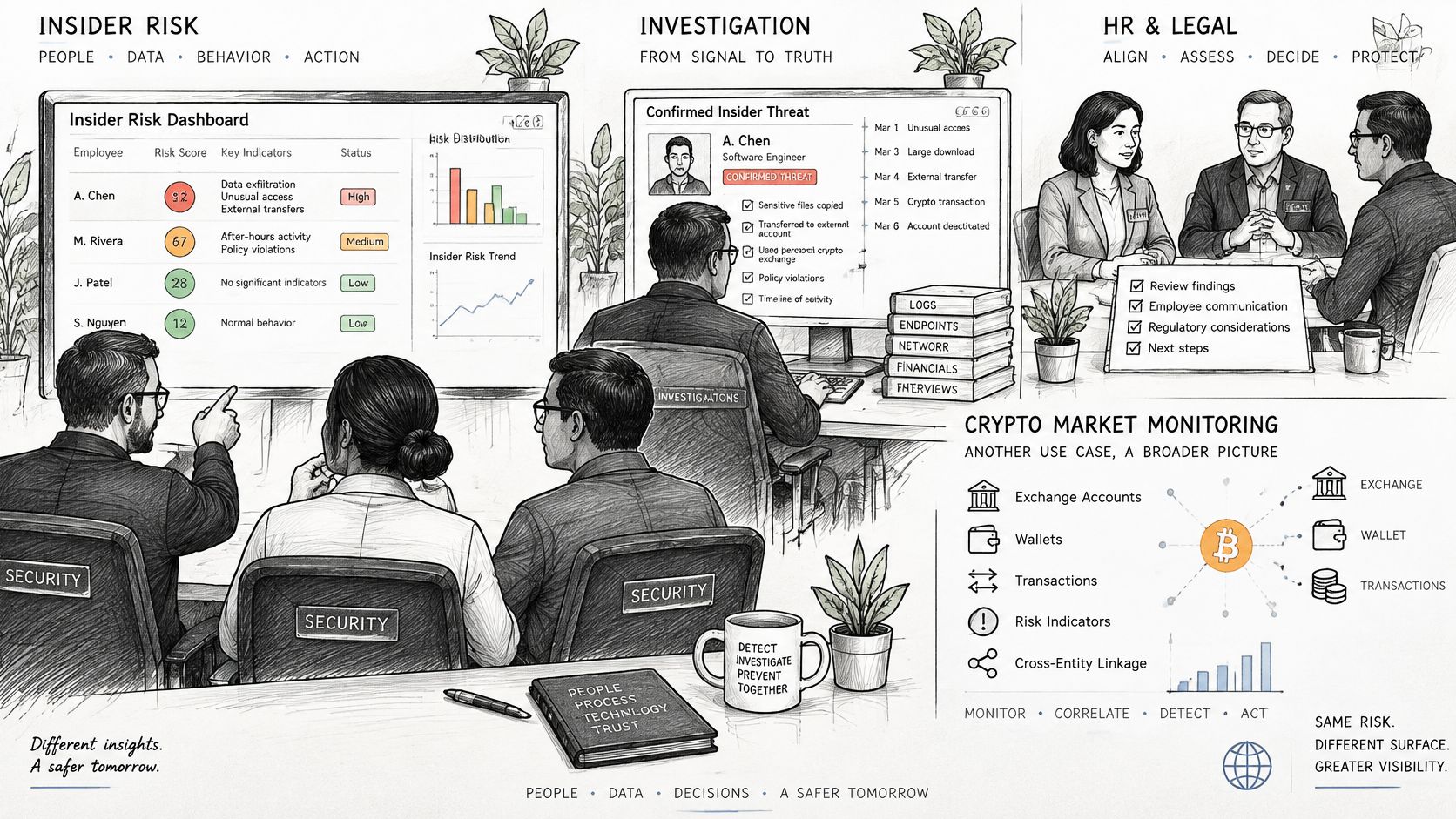
Investigators should report whether they substantiated the suspected pathway and what they contained. Risk owners should report whether interventions reduced exposure, whether prioritization was reliable, and which business owner accepted unresolved risk. Closing a case doesn't necessarily remove the permission or process weakness that enabled it.
Apply the logic without equating the domains
In crypto markets, “insider-like” activity is an analytical description, not a direct equivalent of employee misuse. Creator privileges, wallet relationships, token supply, and liquidity control replace the enterprise's employment and access context.
Say creator-linked wallets hold a concentrated share of a newly listed token and begin selling shortly after trading opens. The analyst should inspect the wallet links, transaction sequence, liquidity available to absorb sales, and evidence of prior creator activity. Our DOG insider-concentration case study offers a focused topic for examining this kind of concentration analysis.
The following video provides additional context for the workflow.
In MemeAssist reports, suspicious activity and potentially linked wallets are items to examine, not evidence of wrongdoing. Missing data isn't proof of safety. A trader may decide that uncertainty alone exceeds their tolerance without reaching a conclusion about anyone's intent.
Timing deserves its own measure: the DTEX Systems–Ponemon Institute report, as reported by CSO, put average insider-incident containment time at 86 days in 2023. That enterprise finding isn't a crypto benchmark, but it makes the operational question concrete: how long passes between detecting exposure and limiting it?
Pick the Right Term for Your Program
Choose the term that describes the decision your function owns. An investigation team should lead with insider threat because it must establish a documented pathway and support action. A function responsible for budget, governance, and residual exposure should lead with insider risk because it must prioritize treatment and explain what remains unresolved.
The vocabulary should also constrain claims. An investigation can conclude that an account transferred restricted information without establishing why. A risk owner can recommend reducing access without claiming that a specific employee is malicious.
Choose a starting point that fits the situation
| Situation | Lead term | First action |
|---|---|---|
| A small team relies on a sole administrator | Insider threat | Baseline the highest-privilege account and document concerning access changes |
| A regulated enterprise reports residual exposure to its board | Insider risk | Connect assessed exposure to treatment owners and outcome-based metrics |
| A trader uses on-chain signals to decide whether further checks are needed | Insider risk | Verify the flagged wallet relationship and transaction context |
For the small team, begin with a bounded detection problem rather than an elaborate model that nobody can validate. For the enterprise, don't let an aggregate score hide unresolved access to critical assets. For the trader, don't interpret a favorable rating as a prediction of price appreciation.
The strongest program isn't the one that labels the most people or wallets. It's the one that can explain why a particular action was justified by the evidence available at the time.
Put the distinction into practice this week
- Write policy definitions. State what qualifies as a threat pathway and what your risk assessment estimates. Make unknown intent an explicit, permissible finding.
- Choose outcome metrics. Start with precision, detection lead time, and an explicitly qualified estimate of loss avoided. Assign someone to verify outcomes.
- Baseline privileged access. Identify the accounts with the greatest reach, record their normal activity, and test who can authorize a temporary restriction.
Keep detection records and treatment decisions connected. Otherwise, investigators can repeatedly close similar cases while business owners remain unaware that the underlying exposure persists.
MemeAssist combines live Solana token checks, wallet evidence, and market structure in reports with an Overall Health Score, Rug Risk Rating, AI Verdict, and Detailed Risk Breakdown. Visit MemeAssist to examine the evidence behind a token's insider-related warning signals and decide what needs further verification, treating the report as a research second opinion rather than a guarantee of safety.
Topics: insider threat, insider risk, insider risk management, insider threat detection, insider threat types
Informational only, not financial advice. Meme coins are extremely high-risk.
All articles