Insider Trading Cases: 7 Lessons for Crypto Traders
You've watched a token sit flat for six hours, then jump as five fresh wallets buy in the same minute, right before an announcement drops. That shape isn't unique to Solana. It's the oldest red flag in securities enforcement, and the insider trading cases built on it explain exactly how investigators reconstruct who knew what.
The value in these cases isn't the scandal. It's the method. Every prosecution turns on three questions. Who had access before the market did, when did the trading happen relative to the event, and how did the money move between people. Those questions work the same way on a stock ticker, a prediction market, and a pump.fun launch.
Seven cases follow, each stripped down to the detection pattern it exposed and translated into a check you can run on-chain before your next buy.
Table of Contents
- 1. Ivan Boesky and the 1980s Wall Street Insider Trading Scandal
- 2. Dirks v. SEC and the Personal Benefit Test
- 3. Martha Stewart and the ImClone Trade
- 4. Raj Rajaratnam and the Galleon Group Case
- 5. SEC v. Mark Cuban and the Mamma.com Trade
- 6. Sam Waksal and the ImClone Insider Sales
- 7. The Coinbase Insider Trading Case and the Wahi Brothers
- The seven insider trading cases at a glance
- Reading the Same Patterns on Solana as a Detection Checklist
1. Ivan Boesky and the 1980s Wall Street Insider Trading Scandal
Ivan Boesky built a reputation as a sharp arbitrageur while running an edge that had nothing to do with analysis. Bankers and lawyers working on pending takeovers passed him word before the announcements, and he turned those calls into positions large enough to move his fund's returns. The SEC and the U.S. Attorney charged him in 1986, he pleaded guilty, and he agreed to a penalty of about $100 million. His cooperation then fed the investigations that reached Drexel Burnham Lambert and Michael Milken.
The pattern is accumulation ahead of a known event
Boesky's scheme scaled because the same behaviour repeated across dozens of deals by a small group of people. Enforcement data shows the category never went away. The SEC reported roughly 300 insider trading actions against more than 600 individuals and entities from 2001 onward, including 50 actions filed in fiscal year 2005 alone.
Smaller cases follow the identical template. In 2025 the SEC charged Ryan Squillante over alleged trading on material nonpublic information on at least 11 occasions across securities of at least 10 publicly traded companies, generating about $216,965 in illegal profits. Many events, modest money, one actor.
What that looks like on a Solana launch
- Wallets funded from one source: several addresses created and topped up from the same parent, buying inside the same block range. Insider concentration signals explain how those clusters get scored.
- Sizing that breaks the wallet's history: an address that normally buys small suddenly taking a position many times larger right before a catalyst.
- Event proximity: entries in the minutes before a listing, a space, a partnership post, or a creator's announcement.
2. Dirks v. SEC and the Personal Benefit Test

Raymond Dirks was an analyst, not an insider. A former employee of Equity Funding of America told him the company's filings concealed a large fraud, and Dirks investigated before passing his findings to clients. Some of those clients sold. The Supreme Court had to decide whether the analyst had become a tippee.
The personal benefit test still decides most cases
In 1983 the Court held Dirks not liable. A tippee inherits liability only when the insider breached a fiduciary duty by disclosing the information for a personal benefit, and the tippee knew or should have known about that breach. Remove the benefit and the chain breaks, which is why a tip shared with no obvious motive stays legally dangerous if a benefit surfaces later.
Reciprocity is the part that leaves evidence. A gift, a favour between friends, a trading account opened for someone else, all have been treated as a personal benefit.
The on-chain equivalent
Information has a direction, and so does value. A wallet that feeds early calls to another wallet and receives early calls back is a tip network with something flowing both ways, even when nobody posts publicly.
- Map the funding graph: follow SOL transfers between the wallets that bought early, not just their trade history on the token.
- Look for reciprocal timing: wallet A buys early on a token that wallet B called, then B buys early on A's next call. Two data points are coincidence. Five is a relationship.
- Keep a record of your own research: write down the thesis, the timestamp, and the public source you used before you buy. A dated note is the difference between research and a rumour you acted on.
3. Martha Stewart and the ImClone Trade

Martha Stewart sold about 3,900 ImClone shares in December 2001, days before the FDA rejected the company's cancer drug application and the stock fell hard. Prosecutors said the tip reached her through her broker, who had it from ImClone's CEO, Sam Waksal. A jury acquitted her of the insider trading count itself and convicted her of conspiracy, obstruction of justice, and false statements.
The trade gets the attention, the cover-up gets the conviction
Waksal was convicted separately of insider trading and related charges. What the Stewart case proved is that an investigation survives a weak trading theory. Once agents start asking questions, every answer becomes its own count, and obstruction doesn't need the underlying trade to be illegal.
Watch the second move: the first sale triggers the review. What the wallet does in the hour after being publicly accused tells you more than the sale did.
Cover-up behaviour you can actually observe
On-chain, the equivalent of a false statement is visible. It just takes different shapes.
- Emergency transfers after a public accusation: funds leaving a creator wallet within minutes of a post calling them out.
- Wallet splitting: a flagged address emptying into two or three new ones that then buy the same token again.
- Disappearing context: deleted posts, renamed handles, and a Telegram group that loses its history.
Say a team posts that a partnership fell through forty minutes after the creator wallet sold its allocation. The sale alone proves nothing, because teams sell. The sale plus offloading into fresh wallets plus deleted posts is the sequence worth escalating.
4. Raj Rajaratnam and the Galleon Group Case
Wiretaps are rare in insider trading cases, which is what makes Galleon worth studying. Recordings turned a rumour-driven inquiry into a map of a network: sources inside public companies, consultants, and other funds feeding nonpublic earnings and deal information to one desk.
Raj Rajaratnam was convicted on all 14 criminal counts in 2011 and sentenced to 11 years, then the longest term imposed in an insider trading case. The court ordered forfeiture of more than $53.8 million alongside a $10 million criminal fine, taking combined civil and criminal sanctions above $156.6 million, as the SEC announced. The same announcement counted 35 defendants across the related Galleon cases, trading securities of 15 companies for more than $96 million in illicit profits.
The penalty base is the cluster, not the wallet
The court calculated a civil penalty of $92,805,705, three times the $30,935,235 it found in profit gained or loss avoided under Exchange Act Section 21A, while Rajaratnam's personal economic benefit was reported at about $4.7 million, as the SEC litigation release sets out. The penalty base still included trades executed in Galleon and another account, because the conduct set the number, not the personal take.
Group first, then measure: before you estimate how much a coordinated exit extracted, bundle the wallets by funding source and entry timing. Any single wallet's P&L is a floor, and the real number usually sits at the cluster level.
That's the transferable idea. Investigators won this case by reconstructing the whole network instead of staring at one defendant's trades. On-chain you get the same capability without the wiretap, because the funding graph is already public. A shared funder, entries landing within the same window, and exits converging on one destination wallet sketch the same map the recordings did.
5. SEC v. Mark Cuban and the Mamma.com Trade
Mark Cuban held a stake in Mamma.com and sold after being told ahead of the market that a private placement was coming and would dilute existing holders. The SEC argued the trade was improper because the information was shared in confidence. Cuban's defense was narrower: he disputed that an enforceable duty barred him from selling.
A jury decided the duty was never proven
A federal jury found for Cuban. The lesson is narrow and practical: liability needs a duty of trust and confidence that can be established, and the strength of that duty decides the case before the trading analysis even starts.
What usually happens: the argument is rarely about whether the trader knew something. It is about whether they owed anyone a duty not to use it.
Where that duty comes from in crypto
Privileged access in crypto usually runs through informal channels: a founder's DM, a private allocation list, a listing conversation, a Discord where timing gets shared ahead of the announcement. The on-chain version of the Cuban question is “who was inside the room before the candle moved,” with profit treated as a symptom rather than the test.
- Treat acceptance as the duty: if someone tells you the information is confidential, act as if the restriction exists whether you signed a document or not.
- Assume the terms are documented: screenshots, message logs, and timestamps turn an informal chat into a record you do not control.
- Separate public from early: “everyone knows the launch is coming” and “I know the exact minute” are different facts with different exposure.
- Check the room on-chain: before an announced catalyst, review holder distribution, creator behavior, wallet activity, liquidity and trading patterns, then treat early clustered buying as a lead to verify rather than proof.
If you are in a private group where launch timing or allocation size gets shared, assume you are restricted until it is public. Whether that is legally insider trading depends on facts you will not control. The decision to trade is yours.
6. Sam Waksal and the ImClone Insider Sales
Sam Waksal ran ImClone Systems when he learned in late 2001 that the FDA would refuse to review the company's cancer drug application. He sold his own shares before the news broke, told family members to sell theirs, and passed word to others. The convictions that followed covered insider trading and securities fraud, and he went to prison. The detail that matters for detection is who sold: the insider and a small ring of accounts connected to him, all inside the same window.
Regulatory events concentrate the risk
Insider selling clusters around binary, scheduled news: clinical readouts, FDA decisions, capital raises. During the first half of fiscal year 2026 an independent tally counted seven SEC insider trading cases representing 11.7% of 60 standalone actions, four involving life-sciences companies and at least three with parallel criminal proceedings, per King & Spalding's enforcement analysis.
Solana has its own calendar of binary events. A launch, a CEX listing, a token release, a treasury announcement. The dates are often public before the outcome is.
Build the calendar first: put the event on a calendar, then look at what the wallets did in the 48 hours before it. Behaviour ahead of a known date is the only part you can check before the price moves.
Sales before the announcement are the tell
Waksal's mistake was mechanical. He sold ahead of a decision he already knew, and family accounts did the same inside the same window. On-chain the equivalent is a creator wallet and the addresses funded alongside it cutting exposure hours before a scheduled event, then buying back lower afterward.
- Related wallets moving together: sales from addresses funded by the same source as the team wallet, timed ahead of an announcement.
- Repeat behaviour across events: a wallet that is early on every binary event isn't lucky. It's informed, or it sits inside the group making the decision.
- Sell-then-return: the same cluster buying back after the dip it helped create, which converts an exit into a round trip.
A cluster of early sellers is a lead to investigate. Timing alone never proves intent, and missing data is never proof of safety. The follow-up question is what the token did next, and tracking how tokens flagged for insider risk behaved over the following 24 hours tells you whether the signal you found was worth acting on.
7. The Coinbase Insider Trading Case and the Wahi Brothers
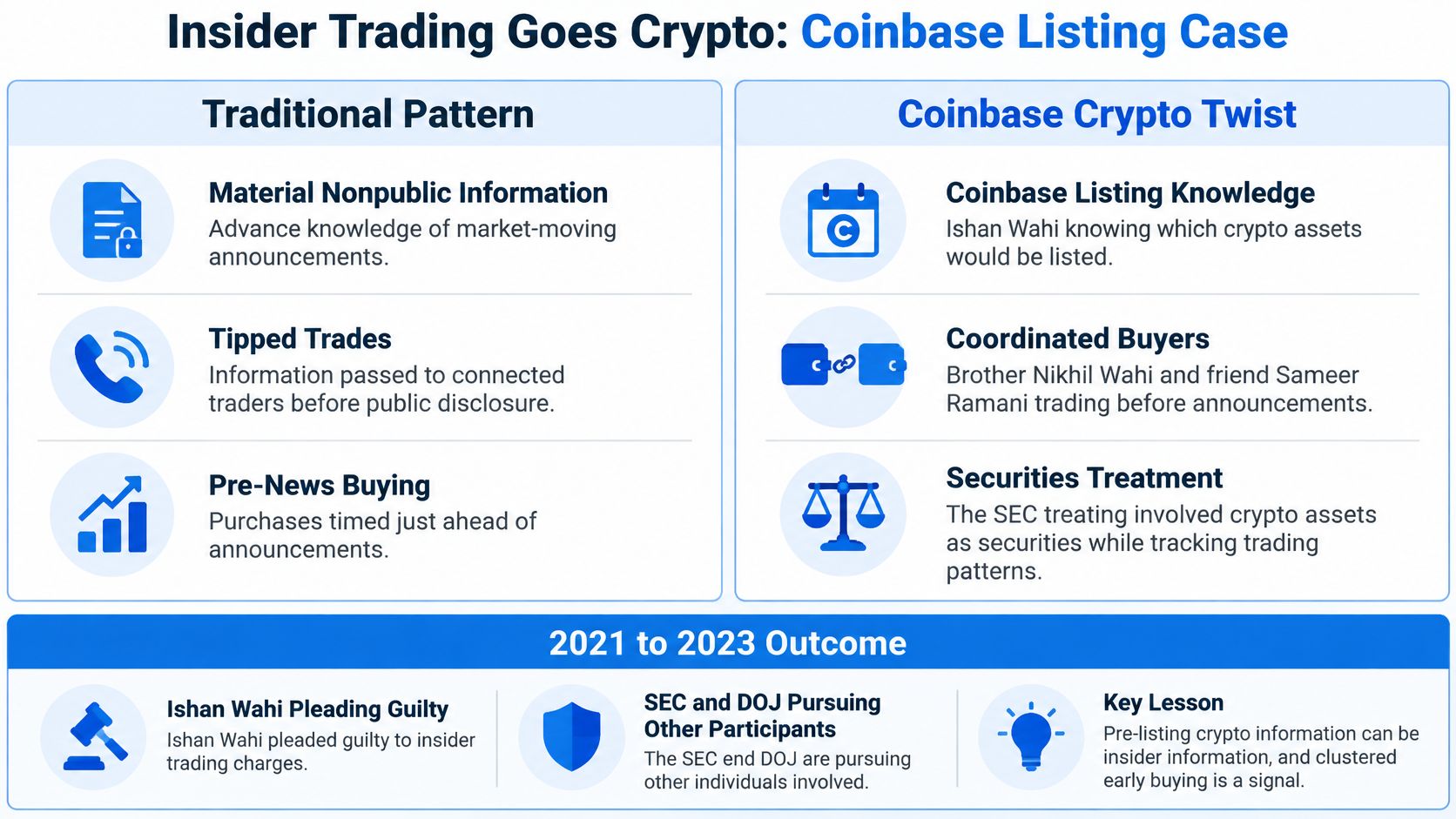
This is the case that moved insider trading doctrine into crypto. Ishan Wahi, a product manager at Coinbase, knew which assets would be listed before the public did. He shared that with his brother Nikhil Wahi and friend Sameer Ramani, who bought the tokens ahead of the listing announcements and sold into the move. The SEC and DOJ charged the group in 2022, and Ishan Wahi later pleaded guilty. Listing information on token markets qualified as material nonpublic information, which was the whole point.
Detection has moved into the data
The modern version of this case gets caught by tooling, not by a tip. The SEC reported 456 enforcement actions in fiscal year 2025 and said its Market Abuse Unit used Consolidated Audit Trail data in a case involving trading on confidential filing-related information, where the alleged conduct occurred on at least 13 occasions and generated more than $2.2 million in profits, per the SEC's enforcement announcement.
That's the same structure you see on-chain. Not one trade, but a series of profitable entries ahead of announcements, all traceable after the fact.
Pattern over event: one early buy is luck. Thirteen profitable positions ahead of thirteen announcements is a strategy with an information source.
Checks before a listing pump
- Wallet age and funding: addresses created and funded in a batch in the days before the announcement, with no prior trading history.
- Early buyers who sell into the news: the profitable wallets usually exit inside the first hours of the listing pump rather than holding through it.
- Holder relationships at launch: a study of insider concentration in dog-themed tokens shows how clustered early allocations look before and after the event they anticipated.
The seven insider trading cases at a glance
| Case | Timeframe | Key Pattern Exposed | Core Lesson | Crypto Parallel |
|---|---|---|---|---|
| Ivan Boesky and the 1980s Wall Street Insider Trading Scandal | 1986 to 1987 | Networked tips enabled trading ahead of takeover announcements | Tips about pending corporate events are material nonpublic information, and tip networks can be traced | Connected traders buying tokens before listings or other announcements may signal a flow of nonpublic information |
| Dirks v. SEC: Defining Tipper and Tippee Liability | 1983 | Tippee liability depends on an insider's breach for personal benefit and the recipient's awareness | Liability turns on whether the insider breached a duty for personal benefit | Crypto tip chains raise similar questions about the source's duty, motive, and what recipients knew |
| Martha Stewart and the ImClone Trade | 2001 to 2005 | A trade before negative news drew scrutiny; obstruction and false statements led to convictions | Obstruction can be prosecuted even when the underlying trading charge is not proven | Pre-announcement token sales may attract scrutiny, while misleading investigators can create separate legal exposure |
| Raj Rajaratnam and the Galleon Group Case | 2009 to 2011 | A network of sources and coordinated trades was exposed through communications and data analysis | Communication and trading patterns can reveal coordinated insider activity | Trading clusters across wallets before the same event can help investigators trace possible coordination |
| SEC v. Mark Cuban and the Mamma.com Trade | 2004 to 2013 | The case turned on whether a clear confidentiality duty existed | Insider liability requires proof of a duty of confidentiality | Private token-listing information may create legal risk when recipients have agreed to keep it confidential |
| Sam Waksal and the ImClone Insider Sales | 2001 to 2003 | An executive and family members traded or received tips before adverse regulatory news | Executives face serious liability for trading on confidential information, and related sales can be traced | Early token trades by insiders or connected wallets before a regulatory or project announcement may be a warning sign |
| Coinbase Insider Trading Case (Ishan Wahi and Associates) | 2021 to 2023 | Advance listing information was shared with connected traders who bought tokens before announcements | Pre-listing information can be insider information, and clustered early buying is a relevant signal | Direct crypto parallel: related wallets trading ahead of exchange listings can expose possible insider positioning |
Reading the Same Patterns on Solana as a Detection Checklist
Seven cases produce three fingerprints. Trading clustered tightly before a known event. Money moving between connected parties. The same actors repeating the behaviour across events. None of that needs a wiretap on Solana, because the funding graph, the block timestamps, and the holder list are public.
So convert each lesson into a check you can run in a couple of minutes. Who funded the early wallets. How concentrated the top holders are. Whether the creator has a history of exiting ahead of announcements. Whether entries cluster inside a narrow window before a dated event. Whether the wallets that bought early are the ones selling into the news.
Treat the output as a ranking of suspicion, not a verdict. Suspicious wallet links are starting points for verification, and missing data is never proof of safety. A tight cluster might be a team, a market maker, a sniper bot, or unrelated buyers reacting to the same public signal. The cases above show how often the same shape turned out to be a network. They also show how often a charge failed when the underlying relationship couldn't be proven.
MemeAssist turns those checks into an on-demand report covering liquidity, holder distribution, creator behaviour, wallet activity, trading patterns with bundle and insider detection, and historical risk indicators. Its public record shows why the checks matter. On 1 August 2026 the token UNTIE was rejected for bundled insider holdings at a $3.7M market cap and its price changed −98.5% over the following 24 hours. Tokens flagged high rug risk averaged a −45.3% price change over 24 hours across 1,320 analysed tokens between 3 August and 22 October 2026.
Run the checks before the chart moves, not after it. That's the only part of these seven cases you can copy.
A full MemeAssist analysis starts from the contract address and returns a health score, a rug risk rating, an AI verdict, and a detailed risk breakdown built from live liquidity, holder distribution, creator behaviour, wallet activity, trading patterns with bundle and insider detection, and historical risk indicators, plus a conditional Trade Setup when the price structure supports one. It costs $0.20, new users get one free full analysis, and no wallet connection is needed. Visit MemeAssist to run your first report before your next entry.
Topics: insider trading cases, crypto insider trading, Solana meme coins, suspicious trading activity, rug pull signals
Informational only, not financial advice. Meme coins are extremely high-risk.
All articles