On Chain Analysis: Key Signals and How to Read Them
The token chart keeps climbing, and the community chat is full of buyers celebrating their gains. You're considering an entry, but you can't tell whether you're watching genuine demand or a coordinated launch designed to attract your money. On chain analysis helps you look past the chart and examine what participants did.
Table of Contents
- What On-Chain Analysis Reveals and Why It Matters
- Six Signals Every On-Chain Check Covers
- How to Read a Solana Transaction Step by Step
- Checking Liquidity Depth and Lock Status
- Measuring Holder Concentration Without Being Fooled
- Spotting Manufactured Volume and Coordinated Wallets
- Why Creator Behavior and Trends Matter More Than Snapshots
- Run the Full Check Before Any Solana Meme Coin Buy
What On-Chain Analysis Reveals and Why It Matters
A price chart shows the latest exchange rate. The public ledger shows the transfers, swaps, token creation, and other recorded actions behind it. Those are different kinds of evidence: a rising price doesn't tell you whether independent buyers arrived or related wallets traded repeatedly.
On-chain analysis means examining a blockchain's recorded transaction history to understand activity and assess risk. Instead of asking whether a token looks popular, you ask who supplied liquidity, which addresses accumulated tokens, and what happened before large sales.
Think of the ledger as security footage anyone can rewind, but with participants wearing masks. You can follow movements and identify repeated interactions without necessarily knowing the people involved.
Visible Actions Aren't Verified Identities
Public addresses are usually pseudonymous, not named identities. Analysts combine transaction graphs, recurring counterparties, timing, and known service addresses to infer relationships, while recognizing that attribution remains uncertain, as described in the Chainalysis Crypto Crime Report.
That distinction matters when a dashboard labels a wallet an insider. A direct transfer from the creator is observable evidence. The conclusion that both wallets belong to the same person requires additional support.
The stakes are substantial: according to TRM Labs' Crypto Crime Report, funds sent to cryptocurrency fraud schemes totaled at least $10.7 billion in 2024, a 40% decrease from 2023. That measures funds sent to identified fraud schemes, not the probability that a particular token is fraudulent.
Practical rule: Judge the evidence behind a wallet label, not the label itself.
Read Behavior as a Timeline
A useful check connects liquidity, holder distribution, creator behavior, wallet activity, trading patterns, and historical risk. Each answers a different question, but their sequence often matters as much as their current values.
For example, creator-linked wallets receiving tokens before promotion and selling after synchronized buying form a more meaningful pattern than any isolated transfer. Keep observations separate from interpretations: record what happened, explain what it could mean, and state what would strengthen or weaken that explanation.
The aim isn't to uncover a person's identity or predict every price move. It's to make a trading decision with clearer evidence and fewer unsupported assumptions.
Six Signals Every On-Chain Check Covers
Six on-chain signals: what to check
| Signal | What It Measures | Healthy Pattern | Red Flag |
|---|---|---|---|
| Liquidity | Pool depth and control over withdrawal rights | Sufficient executable depth with verified, durable restrictions on removal | Shallow pool, removable liquidity, or unexplained pool shifts |
| Holder distribution | Supply controlled by the largest wallets | Supply spread across apparently unrelated owners | A small connected group controls a large supply share |
| Creator behavior | Deployer and team-linked wallet actions | Disclosed allocations with no unexplained early selling or transfers | Early sales or transfers into fresh wallets |
| Wallet activity | Who buys and sells, and when | Apparently unrelated participants with varied timing | Related wallets fund one another or buy in sync |
| Trading patterns | Trade sizes, timing, and repetition | Varied execution with plausible buying and selling | Repetitive trades, suspected wash trading, or coordinated buys |
| Historical risk | Earlier activity associated with the creator | No identified history of harmful launches | Connections to earlier collapses with similar extraction patterns |
These are patterns to investigate, not pass-or-fail guarantees. A legitimate treasury can hold a large allocation, an automated trader can repeat trade sizes, and a creator can move tokens for an announced operational reason.
Start With the Ability to Exit
Liquidity comes first because a quoted price means little if you can't sell near it. Before interpreting popularity, establish whether the trading pool can absorb your intended order and who can withdraw its assets.
Holder distribution comes next. The useful question is how much supply an owner can control, not how impressive the holder count looks.
Creator behavior adds context to that control. An unexplained transfer into fresh wallets deserves closer inspection, but a transfer alone isn't a sale. Follow the recipient's subsequent actions before deciding what happened.
Wallet activity concerns the participants: their funding, relationships, and arrival times. Trading patterns concern their execution: whether trades repeat, alternate, or arrive together. Keeping those questions separate helps you avoid counting the same observation as several independent warnings.
Give Agreement More Weight Than Color
Historical risk helps distinguish an unfamiliar creator from a creator whose earlier launches followed a harmful pattern. A failed token alone doesn't establish wrongdoing. Look for a connection between the wallets, their actions, and the way holders lost access to value.
Use a simple evidence record:
- Observation: What transaction, balance, or permission did you verify?
- Interpretation: Why might it matter for selling, control, or demand?
- Alternative explanation: Could routine operations explain it?
- Confidence: Is the relationship direct, inferred, or unresolved?
Don't just total green and red dashboard cells. A liquidity withdrawal and creator-linked sales can reinforce the same exit-risk explanation, while a lively chat adds little evidence against it.
Converging warnings matter more than a majority of reassuring categories. Record unresolved fields as unknown rather than treating missing evidence as a clean result.
How to Read a Solana Transaction Step by Step
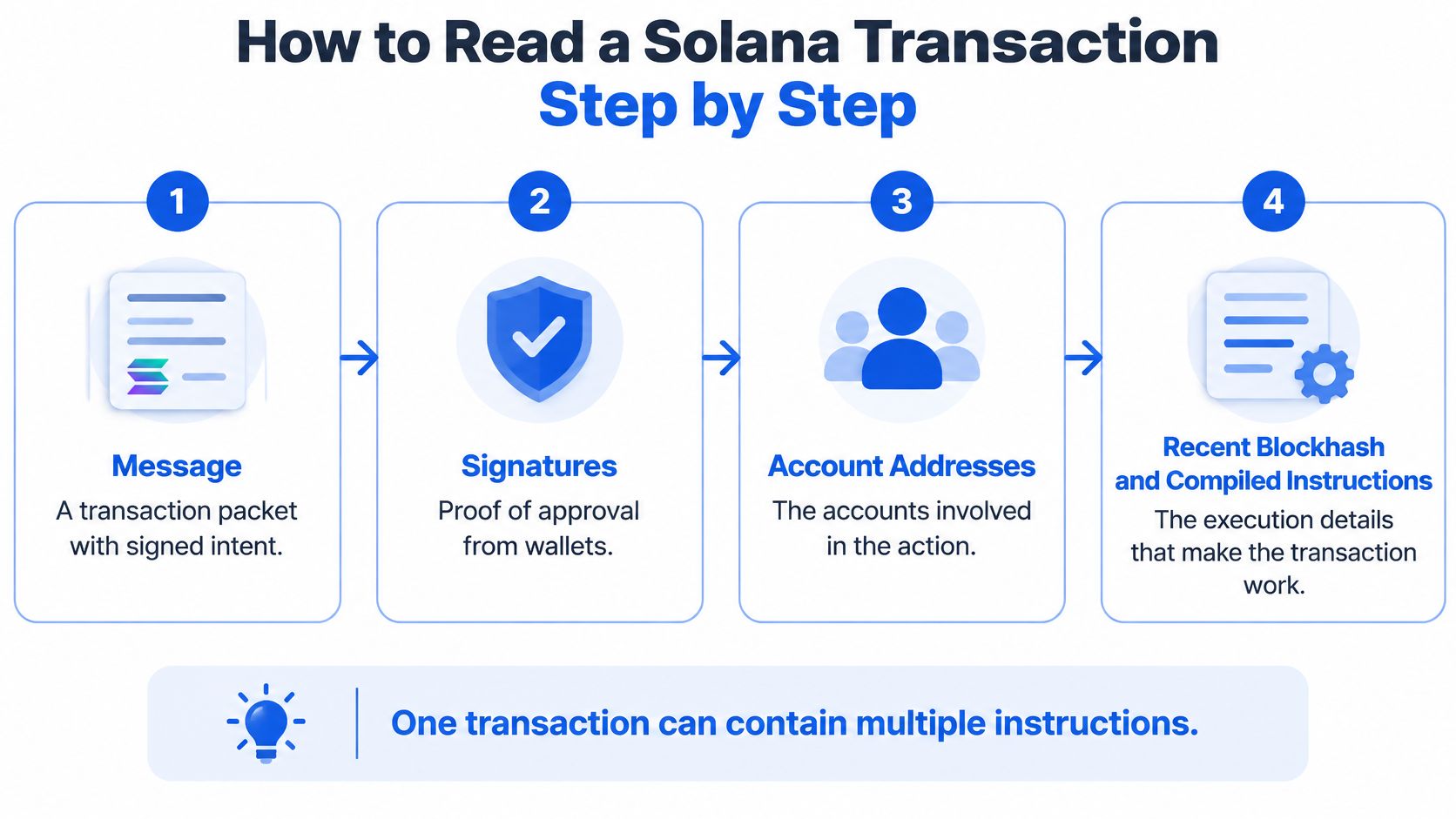
A Solana explorer's transfer summary is a convenient starting point, not a complete account of what happened. According to Solana's transaction-structure documentation, a transaction contains signatures and a message with a header, account addresses, a recent blockhash, and compiled instructions; its documented maximum size is 1,232 bytes, with a limit of 64 executed instructions.
The message's components help you organize the inspection.
Follow the Full Execution
Start with the transaction signature and status. Open the signature in Solana Explorer or Solscan and confirm whether execution succeeded. Don't count a failed attempted swap as a completed purchase.
List every account the transaction touches. Separate wallet addresses, token accounts, pool accounts, and program accounts. An address appearing in the account list doesn't automatically mean it received tokens.
Identify the programs invoked, including token programs and decentralized-exchange programs. Program identity helps explain the operation, but inspect the actual instructions rather than trusting a familiar name.
Check the signers. These accounts supplied transaction signatures authorizing execution. A signer isn't necessarily the final beneficiary, so distinguish authorization from asset receipt.
Compare each relevant account's pre-transaction and post-transaction balances. Read token amounts with the correct mint and decimals, and account for fees when reconciling native SOL changes.
Record instruction order and slot context. A slot places execution within the chain's processing sequence. Nearby transactions can suggest coordination, but proximity alone doesn't prove a shared operator.
Preserve every instruction, including inner program calls. A swap can trigger other programs and associated transfers. Reducing it to a headline wallet-to-wallet movement can hide the economic action you're trying to classify.
Solana executes transaction instructions atomically: if an instruction fails, the transaction's state changes revert. That makes the complete instruction set important when evaluating transactions containing a swap, a liquidity operation, and transfers together.
Reconcile Intent With Results
Suppose an explorer labels an action as a swap. Verify which asset left, which arrived, and which pool accounts changed, rather than assuming every transfer in the transaction was a separate trade.
A clean record should connect the instructions to the resulting balance changes. If they don't reconcile, leave the classification unresolved until you've checked inner instructions, fees, and account roles.
For a companion walkthrough, use the transaction details alongside this video.
Checking Liquidity Depth and Lock Status
Check an executable quote before believing the displayed valuation. Market capitalization applies a quoted token price to supply; it isn't the amount of money available for holders to withdraw.
For a hypothetical worked check, suppose a token has a $2 million market cap, its pool contains $5,000 in total assets, and you're considering a $500 buy. In a balanced pool, the purchase is large relative to the quote-asset reserve, so inspect the exchange's expected output and price impact rather than assuming execution near the chart price.
Verify Withdrawal Control
Use the Solana liquidity checker as a starting point, then inspect the pool's withdrawal rights. Depending on its design, those rights may be represented by LP tokens or a liquidity-position account.
- Depth: Record pool reserves and the expected impact of your intended buy and sell.
- Lock evidence: Verify the locking arrangement, withdrawal restrictions, and expiration, rather than accepting a badge.
- Largest controller: Identify who holds the withdrawal rights and whether other positions remain removable.
A burned or locked position doesn't establish that every pool position is protected. Nor does it stop a large token holder from selling into available liquidity.
A liquidity lock addresses withdrawal control. It doesn't guarantee an affordable exit.
Timestamp withdrawals, position closures, and migrations separately. A falling pool value can also reflect asset-price changes, so verify an actual removal transaction before labeling it a liquidity extraction.
Measuring Holder Concentration Without Being Fooled
A long holder list can conceal concentrated control. Suppose a hypothetical token has many token accounts, but the same wallet controls several of the largest balances. Counting account addresses makes ownership look broader without changing who can sell.
The distinction is explicit in Solana's token-account documentation: a token account tracks a mint and an owner authority, while the account itself is program-owned by the Token Program or Token Extension Program. Program ownership and control over the tokens aren't the same thing.
Rebuild the Ownership View
Begin with token-account balances, then resolve each account to its controlling authority. Aggregate balances sharing that authority before ranking holders.
Next, investigate relationships between different controlling wallets. Direct ownership is stronger evidence than a suspected cluster, so show those totals separately rather than presenting inferred connections as established identity.
The distinction is easier to see when accounts are grouped by controller.
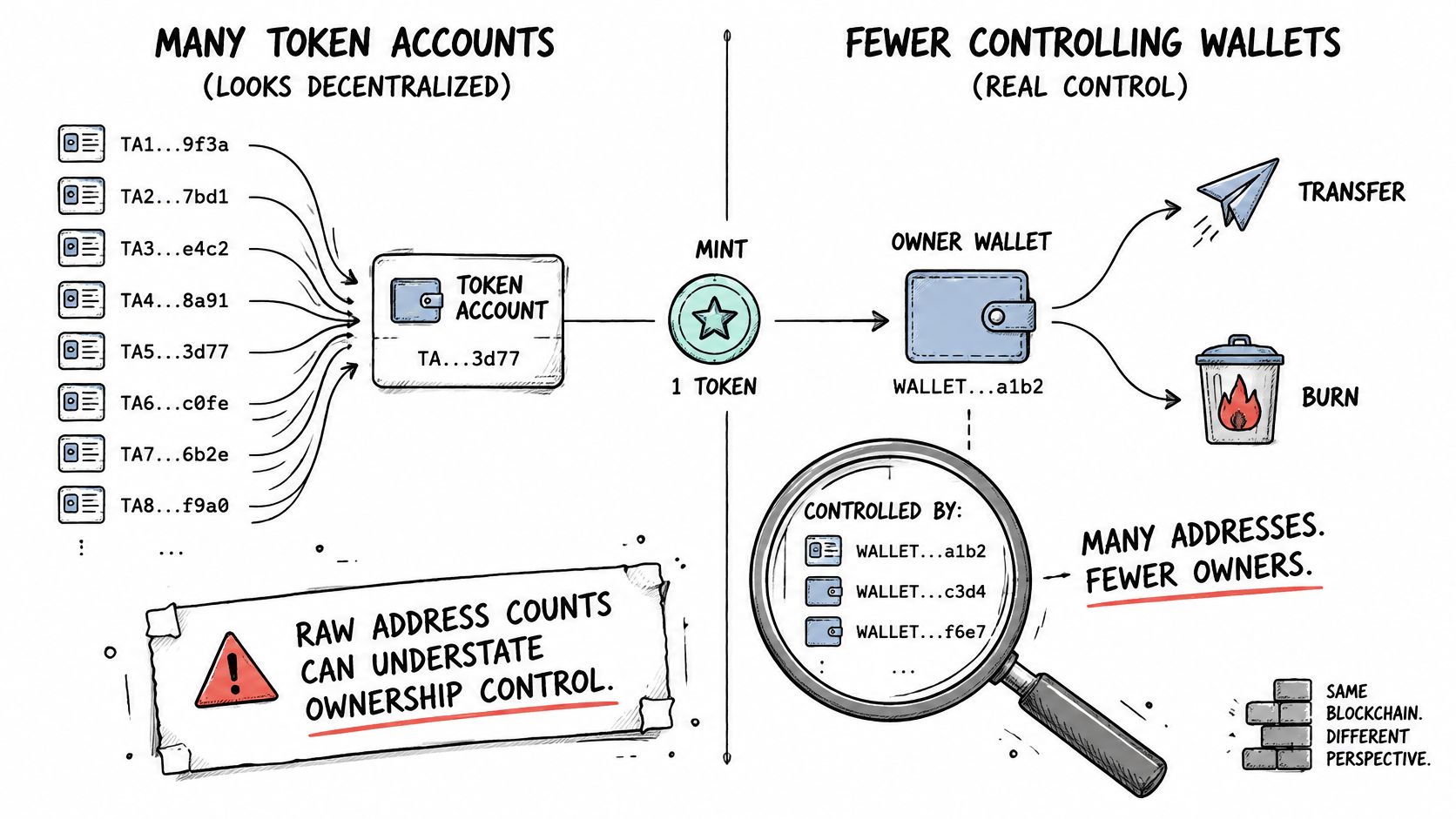
Label liquidity, treasury, custody, and protocol-related accounts explicitly. Otherwise, an exchange custody account might look like a private whale, or a pool balance might be mistaken for a creator's freely transferable allocation.
Use both a total-supply view and a clearly defined circulating-holder view. Exclusions should remain visible so a reader can reproduce the calculation rather than accept an unexplained adjusted percentage.
Inspect What Authorities Can Do
Mint authority can authorize additional issuance, while freeze authority can freeze relevant token accounts. An account's close authority concerns closing that account under applicable program rules; it isn't interchangeable with permission to mint or freeze.
Authority changes also need interpretation. Transferring an authority to another address preserves a controller, whereas setting a supported authority to None permanently revokes that authority.
A useful concentration record includes:
- Largest owners: Their balances and supply shares after account aggregation.
- Creator-linked cluster: A separate combined total with the evidence supporting each connection.
- Excluded accounts: Pool, treasury, and custody labels with explicit calculation rules.
- Active permissions: Mint, freeze, and relevant account-close authority states.
The holder-concentration guide provides additional context for interpreting these relationships.
The causal concern is concentrated, controllable supply. A large holder doesn't prove malicious intent, but that holder may be able to sell enough tokens to overwhelm the exit liquidity available to everyone else.
Spotting Manufactured Volume and Coordinated Wallets
High volume looks like demand. A growing wallet count looks like community growth. Neither establishes that independent buyers are committing fresh capital.
A cross-chain study of 34,988 meme tokens found that 82.89% of tokens achieving returns above 100% showed evidence of artificial growth, including wash trading and liquidity-pool-based price inflation. That finding concerns the study's sample and qualifying tokens, not every successful Solana launch.
Wash trading means creating misleading activity through transactions involving linked participants. In a pool-based market, related wallets can trade through the pool rather than directly with one another, so a list of swap counterparties may not reveal the common controller.
Test the Encouraging Explanation
Apparent positive signals and what they can hide
| Metric | Apparent Meaning | What It Can Hide | Check Next |
|---|---|---|---|
| Trading volume | Strong, real demand | Repeated trades by linked wallets | Counterparty repetition and funding sources |
| Unique wallet count | Broad community | Many wallets funded by a common operator | Funding trails and subsequent behavior |
| Price momentum | Rising interest | Thin liquidity moved by a few trades | Executable depth and trade sizes |
| Early gains above 100% | Product-market fit | Artificial growth through wash trading | Early buyers' exit timing |
Start with funding provenance. Trace how new buyers obtained the SOL needed to trade, and distinguish an identifiable exchange withdrawal from a direct transfer by a creator-linked wallet.
A shared exchange funding source is weak evidence of common control because unrelated customers use the same service. A direct funding chain combined with synchronized execution and common exit destinations is more informative.
Then inspect trade sizes and repetition. Similar orders can reflect bots, copy-trading, or execution strategies, so repetition alone isn't a reliable fraud verdict.
Connect Entry, Recycling, and Exit
Suppose apparently separate buyers receive funds from related wallets, purchase close together, and later send sale proceeds toward a common destination. That sequence supports a coordination hypothesis more strongly than matching order sizes alone.
Ask whether the activity introduced fresh economic exposure or repeatedly recycled the same funds. Also inspect who retained tokens after the promotional buying ended.
The Solana wash-trading guide can help organize those checks. Keep legitimate automated market-making distinct from suspected deceptive activity; automation itself isn't evidence of manipulation.
Useful distinction: Many addresses can participate in a market without representing many independent decisions.
Don't force an organic-or-fake answer when attribution is incomplete. Describe the observed relationships and the unresolved alternatives. Impressive early performance can warrant more scrutiny, not less, especially when the wallets creating momentum are also positioned to exit first.
Why Creator Behavior and Trends Matter More Than Snapshots
A token can look uneventful during an early check and become materially riskier before the next purchase. The useful question isn't just whether a warning exists, but what changed, in what order, and how quickly.
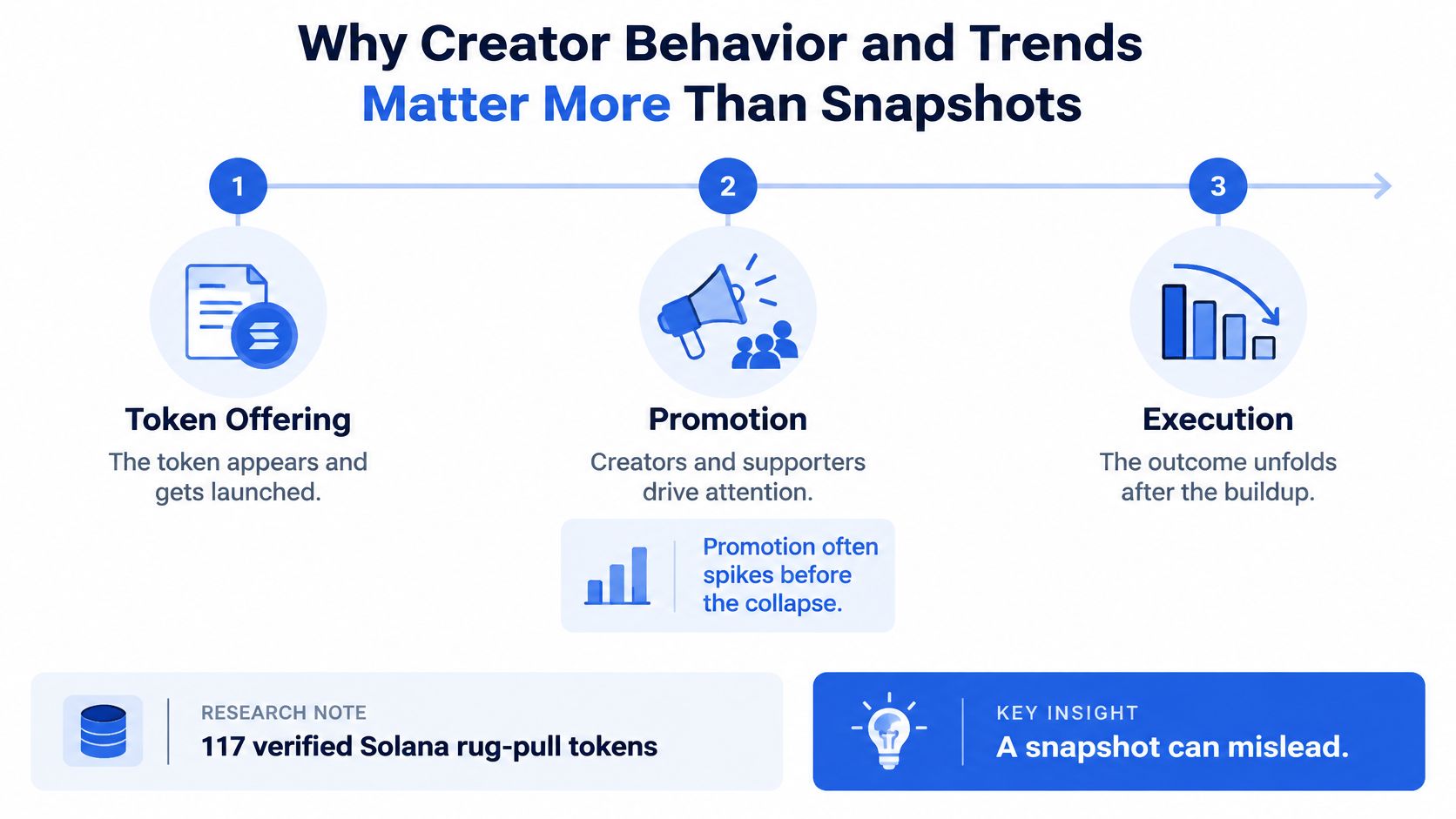
A study examining 117 verified Solana rug-pull tokens describes a recurring sequence of token offering, promotion, and execution, with promotion frequently combining marketing, impersonation, and wash trading. Treat that as a pattern for investigation, not a script that every launch follows.
The timeline below emphasizes why a launch should be assessed across its changing stages.
Follow the Changes Before the Outcome
During the offering, record initial allocations, pool creation, and the addresses receiving launch inventory. This creates a baseline without assuming the launch will end badly.
During promotion, compare public claims with transaction behavior. Attention may be growing while early holders redistribute tokens or begin selling.
During execution, inspect the actual mechanism: sales, withdrawals, or another action that changes holders' ability to exit. Don't classify the outcome solely from a price collapse.
Between observations, prioritize changes that alter control or exit conditions:
- Accelerating transfers: Creator-linked wallets begin moving inventory more frequently.
- Liquidity movement: Withdrawal rights are exercised or assets migrate without a clear explanation.
- New related wallets: Fresh addresses receive funding and join the same activity pattern.
- Selling pressure: Early participants shift from accumulating to distributing.
- Ownership changes: Supply moves into a smaller effective control group.
Preserve a Comparable Evidence Record
For each check, save the observation time, relevant transaction signatures, affected addresses, and the interpretation you made then. Separate newly observed behavior from newly discovered information about older behavior.
That distinction prevents hindsight from making an uncertain warning look obvious. It also lets you test whether your interpretation was useful rather than merely plausible.
A renounced permission or apparently distributed holder list doesn't settle the question of economic coordination. Look at what participants can still do together.
Rapid deterioration deserves priority, but don't dismiss a serious danger merely because it's stable. An unchanged, highly concentrated allocation can remain important even while a new transfer pattern demands immediate attention.
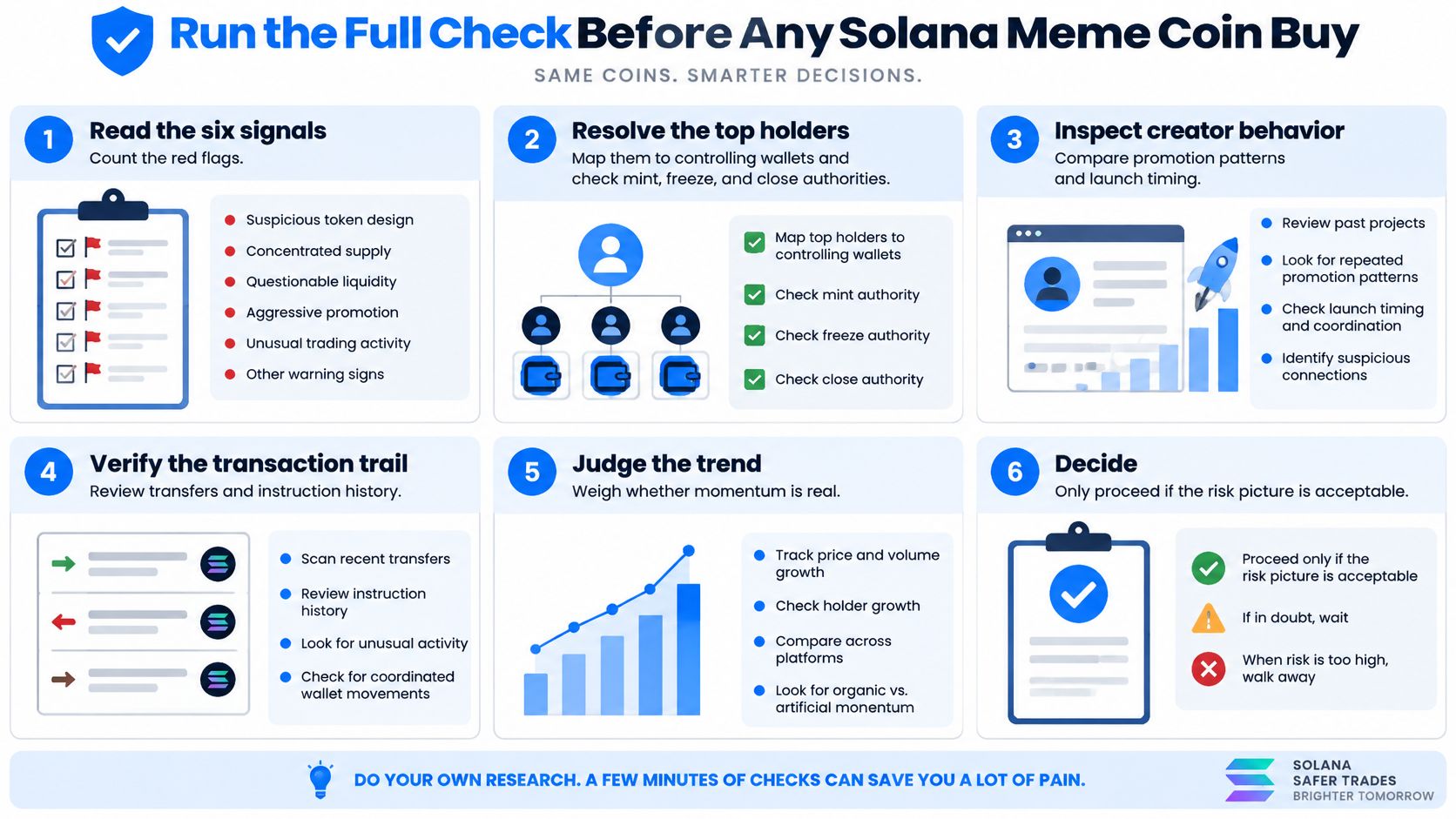
Run the Full Check Before Any Solana Meme Coin Buy
Turn the evidence into a repeatable routine rather than a last-minute search for reassurance.
- Check the signals, starting with executable liquidity and withdrawal control. Identify warnings that support the same risk explanation.
- Resolve leading holders to controlling wallets and inspect relevant mint, freeze, and close permissions.
- Review recent execution for coordinated purchases, repetitive trades, and unexplained balance changes.
- Investigate creator history and earlier launches where wallet connections are supported.
- Compare timestamped observations. Identify deterioration and distinguish it from newly discovered historical evidence.
- Decide whether the uncertainty is acceptable before considering position size. Skipping the trade remains an option.
Use this checklist to keep the process consistent.
Our MemeAssist analysis produces an Overall Health Score, Rug Risk Rating, plain-English AI Verdict, and Detailed Risk Breakdown. AI translates measured evidence; it isn't an independent expert or a substitute for examining that evidence.
A clean report can reduce uncertainty. It cannot remove trading risk.
Visit MemeAssist to examine public Solana token evidence and use an explained report to compare liquidity, wallet control, and trading behavior. Reading public evidence and reopening saved reports is free; running a new analysis is a paid action. Save your findings before buying so your next decision reflects what changed, not just how the chart looks.
Topics: on chain analysis, blockchain analytics, holder concentration, wallet activity, Solana token risk
Informational only, not financial advice. Meme coins are extremely high-risk.
All articles