Risk Breakdown Structure Explained for Solana Meme Coins
You're looking at a new Solana token, and the chart looks promising. Someone beside you is checking the same token but collecting worries instead: thin liquidity, a large holder, an unfamiliar creator, strange trades. You have price action; they have an unsorted list. Neither view tells you clearly where the greatest exposure sits, or whether the evidence is still current.
A risk breakdown structure gives those worries a consistent place. Used well, it also gives you a repeatable way to check what changed before you commit more money.
Table of Contents
- What a Risk Breakdown Structure Is and How Its Levels Nest
- How an RBS Differs From a Work Breakdown Structure
- Turning a Risk List Into Ranked Priorities
- Building a Solana Token Breakdown Branch by Branch
- Why a Static Breakdown Goes Stale Fast
- Run a Solana Token Through Your Own Breakdown
What a Risk Breakdown Structure Is and How Its Levels Nest
A risk breakdown structure (RBS) is a tree that sorts risks by where they come from. You start with broad families of uncertainty, divide those into narrower sources, and finish with specific causes you can investigate. That organization helps you see where exposure might be concentrated, although you still need scoring to judge its importance.
The Project Management Institute's explanation of the RBS describes it as a hierarchical, source-oriented classification of risk. The important word is source: you're organizing the origins of uncertainty, not collecting everything bad that might happen.
Start broad, then make each cause checkable
Think about renovating a kitchen. A late opening date is a possible consequence, but it doesn't tell you what to investigate. A delayed appliance shipment gives you a source, and an unconfirmed supplier dispatch date gives you something concrete to check.
The same progression works for a token. Difficulty selling is a possible consequence. Shallow liquidity is a source of that difficulty, while control of withdrawable liquidity by a particular wallet gives you a more specific cause to examine.
Use these levels as a practical starting template:
Three levels of a risk breakdown structure
| Level | What It Holds | Project Example | Solana Token Example |
|---|---|---|---|
| Level 1: Risk family | Broad area of uncertainty | Schedule | Market structure |
| Level 2: Source category | Where the uncertainty originates | Vendor delays | Liquidity depth |
| Level 3: Specific cause | A concrete trigger you can check | Supplier misses a shipment date | Pool liquidity paired almost entirely against one wallet |
For the token example, treat the lowest-level wording as a prompt to investigate who controls the pool position, not as a conclusion drawn from a wallet balance. Check the pool's ownership and withdrawal mechanics before deciding that a wallet can remove liquidity.
A filing cabinet is a useful analogy. Every document has a folder, and every folder sits in a drawer. Likewise, every specific cause should trace upward to a source category and then to a broader risk family.
That nesting makes the structure useful when your list grows. Instead of rereading scattered notes about wallets, pools, and trades, you can inspect a branch and see which evidence belongs together.
Separate the category from the risk statement
A category such as creator control isn't a complete risk statement. It tells you where to look. A useful entry underneath it describes a condition, a possible event, and the consequence you care about.
For example, you might write: an active mint authority could allow additional token issuance, increasing supply and weakening your assumptions about scarcity. You can then inspect the authority setting rather than arguing over whether the creator seems trustworthy.
Keep the hierarchy in a spreadsheet, a document outline, or a mind-mapping tool. Beside each lowest-level entry, leave room for evidence, the person responsible for checking it, and the next action.
- Family: Choose a broad source of uncertainty, such as technical control or market structure.
- Category: Narrow it to a mechanism, such as token authorities or liquidity withdrawability.
- Cause: Describe an observable condition that could affect your decision.
Don't confuse the RBS with the risk register. The hierarchy supplies the categories; the register holds individual entries, observations, assessments, and responses. You can store both in the same spreadsheet, but they serve different purposes.
Practical rule: Stop splitting a branch when the lowest item is something a person can check and act on.
More detail isn't automatically better. A branch called suspicious activity is too broad to investigate efficiently, but a long subdivision of nearly identical wallet transfers can bury the actual decision. Aim for a clear question and an identifiable evidence source.
Also, don't mistake a tidy structure for a favorable assessment. An empty branch might mean you found nothing concerning, or it might mean you haven't checked it. Mark those states differently.
For a token you're considering, write the family, source category, and specific cause along each branch. Fill in at least one complete path before adding more categories, so your tree starts with an actionable question rather than a collection of labels.
How an RBS Differs From a Work Breakdown Structure
If you already know a work breakdown structure (WBS), an RBS can look like the same tree with different labels. The difference is what you're breaking apart: work in the WBS, uncertainty in the RBS.
A WBS asks what someone must deliver. An RBS asks where threats to that delivery originate. A construction team might have electrical installation in its WBS and supplier reliability in its RBS.
WBS and RBS compared
| Aspect | Work Breakdown Structure | Risk Breakdown Structure |
|---|---|---|
| What it organizes | Deliverables and work packages | Sources of uncertainty |
| Question it answers | What must be built or done? | What could go wrong, and where does it come from? |
| Typical use | Scope, cost and schedule planning | Risk identification, ownership and reporting |
| Link to risk | Each risk points to the work element it affects | Each risk points to its source category |
| Lowest level | A work package someone can deliver | A specific cause someone can check |
Connect sources to affected work
Suppose a team is building a token-screening workflow. Its work packages might include collecting pool data, interpreting wallet activity, and preparing a decision report. Incomplete transaction retrieval belongs under a technical risk source, but it affects the wallet-analysis work package.
That connection tells the team where to respond. It might add a completeness check, retry failed requests, or withhold a conclusion when evidence is missing. Renaming the work package technical risk wouldn't provide the same clarity.
For an individual trader, a formal WBS may be unnecessary. You can still identify the activity affected by each risk, such as validating an entry, sizing a position, or checking an exit route.
Use the WBS to plan the work and the RBS to see where threats to that work come from.
The structures complement each other. Neither should become a substitute for the other, and neither tells you by itself which risk deserves attention first.
Turning a Risk List Into Ranked Priorities
Counting entries can produce the wrong priority. In a hypothetical assessment, a branch containing many minor inconveniences could matter less than a branch containing a few threats that would invalidate the entire plan.
The fix is to assess probability and impact, then use the result to support a decision. Keep the rating definitions consistent: probability describes how plausible the event is within your assessment horizon, while impact describes how seriously it would affect your objective.
Score the causes before comparing branches
Using the probability-impact approach described in the project-risk guidance summarized with NASA's risk-management material, a hypothetical five-point assessment gives probability 4 multiplied by impact 5 a score of 20, while probability 2 multiplied by impact 2 gives 4, making the first priority score five times the second.
That's a comparison of assigned scores, not proof that the first event is proportionally more likely or costly. These are judgment-based ratings unless you've separately calibrated them against observed outcomes.
The illustration highlights why a large list shouldn't automatically outrank a severe threat.
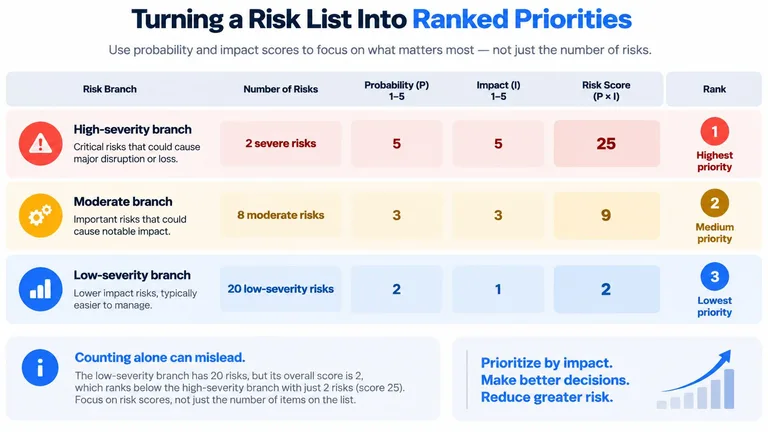
Define your response bands before assessing a token. The following is an illustrative scoring policy, not a universal standard or a set of validated loss thresholds.
Probability times impact score bands
| Score Range | Priority Band | Typical Response |
|---|---|---|
| 1-4 | Low | Monitor at each regular review |
| 5-9 | Moderate | Assign an owner and a mitigation step |
| 10-15 | High | Escalate and set a contingency reserve |
| 16-25 | Critical | Act now and review at a fixed short interval |
For a personal trading workflow, escalation might mean pausing the purchase pending another check. A contingency reserve belongs more naturally in a project budget; it shouldn't become a reason to keep funding a deteriorating trade.
Roll up scores without hiding the worst cause
Add cause-level scores within each branch to create a risk-concentration profile. This can guide mitigation effort, monitoring frequency, and where a project allocates contingency resources. Keep the highest individual score visible beside the branch total.
Avoid counting the same event repeatedly. Creator selling, a falling creator balance, and a transfer to a trading venue may describe connected evidence rather than independent risks. Cross-reference related entries instead of inflating the total.
A meme coin risk score also needs interpretation: check what it measures, which evidence supports it, and what action the underlying conditions justify. A compact rating is useful only when you can inspect the reasons behind it.
Finally, connect each scored cause to its RBS category, its affected WBS element or decision activity, and its response. That produces a usable trail from source to affected work to action, rather than a ranking with no operational consequence.
Building a Solana Token Breakdown Branch by Branch
A newly launched meme coin needs a different tree from a mature operating business. You're examining token permissions, wallet relationships, pool mechanics, and executable trading conditions, often without a long operating history.
An academic study of newly issued Solana tokens analyzed 100,063 tokens issued on major Solana decentralized exchanges during the first half of 2025 and identified 76,469 as rug pulls. That finding describes the study's sample, not a probability you can assign to every token you encounter.
Map the evidence before drawing conclusions
Use the branches below as an investigation template. Their placement doesn't give them equal weight; severity depends on the specific condition you find.
Solana meme coin risk branches
| Branch | Signals to Check | Persistent or Transient | Evidence Source |
|---|---|---|---|
| Liquidity | Pool depth and share of liquidity that can be withdrawn | Transient | Pool account data and live trade quotes |
| Holder concentration | Share held by the largest wallets and number of independent holders | Mostly persistent | Token holder list |
| Creator control | Mint and freeze authorities and creator token holdings | Persistent | Token account and authority settings |
| Creator behaviour | Creator selling, transfers to exchanges or fresh wallets | Transient | Creator wallet transaction history |
| Wallet activity | Early buyers funded from one source or bought in bundles | Transient | Transaction history of early buyers |
| Trading patterns | Wash-like volume and repeated back-and-forth trades | Transient | Trade history for the token |
| Historical risk indicators | Past outcomes of tokens launched by the same creator | Persistent | Creator history and prior analyses |
The visual map separates the investigation paths so you don't substitute a favorable signal in one branch for missing evidence in another.
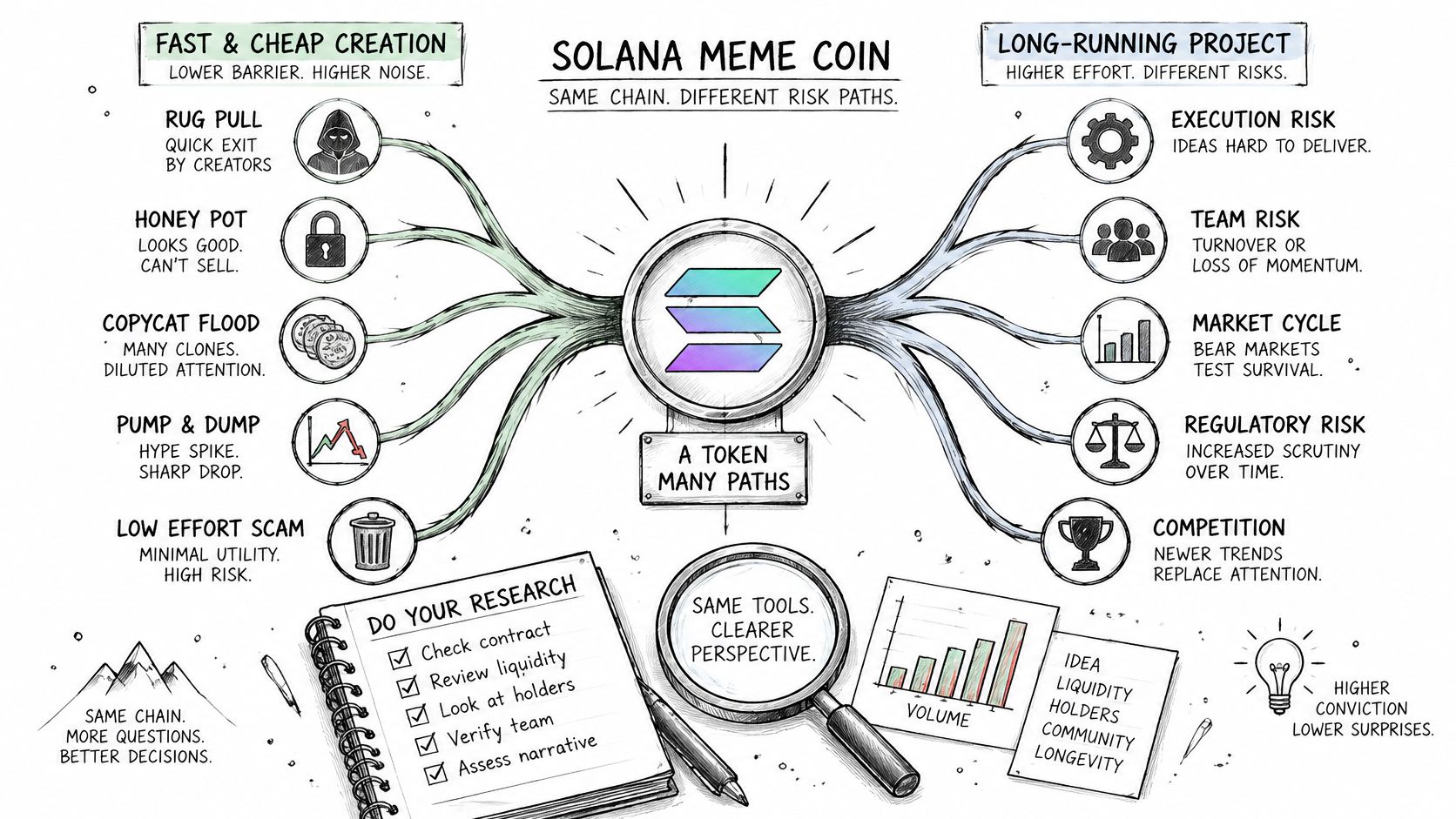
Start with liquidity by requesting a sell quote for the position size you're considering. Inspect the pool account and the mechanism controlling withdrawal, rather than relying only on a displayed liquidity value. A quote is evidence of current conditions, not guaranteed future execution.
For holder concentration, inspect the largest token accounts in Solscan or another Solana explorer. Identify pool accounts, custody arrangements, and potentially related wallets before treating every address as an independent holder. Separate accounts don't necessarily represent separate decision-makers.
Check creator control through the mint and freeze authority fields. Establish which permissions remain active and who controls them; creator holdings are a separate part of the assessment. Removed permissions don't answer questions about selling pressure or wallet coordination.
Follow actions and relationships
For creator behaviour, begin with recent outgoing transactions from the identified creator wallet. Distinguish a token transfer from a confirmed sale by inspecting the transaction instructions and destination. Don't label an unfamiliar destination an exchange without supporting evidence.
Wallet activity requires a relationship check. Trace early buyers' funding paths and transaction timing to look for common funding or coordinated purchases. A shared funding source is a reason to investigate, not conclusive proof of common ownership.
With trading patterns, inspect repeated counterparties and back-and-forth flows instead of accepting headline volume as demand. Wash-like activity is an investigative description, not a finding of manipulation based solely on repetition.
For historical risk indicators, start with earlier launches tied to the same creator address. Record what supports the attribution and what happened afterward. An uncertain wallet link should remain uncertain in your assessment.
Use these Solana token safety checks to turn observations into specific questions. Keep raw evidence separate from interpretation, particularly when a wallet relationship or creator identity is unresolved.
Why a Static Breakdown Goes Stale Fast
A clean hierarchy can create misplaced comfort. Every branch may be filled in, yet the observations underneath may already describe a token that no longer trades the same way.
The ProofHub guide to risk breakdown structures explains the organizing framework and its role in ongoing risk management. The framework sorts causes into families; it does not confirm that the evidence under each branch is still current. Probability, impact, and urgency ratings are only as reliable as the observations feeding them.
Distinguish old evidence from current evidence
Take a dated assessment. At the first check, the sell quote is acceptable and the creator wallet shows no recent sales. Days later, a liquidity provider pulls funds and the creator wallet sends tokens out. The saved hierarchy still reads clean, because the structure kept its shape while the evidence beneath it decayed.
The classification did its job; the monitoring process did not. Nothing revisited the branches that participants can change with a single transaction. A favorable reading from last week describes last week.
Freshness rule: Attach the observation time to the evidence, not just the report's creation time.
Branches age at different speeds, which is why a breakdown works better as a time-stamped monitoring system than as a one-time checklist. Current liquidity, creator transfers, and trading activity decay fastest: any participant can change them in a single transaction, so an observation from this morning may mislead by tonight. Authority settings and prior launch outcomes change rarely, though a revoked or reassigned permission still deserves a periodic check.
Even the fast-versus-slow split needs judgment. Holder concentration looks structural, yet one large seller can redistribute the map quickly. Historical facts stay fixed, while the strength of a wallet attribution can shift as new links surface.
Build an auditable update routine
A few habits keep the structure honest:
- Set a per-branch cadence. Give transaction-sensitive branches a shorter review window than stable historical evidence.
- Define event triggers. A material liquidity move, an authority change, a creator transfer, or a breakdown in quote quality each forces a revisit regardless of schedule.
- Keep dated revisions. Save each reassessment instead of overwriting it, so the reason a rating moved stays visible.
- Note what triggered each revisit. Tie every update to a scheduled check or a specific event, so gaps in attention are easy to spot later.
Broad market context, such as the activity collected in a Solana memecoin market overview, can help you decide which tokens deserve a second look. It cannot confirm whether a specific pool still holds liquidity or a specific wallet just sold, so it never substitutes for a token-level pool, wallet, or execution check.
Finally, record whether each warning was followed by the outcome you anticipated. Specify the observation window, and separate a missed warning from an outcome you had no way to observe. A price decline alone does not prove a rug pull, and an uneventful review does not prove a warning was useless.
That outcome log audits the method itself. Over time it shows which signals earned their place, which branches fire too often, and where missing evidence repeatedly blocked a defensible decision.
Run a Solana Token Through Your Own Breakdown
Choose a token you're considering and create a dated assessment before buying. A spreadsheet is enough if it preserves the evidence, your interpretation, and the next decision. The value is repeatability: a second run on the same token should be comparable to the first.
Treat this checklist as a routine to revisit rather than a form to complete once.
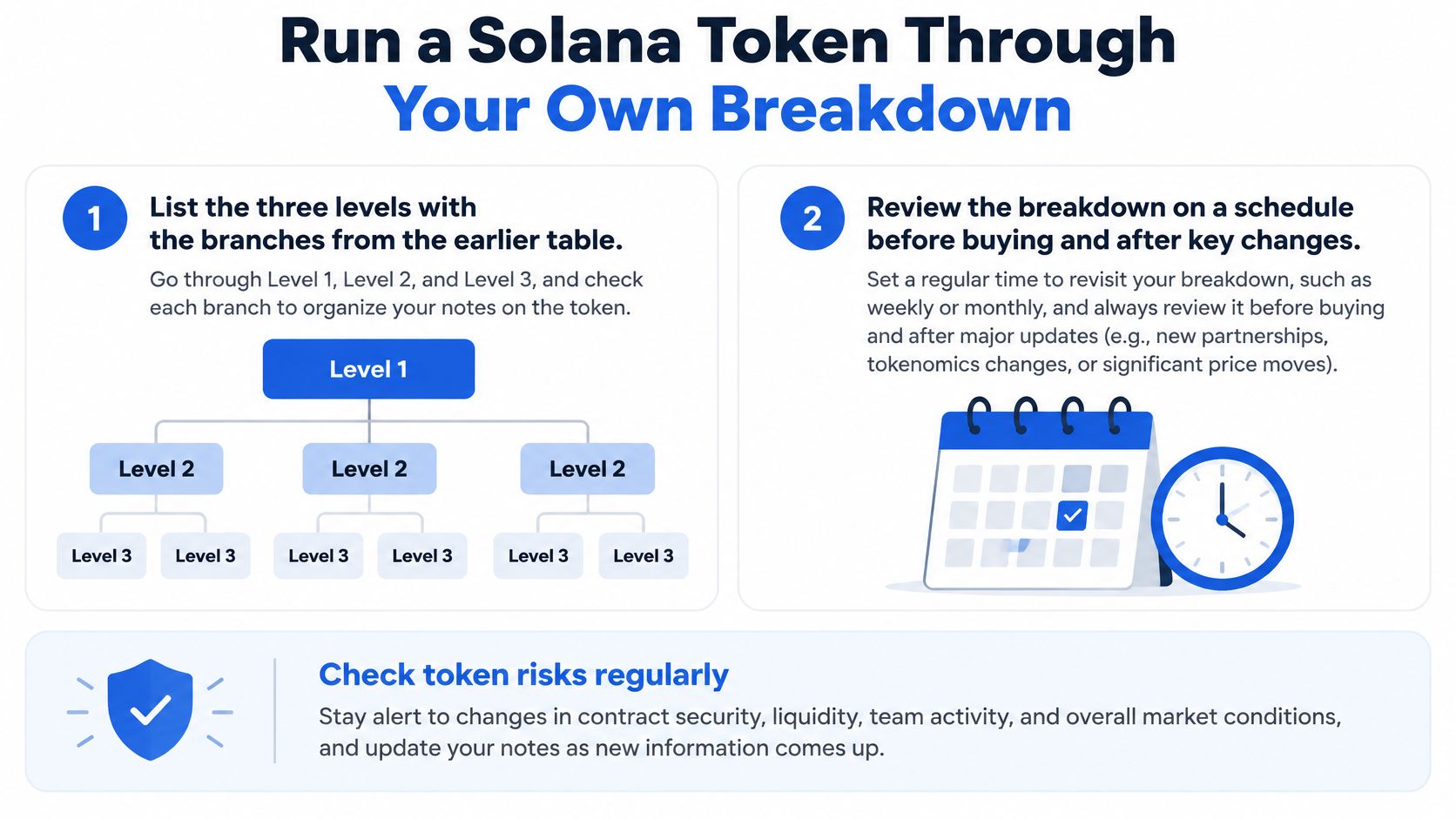
- List the levels and branches. Place each specific cause beneath its source category and broader family. Cover the checks relevant to this token: liquidity, holder distribution, creator behaviour, wallet activity, trading patterns, and historical risk indicators.
- Capture the first signal. Record the observed value or condition, its evidence reference, and the time you pulled it. Write unknown when you can't establish something.
- Mark persistence. Label structural conditions separately from transaction-sensitive observations. Flag any supposedly persistent condition that participants can still change.
- Assign probability and impact. Apply your chosen five-point scoring policy the same way on every branch. Write a one-line reason for each rating so another reader could reconstruct your thinking.
- Compare branch totals. Identify concentrated exposure while keeping severe individual causes and connected events visible. A reassuring aggregate can still hide one decisive problem.
- Schedule the next check. Set a review time for transient evidence and name the event that would move your decision sooner.
Make uncertainty actionable
A missing creator attribution or an unreadable pool position isn't a clean result. Decide whether you can resolve the gap, reduce your exposure, or decline the trade. Unavailable evidence never earns a favorable rating.
A lower rug risk rating doesn't mean a token is safe, and a higher health score doesn't mean its price will rise. The framework structures judgment. It doesn't replace judgment or guarantee an executable exit.
Before you close the assessment, write down the next check and the condition that would make you pause. Return at that time, pull fresh evidence, and save the revised judgment beside the original. Comparing dated runs against the same branches is what turns a one-off checklist into a monitoring system.
MemeAssist produces this kind of dated report on demand. Each analysis turns live on-chain and market data into an Overall Health Score, Rug Risk Rating, AI Verdict, and Detailed Risk Breakdown for a Solana token, with a conditional trade plan shown as an analysis scenario when the current price structure supports one. Open a report to examine the evidence behind a token assessment and use it to inform your own dated risk breakdown structure. Optional monitoring, alerts, exit-liquidity checks, and report-grounded Ask the Analyst questions are charged separately.
Topics: risk breakdown structure, RBS framework, project risk management, Solana token risk, meme coin analysis
Informational only, not financial advice. Meme coins are extremely high-risk.
All articles