Robinhood Meme Coin Rug Checker: How to Spot Rug Risk
You're looking at a chart that's up several hundred percent, the token showed up on a feed carrying the Robinhood name, and the replies under the launch post are all green candles. You paste the ticker into something marketed as a Robinhood meme coin rug checker, get a number back, and still don't know whether to click buy. That gap between a score and a decision is where most of the money gets lost. For permissionless tokens deployed on Robinhood Chain, use the Robinhood Chain token analyzer; this is separate from assets merely listed by Robinhood's brokerage.
The frame that makes this manageable: rug risk is two separate problems. Technical control risk is what the contract lets someone do to you, meaning create new supply, freeze your balance, or pull the liquidity you need to sell into. Market manipulation risk is what the wallets around you are doing, meaning bundled buys, insider accumulation, and coordinated exits. Both have to be read at the moment of purchase, because both change between your check and your fill.
Table of Contents
- How to Confirm You Are Checking the Right Token
- The Rug Risk Signals to Check First
- Reading Liquidity and Holder Concentration
- Creator, Authority and Trading Red Flags
- Where Rug Checks Stop Working
- Decide Before You Buy
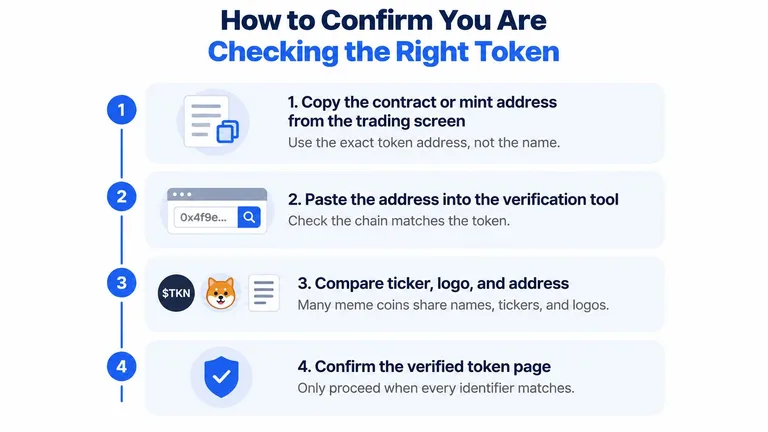
How to Confirm You Are Checking the Right Token
The cheapest rug to avoid is the one where you bought the wrong token. Clones appear within minutes of anything that pumps, reusing the name, the ticker, and often the exact logo. A lookalike can drain a real wallet while the original token is doing something else entirely, so prove you're pointing at the right contract before you evaluate anything else about it.
- Copy the mint or contract address from the trading screen. Not from a search result, a reply, or a screenshot. Tickers get reused constantly; addresses don't.
- Confirm which chain the token lives on. A name that exists on one network can have an unrelated twin on another, and an address from the wrong chain usually buys you the twin.
- Search the name and ticker, then count the results. The token with the longest trading history and the deepest pool is usually the legitimate token. Novelty logo, zero history, three followers, probably not.
- Compare the address against the project's own published links. Any contract posted only in replies stays unverified until it matches something the project itself controls.
- Open the mint authority and freeze authority fields and write down what they show. These two decide whether supply can be inflated after you buy and whether your balance can be locked. There's no negotiating with either one later.
- Look up the creator address and match it to the wallet that launched the token. A deployer with a string of dead launches is a different proposition from a wallet with no history, but neither reading is neutral.
- Re-run the address and authority checks before every buy. Tokens change hands: authorities get reassigned, liquidity gets pulled, a new deployer takes over a live ticker. Last week's clean record says nothing about this morning.
Chains other than Solana don't present a mint authority field in that form. On an EVM chain, look up the equivalent controls on that chain's own explorer: whether the contract is upgradeable, whether it has an owner, whether ownership is renounced, who can mint, and where the liquidity tokens sit. Record what you find the same way, because a field you never opened is not a field that came back clean.
One more thing the branding won't tell you. No official dataset isolates Robinhood-listed meme coins, and appearing in a Robinhood-branded feed means nobody has vetted the token. A name in a URL is not a listing, not a safety mark, and not proof you're on the right contract.
The Rug Risk Signals to Check First
Say a token starts climbing on a Robinhood-linked feed and you've got five minutes to decide. That's the worst state to be reading contract fields in, which is exactly why the order matters. Mint authority and freeze authority come first, because they're two-state readings you can settle in seconds and either one can kill the trade alone. Everything after that is a matter of degree, so work down the list rather than jumping to whichever row looks most alarming.
| Signal | Lower-risk reading | Higher-risk reading | Why it matters |
|---|---|---|---|
| Liquidity lock or burn | LP tokens locked or burned for a long period | LP held by a deployer wallet that can withdraw | Withdrawn liquidity removes any realistic exit |
| Liquidity depth | Pool is deep relative to market cap | Thin pool where small buys move price sharply | Low liquidity lets small groups create large price swings |
| Top 10 holder share | Top 10 wallets hold a modest share of supply | Top 10 wallets hold most of supply | Concentrated supply can be sold at once |
| Mint authority | Revoked, so supply is fixed | Still active, so new tokens can be created | The creator can dilute every other holder |
| Freeze authority | Revoked | Still active, so token accounts can be frozen | Balances can be locked after you buy |
| Creator wallet activity | Creator holds little or has left | Creator holds a large share or has sold recently | Creator selling is a common dump pattern |
| Early trading pattern | Buys spread across many unrelated wallets | Many early buys from linked wallets in the first blocks | Bundled buys suggest insider accumulation |
| Price move versus participation | Price rises with broad wallet participation | Spike driven by a few wallets trading back and forth | Coordinated pump-and-dump activity |
No single row decides the outcome. A token with both authorities revoked can still have a creator sitting on most of the supply, and a tidy holder list means little when the liquidity sits one signature away from being withdrawn. Two or three higher-risk readings in the same token is a far stronger signal than one ambiguous row, and one ambiguous row is a reason to keep looking rather than a verdict in either direction.
Warnings rarely arrive in time to help. By July 2025 the FBI's Operation Level Up had notified 6,475 victims of ongoing cryptocurrency investment fraud, and 77% of them reportedly did not know they were being scammed. That count covers investment fraud broadly rather than meme coin rugs, but the finding is the one that travels: the person at risk is usually the last to see it.
Keep a tally as you go. Note which rows came back clean, which came back higher-risk, and which you couldn't check at all. An unknown row stays unresolved until you open it, and unresolved is not the same as safe.
Reading Liquidity and Holder Concentration
Liquidity is the exit. The price on the chart is what you're hoping for; the pool is what pays you when you sell, and a pool someone else controls is a door someone else can close.
Lock status, duration and scope
Read the lock before anything else, because a locked pool and a burned pool are not the same promise and a partial lock is barely a promise at all.
- Burn versus lock. Burned LP tokens can never come back. Locked LP tokens come back on a schedule, to whoever holds the key.
- Duration. A lock expiring in three days doesn't protect a position you plan to hold for three weeks.
- Scope. Check whether the lock covers the entire LP position or a fraction of it, since the uncovered remainder can be pulled whenever the holder decides.
Depth is the question people skip. Compare pool size against market cap, then estimate the slippage on a position the size you intend to take. In a thin pool, a few thousand dollars of selling moves the price several percent, which is why low liquidity lets a small group produce an outsized candle without much capital.
Reading the holder list
The top-holder concentration breakdown is where most of the damage risk shows up, but only if you read it with some care. Separate exchange wallets, bridges, and program accounts from wallets that look like individuals, then ask whether several large holders could plausibly be the same owner.
Say two tokens both show a top 10 holding 60% of supply. In the first, those wallets bought weeks apart from unrelated funding sources. In the second, five of them received tokens in the same block. The share is identical and the exit risk isn't.
Concentration isn't proof of intent. It measures how much damage one decision can do to your position.
The question before you buy: could the largest holders exit without pushing the price below the level where you'd still be willing to hold?
Creator, Authority and Trading Red Flags
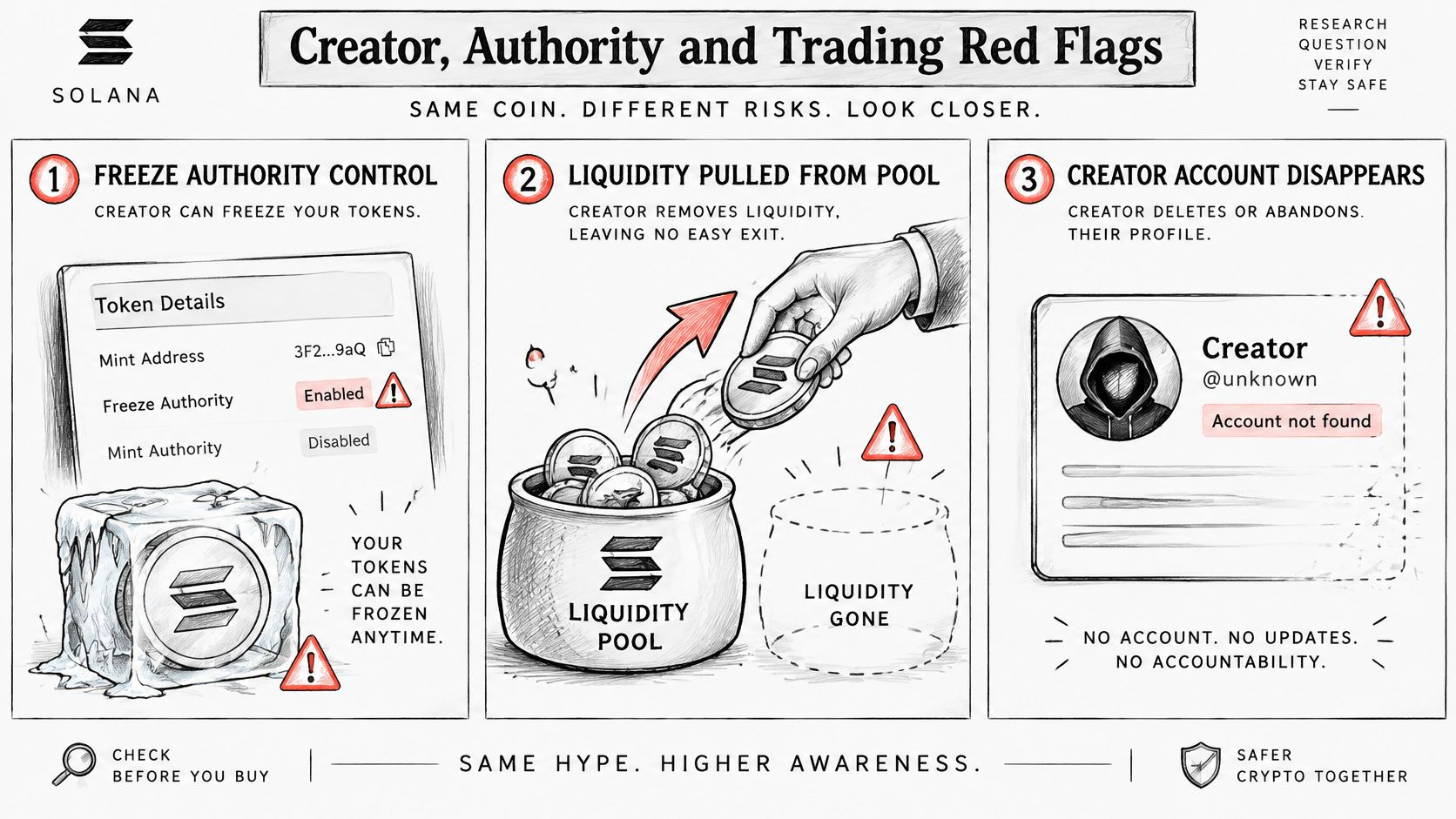
Rug risk splits into two separate problems. The first is technical control risk: the contract or its authorities still give someone power over the token or your balance. The second is market manipulation risk: the chart itself is staged, and the buyers you see are part of the act. A single pass or fail score blurs the two, so check each one for whether it is still live at the moment you buy.
An academic investigation of Solana token launches covering 100,063 tokens on major venues in the first half of 2025 identified 76,469 suspected rug pulls, with at least $151 million in direct losses across 7,322 profiting addresses and 78 recurring syndicates. The study grouped them into three patterns, and each one sits on a different side of the split above.
The three failure patterns
- Freeze-authority abuse. The creator keeps the ability to freeze holder accounts, so your balance can be locked after purchase. This is pure technical control risk: the chart may look untouched while your position is the one that can't move.
- Liquidity withdrawal. Pool depth collapses and a creator wallet receives the proceeds. There's no exit left because the exit was the thing that got taken.
- Pump-and-dump activity. Linked wallets buy in an early window, the price runs, and the same wallets sell into the buyers who arrived on the strength of that chart. This is manipulation risk, and it leaves no contract trace at all.
Where these patterns repeat
Creator history is the trail they leave. Running the Solana token creator wallet check matters more than any single holder reading, because a creator who sold early, funded dozens of early buyers, or left a line of similar tokens behind is showing you a process rather than a one-off. Trading patterns carry the other half: bundled buys inside the first few blocks, round trips between a small set of wallets, and volume rising while unique buyers fall all mean the audience is thinner than the chart suggests.
That thinness shows up in outcomes. Tokens flagged high rug risk by MemeAssist had an average price change of −45.3% over 24 hours, based on 1,320 tokens analysed from 3 August to 22 October 2026.
A coordinated exit is easier to watch than to describe, and this walkthrough traces the wallet pattern as it happens.
Timing is the part people miss. The question is never whether a red flag ever appeared; it's whether that flag is still active when your money goes in. A freeze authority revoked last week is history. One revoked an hour ago, or still standing, is your problem. A pattern that showed up an hour ago may already have drained the token, and a clean reading now says nothing about the next ten minutes.
Where Rug Checks Stop Working
A clean score is not a guarantee, and treating it as one is how careful traders still lose money. What you've confirmed is limited to what was visible at one moment.
A token can pass every check and still collapse because demand disappears, large holders sell, liquidity conditions change, or new information arrives. None of that requires a fraudulent contract. And a falling price alone doesn't prove a rug pull, since ordinary volatility and a coordinated exit can draw a similar chart at different speeds.
Risk ratings carry the same limit. A lower rug pull risk rating doesn't mean a token is safe, and a higher health score doesn't mean its price will rise.
The official numbers work as context, never as a verdict on one token. The FBI's Internet Crime Complaint Center recorded 41,557 cryptocurrency-investment-fraud complaints in 2024, up 29% from 32,094 in 2023, with reported losses of about $5.8 billion, a 47% increase, as summarized in this Congressional Research Service report. Those totals don't count rug pulls, don't isolate meme coins, and don't separate anything that happened through Robinhood. Underreporting cuts one way and multi-wallet schemes cut the other, so the figure can't settle a single token's case.
What makes a check useful is that you can run it again. Recheck the authorities, the holder list, and the liquidity after you buy, not only before.
Set exit conditions in advance. A creator wallet that starts selling, a lock that shortens or vanishes, a freeze authority that comes back on, or a cluster of top holders distributing is your signal to leave, whatever the score said an hour ago.
Decide Before You Buy
Everything above collapses into one decision, made before the order goes in.
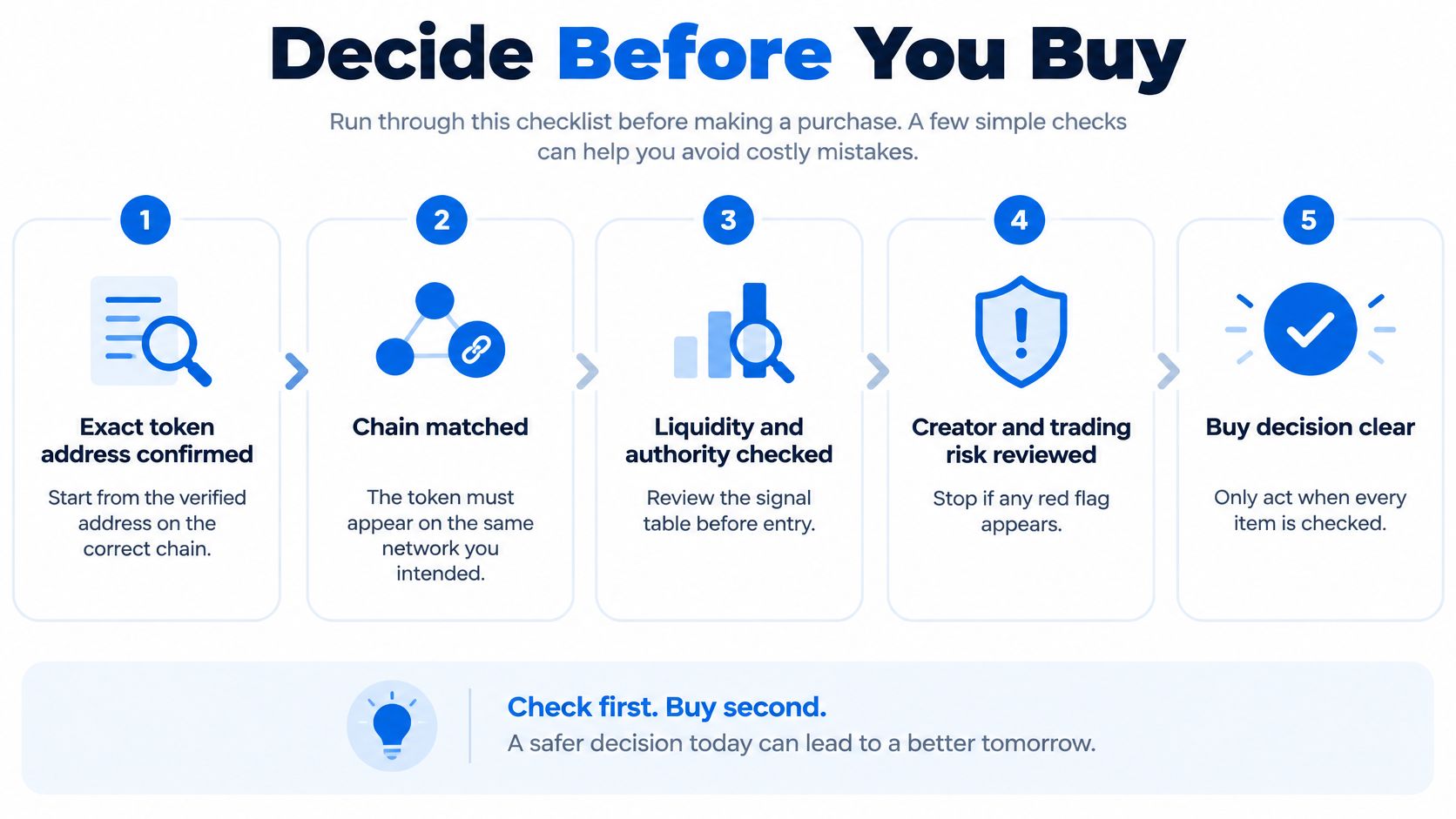
Start from the address and chain you verified, then walk the signals in order: authority status, liquidity, holder concentration, creator and trading activity. Keep two lists as you go, confirmed and unknown. You're deciding around the unknowns, so they need to be visible rather than filed away as probably fine.
Size to the loss, not the target
Work out the maximum you're willing to lose on the position and size to that figure, not to the amount you'd like to make. Position size should follow your exit conditions, which is where the practical side of buying Solana memecoins safely lives.
A free scanner is the right first pass when you're working through a list of new tokens quickly. When the rows are mixed, the position is large, or the signals are close enough that you keep re-reading them, the full analysis is what adds value: a health score, a rug risk rating, an AI verdict, and a detailed risk breakdown that explains the evidence behind each number, with a conditional trade plan when the data supports one. Take that report as a second opinion on your own research, not as a guarantee that a token is safe.
The walk-away rule: don't buy when two higher-risk readings appear together, and don't buy when you can't confirm the mint authority, the freeze authority, and the liquidity. One red flag is a question. Two are an answer.
Keep the base rate in view as well. Meme coins can lose all of the money you put in even when nobody rugs anything, because demand can move on. Sizing that assumes a total loss is the only sizing that survives being right about the contract and wrong about the crowd.
MemeAssist runs these checks against live Solana data and returns a health score, a rug risk rating, an AI verdict and the evidence behind each one, so you can see whether a token's authorities, liquidity and holder distribution still tell the same story at the moment you buy. New accounts get one full analysis free, and every report keeps its underlying checks visible so you can revisit them later. Run the token on your screen through a report at MemeAssist before the candle decides for you.
Topics: robinhood meme coin, rug checker, meme coin risk, rug pull signs, Solana token safety
Informational only, not financial advice. Meme coins are extremely high-risk.
All articles