Robinhood Token Scanner: What It Checks and What It Misses
The advice you'll hear most often is simple. If a token shows up in Robinhood, treat the listing as a quality stamp and move on. That advice answers the wrong question. For permissionless tokens deployed on Robinhood Chain, use the Robinhood Chain token analyzer; this is separate from assets merely listed by Robinhood's brokerage.
A Robinhood token scanner tells you whether you can see and trade an asset on a given product, in a given region. It doesn't tell you who controls the supply, whether liquidity can vanish, or whether the buyers are real. A familiar app's catalog doesn't measure those things.
Say you spot a Solana meme coin because its name appears in a brokerage search. The listing means access. It doesn't mean the mint matches the project you wanted, that the largest wallets hold a modest share, or that you can exit at the price on the screen. Confidence rises faster than risk falls, which is how traders get hurt on tokens that look official.
What you need is the split between an access signal and a safety check, then a short list of what to verify before you size a trade.
Table of Contents
- What a Robinhood Token Scanner Can and Cannot Tell You
- What Robinhood Quotes and API Limits Actually Show
- Why Solana Meme Coins Need Their Own Screening
- Five Checks to Run After Finding a Token
- Listing Warnings and Common Scanner Mistakes
- Confirm the Token Check Before You Buy
What a Robinhood Token Scanner Can and Cannot Tell You
A Robinhood token scanner is a view of supported assets and their quotes, not a Solana-native safety engine. Listing status answers an access question. Can this customer see the asset, and can they trade it, on this product, in this region? For those Robinhood Chain contracts, the Robinhood Chain rug risk checker separates observed contract risks from missing evidence; it does not certify safety.
Three signals people treat as safety tests
Listing status means the name sits in Robinhood's supported set for that account. It doesn't inspect who can mint more tokens or who already holds them.
The quoted price is a live bid and ask you can use to plan an order. It doesn't show how much size sits behind that quote.
A warning label is an automated notice on some assets. Seeing no label isn't evidence the asset is safe. The label wasn't built to certify a liquidity lock, a spread of holders, or organic flow.
Supply control, the ability to pull liquidity, and whether trading is organic aren't in that feed at all.
| Question | Robinhood listing or market data | On-chain check needed |
|---|---|---|
| Can I trade this asset here? | Yes or no, if supported on my product and region | Not applicable |
| Is this the contract address I expect? | Not shown as a safety check | Verify the exact mint address |
| Who controls the supply? | Not reported | Holder concentration and creator wallets |
| Can liquidity be removed? | Not reported | LP ownership and lock status |
| Is trading organic? | Not reported | Bundled buys, wash patterns and insider wallets |
| What is the realistic exit price? | Best bid and ask, excluding order size and fees | Spread, slippage and executable size |
Read the first row as a gate. If the asset isn't supported on your product, you can't place the trade there.
The next four rows stay blank on Robinhood's side. The feed doesn't confirm the mint you expect, the wallets holding supply, whether liquidity can be pulled, or whether buys landed in a bundle. You answer those on the chain: exact mint, holder concentration, LP ownership and lock status, and bundled or insider flow.
The last row is the trap. A best bid and best ask, with order size and fees left out, isn't the price a larger sell will receive. Spread, slippage, and executable size are separate math.
Practical rule: Use the scanner to find the asset and to size an order. Use on-chain checks to decide whether the token is safe to hold.
What Robinhood Quotes and API Limits Actually Show
Robinhood's Crypto Trading API serves U.S. customers through authenticated requests that carry an API key, a signature, and a timestamp, with a documented limit of 100 requests per minute per user and bursts up to 300 under a token-bucket model, per Robinhood's Crypto Trading API docs. A scanner built on that API is an execution tool. It isn't a general blockchain crawler.
Why polling every asset fails
That allowance runs out fast if you poll every listed asset on a short timer. Cache metadata that barely changes, such as the asset symbol and whether the product supports it. Take websocket or other event-driven updates where the feed offers them. Spend REST calls on a short list of ranked candidates, not on the whole catalog every minute.
What the quote actually contains
The quote endpoint returns one best bid and one best ask across partner exchanges. It leaves out order size and fees, and it may not equal the price you eventually get filled at.
| Field | What it tells you | What it leaves out |
|---|---|---|
| Best bid | Highest current buy price across partner exchanges | Order size and fees |
| Best ask | Lowest current sell price across partner exchanges | Order size and fees |
| Midpoint | Average of best bid and best ask | Realisable liquidity and the eventual fill price |
| Spread | Gap between best bid and best ask | Depth beyond the top quote |
Say the best bid is $0.010 and the best ask is $0.014. The midpoint prints $0.012 and looks orderly. The spread is 40% of the bid. A marketable order for more than the hidden size at the top walks the price, and fees sit on top of that walk. You never saw the size, so the midpoint wasn't a price you could realize.
Calculate three numbers yourself before you trust an entry or an exit.
- Spread: The gap between best bid and best ask, as a share of the bid. A wide gap means the displayed middle isn't a trade.
- Expected slippage: How far your order size is likely to move the price past that top quote.
- Executable notional: The dollar amount you can buy or sell near the quote, not the headline price times a wish.
The same quote can't tell you mint authority, freeze authority, who owns the liquidity, how concentrated the holders are, what the creator wallet did, or whether buys were bundled. Those checks live on Solana, not in a partner-exchange top of book.
Why Solana Meme Coins Need Their Own Screening
Listed large-cap assets and fresh Solana meme coins don't fail the same way. Between January 2024 and March 2025, Solidus Labs analyzed more than 7 million tokens launched on Pump.fun, and 98.6% exhibited characteristics of pump-and-dump schemes or rug pulls, according to Gate's account of that review.
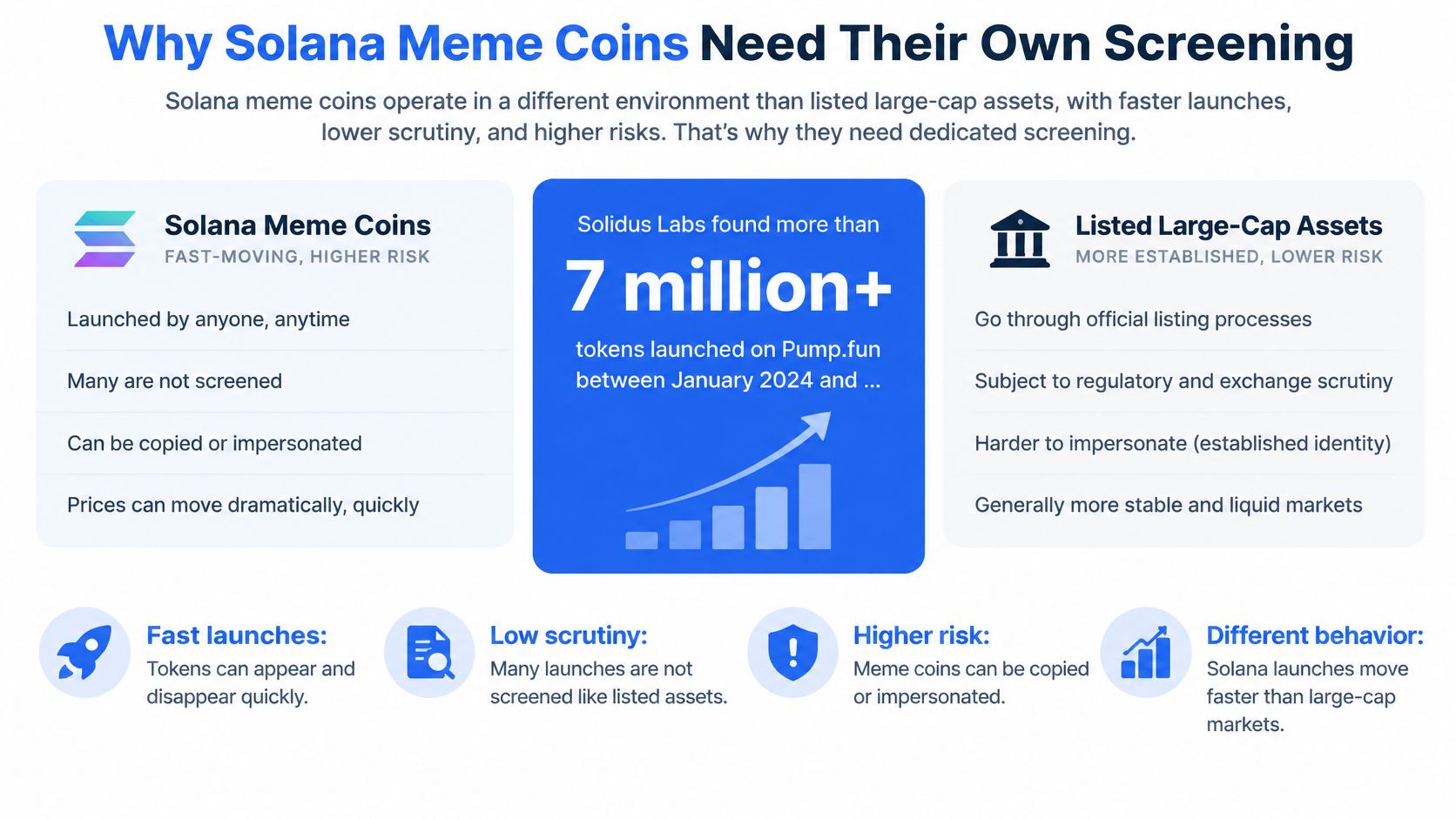
The same research window shows how thin the survivors are. In 2025, Solidus Labs reported that only about 97,000 Pump.fun tokens kept liquidity above $1,000 after more than 7 million were analyzed, as covered by Coinpaprika's summary of the figures. Between January 2024 and March 2025, Solidus Labs also found that 93% of 388,000 Raydium liquidity pools showed signs of soft rug pulls, per Bitcoin.com's report on the review. In 2025, Solidus Labs reported median losses of $2,832 per Raydium rug-pull incident, with the largest identified case exceeding $1.9 million, according to Benzinga's write-up.
What those rates mean for a screen
Most new tokens aren't buy candidates. A useful screen filters fast and assumes nothing about legitimacy. Those rates describe patterns across many tokens. They don't prove that any single mint is a fraud. Treat them as a reason to slow down, not as a verdict on the coin in front of you.
A typical rug is plain once you name the steps. Insiders take supply at launch. They attract buyers with a rising chart. Then they pull liquidity or sell into that demand. Holders are left with a token they can't sell at a useful price.
Picture a shop with a bright sale sign and a locked back room. You can see the storefront chart. You can't see who controls the stock.
Each piece of that pattern has a matching check, and none of them come from a brokerage listing.
- Fast launches: Confirm the exact mint before you care about the name, because copies appear in minutes.
- Liquidity that can leave: Check LP ownership and whether the pool is locked or removable.
- Supply sitting with a few wallets: Measure holder concentration and creator-linked wallets, not the logo.
- Volume that isn't demand: Look for bundled buys and a small set of unique buyers.
A large-cap quote on a familiar app doesn't run those checks. A Solana meme coin needs them before the chart is worth reading.
Five Checks to Run After Finding a Token
Run these in order. One serious red flag is enough to skip the trade. A clean pass lowers risk. It doesn't remove it.
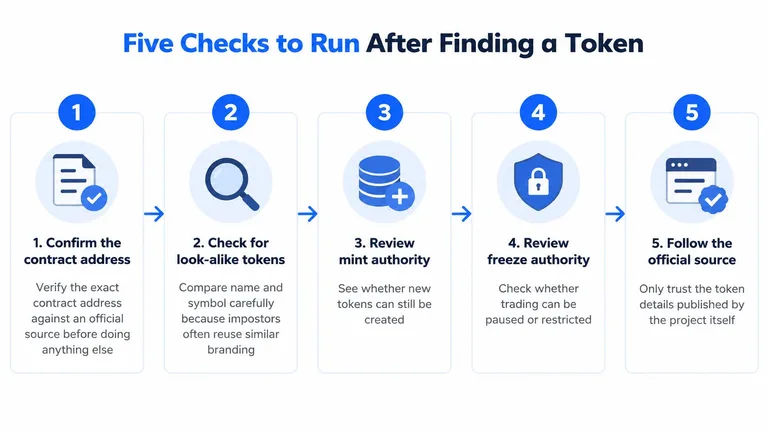
Confirm the exact contract address. Match the mint to an official project source, then look at mint authority and freeze authority. Look-alike tokens share names and symbols, so the common slip is checking the ticker and feeling done. If either authority is still live, someone can mint more supply or freeze transfers after you buy. The Solana token safety checks walk through what those authorities mean in practice.
Check liquidity depth and whether it can be removed. Ask how much you could sell before the price collapses, and whether the creator can pull the pool. Traders trust a large liquidity number and never ask who can withdraw it. Deep liquidity that isn't locked is a door, not a cushion.
Review holder concentration. Measure the share of supply in the largest wallets, and whether several top holders look linked. Counting wallets is the slip. A hundred tiny wallets don't matter if one wallet holds most of the float and can exit in a single trade.
Inspect the creator wallet and linked wallets. See whether the creator still holds tokens, has launched other mints, or moved funds recently. Checking a public display name isn't the same as reading the wallet. Recent transfers out, or a creator still sitting on a large share, are insider risk you can see before the chart breaks.
Look for abnormal volume and bundled transactions. Many buys landing in the same block, or high volume from few unique buyers, is not organic demand. The slip is reading a tall volume bar as real interest. Buys spread over time, from many unrelated wallets, are the healthier pattern.
| Check | Why it matters | Common slip | Clean result |
|---|---|---|---|
| 1. Exact contract address | Look-alike tokens share names and symbols | Checking the name instead of the address | Address matches an official source and mint and freeze authority are reviewed |
| 2. Liquidity depth and lock | Shows how much could be sold before the price collapses | Trusting total liquidity without checking if the creator can remove it | Liquidity is deep and locked or not removable |
| 3. Holder concentration | One wallet can exit the market in a single trade | Counting wallets instead of measuring supply share | Largest holders own a modest share and none appear linked |
| 4. Creator and linked wallets | Shows whether insiders still hold supply or moved funds | Checking only the creator's public name | Creator holds little supply and has no recent fund movements |
| 5. Abnormal volume and bundles | Shows whether trading is organic | Reading high volume as real demand | Buys are spread over time and come from many unique buyers |
What a pass actually looks like
A clean result lines up across all five. The mint matches an official source, mint and freeze authority have been reviewed, liquidity is deep and not removable by the creator, the largest holders own a modest share and don't look linked, the creator holds little and hasn't just moved funds, and buys are spread across many unique wallets. If any one of those fails hard, skip the trade. If all five look clean, you still size small, because wallets can change after you enter.
Listing Warnings and Common Scanner Mistakes
A recognizable app lowers the effort of finding a token. Risk doesn't drop at the same speed. Robinhood's own crypto risk disclosures warn that crypto trading stays exposed to extreme volatility, flash crashes, market manipulation, and cybersecurity risks. The same disclosure says an automated warning label isn't a safety guarantee, and the absence of a label doesn't make an asset safe.
A listing isn't approval
The scanner shows which assets a customer can access on a given product and in a given region. Robinhood's crypto availability guide notes that some cryptocurrencies can only be viewed or traded on particular products, including the mobile app, the classic web interface, or Robinhood Legend. A token visible on your phone may be missing from the classic site. That is a product boundary, never a quality grade.
The catalog works as an availability layer tied to supported assets and to your jurisdiction. Tokens traded on decentralized exchanges, or launched on venues such as Pump.fun, may not be listed, searchable, or risk-screened there at all.
No warning label isn't no risk
Traders read a blank label as a pass. The disclosure says the opposite. An automated warning isn't a guarantee, and a missing label gives no proof the asset is safe. Volatility, flash crashes, manipulation, and cybersecurity risk still apply to assets carrying no label at all.
The midpoint isn't your exit
Don't treat the displayed middle of the quote as the price you'll receive. A calm quote can still hide a wide gap between what buyers bid and what sellers ask, so a sizeable order moves the price. Extreme moves and thin books are exactly the conditions the risk disclosure flags.
One clean reading doesn't stay clean
Holder share, liquidity, and creator behavior can change after you enter. A check you liked this morning expires by the afternoon. Market manipulation and sudden crashes don't wait for your next review.
Reported trading activity doesn't close that gap. In Robinhood's reported second quarter 2026 results, combined crypto notional trading volume reached $40 billion, with $18 billion from Robinhood App trading and $22 billion from Bitstamp, while Robinhood App volume decreased 35% year over year, according to the company's shareholder disclosure. Notional volume is the dollar value of executed purchases and sales. It counts trades that happened. Liquidity durability and supply distribution are separate questions it cannot answer.
The gap shows up in two everyday cases. A Solana meme coin trading only on a decentralized exchange has no Robinhood listing to lean on. A Pump.fun token may not be searchable on Robinhood at all, so there is no label, no quote, and no implied review.
Pause when the signals disagree.
- Supply sits with a few new wallets, even if the name looks familiar.
- Price rises on few unique buyers, so the volume bar overstates demand.
- The creator wallet is hard to trace, or funds moved and you can't follow them.
When those show up, wait, cut the position size, or pass. A honeypot check on a Solana token belongs in that pause, because a chart you can buy and can't sell is the failure mode a listing never tests.
Confirm the Token Check Before You Buy
Robinhood tells you what you can trade. On-chain checks tell you what you're exposed to. Decide in that order, and write the exit down before you enter.
- Confirm the token is available on the product you use. A name in one interface is not a guarantee it trades in another.
- Run the five checks against the exact contract address, not against the ticker. Stop if mint authority, freeze authority, removable liquidity, concentrated supply, creator holdings, or bundled buys fail.
- Compare the liquidity you could exit through with your position size. If a normal sell would move the price past your plan, the position is too big.
- Set a written exit level before you buy. If the chain picture changes, you already know the price or the condition that gets you out.
Where a dedicated Solana check fits
A free scanner is a reasonable first pass when you only need to see whether the obvious problems are present. When you want the evidence behind a score, our full analysis evaluates six signal categories: liquidity, holder distribution, creator behaviour, wallet activity, trading patterns, and historical risk indicators. That report explains the evidence behind the health score and rug risk rating, adds an AI verdict and a detailed risk breakdown, and includes a conditional trade plan when the data allows. Reports are automated. The people named on our about page shouldn't be understood to have individually reviewed or approved each report. Any report is one input, not a guarantee, and it doesn't replace the exit rule you wrote down. Pair that with a plain sequence for how to buy Solana meme coins safely so the order of checks stays the same when you're in a hurry.
Start with three actions today.
- Address check: Paste the mint from an official source and reject anything that only matches the name.
- Holder check: Write down the share held by the largest wallets and whether they look linked.
- Exit plan: Name the size you can sell without blowing through the book, and the level where you leave.
If the access screen and the chain disagree, trust the chain. The listing only told you the door was open.
MemeAssist reads live Solana data so you can see liquidity, holders, creator wallets, and trading patterns that a Robinhood listing never measures. Use it when a token looks available and you still need to know whether the mint is safe to hold. Visit MemeAssist and run the check before you size the trade.
Topics: robinhood token scanner, solana token safety, rug pull check, crypto token analysis, meme coin scanner
Informational only, not financial advice. Meme coins are extremely high-risk.
All articles