Rug Pull Coin Explained: How to Spot, Avoid, and Check One
Learn what a rug pull coin is, how Solana scams work, the red flags to check, and how MemeAssist scores rug risk before you trade.
Published
Updated
Chainalysis estimated that victims lost more than $2.8 billion in cryptocurrency to rug pulls in 2021, and rug pulls made up 37% of all crypto scam revenue that year, up from 1% in 2020. That turns the phrase rug pull coin from a meme into a real screening problem, especially on fast-moving Solana launches where a token can look alive right up until the liquidity disappears.
A useful way to think about it is simple: the coin itself usually isn't the scam, the control around it is. Buyers enter, liquidity sits in a pool, and then a creator-linked wallet either drains that pool, sells into thin bids, or leaves the market too broken to exit cleanly. The difference between those outcomes matters, because a hard liquidity pull, a soft dump, and plain abandonment don't behave the same way on-chain or in your wallet.
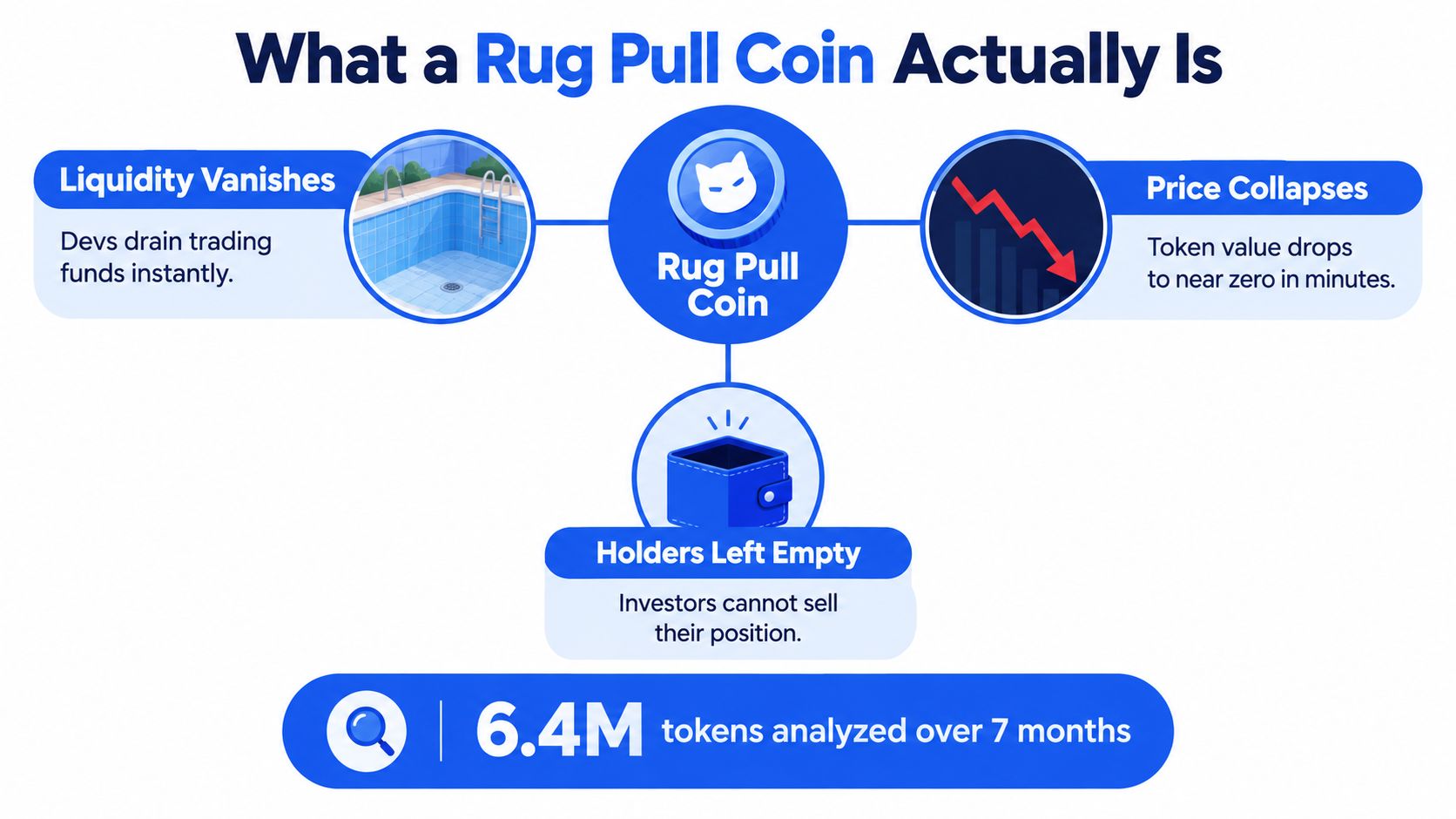
Table of Contents
- What a Rug Pull Coin Is
- The Three Mechanics That Drive Rug Pull Coins
- Why the First Hour Changes the Risk on Solana
- Seven Red Flags You Can Check Before You Buy
- Frequency Versus Impact on Real Wallets
- How MemeAssist Scores a Rug Pull Coin
- A 60-Second Pre-Trade Checklist for Solana Meme Coins
What a Rug Pull Coin Is
A rug pull coin is a token whose trade structure gives insiders enough control to leave buyers exposed to an exit. In practice, the project launches, liquidity is paired on a DEX, buyers move in, and then a wallet tied to the creator or early insiders changes the terms by removing liquidity or dumping supply into weak demand.
Why the label is less important than the mechanism
The label gets used too loosely. A failed meme coin, a pump-and-dump, a dead community, and a true rug pull can all end with a chart that looks broken, but they fail in different ways. If the pool is drained, holders may not be able to sell at all. If the token is abandoned, a market may still exist, just with almost no bids.
Practical rule: don't ask first whether a token is “a rug.” Ask who controls liquidity, who can move the supply, and what happens if those wallets change behavior.
That distinction matters because aggregate loss numbers can hide how the damage is distributed. Chainalysis estimated that victims lost more than $2.8 billion in cryptocurrency to rug pulls in 2021, and rug pulls made up 37% of all crypto scam revenue that year, up from 1% in 2020. In the same analysis, Thodex accounted for roughly 90% of the value attributed to that year's rug pulls, which shows how one huge exit scam can dominate a global total while smaller cases still inflict real losses. Chainalysis also cited AnubisDAO, which allegedly extracted more than $58 million in cryptocurrency, so this is not a niche retail problem.
What buyers should look for
A useful definition has three parts. First, there has to be a tradable token. Second, insiders need a meaningful control point, usually liquidity, contract permissions, or concentrated supply. Third, that control has to be used in a way that leaves late buyers worse off and often trapped.
Market cap alone means almost nothing. If you do not know who controls the pool, the creator wallets, and the exit path, you do not really know what you bought.
The Three Mechanics That Drive Rug Pull Coins
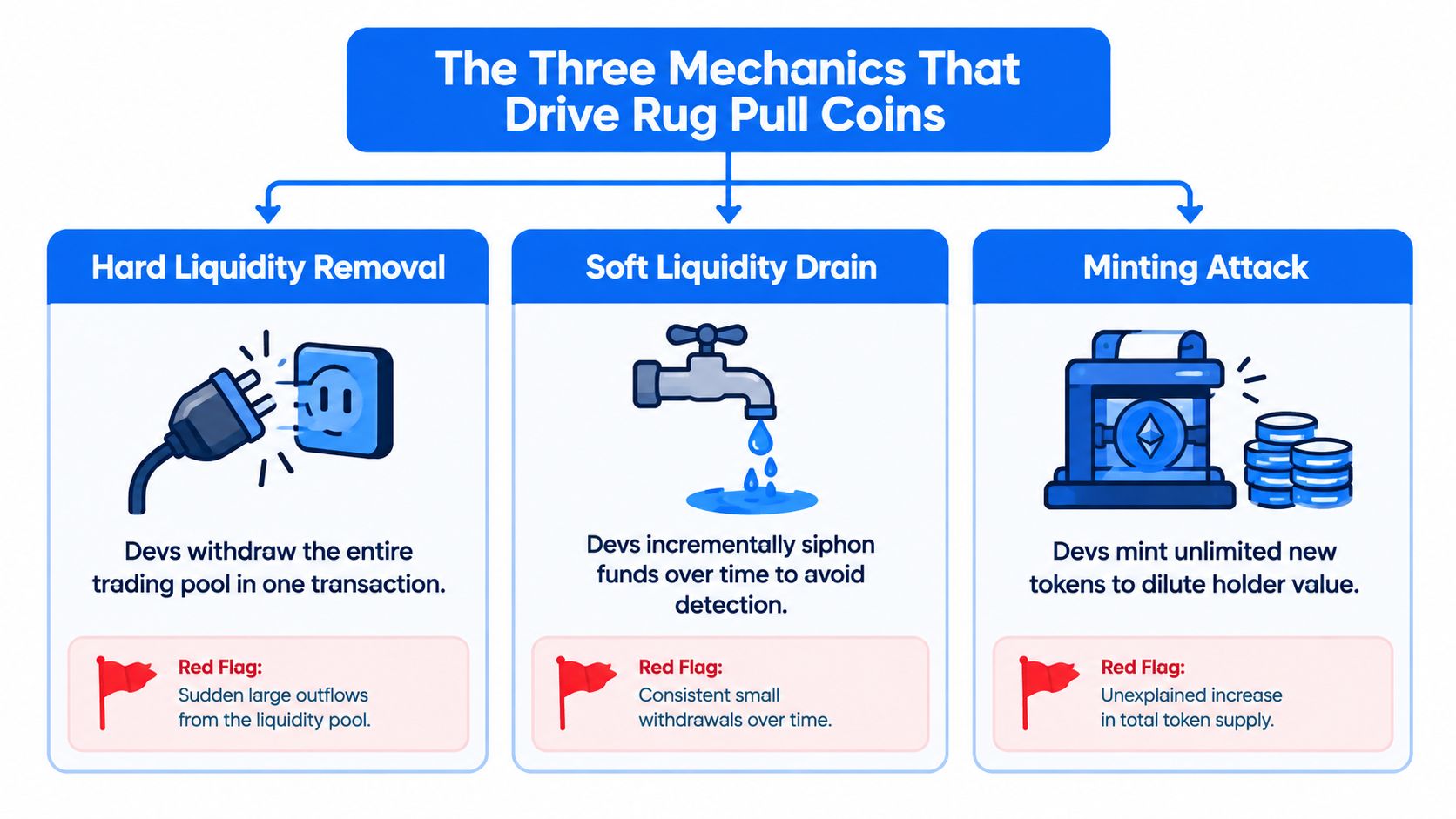
Hard liquidity removal
The cleanest rug pull removes liquidity outright. Insiders pull the paired asset from the pool, and the token may still sit in wallets even though there is almost nothing left to sell against. That makes rug pulls a liquidity-control problem, not just a price-chart problem.
A Chainalysis rug pull report described a strong, though not conclusive, pattern: after at least five DEX purchases, one address removed more than 70% of pool liquidity and the remaining liquidity fell below $300. Chainalysis also found that about 94% of suspected DEX-pool rugs were linked to the address that created the pool. Traders should treat that creator-wallet link as a direct exposure signal, because the person who formed the pool often controls the exit.
Soft rug selling
Soft rugs are less visible because liquidity may stay in place. Insiders sell a large allocation into public demand, and the pool or order book cannot absorb the flow. Buyers experience the same damage, only more slowly, which also makes it easier for operators to deny intent.
Abandonment without a clean drain
Some tokens do not show a clear pool drain. The team disappears, development stops, and the token drifts into illiquidity because nobody maintains it. That is not the same as a hard rug, but holders can still end up with little practical exit.
Hard rugs, soft rugs, and abandonment need different responses. One is a custody problem, one is a concentration problem, and one is a market quality problem.
The key is to separate mechanism from headline. If you know whether the threat is liquidity removal, concentrated selling, or abandonment, you can judge whether the token is fragile, already compromised, or effectively dead.
Why the First Hour Changes the Risk on Solana
A token can look acceptable at launch and still become dangerous within minutes. On Solana, the risk profile moves quickly enough that a single snapshot often misses the point.
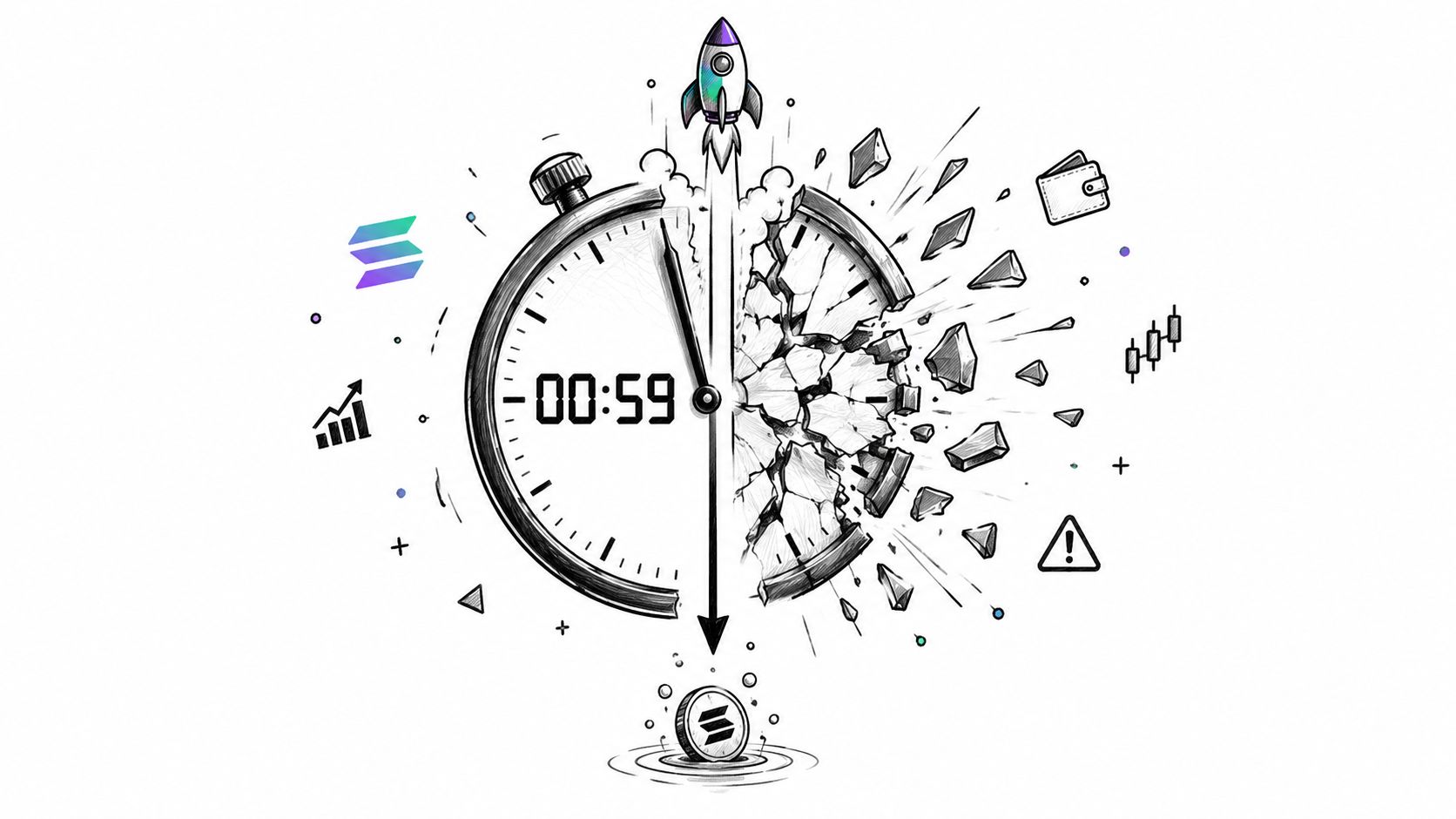
A 2025 study analyzing 6.4 million Solana tokens over seven months reported that most tokens showing rug-pull characteristics did so within the first hour, and that models using only the first five minutes of trading data could already detect potential fraud. That matters because the early phase is where mechanism, timing, severity, and victim exposure start to separate. A thin pool can fail fast, a coordinated sell can build more slowly, and the trader who enters late absorbs the damage.
Static checks can help, but they're not enough
Renounced authority, locked liquidity, and a verified contract are useful signals. They do not clear the token on their own, because insider buys, bundled wallets, rapid creator selling, artificial volume, and sudden liquidity shifts can appear after the basic checks pass.
Live behavior matters more than the launch page. If liquidity thins, holder concentration rises, or creator-linked wallets begin moving together, the token's risk profile has changed even if the branding still looks clean.
The practical conclusion is simple. On Solana, time is part of the security model. A one-time check can miss the exact window when the rug becomes visible.
For a closer look at the timing pattern, read how fast Solana memecoins rug.
The short walkthrough below shows what a first-hour liquidity drain looks like on-chain.
Seven Red Flags You Can Check Before You Buy
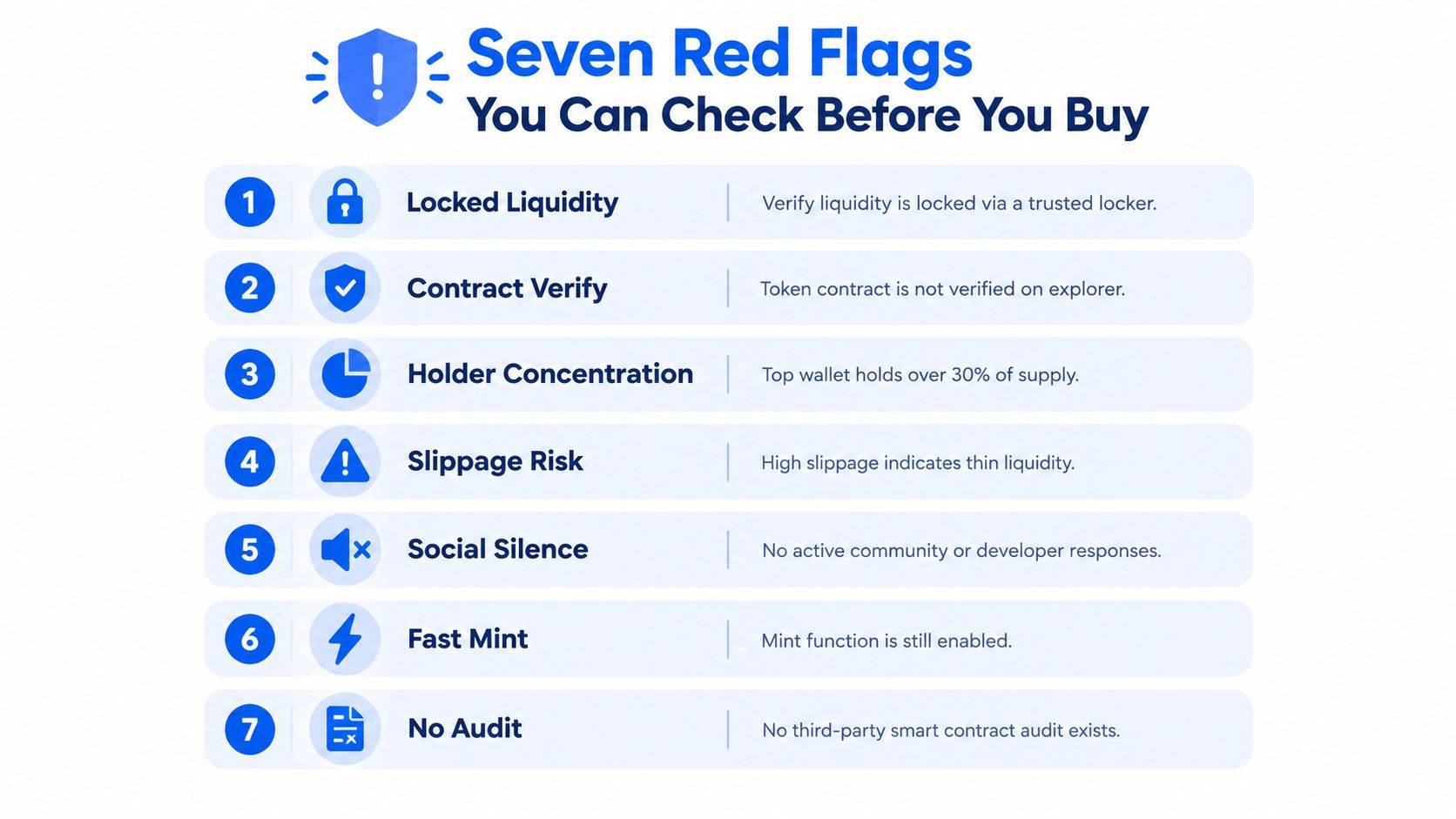
Start with liquidity depth and exit room
A token with thin liquidity can look active and still be hard to leave. If your planned position is large relative to the pool, you become part of the liquidity problem. The first question is simple, does the pool have enough real depth for ordinary selling, or will a small exit move the price sharply?
Trace top holders and wallet clusters
Balance tables can hide coordination. A cluster matters more than a single large holder when the same funding source, deployer-linked wallet, or synchronized buying pattern sits behind several “different” addresses. The creator-proximity pattern from the mechanics section is the reason analysts focus on linked wallets rather than raw holder counts. One useful example is a set of wallets funded from the same fresh source, buying within minutes of one another and then holding nearly identical balances.
Check creator history and prior deployments
A wallet that keeps launching short-lived tokens deserves more skepticism than one with a clean track record. Reused deployers, repeated liquidity events, and fast resets after previous launches point to a pattern of behavior, not a one-off failure. That history does not prove intent by itself, but it raises the odds that the same operator will act the same way again.
Verify authority and mint controls
If mint or freeze powers still exist, the team may still be able to change supply or restrict transfers. That does not confirm a rug pull, but it leaves a live control surface in place. A token can still trade while those controls remain active, so the risk is structural, not just cosmetic.
Watch for bundled or synchronized buys
Multiple wallets entering almost at the same time, especially from shared funding sources, often points to coordinated positioning rather than natural demand. The pattern becomes more concerning when it appears beside thin liquidity and a hype-heavy launch. The buying may look broad on a chart, while the underlying source of demand is highly concentrated.
Compare buy-to-sell quality
Volume can be manufactured. Repeated self-like transactions, trade sizes that look mechanically copied, and activity that never turns into durable bids all weaken the signal that real buyers are present. The useful question is whether people are willing to absorb supply after the launch rush fades.
Ask where liquidity moved
A planned migration to a known venue is different from a transfer to an unrelated wallet. An infographic titled Seven Red Flags You Can Check Before You Buy, listing common cryptocurrency investment risks. A liquidity move into an unexpected cluster, or into wallets that then stop behaving like a normal treasury, deserves a much closer look.
Practical rule: if two or more red flags show up together, stop treating the token like a normal speculative bet. You're now in evidence-gathering mode.
Frequency Versus Impact on Real Wallets
The biggest rug pull numbers do not show whether your own trade can survive. A 2025 analysis reported that the median Raydium rug-pull loss was about $2,832, while the largest identified case reached $1.9 million. Frequency and impact are separate risk dimensions. A token can be widely targeted and still leave one buyer with a manageable loss, or hit a small holder so hard that recovery is unrealistic.
That is why the label “rug pull coin” is too broad on its own. It tells you something went wrong, but not whether your position is frozen, partly recoverable, or effectively unrecoverable. Position size, pool depth, and how fast the exit happens all shape the outcome.
The Cambridge study documented 101 rug pulls across six DeFi service types and found that 23.8% of the studied projects stayed active for more than two years before rug-pulling. Longevity did not eliminate risk. A project can look established and still flip on buyers later.
What this means for the trader
A simple yes-or-no answer, rug or not, leaves out the parts that determine loss. You need to separate mechanism, timing, severity, and your own exposure.
- Mechanism: Was value removed, sold down, or abandoned?
- Timing: Did the risk appear in minutes, hours, or months?
- Severity: Is the pool shallow enough to make even a small exit costly?
- Exposure: Is your position small enough that you can still leave?
That framework is more useful than a meme-coin label because it matches how losses happen in practice. Traders do not lose money to categories. They lose money to execution.
How MemeAssist Scores a Rug Pull Coin
MemeAssist is built around live Solana token analysis, so it can score the things rug pull coins tend to hide. The report pulls from six evidence categories, liquidity, holder distribution and concentration, creator behavior, wallet activity, trading patterns including bundle and insider detection, and historical risk indicators, then turns that into a structured view instead of a raw wallet dump. It also runs without wallet connection, which matters if you don't want to expose signing access just to check a token.
The output is straightforward. You get an Overall Health Score, a Rug Risk Rating, a plain-English AI Verdict, and a Detailed Risk Breakdown, plus a Trade Setup that summarizes the risk and opportunity context in one place. That gives you a fast read on whether the token looks tradable, fragile, or structurally compromised.
Why live scoring matters
Cached snapshots miss the part where rugs happen. MemeAssist uses live on-chain and market data at the moment of analysis, then regrades flagged tokens over the next 24 hours so the score can move with the token instead of freezing at first sight. Public evidence visibility also lets users review the underlying checks later, which is useful when you want to audit the decision instead of just trusting a label.
The internal report format is designed for quick pre-trade checks, not just post-mortems. If you want to review the scoring workflow directly, this is the relevant page: MemeAssist risk score
A 60-Second Pre-Trade Checklist for Solana Meme Coins
Start with live evidence, not vibes. Pull a fresh report, read the Rug Risk Rating, and scan the Detailed Risk Breakdown for the three strongest signals. If liquidity looks thin, creator-linked wallets are active, and holder concentration is rising, the trade already has a structural problem.
Then compare the position size to the pool depth. If you can't exit without materially moving the market, your risk is higher than the token's sticker price suggests. The first-hour research also means you should re-check very new launches after a few minutes, because the profile can change fast once synchronized wallets or creator sells begin to show up.
A simple flow that holds up better than a gut check
- Read the live report first. Don't start with social posts or chart noise.
- Compare severity, not just labels. A high-frequency scam category doesn't mean your specific position is unrecoverable.
- Look for movement, not just conditions. Static checks are useful, but live behavior tells you whether the risk is getting worse.
- Re-check after launch if the token is new. The first minutes can reveal what the initial snapshot hid.
The point is to treat rug pull coin risk as a moving system, not a fixed badge. Treat severity separately from frequency, because the median loss and the worst-case loss aren't the same thing. Treat static indicators as necessary but never sufficient, because creator wallets and liquidity can change after the page looks clean.
If you want one more place to review the execution checklist itself, use this reference: MemeAssist trade check
If you trade Solana meme coins, use MemeAssist to check liquidity, holder concentration, creator-wallet behavior, and live trading patterns before you click buy. It's built for the exact problem this article covered, separating mechanism, timing, severity, and victim exposure so you can make a faster call on a token's real risk. Visit MemeAssist and run a pre-trade analysis on your next coin before the market moves without you.