What Is Verdict in MemeAssist: Understanding AI Analysis
Learn what is verdict in MemeAssist reports. Understand how AI generates verdicts alongside quantitative scores and risk data for Solana token analysis.
Published
Updated
A verdict is the plain-English AI narrative that interprets and contextualizes quantitative risk scores from live on-chain analysis. In MemeAssist, it sits beside the numbers so you can see not just the score, but the reason behind it.
You've probably seen a token with a decent-looking rating and still felt uneasy. Or a harsh risk score that didn't quite match the trading setup you were seeing on-chain. That gap is exactly where a verdict earns its place.
Table of Contents
- Understanding the Verdict Concept in Risk Analysis
- How the Verdict Is Generated from Live Data
- Interpreting the Verdict Alongside Quantitative Scores
- Example Verdict Phrases and What They Mean
- The Value of Narrative Context in Token Analysis
- Practical Checklist for Using Verdicts in Trading Decisions
- Conclusion - Mastering Verdict Interpretation
Understanding the Verdict Concept in Risk Analysis
A trader can stare at a Health Score and a Rug Risk label and still not know whether the token deserves attention, caution, or an instant pass. The number tells you where the analysis landed, but not why it landed there. A verdict fills that gap by turning the evidence into a readable conclusion.
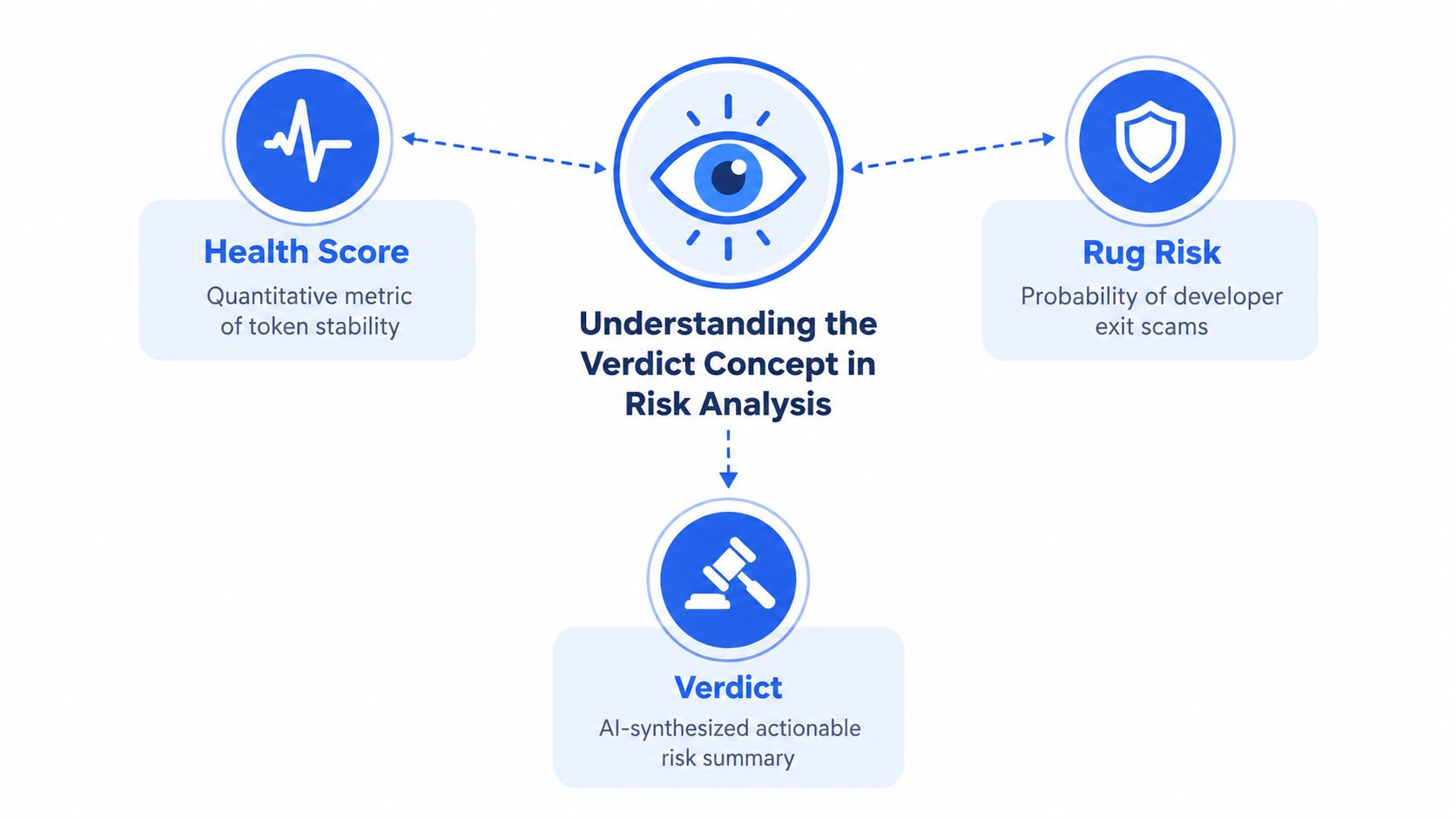
The score tells you the level, the verdict tells you the story
In legal terms, a verdict is the formal decision reached after the facts are weighed under the relevant rules, and that same idea translates well to trading risk analysis. The point is not just to label a token, but to show how the evidence supports that label. A score without explanation is like seeing a temperature reading without knowing whether the room is sealed, windy, or full of engines.
For Solana meme coins, that distinction matters. A token can show warning signs in liquidity or holder concentration, yet the broader pattern may still be unclear until the narrative ties those signals together. The verdict does that translation work, which is why it's more useful than a standalone label.
Practical rule: treat the score as the headline and the verdict as the rationale.
That's especially important when you're moving fast. A trader who understands the verdict can decide whether a score reflects a one-off anomaly, a repeatable scam pattern, or merely incomplete evidence. If you want the mechanics behind that workflow, the methodology is laid out in how MemeAssist AI analyzes Solana tokens.
Why traders misread numbers without narrative context
Numbers are efficient, but they're also blunt. A rug risk rating can be directionally useful and still leave the central question unanswered, which is whether the current behavior matches the kind of risk you genuinely care about. That's why a narrative verdict works better for decision-making than a score viewed in isolation.
The cleanest way to think about it is this. The score compresses the data, while the verdict restores the explanation. One is compact, the other is readable, and you need both if you're trying to decide whether to engage with a token or stay out.
How the Verdict Is Generated from Live Data
A verdict only works if it starts with live evidence. MemeAssist pulls from current on-chain and market data at the moment of analysis, so the conclusion reflects what is happening now, not a stale snapshot. That matters in token analysis, because creator activity, wallet flows, and trading patterns can shift fast around the same asset.
Two gates before the narrative is written
Before a verdict is formed, the evidence has to pass two related checks. The first is the burden of production, which asks whether there is enough reliable information to support any conclusion at all. If the data is thin, missing, or unusable, a concern should remain a concern, not a proven case.
The second is the burden of persuasion, which asks whether the combined signals are strong enough to support the final judgment. For traders, that separation keeps weak signals from being treated like firm ones. Missing evidence is not the same as positive evidence, and a cluster of correlated signals does not automatically create conviction.
A serious risk read begins by asking whether the evidence is sufficient, then asking whether it is convincing.
What the analysis looks at
The verdict is built from six evidence categories, liquidity depth, holder distribution, creator behavior, wallet activity, trading patterns, and historical risk indicators. Each category adds context, but none should be read alone. A concentrated holder base means something different when it appears beside suspicious wallet activity than when it appears beside broad, steady participation.
The narrative matters because it connects those pieces into one coherent statement. The score compresses the data, while the verdict restores the explanation. That turns separate checks into plain English, so you can move from observation to action without losing the evidence trail.
For traders who want direct interpretation rather than scattered signals, the output appears as a plain-English verdict alongside the scoring view. The workflow behind that approach is described in how MemeAssist AI analyzes Solana tokens.
Interpreting the Verdict Alongside Quantitative Scores
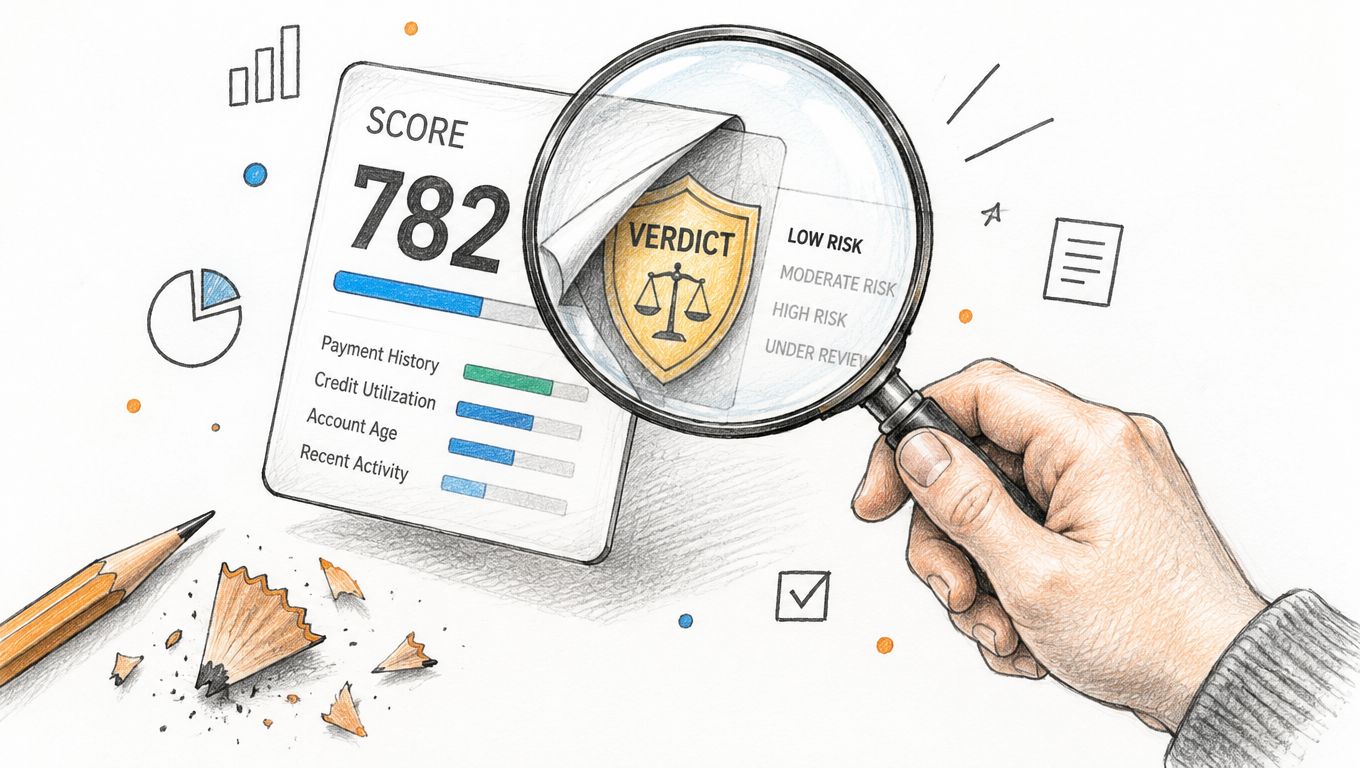
When a Health Score reads 62 and the verdict warns of concentrated holders, the score flags the condition while the verdict names the pattern. That difference matters because traders do not trade a number in isolation, they trade the reason the number exists.
A quantitative score compresses many signals into one output. The verdict turns that compression back into language you can act on. In practice, that is the gap between “something is off” and “holder concentration is likely driving the risk.”
How to read agreement and tension
When the score and the verdict point in the same direction, the read is usually simple. A strong score paired with a restrained narrative suggests the evidence does not justify aggressive confidence. A weak score paired with a negative verdict tells you the report sees a risk pattern worth respecting.
Mixed cases deserve more attention. A token can post a mediocre score and still receive a nuanced verdict if the evidence points to an unusual setup rather than a clean warning. That is often the point where traders misread the report, because the number feels blunt while the narrative shows where the pressure really sits.
The narrative also helps you separate structure from noise. A score may tell you the overall condition, while the verdict shows whether the issue comes from holder concentration, wallet behavior, or trading patterns. If you want to compare both views side by side, the meme coin risk score view keeps the summary and the explanation in one place.
Questions to ask every time
- What evidence is driving the verdict? Focus on the signals that shape the conclusion, not only the final label.
- Does the narrative explain the score? If the wording and the number feel disconnected, review the evidence breakdown more carefully.
- Is the language decisive or cautious? Decisive phrasing usually points to clearer patterns, while cautious phrasing often reflects thinner or mixed evidence.
- Would this still concern me if the score were a little higher? That question helps separate real structure from short-term noise.
The video below shows how to think about score interpretation in a practical workflow.
A good verdict does more than repeat the score. It explains why the score sits where it does, adds limits to the conclusion, or sharpens the read with context the number cannot carry on its own. Traders should pay close attention there, especially when the numeric result feels ambiguous.
Example Verdict Phrases and What They Mean
Verdict language usually falls into a few recognizable shapes. Some phrasing is blunt because the evidence is blunt. Other phrasing is more cautious because the report is dealing with incomplete or mixed observations.
Protective language
A strong warning usually reads as a clear risk signal rather than a polite suggestion. In trading terms, that kind of wording tells you the report sees enough concerning structure to discourage entry or demand much deeper review before any action. The tone matters because it reflects confidence in the pattern, not just discomfort with the token.
Balanced language
Balanced verdicts are the ones traders misread most often. They can acknowledge both opportunity and risk without pretending the situation is clean. That does not make them weak. It means the analysis found something real on both sides, and your decision has to account for that tension instead of flattening it into a yes-or-no answer.
Cautious language
Cautious phrasing often points to uncertainty in the evidence rather than uncertainty in the market. That distinction matters. A report can hesitate because the dataset is thin, the signals don't line up neatly, or the pattern isn't strong enough yet to justify a harder conclusion.
Read hesitation as a data problem first, not automatically as a bullish sign.
A trader who learns these language patterns gets faster at scanning reports. You start to see whether the verdict is acting like a stop sign, a yellow light, or a note that says more observation is needed. That makes the narrative far more actionable than a raw score alone, because the wording tells you how forcefully the evidence should be weighted.
The Value of Narrative Context in Token Analysis
Without narrative context, you're forced to stitch the evidence together yourself. That can work if you already have deep on-chain experience, but it creates drag and increases the chance of missing a critical pattern. A verdict centralizes that reasoning so the evidence reads like a case, not a pile of fragments.
The same problem appears in legal settings. Facts matter, but facts without a structured conclusion don't help much until they're interpreted under a rule set. Risk analysis works the same way, especially when the question is not just whether something looks odd, but whether the oddness is meaningful enough to trade on.
Why context matters more when signals conflict
Conflicting signals are common in token analysis. Liquidity can look acceptable while wallet behavior looks strange. Holder concentration can appear high while trading activity looks active enough to distract from the risk. A narrative verdict helps separate cosmetic activity from structural quality.
That becomes even more useful in a single-chain workflow where the analyst is looking closely at Solana-specific patterns rather than trying to generalize across chains. MemeAssist combines live data ingestion with a self-grading process that revisits flagged tokens over a 24-hour tracking period, which helps refine the analysis over time. The result is a narrative that's designed to explain what the data is doing, not just what the score says.
For a closer look at the token-level narrative angle, see Solana memecoin narratives.
When the verdict should be treated as preliminary
A verdict is strongest when the evidence is broad, current, and internally consistent. It should be treated more cautiously when the underlying observations are incomplete, highly correlated, or pulled from a narrow slice of activity. In those cases, the narrative still helps, but it should be read as a provisional judgment rather than a final one.
That honesty is part of the value. A good verdict doesn't pretend certainty where the data doesn't support it. It gives you the best current reading, then leaves room for better evidence to change the conclusion.
Practical Checklist for Using Verdicts in Trading Decisions
Start with the numbers, but don't stop there. A sensible workflow begins with the Health Score and Rug Risk rating, then moves into the verdict to understand why those labels appeared. After that, the detailed breakdown should be used to check whether the explanation matches the evidence you care about.
A simple decision path
- Read the score first. Get the quick signal before you dive into detail.
- Read the verdict second. Look for the reasoning, not just the label.
- Verify the evidence breakdown. Make sure the narrative isn't leaning on a single weak signal.
- Check the trade setup context. Use it to understand the practical implications, not just the risk label.
- Decide according to your own tolerance. A cautious trader may pass on a mixed report, while another may continue researching before acting.
What to do with disagreement
If the verdict conflicts with your first impression, slow down. That conflict is usually a cue to inspect the underlying signals more carefully, not to dismiss the report. Traders often ignore the narrative when it challenges a preferred setup, then regret it later when the pattern was already visible.
If the verdict is clearly warning you, treat it as more than decoration. If it is merely cautious, keep researching until the evidence becomes clearer. And if it is confident but the evidence feels thin, that's a reason to question completeness before you question the conclusion.
Practical rule: use verdicts to reduce false confidence, not to replace judgment.
MemeAssist also tracks flagged tokens over a 24-hour post-flag period, which can help you judge whether the initial reading stays consistent as more information comes in. That makes the verdict useful both as a point-in-time summary and as part of an ongoing review process.
Conclusion - Mastering Verdict Interpretation
When a report gives you a score and a verdict, the useful part is how they work together. The score gives the quick read, like a market snapshot. The verdict explains why that reading exists, so you can judge whether the signal deserves trust, caution, or more research.
A trader who focuses only on metrics sees a number. A trader who reads the verdict sees the reasoning behind it, the evidence pattern, and the level of confidence. That matters when a token looks quiet on the surface but still carries a risk profile that changes the trading decision.
Read the score first, then read the verdict, then check the evidence behind it. Use that sequence to separate a clean setup from a noisy one, and to decide whether the report supports action, restraint, or another pass through the chart and chain activity.
MemeAssist brings the Health Score, Rug Risk, Verdict, and Detailed Risk Breakdown into one Solana token report, so the rating and the explanation stay side by side. That makes each report more useful as a decision aid, not just a dashboard check.