AI Crypto Trading Explained: Strategies, Risks and Tools
You're watching a new token climb on your phone, someone in a chat posts a bot dashboard showing smooth, steady gains, and you wonder what's behind that screen. Is the software really smarter than the market, or is it just drawing a confident line through noisy data? That's the right question to ask about AI crypto trading, because a prediction is only one link in a longer chain. The data feeding the model can be manipulated, the trade can cost more than the forecast earns, and the product using AI as a label may not trade at all. Understanding each link helps you judge a tool on evidence, not on its charts.
Table of Contents
- What AI Crypto Trading Actually Does
- The Five AI Approaches Behind Crypto Trading Tools
- What the Research Says About AI Trading Returns
- Manipulated Volume and Thin Liquidity Mislead Models
- Why Backtests Diverge from Real Trading Results
- Spotting Scams and Judging AI Trading Products
What AI Crypto Trading Actually Does
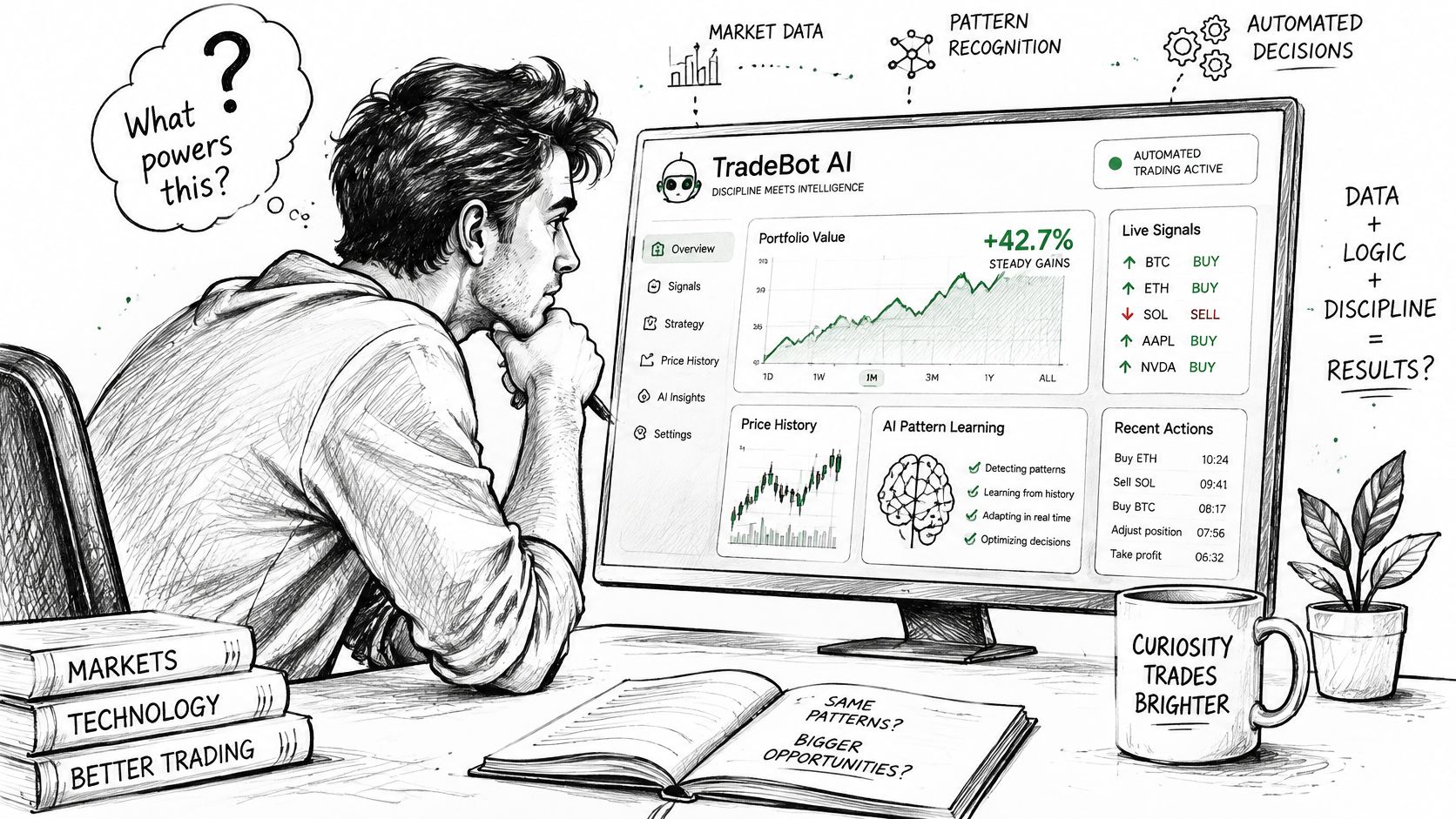
Say a trader opens a bot dashboard that promises steady gains and shows a token scored 82 out of 100. AI crypto trading means software that learns patterns from market data and turns them into scores, signals, or orders. Think of a weather forecast. It can estimate the chance of rain, but it doesn't decide whether you carry an umbrella, cancel a trip, or ignore it. The trader still chooses, based on cost and risk.
Three levels of automation
- Analysis tools: These score a token's risk from live data and explain the evidence, but they don't place trades.
- Decision-support systems: These rank opportunities for a human to review, compare, and approve or reject.
- Fully automated bots: These place orders with no human check, so a bad signal becomes a real position immediately.
Most retail users sit at the first two levels. Their tools read price and volume history, order book snapshots, on-chain transfers, wallet clusters, holder lists, and news or social text. Use is already common. In 2025, 36.6% of surveyed retail crypto participants said they already used AI tools to assist with trading, while 28% planned to adopt them soon, in a global survey conducted by crypto trading platform Tothemoon and reported by Finance Magnates.
The benefits are practical. Software can scan many tokens faster than a person, apply the same rules every time, and reduce some emotional decisions. The risks sit outside the model itself. They include biased training data, fake volume, execution slippage, and AI-branded scams. A model's output is one input to a decision, not the decision itself.
The Five AI Approaches Behind Crypto Trading Tools
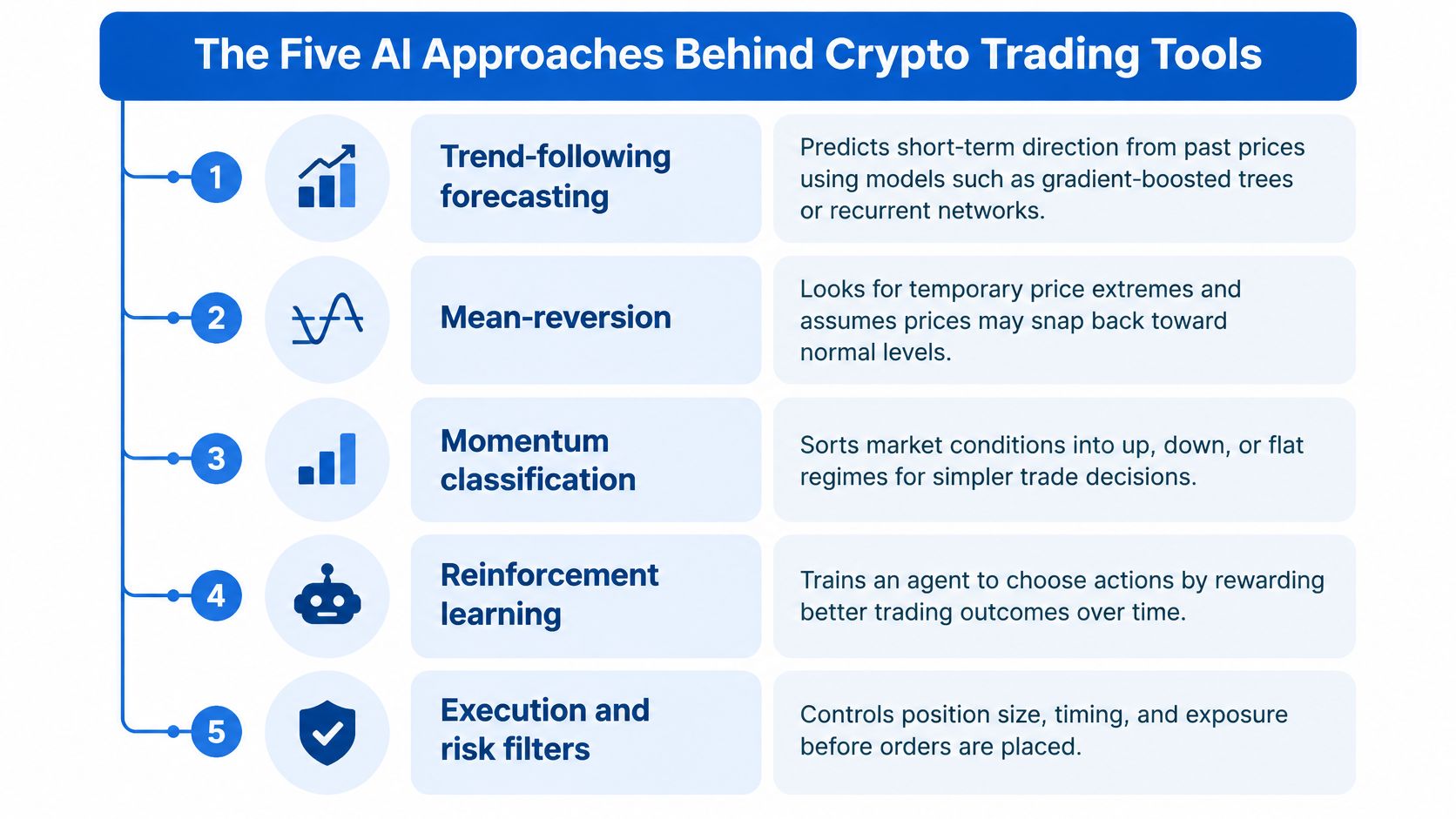
Different products use AI for very different jobs, and the label on the homepage rarely tells you which one drives the output. This comparison sets out the main families you'll meet.
| Approach | What the model does | Data it relies on | Main weakness |
|---|---|---|---|
| Trend-following forecasting | Predicts short-term price direction from past prices | Candles, volume, order book snapshots | Breaks when regimes shift or volume is inflated |
| Sentiment analysis | Scores social posts and news for bullish or bearish tone | Posts, chat groups, news feeds | Easy to distort with bot-generated chatter |
| Arbitrage and market making | Exploits price gaps between venues or quotes liquidity | Live quotes across exchanges and pools | Margins shrink to fees, latency and slippage |
| Reinforcement learning agents | Learns a buy-or-sell policy through simulated episodes | Historical or simulated market data | Overfits the simulation and is hard to audit |
| Anomaly and risk detection | Flags unusual wallet, holder and trading patterns | On-chain transfers, holder lists, trade records | Warns of risk but does not forecast price; false positives |
The diagram below groups these approaches so you can see how they relate to each other.
Models that predict or act
Trend-following forecasting models, often gradient-boosted trees or recurrent networks, learn from past prices and volume. They work until market behavior changes. A model trained in a calm, rising market can keep predicting continuations after conditions turn choppy, and inflated volume makes weak moves look strong.
Sentiment analysis reads posts, news, and chat groups and scores tone. That's useful context, but it's easy to game. Coordinated accounts can flood a token's mentions with bullish phrases, and the model may read manufactured excitement as genuine demand.
Arbitrage and market-making systems chase small gaps between venues or earn fees by quoting prices. Their edge is thin by design. Fees, latency, and slippage can consume the whole gap before an order fills, especially for a retail user competing with faster infrastructure.
Reinforcement learning trains an agent through simulated trading episodes, rewarding actions that performed well in the simulation. The agent can memorize quirks of that simulation rather than learn transferable judgment. When it acts oddly in live markets, even its builders may struggle to explain why.
This short video shows how these model families fit into a typical trading workflow.
Models that detect danger
Anomaly and risk detection does something different. It flags unusual wallet behavior, concentrated holders, or abnormal trading patterns. It doesn't forecast price, and it produces false positives, warning about tokens that turn out fine. Its value is narrower and more honest. It tells you where to look before you buy.
The first four approaches try to predict or act. The fifth tries to detect danger. Confusing those jobs leads traders to treat a risk warning as a price target, or a price forecast as a safety check.
Many commercial products combine several approaches. A dashboard might use sentiment for ranking, forecasting for timing, and risk detection as a filter. Ask which component produces the headline score, because each component fails in a different way.
What the Research Says About AI Trading Returns
The honest answer is that the evidence is still developing. AI-based crypto trading isn't a reliably proven source of excess returns, and anyone selling certainty is getting ahead of the published record.
A 2024 systematic literature review of 143 research articles on artificial-intelligence techniques in financial trading found that only 16% described systems that fully automated the trading process. Most work stopped at prediction or analysis. That gap matters, because predicting a move and profiting from it after costs are different achievements.
A coverage bias toward large assets
Cryptocurrency research in that review concentrated heavily on large, liquid assets. Bitcoin appeared in 19 studies, Ethereum in 9, and Litecoin in 8. Those markets have deep liquidity, long price histories, and relatively complete data.
A newly launched meme coin has none of those advantages. Its pool may be thin, its holders few, and its trading history measured in hours. In that setting, slippage, holder concentration, manipulation, and missing data can dominate whatever pattern a model thinks it sees. A strong backtest on Bitcoin therefore says little about a small token, even if the same model architecture is used.
Three questions for any published result
- Which asset and period: Was the test run on a deep, liquid market during one favorable stretch, or across varied conditions?
- Were costs included: Does the reported return subtract fees, spread, and price impact, or does it assume free trading?
- Was the test out of sample: Did the model trade data it had never seen during training, in chronological order?
Consider two claims that look similar on a sales page. One shows a backtest on a major pair with costs excluded and the training and test data shuffled together. The other shows a smaller, messier live record on a small token, with losing trades included and costs deducted. The second claim is less exciting and more credible. It faced the conditions you'd face.
Practical rule: Treat AI as a decision-support layer, not a profit guarantee. Prediction is one component of decision quality, alongside execution conditions, liquidity, holder structure, and abnormal trading behavior.
That framing isn't pessimism. It's how you keep a useful tool from making promises it can't keep.
Manipulated Volume and Thin Liquidity Mislead Models
Many AI strategies treat volume as proof of demand. More trading should mean more interest, so a volume spike pushes the score up. The problem is that volume can be manufactured, and a model reading the feed can't always tell the difference.
A study of cryptocurrency trading activity reported by Cornell researchers examining Bitcoin, Ethereum, Litecoin, and Ripple found that more than 70% of trading activity on unregulated exchanges was detected as potentially fabricated wash trading, estimated at more than $1 trillion in transaction volume per month. Wash trading means offsetting purchases and sales, often between linked accounts, designed to create artificial activity. No genuine demand changes hands, but the chart looks busy and liquid.
Signals that deserve a second check
| Signal | Misleading case | What to check |
|---|---|---|
| Volume spike | Wash trades between linked wallets | Unique buyers and liquidity depth |
| Holder concentration | A few wallets hold most supply and can sell together | Top-holder share and locked supply |
| Thin liquidity | Small orders move the price sharply | Pool depth against your intended order size |
| Bundled early buys | Many wallets buying in the same block | Whether buyers were funded from one source |
| Creator behaviour | Creator can remove liquidity or mint more supply | Mint and freeze authorities, liquidity lock status |
On Solana, a token can be launched, promoted, and abandoned quickly. Creator wallets, bundled early purchases, and concentrated holdings can make a rising chart look like organic discovery. If a few linked wallets hold most of the supply, they can also sell together and remove the exit you assumed was there. Our guide on how to detect wash trading on Solana walks through the wallet-level checks behind the table above.
A worked example
Say a token's reported volume triples overnight and a trend model upgrades it. You check two other numbers. The count of unique buyers barely moved, and liquidity depth in the pool is unchanged. Real new demand usually brings new wallets and deeper books. Flat buyer counts with tripled volume point to the same wallets trading with each other. The model saw activity. The cross-check shows it probably wasn't demand.
Thin liquidity adds a second trap. In a shallow pool, your own order moves the price against you, so the entry price on the chart isn't the price you receive. Cross-check every volume-based signal against holder and liquidity data before acting. A signal that survives that check is worth more than a louder one that doesn't.
Why Backtests Diverge from Real Trading Results
A backtest can show a profitable signal while a live order loses money. The reason is simple: a simulation often assumes a trade fills at the historical price, while real execution involves costs, delays, and price impact.
The diagram below shows five places where the gap between backtested and live results can open.
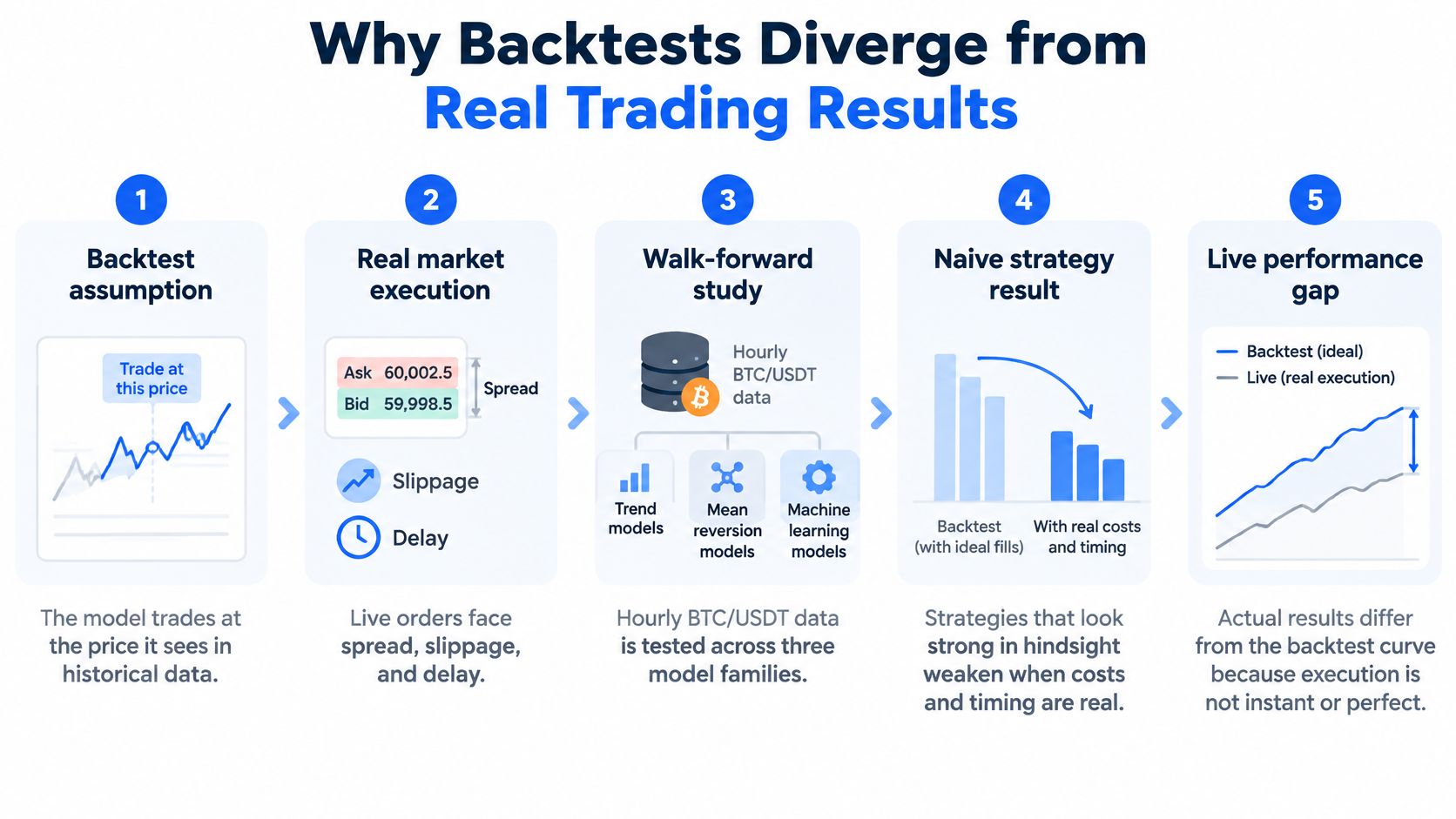
A walk-forward study of about 70,000 hourly BTC/USDT observations from 2018–2026 tested XGBoost, LSTM, and iTransformer models across 27 sequential test folds. Several configurations showed positive gross performance, but simple strategies that traded whenever predicted returns were positive or negative failed after applying an assumed transaction cost of 10 basis points. Small forecasted moves may not cover the cost of making each trade.
A cost-aware filter improved results in selected configurations by trading only when the forecast was large enough to clear expected costs. This reduced trading frequency, but the strongest result still depended on the model, period, and rules. It was not a general promise of profitability.
Where the money leaks on thin pools
For Solana meme coins, execution costs can take several forms:
- Spread and price impact: Buying into a shallow pool pushes the price up as the order fills.
- Priority fees and slippage: During a busy launch, higher fees may be needed to land a transaction, while the price can move before it confirms.
- Sandwich-style manipulation: Traders may position themselves around a pending transaction, reducing the value you receive.
Live trading exposes these frictions, so intended and executed prices can diverge more than a backtest suggests. A forecast can be directionally right and still lose after execution costs. The guide to Solana memecoin trade setups versus backtesting explains how conditional price levels differ from historical simulations.
Three reporting standards to demand
- Separate gross and net returns. This shows how much fees and other costs reduce performance.
- Use realistic impact assumptions. They should reflect the order size and pool depth being tested.
- Validate in chronological order. Walk-forward testing better reflects how a strategy would have been developed and tested over time than randomly shuffled data, which can leak future information into training.
MemeAssist reports may include a conditional trading scenario when the token's current price structure supports one. These scenarios are analysis, not trading instructions, and do not predict a certain outcome or guarantee execution at the displayed price.
Spotting Scams and Judging AI Trading Products
Some AI trading products aren't bad tools. They aren't tools at all. The U.S. SEC, NASAA, and FINRA investor alert on artificial intelligence fraud warns that fraudsters increasingly use claims about artificial intelligence and emerging technologies to market investment scams. SEC enforcement allegations describe schemes in which operators promoted supposed AI-generated trading signals or rented AI bots through messaging groups, displayed fictitious profits, and demanded additional payments before withdrawals. In the alleged cases, no genuine trading occurred.
That pattern is worth memorizing. The dashboard shows gains, the group chat celebrates, and the first real test comes when you try to withdraw. Suddenly there's a fee, a tax, or a minimum balance required to access your own money. AI branding itself is not evidence that a service exists or is legitimate.
Red flags you can spot quickly
- Guaranteed or unusually high returns: No model can promise these in volatile markets.
- Unverifiable balances: Profits exist only inside the operator's own dashboard.
- Pressure to pay in cryptocurrency: Especially payments demanded before a withdrawal is released.
- Signing requests: You're asked to sign transactions or grant wallet permissions just to view an analysis page.
Three checks that take under ten minutes
First, confirm that claimed trades appear in exchange or blockchain records you can inspect yourself, not only in screenshots. Second, test a small withdrawal before depositing more, and treat any new payment demand as an answer. Third, ask who controls custody. If the operator holds your funds and can't explain withdrawal controls clearly, the model's quality is irrelevant.
Our walkthrough on how to detect a Solana meme coin scam applies the same suspicion to the tokens themselves, covering creator behavior and liquidity tricks.
A seven-criterion checklist for any product
| Criterion | Strong sign | Red flag |
|---|---|---|
| Results basis | Live or forward-tested results reported net of costs | Backtest curves with no cost assumption |
| Evidence visibility | Reports show the checks behind each score | Scores with no visible inputs |
| Outcome tracking | Flags compared with later token outcomes | No record of flagged tokens afterwards |
| Custody | No wallet connection or signing requests | Asks you to sign or grant permissions to see analysis |
| Payment terms | Clear per-action pricing and stated terms | Guaranteed returns or pressure to pay in crypto to unlock trades |
| Scope | Clear about which chains, assets and data it covers | Claims to predict any coin on any chain |
| Risk language | States that outcomes are not guaranteed and capital can be lost | Promises certainty or unusually high returns |
Outcome tracking deserves emphasis because it's the only way to show calibration. Any tool can flag tokens with confidence. Comparing those flags with what the tokens did afterwards separates a measured signal from persuasive narration. We compare our signals with subsequent trading activity and observed token outcomes to evaluate their reliability, and that record is exactly what you should ask every provider to show.
Separate model capability from platform integrity. A brilliant model inside a dishonest platform still loses your money, just through a different door.
Use MemeAssist as one Solana-focused example to test against the checklist, not as an exemption from it. Our reports publish the checks behind each score, track flagged tokens for 24 hours, and require no wallet connection. Verify each of those claims the same way you'd verify a rival's, by running an analysis and inspecting the evidence yourself.
Two limits apply to every tool in this category. Analysis is not financial advice, and meme coins can go to zero, including ones that pass every screen today. A clean report lowers specific, identifiable risks. It can't remove the risk of the market itself.
So run the checklist before you commit money to any AI trading product. Record the answers in writing, including the ones a provider couldn't give you. Only then decide how much capital, if any, the evidence justifies risking.
Before your next trade, put the checklist to work on a live token. MemeAssist analyzes Solana meme coins across liquidity, holder distribution, creator behaviour, wallet activity, trading patterns, and historical risk indicators, then shows the evidence behind its health score and rug risk rating with no wallet connection required. Run your first full analysis at MemeAssist and judge the output against the same standards you'd apply to any AI trading tool.
Topics: AI crypto trading, crypto trading bots, algorithmic crypto trading, AI trading risks, AI trading tools
Informational only, not financial advice. Meme coins are extremely high-risk.
All articles