Key Learnings
- 01Eight checks: mint identity, authorities, Token-2022 controls, liquidity, early supply, creator history, trading quality and sellability. Wallet-link safety is a separate check before signing.
- 02In a published historical cohort through 31 August 2026, 486 of 914 High-risk observations had dead-pool outcomes (53.2%), versus 294 of 2,169 Low-risk observations (13.6%). These are not proven-scam rates.
- 03A separate concentration study observed 24-hour dead-market rates of 2.0%, 7.4% and 70.6% across three displayed top-10 holder bands. These selected historical observations do not establish a universal safe cutoff.
A Solana meme coin scam is not always an obvious fake token. It can be a lookalike mint promoted under a real project's name, a token with hostile transfer controls, removable liquidity, or insiders selling supply that looks dispersed across wallets. A malicious claim page is another threat entirely: it can steal assets through what you sign, even if the token you were researching is real.
The useful question is not “does this coin look legitimate?” It is “what can I verify, what can someone still control, and what evidence is missing?” This guide gives you a repeatable checking process, explains where MemeAssist can help and uses our own dated research without turning every failed token into a proven scam.
The quick Solana meme coin scam checklist
Start without connecting a wallet. Copy the token's exact mint address from independently verified sources, open it in an explorer and review the evidence before considering any transaction. Do not follow a scanner link supplied by an unsolicited “support” account.
| Check | What you need to establish | Where to investigate |
|---|---|---|
| 1. Mint identity | You have the intended token—not a copied name, ticker or logo. | Independently verified project channels, Solscan and the exact mint in the MemeAssist report. |
| 2. Authorities | Who can issue more supply or freeze token accounts? | Explorer mint details and MemeAssist's authority findings. |
| 3. Token-2022 controls | Can hooks, fees, delegates or other controls interfere with transfers? | Parsed extension data, authority state and the report's warnings. |
| 4. Liquidity | Which market is active, how deep is it, and who can withdraw liquidity? | The actual pool or bonding curve, its positions or lock evidence, and report liquidity context. |
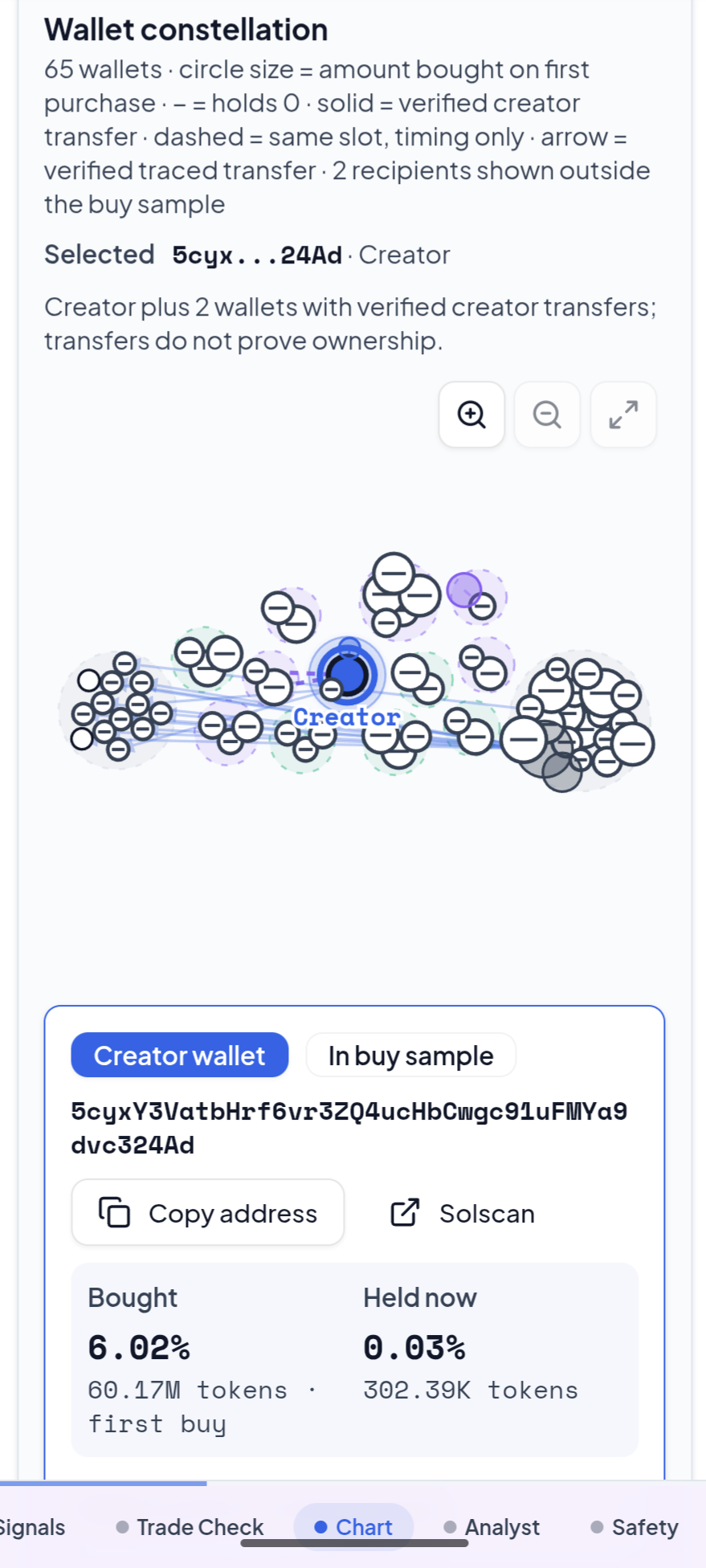
| 5. Early supply | Who bought first, what do they still hold, and where did transferred tokens go? | Holder data, transactions and MemeAssist's creator investigation and wallet constellation where supported. |
| 6. Creator history | Is the creator identity directly verified, and what do earlier launches actually show? | Creation evidence, linked transactions and available creator-history findings. |
| 7. Trading quality | Does apparent demand make sense alongside liquidity, holder change and wallet activity? | Trading history, chart evidence and the report's flow and wallet findings. |
| 8. Sellability | Is there a usable route for your intended size, and what could you receive? | A supported size-specific quote, transaction evidence and MemeAssist's optional Exit Liquidity Check. |
Separately check the website and every signing request. A clean token report does not certify a project website, claim page or transaction. Missing coverage means “not established”, not “passed”.
How to perform the eight Solana scam checks
1. Verify the exact mint—not just the meme, ticker or logo
On Solana, the mint address identifies the token. The name, image and symbol do not: another mint can copy all three. A pool address, wallet address or LP-token mint is not a substitute for the token's own mint.
Compare the full address across an independently verified project source, the explorer and the token you are about to research or trade. Do not rely on matching the first and last few characters. Be particularly cautious with viral replies, paid search ads, celebrity claims and newly created “official” groups; even a genuine social account can be compromised.
In MemeAssist: paste the verified Solana mint into the analyser and confirm the report is for that same address. The report analyses the supplied token; it does not prove an account, celebrity or brand endorses it. If the mint does not match, stop investigating the lookalike as though it were the intended token.
2. Inspect mint authority and freeze authority separately
Mint authority can authorise additional token issuance. Freeze authority can freeze token accounts and prevent their tokens from moving. Revoking one does not revoke the other. Solana's authority documentation explains that setting an authority to None permanently removes that role.
For an ordinary speculative memecoin, unexplained issuance or freeze powers deserve serious attention. Find the current authority value, not just a promotional claim that “ownership is renounced”. That generic EVM phrase is not a complete Solana token-authority check.
In MemeAssist: mint and freeze checks are included in a full analysis. Read the finding and its context in the Detailed Risk Breakdown, then verify significant warnings on an explorer. An authority is a capability, not proof that its holder has committed fraud; an unreadable authority is not verified revocation. Our Solana authority and liquidity guide explains the mechanics.
3. Check Token-2022 controls—not just the token-program label
Token-2022 is not itself a scam signal. It supports legitimate extensions, but some controls change what a holder can do. Look for active transfer hooks, transfer-fee settings and their change authorities, permanent delegates, default-frozen accounts, pausing or non-transferability where applicable.
A transfer hook runs additional program logic during transfers. It can reject a transfer, and integration problems can also cause failures. A hook's current program, its update authority and any program upgrade controls matter; its behaviour is not established by a single extension badge. An explicitly disabled hook with a remaining activation authority is different from a currently active hook—and different again from unreadable state.
In MemeAssist: read any extension and sellability warnings together. Do not turn “extension present” into “confirmed honeypot”, or absent data into “no extension”. Confirm current controls for unfamiliar tokens using the Token-2022 reference and transfer-hook integration guide.
4. Identify the active market and verify its liquidity controls
A large market capitalisation or fully diluted valuation is not cash available for sellers. Find where the token actually trades, inspect usable liquidity and establish whether someone can remove the liquidity supporting that market.
Do not apply one “LP burned” rule to every Solana venue. A bonding-curve launch may not yet have the migrated AMM pool a scanner expects. A migrated token may have several pools. Raydium's standard constant-product pools use fungible LP tokens, while concentrated-liquidity positions use position NFTs. A lock claim must match the actual pool or position, cover a meaningful share and have a verifiable duration.
Even “burn” needs context: Raydium's Burn & Earn documentation describes permanent escrow, not destruction of the position. A redemption transaction that burns LP tokens while withdrawing assets is not evidence that liquidity stayed permanently locked.
In MemeAssist: use the liquidity findings as a starting point, then verify the pool-specific evidence. Unknown pool coverage is not a confirmed liquidity rug. Burned or locked liquidity can restrict withdrawal of the covered liquidity; it cannot stop holders dumping their tokens, guarantee trading depth or secure every other pool. See the manual Solana rug-check workflow.
5. Trace early buyers, concentration and onward transfers
A holder list answers who holds tokens now. It does not, by itself, show who acquired the supply at launch or whether an emptied wallet sold, transferred or split its tokens into new wallets.
Exclude verified pool and program custody when interpreting ordinary holder concentration. Inspect large first purchases, early buyer exposure, current balances and supported transfer paths. Keep the denominator and time clear: a share of original minted supply is not automatically comparable to a share of today's circulating or remaining supply.
In MemeAssist: the supported creator investigation and early-buy wallet constellation help you compare initial purchases with current holdings and inspect wallet evidence. A same-slot group shows timing; a shared signed transaction shows co-execution. Neither automatically proves common ownership. Even common funding can come from a shared exchange or service. Read how to interpret a bundled launch and holder concentration before making an accusation.
6. Verify creator identity before judging creator history
The transaction fee payer, launch sponsor, first buyer and token creator can be different wallets. A scanner attaching a poor history to the wrong wallet can produce a convincing but false accusation.
Start with direct launch evidence identifying the creator. Then distinguish verified earlier launches from lookalike names, shared infrastructure or unverified funding links. A previous dead market is relevant history, but a failed project alone does not establish deliberate fraud. A creator with no recorded history may simply be new or outside the available coverage.
In MemeAssist: available creator-history findings are included in the report. The separate creator wallet investigation can provide deeper supported launch evidence and buyer analysis; it has its own availability and charging terms. Inspect the evidence rather than treating “no history found” as a clean bill of health. Read how to investigate a Solana token creator.
7. Compare trading activity with liquidity and holder behaviour
Rising price, high volume, a trending badge and a busy Telegram group are not independent proof of genuine demand. Inspect repeated trade sizes, concentration of activity in a few wallets, buy/sell balance, available holder change and whether the market has enough liquidity to support the apparent interest.
There is no universal volume-to-holder ratio that proves wash trading. Market makers, arbitrage and launch bots can produce repetitive activity without establishing fraud. Transfers between related accounts also need to be distinguished from actual purchases and sales.
In MemeAssist: review trading-pattern and wallet-activity findings alongside liquidity, holder distribution, creator behaviour and historical risk indicators. Those are the six signal categories behind the report—not six independent guarantees. Use our wash-trading guide for a closer investigation. Social momentum can explain attention; it never cancels a token-control warning.
8. Assess sellability for the size that matters
A honeypot-style trap lets buyers acquire a token while restricting their exit. Review current transfer controls, independent sell transactions and a usable sell route for the intended size. Other wallets selling is useful evidence, not a guarantee that your account, amount and route will work.
In MemeAssist: the optional, separately charged Exit Liquidity Check provides a supported position-sized sell quote and its limitations. Read expected proceeds, price impact and warnings—not only the displayed token price. You do not need to make a test purchase just to research the token.
A quote is not a completed transaction or a guaranteed fill. Conversely, “no route” can reflect tiny trade size, thin liquidity, pool migration, unsupported routing or provider problems as well as hostile token controls. Do not fix an unexplained failure by repeatedly raising slippage or signing prompts from strangers. Follow the Solana cannot-sell troubleshooting guide and the honeypot evidence guide.
What MemeAssist's own data says about the warning signs
Research is more useful when it tells you which warnings related to later outcomes—not just which flags sound alarming. MemeAssist records analysis-time observations and tracks subsequent outcomes, allowing evidence-led review. These historical studies assess associations, not whether every failed token was a scam.
Severe risk warnings separated a worse historical cohort
A published snapshot through 31 August 2026 contained 3,971 resolved observations with a recorded Rug Risk Score:
| Recorded risk band | Resolved observations | Dead-pool classifications |
|---|---|---|
| High (75–100) | 914 | 486 · 53.2% |
| Medium (30–74) | 888 | 121 · 13.6% |
| Low (0–29) | 2,169 | 294 · 13.6% |
The observed High-band dead-pool rate was approximately 3.9 times the Low band's. The useful takeaway is to investigate severe warnings—not to call 53.2% of tokens proven scams. Medium and Low did not form a clean return ladder, and all three bands had negative average returns.
Limits: selected historical analyses, not a random market sample or a test of today's exact model. Missing and unresolved outcomes were excluded; this study assigned dead pools −100%. No confidence intervals or significance tests were calculated. Public row-level records are unavailable and records were not manually verified one by one. Read the complete risk-score outcome study.
Concentration mattered—but the data does not create a safe cutoff
A separate study joined 3,779 resolved observations from 22 July–24 August 2026 to analysis-time concentration flags. Its displayed top-10 non-pool holder bands showed:
| Top-10 non-pool share at analysis | Resolved observations in band | Observed 24-hour dead-market rate |
|---|---|---|
| 30–44% | 559 | 2.0% |
| 45–64% | 486 | 7.4% |
| 65%+ | 513 | 70.6% |
That is a reason to investigate heavy concentration, not a rule that “under 30% is safe”. These are selected, unadjusted observational bands, not validated trading thresholds or fraud probabilities. Missing-outcome counts were not retained; repeated analyses could not be adjusted for, statistical uncertainty was not quantified and public row-level records are unavailable. The displayed bands are only part of the cohort. This study and the risk-score study may overlap and must not be added as independent samples. See the full concentration study and limitations.
"Verify the mint, understand who can change the rules, trace the supply and check the exit. A green score is not a substitute for those answers."
How to run the checks in MemeAssist
- Verify the mint independently, then open the MemeAssist analyser. Eligible new accounts receive one free full analysis; no card or wallet connection is required at signup. Further analyses use prepaid credit.
- Read the four outputs together. Start with the Overall Health Score, Rug Risk Rating, AI Verdict and Detailed Risk Breakdown. Inspect the authority, liquidity, holder and creator findings behind them, including missing or unavailable evidence.
- Investigate the important uncertainty. Use supported wallet evidence or the separate creator investigation for early supply; a separately charged Exit Liquidity Check for size-specific sell context; or optional Ask the Analyst questions grounded in the report. An AI explanation is not a substitute for a missing transaction.
- Revisit dated evidence. Compare saved analyses when supported. Optional monitoring and alerts can help follow changes, but cost separately and may be delayed; they are not continuous certification. Reopening a saved report is free, while a fresh analysis is a separate action after applicable free benefits.
Every full analysis checks for a conditional Trade Setup when price structure supports it. A setup is not a safety override: attractive targets cannot neutralise hostile controls, concentrated exposure or an unverified mint. See how MemeAssist's analysis works, current pricing and whether the combined research workflow suits you.
Four shortcuts that can produce the wrong verdict
| Shortcut | What it misses | Better question |
|---|---|---|
| “Mint revoked and LP burned, so there is no remaining risk.” | Existing insider supply, other pools, hostile controls and ordinary market collapse. | Who can sell how much, into which liquidity, under which current controls? |
| “Twenty wallets bought together, so one scammer owns them.” | Timing or co-execution does not establish beneficial ownership. | What funding, transaction and transfer evidence supports the claimed connection? |
| “The early wallet is empty, so it has no exposure.” | Tokens may have been transferred onward rather than sold. | Where did the supply move, and which balances are still attributable? |
| “No sell route means confirmed fraud.” | Migration, unsupported markets, dust amounts and provider failure can also prevent a quote. | Do current token controls and transaction evidence explain the failure? |
A large price decline alone is not proof of fraud. Neither is a new creator, anonymous team or paid promotion. Those facts can justify more scrutiny, but specific accusations need specific evidence. Equally, lack of proof of fraud is not proof of safety.
If you already hold the token—or signed something suspicious
First separate a token-market problem from a wallet-compromise problem. They require different evidence and responses.
- Token or sell concern: confirm the mint, active market, current controls and actual transaction error. Review current route and proceeds information through independently verified tools. Avoid reflexively raising slippage, doubling down or paying someone to “unlock” a sale.
- Suspicious website or prompt: stop signing, close the site and inspect recent wallet activity through a trusted explorer. Disconnect the suspicious app and review any token-account delegates or other permissions separately. Disconnecting a website does not revoke an on-chain permission or reverse a completed transfer.
- Exposed recovery phrase or private key: regard that wallet's signing authority as compromised. Follow your wallet provider's official guidance for moving remaining assets to a newly generated wallet on a trusted setup. A permission revocation cannot make a leaked key secret again.
- Preserve evidence: save the mint, wallet addresses, transaction signatures, timestamps, URLs and relevant messages. Report through official wallet, platform and local fraud-reporting channels. Never give a “recovery agent” your seed phrase or send an upfront recovery payment; recovery is not assured.
Phantom's official scam-avoidance guide explains explorer checks, connected apps and Solana permission revocation. Simply receiving an unsolicited token does not by itself mean your wallet is compromised. Do not visit the URL embedded in its name or sign a claim, burn or cleanup transaction from an untrusted site.
The bottom line: verify the risk, not the promise
A strong Solana meme coin scam check establishes identity, token controls, supply exposure and a plausible exit, while keeping wallet-link safety separate. It also says what remains unknown. That is more useful than a universal concentration cutoff, a green badge or a promise that a quick scan catches every trap.
Check a verified Solana mint with MemeAssist, then use the report to investigate the findings—not to replace them. For the narrower liquidity-withdrawal and insider-dump patterns, continue to our Solana rug-pull guide. For the wider buying process, read how to buy Solana memecoins safely.
Educational research, not financial or legal advice. Data, AI interpretations, quotes and alerts can be incomplete, mistaken or stale. No tool guarantees safety, fraud detection, execution or profit. Memecoins can lose their entire value with or without a scam.
Frequently asked questions
How do I check whether a Solana meme coin is a scam?
Verify the exact mint, inspect mint and freeze authorities and Token-2022 controls, check the active market's liquidity, investigate early supply and verified creator history, compare trading activity and assess a size-specific sell route. Independently verify websites and signing requests. A risk flag supports investigation; it is not always proof of fraud.
Can I check a Solana token without connecting my wallet?
Yes. You can research a public mint address and its transactions without connecting a wallet. Eligible new MemeAssist accounts receive one free full analysis with no card or wallet connection needed at signup. Optional tools and further analyses have separate terms and charges.
Does burned liquidity mean a Solana memecoin is safe?
No. Verify the actual pool, position and lock or burn mechanism. Protection against withdrawing covered liquidity does not stop insiders selling existing supply, guarantee sufficient depth or protect another pool. Bonding curves and concentrated-liquidity positions also need different checks.
Are all Token-2022 memecoins honeypots?
No. Token-2022 supports legitimate extensions. Inspect current transfer hooks, fees, delegates and other controls, including who can change them. An active restriction, a disabled hook with an activation authority and unreadable extension data are different states; the program label alone does not establish a honeypot.
Does a bundled Solana launch prove one scammer owns the wallets?
No. Same-slot timing or a shared transaction does not by itself establish common ownership. Investigate verified purchases, supply share, funding links and onward transfers. Distinguish co-execution from beneficial ownership and transfers from sales.
What holder concentration percentage is safe?
There is no universally safe cutoff. MemeAssist's historical concentration study observed different dead-market rates across selected bands, but it did not establish causation or validated trading thresholds. Verify pool exclusions, the supply denominator, early purchases, current balances and connected exposure.
Does MemeAssist's research measure the percentage of memecoins that are scams?
No. The cited studies measure resolved price or dead-market outcomes in selected historical analysis cohorts. For example, 53.2% of the recorded High-risk band had dead-pool outcomes versus 13.6% of the Low band. A dead pool is not a legal finding of fraud, and the figures are not market-wide scam rates.
Why can I buy a Solana token but not sell it?
Possible causes include freeze or transfer controls, thin liquidity, unsupported routing, pool migration, trade size or provider problems. Check current controls and the transaction error. Other wallets selling and a successful quote do not guarantee your sale; a missing quote alone does not prove fraud.
Does disconnecting a scam website protect my Solana wallet?
Disconnecting ends the app connection but does not revoke an existing on-chain permission, reverse transfers or repair an exposed recovery phrase. Review wallet activity and permissions using official guidance. If the recovery phrase or key leaked, treat the wallet as compromised.
Is an unsolicited token in my wallet dangerous by itself?
Receiving an unsolicited token does not by itself mean the wallet is compromised. The danger often comes from visiting a promoted URL or signing a malicious claim or cleanup request. Avoid interacting through links embedded in token names, descriptions or unsolicited messages.
Sources & further reading
- Solana: setting and revoking token authorities
- Solana Token-2022 extension reference
- Solana: transfer-hook integration and update authorities
- Raydium: pool types, LP tokens and concentrated-liquidity positions
- Raydium: Burn & Earn permanent liquidity escrow
- Phantom: tools to avoid scams, verify tokens and revoke permissions
- MemeAssist: 3,971-observation risk-score study, historical snapshot through 31 August 2026
- MemeAssist: concentration study, 22 July–24 August 2026
- MemeAssist methodology and report coverage
- MemeAssist current tool pricing and eligibility
Related guides
How to Spot a Solana Rug Pull
Learn seven on-chain signals associated with Solana meme coin rug pulls, including holder concentration, mint authority, unlocked liquidity, and bundling.
Solana Token Safety Checks Before You Buy
What mint authority, freeze authority, LP burn and Token-2022 transfer hooks actually mean for Solana meme coin safety — and how each one becomes a rug mechanism.
Free 7-Step Solana Rug Check Workflow
A seven-step Solana rug-check workflow covering contract controls, holders, creator history, liquidity and suspicious volume before you buy.
Check if a Solana Token Is a Honeypot
Learn how Solana sell restrictions can involve freeze authority, transfer hooks or permanent delegates, and what each check cannot prove.
Check if a Solana Token Is Bundled
Bundled wallets are insider supply in disguise. How to detect bundles on any Solana token, plus the copycat-wave patterns our engine rejected 652 times.
Check a Token's Creator Wallet
Production screening telemetry logged 1,837 serial-creator rejections, including creators with 50+ prior tokens. Run the creator-wallet check in two minutes.
Rug-Risk Scores vs. 24-Hour Outcomes
Study of 3,971 resolved Solana token outcomes: high rug-risk scores were linked to 53.2% dead pools, while medium and low bands did not rank cleanly.
Holder Concentration Outcomes
Descriptive 24-hour outcomes by holder-concentration band in a non-random cohort of 3,779 Solana tokens observed from July 22 to August 24, 2026.
Is MemeAssist Worth It?
Is MemeAssist worth it? Compare its Solana meme coin analysis with free tools and paid subscriptions, including report features, real costs and outcome evidence.
Continue: Before You Buy
More evidence-led reading for this decision stage.
Run these checks automatically
Paste any Solana mint address into the MemeAssist analyzer for holder intelligence, authority checks, creator history and an AI health score in one report. New accounts get 1 free full token analysis with Trade Setup. Further analyses and other paid tools require account credit.
Try with 1 free full analysis